Quick definition: Gen Alpha slang is the internet-born vocabulary used by Generation Alpha (kids born roughly between 2010 and 2025). It includes words like skibidi (chaotic nonsense), rizz (charm), gyat (exclamation of surprise), sigma (lone-wolf cool), Ohio (weird or cursed), and 6-7 (a meaningless chant that was Dictionary.com’s 2025 Word of the Year). Most of it comes from TikTok, YouTube, gaming, and streaming culture — and much of it is designed to confuse adults on purpose.
Gen Alpha Slang Meaning & Definition
Gen alpha slang refers to the collection of slang words, phrases, and inside jokes created and popularized by Generation Alpha — the generation born from about 2010 to 2025, who are now roughly ages 1 to 16. If you have heard a 10-year-old yell “six-seven!” at nothing, watched a kid call their friend “unc,” or read a comment that says “bro has no rizz,” you have already run into gen alpha slang in the wild.
Unlike the slang of earlier generations, which spread slowly through schools and neighborhoods, gen alpha slang spreads at internet speed. A single TikTok clip, a YouTube series like Skibidi Toilet, or a streamer’s catchphrase can take a word from zero to global in days. The result is a vocabulary that feels chaotic, absurd, and sometimes completely meaningless — and that is often the entire point. Many gen alpha slang terms are intentionally confusing to outsiders. Being “in” on the joke is what makes it fun.
This guide breaks down gen alpha slang the way a friendly translator would: what the words mean, where they came from, how kids actually use them, what to say instead in formal settings, and the mistakes adults (and kids) make when trying to use them.
Introduction
Every generation invents its own secret language. Millennials had “YOLO” and “bae.” Gen Z had “slay,” “sus,” and “no cap.” Now Generation Alpha — the first generation to grow up entirely inside smartphones, tablets, YouTube Kids, Roblox, and TikTok — has built the strangest slang dictionary yet.
Gen alpha slang is faster, weirder, and more meme-driven than anything before it. Words do not need real definitions to go viral. Skibidi can mean cool, bad, weird, or absolutely nothing depending on the sentence. 6-7 is literally just two numbers chanted for fun. And yet these terms dominate school hallways, group chats, and gaming lobbies across the United States.
For parents, teachers, and older siblings, gen alpha slang can feel like a foreign language — because it kind of is one. It was built in comment sections and livestream chats, not in real-world conversation. But understanding it matters: slang is how kids bond, joke, and express identity. When you know what “fanum tax” means, you are not just decoding a word — you are speaking your kid’s language. Much like decoding other internet shorthand such as csl meaning in texts, learning gen alpha slang terms one by one is the fastest way to stop feeling lost in the group chat.
Origin
Gen alpha slang was not born in one place — it was born on screens. Three forces created it:
- Short-form video (TikTok, YouTube Shorts): A 15-second clip can launch a word globally overnight. Sounds, dances, and catchphrases become slang when millions of kids repeat them.
- Gaming (Roblox, Fortnite, Minecraft, Among Us): Voice chats and in-game text chats are slang factories. Terms like sus (from Among Us), NPC, and clutch crossed from games into everyday kid talk.
- Streaming culture (Twitch, YouTube streamers): Streamers like Kai Cenat (who popularized rizz) and Fanum (who gave us fanum tax) coin phrases in front of live audiences of millions, and their communities spread them everywhere.
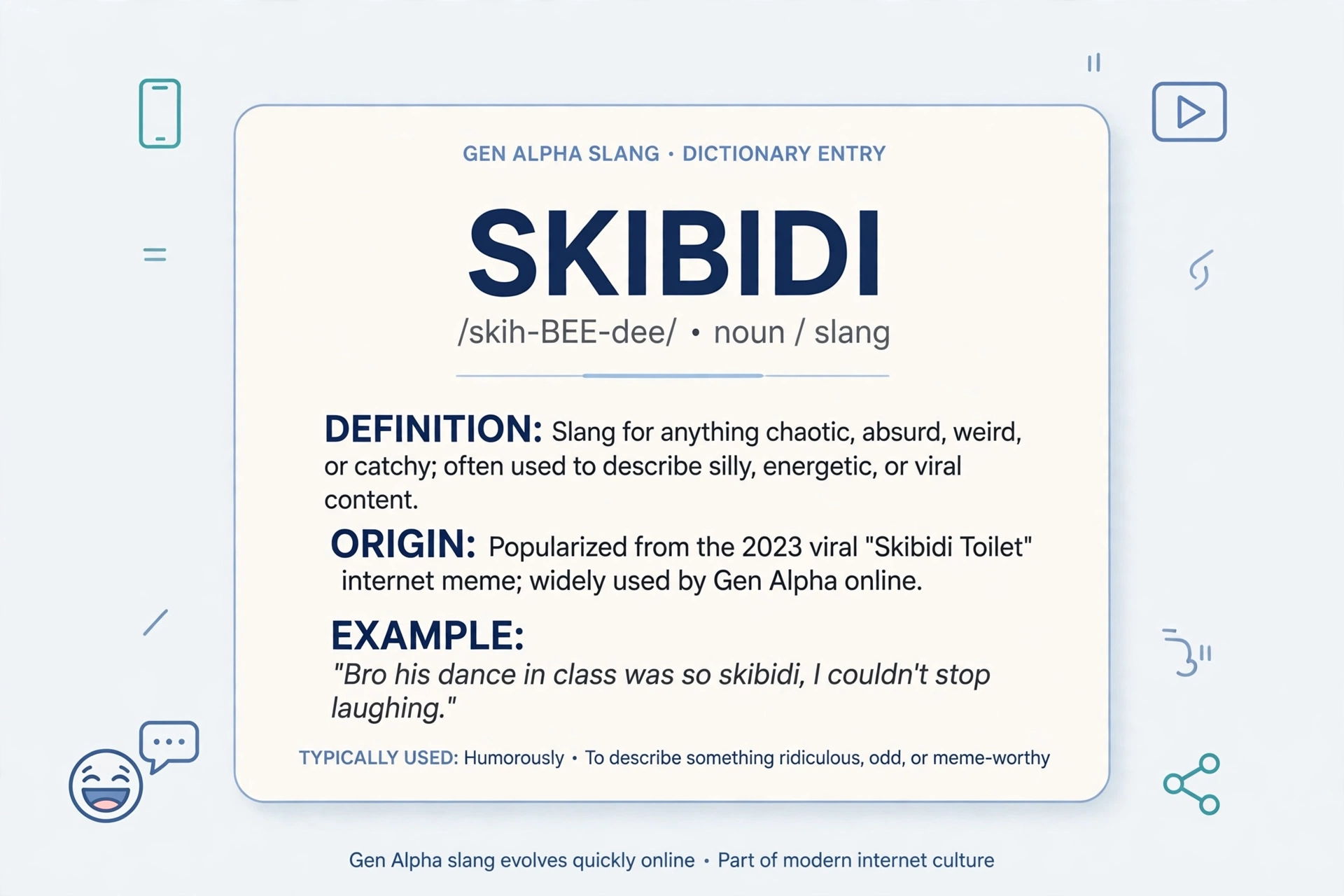
The single biggest origin story in gen alpha slang is Skibidi Toilet — an absurdist animated YouTube series by creator DaFuq!?Boom! featuring singing heads emerging from toilets, battling camera-headed humans. It became one of the most-watched things on the planet among young kids, and its theme song’s nonsense word “skibidi” escaped the show to become all-purpose slang. Merriam-Webster’s own guide to Gen Alpha slang in the dictionary tracks how words like skibidi moved from viral video to legitimate dictionary entries.
Another landmark moment: rapper Skrilla’s song “Doot Doot (6 7)” collided with memes about basketball player LaMelo Ball (who is 6-foot-7) and produced the chant “six-seven” — which Dictionary.com named its 2025 Word of the Year despite having no fixed meaning at all. That tells you everything about how gen alpha slang works: the joke is the meaning.
Popularity
Gen alpha slang is not a niche internet joke — it is mainstream kid culture in the United States and beyond. Here is how big it has gotten:
- Dictionary recognition: Rizz was Oxford’s 2023 Word of the Year. Brain rot was Oxford’s 2024 Word of the Year. 6-7 was Dictionary.com’s 2025 Word of the Year. Three years in a row, the defining word of the year came from this slang ecosystem.
- Schools: Teachers report entire classrooms chanting “six-seven” unprompted. Some schools have had to address the disruptions — which only makes the slang funnier to kids.
- Brands and media: Advertisers, news outlets, and even politicians now drop gen alpha slang to seem relatable (with mixed results — kids can smell forced usage instantly).
- Parents Googling: Searches like “what does skibidi mean” and “gen alpha slang translator” spike every school year as a new wave of parents encounters the vocabulary.
The popularity keeps compounding because each new term arrives with a meme, a sound, or a hand gesture attached — slang you can perform, not just say. That performability is why it spreads in hallways faster than any previous generation’s slang ever could.
How It Is Used
Gen alpha slang lives in three main habitats:
- Texting and group chats: Short, punchy, often ironic. “That’s so skibidi” can praise or roast depending on context and tone — similar to how context flips the meaning of other texting slang like wyfw meaning in different conversations.
- Gaming voice chats: Fast callouts and reactions. “He’s got no rizz,” “that play was Ohio,” “stop yapping.”
- In-person performance: Chants (“SIX-SEVEN!”), gestures (the palms-up 6-7 hand motion), and meme reenactments. A lot of gen alpha slang is closer to a catchphrase than a word.
Tone matters enormously. Most gen alpha slang is ironic by default — kids say the opposite of what they mean, exaggerate wildly, or deploy words purely for their sound. Calling something “sigma” is usually a joke, not a compliment. Understanding the irony layer is the difference between translating the words and actually understanding the conversation.
Examples
Here is how gen alpha slang sounds in real sentences, grouped by tone:
Friendly Examples
- “Bro actually has W rizz, he got the whole lobby laughing.” (He is genuinely charming/funny.)
- “Your fit is so skibidi today, I love it.” (Playful compliment — your outfit is cool/chaotic in a good way.)
- “I owe you fanum tax for that fry.” (I’m playfully taking one of your fries.)
- “She ate and left no crumbs with that presentation.” (She did it flawlessly.)
- “No cap, that was the best match we’ve played.” (Honestly, no lie.)
Professional Examples
Gen alpha slang has almost no professional register — that is part of its identity. But in casual workplaces with young teams, you might hear softened versions:
- “Let’s not crash out over the deadline, we’ve got this.” (Let’s not panic.)
- “That campaign was kind of mid, we can do better.” (It was mediocre.)
- “She’s got main-character energy in client meetings.” (Adapted from aura/rizz-adjacent praise.)
Rule of thumb: keep gen alpha slang out of emails, interviews, and anything your boss reads. It reads as unserious to anyone over 25.
Funny Examples
- “Sticking out your gyat for the rizzler, you’re so skibidi, you’re so fanum tax — I just wanna be your sigma.” (The viral meme-song lyric that mashes half the dictionary into one sentence.)
- “Erm, what the sigma?!” (Mock-dramatic disbelief, said in a deliberately cringe voice.)
- “Bro is NOT the Ohio final boss.” (He is not built for this chaos.)
- “Me after saying ‘six-seven’ for the 40th time today: still funny.” (It never stops being funny to them. It does to you.)

Comparison with Similar Terms
Gen Alpha did not invent slang from nothing — it remixed Gen Z and millennial slang through a meme filter. Here is how the generations line up:
| What you want to say | Gen Alpha says | Gen Z said | Millennials said |
|---|---|---|---|
| That’s cool / impressive | Skibidi, W, goated | Slay, bussin, fire | Awesome, dope, lit |
| That’s weird / bad | Ohio, L, chopped | Cringe, sus | Weird, lame |
| Charming / flirty | Rizz, rizzler | Smooth, “game” | Charming, smooth talker |
| Honestly / for real | No cap, fr, ong | Deadass, fr | TBH, real talk |
| That’s mediocre | Mid | Mid | Meh, basic |
| Stop talking | Stop yapping | Shut up / pipe down | Zip it |
| Independent / cool loner | Sigma | Lone wolf | Alpha (ironically, the old “alpha male”) |
| I agree / let’s do it | Bet | Bet | Deal / word |
| Over-the-top nonsense content | Brain rot | Cursed content | Clickbait |
| Showing off / flexing | Aura farming, glazing | Flexing, clout chasing | Showing off, bragging |
Notice the pattern: Gen Alpha took Gen Z’s words (mid, bet, slay), kept a few, and replaced the rest with louder, more performable alternatives. Where Gen Z slang was often typed, gen alpha slang is often shouted. If Gen Z texted “that’s sus,” Gen Alpha yells “SIX-SEVEN” at a lunch table — and the table erupts.

Alternate Meanings
A few gen alpha slang terms have alternate or disputed meanings worth knowing:
- Skibidi: Can mean cool, bad, weird, dumb, or nothing — entirely context-dependent. Some kids use it as a pure intensifier (“that’s skibidi good”). Its only stable meaning is “meme-coded chaos.”
- Gyat / gyatt: Most commonly an exclamation of surprise (“GYAT!”). It originated as a shortening of “God damn,” often said upon seeing someone attractive — which is why adults should know it but kids should use it carefully.
- Sigma: Seriously, it describes the “lone wolf” archetype. Ironically (its far more common use), it is a joke label for anyone doing something slightly independent, like eating lunch alone.
- Ohio: As slang, it means weird/cursed — not the U.S. state. (Ohioans are aware of the meme and mostly tired of it.)
- Brain rot: Can mean the low-quality content itself (“this video is brain rot”) or the mental fog from consuming too much of it (“I have brain rot from scrolling”).
- Unc: Short for “uncle,” used to call someone old or out of touch — even if they are 22. It is the gen alpha equivalent of “OK boomer,” but aimed at anyone older than them.
- Cooked: Means doomed or finished (“we’re cooked”) — the opposite of “let him cook” (let him do his thing). Same root word, opposite meanings, maximum confusion.
Professional or Polite Alternatives
If you need the idea without the meme energy, here are grown-up translations:
| Gen alpha slang | Polite / professional alternative |
|---|---|
| That’s skibidi | That’s impressive / unusual |
| He has rizz | He’s charismatic / personable |
| That’s so Ohio | That’s strange / unfortunate |
| Stop yapping | Let’s stay on topic |
| That’s mid | That was average / it needs work |
| She ate | She did an excellent job |
| No cap | Honestly / frankly |
| He’s sigma | He’s independent / self-reliant |
| Don’t crash out | Stay calm / don’t panic |
| Fanum tax | May I have a bite? |
Parents talking to teachers, kids writing school essays, and anyone in a job interview should default to the right-hand column. Save the left-hand column for the group chat.
Common Mistakes
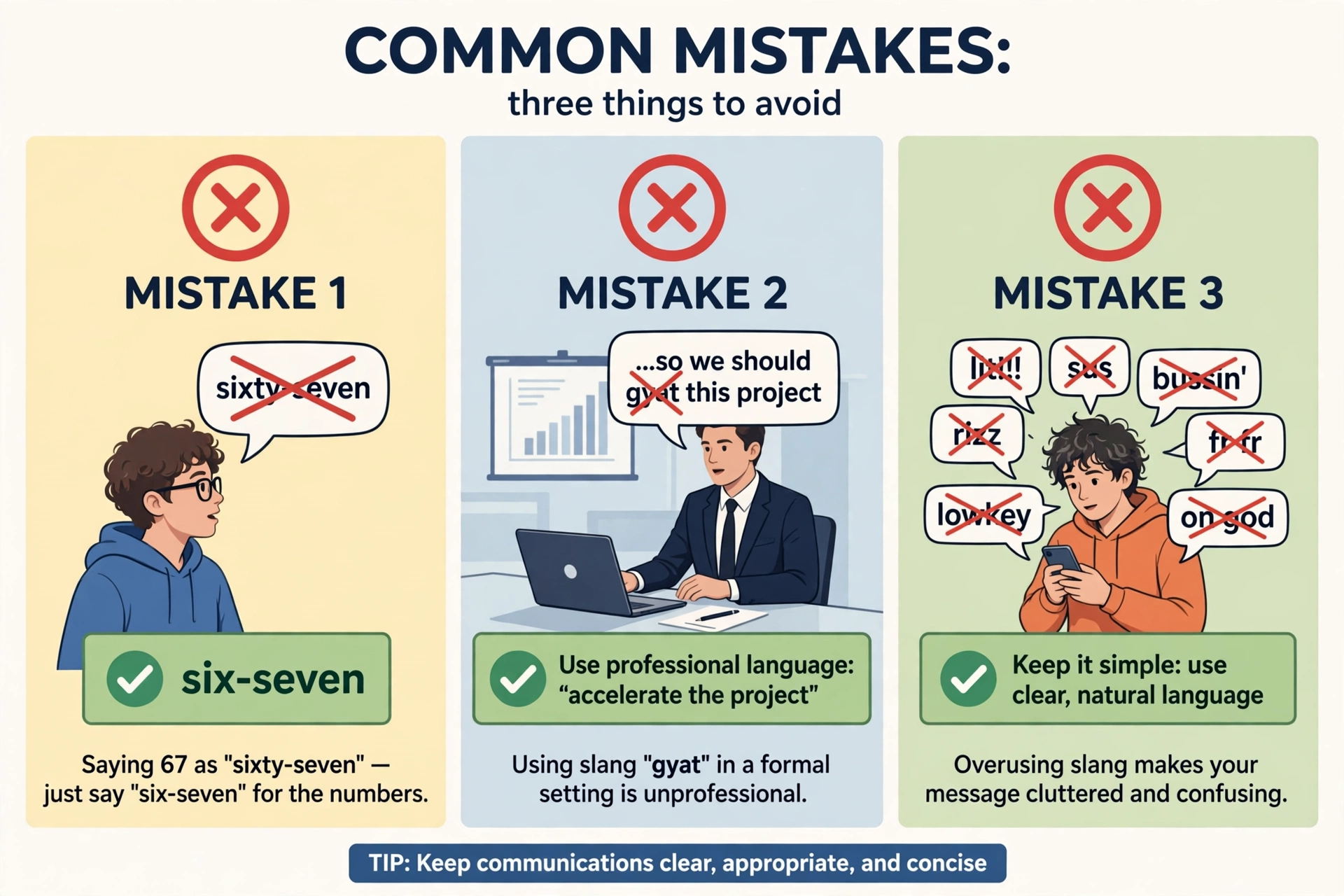
Using gen alpha slang wrong is worse than not using it at all. The classic mistakes:
- Saying “sixty-seven” instead of “six-seven”: The chant is always “six-seven,” digit by digit, usually with a palms-up hand gesture. Saying “sixty-seven” instantly marks you as an outsider — it is the single most common adult mistake.
- Using gyat around the wrong people: Because of its origins, shouting it at school or work can come across as crude rather than funny. Know the room.
- Taking sigma seriously: Calling yourself sigma unironically is the fastest way to prove you are not. The word lives in irony; sincerity kills it.
- Forcing it in marketing or parenting: Kids detect inauthentic usage instantly. One “how do you do, fellow rizzlers” from a brand account becomes a meme about the brand. If you would not naturally say it, do not say it.
- Mixing up cooked and let him cook: “We’re cooked” = we’re doomed. “Let him cook” = let him work his magic. Confusing them reverses your meaning completely.
- Overusing every term at once: Dropping skibidi, rizz, sigma, gyat, and Ohio into one sentence (outside of the meme song) reads as trying too hard. One slang term per sentence is plenty — a mistake people also make with rapid-fire texting abbreviations like pmtfo meaning in text style shorthand.
Quick Tips
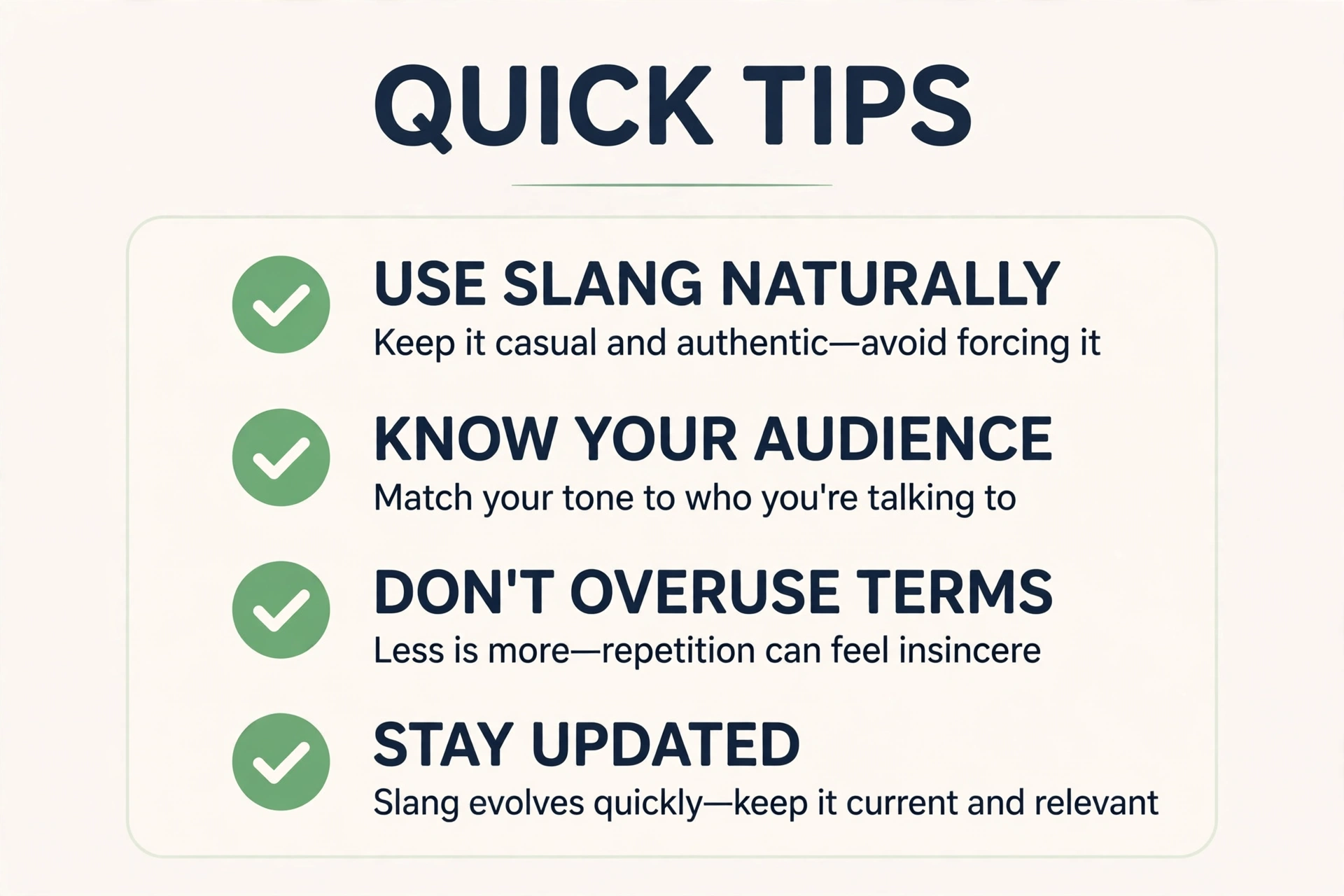
- Listen before you speak: Spend a week just hearing how kids use a term before trying it yourself. Context is everything in gen alpha slang.
- Match the irony level: Most terms are jokes first, words second. Say them lightly, never with a straight face the first time.
- One term at a time: Learn rizz this week, skibidi next week. Fluency beats vocabulary size.
- Know your audience: Group chat with friends? Go wild. Classroom presentation? Stick to standard English.
- When in doubt, ask: “What does that mean?” is always cooler than pretending. Kids love explaining their slang — it makes them the expert.
- Do not correct the chaos: Telling a kid “skibidi isn’t a real word” misses the point. It is real because millions of people use it — that is how all slang works.
- Watch the expiry dates: Gen alpha slang burns fast. Today’s viral word is next month’s “unc” behavior. Terms like rizz have stuck around; most will not.

FAQ
What does gen alpha slang mean?
Gen alpha slang is the informal vocabulary of Generation Alpha (born ~2010–2025). It includes meme-born words like skibidi, rizz, gyat, sigma, Ohio, and 6-7, spread mainly through TikTok, YouTube, gaming, and streaming culture.
What is the most popular gen alpha slang word in 2026?
6-7 (“six-seven”) dominated 2025 — it was Dictionary.com’s Word of the Year — while skibidi, rizz, and aura remain everyday staples. New terms surface monthly, so the “most popular” crown changes fast.
What does skibidi mean?
Skibidi comes from the viral YouTube series Skibidi Toilet. As slang, it is intentionally flexible — it can mean cool, bad, weird, chaotic, or nothing at all, depending on context. Often it is just a funny sound used for emphasis.
What does rizz mean?
Rizz is short for “charisma” — someone’s charm or ability to attract others, especially romantically. “W rizz” means smooth; “L rizz” means no game. It was popularized by streamer Kai Cenat and named Oxford’s 2023 Word of the Year.
What does 6-7 mean in gen alpha slang?
Almost nothing — and that is the joke. It comes from Skrilla’s song “Doot Doot (6 7)” and memes about 6-foot-7 basketball player LaMelo Ball. Kids chant “six-seven!” (never “sixty-seven”) as a nonsense exclamation, often with a palms-up gesture.
Is gen alpha slang appropriate for kids?
Mostly yes — the majority of terms are silly rather than offensive. The main exceptions are gyat (which has suggestive origins) and insults like chud. As with any slang, context and audience matter more than the word itself.
How is gen alpha slang different from Gen Z slang?
Gen Alpha slang is louder, more performative, and more meme-driven. Gen Z typed “slay” and “sus”; Gen Alpha chants “six-seven” and acts out memes in person. It also cycles faster — words can peak and fade within months.
Will gen alpha slang disappear?
The specific words will mostly fade — that is the nature of slang. But the pattern (meme-born, irony-layered, performance-friendly vocabulary) is now the template for how youth slang spreads, so expect every future generation’s slang to work this way.
Conclusion
Gen alpha slang looks like chaos from the outside — nonsense words, shouted numbers, and jokes designed to confuse adults. But underneath the absurdity, it works exactly like every generation’s slang before it: it bonds friends, marks insiders, and turns shared culture into shared language. Words like rizz, skibidi, sigma, and 6-7 are not just jokes; they are proof that language is alive, fast, and funnier than ever.
You do not need to use gen alpha slang to appreciate it. But understanding it — knowing why “six-seven” is funny, what fanum tax really means, and when Ohio is a compliment versus a roast — puts you one step closer to the kids speaking it. Start with one term, use it lightly, and let the group chat do the rest. And if you ever feel lost again, remember that every confusing abbreviation has a guide waiting — from wybo meaning slang to the full gen alpha dictionary above. No cap.

22 thoughts on “Gen Alpha Slang: What It Means, 25+ Popular Terms & Examples (2026 Guide)”