
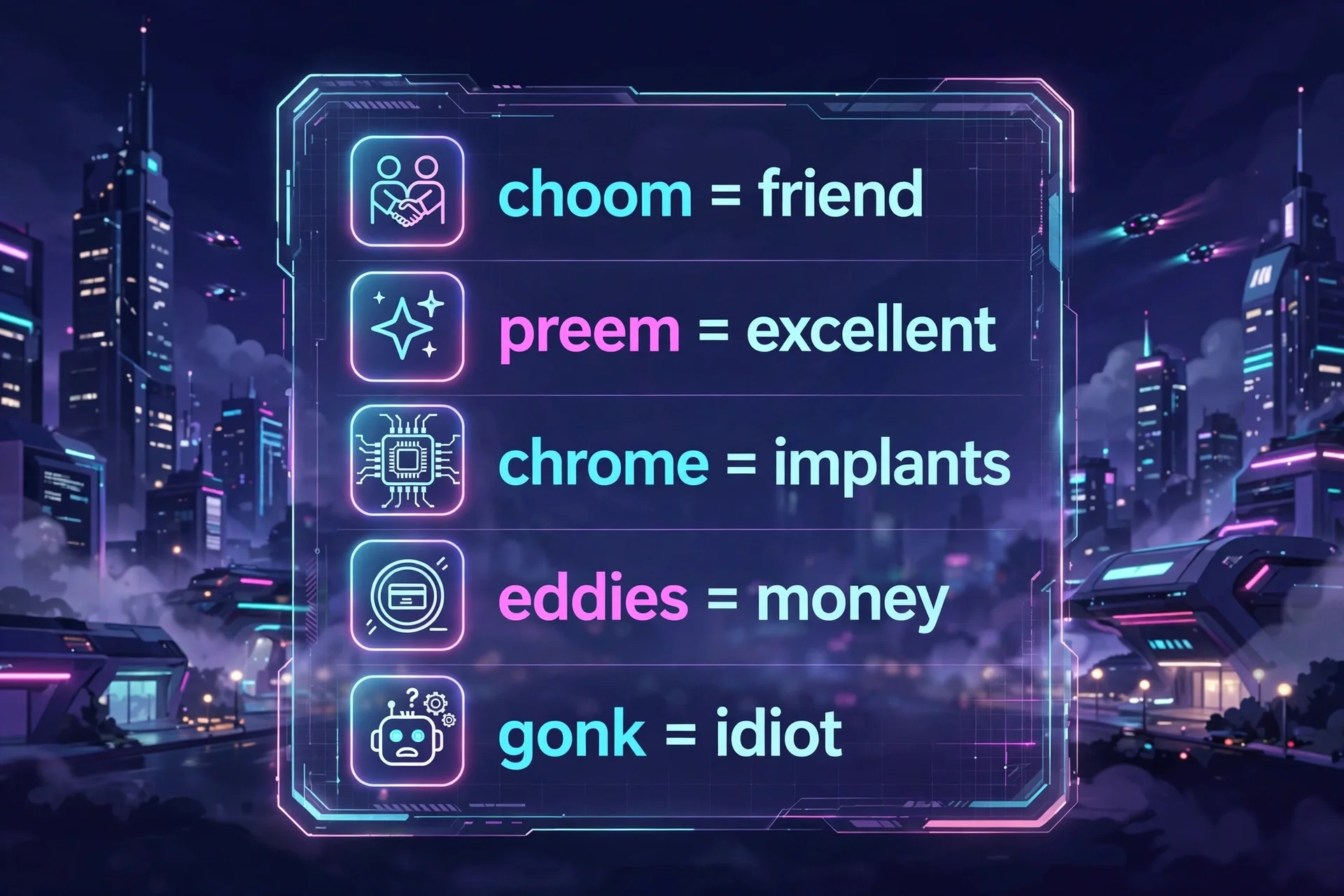
Quick definition: Cyberpunk slang is the street language of cyberpunk fiction — the invented and repurposed words used by hackers, mercenaries, fixers and ordinary people in a high-tech, low-life future. Choom means friend, preem means excellent, chrome means cybernetic implants, and gonk means idiot. Most of it comes from William Gibson’s novels, Mike Pondsmith’s Cyberpunk tabletop game, and the video game Cyberpunk 2077, and today it lives on in gaming chats, fan communities, TikTok edits and science-fiction writing.
Cyberpunk Slang Meaning & Definition
Cyberpunk slang is not one single dictionary. It is a loose family of words that grew up across forty years of books, games, comics, films and, most recently, one very large video game. At its heart is a simple idea: if ordinary people lived in a world ruled by giant corporations, surrounded by implants, hackers and street markets for body parts, they would not talk like a corporate press release. They would shorten words, borrow from other languages, turn brand names into verbs, and invent nicknames for the things that scared them or impressed them. That is exactly what cyberpunk slang does.
The word cyberpunk itself is a combination of two ideas. “Cyber” points to computers, networks and machines. “Punk” points to rebellion, street culture and a refusal to respect authority. Put them together and you get the genre’s famous summary: high tech, low life. The slang follows the same pattern. Half of it sounds like an engineer’s manual — ICE, wetware, cyberdeck, braindance. The other half sounds like something shouted across a crowded street — choom, gonk, preem, nova. That mix is the whole point. In Night City, the fictional city of Cyberpunk 2077, a ripperdoc and a street kid might use the same word and mean almost the same thing, but you can hear the difference in who is speaking and why.
It helps to think of cyberpunk slang in three layers. The first layer is the original literary slang of the 1980s: William Gibson’s Neuromancer (1984) gave us cyberspace, console cowboys, meat (the physical body) and the matrix as a name for the global computer network. The second layer is the tabletop game layer: Mike Pondsmith’s Cyberpunk 2020 (1990) built a playable street vocabulary — choomba, eddies, solos, fixers, ripperdocs — that fans could actually use at the table. The third layer is the video-game layer: Cyberpunk 2077 (2020) and the anime Cyberpunk: Edgerunners (2022) took that vocabulary to tens of millions of people who had never rolled a die in their lives. When someone says “choom” in a Discord server today, they are usually quoting the third layer, even if the word itself is more than thirty years old.
One warning matters before you learn a single word. Cyberpunk slang is mostly fictional slang. Unlike Gen Alpha slang, which real teenagers use in real group chats every day, cyberpunk slang is mainly used in roleplay, gaming, fan fiction, cosplay and jokes about technology. Some of it has leaked into real life — hackers really do talk about ICE, and gamers really do call a job a “gig” — but nobody in a real office is going to take you seriously if you call your manager a corpo to their face. The fun of this vocabulary is knowing where it belongs, and this guide will show you exactly that: what each major term means, where it came from, how it sounds in a sentence, and when to leave it in Night City.
Introduction
Picture this. Your phone buzzes. A friend sends a screenshot from a game, captioned: “This choom just tried to flatline my whole run for 500 eddies. Gonk.” You have two problems. First, you have no idea whether your friend is angry, joking, or both. Second, you are fairly sure “gonk” is not a compliment. You are right on both counts, and you are not alone. Since Cyberpunk 2077 became a cultural phenomenon, its street language has spilled out of the game and into memes, usernames, Twitch chats and TikTok comments, often with no translation attached.
This guide fixes that. It is a complete, plain-English tour of cyberpunk slang: the essential words, the world they come from, and the unwritten rules for using them. You will learn the five words you actually need first — choom, preem, chrome, eddies and flatline — then the wider vocabulary of fixers, netrunners, ripperdocs and corpos. You will see how the same word can be friendly in one sentence and an insult in the next, why “chrome” means something completely different in a browser tab, and which trendy terms floating around social media are real game vocabulary and which ones somebody invented last week. By the end, you will be able to read a cyberpunk meme without guessing, write a game character who sounds like they belong on the street, and know when a term is perfect for a joke with friends and when it would land badly in real life.
Cyberpunk slang rewards curiosity because it is really a story about how language works. New technology always creates new words. The telephone gave us “hang up.” The internet gave us “spam” and “viral.” Cyberpunk fiction simply asks what happens next: when the technology gets inside the body, when the network gets inside the head, when money becomes a number and a job becomes a contract with a stranger. The slang is the answer that fiction invented, and it turns out to be surprisingly useful for talking about our own world, too. That is why players, writers and even tech workers keep borrowing it. It names things we can feel but do not yet have a normal word for: the friend you only know online, the job that pays in exposure, the boss who is really just the company wearing a human face.
Origin
The story of cyberpunk slang starts before the genre even had a name. In 1980, the writer Bruce Bethke published a short story called “Cyberpunk.” He had combined “cybernetics” — the science of machines and control systems — with “punk,” the raw, anti-authority music and attitude of the late 1970s. The title stuck. A few years later, William Gibson’s novel Neuromancer (1984) gave the genre its first masterpiece and its first real slang. Gibson did not write a glossary. He dropped readers into the deep end: console cowboys jacking into the matrix, “meat” for the flesh-and-blood body, “ice” for the security programs that guarded corporate data, and a whole underworld of dealers, fixers and street samurai. Readers had to learn the language the way a traveller learns a city — by listening.
Gibson’s slang was deliberately strange and poetic. He took ordinary words and bent them. A “cowboy” was not a man on a horse; it was a hacker riding the network. “Meatspace” was not a butcher’s shop; it was the physical world, as opposed to cyberspace. “Wetware” was a joke with a sharp edge: if software runs on hardware, then the brain is wetware — the squishy, biological computer that no upgrade can quite replace. Much of this vocabulary was never meant to be a complete language. It was atmosphere. But fans loved it, and the next generation of creators treated it as a foundation to build on.
The second great wave came from games. Mike Pondsmith’s tabletop roleplaying game Cyberpunk 2013 (1988), revised as the hugely influential Cyberpunk 2020 (1990), needed words that players could actually say out loud during a game. Pondsmith and his writers built a street dialect that felt lived-in: choomba (later shortened to choom) for a close friend, eddies for eurodollars, preem for anything premium or excellent, nova for something brilliant, gonk for a fool, corpo for anyone who worked for — or had been swallowed by — a corporation. The game also named the jobs of its world: solos (mercenaries), fixers (deal-makers), netrunners (hackers), ripperdocs (back-alley surgeons) and media (journalists). Because the game was played by groups of friends talking to each other for hours, this slang had to work in real conversation. It did, and it spread far beyond the table.
The third wave is the one most people meet first today. Cyberpunk 2077, the video game by CD Projekt Red based on Pondsmith’s world, launched in 2020 and, after a famously rocky start, became one of the most talked-about games of the decade — helped enormously by the Netflix anime Cyberpunk: Edgerunners in 2022. The game did not invent most of its slang, but it taught it to a global audience. Suddenly millions of players heard Jackie Welles call V “choom” in the opening hours, heard fixers offer “gigs” for eddies, and learned that getting “flatlined” was the worst possible outcome of a job. TikTok clips, memes and cosplay captions carried the words further. Search interest in individual terms spiked with every update, every anime episode, and every viral edit set to pulsing synth music.
It is worth noting what cyberpunk slang is not. It is not an ancient street dialect, and it is not a secret code used by real hackers. Real computer-security professionals do use the term ICE — Intrusion Countermeasures Electronics — and the word “cyberspace” really did escape from Gibson’s fiction into everyday tech language. But most cyberpunk slang is a literary invention that fans adopted for fun. That does not make it less interesting. If anything, it makes it more revealing: this is what happens when millions of people agree, for the sheer pleasure of it, to speak a future into being. The cyberpunk genre itself began as a warning about corporate power and runaway technology, and its slang carries that warning in every word — even when it is being used for a joke.
Popularity
Cyberpunk slang has had three separate moments of popularity, and each one reached a different audience. The first, in the 1980s and 1990s, belonged to science-fiction readers and tabletop gamers. It was niche, passionate and mostly offline. The second, in the 2000s, belonged to the wider internet: forums, fan fiction and early YouTube, where quotes from Gibson and Pondsmith circulated as a kind of shared password. If you knew what a console cowboy was, you were in the club. The third moment, from 2020 onwards, is the biggest by far, and it belongs to everyone with a phone.
Cyberpunk 2077 is the main reason. The game sold tens of millions of copies, and its dialogue is saturated with street slang. Players do not just hear “choom” once; they hear it hundreds of times, from different characters, in different moods — warm, teasing, desperate, threatening. That repetition is how slang is learned in real life, too. Then Edgerunners gave the vocabulary an emotional core: the show’s young characters use the same words to talk about friendship, ambition and loss, which made the slang feel human rather than decorative. Clips of the anime’s most quoted lines travelled across TikTok and Instagram Reels, often subtitled, often remixed, and the words travelled with them.
Gaming culture did the rest. Twitch streamers greet their chat with “what’s up, chooms.” Discord servers for cyberpunk games and tabletop campaigns use “gig” for a mission and “eddies” for in-game currency in a dozen different games, not just Cyberpunk 2077. Cosplayers caption photos with “fully chromed” and “preem fit.” Writers of fan fiction and original science fiction borrow the vocabulary because it instantly signals a world: one word, “ripperdoc,” tells the reader more about a setting than a paragraph of description. Even fashion and music have joined in. “Cyberpunk aesthetic” — neon, chrome, rain, high collars, glowing implants — is a whole visual style on Pinterest and Instagram, and its captions borrow the slang freely.
There is also a quieter, more practical reason for the popularity. Cyberpunk slang gives people a playful way to talk about modern life. Calling a freelance job a “gig” feels more honest than calling it an “opportunity.” Calling a faceless corporation a “corpo” is funnier, and sharper, than a long complaint about late-stage capitalism. Calling a friend “choom” in a group chat is a small act of belonging: it says we share a world, even if that world is fictional. Like other internet slang, it spreads because it is useful, funny and slightly rebellious — and because it lets a huge, scattered community recognise itself in a single word. That is the same engine that powers regional slang traditions, from Australian slang to the many local vocabularies of the American South, except here the “region” is a city that does not exist.
Popularity has a cost, though: dilution. As the words spread, they also get misused, overused and invented. Social-media listicles mix genuine Cyberpunk 2020 terms with words somebody made up for a video, and readers cannot tell the difference. This guide separates the two wherever it matters. The core vocabulary below is drawn from the books, the game and the game itself. Where a term is fan-made, recent, or disputed, it is labelled as such. That honesty is part of what makes a slang guide trustworthy — and it is exactly the gap the thinner guides online leave open.
How It Is Used
Cyberpunk slang is used in four main situations, and the rules are different in each one. Understanding the situation is more important than memorising a word list, because the same term can be warm, neutral or insulting depending on who says it, where, and to whom.
1. In games and roleplay. This is the home territory of cyberpunk slang. In Cyberpunk 2077, in tabletop Cyberpunk RED campaigns, and in other sci-fi roleplaying games, players use the vocabulary in character. A fixer offers a gig. A netrunner jacks in. A solo watches the door. Nobody pauses to explain, because the shared fiction does the explaining. If you are joining a campaign or a game server, learning ten core terms before you start will make you sound like you belong — and will save you from asking what an eddie is in the middle of a tense scene.
2. In fan communities and group chats. This is where most people actually meet cyberpunk slang today. Friends who play the same games greet each other as chooms, joke about being “flatlined” by a difficult boss fight, or call a great outfit “preem.” Here the slang is playful and affectionate. It works like an in-joke: a signal that everyone in the chat shares the same references. The tone is light, the stakes are low, and a little exaggeration is part of the fun. One or two terms per message is plenty. A whole paragraph of street slang in a group chat stops being funny and starts being hard to read.
3. In creative writing and worldbuilding. Writers use cyberpunk slang to build a setting quickly and to give characters distinct voices. A corpo executive should not sound like a street kid, and slang is the fastest way to show that difference. A fixer might say “I got a gig, preem pay, no questions.” A corporate manager might say “the asset” and “the deliverable” and never once say “choom.” Good writers use the vocabulary sparingly — a flavour, not a flood — and always make the meaning clear from context on first use. If a reader has to stop and look up every third word, the slang has failed, no matter how authentic it is.
4. In jokes about real technology and work. This is the newest and loosest use. A programmer might joke that a security firewall is “heavy ICE.” A freelancer might call a client a “fixer” and a project a “gig.” A tech worker might call their employer a “corpo” after a bad meeting. This usage is metaphorical: nobody literally believes they live in Night City. It works because the comparison is pointed. But it also has limits. In a professional setting, most of these words will confuse people or sound unprofessional. Save them for friends, for creative work, and for conversations where everyone is in on the joke.
Grammar follows the same shortcuts as other slang. Words get clipped: choomba becomes choom, eurodollars become eddies, premium becomes preem. Nouns become verbs: you “jack in” to the network, you “chrome up” when you get new implants, you “flatline” someone (in fiction) when you kill them. Plurals are simple and regular: chooms, gonks, eddies, gigs. There is no special cyberpunk grammar to learn, which is one reason the vocabulary travels so well. If you can use the word in a normal English sentence, you can use cyberpunk slang — the skill is choosing the right word for the right moment, not mastering a new syntax.
Tone is where beginners go wrong. Cyberpunk slang is overwhelmingly informal. Choom is warm and familiar, like “mate” or “buddy.” Gonk is rude, like “idiot” said with a sneer. Preem and nova are enthusiastic, like “awesome” and “brilliant.” Corpo is dismissive, even hostile, when used by street characters. Flatline is blunt and violent — it is not a word to use lightly, even in a joke, because its literal image is a heart monitor going silent. Before you use any term, ask yourself: would I say the ordinary English equivalent in this situation? If you would not call someone an idiot to their face, do not call them a gonk. If you would not tell your boss their project is “premium” in a slangy way, do not call it preem in a meeting. The slang changes the flavour, not the meaning.
The 15 Core Terms, Explained
Every guide to cyberpunk slang lists dozens of words. Most readers only need fifteen. Learn these, and you will understand the vast majority of memes, game dialogue and fan fiction. The table below gives each term, its meaning, and its origin, so you can see at a glance which layer of the genre it comes from.
| Term | Meaning | Where it comes from |
|---|---|---|
| Choom (CHOOM) | Friend, buddy, close companion | Cyberpunk 2020; short for choomba |
| Preem (PREEM) | Excellent, premium, top-quality | Cyberpunk 2020; short for premium |
| Nova | Brilliant, awesome, outstanding | Cyberpunk 2020 street slang |
| Eddies | Money; eurodollars, the currency of Night City | Cyberpunk 2020 / 2077 |
| Chrome | Cybernetic implants; being heavily augmented | General cyberpunk fiction; popularised by the games |
| Flatline | To kill, or to die; brain death in cyberspace | Medical image; Gibson-era and game usage |
| Gonk | Idiot, fool (insult) | Cyberpunk 2020 |
| Corpo | A corporate employee; the corporation itself | Cyberpunk 2020 / 2077 |
| Fixer | A middleman who arranges jobs and deals | Cyberpunk tabletop and game roles |
| Gig | A paid job or contract, usually short-term | Cyberpunk 2077; also real-world usage |
| Netrunner | A hacker who breaks into computer systems | Cyberpunk tabletop; Gibson’s console cowboy |
| Ripperdoc | A surgeon who installs and repairs cyberware | Cyberpunk 2020 / 2077 |
| ICE / Black ICE | Security software; Black ICE can kill a hacker | Gibson’s Neuromancer |
| Deck / Cyberdeck | A portable computer for hacking the Net | Gibson; Cyberpunk games |
| Braindance (BD) | A recording that replays another person’s sensations | Cyberpunk 2020 / 2077 |
A few more terms complete the picture. A solo is a mercenary or bodyguard for hire — the muscle of the cyberpunk world. Jacking in means connecting your brain directly to a computer network. Meatspace is the physical world, and the meat is your actual body, as opposed to your digital self. Wetware is the brain, treated as hardware. Simsense (in Gibson’s work) and braindance (in Pondsmith’s) both describe recorded sensory experience, and fans often use them interchangeably, though purists will tell you they belong to different fictional universes. Zero is street slang for killing someone quickly and quietly — “zero the target and vanish” — and it is one of the bluntest words in the whole vocabulary, so it is best left to fiction.
Examples
Examples are where cyberpunk slang comes alive. The same word can sound completely different in a friendly chat, a work message, and a joke, so this section separates the three. Read them aloud if you can: slang is spoken language, and it should feel natural in the mouth. If a sentence sounds forced when you say it, it will sound forced when someone reads it, too.
Friendly Examples
- “You good, choom? That last mission was rough.” — A friend checking in after a hard game session. Warm, concerned, informal.
- “Preem work on that build, choom. That rig is nova.” — Praising a friend’s character or computer setup. Enthusiastic, not sarcastic.
- “Meet me at the usual spot, choom. I got eddies and a plan.” — A playful way to arrange a gaming session. The “plan” is almost certainly just another mission.
- “Choom, you carried the whole team tonight. Absolute nova.” — A compliment after a multiplayer match. “Nova” here means outstanding.
- “Don’t worry, choom, we’ll run it back tomorrow.” — Reassurance after a failed attempt. “Run it back” means try again, and “choom” softens the disappointment.
Professional Examples
Cyberpunk slang has almost no place in a genuinely professional message. The examples below are for the narrow situations where it does belong: creative work, game development, and writing about the genre itself. Even here, use it deliberately and sparingly.
- “In this scene, the fixer offers the player a gig: 2,000 eddies, no questions asked.” — A game writer describing a quest. The slang is part of the fictional world being described, not the writer’s own voice.
- “The ripperdoc sequence needs to show the chrome installation clearly, so new players understand what an implant does.” — A design note. “Chrome” is the game’s own term for its subject matter.
- “Our article explains what ‘flatline’ means in Cyberpunk 2077, and why it has two related senses.” — A writer or editor talking about the slang itself. Quoting the term is professional; using it about a real person is not.
- “Please avoid corpo-speak in the marketing copy — the audience will read it as inauthentic.” — A creative director borrowing “corpo” as a critical term for corporate jargon. This works only if the whole team shares the reference.
Notice what none of these examples do: none of them call a real colleague a gonk, a real client a fixer, or a real salary “eddies.” In a real workplace, those words would confuse people at best and offend them at worst. Cyberpunk slang is professional only when the job itself is about cyberpunk — games, fiction, film, criticism, cosplay, or fan media. Everywhere else, keep it for after work.
Funny Examples
- “My Wi-Fi has more ICE than a corporate server. I just got flatlined by my own router.” — A joke about a bad connection. The exaggeration is the joke.
- “That gonk tried to sell me a ‘preem’ phone charger for 50 eddies. It broke before I left the shop.” — A joke about being ripped off. “Gonk” does the insulting; “preem” in quotation marks does the sarcasm.
- “Fully chromed, zero eddies, and my deck still won’t boot. The future is a scam, choom.” — A self-deprecating joke about an expensive computer that will not start.
- “Me: I will save money this month. Also me: buys chrome I don’t need because it looks nova.” — A meme-format joke about impulse spending. The slang makes an ordinary confession funnier because it frames it as a Night City story.
- “POV: you’re the gonk who jacked into the wrong server and now the Black ICE is coming.” — A caption for a reaction image or video. The humour comes from the over-the-top stakes applied to an everyday mistake.
Example Chat Table
Here is how a short cyberpunk-flavoured exchange might look in a gaming group chat, with a plain-English translation alongside. Notice how little slang is actually needed: five terms carry the whole conversation, and every sentence would still make sense without them.
| Chat message | What it really means |
|---|---|
| “Choom, gig’s up. Fixer wants us downtown.” | “Friend, there’s a job. Our contact wants us in the city centre.” |
| “Pay?” | “How much does it pay?” |
| “3,000 eddies. Preem rate.” | “3,000 eurodollars. That’s an excellent rate.” |
| “Any ICE on the target?” | “Does the target have serious computer security?” |
| “Light ICE. In and out, no flatlines.” | “Light security. Quick job, nobody gets killed.” |
| “Nova. Meet at the ripperdoc’s in ten.” | “Great. Meet at the implant clinic in ten minutes.” |

Comparison with Similar Terms
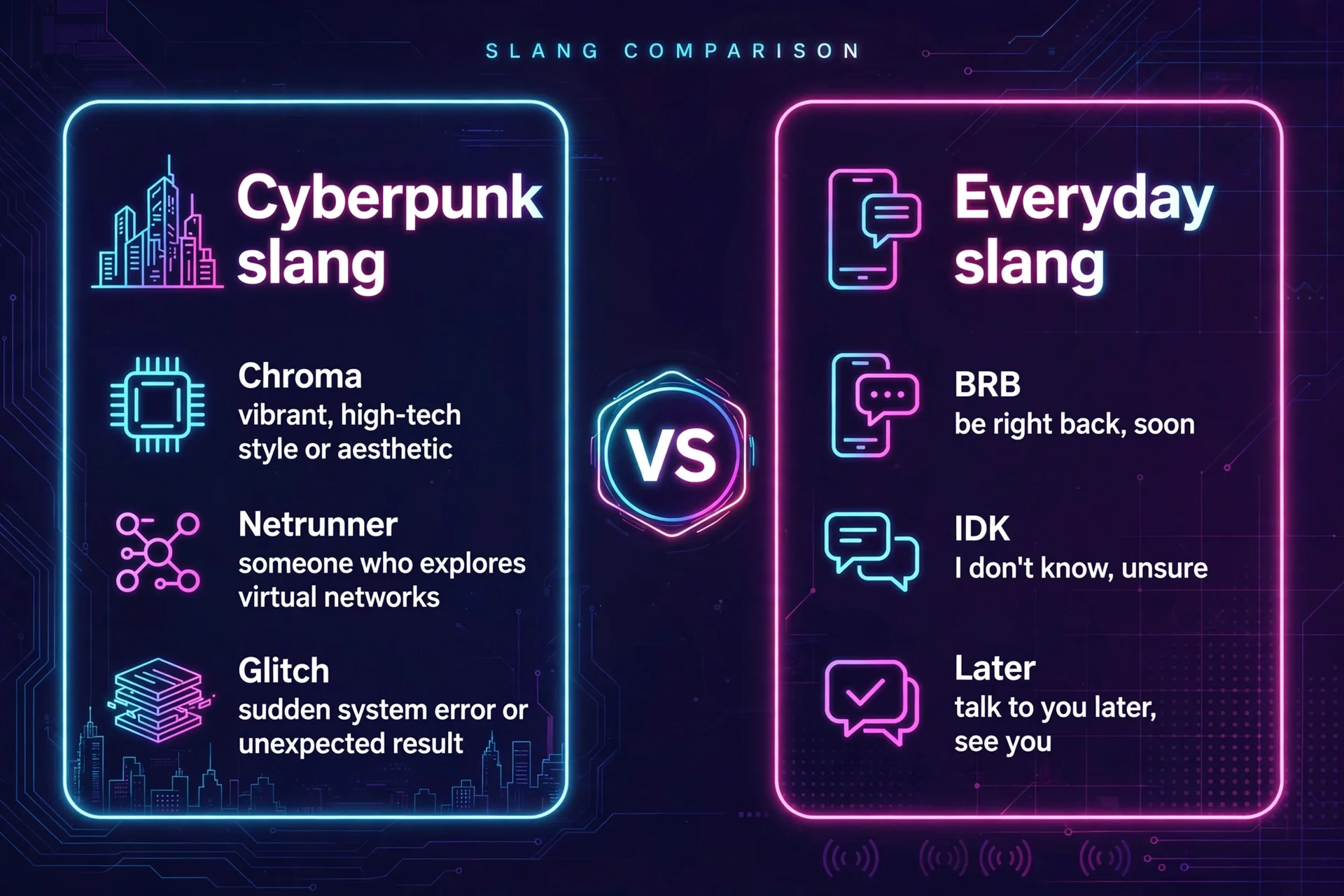
Cyberpunk slang overlaps with several other vocabularies: real hacker slang, gamer slang, general internet slang, and other science-fiction slang. The overlaps are where confusion happens, so this section puts the closest neighbours side by side. The pattern to remember is simple: cyberpunk terms are usually more specific and more fictional than their real-world cousins. A hacker is a real job. A netrunner is a hacker’s fictional, romanticised cousin. A gig is a real freelance job. A gig in Night City is a contract that might get you killed.
| Cyberpunk term | Similar term | Difference |
|---|---|---|
| Choom | Homie, bro, mate | Choom is fictional and fandom-specific; homie and mate are real everyday words. Use choom with fans, mate with everyone. |
| Preem / Nova | Lit, fire, awesome | Preem and nova praise quality; lit and fire are broader and current. Preem signals “I know this game.” Lit signals “I know this moment.” |
| Eddies | Cash, bread, dough | Eddies are fictional eurodollars. Cash and bread are real money slang. Never use eddies for real money except as a joke. |
| Gonk | Noob, idiot, clown | Gonk is a direct insult in a fictional world. Noob is gaming-specific; idiot is universal. Gonk is ruder than it sounds. |
| Corpo | Suit, corporate drone | Corpo can mean the person or the company. Suit usually means the person. Both are dismissive. |
| Netrunner | Hacker, programmer | Netrunner is a fictional role with implants and danger. Hacker is a real skill set. Console cowboy is Gibson’s older version of the same idea. |
| Flatline | KO’d, wiped, deleted | Flatline is permanent and violent in fiction. KO’d is temporary in games. Wiped can mean data loss or a team defeat. |
| Chrome | Bling, gear, mods | Chrome means body implants. Bling means jewellery. Gear and mods are broader. Chrome in a browser means Google Chrome — context decides. |
| Gig | Side hustle, freelance job | In cyberpunk, a gig is a mission from a fixer. In real life, a gig is any short-term paid job, including a music performance. |
| Fixer | Agent, middleman, dealer | A fixer arranges illegal or grey-area work in fiction. An agent arranges legal work in real life. The fixer is far more dangerous. |
There is also a family resemblance to other “punk” genre slang. Steampunk fiction has its own vocabulary — aether, brass, clockwork, airship pirates — but it describes a Victorian, steam-powered past-that-never-was, not a corporate future. Solarpunk, a newer and more hopeful genre, talks about permaculture, community gardens and repair culture, and deliberately avoids cyberpunk’s cynicism. Biopunk talks about genetic engineering and body modification, and shares some DNA with cyberpunk: both worry about what happens when technology gets inside the body. If you are writing fiction, these vocabularies are neighbours, not substitutes. Borrowing a steampunk word into a cyberpunk story will sound wrong for the same reason “choom” would sound wrong in a Jane Austen novel: the words carry their worlds with them.
One comparison deserves special care: cyberpunk slang versus real hacker slang. Real hackers and security researchers do use words like “black hat,” “phishing,” “zero-day” and “rootkit.” Some cyberpunk terms, especially ICE, really did cross over into professional use. But most of the street vocabulary — choom, preem, gonk, eddies — has no professional counterpart and no place in a security report. Treating fan vocabulary as professional vocabulary is one of the fastest ways to sound like you learned your trade from a video game. Enjoy the fiction, respect the profession, and keep the two word lists in separate boxes.
Finally, a note on regional slang. Cyberpunk slang is deliberately placeless — Night City is a fictional American city with influences from everywhere, and its slang mixes English, Spanish, Japanese and corporate jargon. Real regional slang, by contrast, is deeply placed. Southern slang sounds like the American South because it grew there, and British slang insults like “muppet” and “plonker” belong to a specific culture in the same way “gonk” belongs to Night City. That difference matters for writers: a character from Night City should not suddenly sound like a Londoner, and a Londoner should not suddenly say “choom,” unless the story explains why.
Alternate Meanings
Almost every cyberpunk term has another life outside the genre, and several have meanings that can cause real misunderstandings. This section covers the most important doubles. When in doubt, context is everything: the same word in a game chat and in a hospital means very different things.
Cyberpunk itself has three common uses. First, it is the name of the genre — dystopian science fiction about high technology and low life. Second, it is the name of the game franchise: Cyberpunk 2020, Cyberpunk RED and Cyberpunk 2077. Third, it is a fashion and visual aesthetic: neon signs, rain, chrome, dark clothing, glowing accents. A “cyberpunk outfit” on social media usually means the look, not the politics. A “cyberpunk story” usually means the genre. A “cyberpunk build” in a game usually means a character specialised in hacking or implants. All three uses are correct; the sentence around the word tells you which one is meant.
Chrome is the trickiest double. In cyberpunk fiction, chrome means cybernetic implants, or a person who has many of them: “she’s fully chromed.” In everyday tech talk, Chrome with a capital C is Google’s web browser. In everyday English, chrome (lowercase) is the shiny metal coating on a car bumper or a tap. In fashion, “chrome” can mean shiny, metallic clothing. A sentence like “I need to update my chrome” is almost certainly about the browser. A sentence like “he got new chrome at the ripperdoc’s” is definitely about implants. Writers should be careful with the first sentence of a story: if you open with “chrome,” make the fictional meaning clear within a line or two, or readers will picture a browser tab.
Deck has at least three lives. In cyberpunk, a deck or cyberdeck is a hacker’s portable computer. In card games, a deck is a set of playing cards. In offices, a deck is a slide presentation (“send me the deck”). The fictional meaning is usually signalled by words nearby: cyberdeck, jack in, ICE, netrunner. Without those neighbours, “deck” will default to cards or slides in most readers’ minds.
Ice / ICE is another word to handle with care. In cyberpunk, ICE stands for Intrusion Countermeasures Electronics: the security programs that guard a system, with Black ICE as the lethal version. In drug slang, “ice” is a street name for crystal methamphetamine — a completely different and very serious meaning. In jewellery slang, “ice” means diamonds. In everyday English, ice is frozen water. Capitalisation helps — ICE in capitals, in a hacking context, is the cyberpunk term — but in speech there is no capitalisation, so context has to do all the work. Never use “ice” casually in a conversation where the drug meaning could be heard.
Ghost also splits. In cyberpunk, a ghost can be a hacker who leaves no trace, or a digital echo of a dead person’s consciousness “ghosting” in a system. In modern dating and messaging slang, to ghost someone means to cut off contact without explanation — a meaning that has nothing to do with hackers and everything to do with disappearing. In older English, a ghost is a spirit. The cyberpunk and dating meanings can even collide in a sentence like “she ghosted the server,” which could mean she vanished from a chat or hacked without a trace. If the sentence could be read two ways, rewrite it.
Flatline has a medical meaning that predates all of this: in a hospital, a flatline is the flat trace on a heart monitor when a heart stops. Cyberpunk borrowed that image and made it a verb: to flatline someone is to kill them, and to flatline is to die. In gaming more broadly, “flatline” is sometimes used loosely for any defeat. The medical sense is solemn and real; the fictional sense is dramatic and violent. Do not use the fictional sense about a real person’s health, ever. It will read as flippant at best and cruel at worst.
Gig, hacker, matrix and virus are quieter doubles. “Gig” is a real word for a performance or a freelance job long before it was a Night City contract. “Hacker” is a real profession, not just a fictional role. “Matrix” in Gibson means the global network; in the films The Matrix it means a simulated reality; in mathematics it means a grid of numbers. “Virus” in cyberpunk can mean a computer virus or, in biopunk-adjacent stories, a biological one. None of these doubles is dangerous, but all of them reward a moment’s thought before you use the word. Good slang use is precise slang use.
Professional or Polite Alternatives
Sometimes you need the idea without the slang. Perhaps you are writing a work email, a school essay, a news article, or a message to someone who has never played the game. The table below gives you a clean, polite alternative for each major cyberpunk term, so you can keep the meaning and drop the street flavour.
| Cyberpunk term | Professional / polite alternative | When to use the alternative |
|---|---|---|
| Choom | Friend, colleague, everyone | Any real message to a real person, especially at work or school. |
| Preem / Nova | Excellent, outstanding, high-quality | Reviews, feedback, recommendations, formal praise. |
| Eddies | Payment, budget, fee, salary | Any real discussion of money. Always. |
| Gonk | — (no polite version; say what went wrong instead) | Never use gonk about a real person. Describe the mistake, not the person. |
| Corpo | Company, employer, corporate team | Work messages, journalism, any neutral description of a business. |
| Fixer | Agent, coordinator, contact, intermediary | Real-world introductions and business writing. |
| Gig | Assignment, project, contract, job | Freelance and work contexts, unless the job really is a performance. |
| Flatline | Failed, stopped, was terminated (for a project); died (for a person, with care) | Project updates and any serious topic. Never as a joke about a real person. |
| Chrome | Implant, augmentation, prosthetic (in fiction); browser (in tech) | Medical and technical writing; say which meaning you intend. |
| Netrunner | Hacker, security researcher, programmer | Professional and journalistic writing about real computer work. |
| Ripperdoc | Surgeon, clinician, technician | Any real medical or technical context. Ripperdoc belongs in fiction. |
| Jack in / Jack out | Log in / Log out, connect / disconnect | Everyday tech instructions and support messages. |
The most important row in that table is “gonk.” There is no polite version of an insult, and dressing an insult up in fictional slang does not make it polite. Calling a colleague a gonk in a meeting is still calling them an idiot; it just adds confusion to the rudeness. The same applies, more gently, to “corpo.” It is a fun word in a fan community and a sneering word in an office. If your goal is to be understood and respected, use the ordinary word. Save the street language for the street — or, in this case, for Night City.
There is one exception worth naming: creative and critical writing about cyberpunk. If you are reviewing Cyberpunk 2077, analysing Edgerunners, or writing a story set in Night City, the slang is your subject matter, and using it — quoted, explained, and placed in context — is not just acceptable, it is the job. The difference is framing. “In the game, fixers offer gigs for eddies” is professional writing about slang. “Hey choom, got a gig for me?” sent to your manager is not. Framing decides everything.
Common Mistakes
Most mistakes with cyberpunk slang are not about getting a definition wrong. They are about using the right word in the wrong place, at the wrong volume, or with the wrong confidence. Here are the mistakes beginners make most often, and how to avoid each one.
1. Using every term at once. A sentence like “Choom, that preem nova chrome gig with the fixer and the ripperdoc was totally gonk-free” is technically full of correct words and completely unreadable. Real street speech — fictional or otherwise — mixes slang with ordinary language. One or two slang terms per sentence is the natural maximum. Let the ordinary words carry the grammar and let the slang carry the flavour.
2. Calling real people gonk, corpo or a fixer. These words carry attitudes. Gonk is contemptuous. Corpo is hostile. Fixer implies shady dealings. Using them about real people, even as a joke, can offend, confuse, or damage a working relationship. In fiction, characters can insult each other freely. In real life, describe behaviour, not people: “that decision was a mistake” lands better than any insult, fictional or otherwise.
3. Treating invented social-media terms as canon. Not every word in a viral listicle is real cyberpunk vocabulary. Some lists invent terms for clicks — shiny new words with no history in the books or the game. Before you repeat a term you found online, check it: does it appear in Cyberpunk 2020, Cyberpunk RED, Cyberpunk 2077 or Gibson’s novels? If you cannot find a source, treat it as fan invention. There is nothing wrong with fan invention in fan fiction, but presenting it as established slang misleads readers.
4. Mixing universes without noticing. “Console cowboy” is Gibson. “Choom” is Pondsmith. “Braindance” is Pondsmith. “Simsense” is Gibson. “Street samurai” is Gibson and Shadowrun, a different game world. Mixing them in one story is not a crime — fans do it all the time — but a writer who knows the difference will sound more credible than one who treats all sci-fi slang as one big word salad. A short note in your own head — “this word is 2077, that word is Gibson” — is enough.
5. Getting flatline backwards. In cyberpunk usage, to flatline someone is to kill them, and Black ICE flatlines netrunners by destroying their brains through the network. It does not mean “to faint,” “to lose a game,” or “to go offline.” Using it for a minor defeat (“my phone flatlined”) is an exaggeration that can sound flippant, because the literal image is death. Keep it for high-stakes fictional contexts, or use it knowingly as a deliberate overstatement among friends who will hear it as a joke.
6. Misspelling the core words. It is choom, not “chum” (a different word entirely — a friend in old slang, or fish bait). It is preem, not “preme” or “prime.” It is choomba, not “chumba,” if you use the full form. It is eddies, not “eddys.” It is ripperdoc, one word, not “ripper doc.” Small spelling errors signal to fans that the writer has heard the words but never seen them written down, and in a guide or a story, that costs credibility. When in doubt, check the in-game subtitles: they are an excellent spelling reference.
7. Using cyberpunk slang to sound tough. Slang does not make a sentence tough; character and situation do. A quiet “You good, choom?” from a loyal friend is more powerful than a paragraph of shouted street talk from a stranger. Beginners sometimes pile on slang because they want to sound like they belong. The paradox is that belonging sounds relaxed. The most convincing cyberpunk dialogue in the games is often the simplest: short sentences, ordinary words, one slang term doing a lot of work.
8. Forgetting the audience. A Discord server full of Cyberpunk 2077 players will understand every word in this guide. A general audience — your grandmother, your teacher, a reader who has never played the game — will understand almost none of it without help. Always ask who will read your words. For a general audience, explain the first use: “choom, the game’s word for a close friend.” For a fan audience, you can skip the explanation. Writing for the wrong audience is the most common mistake of all, and the easiest to fix.
Quick Tips
If you remember nothing else from this guide, remember these five habits. They will keep your cyberpunk slang natural, accurate and welcome, whether you are chatting with friends, writing a story, or trying to understand a meme.
- Learn five words first. Choom, preem, chrome, eddies and flatline cover most of what you will meet. Add gonk, corpo, fixer, netrunner and ripperdoc next. Ignore the rest until you need it.
- One term per sentence. Slang is seasoning, not the whole meal. A sentence with one well-chosen term sounds confident. A sentence stuffed with terms sounds like a vocabulary test.
- Match the room. Gaming chat, fan fiction and cosplay captions: slang welcome. Work, school and messages to strangers: use ordinary English. When unsure, use ordinary English and save the slang for later.
- Learn the tone, not just the definition. Choom is warm. Gonk is rude. Corpo is dismissive. Preem is enthusiastic. Flatline is violent. Knowing the tone is knowing the word.
- Check a term before you teach it. If you found a word in a listicle, verify it against the game or the books before you repeat it as fact. The internet invents slang faster than any dictionary can keep up.
- Let context explain. In writing, introduce a term with a clue: “the fixer — the woman who arranged the jobs — smiled.” Readers should never have to leave your story to understand it.
- Listen before you speak. In a game or a campaign, hear how other players use the words before you join in. Every group has its own favourite terms and its own jokes. Copying the group’s style is smarter than importing a list.
- Keep the joke kind. Cyberpunk slang is at its best when it is playful and self-aware. If a joke needs someone to be the gonk, make the gonk yourself, not a friend.
Two more practical tips for writers. First, keep a small personal glossary as you write: every slang term you use, its meaning, and the page or scene where you first explained it. Consistency matters more than variety. A reader who learns that your fixer is called a fixer will be confused if she is suddenly a “dealer” three chapters later with no explanation. Second, read your dialogue aloud. Cyberpunk slang is meant to be heard — in game voice acting, in anime dubbing, in a friend’s impression of Jackie Welles. If a line sounds clunky out loud, it will sound clunky on the page. Shorten it, simplify it, and let one good term do the work of five.
For players and fans, one last tip: enjoy the words, but do not let them replace real conversation. “Choom” is a lovely word for a friend. It is not a substitute for asking how that friend actually is. The best slang in the world is still just a tool. The friendship is the point — in Night City and everywhere else.


FAQ
What does choom mean in cyberpunk slang?
Choom means a close friend, buddy or companion. It is short for “choomba,” a term from Mike Pondsmith’s Cyberpunk 2020 tabletop game, and it became famous worldwide through Cyberpunk 2077, where characters use it constantly as a warm, informal form of address. Saying “you good, choom?” is like saying “you OK, mate?” It is friendly, never formal, and it signals that the speaker and listener share the same world.
What does preem mean?
Preem means excellent, premium or top-quality. It is short for “premium,” and it comes from Cyberpunk 2020 street slang. A “preem ride” is an excellent car. “Preem work” is outstanding work. Its close cousin, “nova,” means brilliant or awesome. Both words express enthusiastic approval, and both are used far more in fandom and gaming than in everyday speech.
What are eddies in Cyberpunk 2077?
Eddies are money — specifically eurodollars, the currency used in Night City in Cyberpunk 2077. The word is short for “eurodollars,” clipped the way real slang clips long words. A fixer might offer “2,000 eddies” for a gig. In real life, nobody is paid in eddies; the term is fictional currency slang, and using it about real money is only ever a joke among fans.
Is cyberpunk slang real slang?
Mostly, no — and that is an important distinction. Cyberpunk slang is largely invented vocabulary from novels, tabletop games and video games. A few terms, like ICE and cyberspace, did cross into real tech language. But choom, preem, gonk and eddies are not used by real communities in everyday life the way Gen Alpha slang or regional slang is. People use cyberpunk slang in roleplay, gaming, fan communities and jokes, not as their ordinary daily vocabulary.
Where did cyberpunk slang come from?
It came from three waves. William Gibson’s Neuromancer (1984) invented the literary layer: cyberspace, console cowboys, ICE, meat and wetware. Mike Pondsmith’s Cyberpunk 2020 (1990) built the playable street layer: choomba, eddies, preem, nova, gonk, corpo, fixers and ripperdocs. Cyberpunk 2077 (2020) and the anime Cyberpunk: Edgerunners (2022) carried that vocabulary to a global audience. The word “cyberpunk” itself was coined by Bruce Bethke in a 1980 short story of the same name.
Can I use cyberpunk slang in everyday conversation?
You can, with friends who share the reference — and that is the key condition. With fellow fans in a gaming chat or at a convention, “choom” and “preem” will be understood and enjoyed. With strangers, colleagues or teachers, they will usually confuse people. Never use insulting terms like “gonk” or hostile terms like “corpo” about real people. A good rule: use cyberpunk slang where everyone is in on the joke, and use ordinary English everywhere else.
What does gonk mean?
Gonk is an insult meaning idiot or fool. It comes from Cyberpunk 2020 street slang, and in Cyberpunk 2077 characters use it to dismiss someone as stupid or useless. It is ruder than it sounds — a short, blunt word with no softening in it. It belongs in fiction and in jokes among friends who know it is not serious. Do not call a real person a gonk, even jokingly, unless you are certain they will hear it as a game reference and not as a real insult.
What does flatline mean in Cyberpunk 2077?
To flatline means to kill, or to die. The image comes from a hospital heart monitor: a flat line means the heart has stopped. In the game, a character can be flatlined by a weapon, and a netrunner can be flatlined by Black ICE, the lethal security software that attacks the brain through the network. It is a blunt, violent word with a serious literal image behind it, so it is best kept for fictional and gaming contexts, not for jokes about real health or real people.
Conclusion
Cyberpunk slang is a small vocabulary with a very large story behind it. In a handful of words — choom, preem, chrome, eddies, gonk, flatline — it carries forty years of science fiction: Gibson’s poetic hacking slang, Pondsmith’s playable street dialect, and the global gaming phenomenon of Cyberpunk 2077. It is the language of a fictional city, invented to make that city feel real, and it worked so well that millions of real people now speak a little of it for fun.
The key takeaways are simple. First, learn the core words and their tones: choom is warm, preem is praise, chrome is augmentation, eddies are fictional money, gonk is an insult, and flatline is death. Second, remember where the words come from and where they belong: games, fan communities, creative writing and jokes about technology — not work meetings, not school essays, and not conversations with strangers. Third, use the vocabulary lightly. One term per sentence, explained on first use for a general audience, will always sound more convincing than a paragraph crammed with street talk. And fourth, stay honest about sources. The real vocabulary is rich enough without invented terms; check a word against the books or the game before you teach it to someone else.
If you enjoy exploring how invented worlds build their own language, the same curiosity will serve you well elsewhere on this site. Our guides to Gen Alpha slang show how real teenagers build a living vocabulary in real time, while Australian slang and Southern slang show how place, history and humour shape the way whole communities talk — and our guide to British slang insults is the perfect companion piece if “gonk” made you smile, because every culture invents its own affectionate and not-so-affectionate names for a fool. Cyberpunk slang belongs in that same great tradition. It just happens to come from a future that has not happened yet — and, if the fiction is to be believed, probably should not.
So the next time a friend messages you, “You good, choom?” you will know exactly what they mean, exactly where the word came from, and exactly how to answer. Try it: “All good, choom. Preem day. No flatlines.” Then put the slang away, go back to ordinary English, and save Night City for the next game night — which is, after all, where it was always meant to live.

1 thought on “Cyberpunk Slang: What Choom, Preem, Chrome and Gonk Really Mean”