
SYBAU Meaning Slang: Meaning & Definition
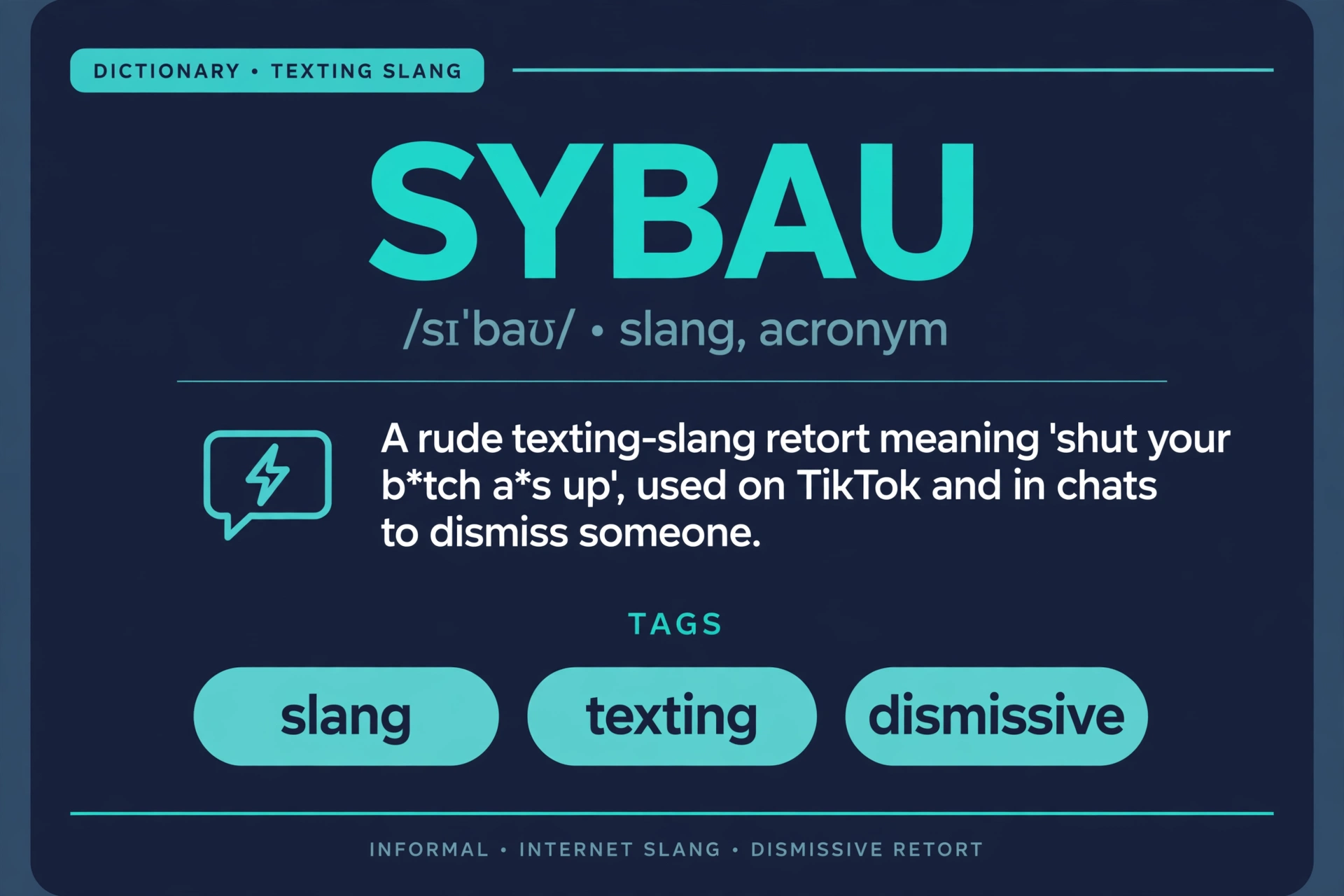
SYBAU is internet slang — an acronym that stands for “shut your b*tch a*s up.” In plain terms, it is a rude, dismissive way of telling someone to be quiet, most often used as a retort in TikTok comments, text messages, and gaming chats. The acronym softens the blow of the actual words, but the attitude stays exactly the same: impatient, mocking, and confrontational.
Because the letters mask the profanity, SYBAU flies under the radar of casual readers and sometimes even content filters. But make no mistake — it is an insult, not a compliment. Understanding the sybau meaning slang definition is essential before you ever type it, because dropping it in the wrong conversation can turn a joke into a genuine argument.
Introduction
Scroll through the comments of almost any viral TikTok video from the past year and you will spot it: a single blunt word in all caps — SYBAU. Sometimes it stands alone. Sometimes it comes with a broken heart emoji. Either way, it stops readers in their tracks, because even people who have never heard the term can feel the aggression radiating off those five letters.
If you are a parent, teacher, or simply someone who does not live on TikTok, seeing SYBAU pop up in your kid’s texts or in a comment thread can be genuinely confusing. Is it a compliment? A typo? A new meme? The short answer is that SYBAU is one of the most viral additions to the ever-growing wave of Gen Alpha slang — a fast, punchy, and deliberately edgy piece of internet language that exploded across social media in late 2024 and early 2025.
This guide breaks down everything you need to know: what SYBAU stands for, where it came from, how it spread, how people actually use it in conversation, and — just as importantly — when you should never use it. By the end, you will be able to decode every SYBAU you encounter online and decide for yourself whether it belongs in your vocabulary.
Origin of SYBAU
SYBAU did not start on TikTok — and that surprises a lot of people. According to Merriam-Webster’s slang entry, evidence of SYBAU dates back more than 20 years, and Know Your Meme documents an Urban Dictionary definition of the acronym from as early as November 19, 2003. The phrase it abbreviates has much older roots in African American Vernacular English (AAVE), where “shut your b*tch a*s up” existed as a spoken, deliberately provocative insult long before the internet got hold of it.
For years, SYBAU lived a quiet life as niche online slang — the kind of term you might see in gaming lobbies, hip-hop forums, or old message boards, but never in mainstream feeds. The abbreviation worked perfectly as algospeak: the letters hid words that could trigger automatic content moderation or offend casual readers, letting the insult pass through filters while keeping its full meaning obvious to anyone in the know.
The real turning point came in the mid-2020s. SYBAU rode a wave of what Gen Z calls “slang overload” content — videos and memes that stack half a dozen acronyms into a single sentence for comedic effect. Phrases like TS (“this s*it”), PMO (“p*ss me off”), and ICL (“I can’t lie”) became the genre’s signature vocabulary, and SYBAU fit the pattern perfectly: short, aggressive, and instantly meme-able. The culture around hyper-masculine, tongue-in-cheek “sigma” internet humor — the same ecosystem that made sigma slang go viral — gave SYBAU the perfect audience of teenagers and young men ready to spray it across comment sections.
By early 2025, the term had become a fixture of “brainrot” meme culture: absurd, fast-moving, self-aware internet humor that Gen Alpha treats as a badge of honor. And that was only the beginning of its explosion.
The Rise and Popularity of SYBAU
SYBAU’s breakout moment can be traced to February 2025. On February 8th, TikToker @swaggsolos posted a video using the phrase that gathered over 2 million views in about three weeks. Shortly after, on February 25th, TikToker @onmybehalf posted a video purposely misdefining SYBAU as “so you’re beautiful and unique,” which racked up over 1.6 million views in just three days. That second video was important: it introduced the term to millions of people who had never heard the real meaning, creating an entire sub-genre of jokes built on the gap between the wholesome fake definition and the genuinely harsh real one.
Then came the SYBAU Picture — also known as the SYBAU Guy — in March 2025. A meme showing rapper Lazer Dim 700 holding up his hands, captioned “SYBAU” alongside a broken heart emoji, began circulating as a reaction image in TikTok comment sections. Posted originally by TikToker @awoppoepaeol.2, the image earned over 113,000 likes in two months and quickly became one of the platform’s go-to dismissive reactions, appearing under controversial takes, unpopular opinions, and anything the comment section collectively decided to shut down.
Why did SYBAU catch on so aggressively when thousands of similar acronyms faded? Three reasons:
- Brevity meets punch. Five letters deliver a full insult with zero typing effort — perfect for fast-moving comment threads and heated gaming chats.
- Filter evasion. The acronym slips past automated profanity filters that would flag the spelled-out phrase, giving it a rebellious “algospeak” appeal.
- Meme infrastructure. It landed inside an already-booming ecosystem of slang-overload videos, reaction images, and emoji pairings (especially the 💔 and 🥀 emojis), so every new post gave the term free distribution.
Today SYBAU sits firmly in the same tier of viral internet vocabulary as terms like mewing — recognizable to anyone under 25 and mystifying to everyone else. It shows up on TikTok, Instagram Reels comments, Snapchat, Discord servers, Roblox and Fortnite lobbies, and increasingly in real-world teenage conversation, where saying “sybau” out loud has become its own kind of flex.
How SYBAU Is Used
SYBAU functions as a conversational kill switch — a way to shut down what someone is saying, signal disrespect, or win a verbal exchange in a single word. But like most slang, its exact meaning shifts with tone, context, and relationship between the speakers. Here is how the usage breaks down:
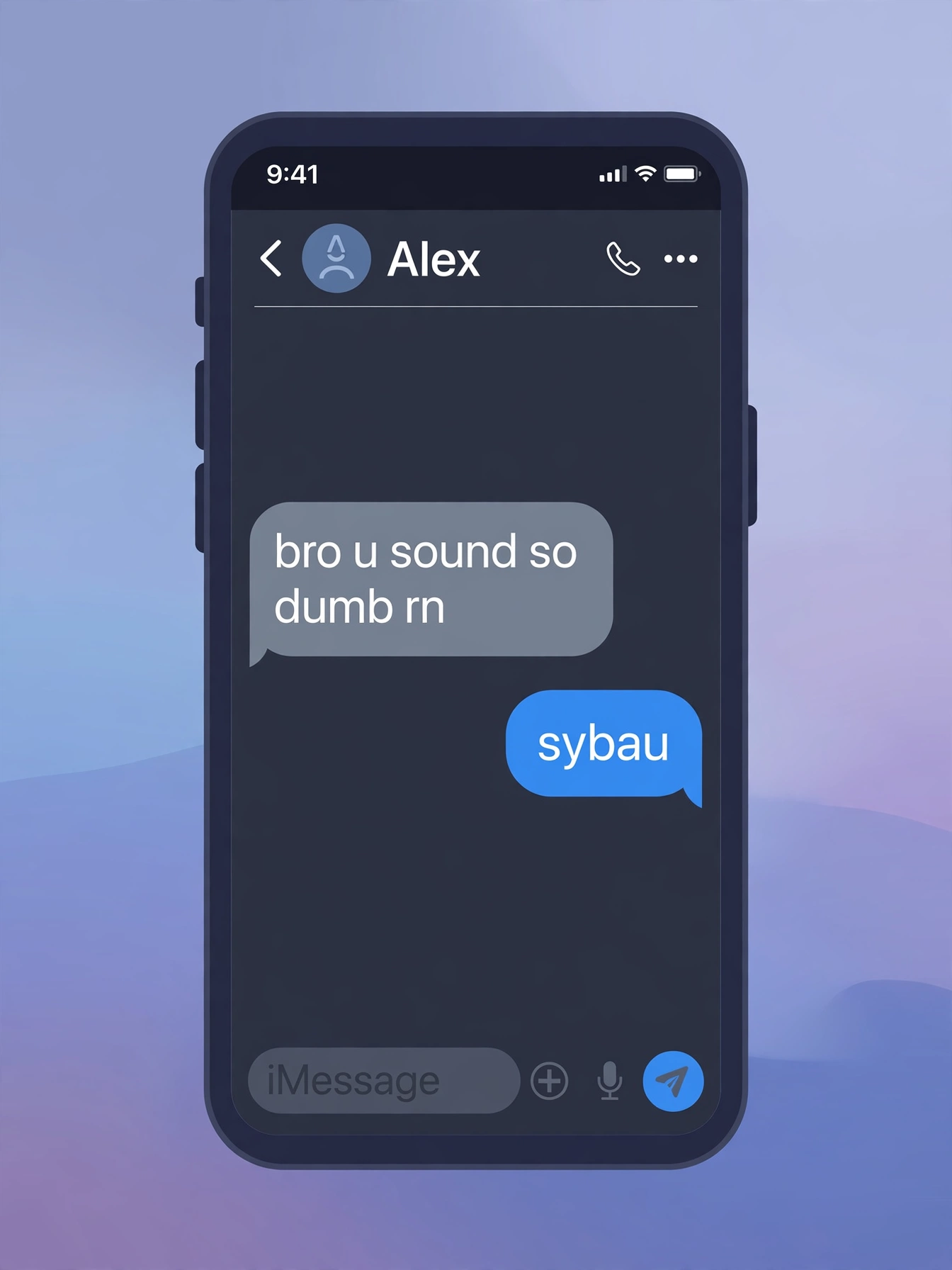
- Dismissive retort. The most common use. Someone says something annoying, wrong, or cringe, and the reply is simply “sybau.” The conversation ends there — or escalates.
- Playful roast between friends. Close friends who trade insults as affection will drop “sybau” with laughing emojis (😂, 💀) to signal that it is a joke. The profanity is part of the humor, not an actual attack.
- Comment-section clapback. Under TikToks, reels, and tweets, SYBAU works like a community verdict — the digital equivalent of booing someone off stage. Dozens of commenters replying “sybau” to one person’s take is a pile-on.
- Gaming trash talk. In competitive games like Fortnite, Roblox, or Call of Duty, SYBAU is quick-fire trash talk mid-match — short enough to type between plays.
- Meme caption. The SYBAU Guy reaction image lets people deliver the insult without typing a word at all. Posting the image under someone’s video carries the full meaning silently.
- Ironic or wholesome misuse. Following the “so you’re beautiful and unique” joke, some users post SYBAU under genuinely kind content as an inside joke — a usage that only works if the audience knows the real meaning and finds the contrast funny.
The tone is the entire message. Typed flatly — “sybau.” — it reads as genuinely hostile. Typed with emojis — “sybau 😭🙏” — it reads as dramatic, self-aware humor. Spoken aloud among friends, it can even sound playful. But there is no version of SYBAU that is polite. At best it is affectionate roasting; at worst it is a straight-up insult. Knowing the difference depends entirely on reading the room.
Examples of SYBAU in Conversation
Context is everything with this term. These examples show how SYBAU shifts across friendly, formal, and funny settings — and why the setting matters more than the word itself.
Friendly Examples
Between close friends who already roast each other, SYBAU lands as humor rather than hostility. These exchanges only work because the relationship is already established:
- Friend 1: “Bro I could beat you in a 1v1 with my eyes closed.”
Friend 2: “sybau 😂 you lost to a bot last game” - Friend 1: “I just finished my whole essay in one night, I’m built different.”
Friend 2: “sybau, you started crying at page two 💀” - Group chat, after someone sends a bad take: “Pineapple pizza is elite.” → “sybau 💔” → “nah he has a point tho”
- Friend 1: “I look good in this fit, admit it.”
Friend 2: “SYBAU, you look like an NPC 😭”
Notice the pattern: emojis, laughter, and an existing friendship do all the heavy lifting. Without those signals, the same messages would read as genuine aggression.
Professional Examples
Let us be direct: there is no professional example of SYBAU. The term is profanity-adjacent, aggressive, and dismissive — the exact opposite of workplace communication. Using it with a coworker, boss, client, or teacher would be unprofessional and could have real consequences, from a disciplinary conversation to losing a job or a client.
What does belong in a professional setting is the underlying function: shutting down a tangent, redirecting a conversation, or disagreeing firmly. Here are workplace-safe ways to do what SYBAU does without the insult:
- “Let’s table that for now and stay on track.”
- “I hear you — let’s circle back to the main point.”
- “I disagree, and here’s why.”
If a coworker uses SYBAU toward you, treat it as inappropriate regardless of intent and address it through normal workplace channels. Slang this aggressive has no place in professional communication, full stop.
Funny Examples
Meme culture runs on SYBAU’s absurdity. These examples lean into the joke — the over-the-top delivery is the entire point:
- Someone posts a 10-paragraph rant about why their favorite anime character would win a fight. First reply: “sybau 🥀”
- TikTok comment: “POV: me explaining to my mom why I need a new phone” → reply: “sybau, she said no 💔”
- A friend sends a voice note complaining for the fifth time about the same situationship. Reply: “SYBAU 😭🙏 we’ve heard this one”
- Under a cooking video: “I made my situationship dinner to convince him to make us official” → top comment: “sybau, I’m here for recipes”
- The ironic wholesome flip: under a video of a grandma baking cookies — “SYBAU (so you’re beautiful and unique) 🥰” — funny only because everyone knows the real meaning.
The humor works because SYBAU is disproportionate — a nuclear insult deployed against minor annoyances. That gap between the tiny trigger and the massive response is the joke.
Comparison with Similar Terms
SYBAU does not exist in a vacuum. It belongs to a whole family of dismissive slang that tells someone to stop talking — but each term carries a different weight, tone, and risk level. Here is how SYBAU stacks up:
| Term | Stands For | Tone | Harshness | Typical Setting |
|---|---|---|---|---|
| SYBAU | Shut your b*tch a*s up | Aggressive, mocking | High | TikTok comments, gaming chats, friend roasts |
| STFU | Shut the f*** up | Blunt, hostile | Very high | Heated arguments, trash talk |
| Shut up | — | Direct, rude | Medium | Everywhere; the plain-English version |
| SYFM | Shut your f***ing mouth | Aggressive, meme-y | Very high | TikTok meme audios, comment sections |
| Bruh | — | Exasperated, casual | Low | Friendly chats, mild disbelief |
| SMH | Shaking my head | Disappointed, judgy | Low | Texts, social media reactions |
| L + ratio | Take the loss + ratio | Mocking, competitive | Medium | Twitter/X, TikTok comment battles |
A few takeaways from the comparison:
- SYBAU vs. STFU: Both are harsh, but STFU hits harder because the profanity is fully spelled out. SYBAU’s abbreviation softens it just enough to function as meme humor — which is exactly why it spread further.
- SYBAU vs. bruh / SMH: Not the same category at all. “Bruh” expresses disbelief; SYBAU expresses contempt. If someone says “bruh” to you, you made a bad point. If someone says “SYBAU,” they want you silent.
- SYBAU vs. SYFM: Cousins in the slang-overload family — same structure (S-Y + insult + body part), same aggressive energy. SYFM trends more as an audio meme; SYBAU trends more as a text/comment meme.
- SYBAU vs. “shut up”: Functionally identical, but “shut up” is transparent — everyone, including your grandma, knows what it means. SYBAU hides behind its letters, which is precisely why teens prefer it.
Like glizzy and other viral slang terms, SYBAU’s power comes partly from being an in-group code — using it signals that you are fluent in internet culture, while outsiders are left guessing.
The standard, widely recognized meaning of SYBAU is the rude one — “shut your b*tch a*s up.” That is what the vast majority of users intend, and it is the definition recorded by Merriam-Webster and Know Your Meme. But the internet being the internet, several alternate and joke meanings have circulated. Treat every one of these as a joke, a misunderstanding, or a deliberate misdirect — never the “real” definition:
- “So you’re beautiful and unique” — the famous fake definition from the viral @onmybehalf TikTok. Used ironically under wholesome content; the humor depends on everyone knowing the actual meaning is the opposite.
- “See you, be awesome, yo” — an occasional wholesome backronym invented by commenters for comedic contrast. No one uses this sincerely.
- “Shut your butt up” — a sanitized version some younger users or parents invent to soften the term. It is not standard, but you may hear it as a PG substitute.
- “SYB” (truncated) — sometimes people just type “syb,” which carries the same meaning in shorter form, common in very fast-paced chats.
A note of caution: if someone tells you SYBAU means something innocent, they are either joking or misinformed. The wholesome backronyms exist because the real meaning is harsh — the contrast is the joke. Never assume a “sybau” directed at you is friendly until the tone and context make that unmistakable.
Professional or Polite Alternatives to SYBAU
There will be moments when you feel the exact emotion SYBAU captures — frustration, exasperation, the urge to end someone’s monologue — but the setting demands better. Here are alternatives organized by situation, so you can match the firmness of SYBAU without the fallout:
| Situation | Say This Instead | Why It Works |
|---|---|---|
| Friend won’t stop talking | “Okay, I need you to pause for a sec 😂” | Firm but keeps the friendship intact |
| Someone’s take is bad | “Hard disagree — here’s my take.” | Challenges the idea, not the person |
| Group chat is spiraling | “Can we move on? This is going nowhere.” | Redirects without targeting anyone |
| Gaming, playful trash talk | “Quiet, I’m locked in 😤” | Keeps the competitive banter clean |
| Workplace disagreement | “Let’s stay on topic — we can revisit that later.” | Professional boundary, zero hostility |
| Someone is being rude to you | “That’s not okay. Let’s reset.” | Names the behavior without escalating |
More one-liner swaps for everyday use:
- “Alright, we get it 😅” — the friendly shutdown
- “Anyway—” — the classic subject change
- “Moving on!” — light, final, no drama
- “Let’s agree to disagree.” — the disagreement off-ramp
- “I need a minute of quiet, please.” — honest and direct
The goal is the same as SYBAU — ending an unwanted monologue — but every one of these keeps your relationships, reputation, and (in professional settings) your job safe.
Common Mistakes People Make with SYBAU
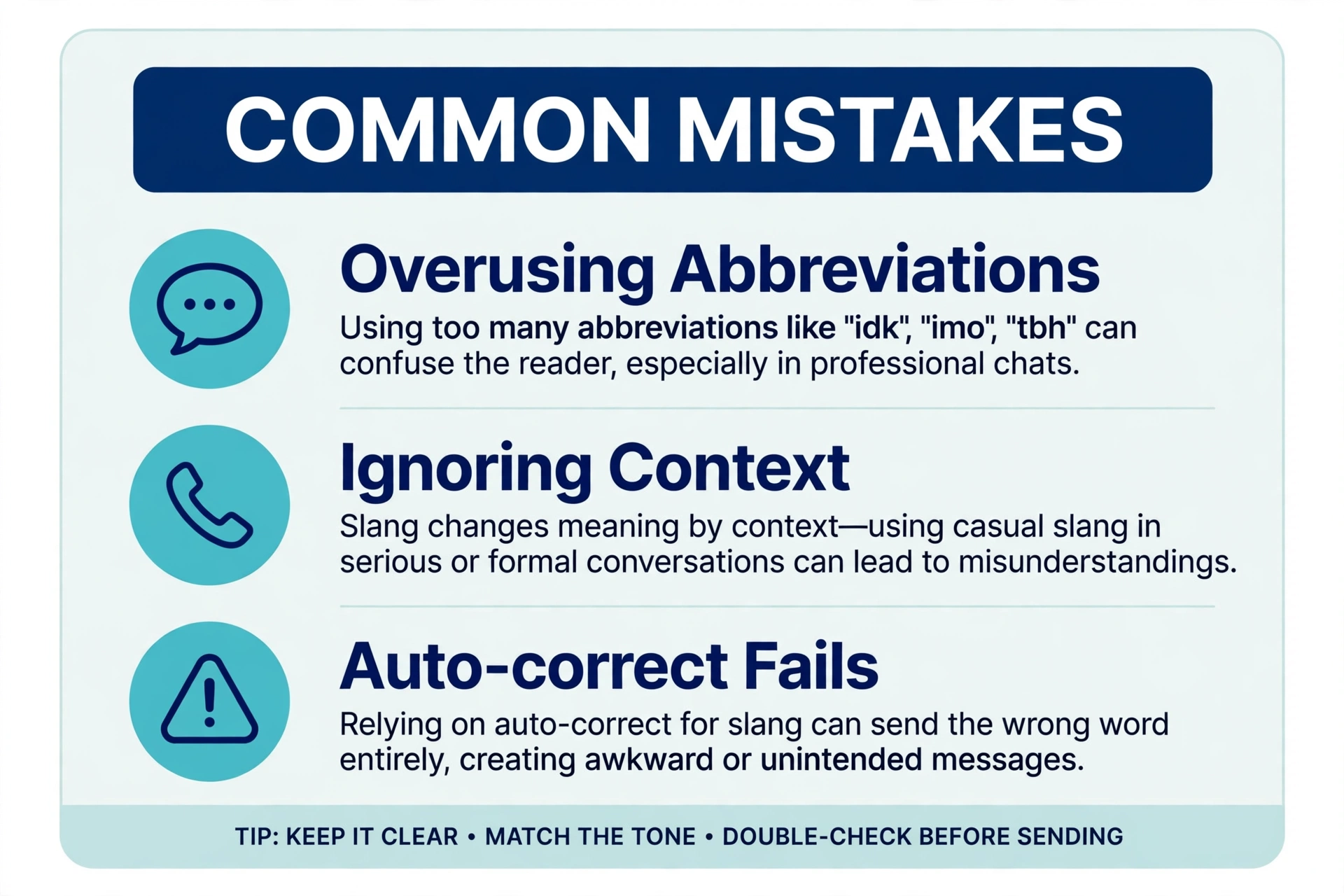
Because SYBAU is short, edgy, and everywhere, people misuse it constantly. These are the mistakes to avoid:
- Using it with strangers. The number-one error. Dropping SYBAU on someone you do not know — in a comment section, a game lobby, or a DM — reads as a genuine insult, not a joke. You have no shared context to soften it, so it lands at full force.
- Believing the wholesome backronyms. “So you’re beautiful and unique” is a meme, not a meaning. If you tell a friend “sybau!” thinking it is sweet, you have just insulted them. Learn the real definition first.
- Typing it at school or work. SYBAU abbreviates profanity. Teachers, professors, and employers treat it the same as typing out the full phrase. It can trigger disciplinary action, content flags on school networks, or HR problems.
- Assuming everyone knows it is a joke. The “ironic wholesome” usage only works inside meme-literate circles. Outside those circles — with parents, older relatives, new acquaintances — SYBAU is just an insult, full stop.
- Overusing it until it loses meaning. Like any slang, SYBAU gets stale fast. Teens who spam it in every chat quickly sound like they are trying too hard. Restraint keeps it funny; overuse makes it cringe.
- Escalating real conflicts with it. In a genuine argument, “sybau” pours gasoline on the fire. It dismisses the other person entirely, which guarantees they will come back angrier. Never use it when tempers are already high.
- Confusing it with similar acronyms. SYBAU is not SYFM (“shut your f***ing mouth”), not SYB (a truncation), and not TS PMO ICL (a different slang cluster entirely). Mixing them up in front of meme-literate friends will get you roasted — possibly with a “sybau” of your own.
- Posting it under serious content. Replying “sybau” to someone’s genuine question, emotional post, or cry for help is not edgy — it is cruel. The meme works on low-stakes content; on high-stakes content it makes you the villain of the comment section.
Quick Tips for Using (or Surviving) SYBAU
- Read the room first. SYBAU is safe only where roasting is already the established dynamic — close friends, meme pages, competitive lobbies. Anywhere else, skip it.
- Let emojis do the tone work. “sybau 😂” and “sybau.” are two completely different messages. If you insist on using it playfully, the emojis are what make it playful.
- Never type it angry. If you are genuinely furious, SYBAU will not defuse anything. Step away from the keyboard instead — the acronym will still be there tomorrow.
- Teach, don’t assume. If a younger sibling or friend uses SYBAU without knowing what it means, explain it plainly rather than shaming them. Most kids pick it up from memes long before they learn the full phrase.
- Parents: treat it as a conversation starter. Seeing “sybau” in your teen’s texts is an opening to talk about tone, context, and how words land differently online versus in person — not necessarily a crisis.
- If someone says it to you: check the context before reacting. From a close friend with laughing emojis, laugh it off or fire back. From a stranger in an argument, disengage — responding escalates a fight you did not start.
- Keep it out of anything permanent. School essays, job applications, college emails, public bios — SYBAU has a half-life online, but screenshots are forever.
- When in doubt, use the alternatives. Everything SYBAU accomplishes socially can be done with “alright, moving on” or “hard disagree.” The insult is optional; the boundary is not.

Frequently Asked Questions About SYBAU
What does SYBAU stand for?
SYBAU stands for “shut your b*tch a*s up.” It is a dismissive, insulting acronym used mainly on TikTok, in text messages, and in gaming chats to tell someone to be quiet. The letters mask the profanity, but the meaning is unchanged — it is an insult, not a compliment.
Is SYBAU rude?
Yes — unambiguously. SYBAU abbreviates a profane insult, and even when used jokingly between friends, the rudeness is the point of the joke. It should never be used in professional, academic, or formal settings, and using it with strangers will almost always be read as genuine hostility.
Where did SYBAU come from?
The phrase has roots in African American Vernacular English (AAVE), and the acronym was defined on Urban Dictionary as early as 2003. It stayed niche for years before exploding on TikTok in late 2024 and early 2025, driven by slang-overload meme culture and the viral SYBAU Guy reaction image posted in March 2025.
Is SYBAU Gen Alpha or Gen Z slang?
It sits right on the border. The term’s older roots and 2000s internet usage are millennial-era, its slang-overload revival was driven by Gen Z meme culture, and its current peak popularity — especially the SYBAU Guy meme and spoken use — is firmly Gen Alpha territory. Most people who use it today are teenagers and young adults.
Can SYBAU ever be friendly?
Sometimes, but only inside a close friendship where roasting is already normal — and usually with laughing emojis to signal the joke. The “friendly” version works because both people understand the real meaning and find the exaggeration funny. Without that shared context, SYBAU is simply an insult.
What does SYBAU mean on TikTok?
On TikTok, SYBAU is primarily a comment-section weapon: a one-word reply that dismisses someone’s take, often posted dozens of times under a controversial video as a community pile-on. It also appears in slang-overload videos alongside terms like TS, PMO, and ICL, and as the SYBAU Guy reaction image (rapper Lazer Dim 700 with a broken heart emoji).
How should I respond if someone says SYBAU to me?
Check the context first. If it comes from a close friend with emojis, treat it as a roast — laugh it off or fire back playfully. If it comes from a stranger in a comment section, the smartest move is to ignore it; replying escalates a fight with someone you will never meet. If it happens at work or school, treat it as inappropriate language and address it through the proper channels.
Should I be worried if my kid says SYBAU?
Not necessarily alarmed, but it is worth a conversation. Most teens pick up SYBAU from memes before they fully grasp the profanity behind the letters. Use it as a teaching moment: explain what it actually stands for, why tone and audience matter, and where it is never acceptable (school, work, with strangers). The goal is digital literacy, not panic.
Conclusion
SYBAU is a perfect specimen of modern internet slang: an acronym born in AAVE, defined online over two decades ago, resurrected by TikTok’s slang-overload meme culture, and turned into one of Gen Alpha’s favorite dismissive retorts — all in five letters. The sybau meaning slang definition is simple (“shut your b*tch a*s up”), but the term’s real power lies in its flexibility: a joke between friends, a weapon in comment sections, a reaction image, and a filter-dodging piece of algospeak all at once.
The key takeaway is tone. SYBAU is never polite — at best it is affectionate roasting among people who already trust each other, and at worst it is a straight insult that can start real fights. Knowing the difference is what separates someone who is fluent in internet culture from someone who is about to learn a hard lesson in a group chat.
So the next time you see “sybau 💔” under a viral video, you will know exactly what is happening: the comment section has rendered its verdict. And now you are in on the joke — just think twice before you type it yourself.

1 thought on “SYBAU Meaning Slang: The Gen Alpha Diss Everyone Keeps Texting, Explained”