
Quick definition: EYP has no single settled, innocent meaning, and that is the most important thing to know about it. In TikTok comments and group chats, lowercase “eyp” most often reads as a stylised way of typing “yep” — a quick yes, agreement, or “I relate.” Uppercase EYP, especially in flirty or coded TikTok slang, has a documented explicit expansion that is not safe to guess at or to use with strangers. On top of those two readings, dozens of websites invent other expansions for EYP, from “enjoy your pie” to “enjoy your privilege,” with no real evidence that people actually use them that way. If you see eyp meaning slang in a search box, you are really asking: which EYP did this person mean, in this conversation, on this platform? This guide answers that question honestly, separates what is documented from what is invented, and ends with a simple rule: when you are not sure, do not use it — write “yes” instead.
EYP Meaning Slang: Definition and Quick Answer
The reason EYP confuses people is not that it is complicated. It is that the same three letters are doing three different jobs, and the job is decided by capital letters, by the platform, and by who is talking to whom. Most slang terms settle into one main meaning over time. EYP has not. It is still split between a harmless typing habit, a coded phrase with an adult meaning, and a pile of made-up dictionary entries that only exist on low-quality websites trying to rank for the search term.
Start with the two readings that actually show up in real conversations. The first is the lowercase one. A comment that just says “eyp” under a relatable video, or a reply of “eyp…” to a friend’s story, is almost always agreement. It is “yep” typed fast, typed playfully, or typed with extra letters for emphasis — “eypppp” works the way “yessss” works. The second is the uppercase one. When EYP appears in all caps in a flirty comment, a thirst-trap comment section, or a gaming chat where someone is trying to be edgy, it is usually being used as coded shorthand, and the expansion behind it is explicit. That is not a meaning you can safely treat as a joke, and it is not a meaning this guide will demonstrate with example sentences, because using it that way is precisely the mistake to avoid.
| Form you see | Most likely reading | How sure can you be? |
|---|---|---|
| Lowercase “eyp” as a reply or comment | “Yep” / yes / agreement | High, if the context is agreement or relating |
| “eypppp” with extra letters | Emphatic “yesss” | High — emphasis, not a new word |
| Uppercase EYP in a flirty or coded context | An explicit coded phrase | High — do not use or repeat it casually |
| EYP in a formal or academic context | European Youth Parliament | High, but only in that setting |
| Any other expansion you found on a random site | Probably invented for search traffic | Low — treat as unverified |
The table above is the whole article in miniature. If you remember nothing else, remember the capitalisation rule and the context rule. Lowercase agreement is the everyday reading. Uppercase coded use is the risky reading. And any neat three-word expansion that sounds too perfect — the kind that fits the letters exactly and flatters the website that published it — should be treated as a guess until you see real people using it in real conversations. Real slang is messy. Invented slang is suspiciously tidy.
It also helps to know what EYP is not. It is not an official abbreviation with a dictionary entry. It is not a standard greeting, and it is not a polite alternative to anything. It does not mean the same thing in every chat, and it does not change meaning based on whether a guy or a girl sends it — the conversation around it decides the meaning, not the sender’s gender. Anyone who tells you EYP has one simple definition, and that definition happens to be the one on their website, is selling you certainty that the evidence does not support.
Introduction
You are scrolling TikTok when a comment stops you. Under a video about being broke before payday, someone has written a single word: “eyp.” A few videos later, under a completely different kind of post, another comment reads “lemme EYP.” Then a friend drops “eyp…” in your group chat in reply to a plan you suggested. Three uses, three tones, and nowhere does anyone stop to explain what they meant. You nod along, because that is what everyone does online, and you quietly wonder whether you just agreed to something you did not understand.
That confusion is not your fault. EYP is a term that arrived without a manual, spread through comment sections faster than any dictionary could follow, and then got picked up by content farms that each gave it a different definition. Searching for it makes the problem worse, not better. One page tells you it means “enjoy your privilege.” The next tells you it means “enjoy your present.” A third tells you it is just “yes.” A fourth gives you a meaning you cannot repeat at work. All of them sound confident. Only some of them describe language that real people actually use, and the confident tone is exactly how the confusion spreads — one invented definition at a time, copied from site to site until it looks like consensus.
This guide does the opposite. It tells you what is actually documented about where EYP came from, how the lowercase and uppercase forms split apart, and why so many fake meanings exist. It shows you the safe, everyday reading with real-feeling examples, explains the risky reading without turning it into entertainment, and gives you a decision rule you can use in five seconds the next time the letters appear on your screen. It also connects EYP to the wider world of Gen Alpha slang, where short forms spread through repetition first and explanations arrive much later — if they arrive at all. If you have ever stared at “eyp” and guessed, this is the article that stops the guessing.

Origin
Unlike many slang terms that seem to appear from nowhere, the coded uppercase form of EYP has a documented trail, and the best-documented source for it is Know Your Meme’s documented history of the term, which traces its earliest known use to TikTok. On 1 August 2022, TikToker @hoodiezay1 posted a video captioned “ur smile make me wanna eyp,” which gathered more than 140,000 views over the following two years. That caption is the earliest known use of the term in its coded sense. It did not go massively viral on its own, but it put the letters on record, in exactly the flirty context that would define the uppercase form.
The term stayed quiet for a while, then spread through 2024. In January 2024 an X (formerly Twitter) post used it, and through the year it became increasingly common on TikTok, particularly in comment sections where users wanted to say something suggestive without writing it out in full. By February 2024, videos using the term were reaching audiences in the millions — one notable example passed 2.6 million views. The pattern will be familiar to anyone who follows TikTok slang: a coded form spreads because it dodges automated moderation, because curious viewers flood the comments asking what it means, and because that curiosity itself boosts the video. The code is the content.
EYP belongs to a whole family of coded TikTok acronyms from the same period, including long strings like LMSYCUYCDMT and DYWMTCOAEYPTYCOMF. All of them work the same way: they compress a sentence that would be flagged, removed, or judged into a short string that only insiders recognise, at least at first. Once outsiders start asking questions, the code stops being secret and starts being a meme in its own right. That is the moment a term like EYP escapes its original corner of the internet and starts appearing in places where nobody knows its history — gaming chats, group chats, and comment sections full of people who read it as something else entirely.
The lowercase form has a different, looser origin, and honesty requires saying so plainly: nobody can point to the first person who typed “eyp” instead of “yep.” It grew the way fast-typing variants always grow. On a phone keyboard, “eyp” is a plausible slip, a playful respelling, or a deliberate stylisation — the same impulse that gives us “ye,” “yuh,” and “yessir” in different corners of TikTok. In lifestyle, fashion, and aesthetic niches of the app, “eyp” shows up as a soft, quirky agreement marker: a way of saying “yes, this is me” or “I relate” without the flatness of a plain “yes.” Extra letters add feeling, the way stretching any word adds feeling online. “Eypppp” is not a different word. It is “yep” with the volume turned up.
That split origin is why the term is so hard to pin down. One form was born as a code with a specific, adult expansion. The other was born as a typing habit with no expansion at all — just a sound, “yep,” respelled. They look identical when you strip away capital letters and context, which is why readers keep colliding with the wrong meaning. The history does not give you one answer. It gives you two histories, and the rest of this guide is about telling them apart in the wild.
Popularity
EYP is popular in a narrow, uneven way. It is not a mainstream word like “lol” or “brb,” which almost everyone recognises. It is a niche term that is very visible inside a few specific feeds and almost invisible outside them. On TikTok, it lives in comment sections: relatable videos, thirst traps, POV videos, and trend posts where a one-word reaction is the whole comment. On X and Reddit, it appears in threads about slang itself, where people ask what it means — which is, ironically, one of the main ways it keeps spreading. In gaming, particularly in games like Valorant, it shows up in match chat, where players use it to be edgy, to flirt awkwardly, or simply because they saw it somewhere else and copied it.
Its popularity also follows the classic coded-slang curve. First, a small group uses it as an in-joke or a workaround. Then curious outsiders ask what it means, which creates a second wave of posts explaining it — many of them wrong. Then content sites publish competing definitions, which creates a third wave of people who arrive through search and leave more confused than they came. Each wave makes the term look bigger than it is, while making its actual meaning harder to find. If you judge EYP by search results alone, it looks like one of the most important slang terms of the year. If you judge it by how often ordinary people use it in ordinary conversation, it is a minor term with a loud online footprint.
That gap matters for anyone deciding whether to use it. A term can be famous online and still be a bad choice in your own messages. EYP is famous in exactly the wrong way: the people most likely to recognise the uppercase form are the people most likely to read it as suggestive, while the people most likely to read the lowercase form as “yep” are the people already inside your friend group. There is no version of EYP that is universally understood and universally safe. Popularity, in this case, is not a recommendation. It is a warning that the audience will split, and you will not control which half hears you.
How It Is Used
EYP appears in a small number of shapes, and learning those shapes is faster than memorising definitions. The most common is the standalone reply: a single “eyp” or “eyp!” in response to a question, a plan, or a relatable post. That shape is almost always agreement. It works the way “yep” works, and it is usually typed in lowercase, often without punctuation, often from a phone. The second shape is the stretched reply: “eyp…”, “eypppp,” or “eyp lol.” The extra letters and trailing dots add tone — hesitation, emphasis, or laughter — in the same way they would on any short reply. The letters do not change meaning. The punctuation does the emotional work.
The third shape is the one to watch for. Phrases built around uppercase EYP in a flirty or suggestive sentence — the classic construction pairs “lemme” with EYP — belong to the coded reading, not the agreement reading. If you see that construction, you are not looking at a typo for “yep.” You are looking at someone using the term deliberately, in a context where the adult expansion is the point. The correct response is not to copy the construction as a joke. The correct response is to recognise it, decide whether you want anything to do with that conversation, and otherwise leave it alone. Treating it as harmless because you saw it in a meme is how people accidentally send a message they did not mean.
Capitalisation is the most reliable clue you have, and it is worth slowing down for. Lowercase “eyp” in a casual reply leans toward “yep.” Uppercase “EYP” in a comment or caption leans toward the coded phrase, especially when the surrounding content is flirty, suggestive, or deliberately provocative. Capitalisation is not proof — people type carelessly, autocorrect does strange things, and some people capitalise everything — but it is the best single signal available, and it is the signal most explainers never mention. If you are ever unsure, look at the sentence around the letters before you look at the letters themselves. The context is the definition.
| Shape | Typical context | Best reading |
|---|---|---|
| “eyp” alone as a reply | Friend asks a question, shares a plan | Yes / yep / agreed |
| “eyp…” or “eypppp” | Relatable video, funny post | Emphatic yes, “I relate” |
| Uppercase EYP in a flirty comment | Thirst trap, suggestive caption | Coded phrase — do not copy it |
| EYP in a work, school, or formal message | Email, class chat, official post | Do not use it at all |
| EYP as an organisation name | Conference, youth politics, Europe | European Youth Parliament |
There is one more pattern worth naming, because it explains a lot of the confusion in gaming and group chats: the accidental EYP. Someone means to type “yep,” their thumb slips or their phone suggests the wrong word, and “eyp” goes out into a chat where a stranger reads it as something else entirely. The sender meant agreement. The reader sees a code. Nobody is lying, and nobody is wrong about what they saw — they are just reading different histories into the same three letters. If you ever receive an EYP that does not fit the conversation, the most likely explanation is not that the sender was being bold. It is that they were being careless, and the kindest reading is the boring one.
Examples
The examples below show only the safe, everyday reading of EYP — the lowercase agreement use — because that is the only use this guide can responsibly demonstrate. Notice how ordinary every example is. That ordinariness is the point. When EYP means “yep,” it is doing the most boring job in language: saying yes. The examples are grouped by tone, following the structure of a full slang guide, with an honest note where a category does not really exist for this term.
Friendly Examples
- “Are we still meeting at seven?” — “eyp, see you there.”
- “That video about payday was too real.” — “eyp lol, literally me.”
- “Did you finish the episode?” — “eypppp, watched it twice.”
- “Pizza tonight?” — “eyp. Always.”
- “I finally found jeans that fit.” — “eyp! Show me.”
Friendly uses are warm, short, and low-stakes. The reply does not carry information beyond agreement and enthusiasm. If you replace “eyp” with “yep” in any of these sentences, nothing changes — and that is the test for whether the agreement reading is correct. If replacing it with “yep” makes the sentence sound normal, you are reading the right meaning. If replacing it with “yep” makes the sentence sound strange or suggestive, you are not, and you should stop and re-read the context before replying.
Professional Examples
Here honesty matters more than completeness: there are no good professional examples of EYP, because EYP is not professional language in any of its readings. The agreement form is too casual and too easily misread for work, and the coded form is entirely inappropriate. The examples below therefore show what to write instead, in the situations where someone might be tempted to reach for a short reply. If a message could be forwarded to a manager, a client, a teacher, or a formal record, write the full word. Shortcuts that need a footnote are not shortcuts.
- Instead of “eyp” in a team chat, write: “Yes, confirmed — I will send it by five.”
- Instead of “eyp” in a client message, write: “Agreed. I will go ahead with that version.”
- Instead of “eyp” in a class group chat, write: “Yes, I can present on Thursday.”
Even in casual internal chats where slang is normal, EYP carries a risk that “yep” does not: a colleague who has only seen the uppercase, coded form will read your friendly reply as something else. That misreading is not their fault, and it is not worth the two letters you saved. Professional writing is not the place to test whether your audience knows the innocent history of an ambiguous term. Use the plain word, and save the slang for conversations where everyone already shares the context.
Funny Examples
- “Me: I will save money this month. Also me, buying candles: eyp…”
- “My phone autocorrected ‘yep’ to ‘eyp’ and now my aunt thinks I speak a new language.”
- “POV: you type ‘eyp’ and spend ten minutes explaining that you just meant yes.”
- “Group chat energy: one ‘eyp,’ three question marks, one screenshot, zero clarity.”
Funny uses of EYP are almost always jokes about the confusion itself, not jokes told with the term. That is telling. When a word’s funniest use is a joke about how nobody knows what it means, the word has a clarity problem, not a comedy career. The humour in the examples above comes from recognition: everyone has been the person who sent a short reply and then had to explain it. Laughing at that shared experience is fine. Building a personality around a term that half your audience will misread is not.

Comparison with Similar Terms
EYP is easiest to understand by comparison, because every term it gets confused with has a clearer job. Put them side by side and the differences jump out: one is a plain yes, one is a platform label, one is a coded phrase, and one is an organisation that has nothing to do with slang at all. The table below keeps them apart, and the paragraphs after it explain the two comparisons that cause the most trouble in real conversations.
| Term | What it means | How it differs from EYP |
|---|---|---|
| Yep / yeah | Yes, agreement | Clear, universal, safe everywhere casual — EYP is none of those |
| Ye / yuh | Stylised yes in TikTok speech | Same job as lowercase eyp, but without the coded second meaning |
| FYP | For You Page (TikTok) | A platform label, not a reply — confusion is only visual |
| POV | Point of view | A framing device for videos, not agreement or flirting |
| LMSYCUYCDMT | A long coded TikTok acronym | Same coded family as uppercase EYP — suggestive, coded, not casual |
| EYP (organisation) | European Youth Parliament | A real institution founded in 1987 — unrelated to slang |
The comparison with “yep” is the most useful one, and it deserves a full paragraph. “Yep” has one job, it does it everywhere, and nobody has to guess. Lowercase “eyp” is trying to do the same job with a respelling, and it mostly succeeds inside friend groups where everyone already knows the code. Outside those groups, it fails, because the reader has to decide between two histories with no evidence. That is the difference between a good shorthand and a bad one: a good shorthand removes effort, and a bad shorthand adds a decision. EYP, outside a trusted circle, adds a decision every time it appears. That is why guides like this one keep recommending the plain word — not because slang is bad, but because this particular shorthand charges interest.
The comparison with the coded acronym family is the most important one for safety. Terms like LMSYCUYCDMT and the uppercase form of EYP share a design: they exist to say something explicitly without writing it explicitly, so that moderation systems and casual readers miss it. Recognising the family resemblance helps you recognise the intent. If a string of letters looks like a code, appears in a flirty or provocative context, and makes people in the comments ask what it means, it is probably a code, and the safe move is to treat it as one. You do not need to decode it to handle it well. You need to decide, quickly, that you are not going to copy it, forward it, or use it as a joke with someone who has not already shown they know what it is.
Finally, the organisation comparison is a useful reminder that acronyms are not owned by slang. EYP has meant European Youth Parliament since 1987, in conferences, school programmes, and youth politics across Europe. That meaning is real, documented, and completely unrelated to TikTok. It only causes confusion when someone searches “EYP” without any context and lands on a youth-politics page while looking for slang, or vice versa. Context, again, is everything: a conference schedule and a comment section are different worlds, and the same three letters mean different things in each.

Alternate Meanings
This is the section where most competing articles go wrong, and where this guide has to be blunt. Search for EYP and you will find a long list of neat expansions: “enjoy your privilege,” “enjoy your present,” “enjoy your pie,” “enjoy your podcast,” “eat your peas,” “express your point,” “end your problem,” and more. They all fit the letters. Almost none of them describe language that real people have been observed using in real conversations. They are the product of a simple, cynical process: a website needs a definition, the letters can expand a dozen ways, so the website picks one, publishes it confidently, and waits for search traffic. The next website copies it, or invents a different one, and within months there are ten “definitions” and no evidence for any of them.
| Claimed expansion | Where you see it | Verdict |
|---|---|---|
| Enjoy Your Privilege | SEO slang sites | Unverified as slang — no documented conversational use |
| Enjoy Your Present | SEO slang sites | Unverified — a plausible phrase, not an observed slang term |
| Enjoy Your Pie / Enjoy Your Party | SEO slang sites | Unverified — invented expansions, treated as jokes at best |
| Enjoy Your Podcast | SEO slang sites | Unverified — no evidence of real use |
| Eat Your Peas / Express Your Point | SEO slang sites | Unverified — tidy fits for the letters, nothing more |
| European Youth Parliament | Official and academic sources | Real — but an organisation, not slang |
The test for any claimed meaning is simple, and you can run it yourself. Ask: can I find real people using this expansion in real messages, outside of articles that are themselves trying to define the term? For the coded uppercase reading, the answer is yes — there is a documented TikTok trail, dated posts, and a meme-database entry. For the lowercase “yep” reading, the answer is also yes — you can watch it happening in comment sections, in context, every day. For the invented expansions, the answer is no. You find articles, not conversations. You find definitions, not dialogue. That absence is evidence, and it is stronger than any single website’s confidence.
There is also a psychological reason the invented list keeps growing. People dislike ambiguity, and an acronym with no settled meaning feels like a puzzle that must have an answer. “Enjoy your pie” feels like an answer. It fits, it is friendly, and it lets the reader move on. But feeling like an answer is not the same as being one. Real slang research is boring in exactly this way: it requires saying “we do not know” or “people use it inconsistently” when the searcher wanted a clean line. This guide would rather be boring and right than tidy and wrong, because the cost of the tidy version is a reader who walks into a conversation using a phrase nobody recognises, in front of people who recognise a very different one.
Professional or Polite Alternatives
If you need a short reply, you do not need EYP. You need one of the plain words that already does the job without a footnote, and the right choice depends on the tone you want. “Yes” is the safest choice everywhere. “Yep” is the casual version, fine with friends and in informal chats. “Agreed,” “exactly,” and “same” add a little more feeling without adding any risk. “Sounds good” works for plans. “I relate” works for relatable posts. None of these require the reader to know a TikTok history, to check capitalisation, or to guess which of two meanings you intended. That is what makes them better, not just safer.
For the situations where EYP’s other readings might tempt you, the alternatives are equally simple. If you want to tell someone to enjoy something, say so in full: “Enjoy your evening,” “Hope you enjoy the gift,” “Have a great time.” If you want to call out privilege or entitlement in a discussion, say what you actually mean, in words, with the specific behaviour you are responding to — a three-letter code adds judgment without adding clarity, and it will read as an insult whether you intended it that way or not. If you want to flirt, do it openly, with a person who has shown they welcome it, in plain language you would be comfortable having quoted back to you. A coded acronym is not consent, it is not charm, and it is not a joke that lands with strangers.
- To agree: yes, yep, agreed, exactly, sounds good.
- To relate: same, literally me, I relate, so true.
- To cheer someone on: enjoy it, have fun, hope it goes well.
- To challenge an opinion: say the specific point, in full sentences.
- To flirt: do not use a code — use clear, respectful, welcome language, or do not send it.
The pattern behind all of these is the same: replace the code with the sentence. Slang is at its best when it saves time without costing clarity. EYP, in its current state, costs clarity in almost every room except the smallest friend group. The alternatives above cost nothing, and they work in every room. That is not a puritanical argument against slang. It is a practical one, from the same tradition as the rest of this site’s guides to terms like WYB, where the advice is always the same: use the form your reader will actually understand, not the form that looks cleverest on your screen.
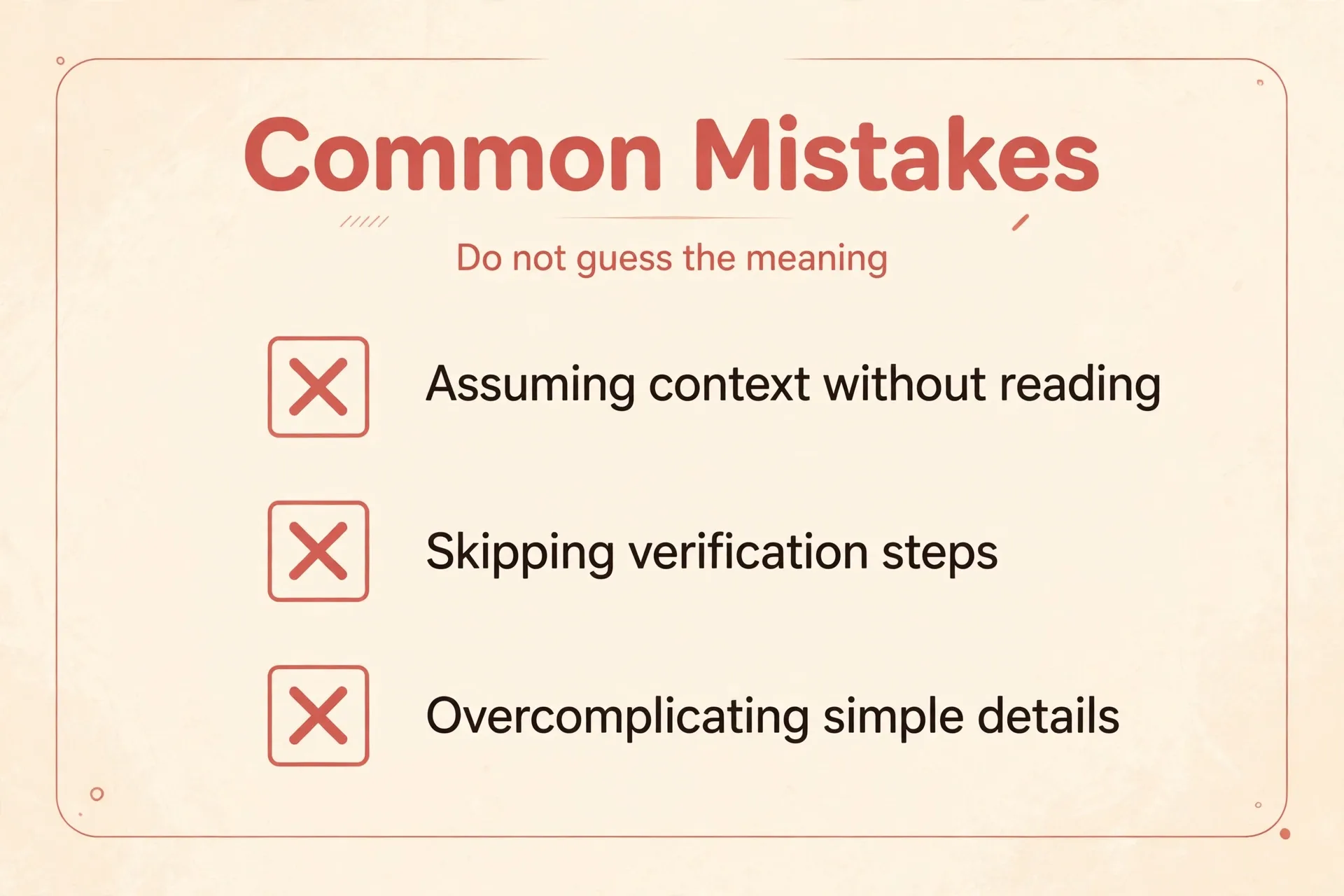
Common Mistakes
The most common mistake with EYP is the one this whole guide exists to prevent: assuming it has one meaning and acting on that assumption. A reader sees “eyp” in a friendly chat, learns the coded expansion from a search result, and decides the friend was being suggestive. Or a reader sees uppercase EYP in a flirty comment, learns the “yep” reading from another site, and decides it is harmless to copy. Both readers are working from a single search result, and both are wrong in opposite directions. The mistake is not stupidity. It is trusting a format — the confident dictionary-style article — that was never designed to handle ambiguity honestly.
- Guessing from one search result. One page, one definition, one confident tone — and a reader who stops there. Always check a second source, and prefer sources that show real posts and dates over sources that only assert a definition.
- Ignoring capitalisation. Treating “eyp” and “EYP” as identical throws away the best clue you have. Case is not decoration here. It is the difference between a typing habit and a code.
- Using the coded form as a joke. Sending the uppercase construction to a friend, a stranger, or a group chat “as a joke” is the fastest way to make someone uncomfortable and to earn a reputation you did not intend. Jokes need shared context. A code most people cannot decode is not shared context.
- Sending EYP to strangers. In a stranger’s comments or DMs, you have no shared history to disambiguate the letters. The reader will pick the reading that fits their own history, and you will not be there to correct it.
- Using it at work or school. The agreement form is too casual and too ambiguous, and the coded form is inappropriate. There is no professional version of this term. Use the plain word.
- Correcting other people into it. Telling a friend “just say eyp” when they said “yep” adds nothing and risks everything above. Slang spreads by being useful, not by being imposed.
- Trusting the invented expansions. Repeating “enjoy your pie” or “enjoy your privilege” as if they were established slang marks you out, immediately, to anyone who actually follows this corner of the internet. It is the slang equivalent of citing a source you never read.
There is a deeper mistake underneath all of these, and it is worth naming because it applies to every ambiguous term, not just this one. The mistake is treating slang as a vocabulary list when it is really a social signal. Words do not just carry definitions. They carry membership, tone, history, and risk. EYP carries two histories that point in opposite directions, which means using it is always also a statement about which history you belong to — whether you meant it that way or not. The safest way to handle a word like that is not to memorise a longer list of definitions. It is to ask, before you send it: who will read this, what history will they bring to it, and what will happen if they bring the other one?
Quick Tips
- Read the room before you read the letters. Flirty context, gaming chat, and relatable-video comments are different rooms. The room decides the meaning more than the letters do.
- Check the case. Lowercase “eyp” leans to “yep.” Uppercase EYP leans to the coded phrase. It is a clue, not a proof — but it is the best clue you have.
- When in doubt, write “yes.” If you have to think for more than a few seconds about whether EYP is safe here, it is not. The plain word costs you nothing and risks nothing.
- Never send the coded construction to strangers. No exceptions for jokes, memes, or “everyone is saying it.” Strangers do not share your context, and you do not get to choose their reading.
- Do not forward or screenshot EYP to ask what it means in public. Asking in a group chat is fine. Posting someone’s message publicly to crowdsource a definition is not — it exposes them and it spreads the ambiguity further.
- If someone sends you EYP and you are unsure, ask. “Did you mean yes?” is a perfectly good reply. It is faster than guessing, and it is kinder than assuming the worst.
- Do not build a habit around it. Even if your friend group uses lowercase “eyp” happily, it will leak into other chats eventually — autocorrect, copy-paste, and habit see to that. Keep the habit small, or drop it for “yep” and keep the friendship.


FAQ
What does EYP mean in slang? EYP has no single slang meaning. Lowercase “eyp” usually means “yep” or yes, especially as a quick reply or comment. Uppercase EYP in flirty or coded TikTok contexts has a documented explicit expansion. Many other expansions found online are unverified inventions. Context and capitalisation decide which reading applies.
What does “eyp” mean on TikTok? On TikTok, lowercase “eyp” in comments most often means agreement or “I relate,” sometimes stretched to “eypppp” for emphasis. Uppercase EYP in suggestive comment sections belongs to the coded reading. The same app hosts both uses, which is why TikTok is where the confusion is worst.
Is EYP rude or dirty? The lowercase agreement use is not rude. The uppercase coded use is explicit, and sending it to someone who has not welcomed that kind of message is rude at best and harassing at worst. Because you cannot control which reading a stranger brings to it, the term as a whole should be treated as risky, not as harmless.
Does EYP mean “yep”? Often, yes — when it is lowercase, in a casual reply, and the conversation is about agreement. That is the most common everyday reading. But “often” is not “always,” and the existence of the coded uppercase form means you should confirm the context before assuming the “yep” reading, especially with strangers.
What does “lemme EYP” mean? That construction belongs to the coded, explicit reading of uppercase EYP, documented in TikTok and meme sources from 2022 onward. This guide does not provide example sentences for it, because using that construction — even as a joke — is the behaviour this guide advises against. If you see it, recognise it and do not copy it.
What does EYP mean from a guy or from a girl? The meaning does not change with the sender’s gender. It changes with the context, the capitalisation, and the relationship between sender and reader. A guy and a girl sending the same lowercase “eyp” to a friend are both most likely saying “yep.” A flirty construction from either of them should be read the same way: as the coded phrase, and handled with the same caution.
Can I use EYP at work or in school? No. The agreement form is too casual and too easily misread, and the coded form is inappropriate. Use “yes,” “agreed,” or “confirmed” instead. There is no version of EYP that is worth the risk in a formal or semi-formal message.
What does EYP stand for outside slang? Outside slang, EYP most notably stands for the European Youth Parliament, a youth politics organisation founded in 1987. That meaning is real and documented, but it has nothing to do with TikTok or texting. If you see EYP on a conference programme or a school notice, that is almost certainly the meaning intended.
Conclusion
EYP is a small term that teaches a large lesson about internet language. It shows how a typing habit and a coded phrase can share the same letters, how a documented history can sit next to a pile of invented definitions, and how search results can make confusion look like consensus. The honest answer to “what does EYP mean in slang?” is not a single line. It is a decision procedure: check the case, check the room, check the relationship, and if any of those checks leaves you unsure, use the plain word instead. That procedure takes five seconds, and it will save you from the two worst outcomes — misreading a friend, and being misread by a stranger.
The practical takeaway is simple. Lowercase “eyp” from a friend, in a conversation about agreement, almost certainly means “yep,” and you can reply as if it does. Uppercase EYP in a flirty or coded context is a different word wearing the same letters, and the right response is recognition without imitation. Everything else — the long list of tidy expansions, the confident one-line definitions, the articles that never show a real post — can be set aside. Slang does not owe you certainty, and a guide that pretends otherwise is not helping you. For more slang explained with the same honesty about ambiguity, our guides to mewing and zesty follow the same journey from niche corners of the internet to words everyone online seems to know — and the same rule applies to all of them: context first, letters second, and when in doubt, say it plainly.

1 thought on “EYP Meaning Slang: What EYP Really Means and Why Context Decides Everything”