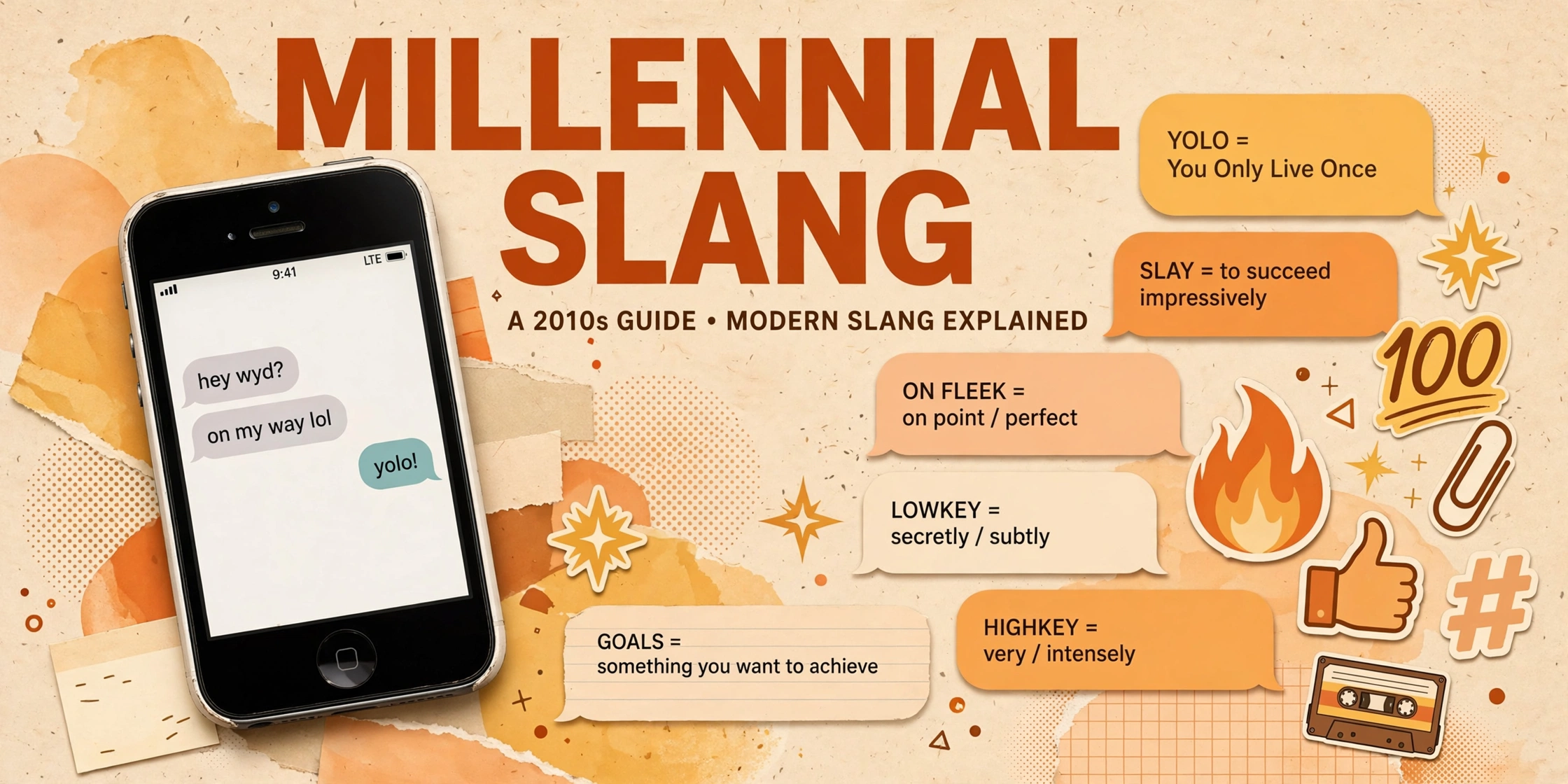
Quick definition: Millennial slang is the informal vocabulary — words like adulting, bae, on fleek, and FOMO — that Americans born roughly between 1981 and 1996 popularised online and in everyday speech, mostly between the late 2000s and the late 2010s. It grew up with Twitter, Tumblr, BuzzFeed listicles, and early Instagram, and it still turns up constantly in texts, memes, group chats, and workplace jokes, even now that a younger generation has taken over the timeline.
Millennial Slang Meaning & Definition
Millennial slang means the set of words, abbreviations, and catchphrases most closely associated with the millennial generation. The generation itself is usually defined as people born from 1981 to 1996, the cohort that grew up with dial-up internet, came of age around the turn of the millennium, and entered adulthood carrying a smartphone. Their slang is therefore a record of that specific passage: part internet shorthand, part hip-hop and Black American English, part television and advertising, and part pure group-chat invention.
Unlike formal vocabulary, millennial slang rarely arrives with a dictionary entry and a fixed spelling. A word spreads because it is useful, funny, or perfectly timed, and its meaning is settled by thousands of people using it the same way. Adulting, for example, was not coined in a meeting. It caught on because it named a feeling — doing ordinary grown-up chores while feeling faintly surprised that nobody more qualified had shown up to do them — better than any existing word did. That is the test most millennial slang passes: it names a shared experience in one or two syllables.
It helps to think of millennial slang as having three layers. The first is internet shorthand carried over from texting and early social media: FOMO, YOLO, AF, TL;DR. The second is spoken slang that the internet amplified: bae, slay, shade, salty, woke. The third is the joke vocabulary of millennial life itself: adulting, side hustle, squad goals, self-care Sunday. A single conversation from 2015 could easily contain all three, which is why outsiders often heard millennial speech as a different language altogether.
- Who uses it: originally millennials themselves, now anyone who lived through the 2010s internet, plus younger people quoting it ironically or affectionately.
- Where you hear it: texts and group chats, Instagram captions, TikTok nostalgia videos, memes, sitcoms, marketing copy, and office banter.
- How formal is it: casual by design. A few terms crossed into mainstream speech, but most still sound deliberately informal, which is the point.
- Is it still current: partly. The core words are understood everywhere; the trendiest ones now read as period pieces, which is exactly why people still enjoy using them.
Introduction
If you have ever read a text that said “I can’t even” and understood, instantly, that the sender was overwhelmed rather than literally speechless, you already speak some millennial slang. You did not need a lesson in it. You picked it up the way everyone did: from a friend’s status update, a meme, a caption, a group chat at midnight. That quiet absorption is the whole story of this vocabulary. It was never taught, and it was barely ever explained. It spread because it was funny, because it was short, and because it described modern life with unusual accuracy.
Millennials were the first generation to do most of their socialising in writing, in public, in real time. Earlier generations had slang too — the Gen X slang of the 1980s and 1990s was just as inventive — but theirs travelled by voice, by music, and by television, slowly. Millennial slang travelled at the speed of a retweet. A joke made on Tumblr on Monday could be a BuzzFeed headline by Wednesday and a line in a sitcom by the end of the month. That speed is why so many millennial terms feel both everywhere and oddly dated: they burned bright, they burned fast, and then the internet moved on to the next thing.
This guide does what the one-line glossaries do not. It gives you the meaning of each major term, where it actually came from, how people used it at its peak, how it sounds today, and what to say instead when the setting calls for plain language. Whether you are a millennial revisiting your own greatest hits, a parent decoding your adult child’s texts, a manager wondering what your team means by “low-key,” or a Gen Z reader trying to work out why your older cousin still says “on fleek,” you will find the answer here, with examples you can picture in a real conversation.

Origin
The word millennial itself comes from the generation’s coming of age around the year 2000, and the Pew Research Center defines millennials as people born between 1981 and 1996. That span matters for the slang, because it means the oldest millennials were teenagers when texting and instant messaging took off, and the youngest were teenagers when the iPhone and Facebook arrived. The whole generation learned to be social in a medium that rewarded brevity, screenshots, and in-jokes. Their slang was built for that medium from the start.
The earliest layer came from the platforms millennials grew up on. Adulting was being used jokingly on Twitter as early as 2008, when the first millennials were hitting their mid-twenties and discovering that rent, laundry, and tax forms did not come with instructions. Bae, a shortening of babe that was also read as an acronym for “before anyone else,” travelled through hip-hop lyrics and then through social media captions until it was unavoidable by 2013. On fleek — meaning perfectly done, usually eyebrows — is credited to a 2014 Vine video, and it spread so fast that it was being used in advertising within a year. None of these words was invented by a brand. All of them were picked up by brands once they were already everywhere.
The second great engine was the listicle. Sites like BuzzFeed, Thought Catalog, and Elite Daily turned millennial vocabulary into shareable content: “27 Words You’ll Only Understand If You’re a Millennial,” “77 Millennial Slang Words That Will Have You Shook.” For a few years in the mid-2010s, explaining slang to other millennials was itself a form of entertainment, and each list pushed a few more terms into the mainstream. Television and film helped too — Bye, Felicia, a dismissive goodbye from the 1995 film Friday, was revived and memed into a standard millennial send-off two decades after the film came out — but the internet did the heavy lifting.
Underneath the jokes, much of this vocabulary has deeper roots, and honest guides say so. A large share of millennial slang comes from African American Vernacular English and hip-hop culture — slay, shade, woke, lit, fam — and travelled into mainstream use through music, social media, and television, often without credit. Other terms came from LGBTQ+ ballroom and drag culture, from gaming, and from the specific shared experiences of growing up in the 90s slang era: Saturday morning cartoons, Blockbuster nights, and the first wave of reality TV. Knowing that history does not make the words harder to use. It makes them easier to use well, with a sense of where they came from and who they belong to.
Popularity
Millennial slang peaked, roughly, between 2013 and 2017. That was the era of the BuzzFeed listicle, the peak-Tumblr dashboard, and the Instagram caption written like a punchline. It was also the era when millennials, then in their twenties and early thirties, were the internet’s dominant cultural force: the people making the memes, writing the tweets, staffing the media companies, and buying the products advertisers wanted to sell. If you were online at all in 2015, you could not avoid bae, on fleek, lit, and I can’t even. They were in headlines, in song lyrics, in everyday speech, and eventually in the dictionary.
What kept the vocabulary alive after its peak was usefulness. Most slang dies because a better word replaces it. Millennial slang survived because many of its words described things that had no good name before them. Ghosting gave a name to vanishing from a conversation without explanation, just as dating apps made that behaviour common. FOMO named the anxiety of watching everyone else’s good time unfold on your feed. Gaslighting, an older term revived in millennial usage, named a pattern of manipulation that people had experienced for years without a shared word for it. Words like these did not fade when the trend cycle moved on, because the experiences they named did not fade either.
Today, millennial slang lives a second life as nostalgia. TikTok is full of affectionate parodies — the “millennial pause,” the side part, the skinny jeans, the “doggo” voice, the overuse of the laughing-crying emoji — and millennials themselves lean into the joke, using their own old slang deliberately, like a band playing its early hits on tour. That is the healthiest way to read the current moment: the vocabulary is no longer the cutting edge of internet speech, and that is fine. It is a shared reference library for an entire generation, and it still works perfectly well in the group chats where it was born.
- Peak years: about 2013–2017, driven by Tumblr, Twitter, Vine, and BuzzFeed.
- Why it spread: short, funny, screenshot-friendly, and unusually precise about modern feelings.
- Why it stuck: many terms named new experiences — ghosting, FOMO, adulting — that had no plain-language name.
- Where it stands now: widely understood, fondly parodied, and still in daily use in casual speech.
How It Is Used
In practice, millennial slang is used in three main ways. First, as emphasis: a word like AF or low-key adjusts the volume of a sentence, telling the reader how strongly you mean it. Second, as social shorthand: squad, fam, and bae mark closeness without a paragraph of explanation. Third, as a joke that everyone is in on: saying “I can’t even” in a group chat is funny precisely because everyone knows the reference, and nobody is expected to take it literally. Most real uses mix all three at once, which is why the same sentence can sound sincere, ironic, and funny depending on who reads it.
Tone is everything. “That party was lit” is praise. “She’s being extra today” is a complaint, usually an affectionate one. “He threw shade at the meeting” is a report, and possibly a warning. The words themselves are short, but the social information they carry is dense, and native users read that information instantly. Newcomers get tripped up not by the definitions, which are simple, but by the register: using a term a beat too earnestly, or in a setting where it lands as a performance rather than a natural choice.
The table below covers the core vocabulary — the thirty terms a reader is most likely to meet, with a plain meaning and the context each one belongs to. Learn these and the rest of millennial slang mostly falls into place.
| Term | Plain meaning | Typical context |
|---|---|---|
| Adulting | Doing ordinary grown-up responsibilities | Paying bills, cooking, doing laundry |
| Bae | Romantic partner or someone you adore | Captions, texts to a partner |
| Basic | Predictably mainstream; unoriginal | Teasing about tastes and trends |
| Bougie | Acting fancy or upper-class | Joking about expensive tastes |
| Bye, Felicia | Dismissive goodbye | Ending an unwanted conversation |
| Clap back | A sharp, witty comeback | Replies to criticism online |
| Extra | Over the top; dramatic for no reason | Describing behaviour or outfits |
| Fam | Close friends, treated like family | Group chats, captions |
| FOMO | Fear of missing out | Seeing friends’ plans online |
| Ghosting | Ending contact without explanation | Dating and messaging |
| Goals | Something to aspire to | “Relationship goals,” “hair goals” |
| Hangry | Angry because hungry | Mealtime jokes |
| Humble brag | Bragging disguised as a complaint | Social media posts |
| I can’t even | Overwhelmed; at a loss for words | Reactions to news or gossip |
| Lit | Excellent, exciting, fun | Parties, events, good news |
| Low-key / high-key | Quietly / openly | “Low-key obsessed,” “high-key stressed” |
| Mood | Something deeply relatable | Replying to a meme or post |
| On fleek | Perfectly done; on point | Makeup, outfits, presentation |
| Salty | Bitter or upset, usually mildly | Gaming, sports, teasing |
| Shade | A subtle insult | “Throwing shade” in conversation |
| Shook | Shocked or shaken | Reactions to surprising news |
| Slay | To do something brilliantly | Outfits, performances, comebacks |
| Squad | A close group of friends | Group photos, plans |
| Sus | Suspicious or shady | Questioning someone’s story |
| Tea | Gossip or the truth | “Spill the tea” |
| Thirsty | Desperate for attention or approval | Social media behaviour |
| Turnt | Wildly hyped, often at a party | Nights out, celebrations |
| Woke | Aware of social injustice | Originally earnest, now often ironic |
| YOLO | You only live once | Justifying an impulsive choice |
| Zero chill | No restraint or subtlety at all | Teasing an over-the-top friend |
Examples
Definitions only go so far. The examples below show how millennial slang actually sounds in the three settings where it appears most: friendly chats, work-adjacent messages, and jokes among people who share the references.
Friendly Examples
- “Adulting is hard today. I paid rent, did laundry, and meal-prepped, and I would still like a nap and a medal.”
- “My bae and I are binge-watching the whole series tonight. Do not text unless it is an emergency.”
- “Her eyebrows are on fleek in every single photo. I have questions and I need answers.”
- “Major FOMO right now. Everyone is at the concert and I am at home in sweatpants eating cereal.”
- “The squad is meeting at seven. Bring snacks, bring charger, bring zero chill and we will have a great night.”
Professional Examples
Millennial slang in professional settings is best used lightly, and usually only once the relationship is warm enough for it. A manager might write “low-key obsessed with this deck” in a team chat, or a colleague might say “that launch was lit” after a successful release, and both land fine because the setting is informal and the audience is in on the joke. The terms that travel best at work are the mild ones — low-key, goals, adulting, FOMO — because they add colour without sounding like a performance.
- “Low-key, this is the best feedback we have had all quarter. Well done, team.”
- “I have serious FOMO about the offsite. Please send photos and at least one terrible group selfie.”
- “Adulting win: I finally filed the expenses before the deadline instead of the night before.”
Terms to keep out of professional messages include thirsty, shade aimed at a named colleague, AF in any form, and anything that reads as a comment on someone’s appearance. The Professional or Polite Alternatives section below gives a swap for every common case.
Funny Examples (if applicable)
- “I can’t even. The group chat planned a whole holiday, booked nothing, and is now arguing about brunch.”
- “She said ‘bye, Felicia’ to the meeting that could have been an email, and honestly, mood.”
- “He is being so extra about his sourdough starter that it now has its own Instagram account. Zero chill, ten out of ten commitment.”
- “YOLO, I said, buying concert tickets on a Tuesday. My bank account said absolutely not.”
| Situation | What someone says | What they mean |
|---|---|---|
| A friend cancels by text, then vanishes | “She totally ghosted me.” | She stopped replying without explanation. |
| A photo gets a hundred likes | “Okay, slay. Those shoes are goals.” | The outfit is excellent and aspirational. |
| A colleague humble-brags online | “‘So tired from my TED talk.’ Sure, Jan. Humble brag much?” | That was a boast wearing a complaint’s clothes. |
| A party exceeds expectations | “Last night was lit, no cap — I mean, high-key lit.” | It was genuinely excellent. (The self-correction is the joke.) |
| Someone is upset about a game | “He is so salty about losing. Shook, honestly.” | He is bitter, and the loss genuinely surprised him. |
Comparison with Similar Terms
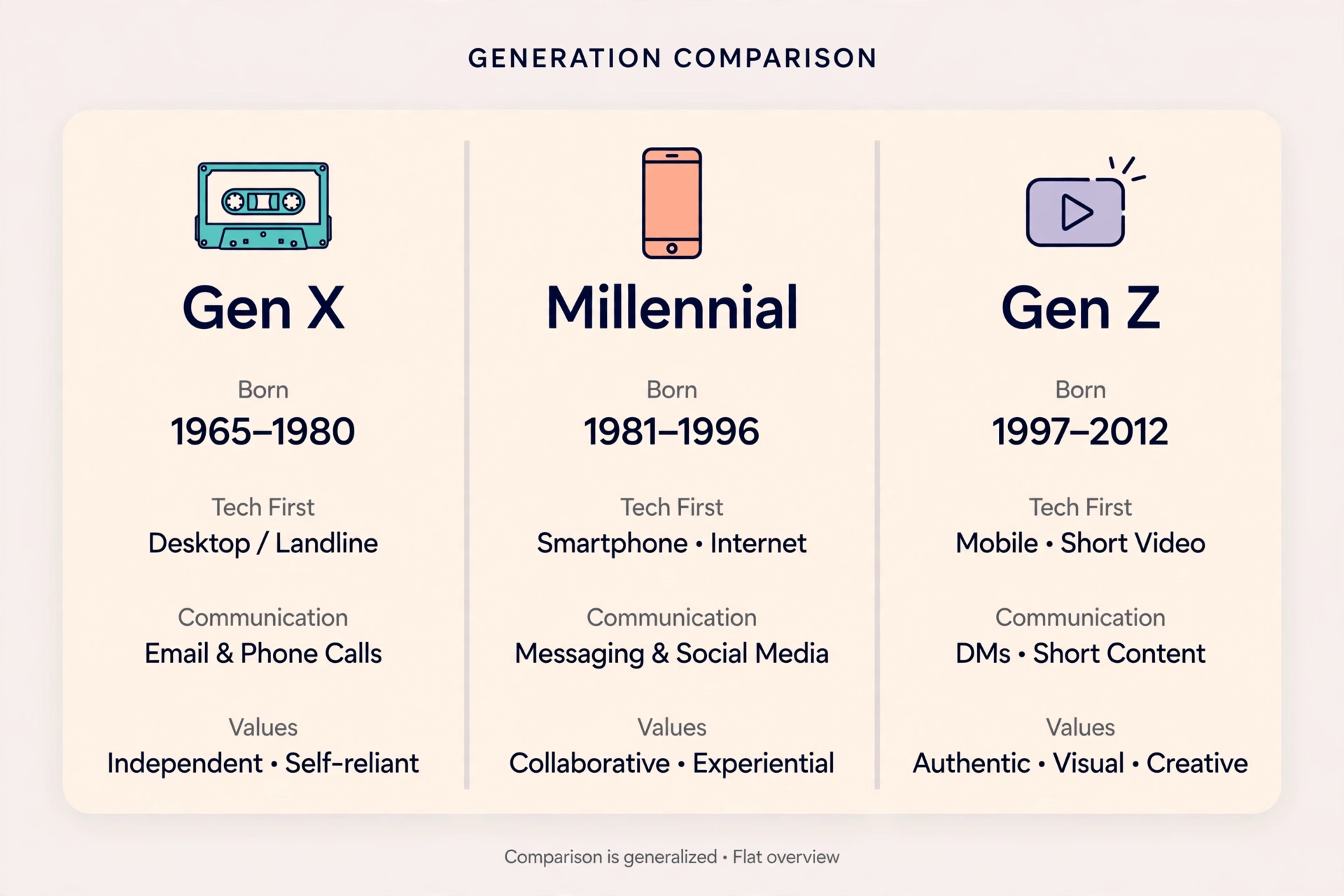
Millennial slang is often confused with the slang of the generations on either side of it, and the confusion is understandable: the three vocabularies overlap, borrow from each other, and share the same internet. The differences are mostly about era, platform, and attitude. Gen X slang grew up with MTV, mixtapes, and the mall; millennial slang grew up with the group chat and the feed; Gen Z slang grew up with the short-form video and the comment section. The Gen Z slang of 2024 — rizz, gyatt, sigma, Ohio — sounds deliberately stranger to outsiders, where millennial slang aimed to be instantly readable. That is not an accident. Each generation’s slang is, in part, a reaction to the last one’s.
| Generation | Signature terms | Home platform | Typical tone |
|---|---|---|---|
| Gen X (1965–1980) | Rad, chill, whatever, as if, buggin’ | MTV, radio, the mall | Detached, ironic, dry |
| Millennial (1981–1996) | Adulting, bae, on fleek, FOMO, lit, slay | Twitter, Tumblr, Instagram, BuzzFeed | Confessional, funny, earnest underneath the joke |
| Gen Z (1997–2012) | Rizz, gyatt, sigma, no cap, slaps, bet | TikTok, Discord, Twitch | Absurdist, layered, irony-first |
A few specific pairs are worth separating. Lit (millennial, excellent or fun) and slaps (Gen Z, excellent, usually music) overlap but are not interchangeable: a party is lit, a song slaps. Bae and rizz both concern attraction, but bae names the person and rizz names the charm used to attract them. On fleek and ate both praise a look, but on fleek is specific and visual — eyebrows, eyeliner, an outfit assembled with care — while ate is a general verdict. Using the wrong one will not cause a misunderstanding. It will simply date you, in one direction or the other, by about five years.
Within millennial slang itself, the closest pairs are salty versus shook, and extra versus zero chill. Salty is bitterness after the fact; shook is shock in the moment. A person can be both, but the words describe different reactions. Extra describes the behaviour; zero chill describes the person doing it. “That entrance was extra” is a comment on one moment. “She has zero chill” is a comment on a whole style. Keep those apart and you will sound like someone who lived through the era rather than someone who read a list about it.
Alternate Meanings
First, the label itself has an alternate life. “Millennial” is not only a birth cohort. In the 2010s it became a piece of shorthand — sometimes affectionate, sometimes a slur — for a whole set of supposed traits: entitled, phone-obsessed, avocado-toast-eating, allergic to phone calls. Articles with titles like “Millennials Are Killing…” ran for years, blaming the generation for everything from napkins to home ownership rates. None of that is what “millennial slang” means, but it is the noise the phrase travels through, and it explains why some millennials now wince slightly at the word even while they happily use the slang.
Second, several individual terms carry unrelated meanings elsewhere. Basic in slang means predictably mainstream; in chemistry it means alkaline, and in everyday speech it simply means simple or fundamental, and context decides which one you are hearing. Lit in slang means excellent; literally, it is the past tense of light, and a room can be lit without a party being lit. Tea is gossip in slang and a drink everywhere else, and “spill the tea” has nothing to do with a teapot. Stan, widely used by millennials, began as an Eminem song about an obsessive fan and now means an enthusiastic, devoted fan; it has no connection to anyone actually named Stan. Woke began as a serious term in Black American English for awareness of injustice and is now used earnestly, ironically, and politically, often by people who mean very different things by it. When a term has this many lives, the safest reading is always the one the surrounding sentence supports.
Third, “millennial slang” is sometimes used loosely to mean “any internet slang a young person uses,” which is how millennials ended up blamed for Gen Z terms they never used, and how Gen Z terms get filed under millennial lists by confused commentators. The distinction in this guide is the stricter one: millennial slang is the vocabulary this generation actually popularised, roughly 2008 to 2019. If a term’s peak was a TikTok trend in 2022, it belongs to a different guide, even if a millennial happens to enjoy it.
Professional or Polite Alternatives
Millennial slang is a casual register, and part of using it well is knowing when to switch it off. The table below gives a plain-language swap for each common term, so the meaning survives the move into a meeting, an email, or a conversation with someone who would rather not decode a meme.
| Millennial slang | Professional or polite alternative |
|---|---|
| Adulting | Handling responsibilities / taking care of errands |
| Bae | Partner / my partner |
| Bye, Felicia | “I’ll leave it there” / simply ending the conversation |
| Extra | Over the top / more than necessary |
| FOMO | Worried about missing out / keen not to miss it |
| Ghosting | Stopped replying / went quiet |
| I can’t even | I’m overwhelmed / I don’t know where to start |
| Lit | Excellent / a great success |
| Low-key | Quietly / somewhat |
| Salty | Upset / disappointed |
| Shade | A pointed remark / criticism |
| Slay | Did brilliantly / nailed it |
| Thirsty | Eager for attention / trying too hard |
| YOLO | “Life’s short” / “worth a try” |
The rule of thumb is simple. If the sentence would still be warm, clear, and funny with the slang removed, it is probably fine in a casual workplace chat. If the slang is doing all the work — if removing it leaves nothing — rewrite the sentence in plain words. Slang should season a message, not carry it.
Common Mistakes
- Using every term at once. A sentence packed with five slang words does not sound fluent; it sounds like a listicle being read aloud. One term per sentence is usually plenty, and two is a lot.
- Using dated terms earnestly with a younger audience. Saying “on fleek” and “bae” with a straight face to a group of Gen Z teenagers will get a smile, but not the one you wanted. With younger listeners, use the terms as a deliberate throwback and own the joke.
- Confusing bae with a name. Bae is a term of affection, not a name. Calling someone “Bae” who is not your partner, or using it for a stranger, reads as presumptuous rather than friendly.
- Calling everything “lit.” Lit describes high energy and excitement. A quiet dinner, a good book, and a successful meeting are not lit, and calling them lit flattens the word until it means nothing.
- Using thirsty or shade about real people at work. Both terms are judgemental, and both travel. A joke about a colleague being “thirsty” in a group chat is the kind of sentence that gets screenshotted. Keep both for fiction, celebrities, and yourself.
- Treating the slang as the whole generation. Not every millennial used these words, and many actively disliked some of them. “Millennial slang” describes a shared vocabulary, not a personality test, and assuming someone’s tastes from their birth year is the fastest way to sound like the stereotype articles this guide is trying to retire.
Quick Tips
- Start with the mild ones. Low-key, goals, FOMO, and adulting are understood by almost everyone and offend almost no one. They are the safest entry points.
- Match the room. Group chat with old friends: anything goes. Work chat: one mild term, maximum. Family chat: add a plain-language clue the first time, such as “FOMO — fear of missing out.”
- Read the term before you repeat it. A few millennial terms come from communities and histories that deserve respect. If you do not know where a word came from, a thirty-second search is worth more than a confident guess.
- Let the joke be the joke. Millennial slang is funniest when it is used knowingly — including knowingly out of date. The “millennial pause” generation is in on it now, and that is part of the charm.
- Do not correct other people’s slang. Language moves fast, and the person using a term differently from you may simply be younger, older, or from a different corner of the internet. Ask what they meant; it is usually a better conversation.
- Keep the best, retire the rest. Ghosting, FOMO, and adulting earned permanent places in the language because they name real things. On fleek and turnt are period pieces now, and they are more fun that way. Use each accordingly.
- When in doubt, say it plainly. “I’m overwhelmed” will never be misunderstood. “I can’t even” might be. Clarity is not the enemy of style; it is what lets style land.

FAQ
These eight questions cover the searches people run most often about millennial slang, from the basic definition to the questions about whether the vocabulary is still in use.
What is millennial slang?
Millennial slang is the informal vocabulary popularised by Americans born between 1981 and 1996, mostly online between the late 2000s and the late 2010s. Its best-known words include adulting, bae, on fleek, FOMO, YOLO, lit, slay, and ghosting. It mixes internet shorthand, spoken slang, and joke terms for modern life, and it is still widely understood today.
Who is a millennial?
The Pew Research Center defines millennials as people born from 1981 to 1996. That makes the oldest millennials about 45 in 2026 and the youngest about 30. The generation is also called Generation Y. Its slang is the vocabulary that cohort spread through Twitter, Tumblr, BuzzFeed, and early Instagram, though plenty of the words were borrowed from older sources, especially Black American English and hip-hop culture.
What are the most popular millennial slang words?
The most durable terms are adulting (doing grown-up chores), bae (a romantic partner), on fleek (perfectly done), FOMO (fear of missing out), YOLO (you only live once), lit (excellent or exciting), slay (to do something brilliantly), ghosting (vanishing from contact without explanation), salty (bitter or upset), and shade (a subtle insult). The glossary table above lists thirty, with meanings and contexts.
Is millennial slang still used in 2026?
Yes, but differently. The core words — adulting, FOMO, ghosting, low-key — are still in everyday use and are understood across generations. The trendiest peak-era terms, like on fleek and turnt, are now mostly used as deliberate throwbacks or jokes. Gen Z slang has taken over the cutting edge, but millennial slang remains the shared reference language of everyone who was online in the 2010s.
What does “adulting” mean?
Adulting means doing ordinary adult responsibilities — paying bills, doing laundry, cooking, booking appointments, filing taxes — with a tone of faint surprise that you are the one doing them. It was used jokingly on Twitter as early as 2008. The humour comes from the gap between the task, which is mundane, and the feeling, which is that adulthood arrived without instructions. “Adulting is hard today” is the classic use.
What is the difference between millennial slang and Gen Z slang?
Millennial slang grew up on Twitter, Tumblr, and Instagram and aims to be instantly readable: bae, lit, FOMO. Gen Z slang grew up on TikTok and Discord and leans absurdist and layered: rizz, gyatt, sigma. The generations overlap and borrow constantly — slay and bet appear in both — but the peak eras, platforms, and tones are different, as the comparison table above shows.
Is “bae” short for “before anyone else”?
Partly. Bae is a shortening of babe or baby, and it was also read as an acronym for “before anyone else,” which helped it spread as a caption and a term of affection. Both explanations circulated at the same time, and both are used. In practice, bae simply means a romantic partner or someone you adore, and the acronym reading is best treated as a popular backstory rather than a strict origin.
Why do people make fun of millennial slang now?
Mostly affectionately, and mostly because it is now a period vocabulary. TikTok parodies of the “millennial pause,” the side part, and the laughing-crying emoji treat the era as a shared memory rather than a target. Some of the teasing is generational one-upmanship — every generation mocks the one before it — and some of it is millennials mocking themselves. The vocabulary earned the attention: it was everywhere for years, and anything that visible eventually becomes a joke. The words that named real experiences, like ghosting and FOMO, survived the teasing intact.
Conclusion
Millennial slang is more than a list of funny words from the 2010s. It is a record of the first generation to grow up in public, in writing, on the internet — to fall in love by text, to argue in comment sections, to turn paying rent into a joke and a hashtag, and to give names to feelings that had never quite had names before. The best of it stuck because it was useful: ghosting, FOMO, and adulting describe experiences that are still happening, in the same group chats, to the same people, now with mortgages and children of their own.
The rest of it is a time capsule, and time capsules are worth keeping. Saying “on fleek” in 2026 is not a mistake if you know what era you are quoting, and neither is admitting that you still say “I can’t even” when the group chat gets out of hand. The vocabulary works best when it is used knowingly, with a sense of where it came from — the Vine videos and Tumblr dashboards, the 2000s slang childhoods, the early feeds where a joke could travel the world before lunch — and with respect for the communities whose words travelled furthest.
If this guide cleared up a message, a meme, or a memory, you now have what you came for: the meanings, the origins, the examples, and the judgement to use each term in the right room. Keep the core words, enjoy the throwbacks, swap in plain language when the setting calls for it, and remember the rule that carried the whole vocabulary in the first place — say the thing that names the feeling, in as few words as possible, and let everyone else recognise themselves in it. That is what millennial slang was always for, and it is why, a decade after its peak, people are still quoting it.
