Quick definition: Dominican slang is the informal, everyday vocabulary of Dominican Spanish — the fast, warm, and inventive way people in the Dominican Republic and the Dominican diaspora actually talk to friends. If you have ever seen KLK in a comment, heard someone say vaina for “thing,” or been told a party was jevi, you have already met dominican slang. It is not a separate language. It is Spanish with Dominican rhythm, Dominican humour, and a set of words that only make full sense once you know the context, the tone, and the relationship between the people talking.
Dominican Slang Meaning & Definition
At its simplest, Dominican slang means the colloquial words, phrases, and shortened forms that Dominicans use in casual conversation, in text messages, on social media, and in music. Standard Spanish will get you understood almost everywhere in the Dominican Republic, but slang is what makes a conversation sound local. A textbook might teach you ¿Qué pasa? for “What is happening?” A Dominican friend is far more likely to greet you with ¿Qué lo qué? — usually written as KLK — and to answer with todo bien, tranquilo, or simply another KLK.
Dominican slang grows out of Dominican Spanish, the Caribbean variety of Spanish spoken in the Dominican Republic and by the large Dominican diaspora in the United States, chiefly in New York City, New Jersey, and other parts of the Northeast. That variety is known for rapid speech, softened or dropped consonants at the ends of words, and a musical rhythm shaped by Andalusian and Canarian Spanish from southern Spain, with influences from African languages, Taíno and other Indigenous languages, and English. Slang is where all of those influences show up most clearly: jevi comes from the English word “heavy,” guachimán comes from “watchman,” and colmado, guagua, and coro describe parts of daily life that a visitor meets within hours of arriving. Like Australian slang, Dominican slang is deeply regional — wonderfully expressive at home, and easy to misunderstand if you translate it word for word.
One more thing matters before you start learning individual words. Dominican slang is social. The same word can be affectionate between friends and rude from a stranger, funny in a group chat and awkward in a formal setting. Tone, age, place, and closeness decide the meaning as much as the dictionary definition does. That is why this guide gives you not just translations, but the situation each word belongs to.
Introduction
Imagine landing in Santo Domingo, opening your phone, and reading a message from a new Dominican friend: “KLK manín, vamos a hacer un coro, la vaina va a estar jevi.” Word for word, that sentence is almost impossible to translate. In context, it is one of the warmest invitations you will ever get: “What is up, bro, let us get together with friends, it is going to be great.” The gap between the literal words and the real meaning is exactly why so many people search for Dominican slang — and why a short list of translations is never quite enough.
Most people meet Dominican slang in one of three ways. Some hear it from Dominican friends, classmates, or co-workers in the United States. Some hear it in music — merengue, bachata, and especially dembow travel far beyond the island, carrying phrases with them. And some meet it online, in TikTok comments, captions, memes, and group chats, where short forms like KLK spread fast because they are quick to type and instantly recognisable. In every case, the questions are the same: what did that word actually mean, was it friendly or insulting, and can I use it myself?
This guide answers those questions properly. You will learn the 25 most useful Dominican slang words and phrases, what each one really means, how Dominicans use it in real sentences, how it compares with slang from other Spanish-speaking countries, the mistakes learners make most often, and the polite alternatives to use when slang would be the wrong choice. By the end, you will not just know what KLK means. You will know when to say it, when not to, and what to say instead.

Origin
Dominican slang did not appear out of nowhere, and it did not arrive all at once. It grew, layer by layer, out of the history of the island itself. The Spanish spoken in the Dominican Republic traces back to the Andalusian and Canarian dialects of southern Spain, brought by early settlers. That is one reason Dominican Spanish sounds so different from the Spanish of Madrid: final consonants soften, syllables run together, and speech moves at a pace that can surprise even fluent Spanish learners. Slang grew inside that sound. Words were shortened for speed — está becomes ta’, para becomes pa’ — and new expressions were coined for the things people talked about every day.
African languages left a deep mark on Dominican speech as well, through the culture, music, food, and everyday language of Afro-Dominican communities. Taíno words survived too, especially in names for places, plants, and foods, and in the word Quisqueya, the Taíno name for the island that Dominicans still use with pride. Later, close ties with the United States added a layer of English borrowings, adapted to Dominican pronunciation and spelling. Jevi (from “heavy,” meaning cool or great), guachimán (from “watchman”), and poloché (from “polo shirt”) are everyday reminders of that exchange. None of these words is used the way English uses the original. Each one was borrowed, reshaped, and given a Dominican life of its own.
Geography shaped slang as well. The Cibao region in the north, the capital Santo Domingo, and the eastern and southern regions each have their own favourite expressions, pronunciations, and jokes. A word that is common in one town may be rare in another, and older and younger speakers often use different vocabularies. Migration then carried all of it abroad. As Dominicans settled in New York, New Jersey, Boston, Philadelphia, and Miami, Dominican slang travelled with them, mixed with English and with the slang of neighbouring communities, and came back to the island changed again — in songs, in videos, in phone calls home, and in the speech of Dominican Americans visiting family. Dominican slang today is therefore both deeply local and widely travelled, and that double life is part of its charm.
Popularity
Dominican slang has never been more visible than it is now. A generation ago, you mostly had to be in the Dominican Republic, or know Dominicans personally, to hear it every day. Today, a teenager in Ohio, London, or Madrid can hear KLK in a TikTok comment, see vaina in a meme caption, and learn jevi from a song lyric without ever having set foot on the island. Music is the biggest carrier. Merengue and bachata made Dominican sounds familiar worldwide decades ago; dembow, the fast, percussive Dominican urban genre, has pushed Dominican street vocabulary into playlists, dance challenges, and comment sections at a speed no textbook could match.
Social media rewards exactly the qualities Dominican slang already has: brevity, energy, and personality. KLK is four letters. Ta’ jevi is two short words for “that is awesome.” Dime a ver opens a conversation the way a wave opens a meeting between friends. Short forms travel well in captions and chats, and because Dominican creators, comedians, and musicians use them naturally rather than explaining them, viewers go looking for the meaning themselves. That curiosity is why searches for Dominican slang keep growing in the United States, where the Dominican diaspora is large, visible, and culturally influential — in music, in baseball, in food, and in everyday city life.
Popularity also brings a warning. Seeing a word online does not mean every Dominican uses it, and it does not mean it is safe to use everywhere. Some expressions in this guide are universal in the Dominican Republic. Others are generational, regional, or tied to a specific group of friends. A few are strong language that friends may use with each other but that a learner should not repeat to strangers. Popularity tells you a word is alive. Context tells you whether it belongs in your mouth. Keep both ideas in mind as you read on.
How It Is Used
Dominican slang is used the way slang is used everywhere: to show closeness, to save time, to add humour, and to mark a moment as informal. Friends greet each other with KLK instead of a formal hello. They call each other pana, manín, or loco instead of using names in every sentence. They describe a good night out as jevi or bacano, a small amount of something as un chin, and a plan with friends as a coro. None of this is random. Each choice signals: we are relaxed, we know each other, and nobody here needs formal language.
Three habits of Dominican speech help learners more than any single vocabulary list. First, Dominicans shorten constantly. You will hear ta’ bien for está bien, pa’ lante for para adelante, and dime a ve for dime a ver. If you try to pronounce every letter, you will sound careful rather than local — which is fine while you are learning, but it helps to recognise the shortened forms when you hear them. Second, Dominicans reuse a small set of flexible words for many jobs. Vaina can be a thing, a situation, a problem, or a filler word while the speaker thinks of the right noun. Dique can mean “supposedly” and quietly signal doubt about what is being repeated. Learning those flexible words pays off faster than memorising rare ones. Third, exclamations carry a lot of feeling. ¡Wepa! celebrates, ¡Dios mío! reacts with surprise, and a drawn-out ay can mean anything from sympathy to disbelief depending on the face that goes with it.
| Situation | What a Dominican friend might say | Natural English equivalent |
|---|---|---|
| Greeting a friend | ¿Qué lo qué, manín? | What is up, bro? |
| Asking how someone is | Dime a ver, ¿tú ta’ bien? | Tell me, are you good? |
| Agreeing something is great | Eso ta’ jevi. | That is awesome. |
| Asking for a little of something | Dame un chin de jugo. | Give me a little juice. |
| Making plans | Vamos a hacer un coro el sábado. | Let us get together with friends on Saturday. |
| Something went wrong | Se dañó la vaina. | The thing broke / the situation fell apart. |
Notice what is missing from that table: formal situations. Dominican slang belongs to friends, family, group chats, music, comedy, and everyday street life. It does not belong in a job interview, a formal email, a classroom presentation, or a first conversation with an older stranger. Switching between slang and standard Spanish is a normal, respected skill in the Dominican Republic, not a sign of poor education. The polite alternatives later in this guide show you exactly how to make that switch.
Examples
The fastest way to learn Dominican slang is to see it working in real sentences. The table below covers the words you are most likely to meet first, with a plain meaning and an example you could actually hear. Read the Spanish example first, say it out loud if you can, and then check the English translation. Notice how often the same word changes its shade of meaning when the sentence around it changes.
| Dominican slang word | Meaning | Example sentence | English translation |
|---|---|---|---|
| KLK / ¿Qué lo qué? | What is up? / Hello | KLK, ¿cómo tú ta’? | What is up, how are you? |
| Vaina | Thing, stuff, situation, problem | Pásame esa vaina. | Pass me that thing. |
| Jevi | Cool, great, awesome | La fiesta estuvo jevi. | The party was awesome. |
| Bacano / Vacano | Cool, awesome, a great person | Ese carro ta’ bacano. | That car is awesome. |
| Pana | Friend, buddy, pal | Ese es mi pana. | That is my friend. |
| Manín | Bro, close male friend | ¿Qué lo qué, manín? | What is up, bro? |
| Tiguere / Tigre | Street-smart, savvy person | Ese tipo es un tiguere. | That guy is street-smart. |
| Chin / Un chin | A little bit | Dame un chin de arroz. | Give me a little rice. |
| Guagua | Bus | ¿Vas en guagua? | Are you taking the bus? |
| Concho | Shared taxi | Voy a coger un concho. | I am going to take a shared taxi. |
| Coro | Group hangout, gathering | Vamos a hacer un coro. | Let us get together. |
| Dime a ver | Tell me / What is up? | Dime a ver, ¿qué pasó? | Tell me, what happened? |
| Tato | Okay, all good | ¿Todo bien? Tato. | Everything good? All good. |
| Jarto / Jarta | Full, or fed up (depends on context) | Estoy jarto de esa vaina. | I am fed up with that situation. |
| Dique | Supposedly, so they say | Dique va a llover mañana. | Supposedly it will rain tomorrow. |
| Pariguayo | Naive person, someone who misses the fun | No seas pariguayo, ven con nosotros. | Do not be a killjoy, come with us. |
| Colmado | Corner store, neighbourhood shop | Ve al colmado y compra hielo. | Go to the corner store and buy ice. |
| Chercha | Joking around, banter | Estamos en chercha. | We are just joking around. |
| Chévere | Cool, good, nice | Qué chévere verte aquí. | How nice to see you here. |
| Wepa | Excited shout: hey! / yay! | ¡Wepa! Llegó la comida. | Yay! The food arrived. |
Friendly Examples
Friendly Dominican slang sounds warm because it assumes closeness. In a group chat between friends, you might see an exchange like this:
A: KLK, manín, ¿qué tú hace?
B: Aquí tranquilo, ¿y tú?
A: Vamos a hacer un coro en el colmado.
B: Tato, llego en un chin.
In English, that is roughly: “What is up, bro, what are you doing?” — “Just chilling, and you?” — “Let us get together at the corner store.” — “Okay, I will be there in a bit.” Nothing in the exchange is formal, and nothing needs to be. The slang does the work of saying: we are friends, this is relaxed, and everyone is welcome. Another friendly pattern uses loco as a form of address between close friends — “Loco, ven acá” means something like “Bro, come here” — but only use it with people who already use it with you. From a stranger, the same word can land very differently, which is a theme you will meet again in the mistakes section.
Professional Examples
There is no professional version of KLK. That sentence is worth remembering, because it captures the register rule for almost all Dominican slang. In a workplace, a school, a government office, or a formal message, Dominicans switch to standard Spanish: Buenos días, ¿cómo está usted? rather than KLK; ¿Me puede pasar ese documento? rather than pásame esa vaina; Me parece una excelente idea rather than ta’ jevi. A learner who uses slang in a formal setting does not sound friendly — they sound as if they have not noticed the setting, which is a worse impression than sounding careful.
That does not mean Dominican workplaces are cold. Colleagues who know each other well may slip a light chévere or ta’ bien into conversation once trust is established. The safe rule for a learner is simple: start formal, listen to how Dominican colleagues speak to each other, and only borrow their informal words after they have used them with you. If you are a visitor, a tourist, or a new co-worker, standard Spanish plus a smile will always serve you better than slang you have not yet earned the right to use.
Funny Examples
Dominican humour loves exaggeration, and slang is its favourite tool. A friend who arrives five minutes late might be greeted with dique tú venías temprano — “supposedly you were coming early” — with a grin that removes any sting. Someone who refuses every plan might be teased as a pariguayo until they give in and join the coro. A tiny portion of food can be requested with maximum drama: dame un chin, un chin nada más — “give me a little, just a little” — while everyone laughs because the plate is already full.
The comedy often depends on timing and on shared knowledge, which is why jokes in Dominican slang can be hard to translate. Vaina is funny precisely because it says everything and nothing at the same time. Se armó una vaina can mean a situation developed, a party started, or a problem exploded, and the audience knows which one from the speaker’s face. If you repeat a funny line without the timing, it falls flat. Listen first, laugh along, and try the line later with the same friends who made you laugh. Humour, like slang itself, is a team sport.

Comparison with Similar Terms
Dominican slang does not exist in isolation. Every Spanish-speaking country has its own word for “what is up,” for “friend,” for “cool,” and for “a little.” Comparing them is the quickest way to stop mixing them up — and the quickest way to appreciate what makes Dominican slang distinctive. The table below compares the Dominican expression with the closest equivalent in a few other varieties. The equivalents are not exact translations. Each one carries its own history and its own social rules, just as the Dominican word does.
| Idea | Dominican slang | Puerto Rican | Mexican | Cuban | General / neutral Spanish |
|---|---|---|---|---|---|
| What is up? | ¿Qué lo qué? / KLK | ¿Qué hay? | ¿Qué onda? | ¿Qué bolá? | ¿Qué pasa? |
| Friend / bro | Pana, manín | Pana, brother | Cuate, compa | Asere, socio | Amigo |
| Cool / awesome | Jevi, bacano | Chévere, brutal | Padre, chido | Chévere, bacán | Genial, estupendo |
| Thing / stuff | Vaina | Cosa, vaina (also used) | Cosa, chingadera (vulgar) | Cosa | Cosa |
| Bus | Guagua | Guagua | Camión, autobús | Guagua | Autobús |
| A little bit | Un chin | Un poquito | Un poquito | Un poquito | Un poco |
| Hangout | Coro | Corillo, jangueo | Reunión, pachanga | Descarga | Reunión |
Two comparisons deserve extra care. First, guagua means “bus” in the Dominican Republic, Puerto Rico, and Cuba, but in several other countries the same word means “baby.” Using it in Mexico or Colombia to mean a bus will confuse people, and using it to mean a baby in Santo Domingo will confuse people in the opposite direction. Always check the country before you trust a familiar word. Second, vaina is shared with neighbouring Caribbean varieties, but its Dominican range is unusually wide. In the Dominican Republic it can replace almost any noun, describe a situation, or fill a pause. In other countries it may sound more limited, more formal, or simply unfamiliar. When in doubt, the neutral word cosa is understood everywhere, even if it sounds less Dominican.
It is also worth comparing Dominican slang with the slang of English-speaking internet culture, because many US readers arrive at Dominican slang through TikTok and group chats. KLK works like “wsp” or “wyd” in English texting: a fast greeting that doubles as a check-in. Jevi works like “fire” or “lit” for something impressive. Pariguayo works a little like “lame” or “party pooper,” though it is harsher and more teasing. These parallels help you feel the register, but they are not translations. A word-for-word swap will sound odd in both languages. Learn the Dominican word in its own sentences, not as a label stuck onto an English word.

Alternate Meanings
Several Dominican slang words have alternate meanings that depend entirely on context, and these are the words that cause the most confusion for learners. Knowing both meanings — and knowing which one a sentence intends — is what separates a confident listener from a confused one.
Guapo is the classic example. In most Spanish-speaking countries, guapo means handsome or pretty. In the Dominican Republic it can also mean angry or upset. Está guapo might mean “he looks good” or “he is in a bad mood,” and only the situation tells you which. If someone says it with a smile and a glance at a new outfit, it is a compliment. If someone says it after an argument, it is a warning. When you are unsure, ask — Dominicans would much rather explain than watch you congratulate someone on being furious.
Jarto splits in a similar way. After a big meal of mangú, estoy jarto means “I am full.” After a long day of problems, estoy jarto de esa vaina means “I am fed up with that situation.” The grammar gives you a clue: jarto alone, after eating, usually means full; jarto de something usually means fed up with it. Loco splits by relationship rather than grammar: between close friends it is an affectionate “bro,” while from a stranger or in an argument it can mean crazy or unbelievable. Tiguere splits by tone: said with admiration, it praises someone sharp and resourceful; said with a frown, it warns that someone is crafty, untrustworthy, or looking for trouble.
Other words shift by spelling and sound. Bacano and vacano are the same word spelled two ways, both meaning cool or awesome. Tigre is a shorter, very common variant of tiguere. Ahorita in the Dominican Republic, as in much of the Caribbean, can mean “soon,” “in a little while,” or, confusingly, “right now,” depending on the speaker — never assume it means a precise time. And chin is always small, but how small is a matter of negotiation: un chin of rum in a friendly offer may be considerably more generous than un chin of chilli in a warning. Context, again, is the dictionary.
Professional or Polite Alternatives
Learning slang is only half the skill. The other half is knowing what to say when slang would be wrong. The table below gives you a safe, polite replacement for the most common Dominican slang words. Use the middle column in shops, offices, hotels, and first meetings. Save the slang column for friends, and you will never embarrass yourself or anyone else.
| Dominican slang | Polite / neutral Spanish | English equivalent | Use the polite version when… |
|---|---|---|---|
| KLK / ¿Qué lo qué? | Buenas, ¿cómo está? | Hello, how are you? | Greeting a stranger, an older person, or a client |
| Vaina | Cosa, situación, asunto | Thing, situation, matter | Any formal or written context |
| Jevi / Bacano | Excelente, muy bueno | Excellent, very good | Praising work, food, or service formally |
| Pana / Manín | Amigo, compañero | Friend, colleague | Introducing or addressing someone respectfully |
| Dime a ver | Dígame, ¿en qué le ayudo? | Tell me, how can I help? | Customer service, phone calls, offices |
| Un chin | Un poco, por favor | A little, please | Ordering, asking for help, making requests |
| Guagua | Autobús | Bus | Asking directions outside the Caribbean |
| Tato | De acuerdo, está bien | Agreed, that is fine | Confirming plans in writing or at work |
A useful habit is to learn each pair together: slang plus polite alternative, as one unit. That way you never have to translate in your head under pressure. You simply choose the register the room expects. Dominicans themselves do this constantly, often within a single conversation — formal with a shopkeeper, full of slang with the friend beside them, formal again on the phone. Nobody thinks less of you for choosing the polite form. If anything, visitors who switch registers thoughtfully earn more respect than visitors who spray slang everywhere in the hope of sounding local. Local is a relationship, not a vocabulary test.
Common Mistakes
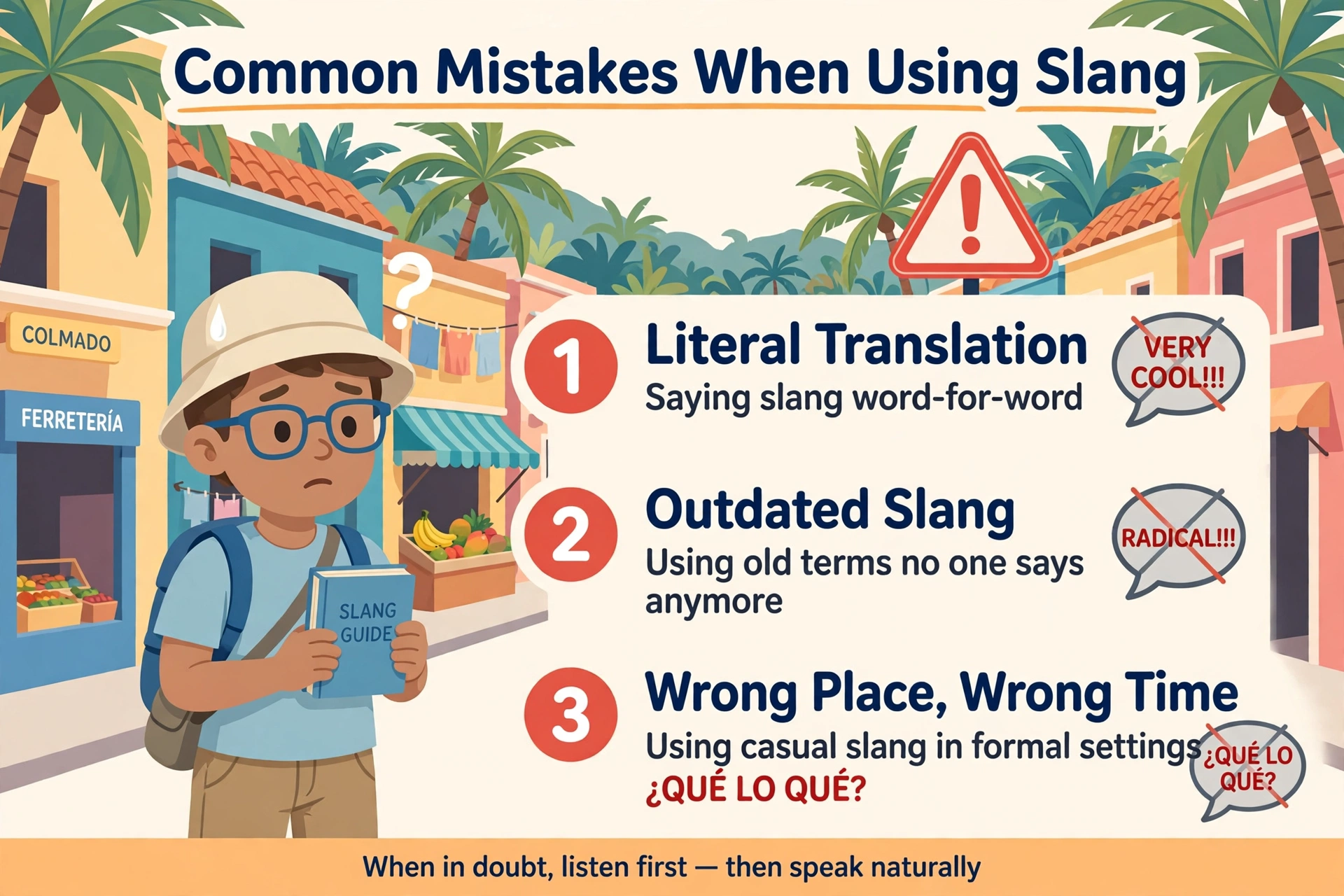
Most learner mistakes with Dominican slang are not about pronunciation. They are about timing, audience, and overconfidence. Avoid the seven mistakes below and you will already sound more natural than most beginners.
- Using slang with strangers. KLK, loco, and manín assume a friendship. With a stranger, they can sound presumptuous or rude. Start with a polite greeting and let the other person invite informality.
- Overusing vaina. Learners sometimes use vaina for every noun because it feels easy. Dominicans use it flexibly, but they also name things precisely. If you know the real word, use it. Vaina is a spice, not a substitute for the whole meal.
- Calling everyone a tiguere. The word can admire or warn, and strangers will hear the warning first. Never use it to describe someone you have just met, and never use it as a compliment until you have heard a Dominican use it that way about the same person.
- Confusing guagua across countries. In the Dominican Republic it is a bus. In Mexico or Colombia, asking for a guagua will get you a very confused look. Use autobús when you are not sure which country’s usage applies.
- Copying strong exclamations. Dominican Spanish has powerful exclamations that friends use with each other. Repeating them as a learner, especially loudly or to strangers, is the fastest way to offend. Learn to recognise them; do not make them your own catchphrases.
- Translating word for word. ¿Qué lo qué? is not “what what,” un chin is not a chin, and se armó una vaina is not about assembling anything. Translate the situation, not the syllables.
- Assuming every Dominican says every word. Age, region, family, and personal taste all shape vocabulary. If a Dominican friend says they never use a word in this guide, believe them. Slang is personal, and variation is normal, not a contradiction.
One more mistake is subtler: treating Dominican slang as a party trick. Asking a Dominican co-worker to “say something in Dominican slang” on demand, or performing KLK as a joke, can feel like being asked to perform an identity for entertainment. If you learn slang because you genuinely enjoy the language, the music, and the people, that respect shows. If you learn it to impress an audience, that shows too. The words are the same. The intention is what people remember.
Quick Tips
You do not need to memorise this whole guide before you try a single word. Start with five core expressions, use them well, and add more slowly. That approach builds real confidence instead of a long list you never use.
- Learn the big five first: KLK, vaina, jevi, un chin, and pana. Those five cover greetings, description, quantity, and friendship — most casual conversations.
- Listen before you speak. Spend a week noticing which words your Dominican friends actually use, with whom, and when. Copy their patterns, not a list from the internet.
- Practise greetings out loud. Say ¿Qué lo qué? and dime a ver until the rhythm feels natural. Dominican greetings are fast and musical; mumbling them slowly sounds more foreign than a careful accent does.
- Ask for slower speech kindly. Más despacio, por favor — “slower, please” — is a perfectly respected request. Most Dominicans are delighted to slow down for a learner who is genuinely trying.
- Watch and listen with subtitles. Dominican music videos, comedians, and everyday vloggers show slang in its natural habitat: fast, funny, and full of gesture. Subtitles help you catch the words your ear misses at full speed.
- Keep a small notebook. Write down each new word with the sentence you heard it in, who said it, and whether it was funny, friendly, or serious. A word without its context is only half learned.
- Use slang only with people who use it with you. That single rule prevents almost every embarrassment. Friendship first, slang second.
- Learn the polite forms in parallel. For every slang word you learn, learn its neutral replacement too. The ability to switch is what makes you sound fluent, not the size of your slang list.
If you are visiting the Dominican Republic, one practical tip helps more than any vocabulary: learn the local words for the things you will use every day. Colmado for the corner store, guagua and concho for transport, un chin for portions, and tato for agreement will carry you through markets, buses, beaches, and restaurants with a warmth that guidebook Spanish rarely achieves. People notice the effort, and they repay it with patience, laughter, and often a longer conversation than you expected.


FAQ
What does KLK mean in Dominican slang?
KLK is the written short form of ¿Qué lo qué?, the standard Dominican greeting. It means “What is up?” or “How are you?” and works as both a hello and a check-in. You can answer it with another KLK, with todo bien (“all good”), or with tranquilo (“chilling”). Use it with friends and in casual messages, never in a formal greeting.
What does vaina mean in Dominican slang?
Vaina is the most flexible word in Dominican slang. It can mean a thing, stuff, a situation, a problem, or a matter, depending on the sentence. Pásame esa vaina means “pass me that thing,” while tengo una vaina con mi carro means “I have a problem with my car.” Learn it from real sentences rather than a single translation, because no single English word covers all of its uses.
Is Dominican slang the same as Spanish?
Dominican slang is part of Dominican Spanish, not a separate language. It uses Spanish grammar and most Spanish vocabulary, plus a set of informal words, shortened forms, and expressions shaped by the island’s history and by English, African, and Taíno influences. A fluent Spanish speaker will understand the grammar immediately but may still need to learn the slang vocabulary, just as a fluent English speaker may need to learn the slang of a new city.
What does jevi mean?
Jevi means cool, great, or awesome. It comes from the English word “heavy,” reshaped by Dominican pronunciation. La fiesta estuvo jevi means “the party was awesome,” and ta’ jevi means “that is great.” It is positive, informal, and safe to use with friends when something impresses you.
Is tiguere a compliment or an insult?
It can be either, and tone decides. Said with admiration, tiguere praises someone street-smart, sharp, and resourceful — a person who always finds a way. Said with suspicion, it warns that someone is crafty, scheming, or looking for trouble. Because the line is so thin, learners should not use the word about people they do not know well, and should listen carefully to how Dominicans use it before trying it themselves.
How do Dominicans say “what is up” and “hello”?
The everyday greeting is ¿Qué lo qué?, written KLK, often followed by manín, pana, or a name. Dime a ver is a close cousin, meaning “tell me” or “what is up?” In formal settings, Dominicans use buenos días, buenas tardes, or ¿cómo está? instead. The greeting you choose tells the other person how well you think you know them, so choose carefully.
Is Dominican slang rude?
Most Dominican slang is not rude at all — it is warm, funny, and friendly between people who know each other. A small set of expressions is strong language, and a few words, like tiguere or loco, can turn sharp depending on tone and audience. The same sentence can be affectionate from a friend and offensive from a stranger. That is true of slang in every language. Learn the friendly core of this guide first, and treat the stronger expressions as words to recognise rather than words to repeat.
How can I learn Dominican slang fast?
Start with five words — KLK, vaina, jevi, un chin, and pana — and use them with Dominican friends who already use them with you. Listen to Dominican music and everyday videos with subtitles, keep a notebook of words with their full sentences, and ask más despacio, por favor when speech is too fast. Most importantly, learn the polite alternatives alongside the slang, so you can switch registers. Speed comes from real conversations, not from longer lists.
Conclusion
Dominican slang is much more than a list of funny words. It is the sound of friendship in the Dominican Republic: fast, warm, inventive, and full of history. KLK opens a conversation, vaina fills the gaps when the right noun will not come, jevi celebrates a good moment, un chin softens every request, and pana turns an acquaintance into a friend. Behind each word is a story — of Andalusian settlers and Taíno names, of African rhythms and English borrowings, of a diaspora that carried the island’s voice to New York and brought new words home again. Learning the vocabulary matters, but learning the context matters more: who you are talking to, how well you know them, and whether the moment calls for slang or for standard Spanish.
Start small, listen more than you speak, and let Dominican friends set the pace. Use the five core words in this guide until they feel natural, add new ones one at a time, and keep the polite alternatives ready for every formal moment. If you enjoy exploring how regional speech works, our guides to Gen Alpha slang and Australian slang show how other communities build the same kind of inventive, fast-moving vocabulary, while mewing and zesty trace how single words can travel from a small online corner to everyday conversation. Dominican slang rewards the same curiosity: learn it with respect, use it with friends, and the next time someone greets you with KLK, you will know exactly what to say back.

1 thought on “Dominican Slang: 25+ Words and Phrases That Explain How Dominicans Really Talk”