
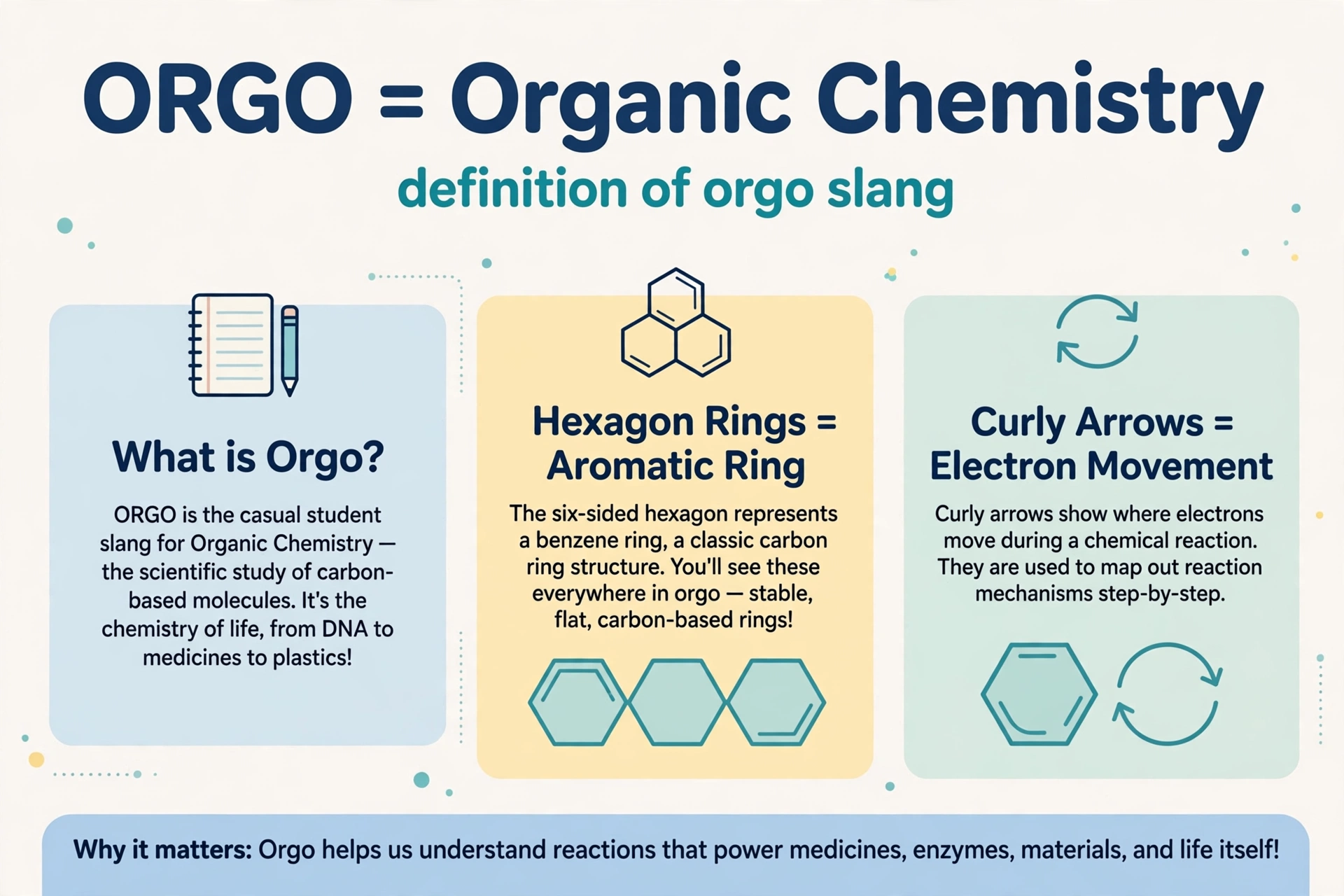
Quick definition: Orgo slang is the informal vocabulary used by organic chemistry students. At its core, the word “orgo” is simply student shorthand for organic chemistry, and the slang around it covers everything from reaction nicknames like SN1 and SN2 to jokes about “seeing hexagons in your sleep.”
Orgo Slang Meaning & Definition
If you have ever overheard a college student say “I have orgo until midnight” or “orgo ruined my weekend,” you have heard orgo slang in action. The term “orgo” is a clipped, casual form of “organic chemistry,” the notoriously tough course that sits at the center of pre-med, chemistry, pharmacy, and biology degrees in the United States.
But orgo slang is bigger than one abbreviation. It is a whole shared language: shortened reaction names, lab jokes, study-group shorthand, and memes about a class that many students describe as the hardest they will ever take. When students say they are “doing orgo,” they usually mean they are studying mechanisms, drawing structures, or preparing for an exam — not just attending a lecture.
Unlike much of the internet slang covered on this site, orgo slang was not born on TikTok. It grew out of lecture halls, labs, and late-night study sessions, and only later spread to group chats, Reddit threads, and campus memes. That is what makes it so durable: it is tied to a real, shared experience that repeats every semester for hundreds of thousands of students.
Introduction
Organic chemistry has a reputation, and every STEM student in America knows it before they ever set foot in the classroom. It is the course upperclassmen warn you about, the one with the thick textbook, the curved exams, and the lab reports that eat entire Sundays. So it is no surprise that students invented their own language for it.
Orgo slang does three jobs at once. First, it saves time: “SN2” is faster to say and type than “bimolecular nucleophilic substitution.” Second, it lowers stress: turning a terrifying reaction into a nickname makes it feel beatable. Third, it builds community: if you understand what “curly arrows” and “the orgo final” mean, you are part of the club — the group of students surviving the same course together.
In this guide, we break down the full meaning of orgo slang, where it came from, the terms every student needs to know, how it shows up in texts and conversations, and the mistakes to avoid when you use it. Whether you are a student about to take the course, a parent trying to decode your kid’s texts, or just curious about campus language, this is the complete explanation.
Origin
The word “orgo” comes from a simple linguistic habit: students shorten long course names. Just as “bio” stands for biology and “chem” for chemistry, “orgo” stands for organic chemistry. The clipping probably started decades ago on American campuses, passed down from one class of students to the next, and it stuck because it sounds natural — quick, a little playful, and instantly recognizable to anyone in the sciences.
The wider slang grew alongside the course itself. Organic chemistry became a required “weed-out” course for medical school hopefuls in the twentieth century, and as its reputation for difficulty grew, so did the folklore around it. Students created nicknames for reactions (SN1, SN2, E1, E2), shorthand for lab tasks (“reags” for reagents), and jokes about the visual language of the subject — the hexagon rings of carbon structures that fill every page of notes.
Online forums and study communities accelerated the spread. Students on Reddit, Discord servers, and campus meme pages began swapping orgo jokes and terms, and soon the same vocabulary was being used at universities across the country. Today, a student in California and a student in New York will understand each other perfectly when they complain about “orgo” — even if one of them calls the course “o-chem” instead.
Popularity
Orgo slang is popular for one simple reason: organic chemistry is nearly universal in American science education. Every year, hundreds of thousands of undergraduates take the two-semester sequence, most of them aiming for medical, dental, pharmacy, or veterinary school. That huge, rotating audience keeps the slang alive, because every fall a new class of students discovers the course — and its language — for the first time.
Social media keeps it circulating between semesters. Orgo memes about impossible exams, “mechanism” jokes, and hexagon doodles regularly go viral on student accounts, and campus humor pages treat orgo as a permanent punchline. Unlike trend-driven slang that fades in months, orgo slang renews itself every academic year, which is why it has lasted for decades while other terms come and go.
The slang also travels beyond the classroom. Pre-med influencers, study YouTubers, and tutoring channels all use orgo terms casually, so even high school students planning a science major often arrive at college already knowing what “orgo” means before their first lecture.
How It Is Used
Orgo slang shows up in three main settings: everyday conversation, texting, and studying.
In conversation, “orgo” usually replaces the full course name: “I can’t come, I have orgo lab,” or “How was orgo today?” The reaction nicknames appear when students talk shop: “The SN1 question destroyed me,” or “I finally get E2 eliminations.” These terms work because everyone in the group already knows the code.
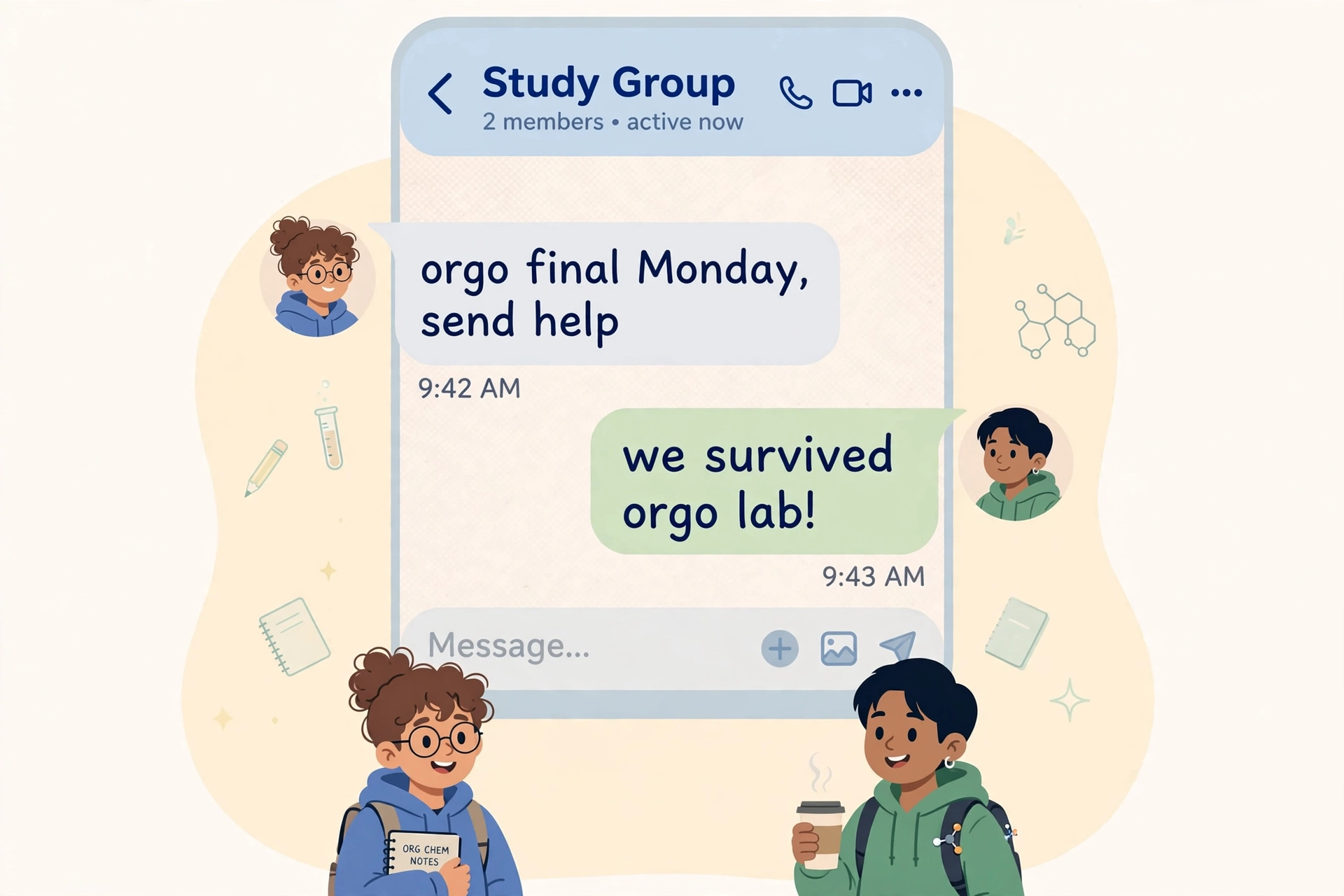
In texts and group chats, orgo slang is even more compressed. Students warn each other about exams, share study plans, and vent, often in a single line: “orgo final monday. send help.” The tone is usually stressed but joking — the slang turns a shared struggle into a shared joke.
While studying, the slang becomes a practical tool. Saying “push the arrows” or “find the nuc” is faster than spelling out full mechanism language, and in a timed exam or a fast-moving study group, that speed matters. Professors may use formal terms in lectures, but in the library at midnight, it is all orgo slang.
Examples
Here is how orgo slang sounds in real life, broken down by tone.
Friendly Examples
- “Good luck on your orgo exam tomorrow — you have totally got this!”
- “Want to study orgo together this weekend? I will bring snacks and the mechanism sheets.”
- “We survived orgo lab! Coffee is on me.”
Professional Examples
- “My orgo professor posts the mechanisms online before every lecture.”
- “I am reviewing orgo reactions for the MCAT this summer.”
- “Organic chemistry — orgo, as students call it — is a prerequisite for most medical schools.”
Funny Examples
- “I see hexagons in my sleep now. Orgo has officially broken my brain.”
- “Just dropped my orgo class. Med school is officially canceled.”
- “Orgo exam on Monday and I have not started studying. This is fine.”
- “My love language is someone explaining SN1 vs. SN2 to me slowly.”
Notice the pattern: in every example, “orgo” stands in for the course itself, and the reaction nicknames stand in for specific topics. The slang never replaces real understanding — it just makes talking about a hard subject faster and funnier.
Comparison with Similar Terms
Orgo slang sits next to several related terms, and students often mix them up. Here is how they compare:
| Term | What It Means | How It Differs from Orgo Slang |
|---|---|---|
| Orgo | Shorthand for organic chemistry | The course itself; the core term of orgo slang |
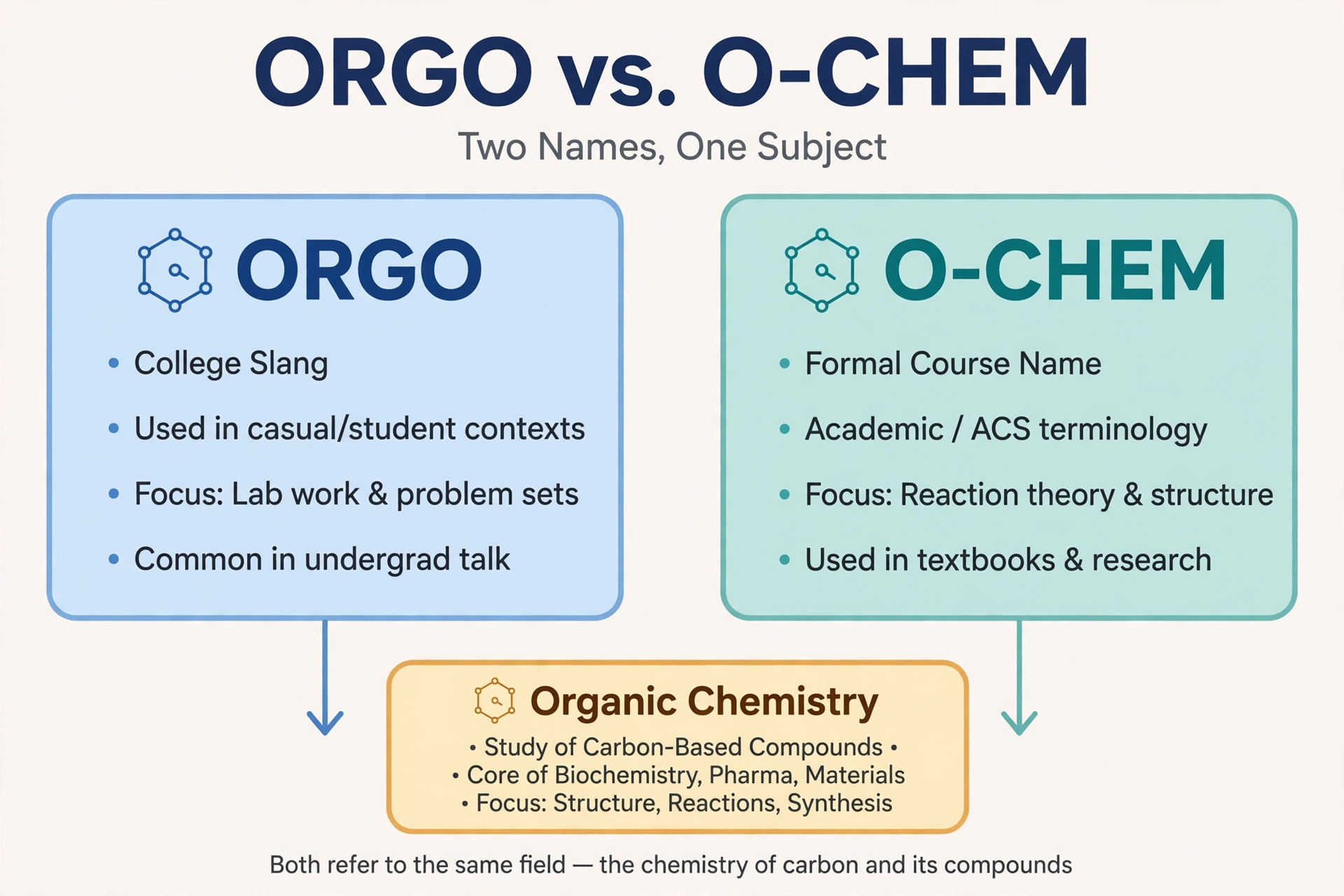
| O-Chem | Another abbreviation for organic chemistry | Same meaning; more common on the West Coast, while “orgo” dominates the East Coast |
| Gen Chem | General chemistry | The earlier, broader course students take before orgo |
| Orgo Lab | The laboratory section of the course | Refers to hands-on experiments, not lectures or exams |
| Biochem | Biochemistry | A different, later course about chemistry in living things |
| Org | Short for organization | Not chemistry at all — a common mix-up to avoid |
The most important distinction is the regional one: “orgo” versus “o-chem.” Both mean exactly the same course, and students will understand either one, but using the local favorite instantly marks you as an insider on that campus.
Another key distinction is between orgo slang and formal chemistry language. A professor will say “nucleophilic substitution” in a lecture; students will say “SN2” in the hallway. Same concept, different register — and knowing both is part of doing well in the course.
Alternate Meanings
Does “orgo” mean anything besides organic chemistry? Mostly, no — and this is where many online slang dictionaries get it wrong.
Some automated websites claim orgo means “organic food,” “organic marketing,” or “an organization.” In real student usage, none of these are true. Nobody says “I bought orgo apples,” and nobody shortens “organization” to “orgo” — that word is “org.” If you see those definitions online, they are guesses generated without checking how students actually talk.
There are a few genuine edge cases. In some niche contexts, “Orgo” appears as a brand or product name, and very rarely as a nickname for a person. But in everyday American English — and in every text message, meme, and study group where the word appears — “orgo” means organic chemistry, full stop. Context makes it obvious: if chemistry, exams, or labs are anywhere in the conversation, it is the course.
Professional or Polite Alternatives
Orgo slang is perfect for friends and study groups, but there are moments when the full, formal term works better:
- In emails to professors: write “organic chemistry” rather than “orgo.” (“I have a question about the organic chemistry homework.”)
- On a resume or application: list “Organic Chemistry I & II” — never “orgo.”
- Talking to family or non-science friends: say “my organic chemistry class” first, then switch to “orgo” once they know what you mean.
- In academic writing: use the full reaction names (“nucleophilic substitution”) instead of nicknames like “SN1.”
The rule of thumb is simple: slang with peers, formal terms with professors, employers, and anyone outside the science world.
Common Mistakes
Even students who live in orgo slang make these mistakes:
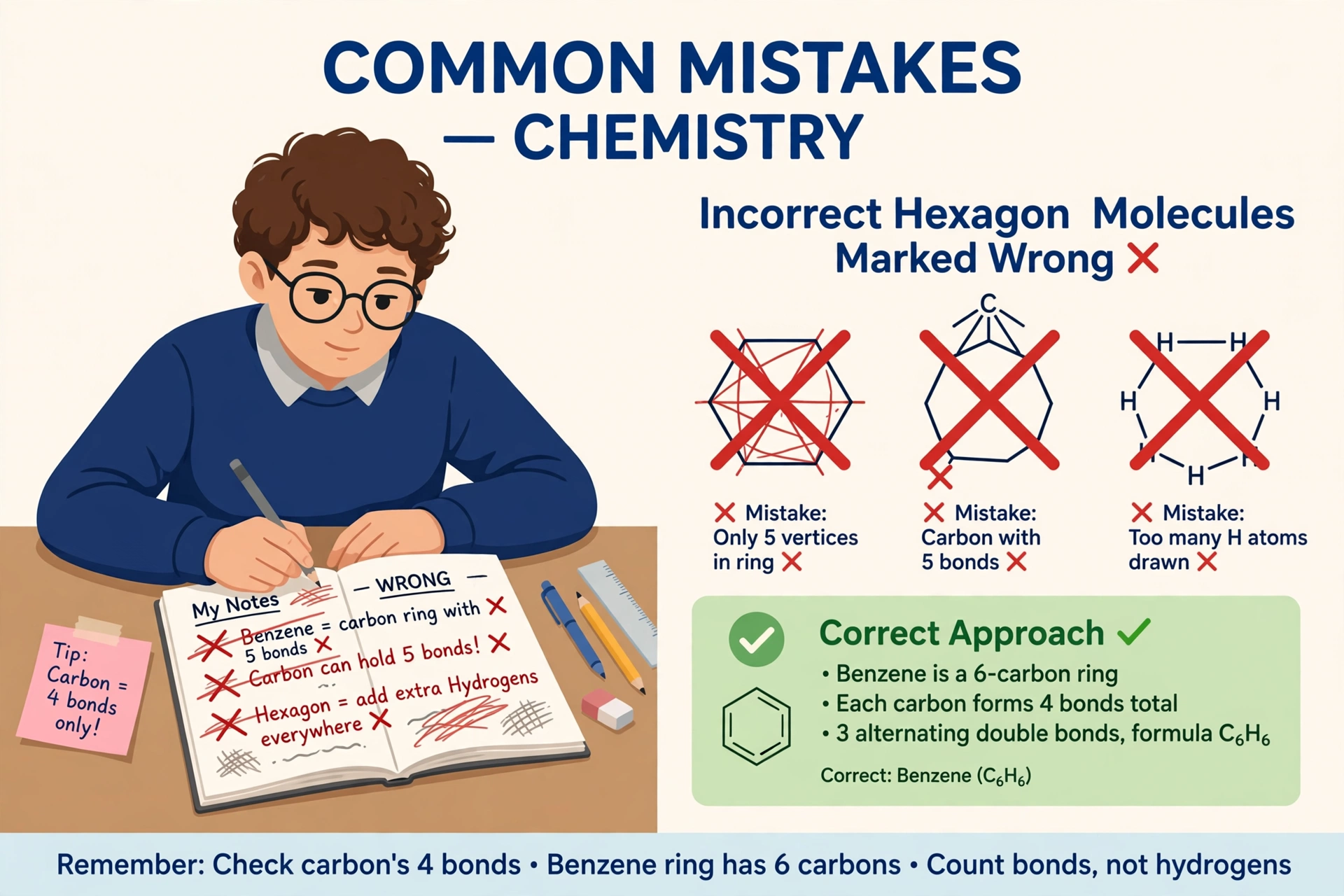
- Confusing “orgo” with “org”: “org” means organization. “Orgo” means organic chemistry. Mixing them up confuses everyone.
- Using slang in formal writing: “SN2” in a lab report or email to a professor reads as careless. Save nicknames for study groups.
- Assuming orgo means organic food: it does not. That definition comes from bad slang websites, not real students.
- Mixing up SN1 and SN2: the names look alike, but the reactions are different — one is a two-step process, the other happens in a single step. Confusing them is the classic orgo exam trap.
- Thinking slang replaces studying: knowing the nicknames is not the same as understanding the mechanisms. The slang helps you talk about the material, not master it.
- Calling every chemistry class “orgo”: general chemistry is “gen chem,” biochemistry is “biochem.” Only organic chemistry is orgo.
Quick Tips
If you are about to take orgo — or just want to sound like you know what you are talking about — these tips help:
- Learn the nicknames early: SN1, SN2, E1, E2, “nuc” (nucleophile), “elec” (electrophile), and “mechs” (mechanisms) cover most study-group conversations.
- Draw, do not just read: orgo is a visual subject. Practice pushing curly arrows by hand until the mechanisms feel automatic.
- Use free resources: free resources like Khan Academy’s organic chemistry course explain the same reactions your professor covers, in plain language.
- Join a study group: orgo slang exists because the course is a team sport. Explaining a mechanism to someone else is the fastest way to learn it.
- Do not fall behind: every orgo topic builds on the last one. Missing one week of mechanisms can make the next three weeks feel impossible.
- Match your language to the room: slang in the group chat, formal terms in the lab report.


FAQ
What does orgo slang mean?
Orgo slang is the informal vocabulary of organic chemistry students. “Orgo” itself is shorthand for organic chemistry, and the slang includes nicknames for reactions (SN1, SN2, E1, E2), lab terms (“reags,” “curly arrows”), and jokes about the course’s difficulty.
Is orgo the same as o-chem?
Yes. Both mean organic chemistry. The difference is mostly regional: students on the East Coast of the United States tend to say “orgo,” while West Coast students more often say “o-chem.” Everyone in the sciences understands both.
What does orgo mean in high school?
Mostly a college term, but high school students in AP Chemistry or advanced science electives sometimes use “orgo” for the organic chemistry units of their syllabus.
Does orgo ever mean organic food?
No. Despite what some automated slang websites claim, no student uses “orgo” to talk about organic groceries. If someone means organic food, they just say “organic.”
Why is orgo considered so hard?
Organic chemistry is visual, cumulative, and fast-paced: students must memorize reactions, draw mechanisms, and apply patterns to molecules they have never seen before. It is also a high-stakes course, since grades in it matter for medical and pharmacy school admissions.
What are SN1 and SN2 in orgo slang?
They are nicknames for two types of nucleophilic substitution reactions. SN1 happens in two steps through a carbocation intermediate, while SN2 happens in a single step. Telling them apart is one of the first big skills students learn in the course.
What does “I see hexagons in my sleep” mean?
It is a classic orgo joke. Organic molecules are drawn as hexagon rings, and after hours of drawing structures, students joke that the shapes follow them into their dreams. It is shorthand for “I have been studying way too much.”
Is orgo slang used outside the United States?
Less commonly. The term is strongest in American universities, where organic chemistry is a standard pre-med requirement. Students in other countries may know it from the internet, but their own local terms for the course are usually different.
Conclusion
Orgo slang is more than a nickname for a hard class. It is the language of a shared rite of passage — the shorthand, jokes, and reaction nicknames that hundreds of thousands of American students use every semester to survive organic chemistry together. “Orgo” means the course, “SN1” and “SN2” mean the reactions, and “seeing hexagons in your sleep” means you have officially joined the club.
The key takeaways are simple: use “orgo” with peers and “organic chemistry” with professors; do not confuse it with “org” or with organic food; and remember that the slang is a tool for talking about the subject, not a substitute for learning it. Draw the mechanisms, join a study group, and keep up week by week — that is how students actually pass.
Want to decode more of the terms floating around the same campus group chats? Check out our guides to Gen Alpha slang, sigma slang, mewing, and glizzy — the whole campus slang cluster, explained.
