Quick Definition: 70s slang is the informal vocabulary of the 1970s in the United States — words and phrases like groovy, far out, right on, and can you dig it? that people used in everyday conversation, in music, on television, and in the disco and funk scenes. It mixed hippie language carried over from the late 1960s with Black American English, surfer and street talk, and the brand-new vocabulary of disco, and it still turns up today whenever someone wants to sound retro, playful, or deliberately old-school.
70s Slang Meaning & Definition
70s slang means the casual, expressive language that defined how Americans spoke in the 1970s. It was not a separate language, and it was not written down in one official dictionary. It was a shared set of words that told listeners where you stood: whether you were hip or square, relaxed or uptight, part of the scene or watching it from the outside. A single word like groovy could do the work of a whole sentence. It said something was excellent, attractive, fashionable, and fun, all at once, and it said it with a smile.
The dictionary sense helps to anchor the word that most people associate with the decade. Merriam-Webster defines groovy as marvellous or wonderful, and notes its slang sense of being fashionable and exciting. That is exactly how 70s slang worked in practice. It was language built for approval. Far out meant amazing or astonishing. Right on meant exactly right, or I completely agree. Outta sight meant so good it was beyond description. Solid meant reliable and excellent. The vocabulary was warm, approving, and a little theatrical, which suited a decade that loved big hair, loud music, and even louder clothes.
At the same time, 70s slang was practical. People needed quick words for money (bread), for a car (wheels), for a party (bash or shindig), for leaving (split or boogie), and for understanding (dig it). They needed words for people, too: a dude was a man, a chick was a young woman, a fox was an attractive person, a square was someone conventional and out of touch, and a turkey was a loser or a failure. Much of this language had been circulating for years, and some of it is still understood instantly today, even by people who were born decades after the 1970s ended.
What makes 70s slang distinct from the slang of the decades around it is its blend. The 1960s gave it groovy, hip, and peace. The 1970s added disco, funk, and a new street confidence: funky, jive, boogie, hustle, and bad meaning good. The 1980s would later take that energy in a different, sharper direction. If you want to see how the vocabulary changed, compare this guide with the 80s slang guide, where rad, gnarly, and totally take over, and with the 90s slang guide, where the tone turns cooler and more ironic. The 1970s version is the warmest of the three: sincere, musical, and openly enthusiastic.
Introduction
Picture a Friday night in 1977. The disco ball is turning, the bass line is walking, and someone in platform shoes leans over and says, “This band is far out — can you dig it?” Nobody in the room needs a translation. Far out means wonderful. Can you dig it? means do you understand, do you feel it, are you with me? In two short phrases, a whole mood has been set: the music is good, the night is good, and everyone present is in on the same feeling.
That is the world of 70s slang. It was the language of a decade that was, by turns, joyful and uneasy. The Vietnam War was ending, Watergate shook trust in politics, the economy wobbled, and yet popular culture exploded with colour and confidence. Disco filled the dance floors, funk filled the radio, soul and rock filled the arenas, and television brought new catchphrases into living rooms every week. Slang was how ordinary people joined in. You did not need to be a musician or a movie star to say right on or sock it to me. You just needed to be listening.
This guide explains 70s slang properly: what the words meant, where they came from, how they were used, and which ones are safe, funny, or risky to use now. You will find a large glossary table of more than sixty terms, real examples in friendly, professional, and funny contexts, a comparison with the slang of neighbouring decades, the mistakes people make when they quote the 1970s, and answers to the questions people actually search for. Whether you are writing a retro character, decoding a parent or grandparent, preparing a 1970s-themed party, or just curious about why everyone keeps saying groovy, this is the complete guide.

Origin
70s slang did not appear from nowhere in 1970. It grew out of at least four overlapping sources, and most of its best-known words can be traced to one of them. The first source was the hippie and counterculture movement of the late 1960s. Words like groovy, hip, far out, peace, love-in, and heavy were already in use before the decade turned, and they carried their 1960s values into the 1970s: openness, music, community, and a suspicion of anything square or uptight. As the 1960s faded, the language stayed, but the mood softened. The protest edge dulled a little, and the party edge sharpened.
The second source, and the most important for the sound of the decade, was Black American English and the music that carried it. Jazz had already given American English words like hip, cool, dig, and cat (a person, especially a musician). In the 1970s, soul, funk, and disco took those words to a national audience. James Brown, Sly and the Family Stone, Parliament-Funkadelic, Earth, Wind & Fire, and the artists of Motown and Philadelphia soul did not just make hits; they made phrases famous. Funky moved from describing a strong, earthy musical groove to describing anything stylish and distinctive. Jive, boogie, get down, and can you dig it? travelled the same route, from Black music and street language into mainstream conversation, sometimes with their origins acknowledged and sometimes, regrettably, without.
The third source was television and film. Soul Train, which went national in 1971, showed a national audience how young Black Americans danced, dressed, and talked. Saturday Night Fever (1977) turned disco dancing into a national craze and made the white suit, the pointed collar, and the dance-floor strut into visual shorthand for the decade. Cop shows and sitcoms added their own catchphrases. Sock it to me, popularised on the comedy show Rowan & Martin’s Laugh-In in the late 1960s, was still being quoted well into the 1970s. Detective slang, surfer slang, and trucker slang all fed the same pool, which is why a decade of 70s slang can sound, within a few sentences, like a beach, a dance floor, and a police drama at once.
The fourth source was everyday life: school, work, cars, and the street. Teenagers and young workers needed words for the ordinary things they talked about every day, and they borrowed, shortened, and repurposed whatever was close at hand. Bread for money was already old, but it stayed. Wheels for a car stayed. Split for leave, crash for fall asleep somewhere, cop for buy or steal, and bummer for a disappointment were all part of that practical, everyday layer. Together, these four sources produced a vocabulary that was at once musical, political, funny, and completely ordinary — which is why it still feels familiar fifty years later.
Popularity
70s slang became popular for a simple reason: the culture that carried it was everywhere. By the mid-1970s, disco was not a niche sound. It was the sound of radio, of weddings, of roller rinks, and of the biggest film of the year. Funk and soul were chart music, not underground music. Television was a shared national experience in a way it no longer is, so a catchphrase from a single show could be repeated in schoolyards and offices the next morning. When everyone is watching and listening to the same few things, slang spreads fast, and it spreads evenly.
Music did most of the heavy lifting. A song title or a lyric could fix a phrase in the national memory in a single summer. “Boogie” became a verb for dancing because the songs kept telling people to boogie. “Hustle” became a dance because Van McCoy’s “The Hustle” (1975) made it one. “Funky” stayed in the charts because funk bands kept naming it. Even words that were not song titles rode the same wave: if a funk singer said right on between verses, the audience said it back, and then they said it at work on Monday. Radio DJs, who were still powerful cultural figures in the 1970s, repeated the language hour after hour, and the repetition turned slang into habit.
Fashion and film helped just as much. The visual style of the 1970s — flared trousers, platform shoes, wide collars, feathered hair, and later the disco look — gave the slang a costume. Saying groovy in jeans and a T-shirt is one thing; saying it under a disco ball in a satin shirt is another. The words and the look reinforced each other, and both became shorthand for the whole decade. That is why, in films and television made long after the 1970s, a character only has to say “far out, man” for the audience to know exactly which era is being quoted, even before the costume department has done anything.
The popularity of 70s slang never fully went away. It dipped in the 1980s, when the new slang sounded faster and sharper, and it became a joke in the 1990s, when every retro reference was delivered with a wink. But it kept returning. The Austin Powers films of the late 1990s brought groovy, yeah, baby, and the whole 1960s and 1970s vocabulary back into mainstream comedy, this time as deliberate parody. Nostalgia television, 1970s-themed parties, and social media have kept the words alive ever since. Today, 70s slang is used in three main ways: sincerely, by people who lived through the decade; ironically, by younger people quoting it for fun; and affectionately, by everyone in between. The meaning has barely changed. The tone is what moves.
How It Is Used
70s slang is used in very specific ways, and context decides everything. The same word can be a compliment, a joke, or a dated embarrassment depending on who says it, where, and with what tone. The golden rule is simple: 70s slang works best in small doses, in casual settings, and when everyone present knows it is a quotation or a bit of fun. A sentence with one 1970s word in it sounds playful. A sentence stuffed with five of them sounds like a costume.
- In friendly conversation: Short, warm, and approving. “That party was far out.” “Right on, I agree completely.” “You look groovy tonight.” The words add enthusiasm to ordinary praise, and they signal that the speaker is relaxed and in a good mood.
- In music and dancing: Physical and rhythmic. “Let’s boogie.” “Get down tonight.” “That bass line is funky.” Here the slang is part of the activity itself, not just a description of it, and it works because the music gives it a place to live.
- In storytelling and nostalgia: Evocative and deliberate. “Back in the seventies, we would split after school and cruise in my wheels.” The slang sets the scene and tells the listener which decade the story belongs to, which is useful for memoirs, novels, and family stories.
- In humour and parody: Exaggerated on purpose. “Far out, man. That is one groovy sandwich.” The joke depends on the audience recognising the words as period pieces, so the exaggeration is the point. This is the most common use of 70s slang today.
- In texts and social media: Brief and self-aware. “Groovy 🌼” on a retro photo, “can you dig it?” as a caption, “right on” as a reply. Online, the words usually come with a visual cue — a 1970s photo, a disco emoji, a vintage filter — that tells readers the retro tone is intentional.
- Not in formal settings: 70s slang does not belong in a job application, a business email, a legal document, or a serious news report. Its whole charm is informality, and informality is exactly what formal settings are designed to avoid. Save it for the party, not the presentation.
Tone matters as much as vocabulary. Groovy said warmly to a friend is a compliment. Groovy said flatly to a stranger can sound sarcastic. Can you dig it? said with a grin is an invitation. Said sharply, it can sound like a challenge: do you understand me, or do I have to explain it again? The words carried attitude in the 1970s, and they still do. Listen for the attitude before you copy the word, and you will usually get the usage right.
Examples
The best way to learn 70s slang is to see it in sentences, with the situation attached. The examples below are grouped by tone, because tone is what decides whether a 1970s word lands well or falls flat. Notice how the same handful of words — groovy, far out, right on, dig it — can sound friendly, professional, or funny depending on the sentence around them. That flexibility is part of why the vocabulary survived.
Friendly Examples
- “Your new record collection is far out — where did you find all those funk albums?”
- “Right on! I am so glad you can make it to the party on Saturday.”
- “Can you dig it? We finally got tickets for the reunion show.”
- “That jacket is groovy. The colours are perfect for a disco night.”
- “Let’s split early and catch the sunset cruise. The weather is outta sight today.”
- “Don’t be uptight about the playlist. Just boogie and enjoy the music.”
- “She is one cool chick, and her taste in music is solid.”
- “What a bummer that the show was cancelled. We will catch the next one, though.”
In friendly use, 70s slang is generous. It praises people, celebrates plans, and smooths over small disappointments. A bummer is not a disaster; it is a disappointment you can shrug off. A cool chick or a groovy outfit is a compliment with a smile built into it. This is the register most people mean when they say they love 1970s language, and it is the safest register to copy.
Professional Examples
Strictly speaking, 70s slang has no real professional register, because the vocabulary was built to be casual. In a modern workplace, the professional use of 70s slang is almost always light, deliberate, and clearly marked as a joke or a theme. A team planning a 1970s-themed event, a retro marketing campaign, or a nostalgia piece can use the words freely, because the theme gives everyone permission. Outside a theme, a single, gentle use is the limit.
- “Right on — that timeline works for the retro launch. Let’s confirm the disco-night theme for the team social.”
- “The vintage branding is groovy, in the best sense: bold colours, clean type, and a real 1970s feel.”
- “Can we dig into the archive photos? The 1970s collection would be perfect for this campaign.” (Note: dig into here is modern business English, not 1970s dig it, and the distinction matters.)
- “That is a solid plan. No need to overcomplicate it.” (Solid has survived into modern professional English, which is why it works where groovy would not.)
The lesson is practical. If the setting is formal, translate the 1970s word into its plain modern equivalent: groovy becomes excellent, right on becomes exactly, far out becomes remarkable, split becomes leave, and bread becomes money. Keep the slang for the social, the creative, and the themed, and your professional writing will never have to apologise for it.
Funny Examples
- “Far out, man. This instant coffee is the grooviest thing to happen to my Tuesday.”
- “I tried to hustle at the wedding disco and pulled a muscle. My dancing days are officially outta sight — in the worst way.”
- “Don’t be a jive turkey about the group photo. Just smile and boogie.”
- “My dad says my playlist is funky. I think he means the bass, not the smell. I hope he means the bass.”
- “We split from the party at midnight in my wheels, which is a 2009 hatchback with one working speaker. Very groovy.”
- “Sock it to me with the good news first. I can handle the bummer after.”
Funny use works because the audience knows the words are old. The humour comes from the gap between the grand, theatrical 1970s word and the small, ordinary modern situation: a sandwich, a playlist, a hatchback. Lean into that gap and the joke lands. Pretend the gap is not there, and the same sentence can sound as if you are trying too hard to be retro. Self-awareness is the whole trick.

Comparison with Similar Terms
70s slang is often confused with the slang of the decades on either side of it, and the confusion is understandable. The 1960s, 1970s, and 1980s share words, share music, and share a general counterculture feeling. But the vocabularies are not identical, and the differences are worth knowing, especially if you are writing, teaching, or choosing a theme. The table below compares 70s slang with the closest neighbouring vocabularies, so you can place a word in the right decade at a glance.
| Term or theme | 70s slang | Closest neighbour | Key difference |
|---|---|---|---|
| Excellent, wonderful | Groovy, far out, outta sight | 80s: rad, totally awesome | 70s praise is warm and musical; 80s praise is louder and more extreme. |
| Agreement | Right on, solid | 60s: groovy (as agreement); 90s: word, for sure | Right on is the classic 70s agreement, with a political and soul-music history. |
| Understanding | Can you dig it?, I dig it | 60s: I dig (from jazz); modern: I get it | Dig is older jazz slang that peaked in everyday use in the 1970s. |
| Dancing | Boogie, get down, hustle | 80s: breakdance, pop and lock | 70s dancing words come from disco and funk; 80s words come from hip-hop and breakdancing. |
| Stylish, distinctive | Funky, hip, cool | 90s: fly, dope, phat | Funky is a music word first; 90s equivalents come from hip-hop fashion. |
| Conventional person | Square, uptight | 60s: square, straight; 2000s: basic | Square is the long-running opposite of hip across both the 60s and 70s. |
| Good, impressive (reversed meaning) | Bad meaning good | 80s: bad meaning good; 90s: dope, ill | Reversed bad runs through several decades; in the 70s it is tied to funk and soul. |
| Money | Bread | 60s: bread; 80s: bucks, dough; 90s: cheddar | Bread is the durable 60s and 70s word; later decades invent new money words. |
| Leaving | Split, boogie (leave), cruise | 80s: bail, jet; 90s: bounce, peace out | Split is the classic 70s exit; peace out belongs to a later era. |
| Attractive person | Fox, looker, cool chick, dude | 80s: babe, hunk; 90s: hottie, fine | Fox is the signature 70s compliment; chick is now dated and should be used with care. |
The comparison also works across generations. Gen X slang, which grew up in the late 1970s and 1980s, kept some 1970s words — cool, dude, solid — and dropped others, like groovy and sock it to me, which came to sound like a parent’s vocabulary. That is a normal pattern. Every generation keeps the words that still name something useful and lets the rest become period pieces. The 1970s words that survived, like cool, dude, and funky, survived because they were flexible. The words that did not survive, like jive turkey as everyday insult, survived only as quotations, because their moment passed.
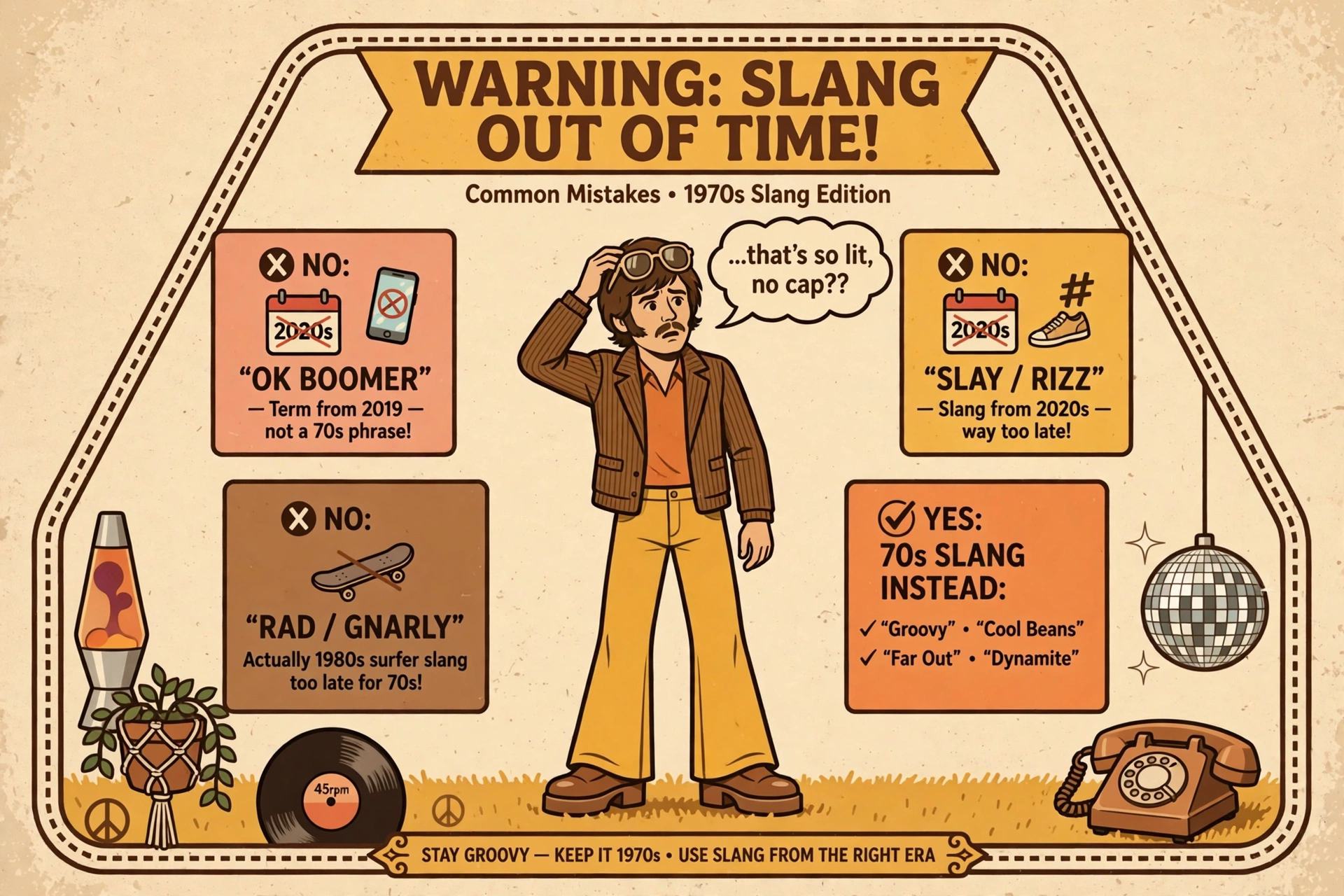
One more distinction matters. “70s slang” is sometimes used loosely to mean any old-fashioned slang, and that looseness causes most of the mistakes. Rad, gnarly, tubular, and totally are 1980s words, not 1970s words, even though they feel retro in the same general way. Groovy is a 1960s word that stayed popular through the 1970s, so it belongs in both decades, but it is not a 1970s invention. Getting the decade right is not pedantry. It is what makes a retro reference sound knowledgeable instead of approximate, and it is what separates a good period piece from a costume that mixes three decades at once.

Alternate Meanings
Most 70s slang words have one clear meaning, but a few have alternate meanings that change with context, and a few belong to more than one world. Knowing the alternates is what stops a friendly compliment from becoming an awkward misunderstanding.
Funky is the best example. In music, funky is a compliment: a funky bass line is rhythmic, earthy, and irresistible. In fashion and design, funky means stylishly unusual: funky wallpaper, a funky pattern. But funky also has an older, literal sense: having a strong, unpleasant smell, from funk meaning a musty odour. The musical sense is the one people usually mean in a 1970s context, and the context almost always makes it clear, but the joke in the funny examples above exists precisely because the two senses sit side by side. If you call someone’s cooking funky, be ready to explain which funky you meant.
Bad is the famous reversal. In standard English, bad means poor or unpleasant. In 1970s soul and funk language, bad could mean impressively good, especially for music, dancing, or style: “That band is bad” meant the band was excellent. The reversal is still understood today, thanks to Michael Jackson’s Bad (1987) and to hip-hop, but it is always a judgement call. In a formal or safety-critical context, never use bad to mean good. The risk of being misunderstood is too high, and the joke is not worth it.
Dope has a similar double life. In 1970s slang, dope could mean excellent, and it could also mean drugs, especially marijuana or heroin. The drug sense is older and, in many contexts, dominant, which is why dope is best avoided unless the context is unmistakably musical or clearly modern hip-hop, where the excellent sense is standard. Heavy is another word with two lives: it can mean serious or emotionally weighty (“That news is heavy”), and it can mean impressive or intense (“That guitar solo is heavy”). Both senses were current in the 1970s, and the sentence around the word usually settles which one is meant.
Finally, “the 70s” itself can mean different things. In music writing, “70s” usually means the disco, funk, and soft-rock era of 1970 to 1979. In fashion writing, it can mean the flared, platform, earth-tone look that peaked in the middle of the decade. In slang discussions, “70s slang” is used for the whole vocabulary of the decade, including words inherited from the 1960s. If someone says “70s slang” and means only words invented between 1970 and 1979, the list gets much shorter, and groovy itself would barely qualify. The broader, decade-as-era sense is the one this guide uses, because it is the sense most readers mean when they search for the phrase.
Professional or Polite Alternatives
70s slang is charming, but charm is not always appropriate. In a workplace, a classroom, a customer email, or any setting where clarity and respect matter more than personality, the polite move is to translate the slang into plain English. The table below gives a direct translation for the most common 70s slang words, so you can keep the meaning and drop the period costume whenever the setting calls for it.
| 70s slang | Meaning | Polite or professional alternative |
|---|---|---|
| Groovy | Excellent, wonderful | Excellent, wonderful, impressive |
| Far out | Amazing, remarkable | Remarkable, impressive, surprising |
| Right on | Exactly right, I agree | Exactly, I agree, well said |
| Can you dig it? | Do you understand / feel it? | Does that make sense? Do you follow? |
| Outta sight | Beyond description, superb | Outstanding, superb |
| Bummer | Disappointment | Disappointment, setback, shame |
| Split | Leave | Leave, head off |
| Bread | Money | Money, budget, funds |
| Wheels | Car | Car, vehicle |
| Chick | Young woman | Woman, colleague, person (avoid chick in formal settings) |
| Square | Conventional, out of touch | Conventional, traditional |
| Uptight | Tense, rigid | Tense, stressed, inflexible |
| Boogie | Dance, or leave quickly | Dance, or leave (state which you mean) |
Two words deserve a special note. Chick was ordinary, even affectionate, in 1970s casual speech, but in modern professional settings it reads as dated and diminishing, and it should not be used for a colleague or a stranger. Jive turkey, which is explained below, was an insult then and remains an insult now, and it carries racial history that makes it unsuitable as a joke between strangers. Polite alternatives are not about being dull. They are about choosing the word that respects the room you are in, and keeping the groovy words for the rooms where they will be welcomed.
Common Mistakes
People make the same handful of mistakes with 70s slang, and most of them come from treating the decade as a single costume rather than a real period with its own history. The first mistake is mixing decades. Saying “That is totally rad and groovy, dude” in one breath mixes a 1980s word (rad), a 1960s and 1970s word (groovy), and a word that spans several decades (dude). Each word is fine on its own. Together, they sound like three costumes worn at once. If you want a 1970s voice, stay in the 1970s word list for that sentence. If you want an 1980s voice, switch lists completely.
The second mistake is overuse. 70s slang was never spoken in every sentence, even in the 1970s. Real speakers mixed slang with ordinary English, and the slang stood out because it was occasional. A paragraph with groovy, far out, right on, dig it, and outta sight in every line does not sound like 1975. It sounds like a parody of 1975, which is fine if parody is the goal, and tiring if it is not. One or two period words per paragraph is plenty for a retro effect. Let the ordinary words do the ordinary work.
The third mistake is using groovy and far out as if they were still current compliments in serious settings. They are not. In 2026, both words are understood, but both are understood as quotations. Using them sincerely in a business meeting, a job interview, or a first message to a stranger will usually be read as a joke, even if you meant it sincerely. That is not a reason never to use them. It is a reason to use them where a joke, or a warm retro tone, is welcome, and to use plain English where it is not.
The fourth mistake is misusing words with a history. Jive turkey is the clearest case. In 1970s Black American slang, a jive turkey was a person who talked nonsense, a phony, or a fool, and the phrase was popularised in film and television. Used today by a stranger, especially across racial lines, it can land as mocking or offensive, because it borrows a piece of Black language as a joke. The same caution applies to chick, fox for a woman, and bad for good in a mixed or formal audience. None of these words is forbidden in a historical discussion, a novel, or a quotation. All of them need care in direct address. When in doubt, quote the word and explain it, rather than aiming it at a person.
The fifth mistake is getting the pronunciation and spelling wrong in writing. Outta sight is written as outta sight or out of sight in period sources, not outta-site. Can you dig it? is a question, with a question mark, and it loses its invitation quality if it is written as a statement. Right on is two words, not right-on as a single adjective, except when it is used before a noun in a deliberately retro headline. Small details like these are what make a retro piece feel researched rather than guessed.
Quick Tips
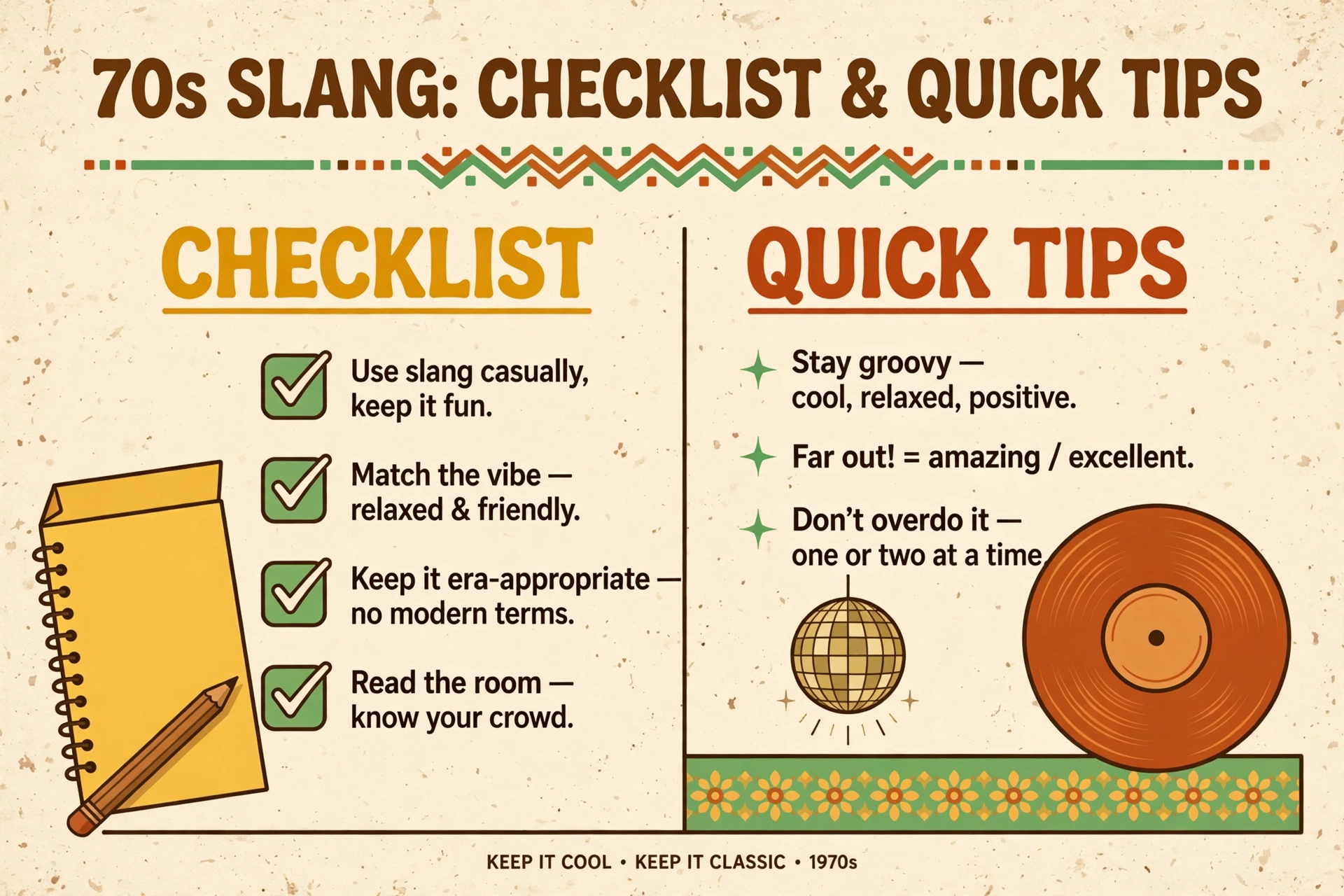
- Start with one word. Pick groovy, far out, or right on and use it once, in a casual sentence, before you try a whole paragraph of 1970s language. Confidence with one word beats confusion with ten.
- Match the room. 70s slang belongs at a party, in a retro post, in a story, or among friends who share the joke. It does not belong in a formal email, a job interview, or a serious announcement.
- Know the decade. Keep 1970s words together and 1980s words together. Do not mix groovy with rad unless you are deliberately joking about mixed decades.
- Use the glossary table. When you meet a new 1970s word, check its meaning, its tone, and its history before you use it. The table below lists more than sixty terms with their meanings and contexts, and it is the fastest way to avoid a mistake.
- Listen for tone. Can you dig it? and right on are warm when they are warm and sharp when they are sharp. Copy the tone as well as the word.
- Quote, don’t aim. For words with a loaded history, like jive turkey, quote and explain them rather than directing them at a person.
- Pair slang with a visual cue. Online, a 1970s word works best with a retro photo, a disco reference, or a clear theme, so readers know the tone is intentional.
- Keep the rest of the sentence plain. One period word in a plain sentence sounds natural. Five period words in one sentence sound like a costume.
70s Slang Glossary: 60+ Words, Meanings & Examples
The glossary below is the heart of this guide. It collects the words most associated with 1970s speech, with a plain meaning and a short example for each. Read it as a reference, not as a script: dip in for the word you need, check the example, and then use the word once, in your own sentence, in the right setting.
| 70s slang term | Meaning | Example |
|---|---|---|
| Groovy | Excellent, wonderful, fashionable | “That new album is groovy.” |
| Far out | Amazing, astonishing, wonderful | “Far out! You got front-row seats?” |
| Right on | Exactly right; I completely agree | “Right on — the band was incredible.” |
| Can you dig it? | Do you understand / feel it? | “This funk groove is unreal — can you dig it?” |
| Outta sight / Out of sight | So good it is beyond description | “Her disco outfit was outta sight.” |
| Solid | Reliable, excellent, trustworthy | “He is a solid friend.” |
| Funky | Rhythmic and earthy (music); stylishly unusual | “That bass line is funky.” |
| Boogie | To dance; also, to leave quickly | “Let’s boogie all night.” |
| Get down | To dance energetically; to enjoy music | “Get down tonight at the disco.” |
| Hustle | A disco dance; also, to work hard or hurry | “Do the hustle — everyone knows the steps.” |
| Bad | Impressively good (reversed meaning) | “That guitarist is bad — in the best way.” |
| Cool | Calm, stylish, admirable, excellent | “Stay cool. Everything will work out.” |
| Hip | Aware, fashionable, in the know | “She is hip to all the new music.” |
| Square | Conventional, boring, out of touch | “Don’t be such a square — come dancing.” |
| Uptight | Tense, rigid, anxious | “Relax, don’t be uptight about the seating.” |
| Bummer | A disappointment; a bad experience | “What a bummer — the concert was cancelled.” |
| Dude | A man, a guy (casual address) | “Hey, dude, did you hear the new single?” |
| Chick | A young woman (dated; use with care) | “She’s a cool chick with great taste in soul.” |
| Fox | An attractive person | “He was a real fox in that white suit.” |
| Cat | A person, especially a musician or hip person | “That cat can really play the sax.” |
| Turkey | A loser, a failure, a flop | “That film was a real turkey.” |
| Jive | Nonsense, empty talk; also, lively swing music and dance | “Don’t give me that jive.” |
| Jive turkey | A phony, a fool, someone talking nonsense | “Don’t be a jive turkey — tell us straight.” |
| Bread | Money | “I need more bread before the weekend.” |
| Wheels | A car | “Let’s take my wheels to the beach.” |
| Split | To leave | “We should split before the traffic gets bad.” |
| Cruise | To drive around slowly, socially | “We cruised down Main Street all evening.” |
| Crash | To fall asleep somewhere; to stay overnight | “You can crash at my place tonight.” |
| Bash / Shindig | A party, a lively social event | “Are you going to the bash on Friday?” |
| Heavy | Serious, intense, emotionally weighty | “That news is heavy, man.” |
| Dope | Excellent; also, drugs (use with care) | “That funk track is dope.” |
| Sock it to me | Give it to me; tell me straight; let me have it | “Sock it to me — what’s the good news?” |
| Keep on truckin’ | Keep going, persevere cheerfully | “Times are tough, but keep on truckin’.” |
| Peace / Peace out | Goodbye; a wish for peace (later form: peace out) | “Peace, man. See you at the show.” |
| Love-in | A gathering celebrating love and peace | “The park hosted a love-in on Sunday.” |
| Rap | To talk, to chat (before hip-hop rap music) | “Let’s rap for a while about the trip.” |
| Dig | To understand, to appreciate, to enjoy | “I really dig that soul singer.” |
| Pad | A home, an apartment, a place to live | “Come over to my pad after the show.” |
| Threads | Clothes, an outfit | “Check out his new threads.” |
| Stoned | Intoxicated by drugs or alcohol (period usage) | “He was stoned and laughing all night.” |
| High | Intoxicated; also, feeling euphoric | “The music left us all feeling high.” |
| Trip | A drug experience; also, an experience or journey | “That concert was a real trip.” |
| Mellow | Relaxed, calm, easygoing | “Stay mellow. The night is young.” |
| Laid back | Relaxed, unhurried | “He has a laid-back way about him.” |
| Blow your mind | To amaze or astonish completely | “That light show will blow your mind.” |
| Mind-blowing | Amazing, astonishing | “The finale was mind-blowing.” |
| Hang loose | Relax, take it easy | “Hang loose — we’ll get there in time.” |
| Hang ten | Surfer term: ride a wave with toes over the board; by extension, relax | “Hang ten and enjoy the wave.” |
| Bogue / Bogus | Fake, unfair, disappointing (bogus survived into later slang) | “That’s bogus — the show was sold out.” |
| Cop | To get, buy, or take | “Let’s cop some tickets before they sell out.” |
| Score | To obtain something wanted, especially tickets or drugs | “Did you score tickets for Saturday?” |
| Stash | A hidden supply; to hide away | “He stashed the records in the attic.” |
| Freak out | To panic, or to react with wild excitement | “Don’t freak out — the band is still coming.” |
| Freak | An enthusiast; also, a strange or eccentric person | “She’s a real disco freak.” |
| Stone fox | A very attractive person | “She was a stone fox in that dress.” |
| Looker | An attractive person | “He’s a real looker.” |
| Main squeeze | A romantic partner, a sweetheart | “That’s my main squeeze over there.” |
| Old lady / Old man | A wife, girlfriend, husband, or boyfriend (period usage) | “My old lady loves soul music.” |
| Right arm | A close, trusted helper (less common) | “He’s my right arm at the record shop.” |
| Down | Willing, in agreement, ready | “Are you down for the disco tonight?” |
| Down with it | In agreement, understanding | “I’m down with that plan.” |
| Far-out (adjective) | Unusual, avant-garde, amazing | “That far-out art show opens Friday.” |
| Spacey | Dreamy, spaced out, otherworldly | “That synth sound is really spacey.” |
| Spaced out | Dazed, dreamy, distracted | “He looked spaced out after the long drive.” |
| Trip out | To be amazed; to enjoy an experience intensely | “We tripped out on the light show.” |
| Yeah, baby | Enthusiastic agreement (later popularised as parody) | “Yeah, baby — the band is back!” |
| What’s happening? | What’s going on? How are you? | “Hey, man — what’s happening?” |
| What’s shakin’? | What’s happening? What’s new? | “What’s shakin’, dude?” |
Two cautions belong with the glossary. First, some entries — stoned, high, trip, score in its drug sense — describe drug use, because drug culture was part of the 1970s story and part of the language. They are included for completeness and for understanding period writing, film, and music, not as encouragement. Second, some entries — chick, old lady, jive turkey — are dated in ways that modern readers will notice. Quoting them in a historical guide is appropriate. Aiming them at a real person in 2026 usually is not.

FAQ
What does 70s slang mean?
70s slang means the informal vocabulary of the 1970s in the United States. It includes words like groovy (excellent), far out (amazing), right on (exactly right), and can you dig it? (do you understand or feel it?). The vocabulary mixed hippie language from the late 1960s with Black American English, disco and funk music, television catchphrases, and everyday street talk. Today it is used mainly as retro language, in nostalgia, humour, themed events, and period writing.
What is the most famous 70s slang word?
Groovy is the most famous, even though it originated in the 1960s. It is the word most people reach for when they want to sound like the 1970s, because it is instantly recognisable, warm, and easy to use: “That outfit is groovy.” Far out and right on are close behind. All three are still understood in 2026, but all three are now heard as quotations from the decade rather than as current everyday words.
What did people say instead of cool in the 70s?
People did say cool in the 1970s — it was already well established from jazz and beat culture — but they also said groovy, far out, outta sight, solid, and funky, depending on the shade of meaning. Cool meant calm and admirable. Groovy meant wonderful and fashionable. Funky meant rhythmic and stylishly earthy. Solid meant reliable and excellent. Choosing between them was a matter of tone, not just vocabulary.
What does “can you dig it” mean?
“Can you dig it?” means “Do you understand? Do you feel it? Are you with me?” It comes from dig, jazz-era slang for understanding or appreciating something, which was already in use in the 1950s and 1960s. In the 1970s it became a general invitation to share an experience, especially a musical one. “This band is far out — can you dig it?” means the band is amazing, and the speaker is checking that the listener feels the same excitement.
Is groovy a 60s or 70s word?
Both. Groovy originated in jazz and beat slang and became widely popular in the 1960s, and it stayed popular through the 1970s, when it became one of the defining words of the decade in popular memory. That is why it appears in guides to both decades. If you need a word invented in the 1970s alone, the list is shorter, and the decade-as-era sense — words in use during the 1970s, whatever their birth date — is the sense most people mean when they search for 70s slang.
How do you use “far out” in a sentence?
Use far out as an exclamation or as an adjective meaning amazing. As an exclamation: “Far out! You won the tickets?” As an adjective: “That was a far-out concert.” Keep it to one use per conversation in modern speech, in a casual or retro setting, and pair it with a plain sentence around it so the tone reads as playful rather than forced. “Far out, the sunset was beautiful tonight” works. A paragraph full of far out, groovy, and right on in every line does not.
What does “jive turkey” mean, and is it offensive?
A jive turkey is a phony, a fool, or someone who talks nonsense — jive meaning empty talk, and turkey meaning a loser or a failure. The phrase comes from 1970s Black American slang and was popularised in film and television. It is not a neutral insult today. Used by a stranger, especially across racial lines, it can sound mocking, because it borrows Black language as a joke. In a historical guide, a novel, or a quotation, it is appropriate to explain it. Aimed at a real person, it is best avoided.
Is 70s slang still used today?
Yes, but as retro language rather than as everyday speech. Cool, dude, solid, funky, and mellow never left everyday English. Groovy, far out, right on, and can you dig it? survive as deliberate quotations, in themed parties, retro marketing, comedy, social media captions, and period film and television. Younger speakers use them ironically or affectionately, and older speakers use them nostalgically. The words are understood across generations, which is why they keep coming back.
Conclusion
70s slang is more than a list of funny words from a loud decade. It is a record of how Americans talked when music was the centre of popular culture, when television was a shared national experience, and when a single phrase from a song or a show could travel from a dance floor to a schoolyard in a week. The vocabulary was warm, musical, and generous: it praised generously (groovy, far out, outta sight), agreed enthusiastically (right on, solid), and invited people in (can you dig it?, get down, boogie). It also carried the history of the communities that made it, especially Black musicians and audiences whose language gave the decade its sound, and that history deserves to be remembered alongside the jokes.
The best of 70s slang survived because it was useful. Cool, dude, funky, mellow, and solid are still in everyday use, because they still name something real. The rest of the vocabulary survives as a time capsule, and time capsules are worth keeping, provided they are labelled correctly. Saying groovy in 2026 is not a mistake if you know which decade you are quoting, and neither is enjoying a disco night with the full costume and the full vocabulary, for one evening, on purpose. The mistake is only in mixing the decades, overusing the words, or aiming a loaded phrase at a person who did not ask for it.
If this guide cleared up a lyric, a film line, a family story, or a message from a friend, you now have what you came for: the meanings, the origins, the examples, and the judgement to use each term in the right room. Keep the core words, enjoy the throwbacks, and place the decade in its wider story — the 1920s slang that started the modern slang tradition, the Gen X slang that inherited the 1970s and sharpened it, and the 2000s slang that quoted it all back with a wink. Use one 1970s word at a time, use it warmly, and let everyone else recognise the feeling in it. That is what 70s slang was always for: naming a good moment, in as few words as possible, and inviting everyone present to dig it too.
