
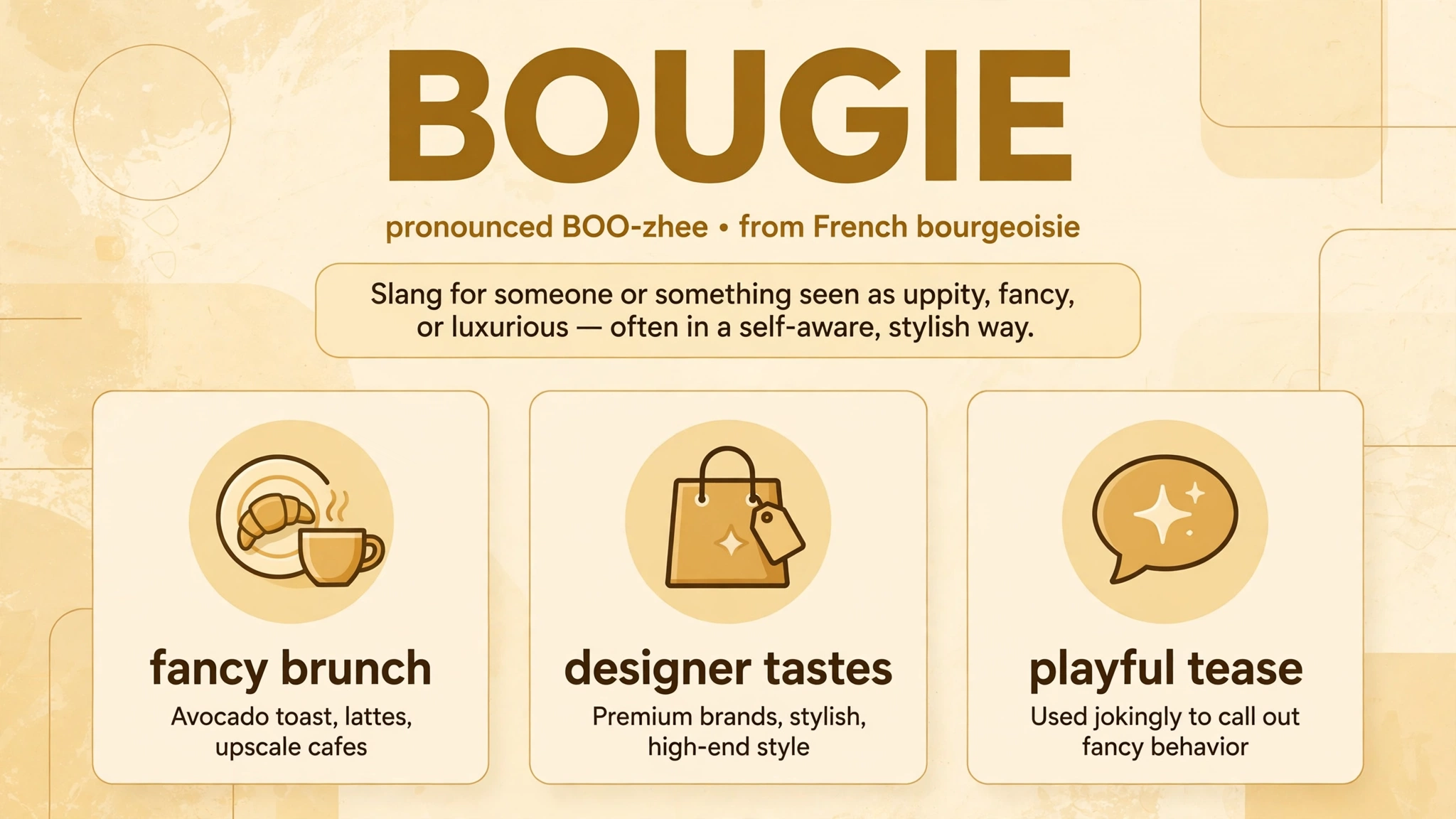
Quick Definition: In slang, “bougie” (pronounced BOO-zhee, also spelled “boujee”) describes someone with expensive or refined tastes — think fancy brunches, designer bags, and artisanal everything. It’s playful rather than mean: calling a friend bougie is usually a compliment wrapped in a tease about their high-maintenance habits.
Bougie Slang Meaning & Definition
Bougie is an adjective used to describe a person, habit, place, or thing that reflects upscale, luxurious, or pretentious tastes. If your friend refuses instant coffee but happily pays eight dollars for a single-origin pour-over with oat milk, congratulations — you have a bougie friend. If you book the hotel with the infinity pool instead of the one across the street, you might be a little bougie yourself.
The word comes from “bourgeoisie,” the French term for the middle and upper-middle class — people whose wealth is relatively new and who enjoy displaying it. In modern slang, bougie carries both admiration and gentle mockery. It celebrates aspiration and the finer things in life while poking fun at anyone who takes their luxury a little too seriously. A “bougie brunch” is not just breakfast; it is mimosas, a waitlist, and avocado toast that costs more than your lunch. A “bougie apartment” has a doorman, a rooftop, and rent that makes your parents nervous.
Importantly, bougie is almost never a serious insult. It lives in the same playful space as calling someone “fancy” or “high maintenance” — said with a laugh, often by people who secretly want the same lifestyle. You will hear it among friends, on TikTok, in memes, and in hip-hop lyrics, where it has become one of the most durable slang terms of the last decade.
Introduction
Some slang words flash across the internet and vanish in a month. Bougie did the opposite — it arrived in the 2010s, got cemented by one of the biggest rap songs of the decade, and is still going strong in 2026. Part of its staying power is that it names something everyone recognizes: the friend who will not fly economy, the coworker with the curated desk, the cousin whose wedding had a live jazz band. Bougie gives that behavior a name, and the name is fun to say.
The word also tells a bigger story about class, culture, and aspiration. It was popularized in Black American culture and hip-hop, where flaunting success — turning struggle into luxury — is both an art form and a statement. Understanding bougie means understanding that tension between admiration and side-eye, between wanting nice things and not wanting to seem like you want them too badly.
In this guide, we break down the full bougie slang meaning: where it came from, how it exploded into the mainstream, how people use it in everyday conversation, and the mistakes to avoid. Whether you heard it in a Migos lyric, saw it in a meme, or got called it by your best friend, you will leave knowing exactly what it means. And like other viral internet terms — from Gen Alpha slang to sigma slang — bougie has its own unwritten rules, which we will cover too.
Origin
The road to “bougie” starts in 19th-century France. “Bourgeoisie” (pronounced boor-zhwah-ZEE) referred to the middle and upper-middle classes — merchants, professionals, and property owners who were wealthy but not aristocracy. Over time, in English, “bourgeois” picked up a second meaning: conventional, materialistic, obsessed with respectability and comfort. Artists and intellectuals used it as an insult for people who cared more about appearances than substance.
American hip-hop picked up the shortened form “bougie” (sometimes “boujee”) and flipped it. In Black American culture, the term became a playful badge of upward mobility — a wink at the idea of “making it” and enjoying the rewards. Rappers used it to describe lavish lifestyles: the cars, the clothes, the champagne. It was aspirational rather than critical, a celebration of success with a knowing smile about how over-the-top it could get.
The word’s defining moment came in 2016, when Atlanta rap trio Migos released “Bad and Boujee” featuring Lil Uzi Vert. The track spent three weeks at number one on the Billboard Hot 100 and turned “boujee” into a national catchphrase overnight. Suddenly everyone — not just hip-hop fans — was calling their brunch boujee, their friends boujee, their entire lifestyle boujee. The song’s hook made the word impossible to ignore, and its spelling variant (“boujee”) entered the mainstream alongside the original.
Merriam-Webster eventually took notice, adding an entry that defines the term for a mainstream audience — you can read their official definition at Merriam-Webster’s dictionary entry for “bougie”. From French class theory to Atlanta trap music to the dictionary: that is quite a journey for one little word.
Popularity
Bougie hit peak saturation in the late 2010s, right after “Bad and Boujee” dominated the charts. Memes did the rest of the work. The “bougie” meme format — usually contrasting an expensive, curated version of something with a basic one — spread across Instagram, Twitter, and later TikTok. “Bougie on a budget” became its own subgenre: people showing how to fake a luxury lifestyle with thrift-store finds and clever hacks.
Brands noticed. Restaurants started advertising “bougie brunches,” hotels marketed “bougie getaways,” and beauty influencers built entire personal brands around being “bougie but relatable.” The word became marketing shorthand for “affordable luxury” — premium enough to feel special, approachable enough to buy.
On TikTok, bougie evolved again. Creators use it to rate everything: dorm rooms, first apartments, coffee orders, even pets. “Is my cat bougie?” is a genuine genre of video. The word’s flexibility is its superpower — it works as a noun (“she’s such a bougie”), an adjective (“that restaurant is so bougie”), and a vibe check (“this whole trip was very bougie”). In 2026, it has outlasted countless trend-cycle slang terms precisely because it describes a permanent human behavior: liking nice things a little too much.
How It Is Used
Bougie is used in three main ways in everyday conversation. First, as a lighthearted tease among friends: “You brought your own linen napkins to the picnic? You’re so bougie.” The tone is affectionate — it says “I see your fancy habits and I love you anyway.” This is by far the most common usage.
Second, as self-deprecating humor: “I know I’m being bougie, but I can’t drink hotel coffee.” People use it to acknowledge their own pickiness before anyone else can call it out. It is a social pressure valve — naming the behavior defuses any judgment around it.
Third, as a descriptor for places, things, and experiences rather than people: a bougie grocery store (the one with the cheese cave), a bougie gym (towel service, eucalyptus steam room), a bougie vacation (not a vacation — an “experience”). In this usage, it simply means upscale, curated, or premium — often with a hint that it might be slightly overpriced.
Grammatically, it is flexible. You will hear “bougie” and “boujee” used interchangeably, though “bougie” is the more standard spelling and “boujee” leans into the hip-hop pronunciation. Both are pronounced “BOO-zhee.” Avoid the common mispronunciation “BOO-gee” (rhymes with “boogie”) — that is a different word entirely, and mixing them up is a classic tell that someone learned the word from text rather than conversation.
Examples
Context changes everything with bougie. The same word can be a compliment, a roast, or a simple observation depending on who says it and how. Here is how it sounds across different settings.
Friendly Examples
Among friends, bougie is almost always affectionate — a way to celebrate someone’s taste while teasing them about it:
- “Girl, you ordered the truffle fries AND the champagne? We are being so bougie tonight and I love it.”
- “My roommate color-codes her closet and irons her bedsheets. She is bougie and she knows it.”
- “Okay, bougie brunch is my love language. Bottomless mimosas or nothing.”
- “He packed a charcuterie board for a road trip. A ROAD TRIP. That’s peak bougie behavior.”
- “We’re staying at the bougie hotel this time — the one with the rooftop pool. We deserve it.”
Professional Examples
In workplaces and formal writing, the slang form is usually softened or replaced — but the concept still appears:
- “The client prefers a more upscale — some might say bougie — venue for the launch event.” (spoken, informal meeting)
- “Our target demographic skews toward affluent, experience-driven consumers.” (the professional translation of “bougie customers”)
- “She has expensive taste in office design — very polished, very curated.” (polite workplace version)
- Tip: in a professional email, never write “bougie.” Use “upscale,” “premium,” or “high-end” instead. The slang belongs in conversation, not in a quarterly report.
Funny Examples
Comedy loves bougie because the gap between aspiration and reality is inherently funny:
- “I’m not bougie, I’m just financially irresponsible with good taste.”
- “My dog only drinks filtered water now. I didn’t raise him to be bougie, it just happened.”
- “Bougie is me buying the $14 candle and then eating ramen for a week to afford it.”
- “She said ‘I don’t do camping’ and booked a glamping tent with a chandelier. The bougie is strong with this one.”
- “POV: you’re bougie on a budget, so your ‘spa day’ is a face mask from the dollar store and a bath with the good towels.”

Comparison with Similar Terms
Bougie sits in a crowded neighborhood of slang about class, taste, and lifestyle. Here is how it compares to its closest relatives:
| Term | Core Meaning | Tone | How It Differs from Bougie |
|---|---|---|---|
| Bougie / Boujee | Expensive tastes, fancy habits | Playful, admiring | — (the reference point) |
| Basic | Unoriginal, mainstream tastes | Mildly insulting | Basic is bougie’s opposite: pumpkin-spice mainstream vs. curated luxury. You can be bougie without being basic, but “bougie basic” is a real roast — expensive AND unoriginal. |
| High maintenance | Requires a lot of effort/money to satisfy | Neutral to critical | Describes the cost of keeping someone happy; bougie describes the taste itself. A bougie person is often high maintenance, but not always. |
| Extra | Over-the-top, dramatic | Playful | Extra is about intensity and drama; bougie is specifically about luxury. An extra person makes a scene; a bougie person orders the tasting menu. |
| Pretentious | Faking sophistication to impress | Genuinely insulting | Pretentious accuses someone of being fake; bougie assumes the taste is real (if a bit much). Calling someone pretentious starts a fight; calling them bougie starts a laugh. |
| Keeping up with the Joneses | Competing with neighbors’ lifestyle | Critical | An older idiom for the same insecurity bougie playfully celebrates — buying things to signal status. Bougie is the modern, funnier version. |
The key distinction: bougie is the only term on this list that is primarily affectionate. It admires the aspiration even as it laughs at it — which is why it survived while harsher class-based slang faded.

Alternate Meanings
Bougie has a few meanings beyond the slang, and context will tell you which one someone intends:
- Medical: In medicine, a “bougie” (pronounced boo-ZHEE) is a slender instrument used to dilate a passage in the body, such as the esophagus. Same spelling, completely unrelated — you will only encounter this in a clinical setting.
- Candle (French): “Bougie” is the French word for “candle.” If you see it on a French menu or product label, it has nothing to do with slang.
- Bad and Boujee: As a proper-noun reference, “boujee” instantly evokes the Migos song. Saying “we’re feeling bad and boujee tonight” is a direct lyrical quote meaning you’re going all-out.
- Bougie as a noun: Occasionally used to label a person (“he’s a bougie”), though the adjective form (“he’s so bougie”) is far more common.
In 99% of everyday conversation — texts, TikTok, memes, casual chat — bougie means the slang definition: fancy tastes, playful tease. The other meanings only appear in specialized contexts.
Professional or Polite Alternatives
There are times when “bougie” is too casual: job interviews, client emails, formal writing, or conversations with people who might not know the slang. Use these instead:
- Upscale — “an upscale restaurant” (the safest all-purpose substitute)
- High-end — “high-end fashion” (emphasizes price and quality)
- Refined / sophisticated — “refined tastes” (complimentary, zero slang)
- Premium — “a premium experience” (marketing-friendly)
- Luxurious — “a luxurious getaway” (stronger, more formal)
- Discerning — “a discerning palate” (frames pickiness as expertise)
- Well-appointed — “a well-appointed apartment” (real-estate speak for bougie)
Rule of thumb: if you would not say it to your grandmother’s book club, swap in one of these. Bougie is for friends, social media, and casual writing — the alternatives are for everything else.
Common Mistakes
Bougie is easy to use but also easy to misuse. Avoid these classic errors:
- Pronouncing it “BOO-gee”: The correct pronunciation is “BOO-zhee” (soft French zh sound, like the s in “measure”). Rhyming it with “boogie” instantly marks you as someone who has only read the word.
- Using it as a serious insult: Bougie is playful, not cruel. If you genuinely want to criticize someone’s snobbery, “pretentious” or “elitist” is what you mean. Deploying bougie with real venom misreads the room.
- Confusing it with “basic”: They are opposites. Basic = unoriginal mainstream tastes; bougie = upscale, curated tastes. Calling a luxury handbag “basic” or a pumpkin-spice latte “bougie” gets it exactly backwards.
- Spelling wars: “Bougie” and “boujee” are both accepted. “Bougie” is the standard dictionary spelling; “boujee” is the hip-hop variant popularized by Migos. Do not “correct” someone’s spelling — both are right.
- Forgetting the cultural roots: Bougie was popularized in Black American culture and hip-hop. Using it while mocking the culture it came from — or using it to punch down at people aspiring to a better life — misses the point. Keep it respectful and playful.
- Overusing it: Like any slang, bougie loses its punch if every other sentence includes it. Save it for moments that genuinely deserve the label.

Quick Tips
- Default to playful: Say it with a smile. Bougie lands best as a tease among friends, not as commentary on strangers.
- Try it on yourself first: Self-deprecating bougie (“I’m being so bougie about this hotel”) is always safe and usually funny.
- Pair it with specifics: “Bougie” alone is vague; “bougie brunch with the bottomless mimosas” paints the picture. Details make it land.
- Read the room: With close friends, anything goes. With new acquaintances or in mixed company, keep it light — not everyone enjoys having their spending habits labeled.
- Use “bougie on a budget” for relatability: This phrase is gold on social media — it celebrates the aspiration while admitting the reality. Instant engagement.
- Keep it out of formal writing: Resumes, cover letters, academic papers, and client proposals need “upscale” or “premium,” not slang.
- Embrace the duality: The best bougie jokes acknowledge both sides — loving nice things AND knowing it is a little ridiculous. That tension is the whole joke.

FAQ
What does bougie slang mean?
Bougie slang describes someone or something with expensive, fancy, or refined tastes — like pricey brunches, designer clothes, or luxury habits. It comes from the French word “bourgeoisie” (upper-middle class) and is used playfully, usually as a teasing compliment rather than a real insult.
How do you pronounce bougie?
Bougie is pronounced “BOO-zhee,” with a soft French zh sound like the s in “measure.” Do not pronounce it “BOO-gee” (rhyming with “boogie”) — that is the most common mistake people make with this word.
Is bougie a compliment or an insult?
It is usually a playful compliment or a lighthearted tease. Calling a friend bougie says “I admire your taste, even if it is a little extra.” It only stings if delivered with genuine contempt — in which case the speaker probably means “pretentious” instead.
What is the difference between bougie and boujee?
There is no difference in meaning — they are spelling variants of the same word. “Bougie” is the standard dictionary spelling; “boujee” is the variant popularized by Migos’ 2016 hit “Bad and Boujee.” Use whichever you prefer.
Where did bougie slang come from?
Bougie comes from “bourgeoisie,” the French term for the upper-middle class. It was popularized in Black American culture and hip-hop as a playful word for luxurious tastes, then exploded into the mainstream after Migos released “Bad and Boujee” in 2016, which hit number one on the Billboard Hot 100.
What is the opposite of bougie?
“Basic” is the closest opposite — it describes unoriginal, mainstream tastes (think pumpkin-spice everything). Where bougie means curated and upscale, basic means generic and trend-following. The ultimate roast combines them: “bougie basic” means expensive AND unoriginal.
Can bougie describe things, not just people?
Absolutely. People say “bougie brunch,” “bougie hotel,” “bougie grocery store,” and “bougie vacation” all the time. When applied to things, it simply means upscale, curated, or premium — often with a wink that it might be slightly overpriced.
Is it okay to call someone bougie?
Among friends, yes — it is almost always received as affectionate teasing. Be more careful with acquaintances, coworkers, or anyone sensitive about money and class. When in doubt, use it on yourself first (“I’m being so bougie about this”) — self-deprecation is always safe.
Conclusion
Bougie earned its place in the slang hall of fame the hard way: it is funny to say, instantly understood, and describes something real about how people live. From its French roots in “bourgeoisie” through Black American culture and hip-hop to a Migos chart-topper and finally the dictionary, it has traveled further than almost any slang term of its generation — and it is still evolving on TikTok in 2026.
The secret to using it well is the same secret behind all great slang: know the tone. Bougie is admiration with a wink, aspiration with a laugh. Use it to celebrate the friend with the impeccable taste, to roast yourself for the eight-dollar coffee, and to name the little luxuries that make life fun. Just keep it playful, keep it respectful of its roots, and keep it out of your cover letter.
Want to decode more of the internet’s favorite words? Check out our guides to glizzy meaning and looksmaxxing meaning next — your group chat will thank you.
SEO Meta Title: Bougie Slang Meaning: The Complete 2026 Guide
SEO Meta Description: What does bougie slang mean? Discover its hip-hop origin, playful definition, real examples, and how to use this fancy-tastes slang word correctly in 2026.
SEO-Friendly URL Slug: bougie-slang
Pinterest/SEO Feature Image Prompt: Clean 1200×630 cover graphic, bold elegant typography with only the word “BOUGIE” centered on a luxurious champagne-gold gradient background with subtle sparkle accents, no emojis, high-contrast, Pinterest-optimized.
