Quick definition: In slang, OP most commonly means original poster — the person who started a thread or post on Reddit, forums, and TikTok comments. In gaming, OP means overpowered, describing a weapon, character, or ability that is unfairly strong. The correct meaning always depends on context.
OP Meaning Slang & Definition
If you have spent any time in comment sections, you have seen it: a reply that starts with “OP said…” or a gamer raging that a weapon is “so OP”. Same two letters, two totally different meanings — and mixing them up is the fastest way to look lost in a conversation.
The OP meaning slang question comes down to two dominant definitions:
- Original Poster — the person who created the post or thread you are reading. Used on Reddit, forums, TikTok comments, Discord, and anywhere threaded discussion happens.
- Overpowered — in gaming, something that is too strong relative to everything else. An OP weapon dominates matches; an OP character wins unfairly.
There are also rarer uses — “opps” (opposition/enemies) in UK drill and rap slang, and “op” as shorthand for an operation or mission — which we will cover below so you can tell them apart.
In this guide, you will learn exactly what OP means in each context, where the term came from, how to use it naturally on Gen Alpha slang-filled comment sections and gaming lobbies alike, the mistakes that give away beginners, and quick tips for getting it right every time.
Introduction
Picture two scenes. In the first, you are scrolling Reddit when someone comments, “OP never mentioned that — read the post again.” In the second, you are mid-match in your favorite shooter and a teammate yells, “That sniper is so OP, it needs a nerf!” Same two letters. Completely different conversations.
That is what makes OP meaning slang tricky: OP is one of the internet’s oldest pieces of shorthand, but because it grew up in two different worlds — forums and video games — it picked up two different lives. Online, it quietly became the standard way to talk about the person who started a discussion. In gaming culture, it became the go-to complaint word for anything too strong.
And now the lines are blurring. TikTok comments are full of both meanings, Discord servers mix gaming slang with general chat, and new users regularly guess wrong. A teenager might call a trending sound “OP” (overpowered, meaning unstoppable), while the person who uploaded it — the actual original poster — is right there reading the comments. Context confusion is real.
The good news: once you learn the two main meanings and the simple rule for telling them apart, you will never hesitate again. This guide breaks down both definitions, traces where each came from, gives you real examples from Reddit threads, TikTok comments, and gaming chats, and shows you exactly how to use OP like someone who has been online for years.

Origin
The story of OP starts in the early days of internet forums, long before TikTok or even Reddit existed. On old-school message boards in the late 1990s and early 2000s, threads could run for hundreds of replies, and people needed a quick way to refer to the person who started the whole thing. Typing out “the person who made the original post” every time was tedious, so OP (original poster) caught on as shorthand.
When Reddit launched in 2005, it baked the concept into its culture. Redditors constantly reference the OP — the original poster of the thread — and Reddit eventually gave the OP a special blue “OP” badge on their comments so readers could spot them instantly. That badge cemented OP as a universal internet word. Today, if you say “OP” on any forum, Discord server, or TikTok comment thread, everyone knows you mean the original poster.
The gaming meaning — OP (overpowered) — grew up separately, in multiplayer game communities. In competitive games like World of Warcraft, League of Legends, and later Call of Duty and Fortnite, balance is everything. When developers released a weapon or character that dominated everyone else, players complained it was “overpowered.” Shortened to OP, it became the standard word for anything too strong: an OP gun, an OP strategy, an OP build. The term even spawned its opposite — players now call weak, outdated gear “underpowered” or say it “needs a buff.”
Interestingly, the two meanings rarely collide because the contexts are so different — but both are genuinely old internet slang, dating back well over a decade before most of today’s viral terms like mewing or glizzy existed.
Popularity
OP is one of the rare pieces of internet slang that never faded. While trend-driven terms explode and die within months, OP has stayed relevant for nearly two decades — and it is arguably more popular now than ever, because the places people use it have multiplied.
On Reddit, OP is infrastructure: thousands of comments every day say things like “OP is right” or “OP, update us!” The word is so embedded that new users learn it within their first week. On TikTok, “OP” shows up in comments constantly — “OP ate with this video” means the original poster did great work. On Discord and Twitter/X, both meanings live side by side: someone posts a clip, and the replies argue about whether the move shown was OP (overpowered) while tagging the OP (original poster).
In gaming, OP is arguably the single most-used balance word in existence. Patch notes, YouTube tier lists, and Twitch chat are full of it: “this build is OP,” “nerf OP characters,” “most OP loadout.” Game developers themselves now use the term when addressing balance changes, which shows how completely it has entered the mainstream vocabulary.
There is even a cultural spillover: “OP” has crossed into sports commentary (“that rookie is OP”), anime fandom (“this episode was OP”), and everyday group chats (“my new phone’s camera is OP”). When a slang term survives for 15+ years and keeps spreading, it has earned its place.
How It Is Used
The rule for using OP correctly is simple: figure out the context first, then pick the meaning.
- Discussion context (Reddit, forums, comments): OP = original poster. Use it as a noun to refer to the person who started the thread. Example: “OP’s story is wild.” You would never use it as an adjective here — nobody says “that comment is so OP” when talking about a poster.
- Gaming context (matches, patch notes, tier lists): OP = overpowered. Use it as an adjective describing something too strong. Example: “This sniper is OP.” You would never use it to refer to a person here — well, almost never, more on that below.
Grammar-wise, OP is flexible. As a noun: “The OP deleted their account.” As an adjective: “That’s an OP weapon.” As a verb-ish phrase: “Stop OP-shaming” is rare, but people do write “OP pls nerf” in gaming chats, jokingly treating the OP (original poster/developer) as the person responsible.
One gray area: in gaming, people sometimes call a player OP — “you’re so OP at this game” — meaning their skill level is overwhelmingly strong. That is a playful extension of “overpowered,” not “original poster.” Similarly, on TikTok, creators who go viral are sometimes called “OP” in the overpowered sense: “Bro’s editing is OP.” Context — comments vs. gameplay — is your only reliable guide.
| Context | OP means | Example |
|---|---|---|
| Reddit / forum thread | Original poster | “OP never replied to the top comment.” |
| TikTok / video comments | Original poster | “OP really cooked with this edit.” |
| Gaming lobby / match | Overpowered | “That shotgun is so OP.” |
| Tier lists / patch notes | Overpowered | “Most OP builds after the update.” |
| Sports / everyday chat | Overpowered (figurative) | “Her serve is OP.” |
Examples
Here is how OP shows up in real conversations, split by tone and setting.
Friendly Examples
- “Welcome to the sub! OP, can you share an update?” — warmly asking the original poster for more info on Reddit.
- “OP really said ‘let me just casually drop the best video of the year.'” — a TikTok comment hyping up the creator.
- “Your aim is OP, teach me your settings.” — complimenting a friend’s gaming skill.
- “Thanks OP! This fixed my problem.” — thanking the person who posted a helpful thread.
Professional Examples
- “As the OP of this thread, I want to clarify my original point.” — used in a formal forum discussion.
- “The development team acknowledged that the new character is OP and will rebalance it in the next patch.” — a professional gaming article describing balance issues.
- “Per OP’s edit, the meeting time has changed.” — a workplace-adjacent community update.
Funny Examples
- “OP delivered. OP always delivers. We do not deserve OP.” — a classic over-the-top Reddit praise comment.
- “Bro thinks he’s the OP 💀” — joking when someone acts like they run the comment section.
- “That boss fight was OP…ly unfair and I’m uninstalling.” — dramatic gamer rage, played for laughs.
- “Me: exists. My sleep schedule: OP (overpowered).” — meme format joking that insomnia is unbeatable.

Comparison with Similar Terms
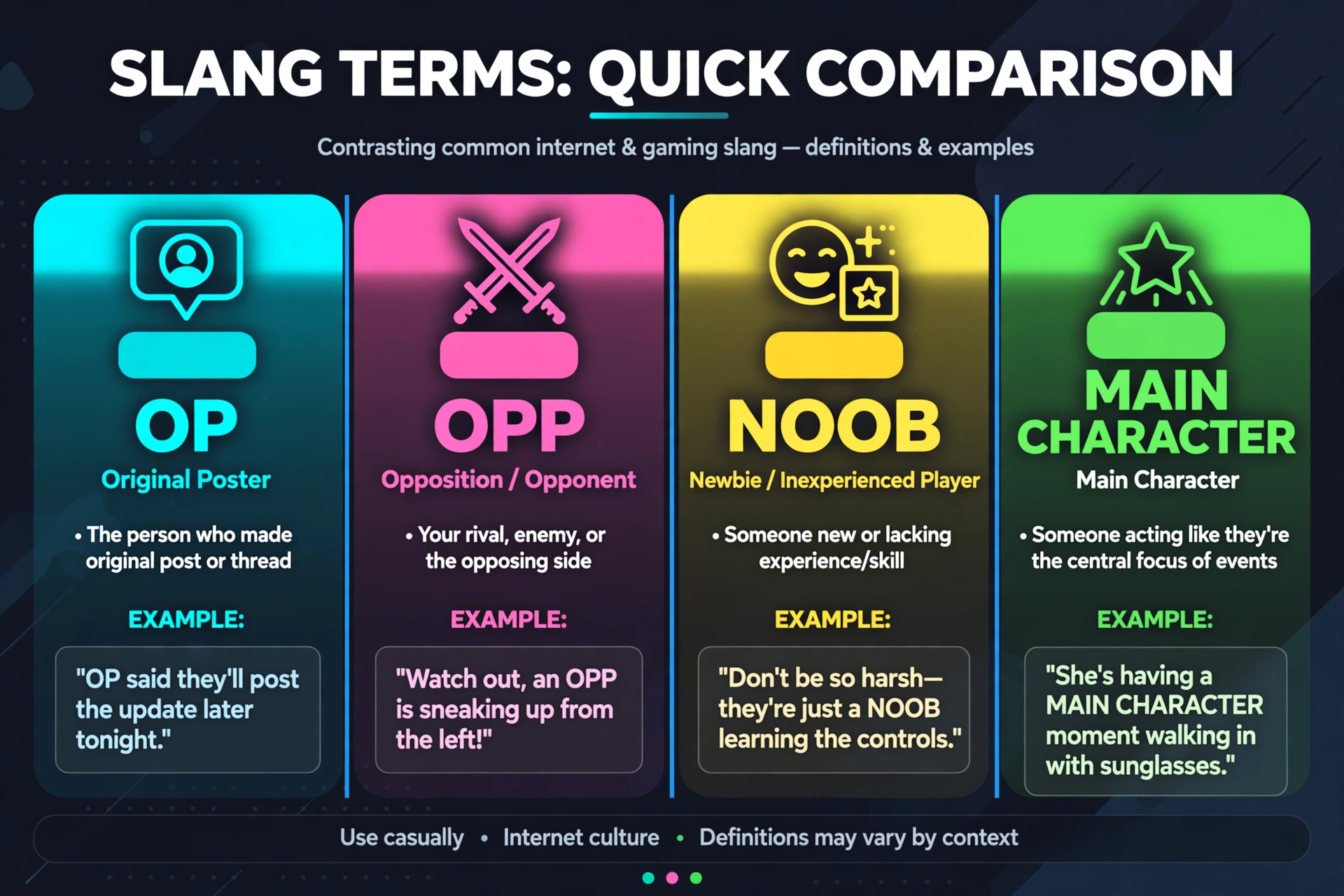
OP has a few lookalikes and neighbors that are easy to confuse. Here is how they differ:
| Term | Meaning | How it differs from OP |
|---|---|---|
| OPP / Opps | Opposition — rivals or enemies (UK drill/rap slang) | Sounds like OP but is a totally different word; “opps” = people against you, never the original poster. |
| Noob | A new or unskilled player | The opposite of an OP player — a noob is weak, an OP build is dominant. |
| Main character | Someone acting like the world revolves around them | About attitude and attention; OP (overpowered) is about strength and balance. |
| GOAT | Greatest of all time | A compliment about overall greatness; OP specifically means unfairly strong right now. |
| Meta | The most effective tactics available | An OP weapon is usually part of the meta, but “meta” describes the whole strategy landscape, not one item. |
| Nerf / Buff | Weaken / strengthen (game balance terms) | What happens to OP things — developers nerf OP weapons and buff weak ones. |
The biggest mix-up is OP vs. opps. If someone in a rap lyric or UK drill context says “the opps,” they mean enemies — spelled with two p’s and an s. If a Redditor says “the OP,” they mean the original poster. One extra letter changes everything, so read carefully.
Alternate Meanings
Beyond the big two, OP pops up with a few other meanings depending on where you are:
- Opposition / Opps (UK drill & rap): In UK drill and some hip-hop, “opps” (short for opposition) means rivals or enemies. “Watch out for the opps” has nothing to do with forum posters or game balance — it is street slang for people working against you.
- Operation: In military, gaming-clan, and roleplay contexts, “op” can be short for operation — a planned mission. “Tonight’s op starts at 8” means a scheduled group activity, not an overpowered weapon.
- Original Post (not poster): Some people use OP to mean the original post itself rather than the person: “Link the OP” = link the original post. Both readings are common, and the difference rarely matters.
- Over Posting: Very rarely, in old forum moderation, “OP” was jokingly read as “over-posting” for users who spammed threads. This usage is basically extinct now.
When in doubt, the two-meaning rule covers 95% of real cases: discussion context = original poster, gaming/strength context = overpowered. The alternates above are the other 5%.
Professional or Polite Alternatives
OP is casual internet slang, so it does not belong in formal writing, work emails, or academic papers. Here is what to say instead:
- Instead of “OP” (original poster): “the original author,” “the thread starter,” “the person who posted this.” Example: “As the original author noted in the first post…”
- Instead of “OP” (overpowered): “unbalanced,” “dominant,” “overly strong,” “disproportionately powerful.” Example: “This strategy is disproportionately powerful compared to the alternatives.”
- In customer support / community management: refer to people by name or username rather than “OP” — it feels warmer and more personal.
That said, in gaming journalism, tech blogs, and community management, “OP” (overpowered) has become accepted professional shorthand — you will see it in official patch notes and esports commentary without anyone blinking.
Common Mistakes
These are the errors that instantly mark someone as new to the term:
- Calling yourself OP: On Reddit, you are the OP of your own thread — but announcing “I’m the OP” sounds awkward. People will figure it out from the badge. Just say “I posted this” or “to clarify my original post.”
- Mixing up OP and opps: “The opps are after me” (enemies) vs. “the OP never replied” (original poster). One is danger, the other is a forum user. Do not swap them.
- Using OP (overpowered) in serious discussion: Telling a coworker their presentation was “OP” will confuse them. Save the gaming meaning for gaming contexts and casual chats.
- Assuming only one meaning: Reading a gaming forum and thinking “OP” means original poster — or reading Reddit and thinking it means overpowered — leads to total misreads. Always check the context first.
- Overusing it: Calling everything OP drains the word of meaning. If every weapon is OP, none of them are. Save it for things that genuinely stand out.

Quick Tips
- Check the context first: Thread or comments? OP = original poster. Game, match, or tier list? OP = overpowered. This one rule solves nearly every case.
- On Reddit, look for the badge: The original poster’s username gets a special “OP” marker, so you never have to guess who it is.
- In gaming chats, pair it with specifics: “OP” alone is vague — “that SMG is OP at close range” tells people exactly what you mean.
- Don’t correct people aggressively: If someone uses the “wrong” meaning, they probably just come from the other context. A friendly “on Reddit OP usually means original poster” works better than mockery.
- Watch for “OP” in TikTok comments: Creators love being called OP (overpowered = amazing), and commenters use OP (original poster) to address them. Both can appear in the same thread.
- When writing guides, define it once: If your audience mixes gamers and non-gamers, write “OP (original poster)” or “OP (overpowered)” the first time, then use it freely.

FAQ
What does OP stand for in slang?
OP stands for original poster (the person who started a thread or post) or overpowered (something unfairly strong in gaming). The term grew up on discussion sites like Reddit and in multiplayer game communities, which is why it has two lives.
What does OP mean on Reddit?
On Reddit, OP always means original poster — the user who submitted the post. Reddit marks the OP’s comments with a special badge, and commenters constantly reference the OP (“OP, please update us!”).
What does OP mean in gaming?
In gaming, OP means overpowered — a weapon, character, ability, or strategy that is too strong compared to everything else. Players say “nerf” (weaken) OP items and “buff” (strengthen) weak ones to restore balance.
What does OP mean on TikTok?
Both meanings appear on TikTok. In comments, OP usually means original poster — the creator of the video (“OP ate with this”). But people also call impressive things OP in the overpowered sense (“his transitions are OP”).
Is OP an insult?
Almost never. Calling someone the OP is neutral — it just identifies who posted. Calling something OP (overpowered) is usually a complaint about game balance, not the person. The only insult-adjacent use is “opps” (with two p’s), which means enemies in drill/rap slang — a different word.
What’s the difference between OP and opps?
OP (one p) = original poster or overpowered. Opps (two p’s, with an s) = opposition, i.e., rivals or enemies, from UK drill and hip-hop slang. They sound similar but mean completely different things.
Can I call myself OP?
Technically you are the OP of your own post, but announcing it sounds odd — your OP badge on Reddit already says it for you. In gaming, calling yourself OP (“I’m so OP”) is fine as playful bragging about your skill.
What is the opposite of OP in gaming?
Players say a weak item is “underpowered,” “trash tier,” or that it “needs a buff.” In tier lists, the opposite of an OP (S-tier) pick is usually an F-tier pick.
Conclusion
OP meaning slang boils down to two words: original poster and overpowered. If you are in a thread, it is the person who started it. If you are in a game, it is the thing that is too strong. That is genuinely all there is to it — and now you will never mix them up.
What makes OP special is its staying power. Born on ancient forums and early multiplayer games, it survived the rise and fall of countless trendier terms and is now used daily by millions of people across Reddit, TikTok, Discord, and every major game. It is proof that the most useful slang is not the flashiest — it is the shorthand that solves a real communication problem.
So the next time someone writes “OP said it best,” you will know they are talking about the original poster — and the next time a teammate screams “that gun is OP,” you will know exactly which kind of OP they mean. Want to decode more internet shorthand? Check out our guides to mewing, glizzy, and sigma slang — the terms filling up the same comment sections where OP lives.

2 thoughts on “OP Meaning Slang: What It Means on Reddit, TikTok & in Gaming”