Quick definition: In slang, OAT most often stands for “of all time.” People write oat meaning slang into search because the same three letters also name a breakfast grain, and the slang sense only makes sense in context. When someone says “best movie OAT” or “worst referee OAT,” they are not talking about breakfast. They are placing something at the extreme end of a ranking — the best, worst, funniest, or most embarrassing example ever, in their opinion. It is a short, dramatic superlative, and it works because it borrows the weight of a phrase everyone already knows.
Oat Meaning Slang: Definition and Quick Answer
OAT is an initialism, pronounced exactly like the grain: “oat.” In online slang it is shorthand for “of all time,” and it almost always follows a superlative or a judgment word. You will see it as “best OAT,” “worst OAT,” “funniest OAT,” “greatest OAT,” or simply attached to a noun phrase: “that goal was OAT.” On its own it is incomplete. It needs the word before it to tell you whether the ranking is praise or a roast.
That dependence on context is the whole trick of the word. “OAT” does not praise by itself. “Best album OAT” is a crown. “Worst take OAT” is a demolition. The letters stay the same; the adjective in front of them decides everything. If you read only the three letters and skip the rest of the sentence, you will miss the point entirely.
| Question | Short answer |
|---|---|
| What does OAT mean in slang? | “Of all time” — the best, worst, or most extreme example ever, in the speaker’s opinion |
| How is it usually written? | Uppercase OAT, usually after best, worst, funniest, or greatest |
| How is it pronounced? | Like the grain: “oat” |
| Where do people use it? | TikTok comments, Instagram captions, X posts, group chats, sports and fandom talk |
| Is it formal? | No — casual slang, not for work emails or formal writing |
| Is it the same as GOAT? | Related, but not identical — GOAT names a person or thing; OAT completes a ranking phrase |
Think of OAT as a shortcut for a sentence people used to write out in full. Instead of typing “that is the best performance I have ever seen in my life,” a commenter types “best performance OAT” and trusts the reader to fill in the rest. In fast-moving comment sections and chats, that saving matters. The meaning survives the cut because “of all time” is one of the most familiar ranking phrases in English.
Introduction
You are scrolling comments under a highlight reel when you see it: “Best goal OAT, no debate.” A few posts later, under a cooking fail, someone writes: “Worst pancakes OAT.” Then a friend texts you about a movie: “Funniest film OAT, you have to watch it.” The same three letters keep showing up, in praise and in mockery, and nowhere does anyone stop to explain them. That is how modern slang travels now — not through dictionaries first, but through repetition, until not knowing feels like being the only person outside the joke.
The confusion is understandable, and it is not only about the slang. “Oat” is an ordinary English word. It is a grain, the stuff of oatmeal and granola bars. It also appears in old idioms such as “feeling your oats” and “sowing your oats,” which have nothing to do with rankings at all. So when the letters appear in all caps in the middle of a heated debate about albums, athletes, or sitcoms, a reader has every reason to pause. Is this a typo? A food joke? A new acronym to memorize?
This guide answers that question properly. It explains what oat meaning slang covers in current online use, where the short form came from, how people actually deploy it in texts and comments, and where it goes wrong. It also separates the dominant meaning from the rare ones, compares OAT with its famous cousin GOAT, and gives you ready-to-use examples so you can read it instantly — and use it without sounding as if you are trying too hard. If you have ever stared at “OAT” and nodded along while quietly unsure, this is the article that ends that.

Origin
OAT did not arrive with a launch date, a creator, or a viral video that everyone can point to. It grew out of a phrase that was already everywhere. “Of all time” has been the standard way to make a superlative absolute for generations: the greatest player of all time, the best album of all time, the worst movie of all time. Sports commentary, music lists, and everyday arguments all leaned on it long before social media existed.
The first half of the story belongs to GOAT. “Greatest of all time” was popularized in sports — Muhammad Ali was famously described as the greatest of all time, and the phrase later became a cultural shorthand through athletes, rappers, and endless ranking debates. LL Cool J titled an album G.O.A.T. in 2000, and by the 2010s the goat emoji had become a visual crown in comment sections. GOAT proved that a ranking phrase could survive being squeezed into four letters and still carry all of its drama.
OAT is the next squeeze. Once GOAT was familiar, dropping the “G” and keeping “OAT” felt natural in places where the superlative was already doing the work. If you have already written “best,” you do not need “greatest” as well. “Best OAT” says the same thing as “best of all time” with three letters instead of nine, and in a comment section, three letters win. That is not a theory about one post going viral; it is how abbreviation works when a community is typing fast, ranking constantly, and competing to sound certain.
That history also explains why OAT feels both new and old at the same time. The letters are new as a standalone slang term. The phrase behind them is not. Nobody had to teach English speakers what “of all time” meant. The slang only had to teach them that OAT was the short form, and the surrounding words — best, worst, funniest — did the rest of the teaching, one comment at a time.
Popularity
OAT lives where rankings live. Sports arguments are its natural habitat: best goal, worst call, greatest comeback. Music fandom runs a close second, with album and artist rankings filling comment sections after every release. Gaming, movies, memes, and food takes follow the same pattern. Anywhere people argue about “the best ever,” OAT has a job to do.
TikTok and Instagram comments spread it fastest, because both reward short, confident takes. A caption that reads “best chorus OAT” is easier to read, easier to agree with, and easier to argue against than a full sentence. X posts use it the same way, often as the punchline of a quote-post. Group chats use it more loosely, as an in-joke superlative between friends who already share a ranking history: the worst parking job OAT, the funniest typo OAT, the best fries OAT.
Its popularity also reflects a broader shift in how Gen Alpha and Gen Z slang handles emphasis. Older internet slang often invented new words. This generation often compresses old phrases instead. OAT, like other clipped forms, keeps the meaning of a full expression while fitting the speed of the platform. It is not trying to be mysterious. It is trying to be fast, and to sound final. Saying something is the best “of all time” closes a debate, or at least pretends to — and that confidence is part of the appeal.
That said, OAT has not replaced GOAT, and it probably will not. GOAT can stand alone as a noun — “She is the GOAT” is a complete sentence. OAT cannot do that job. It remains a phrase-finisher, not a title. Its popularity is real but bounded: strong in rankings and reactions, weak anywhere a standalone label is needed. Knowing that boundary is what separates people who use it naturally from people who force it into sentences where it does not belong.
How It Is Used
OAT follows a simple pattern. It comes at the end of a ranking phrase, after a superlative adjective or a noun that the adjective has already modified. The most common shapes are:
- Superlative + OAT: “Best OAT.” “Worst OAT.” “Funniest OAT.”
- Superlative + noun + OAT: “Best album OAT.” “Worst finale OAT.” “Greatest comeback OAT.”
- Sentence + OAT as a closer: “That save was OAT.” “This episode? Funniest OAT.”
The tone is almost always bold and a little theatrical. OAT is not a quiet word. It claims a top spot across all of history, which is an absurd claim if you take it literally — nobody has seen every movie ever made — and everyone using it knows that. The exaggeration is the point. It signals passion, certainty, and a willingness to argue. In friendly contexts that reads as enthusiasm. In rival fandoms it reads as a challenge.
Capitalization matters more than it usually does with slang. Uppercase OAT signals the acronym. Lowercase “oat” in the middle of a sentence about breakfast, farming, or recipes almost certainly means the grain. Writers who type “oat” in lowercase in a ranking comment risk being misread, and readers who see lowercase “oat” should check the topic before assuming slang. When in doubt, the topic decides: food talk means grain, ranking talk means “of all time.”
OAT also works as a reply on its own, but only as an echo. If a friend writes “That was the best concert ever,” replying “OAT” works as agreement — you are completing their ranking. Replying “OAT” to an unrelated message, with no ranking in sight, will confuse people. The word needs a ranking to attach to, even if that ranking lives in the previous message rather than in the same one.
| Context | Typical use | Tone |
|---|---|---|
| Sports comments | “Best goal OAT” | Confident, argumentative |
| Music fandom | “Best bridge OAT, I will not be taking questions” | Passionate, playful |
| Group chats | “Worst traffic OAT, I am still stuck” | Exaggerated, joking |
| Movie and TV talk | “Funniest episode OAT” | Enthusiastic, recommending |
| Memes and roasts | “Worst haircut OAT” | Teasing, not literal |
Examples
The fastest way to learn OAT is to see it in sentences that sound like real messages. Notice how little work the letters do on their own, and how much the words around them matter. In every example below, removing “OAT” leaves a normal opinion. Adding it turns the opinion into a verdict.
Friendly Examples
- “That homemade pizza was the best OAT. You have to teach me how you made the crust.”
- “Best road trip playlist OAT. I did not skip a single song.”
- “Your dog is the cutest OAT, and I am prepared to defend that ranking.”
- “Funniest voice note OAT. I have listened to it four times and I am still laughing.”
- “Best surprise OAT — I genuinely had no idea you were coming home this weekend.”
Friendly uses are generous and warm. The exaggeration is a compliment, not a claim to be fact-checked. Nobody hearing “best pizza OAT” from a friend assumes a scientific survey of all pizzas in history took place. They hear enthusiasm, and they usually return it.
Professional Examples
Here honesty matters: OAT is not professional language, and most workplaces are the wrong place for it. The examples below show the closest thing to a professional use — casual internal chat, social media work, and creative industries where ranking talk is part of the job — and they still carry risk. If a message could be forwarded to a client, a manager, or a formal record, write the phrase out in full or choose a neutral alternative instead.
- Internal team chat: “Best launch day OAT for our little team. Thank you all.”
- Social media draft, informal brand voice: “Funniest blooper OAT — should we post it?”
- Creative review, casual tone: “Strongest opening paragraph OAT. Keep that energy for the rest.”
Even in those cases, OAT works only because the audience already knows the slang and the relationship is informal. A performance review, a client email, a press release, or a presentation should never contain it. “Of all time” itself is fine in formal writing when it is accurate; the clipped form is not.
Funny Examples
- “Worst parallel park OAT. The curb filed a complaint.”
- “Most dramatic sneeze OAT. The whole office stopped working.”
- “Best accidental screenshot OAT — I captured my own double chin in 4K.”
- “Worst Wi-Fi OAT. I have seen carrier pigeons deliver faster.”
- “Funniest autocorrect OAT. My phone just told my boss I love lasagna instead of saying I will be late.”
Funny uses lean into the absurdity of ranking something trivial across all of history. The joke lands because the claim is so large and the subject is so small. That gap — eternal ranking, everyday mishap — is where most OAT humor lives.

Comparison with Similar Terms
OAT is easy to confuse with the words around it, because they share letters, history, or jobs. The table below keeps them apart. The key distinction is grammatical: GOAT is a label you can give someone, OAT is the tail end of a ranking phrase, and ordinary phrases such as “of all time” and “ever” can go places neither abbreviation can.
| Term | What it means | How it is used | Example |
|---|---|---|---|
| OAT | Of all time | Ends a ranking phrase | “Best album OAT” |
| GOAT | Greatest of all time | Stands alone as a noun or label | “She is the GOAT” |
| Of all time | The full phrase | Any register, including formal | “The best novel of all time” |
| Ever | At any time | General superlative ending | “The best day ever” |
| Peak | The highest point | Slang for something at its best | “That episode was peak” |
| Best ever | The best until now | Casual, no acronym needed | “Best concert ever” |
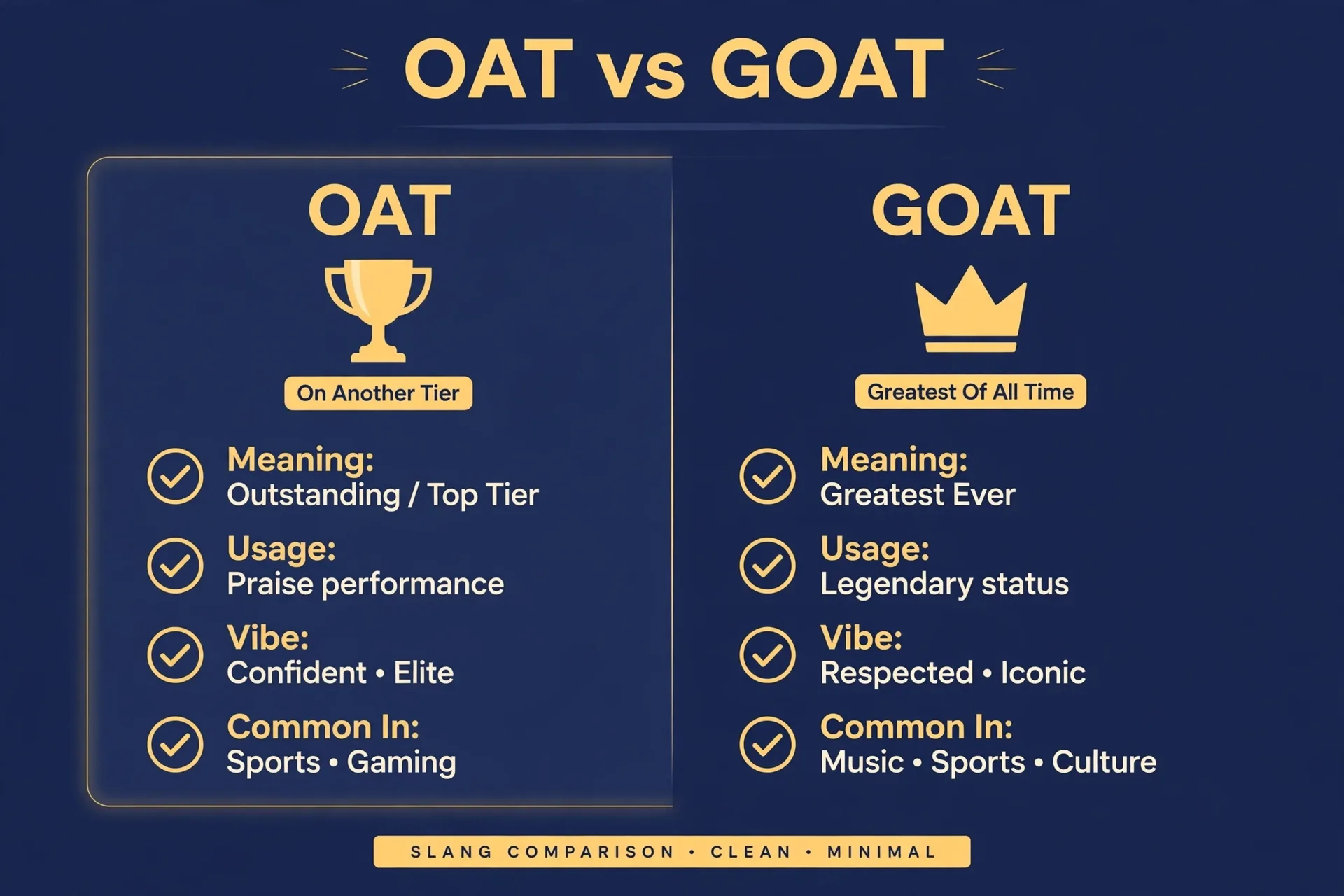
GOAT deserves a closer look, because it is the comparison people ask about most. GOAT names a winner. You can point at a person and say “the GOAT” and the sentence is finished. OAT cannot finish that sentence. “She is the OAT” sounds broken, because OAT is missing the “greatest” that GOAT supplies. OAT needs a superlative in front of it — best, worst, funniest — and that superlative can change the meaning from praise to insult. GOAT is always praise. OAT follows the adjective it is given, for better or worse.
“Ever” is the closest everyday alternative, and often the better choice. “Best day ever” and “best day OAT” mean almost the same thing, but “ever” is understood by everyone, works in speech and writing, and never needs explaining. OAT adds internet flavor and a sense of belonging to ranking culture. It does not add meaning. If clarity matters more than style, “ever” or the full phrase “of all time” wins.
“Peak” overlaps only at the positive end. Something described as peak is at its highest quality. OAT can describe the lowest point too — “worst OAT” has no equivalent in “peak.” Keep them separate, and you will avoid the common mistake of using a praise word for a roast.
Alternate Meanings
Most slang terms collect alternate meanings as they spread, and OAT is no exception. The honest summary is that one meaning dominates so heavily that the others are best treated as footnotes — possible in a specific conversation, but not what a stranger will assume.
The dominant meaning, repeated across slang glossaries and everyday use, is “of all time.” That is the meaning to learn first, and the meaning to assume unless the context screams otherwise. If someone writes “best OAT” or “worst OAT,” there is no real ambiguity.
Two other expansions appear on some smaller slang pages. The first is “one at a time,” offered as encouragement to take things slowly. The second is “on another topic,” offered as a way to change the subject. Neither has the visible, repeated usage that “of all time” has in comments, captions, and chats, and neither is supported by the ranking pattern that explains almost every real example of OAT. A reader who meets OAT in a productivity post might, in theory, be meeting “one at a time,” but that reading is rare enough that it should never be assumed without clear supporting context, such as a sentence about tasks, stress, or pacing. Do not use these expansions yourself unless you are sure your audience shares that niche usage — otherwise you will be misunderstood.
Then there are the meanings that are not slang at all. Lowercase “oat” is the grain, and it stays the grain in food, farming, and recipe contexts. “Oats” in idioms belongs to a different, older layer of English: “feeling your oats” means feeling energetic and confident, “sowing your oats” means living wildly, usually in youth, and “getting your oats” is an old British slang phrase with a sexual sense. Those idioms are recorded in full in the Free Dictionary idiom entry for oat, and none of them is the OAT of comment sections. Capitalization and topic are your guides: ranking talk in caps is slang, food and idiom talk is not.
| Meaning | How common in slang? | Clue in context |
|---|---|---|
| Of all time | Dominant — assume this first | Best, worst, funniest, or greatest nearby |
| One at a time | Rare and weakly attested | Tasks, stress, pacing, encouragement |
| On another topic | Rare and weakly attested | An obvious subject change in a chat |
| The grain | Not slang — literal word | Food, recipes, breakfast, farming |
| Idioms with oats | Not slang — older idioms | Feeling, sowing, or getting your oats |
Professional or Polite Alternatives
Because OAT is casual and absolute, it needs replacing in any setting where tone matters. The right alternative depends on what you are trying to say: praise, criticism, or a neutral ranking. In each case, writing the idea out fully sounds more credible than an acronym that claims to speak for all of history.
- Instead of “best OAT” in a recommendation: “the best I have seen,” “my favorite so far,” or “the strongest in the series.”
- Instead of “worst OAT” in feedback: “the weakest part,” “did not work for me,” or “the least effective section.” These say the same thing without the pile-on energy.
- In formal or work writing: “of all time” in full, only when the claim is genuinely historical, or “to date” when it is not. “The best-selling album to date” is accurate. “The best-selling album OAT” is not work language.
- When you want enthusiasm without slang: “ever” does the job — “the funniest episode ever” — and every reader understands it.
- When praising a person: use GOAT only if the setting is informal and the praise is clear, or say “the greatest” in full. Do not write “OAT” about a person on its own.
Politeness is not only about word choice. OAT’s absoluteness can sound dismissive when it lands on someone’s work. “Worst design OAT” in a public comment reads as a verdict on a person, not just a product. If the goal is honest feedback, a specific sentence — “the checkout step confused me because the button moved” — helps more than a ranking ever will.
Common Mistakes
Most OAT mistakes come from treating it as a standalone word when it is really half a phrase. The errors below show up constantly in comments, and each one is easy to avoid once you see the pattern.
- Using OAT alone as a label: “He is OAT” does not work. Say “He is the GOAT,” or “He is the best OAT” if you must use OAT — though the first is better.
- Using it without a superlative: “That movie was OAT” is vague. Was it the best, the worst, or the weirdest? Add the adjective: “That movie was the funniest OAT.”
- Writing it in lowercase in a ranking: “best oat” reads as a breakfast opinion. Use uppercase OAT for the acronym.
- Using it in formal writing: Reports, emails to clients, school essays, and applications should use the full phrase or a neutral alternative.
- Assuming the rare meanings: Reading “one at a time” into a ranking comment, or using “on another topic” and expecting strangers to follow, creates confusion. Default to “of all time.”
- Confusing it with the grain: If a post is about oatmeal, overnight oats, or oat milk, OAT is almost certainly not slang. Read the topic before the letters.
- Overusing it: A comment section where everything is “OAT” makes nothing stand out. Save it for the one ranking you actually care about, and the word keeps its punch.
The deeper mistake is believing the ranking. OAT is a performance of certainty, not a measurement. A commenter who writes “worst OAT” has not reviewed every example in history. They are telling you how strongly they feel, right now, in this argument. Reading it that way — as enthusiasm, not evidence — keeps you from taking internet rankings more seriously than they deserve.

Quick Tips
- Pair it with a superlative, always. Best, worst, funniest, greatest — the adjective does the meaning work, OAT only finishes it.
- Keep it uppercase. OAT is an acronym. Lowercase “oat” belongs to breakfast.
- Use it where rankings are already happening. Sports, music, movies, games, and friendly debates are home turf. Work emails are not.
- One OAT per opinion. Stacking superlatives — “best funniest OAT” — sounds muddled. Pick one ranking and commit to it.
- Match the tone of the room. In a joking thread, “worst OAT” is funny. In a sincere thread about someone’s work, it can sting. Read the room first.
- When unsure, write it out. “Of all time” is never wrong, never confusing, and works everywhere OAT works and in many places it does not.
- Do not correct people into it. If a friend says “best ever,” there is no need to reply with the slang version. Slang works best when it is offered, not imposed.
FAQ
What does OAT mean in slang? OAT means “of all time.” It follows a superlative — best, worst, funniest, or greatest — to mark something as the most extreme example ever, in the speaker’s opinion. “Best album OAT” means the best album of all time, as far as that speaker is concerned.
What does “best OAT” mean? It means the best ever, in the speaker’s ranking. It is praise with maximum confidence. The same structure with “worst” flips it into a roast: “worst OAT” means the worst ever.
Is OAT the same as GOAT? No. GOAT stands for “greatest of all time” and works alone as a label: “She is the GOAT.” OAT stands for “of all time” and needs a superlative in front of it: “best OAT.” GOAT is always praise; OAT can praise or roast, depending on the adjective.
Does OAT mean “one at a time”? Some smaller slang pages list “one at a time” as an alternate expansion, but it is rare and weakly attested compared with “of all time.” Unless the context is clearly about pacing, tasks, or encouragement, assume OAT means “of all time,” and do not use the rare expansion expecting strangers to understand it.
How do you use OAT in a text? Put it at the end of a ranking phrase: “Best concert OAT,” “Worst traffic OAT,” or “Funniest episode OAT.” Keep it uppercase, keep it casual, and keep it to chats, comments, and social posts rather than formal messages.
Is OAT rude? Not by itself, but “worst OAT” aimed at a person’s work can feel harsh because it claims an absolute verdict. The word is blunt by design. Use the positive forms freely among friends, and soften criticism with specifics instead of a ranking when feelings might be involved.
What is the difference between “oat” and “OAT”? Lowercase “oat” is the grain used for oatmeal and oat milk. Uppercase OAT in a ranking context is the slang acronym for “of all time.” Capitalization and topic together tell you which one you are reading.
Can I use OAT at work or in school? No, not in formal writing. Use the full phrase “of all time” when the claim is appropriate, or a neutral phrase such as “to date” or “the best I have seen.” Save OAT for casual chats and social media, where its tone fits.
Conclusion
OAT is small, but it carries a large claim. Three letters, borrowed from a phrase everyone knows, now do the work of a full ranking sentence in comment sections, group chats, and fandom debates. Used well — uppercase, paired with a superlative, in a casual setting where rankings are already the game — it is fast, funny, and instantly understood. Used carelessly, it confuses readers, sounds forced in formal settings, or gets mistaken for a breakfast grain.
The rule to remember is simple: OAT finishes a ranking, it does not start one. Give it a superlative, give it a casual room, and let it do its one job. When the room is formal, or the ranking needs to be taken literally, write the phrase out in full. And when you see “best OAT” under a highlight, a song, or a sitcom, you will know exactly what is being claimed — not a measured fact about all of history, but a person telling you, as loudly as three letters allow, that this one mattered most to them. For more slang explained the same way, our guides to aura points, mewing, and zesty follow the same journey from niche corners of the internet to words everyone online seems to know.
