Quick definition: Unc slang means short for “uncle” (pronounced “unk”). It is Gen Z and Gen Alpha slang for someone who is old, out of touch, or acting older than their age — usually said with a playful, teasing tone. Depending on context, it can also be a term of affection and respect for an older man.
Unc Slang Meaning & Definition
When someone calls you “unc,” they are not talking about your actual uncle — at least not usually. Unc slang is a shortened form of “uncle,” pronounced “unk,” and in today’s online culture it is a teasing label for someone who seems old, washed, or out of touch. If you ask what a meme means, use an outdated phone, or groan when you sit down, a Gen Alpha kid might grin and say, “Okay, unc.”
The tone matters more than the word itself. Most of the time, unc is a soft roast between friends — closer to a joke than an insult. But it has a deeper history: in African American English, “unc” has long been a sign of respect or lighthearted affection for an older man who shows up for younger people, related by blood or not. That respectful meaning is still alive, which is why unc can land as affection in some conversations while “boomer” almost always lands as contempt. Dictionary.com’s slang guide puts it plainly: unc is Gen Z and Gen Alpha slang for an older person who is uncool or just doesn’t get it — but depending on tone, it can be more affectionate than derogatory.
You will also hear the phrase “unc status” — the moment someone is officially deemed old. “He asked what six seven meant… unc status confirmed.” And when unc teams up with another insult, it gets sharper: “chopped and unc” translates to “unattractive and old,” a pairing that went viral on TikTok and made unc one of the most-searched slang terms of 2025 and 2026.
Introduction
Imagine this: you are sitting with a group of teenagers, someone plays a song from 2015, and you say, “Oh, this is a classic.” The room goes quiet. Then someone laughs and says, “Okay, unc.” You have just been gently roasted for showing your age — and welcome to one of the defining slang words of the current Gen Alpha slang wave.
Unc slang did not appear out of nowhere. It has roots in Black American speech that go back well over a century, traveled through hip-hop lyrics and sports television, and then exploded on TikTok, where a generation of kids turned it into the ultimate tease for anyone acting old-headed. Today it sits comfortably in the dictionary — Merriam-Webster, Dictionary.com, and Cambridge all document it — yet most parents, teachers, and even millennials are still figuring out what it means and when it is okay to use.
This guide breaks down everything about unc slang: the real definition, where it actually came from, why it blew up, how people use it in real conversations, and how to use it without crossing the line. By the end, you will understand not just the word, but the whole culture behind it — and you will know whether you have already reached unc status yourself. 😅
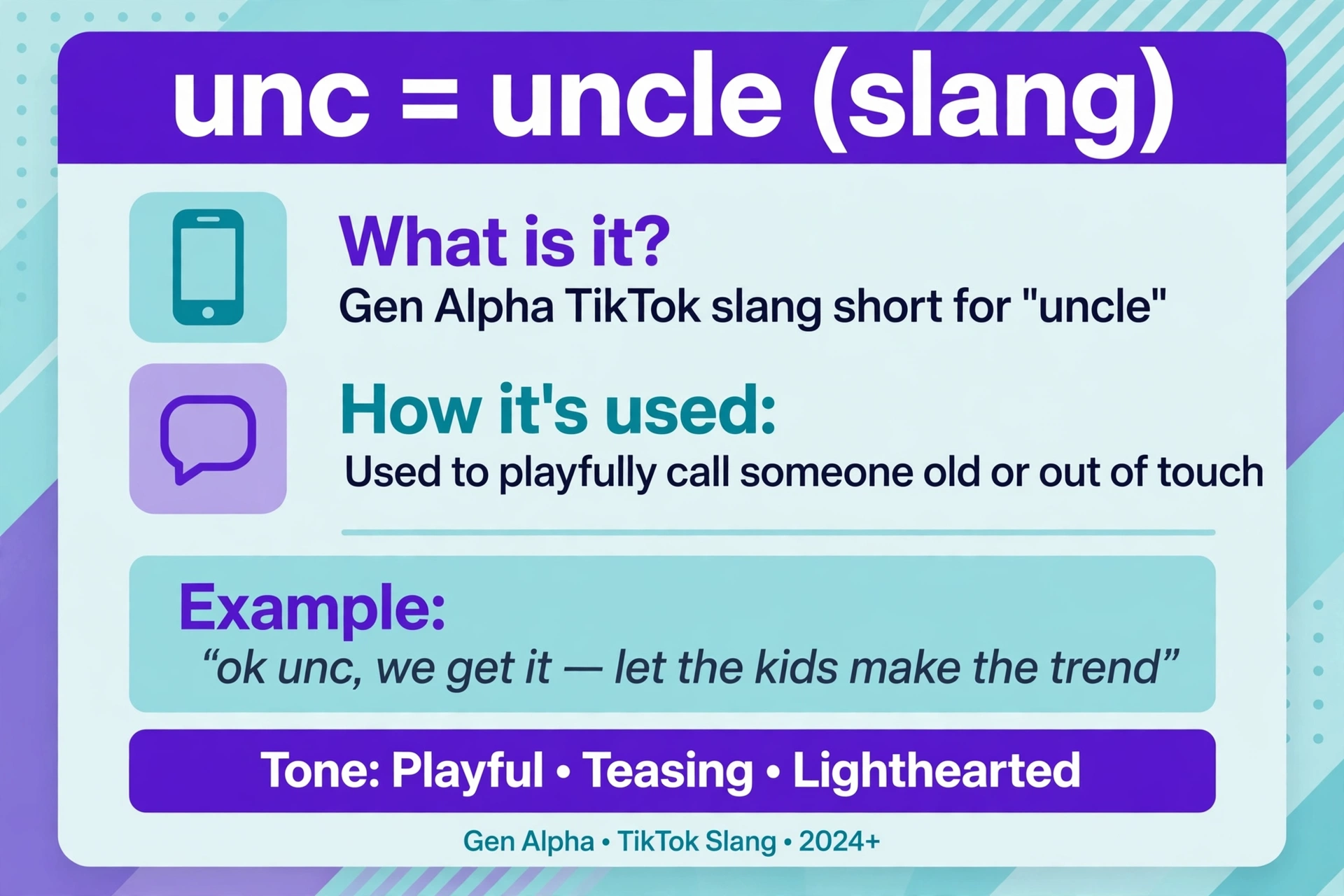
Origin
The story of unc starts much earlier than TikTok — and much earlier than most slang explainers admit. Here is the real timeline:
- 1860s — “unk” enters the record: The Oxford English Dictionary records “unk,” a shortened form of “uncle,” as far back as the 1860s. People have been clipping “uncle” down to a single syllable for over 150 years.
- Longstanding AAVE usage: In African American English and Black communities, “unc” became a term of respect or lighthearted affection for an older male family member or mentor — someone who looks out for the younger generation. “Auntie” works exactly the same way for women. This meaning is not slang-of-the-week; it is a genuine cultural term of endearment that is still used this way today.
- 2003 — hip-hop carries it forward: Rap helped spread unc beyond family circles. Merriam-Webster points to a 2003 song by Defari with the line “yo that’s my unc,” and credits later songs by Gucci Mane (“On the Way”) and J. Cole (“Brackets”) with popularizing it through the 2010s. By the mid-2010s, calling an older respected rapper “unc” was common online — Snoop Dogg, for example, is frequently referred to as unc on the internet as a sign of respect.
- 2017 — mainstream internet: Chance the Rapper tweeted in April 2017: “My daughter recently started calling me ‘mommy’. So now I call her ‘unc’. See how she likes it.” The playful, teasing use was already fully formed.
- 2023 — sports television: Shannon Sharpe and Chad Johnson named their sports show “The Nightcap with Unc & Ocho” in September 2023 — Sharpe is the Unc. This gave the word a huge mainstream platform and a clear face: a beloved, older, charismatic man.
- 2024–2025 — the TikTok explosion: Gen Z and Gen Alpha adopted unc as a tease for anyone acting old, corny, or out of touch. A teacher’s prom-chaperone TikTok in July 2025 fused “chopped” and “unc” into the viral phrase “chopped and unc” (unattractive and old), and the term became inescapable on For You pages, group chats, and gaming Discords.
- 2026 — dictionary status: Dictionary.com published its formal slang entry on unc in July 2026, cementing it as one of the defining words of the era. Merriam-Webster and Cambridge Dictionary document it too.
The key takeaway: unc began as a term of respect in Black communities, was carried through hip-hop and sports culture, and was reborn on TikTok as a playful roast. That dual history — respect and roast — is exactly why the word can feel warm in one sentence and cutting in the next.
Popularity
Unc slang is not a niche meme word anymore — it is mainstream internet vocabulary. Searches for “unc meaning” and “unc slang” surged through 2025 and into 2026, and the term now appears regularly in mainstream media coverage of youth culture, parent guides to Gen Alpha language, and school classroom discussions.
Several things fueled its rise:
- It is endlessly reusable. Unlike one-note meme words, unc works as a noun (“he’s such an unc”), an adjective (“that was unc behavior”), and a diagnosis (“unc status”). This flexibility keeps it alive in everyday conversation.
- It travels in packs. Unc runs with other Gen Alpha staples like chopped, washed, and sigma. The viral “chopped and unc” combo gave it a second wind and a sharper, funnier edge.
- Millennials embraced it ironically. One of the strangest popularity drivers is that millennials and Gen Xers now call themselves unc before anyone else can — a pre-emptive, self-deprecating joke about getting older and losing touch with trends. Self-labeling as unc is practically a rite of passage at age 30.
- It is “safe” slang. Compared to harsher insults, unc is light enough for classrooms, family group chats, and brand social media accounts — which means it spreads everywhere.
Interestingly, the age bar for unc keeps dropping. Ask around and you will hear different answers: 30, over 40, even 25. Some kids will call you unc at 24 if you act like it — not knowing a meme, using full sentences in texts, or saying “LOL” unironically can all earn you the label. It is less about your actual age and more about your energy.
How It Is Used
Unc works in several distinct ways, and reading the room is everything. Here are the main usage patterns:
- The playful roast: The most common use. Someone does or says something old-coded, and the group responds with “okay, unc” or “bro is unc.” This is friendly teasing — the equivalent of a light shove. Example: “He asked what the group chat was called… okay, unc.”
- Unc status: The official diagnosis. Reaching “unc status” means you have crossed the line from occasionally old-acting to certified old. It is usually announced with mock ceremony: “He groaned sitting down. Unc status: confirmed. 💀”
- Self-deprecation: Millennials and older Gen Zers use it on themselves to show they are in on the joke. “I need to sit down after one flight of stairs — I think I’ve reached unc status.” This disarms the insult and earns social points.
- Respect and affection: The original AAVE usage. An older man who mentors, supports, or simply earns admiration can be called unc with genuine warmth. “That’s my unc — he taught me everything I know.” Sports fandom is full of this: beloved veteran athletes and commentators get the unc title as a badge of honor.
- As an adjective: “Unc behavior,” “unc energy,” “unc-coded” — describing actions rather than people. “Saying you don’t trust apps with Face ID is unc behavior.”
Context clues tell you which version you are hearing. Among close friends with laughter, it is a joke. Said coldly to a stranger online, it can sting. Said with warmth about a mentor, it is respect. When in doubt, default to the friendly interpretation — that is how it is used the vast majority of the time.
Examples
Real examples make the meaning click. Notice how the same word shifts tone completely depending on who is talking, who is listening, and what just happened.
Friendly Examples
- “Happy birthday to my unc! 🎂 Thanks for always looking out for me.” (affectionate — the original respectful meaning)
- “Okay, unc, whatever you say 😂” (playful tease after an older friend gives outdated advice)
- “Bro brought snacks for everyone — real unc behavior, we appreciate you 🙏” (warm, joking praise)
- “My unc taught me how to drive last summer. Best teacher ever.” (genuine respect)
- “Chill, unc, it was just a joke 😭” (light deflection between friends)
Professional Examples
Unc rarely belongs in formal writing, but it shows up in workplaces, classrooms, and marketing more often than you might think. Here, self-awareness is the whole game:
- “Call me the office unc, but I still print my boarding passes.” (self-deprecating humor at work — safe and disarming)
- “He introduced himself to the interns as ‘your friendly neighborhood unc’ and they loved it.” (a manager using it to seem approachable)
- “Our brand voice for this campaign? A little unc, in a good way — nostalgic, trustworthy, a bit old-school.” (marketing teams borrowing the term’s energy)
- “The professor joked that not knowing TikTok made him ‘certified unc,’ and the whole lecture hall laughed.” (teachers using it to connect with students)
Rule of thumb for professional settings: only use unc on yourself, never aim it at a colleague, client, or boss. Self-directed unc is charming; directed at someone else in a work context, it can read as ageist.
Funny Examples
- “He said ‘let me put my reading glasses on’ — unc status: CONFIRMED 💀”
- “Told my little cousin I don’t trust apps with Face ID… he hit me with ‘unc behavior’ 😭”
- “He asked what six seven means. Bro is officially unc now.”
- “Me: ‘back in my day, we had to wait for songs to download.’ Group chat: ‘OKAY UNC, we get it 😂'”
- “He fell asleep on the couch at 9pm during the party. The unc allegations are true.”
- “She said ‘LOL’ in all caps in the group chat. We had to have a talk. Unc energy.”
| Tone | Example | What it really means |
|---|---|---|
| Friendly / affectionate | “That’s my unc, always got my back” | Respect and warmth |
| Playful teasing | “Okay, unc 😂” | You’re acting old, but it’s funny |
| Self-deprecating | “I’ve reached unc status” | I’m in on the joke about my age |
| Mildly dismissive | “Nobody asked, unc” | You’re out of touch — back off |
| Genuinely rude | “Shut up, you chopped unc” | Intended to hurt — avoid this |

Comparison with Similar Terms
Unc has plenty of neighbors in the slang universe, and they are not interchangeable. Using the wrong one can change your whole message — here is how they differ:
| Term | Core meaning | Tone | Key difference from unc |
|---|---|---|---|
| Unc | Old or out of touch (short for uncle) | Playful, sometimes affectionate | — |
| Boomer | Older person, especially with outdated views | Contemptuous, political | Boomer is a real insult; unc is usually a joke |
| Washed | Past your prime, skills declining | Judgmental | Washed targets ability; unc targets age/vibe |
| Oldhead | Someone stuck in the old ways | Neutral to teasing | Oldhead is about mindset; unc is about age energy |
| OG | Original, respected veteran | Respectful | OG is a compliment; unc is a roast (unless affectionate) |
| Auntie | Older woman, out of touch or respected | Varies like unc | The female counterpart — same AAVE roots |
| Chopped | Unattractive or rough-looking | Harsh | About looks; “chopped and unc” combines both |
The closest relatives are auntie (same origin, female version) and oldhead (similar teasing energy). The most important contrast is with boomer: calling someone a boomer is a genuine dismissal, often with generational resentment behind it. Calling someone unc is, nine times out of ten, just messing around. If you want the joke without the venom, unc is the safer pick.

Alternate Meanings
Like many short words, unc wears a few different hats depending on context. Here are the ones you might run into:
| Meaning | Context | How to tell |
|---|---|---|
| Short for “uncle” (the slang) | TikTok, group chats, gaming | Lowercase, pronounced “unk,” used as a label or tease |
| A term of respect for an older man | AAVE, hip-hop, sports fandom | Warm tone — “that’s my unc,” “Unc & Ocho” |
| University of North Carolina | College sports, education | Capitalized “UNC,” read letter by letter: “U-N-C” |
| Someone’s actual uncle | Family conversations | “My unc is coming over” — literal family meaning |
| “Unc status” as a milestone | Memes, self-deprecating posts | Always paired with “status” — the official old-age diagnosis |
The University of North Carolina confusion is worth flagging: the school is always capital UNC and pronounced letter by letter, while the slang is lowercase and said “unk.” If someone writes “UNC” in all caps about basketball, they are talking about the Tar Heels, not calling anyone old.
Professional or Polite Alternatives
Sometimes unc is too casual, too jokey, or just too risky — a work email, a formal introduction, or a conversation with someone you don’t know well. Here are polished alternatives that carry the same general idea without the slang:
- Instead of playful unc: “veteran,” “old soul,” “wise beyond their years” (affectionate) — or “a bit old-school,” “set in their ways” (teasing but polite).
- Instead of respectful unc: “mentor,” “elder,” “a respected senior figure,” “father figure.”
- Instead of “unc status”: “showing their age,” “a little behind the times,” “old-fashioned in the best way.”
- Instead of “unc behavior”: “old-fashioned habits,” “a throwback moment,” “very traditional.”
- In formal writing: simply describe the behavior — “he prefers older technology” or “she’s unfamiliar with current trends” — instead of labeling the person.
The golden rule: in any setting where you wouldn’t say “dude,” don’t say “unc.” Save it for friends, family, and casual online spaces where the playful tone is understood.
Common Mistakes
Unc is simple, but people still get it wrong. Here are the mistakes to avoid:
- Using it as a real insult. Stacking it with harsher words — “shut up, you chopped unc” — turns a soft roast into genuine cruelty. Unc is a feather, not a hammer; don’t swing it like one.
- Aiming it at strangers or elders you don’t know. Between friends, “okay, unc” is hilarious. Said to a stranger, a teacher you don’t know, or an actual elderly person, it can feel disrespectful or ageist. The joke needs a relationship to land.
- Forgetting the respectful root. In Black communities, unc carries genuine respect. Using it mockingly toward someone who uses it affectionately — or stripping the history out of it — misses the point. Black writers have rightly noted that relabeling Black speech as generic “Gen Z slang” erases where it came from.
- Pronouncing or writing it wrong. It’s “unk” (one syllable), not “U-N-C.” And it’s lowercase in slang contexts — all-caps UNC means the University of North Carolina.
- Calling women “unc.” Usage skews male; the counterpart for women is “auntie.” Calling a woman unc can confuse people or land wrong — use “auntie” for the same teasing energy.
- Using it at work on other people. Self-directed unc (“I’m the office unc”) is charming. Directing it at a coworker or boss can read as unprofessional or ageist, no matter how jokey your tone.
- Overusing it until it’s cringe. Ironically, calling everything unc is itself unc behavior. Like all slang, it loses power with repetition — and nothing ages a word faster than adults forcing it.

Usage Tips
Want to use unc slang naturally instead of sounding like you’re reading from a glossary? Follow these practical tips:
- Let someone earn it first. The funniest unc moments are reactive — someone says something old-coded, and “okay, unc” lands perfectly. Forcing it into random sentences feels stiff.
- Match the energy. Text it with 😂, 😭, or 💀 to signal playfulness. A bare “unc.” with a period reads cold and can seem genuinely mean.
- Start with self-deprecation. New to the word? Try it on yourself first: “I just said ‘LOL’ out loud — I’ve hit unc status.” It’s low-risk and shows you get the joke.
- Pair it naturally. “Unc behavior,” “unc energy,” and “unc status” are the three most natural constructions. Master those and you’ll sound fluent.
- Know your audience. With Gen Z and Gen Alpha friends, it’s instant rapport. With grandparents, in job interviews, or in formal writing, skip it entirely.
- Don’t explain the joke. Saying “unc, you know, like uncle, because you’re old” kills it. Drop the word and move on — confidence is the whole delivery.
- Stay updated. Slang moves fast; what’s hilarious in 2026 might be dated by 2027. If actual teenagers start groaning when you say it, retire it gracefully — that’s the circle of slang life.


FAQ
What does unc mean in slang?
Unc is short for “uncle” (pronounced “unk”). In current slang, it means someone who is old, out of touch, or acting older than their age. It’s mostly used as a playful tease among Gen Z and Gen Alpha — “okay, unc” — though it originated in African American English as a term of respect for an older man.
Is unc slang disrespectful?
Usually not — it’s meant as a light, friendly roast. But tone and relationship matter. Between friends, it’s a joke. Aimed at a stranger, an elder you don’t know, or stacked with harsher insults like “chopped,” it can feel disrespectful or ageist. When in doubt, keep it playful and keep it among people who know you’re joking.
What does “unc status” mean?
“Unc status” is the joking “official diagnosis” that someone is old. When a person does something unmistakably old-coded — groaning while sitting down, not knowing a viral meme, using a flip phone — friends declare “unc status: confirmed.” It’s almost always self-aware humor rather than a serious judgment.
What does “chopped and unc” mean?
“Chopped and unc” means “unattractive and old.” It pairs two Gen Alpha insults: “chopped” (rough-looking or unattractive) and “unc” (old or out of touch). The phrase went viral on TikTok in 2025 and is sharper than unc alone — it’s meant to sting more than a friendly roast.
Where did unc slang come from?
Unc comes from African American Vernacular English (AAVE), where it began in Black communities as a sign of respect or affection for older men and mentors. It spread through hip-hop in the 2000s and 2010s (Defari, Gucci Mane, J. Cole), got a mainstream boost from Shannon Sharpe’s 2023 show “Nightcap with Unc & Ocho,” and exploded on TikTok in 2024–2025 as Gen Alpha’s favorite tease for anyone acting old.
Can girls be called unc?
Technically yes, but it usually sounds off — unc skews male, and the female counterpart is “auntie,” which shares the same AAVE roots. If you want the same teasing energy toward a woman, “auntie” is the natural pick. Some friend groups use unc for everyone, but “auntie” is the safer and more standard choice.
At what age do you become unc?
There’s no official age — it’s about energy, not birthdays. People joke that the bar keeps dropping: 40, 30, 25, even 24. Realistically, anyone can get called unc the moment they act out of touch: not knowing a trend, using outdated tech, or saying something your group finds old-coded. Millennials now pre-emptively call themselves unc around age 30.
Is unc the same as boomer?
No. “Boomer” is a genuine, often contemptuous dismissal tied to generational resentment. “Unc” is a much softer, usually playful tease — and it can even be affectionate or respectful. If boomer is a punch, unc is a light shove. That’s why unc works in friendly group chats where “boomer” would start an argument.
Conclusion
Unc slang is one of those rare words that carries a whole story in three letters. It started as “unk” in the 1800s, became a term of respect in Black communities, rode through hip-hop and sports television, and landed on TikTok as Gen Alpha’s favorite way to lovingly roast anyone acting old. That journey — from respect to roast and back again — is exactly why the word works: it can be warm, funny, or cutting depending entirely on how you say it and who you’re saying it to.
The practical takeaway is simple. Use unc the way the internet does: playfully, among friends, with a 😂 attached — or turn it inward and claim your own unc status before anyone else can. Respect its roots, don’t aim it at strangers, and retire it the moment it stops being funny. Do that, and you’ll never be the unc who didn’t get the joke.
Want to decode more of the words Gen Alpha won’t stop saying? Check out our complete Gen Alpha slang guide — it covers 25+ terms, from rizz to skibidi, so you’ll always know exactly what’s going on in the group chat.
