
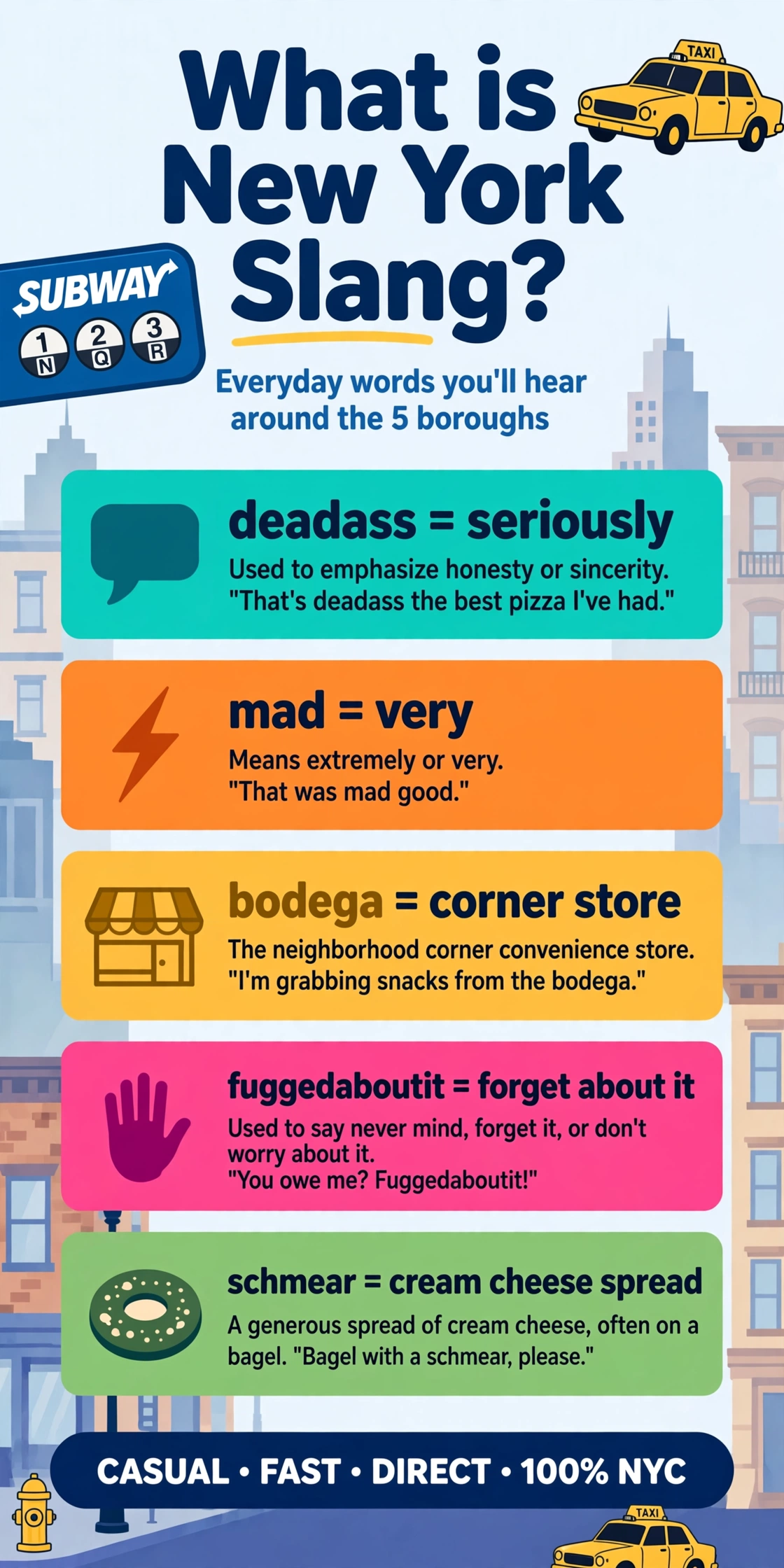
Quick definition: New York slang is the fast, colorful street language of New York City — a mashup of Italian, Yiddish, Spanish, hip-hop, and immigrant vocab that New Yorkers use every day. Words like mad (very), bodega (corner store), deadass (seriously), and schmear (cream cheese) all come from NYC’s five boroughs.
New York Slang Meaning & Definition
New York slang refers to the informal vocabulary, phrases, and expressions born in New York City’s five boroughs — Manhattan, Brooklyn, Queens, the Bronx, and Staten Island. It is shaped by more than 200 languages spoken across the city, generations of immigrants, the golden age of hip-hop, and the city’s famously blunt attitude. When someone says “I’m mad hungry” in Manhattan, they are not angry — mad is New York slang for “very.” When your friend says “meet me at the bodega,” they mean the corner store, not a Spanish wine cellar.
Unlike regional slang that stays local, New York slang travels. Hip-hop, sitcoms, stand-up comedy, and now TikTok have exported NYC phrases to every corner of America. You have probably heard — and maybe even used — words like yo, fuggedaboutit, deadass, and drip without realizing they came from New York. This guide breaks down the most important New York slang words and phrases, their real meanings, where they came from, and exactly how to use them without sounding like a tourist.
Introduction
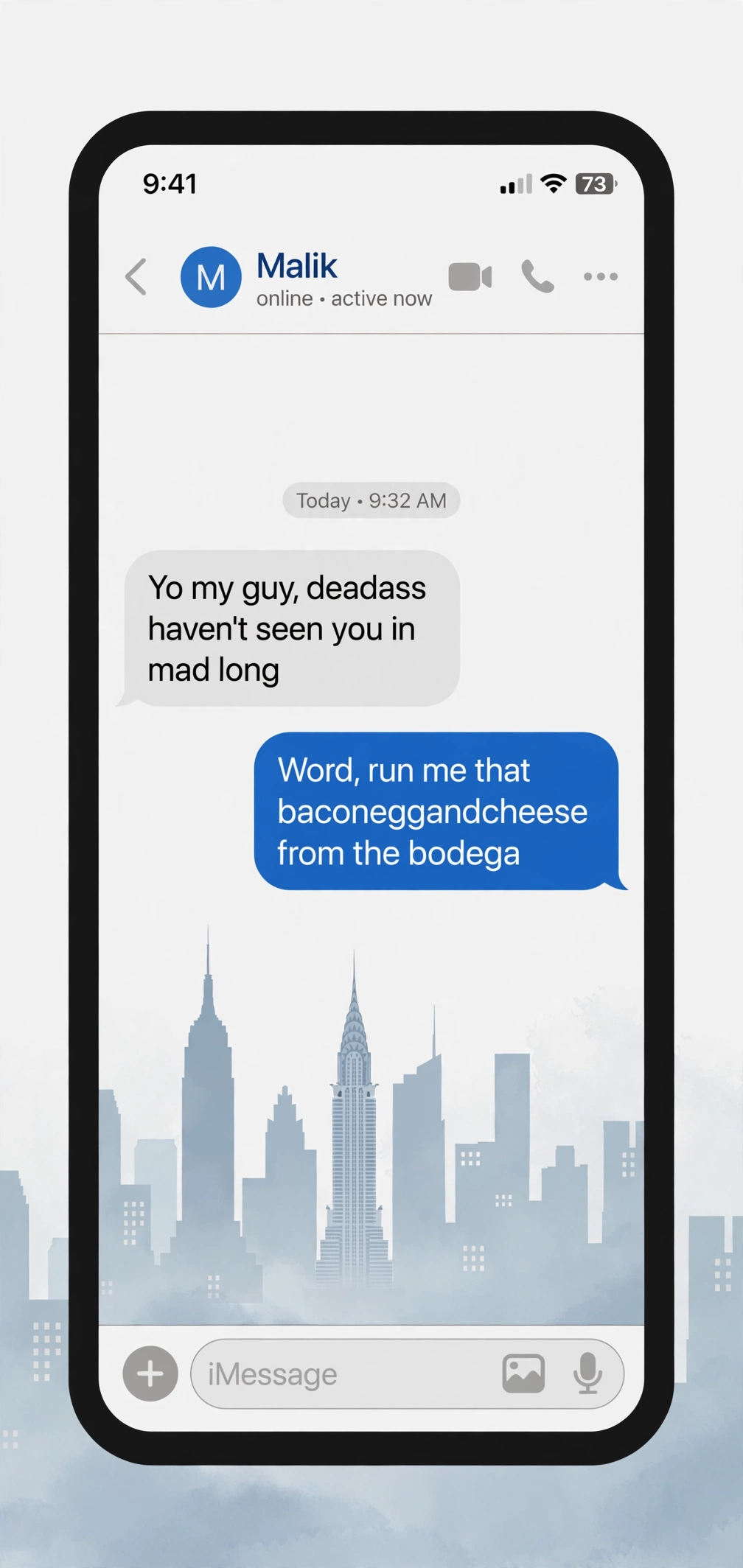
Walk into any bodega in Queens at 2 a.m. and you will hear a language you won’t find in any textbook. The cashier says “deadass, we outta baconeggandcheeses.” A regular answers, “word, run me that chopped cheese then, my guy.” Nobody is confused. This is New York slang doing what it does best: compressing maximum meaning into minimum syllables, at maximum speed.
New York City is home to over 8 million people and has been a slang factory for more than a century. Italian immigrants gave the city fuggedaboutit and gabagool. Jewish immigrants contributed schmear, schlep, and chutzpah. Puerto Rican and Dominican communities made bodega universal. And the Bronx — birthplace of hip-hop — gave the entire world yo, word, peace, and deadass. Each wave of New Yorkers added words, and the city kept the best ones.
In this guide, you will get the 50+ most useful New York slang terms, organized by where they are used and how they actually sound in real conversation. You will also get a pronunciation guide (yes, New Yorkers really do drop their R’s), the mistakes outsiders always make, and quick tips for using NYC slang naturally. Whether you are moving to the city, visiting for a weekend, or just want to understand your favorite rapper’s lyrics, this is your complete New York slang dictionary for 2026.
Origin
New York slang did not appear overnight — it was built layer by layer, one immigrant wave at a time. Understanding the layers helps you understand why the city’s slang sounds the way it does.
The immigrant foundations (1800s–1950s)
The first great wave of New York slang came from the Lower East Side’s Jewish and Italian communities. Yiddish words like schlep (to drag or carry), kvetch (to complain), and schmear (a spread, especially cream cheese on a bagel) entered everyday city speech so completely that most New Yorkers have no idea they are speaking Yiddish. Italian-American families contributed fuggedaboutit (forget about it), gabagool (capicola), and the famous madone (my Madonna — an exclamation).
The hip-hop explosion (1970s–1990s)
The South Bronx in the 1970s is the single most important birthplace of modern New York slang. DJs, MCs, and b-boys at block parties created a vocabulary that would conquer global culture: yo as a greeting, word as agreement, peace as goodbye, dope as excellent, whack as bad. Artists like Run-DMC, Biggie Smalls, Nas, and Jay-Z turned neighborhood slang into worldwide hits. If you have ever said “word” or “dope,” you are speaking Bronx-born New York slang.
The five-borough remix (2000s–today)
Today’s New York slang is a remix culture. Caribbean and Dominican communities in Washington Heights and the Bronx added pa, klk, and dímelo. Drill music out of Brooklyn pushed deadass, son, and facts into the mainstream. TikTok then compressed the cycle: a phrase can go from a Brooklyn block to a Kansas classroom in a single week. The speed is new, but the process — the city absorbing, remixing, and exporting slang — is over a century old.
Popularity
New York slang is arguably the most influential regional dialect vocabulary in the English-speaking world. A few reasons it dominates:
- Media concentration: Most American TV, film, publishing, and music industries are based in NYC. Writers and artists constantly borrow street language for authenticity, pushing terms like fuggedaboutit (immortalized in Donnie Brasco) and deadass into national scripts.
- Hip-hop’s global reach: New York invented hip-hop, and hip-hop invented modern cool. When the world’s biggest genre speaks New York slang, the whole world learns it.
- Tourism and migration: Roughly 65 million tourists visit NYC each year, and millions of former New Yorkers carry the slang to other cities. College campuses from Florida to California are full of ex-New Yorkers saying mad and deadass.
- Internet velocity: NYC-based creators on TikTok, Twitter, and YouTube accelerate slang spread. Terms like it’s giving, no cap (which passed through NYC’s drill scene), and understood the assignment all have New York fingerprints.
The result: you no longer need to live in New York to speak New York slang. But using it correctly — with the right rhythm, context, and attitude — is still a very New York skill. That is exactly what this guide teaches.
How New York Slang Is Used
New York slang is not random — it follows the city’s unspoken rules of communication. New Yorkers value speed, directness, and emotional intensity. The slang reflects all three.
First, New York slang intensifies everything. Where other Americans say “very tired,” New Yorkers say “dead tired” or “mad tired.” Mad is the city’s universal intensifier: mad good, mad far, mad expensive. Deadass turns any statement into a sworn oath: “I’m deadass leaving” means I am absolutely, no-joke leaving.
Second, it compresses. “Bacon, egg, and cheese on a roll” becomes “baconeggandcheese” — one word, said in under a second. “Forget about it” becomes fuggedaboutit. New York is a walking city where everyone is late; the language runs on the same schedule.
Third, it is social. Words like son, my guy, bro, and fam constantly mark solidarity. Even arguments are social: “son, you buggin'” is both a challenge and a term of endearment. New Yorkers argue with love and compliment with insults — the famous “roast culture” of the group chat.
Finally, context is everything. Yo can be a greeting, a warning, or an expression of disbelief depending on tone. Word can mean “I agree,” “I heard you,” or “are you serious?” The words are simple; the delivery carries the meaning.
Examples
Here is how New York slang sounds in real life, broken down by tone. Notice how the same words shift meaning with context.
Friendly Examples
- “Yo, my guy! Deadass haven’t seen you in mad long. We still on for the bodega run?” — Warm greeting between friends.
- “Son, this chopped cheese is bussin’. You gotta try it.” — Enthusiastic food recommendation.
- “Word? That’s fire. I’m proud of you, bro.” — Genuine congratulations.
- “Ay, you good? Need a hand with those bags? I got you.” — Offering help, classic NYC neighborliness under the tough exterior.
Professional Examples
New York slang rarely belongs in the office, but light touches appear in creative industries and casual workplaces:
- “Let’s circle back — I’m slammed right now, deadass.” — Busy coworker (use deadass only with peers, never with clients).
- “The timeline is mad tight, but we can make it work.” — Acknowledging pressure without drama.
- “Word, I’ll have the deck to you by EOD.” — Quick agreement.
- “Fuggedaboutit — we’ll fix it in post.” — Brushing off a minor mistake on a creative team.
Funny Examples
- “Bro really said ‘I’m five minutes away’ — he’s in Jersey. That’s a forty-minute lie, deadass.” — Calling out the classic NYC commute lie.
- “She ordered a ‘regular coffee’ and the guy just knew. That’s not a menu, that’s a trust fall.” — A regular coffee (milk + two sugars) is pure New York slang in action.
- “My landlord raised the rent and said ‘it’s the market.’ Sir, the market is mad disrespectful.” — The universal NYC housing complaint.
- “Tourist asked me where the ‘subway sandwiches’ are. Son, I sent him to the 6 train.” — Subway means the train, never the sandwich shop. Non-negotiable.
Comparison with Similar Terms
New York slang is often confused with general American slang, AAVE (African American Vernacular English), and internet slang. They overlap — New York helped create all of them — but they are not the same thing. This table clears up the confusion.
| Term | Category | Meaning | NYC or not? |
|---|---|---|---|
| Deadass | New York slang | Seriously, for real | Pure NYC — Brooklyn drill origins |
| Mad (intensifier) | New York slang | Very, extremely | Classic NYC, spread nationally via hip-hop |
| Fuggedaboutit | New York slang | Forget about it / no problem | NYC Italian-American, iconic |
| Bodega | New York slang | Corner convenience store | NYC-specific (from Puerto Rican Spanish) |
| No cap | AAVE / internet slang | No lie, for real | Passed through NYC but originated in Atlanta |
| Bet | AAVE / general slang | Okay, agreed | Used heavily in NYC, but not NYC-born |
| Yeet | Internet slang | To throw with force | Not NYC — Vine-era, Southern US roots |
| Bussin’ | AAVE / food slang | Really delicious | Adopted by NYC, popularized nationally on TikTok |
The key takeaway: New York slang specifically refers to terms born in or defined by New York City culture. Many words New Yorkers use every day (like bet or no cap) are beloved in the city but were born elsewhere — and true New Yorkers can usually tell the difference.

Alternate Meanings
Several New York slang words have double lives — meanings that change completely by context. Getting these wrong is the fastest way to embarrass yourself.
- Mad: As an intensifier it means “very” (“mad good”). But a New Yorker can also be mad in the traditional sense — angry. “I’m mad tight right now” is ambiguous: it could mean “I’m very annoyed” or “I’m extremely broke” (tight = broke). Context decides.
- Son: Used as a friendly address (“what’s good, son?”) regardless of age or gender. It is not about anyone’s child in this usage — calling your actual son “son” in NYC sounds oddly formal.
- Regular coffee: “Regular” does not mean black. In New York, a regular coffee is milk and two sugars. Ordering “black” when you want black is the move; ordering “regular” expecting black will get you a sweet milky surprise.
- Pie: In most of America, pie is dessert. In New York, “let’s get a pie” means a whole pizza. A “slice” is one piece; a “pie” is the full thing.
- Stoop: Not a verb here — a stoop is the front steps of a brownstone or apartment building, the city’s original social network. “Stoop kids” hang out there all summer.
- Schmear: Literally a spread of cream cheese on a bagel — but as a verb, “schmear” can also mean to bribe or grease someone’s palm (“he schmeared the doorman”). Same word, very different breakfast.
Professional or Polite Alternatives
New York slang is built for the street, the group chat, and the group dinner — not the boardroom, the job interview, or grandma’s birthday call. Here is how to translate the most common terms when you need to sound professional:
| New York Slang | What it means | Polite alternative |
|---|---|---|
| Deadass | Seriously / I swear | “I’m being completely serious” |
| Mad (intensifier) | Very | “Very” / “extremely” |
| Fuggedaboutit | Forget it / don’t worry | “Don’t worry about it” / “It’s handled” |
| Son / my guy | Friend / buddy | Use their name, or “my friend” |
| You buggin’ | You’re acting crazy | “I think there may be a misunderstanding” |
| Word | Agreed / I hear you | “Agreed” / “Understood” |
| Bodega | Corner store | “Convenience store” (outside NYC) |
| Schlep | To drag / carry far | “It was quite a trip to get here” |
Rule of thumb: in professional settings, keep bodega and schlep (they are charming and widely understood), but drop deadass, son, and you buggin’ entirely. New Yorkers code-switch constantly — it is part of the culture.
Common Mistakes
Outsiders — and even transplants who have lived in the city for years — make the same New York slang mistakes over and over. Avoid these and you will instantly sound more local:
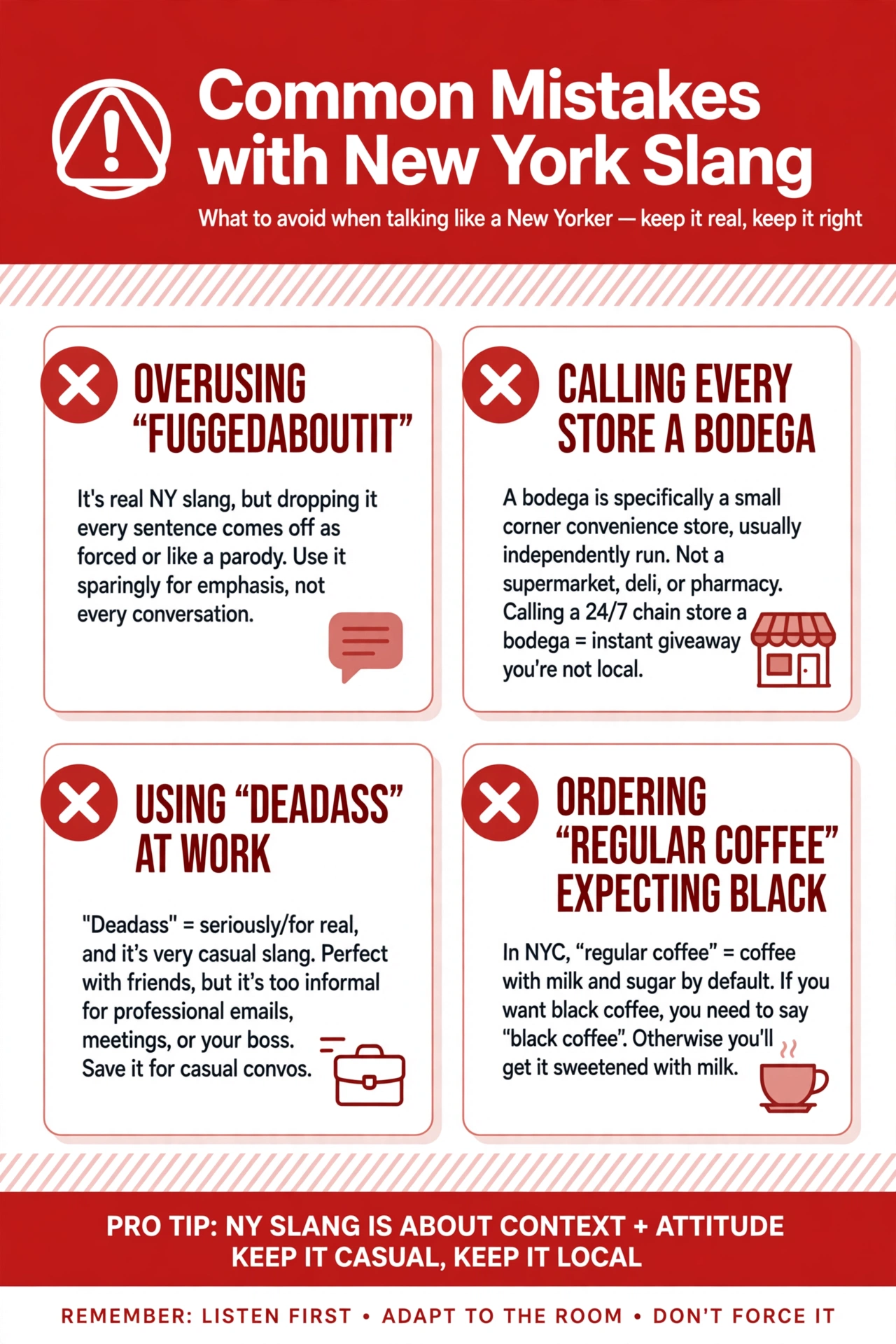
- Overusing “fuggedaboutit.” Real New Yorkers say it sparingly, usually with a hand gesture and a shrug. Saying it every sentence marks you as someone who learned NYC from mob movies.
- Calling every corner store a bodega. A bodega is specifically the small, usually Latino-owned corner store with the cat, the ATM, and the baconeggandcheese. A 7-Eleven is not a bodega. A Duane Reade is definitely not a bodega.
- Using “deadass” in writing or at work. It is spoken slang with an edge. Dropping “deadass” in a Slack message to your manager is a career-limiting move.
- Pronouncing it “New Yawk” on purpose. The accent drops R’s (“cawfee,” “watah”), but performing it theatrically is cringe. If the accent isn’t yours, don’t do the bit.
- Saying “mad” as an intensifier in formal contexts. “The results were mad good” in a client presentation will not land the way you hope.
- Assuming “yo” is rude. It is not — it is the most versatile word in New York slang. “Yo, excuse me” is perfectly polite. Tone is everything.
- Ordering a “regular coffee” expecting black coffee. As covered above: regular = milk + two sugars. This mistake is made daily by every tourist in Manhattan.
- Calling Manhattan “the city” when you are in Manhattan. Actually, this one is correct — all five boroughs call Manhattan “the city.” (“I’m heading into the city” = going to Manhattan.) The mistake is calling all of NYC “the city” when you mean the boroughs.
Quick Tips
Want to use New York slang like you were born on the 6 train? These practical tips will get you there faster than any dictionary:
- Listen before you speak. Spend a week just absorbing — bodega small talk, subway announcements, group chats. New York slang is rhythmic; you learn the beat before the words.
- Start with the safe five: yo, word, mad (intensifier), bodega, and my guy. These are universally understood, hard to misuse, and instantly make you sound comfortable.
- Match the energy, not just the words. New York slang is delivered fast, flat, and confident. Hesitant slang sounds worse than no slang at all.
- Never explain the slang. Saying “that’s New York slang for…” kills it instantly. Use the word naturally or don’t use it.
- Learn the food words first. Baconeggandcheese, chopped cheese, schmear, slice, pie, regular coffee — food is the friendliest entry point into NYC culture, and nobody judges a food order.
- Respect the boroughs. Brooklyn slang, Bronx slang, and Queens slang have different flavors. Deadass is Brooklyn; son is Bronx; mad is everywhere. Using them interchangeably is fine, but knowing the roots earns respect.
- When in doubt, stay quiet and nod. New Yorkers respect someone who listens more than someone who performs. The fastest way to earn the slang is to earn the city’s trust first.

FAQ
What does “deadass” mean in New York slang?
Deadass means “seriously” or “for real” — it is Brooklyn-born New York slang used to emphasize that you are not joking. “I’m deadass tired” means you are genuinely exhausted. It can also be a question: “Deadass?” means “Are you serious?” Use it with friends, never at work.
What does “mad” mean in New York slang?
In New York slang, mad is an intensifier meaning “very” or “extremely” — “mad good,” “mad far,” “mad expensive.” It comes from hip-hop culture and is one of the most widely recognized NYC terms in America. Note that it can still mean “angry” in the traditional sense, so context matters.
What is a bodega in New York?
A bodega is a small corner convenience store, typically Latino-owned, found on nearly every block in NYC. Bodegas sell coffee, sandwiches (especially the famous baconeggandcheese), snacks, and household basics. The word comes from Spanish and is one of the most iconic pieces of New York slang.
What does “fuggedaboutit” mean?
Fuggedaboutit (from “forget about it”) is classic Italian-American New York slang with several meanings depending on tone: “don’t worry about it,” “it’s not important,” or “no way, absolutely not.” It was immortalized in films like Donnie Brasco and remains the most famous NYC phrase worldwide.
What does “schmear” mean?
Schmear is Yiddish-origin New York slang for a spread of cream cheese on a bagel — “a bagel with a schmear” is the definitive NYC breakfast order. As a verb, it can also mean to bribe (“he schmeared the doorman”). Most New Yorkers use it daily without knowing its Yiddish roots.
What does “yo” mean in New York?
Yo is the most versatile word in New York slang — it can be a greeting (“yo, what’s good?”), a warning (“yo, watch out!”), or an expression of surprise (“yo, that’s crazy”). Born in the Bronx hip-hop scene of the 1970s, it is now used worldwide, but New Yorkers still own it.
Is New York slang the same as Gen Z slang?
Not exactly, though they overlap heavily. Much of what is called “Gen Z slang” or “internet slang” passed through New York first — terms like deadass, it’s giving, and understood the assignment all have NYC roots. But true New York slang includes older layers (Yiddish, Italian, classic hip-hop) that Gen Z internet slang does not. If you want the full picture, our guides to Gen Alpha slang and sigma slang cover the newest wave.
How can I learn New York slang fast?
The fastest way is immersion: listen to NYC drill and classic hip-hop, watch New York-based shows and stand-up, follow NYC creators on TikTok, and — best of all — spend time in the city just listening. Start with the safe five (yo, word, mad, bodega, my guy), learn the food vocabulary, and never force slang you have not heard used naturally. For more street-born terms, check out our breakdown of glizzy meaning and mewing.

Conclusion
New York slang is more than a collection of funny words — it is a 200-year record of the most ambitious city on earth, written in the language of its streets. Every deadass carries a piece of Brooklyn drill. Every fuggedaboutit echoes an Italian grandmother on Arthur Avenue. Every schmear remembers the Lower East Side. When you learn these words, you are not just learning slang — you are learning the city.
The practical takeaway is simple: start with the safe five, learn the food words, listen more than you speak, and never perform what you have not absorbed. New Yorkers can spot a fake in one sentence — but they will also happily adopt anyone who shows the city genuine respect. Use this guide as your foundation, keep your ears open on the subway, and within weeks you will be ordering a baconeggandcheese like you were born doing it.
Ready to keep building your NYC vocabulary? Explore our related guides to Gen Alpha slang, sigma slang, and mewing — because in New York, the language never stops moving, and neither should you.

2 thoughts on “New York Slang: The Ultimate Guide to NYC Words, Meanings & How to Talk Like a New Yorker”