
Quick definition: In slang, JOI stands for “jerk-off instructions.” It is the label for a category of adult, explicit audio and video content in which a performer gives spoken, step-by-step guidance to the viewer. If you came here because you saw those three letters in a comment, a forum post, or a search suggestion and wondered what they meant, that is the short answer. The longer answer matters just as much: JOI is NSFW, it is not safe for work, school, or family group chats, and it has no widely used clean meaning in everyday texting. Most joi meaning slang searches are really asking one of two things — what the letters stand for, and whether it is safe to repeat them. This guide answers both, explains where the term came from, clears up the common mix-ups, and shows you what to say instead.
JOI Meaning in Slang & Definition
JOI is an acronym, and like most internet acronyms it only makes sense once you know the phrase behind it. The letters J-O-I stand for “jerk-off instructions.” The term is used as a noun and as a label: people refer to “JOI content,” “a JOI video,” or “JOI audio.” It describes material whose whole point is spoken guidance, usually recorded by a performer talking directly to the camera or microphone, telling the viewer what to do and when. That direct-address style is what separates it from other adult content categories. The content is defined less by what is shown and more by the fact that someone is instructing the audience throughout.
Two things about the definition are worth stating plainly. First, JOI is an adult term. It belongs to the same world as other NSFW labels that you will only meet in age-restricted spaces, private chats between consenting adults, and adult-content platforms. It is not general internet slang in the way that LOL, BRB, or IMO are. You will almost never see it used innocently in a normal group chat, and when it does appear there, it is usually because someone is joking about the term itself, testing whether others know it, or deliberately being provocative. Second, JOI is a label, not a greeting, a reaction, or an instruction you would send to a friend. Nobody uses it the way they use “let’s go” or “say less.” When the letters appear in a message, they are almost always pointing at the category of content, or asking about it.
Pronunciation is simple: people say the three letters one by one, “J-O-I,” rather than pronouncing it as a word. In writing it usually appears in capitals, JOI, although lowercase “joi” shows up in search bars, usernames, and forum tags. Lowercase spelling can cause one extra confusion, because “Joi” is also a given name and a character name in fiction, which is covered in the alternate meanings section below. In a chat or a comment thread, though, capital JOI on its own is a strong signal that the adult meaning is intended.
Introduction
Most slang reaches people the same way. You are scrolling, you see a word you do not know, and the people using it act as if everyone already knows it. JOI works a little differently, because a lot of people meet it through a search suggestion, a Reddit thread title, a comment that only says “JOI?” or a friend laughing at a screenshot. There is rarely any context around it, and asking what it means in the same thread can feel awkward, especially if the thread is public. That is why so many people quietly search for the meaning instead of asking.
That quiet-search pattern is part of a much bigger habit. New slang now travels from small online communities into Gen Alpha slang lists, TikTok comment sections, and group chats within days, and the words that travel fastest are often the ones that are hardest to ask about. JOI is one of them. It started in a very specific corner of the internet, stayed there for years, and then leaked into wider awareness through memes, forum jokes, and recommendation algorithms that surface the term next to completely unrelated videos. Plenty of people first meet it without ever looking for adult content at all. They meet the letters, not the content, and they want a straight explanation before they decide how to react.
This article gives you that explanation. It covers the full form, the origin story, why the term became well known, how it is actually used, and the mistakes people make with it. It also covers the edge cases: the “join” typo, the name Joi, and the wholesome-sounding expansions that float around online but are not how the term is really used. By the end, you will know exactly what JOI means, exactly where it does and does not belong, and exactly what to type if you need to ask about it or warn someone off using it.

Origin
Pinpointing the first use of an internet acronym is rarely possible, and JOI is no exception. What can be said with confidence is that the phrase behind it, “jerk-off instructions,” and the close variant “jack-off instructions,” circulated on adult message boards in the early 2000s, and the shortened form JOI was in use by the late 2000s. The idea itself was simple and cheap to produce: one performer, one camera or microphone, and a script of spoken guidance. There were no elaborate sets and no large crews. That low cost of production is one reason the category grew quickly once adult video sites and forums began tagging and recommending content by category.
Mainstream search interest in the term began to climb around 2009, and by the early 2010s the label was established enough that dedicated communities formed around it. A JOI-focused community on Reddit was created in 2012 and grew to tens of thousands of members within a few years, which is a useful marker of how niche the term still was: it was big inside its own world and almost invisible outside it. Dictionary.com’s entry on JOI traces the same history, noting that the particular phrase “jerk-off instructions” had been around since at least 2008 and that search interest rose sharply in the early 2010s. The dictionary entry is worth reading because it treats JOI the way it treats any other piece of slang: as a word with a history, a spelling, and a specific register, rather than as a joke or a shock term.
The format also explains the staying power of the label. JOI content is built around voice and pacing — teasing, pausing, encouraging, and directing — and that makes it easy to adapt to audio-only formats, short clips, and custom requests. Creators could record it at home, listeners could consume it privately with headphones, and the whole exchange felt more personal than a standard video. None of that changes the basic fact for a casual reader: JOI grew up as an adult-content category label, and every later use of the letters, including jokes and memes about them, borrows its meaning from that origin.
Popularity
JOI is not popular in the way a TikTok dance or a catchphrase is popular. Most people will never use the word in conversation, and most will never need to. Its popularity is better described as recognition: a large number of people have seen the letters, a smaller number know what they stand for, and an even smaller number use the term regularly. That pattern is common for adult slang. The term is widely recognised because search engines, video platforms, and forums keep surfacing it, but it remains confined to specific spaces in actual use.
Three forces pushed JOI from a niche label into wider recognition. The first is categorisation. Adult platforms organise content by tags and categories, and once a tag exists, recommendation systems keep showing it to people who watched anything nearby. A viewer did not have to search for JOI to meet it; the tag could appear in a sidebar, a “related” list, or a search suggestion. The second force is community discussion. Forums and subreddits devoted to adult content talk about categories the way film fans talk about genres, so JOI appears in recommendation threads, “best of” lists, and requests, all of which are indexed and searchable. The third force is humour and shock value. The letters look harmless — they could be a name, a typo, or a cheerful acronym — and that gap between how innocent JOI looks and what it actually means makes it good material for memes, reaction posts, and “today I learned” threads. Each joke teaches a new group of people the meaning without anyone having to seek out the content itself.
That is also why joi meaning slang is a common search phrase today. People are not usually searching because they want to use the term; they are searching because they encountered it somewhere unexpected and want to know whether they should be concerned, amused, or embarrassed. Parents see it in a browser history, teachers see it in a comment, friends see it in a screenshot, and everyone has the same reaction: look it up quietly, get a clear answer, and move on. If you are in that group, you are the normal case, not the exception. Knowing the meaning is useful precisely so that you can recognise the term, avoid repeating it in the wrong place, and respond calmly if someone else uses it around you.
How It Is Used
In practice, JOI appears in a narrow set of places. The most common is as a tag or category label on adult platforms and forums, where it sits alongside other genre labels and tells a browser what kind of content to expect. In those spaces it is used matter-of-factly, the way a streaming service labels a film “documentary” or “thriller.” The second place is in requests and recommendations between adults in private chats and adult communities: someone asks for a recommendation, names a performer, or describes a style, and JOI is the shorthand that keeps the request short. The third place is in jokes, memes, and meta-discussion about internet slang itself, where the term is mentioned rather than used — people talk about JOI the way they talk about any other piece of internet vocabulary they find surprising.
What JOI is not used for is equally clear. It is not a compliment, an insult, a greeting, or a reaction. It does not mean “join,” “joy,” or “just kidding,” and it is not a general word for excitement or agreement. It is also not appropriate in professional, academic, or family settings in any form. Dropping it into a work Slack channel, a class group chat, or a comment under a family member’s post will read as either a serious misjudgement or a deliberate provocation, and most readers will assume the latter. The same applies to usernames, gamer tags, and public bios: using JOI there signals the adult meaning to anyone who recognises it, even if the person who chose it meant something else entirely.
Tone matters here, too. In adult spaces the tone around JOI is direct and transactional; people are naming a category, not making a joke. In general online spaces the tone is usually awkward, joking, or deliberately shocking. That mismatch causes most of the confusion. A person who learned the term from a meme may repeat it lightly, as if it were any other funny acronym, while a person who knows the adult meaning hears something much more explicit. When a word carries an NSFW meaning, the safest assumption is always the explicit one. If you are unsure whether a chat is a place where adult slang is welcome, it is not.
For readers who want a sense of how adult slang labels work more broadly, the same pattern shows up across the slang landscape: a term starts in a specific community, gets shortened for speed, and then spreads faster than its meaning does. Our guide to kink meaning slang follows a similar journey from a specific subculture into general online vocabulary, and it is a useful comparison if you want to see how context decides whether a word is neutral, technical, or explicit.
Examples
The examples below are deliberately about encountering and clarifying the term, not about using it the way it is used in adult spaces. That is the honest way to show JOI in text: in real life, most people’s experience of it is seeing it, searching it, or being confused by it. No graphic dialogue is needed to understand the word, and none is included here.
| Situation | What you might see | What it means |
|---|---|---|
| A forum thread title | “Any good JOI recommendations?” | Someone is asking other adults for adult-content recommendations. |
| A comment under a video | “This turned into JOI real fast.” | A joke that the video started to resemble the adult format. |
| A private message | “What does JOI mean? I keep seeing it.” | Someone asking for the definition, which is the normal way people meet the term. |
| A search suggestion | “joi meaning slang” next to unrelated videos | An algorithm surfacing a popular search phrase, not a recommendation to watch anything. |
| A typo in a group chat | “JOI the call when you are ready” | Almost certainly “join” typed too quickly — see the mix-up section below. |
Friendly Examples
In a friendly chat, the natural way JOI comes up is as a question, not as a statement. A friend might send a screenshot and ask, “Do you know what JOI means? I saw it in a comment and I have no idea.” The helpful reply is a short, plain definition in a private message: “It is adult slang, NSFW — it stands for jerk-off instructions, a type of explicit content. Best not to repeat it in the group chat.” That exchange is friendly, it answers the question, and it keeps the explicit detail to the minimum needed to understand the term. A second friendly pattern is the warning: “Heads up, that username is JOI-related, so it is not as innocent as it looks.” Both examples do the same job. They pass on the meaning without turning the conversation into an adult one.
Professional Examples
There are no professional examples of using JOI, and that is the point. In a work or school setting, the professional move is not to use the term at all. If it appears in a shared document, a comment, or a chat channel, the professional response is to remove it or flag it quietly, without repeating it or making a joke of it. For example, a moderator might write, “Removed a comment containing an NSFW acronym — please keep language work-appropriate.” A teacher or manager who spots it in a student or employee message would treat it the same way they would treat any other explicit term: a brief, private word about keeping communication appropriate, not a public discussion of the meaning. If you ever need to explain why it was removed, one sentence is enough: “JOI is an adult-content term, so it is not suitable here.”
Funny Examples (If Applicable)
The humour around JOI, such as it is, comes from the gap between the letters and the meaning. The classic version is the “join” typo: someone types “JOI the meeting” in a hurry, a colleague who knows the slang meaning does a double take, and the chat fills with laughing reactions once the typo is explained. The joke works because everyone involved knows the term does not belong in a meeting invite. A second, milder version is the autocomplete story: a person searches for a name, “Joi,” and gets JOI-related suggestions instead, then shares a screenshot with the caption “I just wanted a baby-name list.” Both jokes depend on the audience already knowing the adult meaning. Told to people who do not know it, they fall flat or, worse, prompt someone to repeat the term in a place where it does not belong. The rule of thumb is simple: the joke is only funny in a private chat between adults who already know the meaning, and even there it gets old fast.

Comparison with Similar Terms
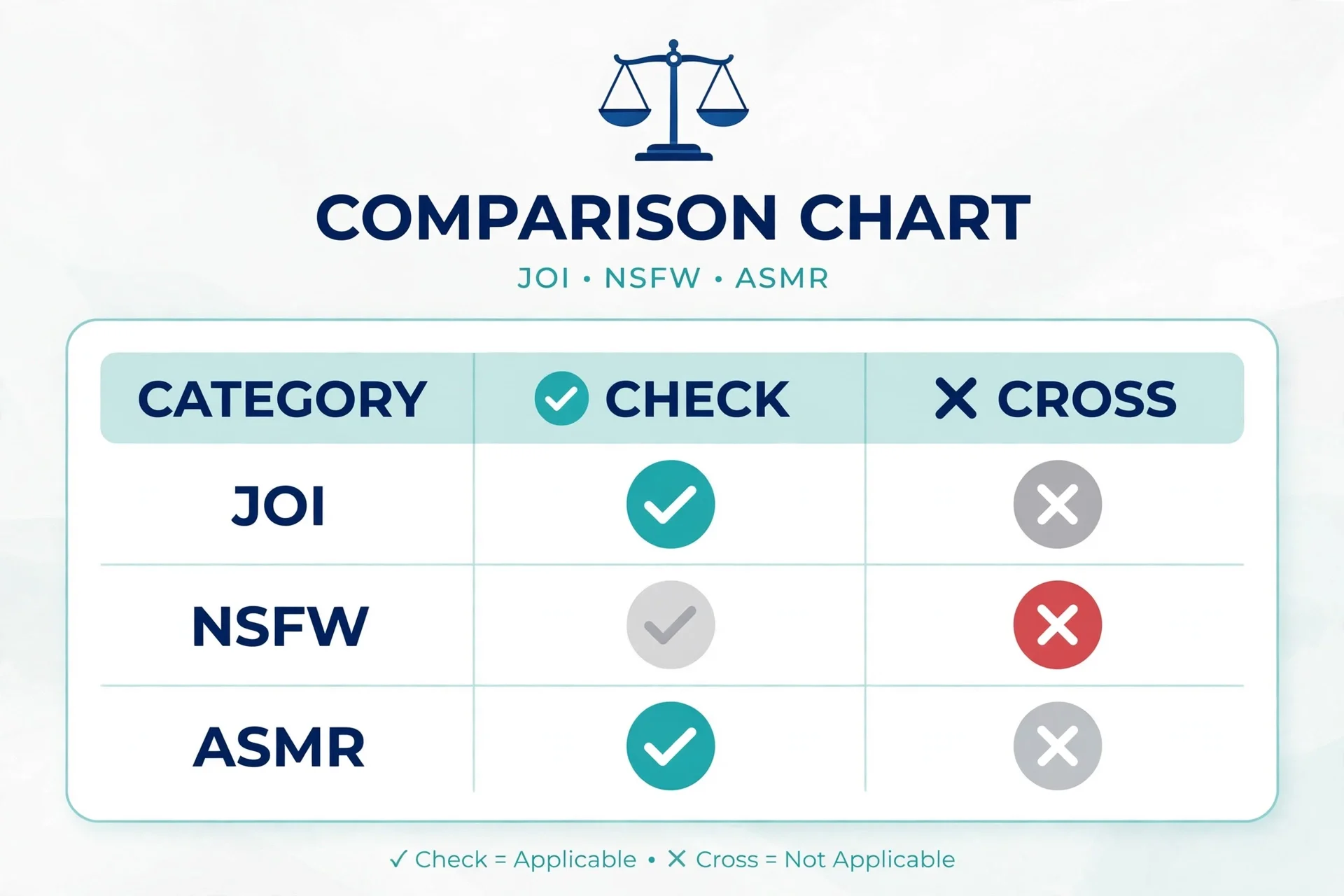
JOI sits in a small family of adult-content labels, and comparing it with its neighbours is the fastest way to see what makes it specific. The table below keeps the comparisons at the level of labels and formats. It does not describe explicit acts, because the differences that matter for understanding the slang are about format and context, not graphic detail.
| Term | What it labels | How it differs from JOI |
|---|---|---|
| JOI | Adult content built around spoken, step-by-step guidance to the viewer | — |
| NSFW | Anything “not safe for work,” from mild innuendo to explicit material | Much broader; NSFW is a warning label, JOI names one specific category. |
| ASMR | Audio focused on soft sounds and whispering, meant to relax or tingle | Mainstream and usually non-sexual; JOI borrows the intimate, direct-address audio style but is explicitly adult. |
| Roleplay | Content or chat where performers act out a scenario or character | Broader format; JOI is one specific scenario type within roleplay-style content. |
| “Join” (typo) | Nothing adult at all — an invitation to take part | Not a slang term; it only looks like JOI when typed quickly. Context makes the difference obvious. |
Two comparisons deserve a little more explanation. NSFW is the term most people should reach for instead of JOI. If you need to warn someone that a link, a username, or a thread is adult in nature, “NSFW” says everything that needs saying without naming a specific explicit category. ASMR is worth mentioning because the two formats can sound similar at first — a quiet voice speaking directly to the listener — and because some JOI content is tagged alongside ASMR-style audio. The difference is intent and content: ASMR is designed to relax, while JOI is designed as adult guidance. Hearing a soft voice does not make something JOI, and the JOI label is what tells you the content is adult.
Alternate Meanings
JOI has a few alternate readings, but none of them displaces the adult meaning in general use. That matters, because a common mistake is to assume that because a harmless expansion exists somewhere online, the term itself must be harmless. It is not. The dominant meaning wins in any mixed or public context, and the alternates below are either rare, coincidental, or specific to a single community.
| Alternate reading | Where you meet it | Should you rely on it? |
|---|---|---|
| Typo for “join” | Fast-typed chats, meeting invites, game lobbies | Yes, when the sentence is clearly an invitation — but retype it as “join” to avoid confusion. |
| Joi, a name | Baby-name lists, fiction, film credits | Yes, as a name it is unrelated; the character Joi in Blade Runner 2049 is the best-known example. |
| “Joy of Inspiration” and similar expansions | Motivational posts, hashtags, small creative communities | No — these are later backronyms, not established slang, and most readers will still read JOI the adult way. |
| “Jump on in” | Occasional gaming or streaming invites | No — rare and easily misunderstood; “hop in” or “join us” says the same thing clearly. |
| Initials of an organisation or product | Business, academic, or technical documents | Only inside that document, where the full name is spelled out on first use. |
The name deserves a separate note, because it is the one alternate reading that is genuinely common. Joi is a real given name, spelled J-o-i, and it appears in films, books, and everyday life with no adult association at all. Capitalisation and context usually separate the two: “Joi” at the start of a sentence about a person is a name, while “JOI” in all capitals in a forum tag is the slang term. Search engines, however, do not always keep them apart, which is how a search for a character or a name can surface adult suggestions. If that happens to you, adding a clarifying word — “Joi character,” “Joi name meaning,” or “Joi Blade Runner” — will clean up the results immediately.
The wholesome expansions need a firmer warning. Phrases like “joy of inspiration,” “journey of imagination,” and “just online, idle” do appear in listicles about JOI, but they are not how the term is used by any large community, and there is no evidence that they predate the adult meaning. They read like attempts to give the letters a clean meaning after the fact. Using one of them in a public post, a username, or a hashtag will not protect you from the dominant reading; most people who see JOI will think of the adult term first and assume the wholesome expansion is either a joke or a cover. The same context rule applies to other acronyms with more than one life. As our EYP meaning slang guide puts it, context decides everything — and with JOI, the context that decides is almost always the adult one.
Professional or Polite Alternatives
Because JOI has no clean everyday use, the polite alternative is usually not a different slang word but a plain description — or silence. If you need to refer to the category in a conversation about internet safety, content moderation, or slang research, “adult content,” “explicit content,” and “NSFW material” all work, and they carry none of the shock value. If you need to ask what the term means, ask in private, in plain words: “I saw the acronym JOI somewhere — can you tell me what it stands for?” That sentence is polite, it shows you are asking about a word rather than requesting content, and it gives the other person room to answer briefly.
If someone sends you JOI content or uses the term at you in an unwanted way, the polite responses are also plain ones. “I am not interested in that kind of content, please do not send it” is complete and does not require an explanation. “Please keep this chat work-appropriate” works in a professional channel. “I do not know what that means, and I would rather not find out this way” works when you genuinely want to disengage. None of these responses requires you to repeat the full form or to debate the meaning. In every case, the alternative to using JOI is describing the situation in ordinary language, which is both clearer and safer.
For writers, moderators, and parents, there is one more alternative worth keeping in your pocket: the category label without the acronym. Writing “an adult-content tag” or “an NSFW acronym” in a report, a school note, or a moderation log communicates exactly what happened without putting the explicit phrase in front of people who do not need to see it. That is the same principle behind content warnings generally — name the category, not the graphic detail — and it is the approach this article follows throughout.
Common Mistakes
Most mistakes with JOI come from treating it like ordinary slang. It is not, and the errors below are the ones people make most often when they learn the term from a meme or a listicle instead of from a clear definition.
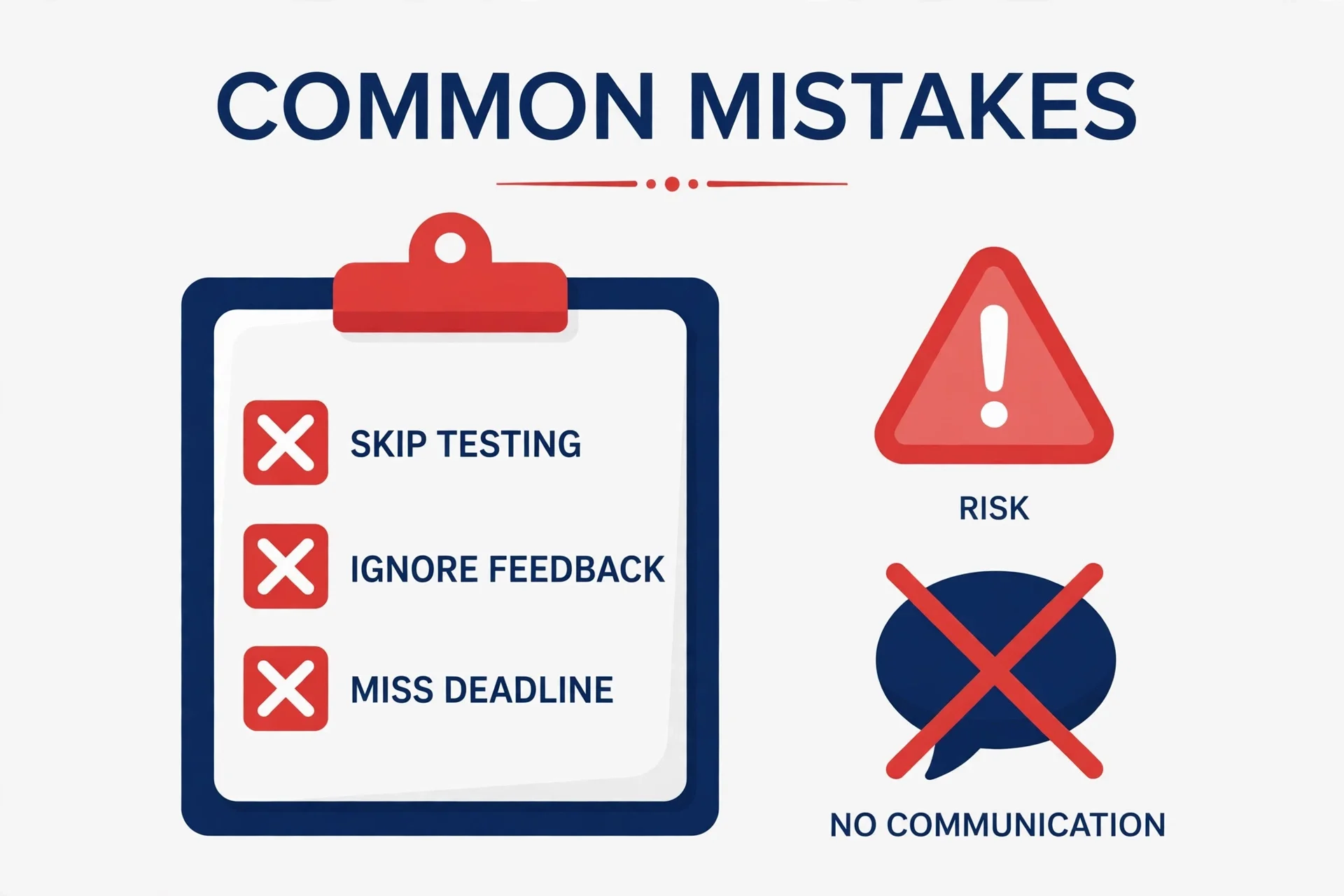
- Using it as a joke in a mixed group chat. In a private chat between adults who know the meaning, a joke about the “join” typo might land. In a mixed group — work colleagues, family, classmates, or strangers — it reads as explicit language, and the joke is on the person who sent it.
- Assuming the wholesome expansions are real. “Joy of inspiration” and its cousins are not established meanings. Building a username, a brand, or a hashtag around them invites exactly the misunderstanding you were trying to avoid.
- Typing JOI when you mean “join.” Fast typing turns “join” into “joi” more often than people expect, because the letters sit close together and autocorrect does not always catch it. In a meeting invite or a game lobby, proofread the word before sending.
- Repeating it to ask about it in public. Asking “what is JOI?” in a public comment thread draws adult-content replies and recommendations you did not want. Ask in private, or search for a dictionary-style definition, as you are doing now.
- Searching for it on a shared device without thinking. Because the dominant meaning is adult, searching the bare acronym can fill a shared browser history and recommendation feed with adult suggestions. Use a private window, or search a fuller phrase such as “JOI acronym definition.”
- Assuming everyone your age knows it. Recognition of JOI is uneven. Younger users often have no idea, older users may know it only as a name, and assuming shared knowledge leads to awkward explanations in both directions.
- Linking or tagging it casually. Adding JOI as a hashtag, a video tag, or a playlist title labels that content as adult to platforms and to viewers, even if that was not the intention. Tags are read literally by algorithms.
Quick Tips
If you only remember five things from this guide, make them these:
- Know the full form, then stop there. JOI stands for “jerk-off instructions.” You do not need any more detail to understand every normal encounter with the term.
- Treat it as NSFW by default. If you would not say it at work or at school, do not type it there either. The NSFW label is the correct mental category for JOI.
- When in doubt, say “adult content.” Plain language replaces the acronym in every polite, professional, or public situation without losing any meaning.
- Fix the “join” typo immediately. If you typed JOI and meant join, correct it in a follow-up message before anyone reads it the other way.
- Ask privately, answer briefly. Definitions of adult slang belong in private messages and dictionary-style articles, not in public threads where the question itself becomes the conversation.
- Check the context before you react. A forum tag, a name, and a typo can all look like JOI. One glance at the surrounding sentence usually tells you which one you are looking at.


FAQ
What does JOI mean in slang?
JOI stands for “jerk-off instructions.” It is the label for a category of adult, explicit audio and video content in which a performer gives spoken, step-by-step guidance to the viewer. It is NSFW and has no widely used clean meaning in everyday texting.
What is the full form of JOI?
The full form is “jerk-off instructions.” The close variant “jack-off instructions” also appears in older forum writing, but “jerk-off instructions” is the form used by dictionary sources and the form most people recognise.
Is JOI safe for work or school?
No. JOI is an adult term and is not safe for work, school, family chats, or any public or professional setting. If you need to refer to it in those settings, use a plain category label such as “adult content” or “an NSFW term” instead of the acronym.
Can JOI mean “join”?
Only as a typo. “JOI the call” is almost always a fast-typed “join,” and the surrounding sentence makes that clear. JOI is not an accepted abbreviation for join, and typing it on purpose will be read as the adult term by anyone who recognises it.
Where did JOI come from?
The phrase behind JOI circulated on adult message boards in the early 2000s, the acronym was in use by the late 2000s, and search interest rose from around 2009 as adult platforms began tagging content by category. Dedicated online communities formed in the early 2010s and helped spread recognition of the label.
Why do I keep seeing JOI if I never searched for it?
Recommendation systems, forum tags, memes, and search suggestions all surface the term to people who never looked for adult content. The letters look harmless, so they travel easily in screenshots and jokes, and each appearance teaches a new group of people the meaning. Seeing the term does not mean your account or device did anything wrong.
What should I do if someone sends me JOI content I did not ask for?
Say plainly that you are not interested and ask them not to send it again, then block or report if it continues. You do not owe an explanation, and you do not need to debate the meaning of the term. On a shared platform, use the report and block tools rather than arguing in the thread.
What does joi meaning slang mean when people search for it?
People searching for “joi meaning slang” are usually asking for a clear, dictionary-style definition of the acronym — what it stands for, where it came from, and whether it is safe to use. The answer is the one this article gives throughout: it is an adult NSFW label with no clean everyday use, and knowing the definition is useful mainly so you can recognise it and avoid using it in the wrong place.
Conclusion
JOI is a short acronym with a long shadow. The letters themselves look innocent, which is exactly why they cause so much confusion: they can be a typo for “join,” a name, or a tag on adult content, and only context tells you which one you are looking at. In slang, though, the answer is settled. JOI stands for “jerk-off instructions,” it names a category of explicit adult content built around spoken guidance, and it belongs only in adult spaces, if it belongs in conversation at all. That single fact answers most of the questions people arrive with. You now know what the term means, where it came from, why it spread, and why the wholesome-sounding expansions floating around online do not change how it will be read.
The practical advice follows from the definition. Do not use JOI in work, school, family, or public chats. Do not build a username or a hashtag around it on the strength of a backronym. If you meet it, read the surrounding sentence before reacting, because a typo and a name are both more likely than they first appear. And if you need to talk about it, use plain language — “adult content,” “an NSFW term” — which says everything necessary without repeating an explicit label. Slang is worth understanding even when it is not worth using, and JOI is a good example of why: like cyberpunk slang, it travelled from a small, specific community into wider awareness, but unlike most slang, the journey did not make it any more suitable for everyday conversation. Knowing the difference is the whole point, and now you do.
