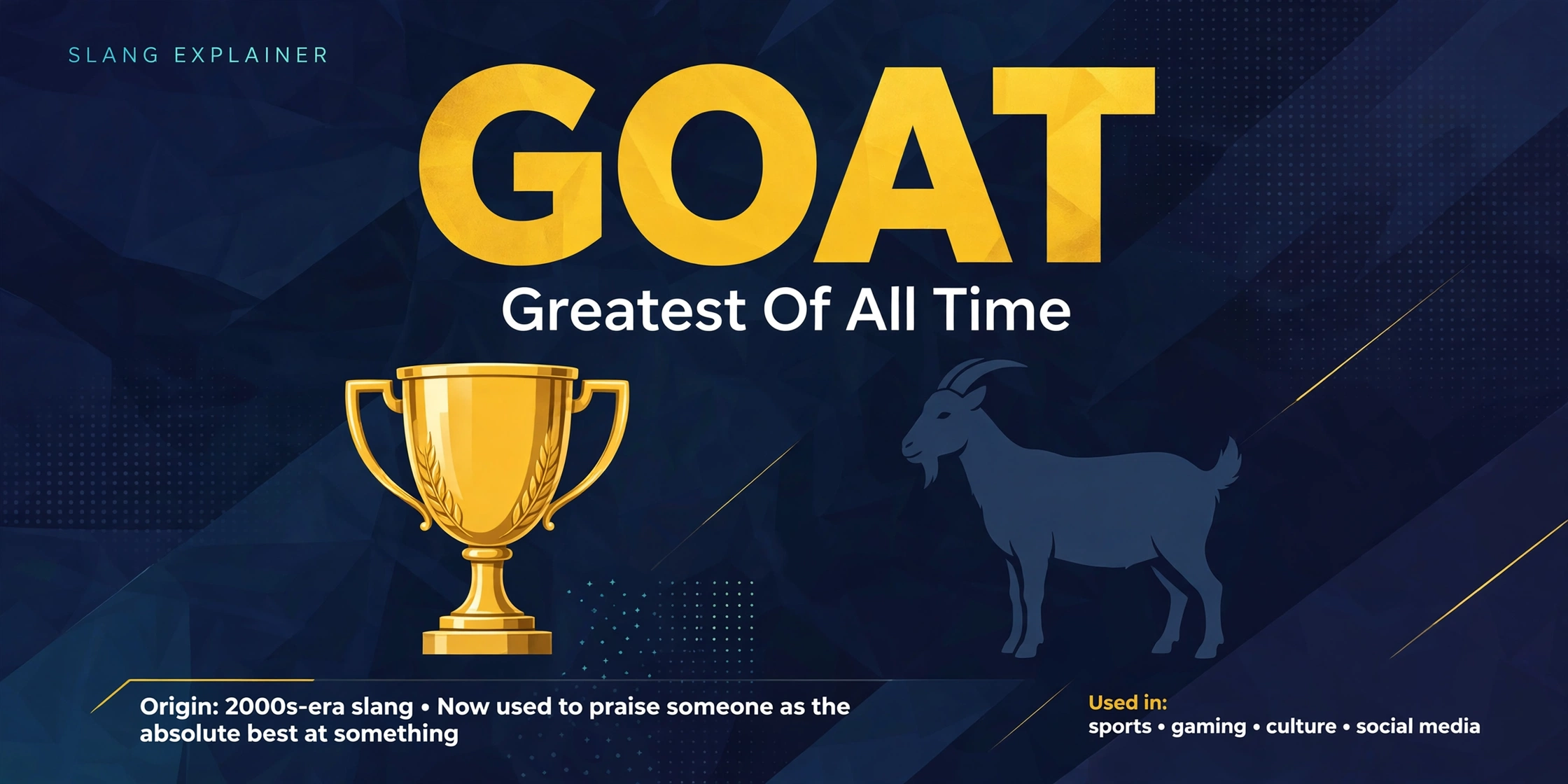
Quick definition: In slang, goat meaning slang is simple: GOAT stands for “Greatest of All Time.” When someone calls a person, a performance, or even a sandwich the GOAT, they are saying nothing and nobody in history has done it better. It is the highest praise in sports talk, music debates, and everyday group chats, and it is almost always written in capital letters so it is not confused with the farm animal.
GOAT Meaning Slang Meaning & Definition
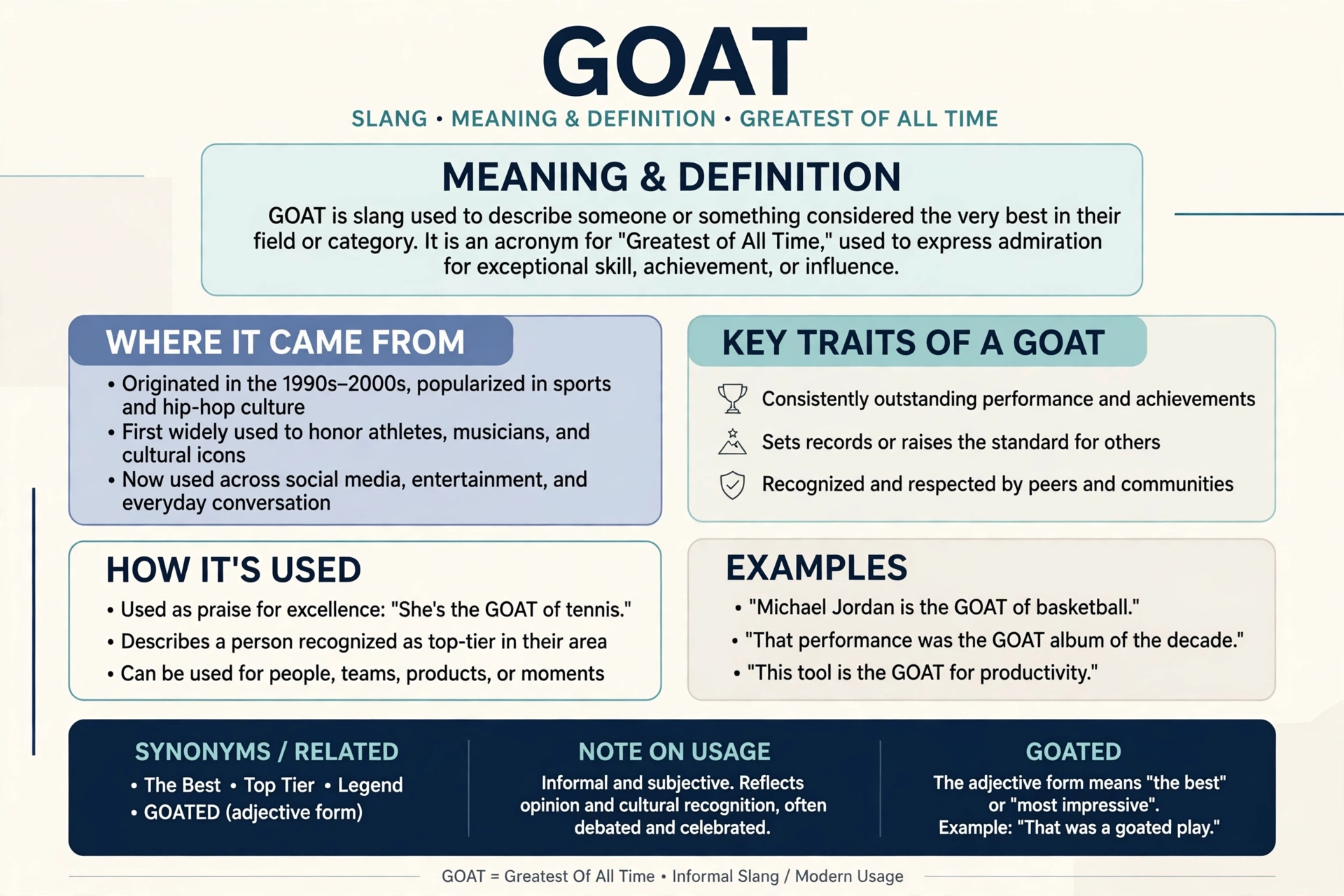
GOAT is an acronym that spells out G-O-A-T: Greatest Of All Time. Unlike “the best right now” or “my favorite,” GOAT makes a claim about all of history. If you say Michael Jordan is the basketball GOAT, you are not just saying he was great in the 1990s. You are saying that, weighing championships, skill, influence, and longevity, no player before or since has matched him.
That all-time claim is exactly why the word sparks so much argument. Sports fans love a GOAT debate because there is no official scoreboard for greatness. One fan points to rings, another to statistics, another to cultural impact, and everyone leaves convinced they won. The term has traveled far beyond sports, though. Today you will hear it about singers, actors, chefs, teachers, video games, and the friend who somehow fixes your Wi-Fi, books the flights, and brings snacks to the road trip. In those everyday uses, GOAT is often playful exaggeration rather than a serious historical ranking, and context tells you which one it is.
Two small style points matter. First, write it as GOAT, in capitals, when you mean the slang term. Written as “goat” in lowercase, most readers will picture the animal first. Second, GOAT usually takes “the” in front of it — “the GOAT” — when it names a person. You can also use it as an adjective, as in “a GOAT performance,” or as a verb in the newer form GOATed, meaning something was so good it reached all-time-great status.
Introduction
Scroll through any sports comment section, TikTok caption, or group chat after a big game and you will find GOAT within seconds. “LeBron or Jordan? GOAT debate time.” “That halftime show was GOATed.” “My grandma is the GOAT, no discussion.” The word is short, punchy, and instantly understood by millions of Americans, which is why it survived long after most slang from the same era faded.
What makes GOAT interesting is that it did not start on the internet. It grew out of boxing bravado, hip-hop, and sports television, then the internet gave it a second life as a meme, an emoji shorthand, and a daily compliment. Understanding goat meaning slang therefore means understanding two stories at once: the serious story of athletes chasing immortality, and the funny, informal story of friends hyping each other up in texts. This guide covers both, with clear examples, the famous origin story, the older and darker meaning of “goat” in sports, and practical tips so you use the term naturally instead of sounding like you just learned it five minutes ago.
Origin
The phrase “greatest of all time” is much older than the acronym. Sports writers used it for decades, for boxers, tennis players, and other champions, long before anyone shortened it to four letters. The acronym itself has a surprisingly specific birthplace: boxing legend Muhammad Ali.
Ali spent the 1960s and 1970s calling himself “The Greatest,” and he backed it up with a style, a voice, and a record that made the claim hard to ignore. In September 1992, his wife Lonnie Ali incorporated a company called G.O.A.T. Inc. — Greatest of All Time, Inc. — to manage his name, image, and business rights. That company name is widely cited as the first clear, public use of GOAT as an acronym for greatest of all time.
Hip-hop carried it from there. On De La Soul’s 1993 album Buhloone Mindstate, the track “Lovely How I Let My Mind Float” includes a line in which the rapper says he is a goat, in the new, positive sense. Then, in 2000, LL Cool J released an entire album titled G.O.A.T., short for Greatest of All Time, and repeated the claim throughout its songs. The album went platinum and reached number one in the United States, and suddenly a boxing-business acronym was a hip-hop badge of honor.
Sports television and then social media did the rest. As debate shows, podcasts, and Twitter threads argued endlessly about Jordan versus LeBron, Messi versus Ronaldo, and Brady versus everyone else, GOAT became the default word for the argument itself. By the 2010s, it was no longer just a sports term. It was internet slang, used in comments, captions, memes, and everyday praise, often paired with a goat emoji for extra effect.
Popularity
GOAT is popular because it does three jobs at once. It praises, it ranks, and it starts a conversation. Saying “she is talented” ends a sentence. Saying “she is the GOAT” starts a debate, invites agreement or disagreement, and signals that you follow the culture closely enough to use its strongest word.
Its popularity also comes from its flexibility. It works in a heated sports bar argument and in a sweet birthday caption. A coach can call a retiring player the GOAT with total seriousness. A teenager can call a friend the GOAT for sharing a charger, and everyone understands the joke: the praise is deliberately too big for the deed, and that is what makes it funny and warm at the same time.
There is a downside to that flexibility, and it is worth naming honestly. When everything is called GOAT, the word loses some of its power. Fans and writers now complain about “GOAT inflation,” where every good performance, every viral clip, and every decent album gets crowned the greatest ever before the week is out. The smartest users of the term save it for moments that genuinely feel historic, or they make the exaggeration obvious so the joke lands. Used sparingly, it still hits hard. Used for everything, it starts to sound like background noise.
How It Is Used
GOAT shows up in several grammatical forms, and each one has a slightly different feel:
- The GOAT (noun): “Serena Williams is the GOAT of women’s tennis.” This is the classic, serious use.
- GOAT as an adjective: “That was a GOAT performance.” Here it describes a single moment rather than a whole career.
- GOATed (verb/adjective): “That finale was GOATed.” This newer, informal form means something reached all-time-great status.
- GOAT debate (compound noun): “Do not start the GOAT debate at dinner again.” This names the argument itself, often with affectionate exhaustion.
- GOAT emoji shorthand: A single goat emoji in a comment often means the same thing as writing GOAT, especially under sports and music posts.
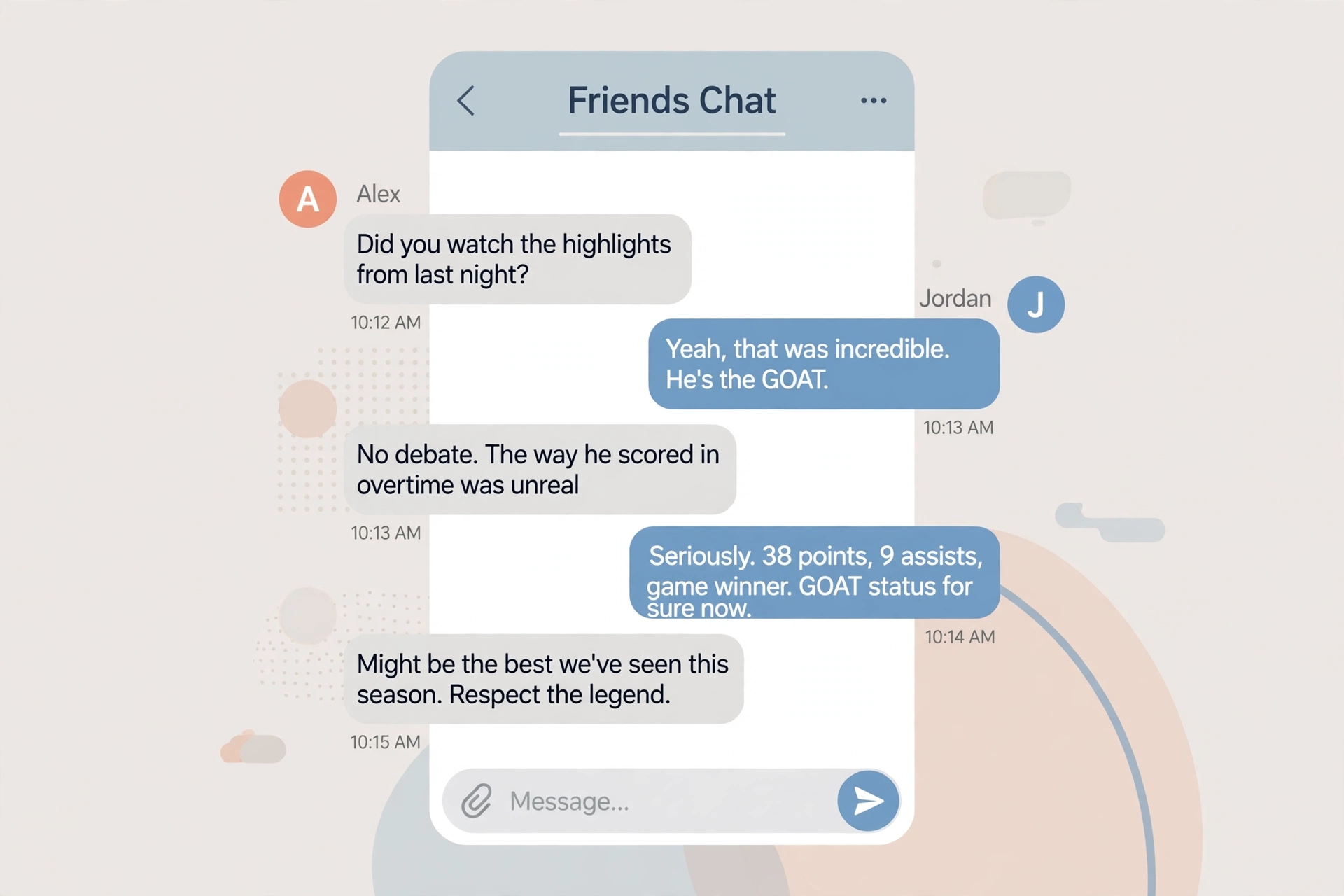
Tone matters as much as grammar. In sports writing, GOAT is confident and argumentative. In a text to a friend, it is warm and hyperbolic. In a joke, it is deliberately over the top, as in “the GOAT of parallel parking” or “the GOAT of being late.” The same four letters can be a serious historical claim, a compliment, or a punchline, and your audience will read the tone from the rest of the message.
GOAT also works across generations now. Older sports fans use it in the Ali and Jordan sense. Gen Z and Gen Alpha users use it in TikTok comments, gaming chats, and school hallways, often without thinking about its boxing origin at all. That shared understanding is rare for slang, and it is one reason the term has lasted for more than thirty years while trendier words have come and gone.
Examples
Examples are the fastest way to learn goat meaning slang, because the word changes color with its context. Read the same term in a sports debate, a work chat, and a joke, and you will hear three different versions of praise.
Friendly Examples
- “You stayed on the phone with me until 2 a.m. before my exam? You are the GOAT, seriously.”
- “Mom made biryani, fixed my laptop, and still drove me to the airport. Certified GOAT behavior.”
- “He gave up his weekend to help us move. That is GOAT-level friendship.”
- “Thank you for covering my shift. You are the GOAT and I owe you coffee for a month.”
Professional Examples
- “After thirty years of teaching, Ms. Rivera retired as the GOAT of our school district.”
- “In the meeting, do not say ‘she is the GOAT’ unless you mean it as a career-level compliment. In a formal email, ‘the most accomplished in the field’ lands better.”
- “The keynote speaker was introduced as one of the GOATs of modern architecture, and the audience agreed.”
- “Her product launch was described in the press as a GOAT performance for a first-time founder.”
Funny Examples
- “I am the GOAT at finding a parking spot. I once circled the block for forty minutes and called it strategy.”
- “My cat slept through the entire party and still got the most photos. GOAT energy, honestly.”
- “He is the GOAT of saying ‘five more minutes’ and then sleeping for two hours.”
- “That group project presentation was GOATed, and we all know only one person did the slides.”
Here is a quick example table that shows how the same word shifts with context:
| Context | Example sentence | What it really means |
|---|---|---|
| Sports debate | “Jordan is the GOAT, and it is not close.” | A serious all-time ranking claim. |
| Music fandom | “Beyoncé is the GOAT. End of discussion.” | Top artist of all time, in the fan’s view. |
| Friendly thanks | “You brought snacks and chargers? GOAT.” | Playful, oversized thanks. |
| Work praise | “That was a GOAT presentation.” | Exceptional, memorable work. |
| Joke | “The GOAT of napping has done it again.” | Deliberate exaggeration for humor. |
Comparison with Similar Terms
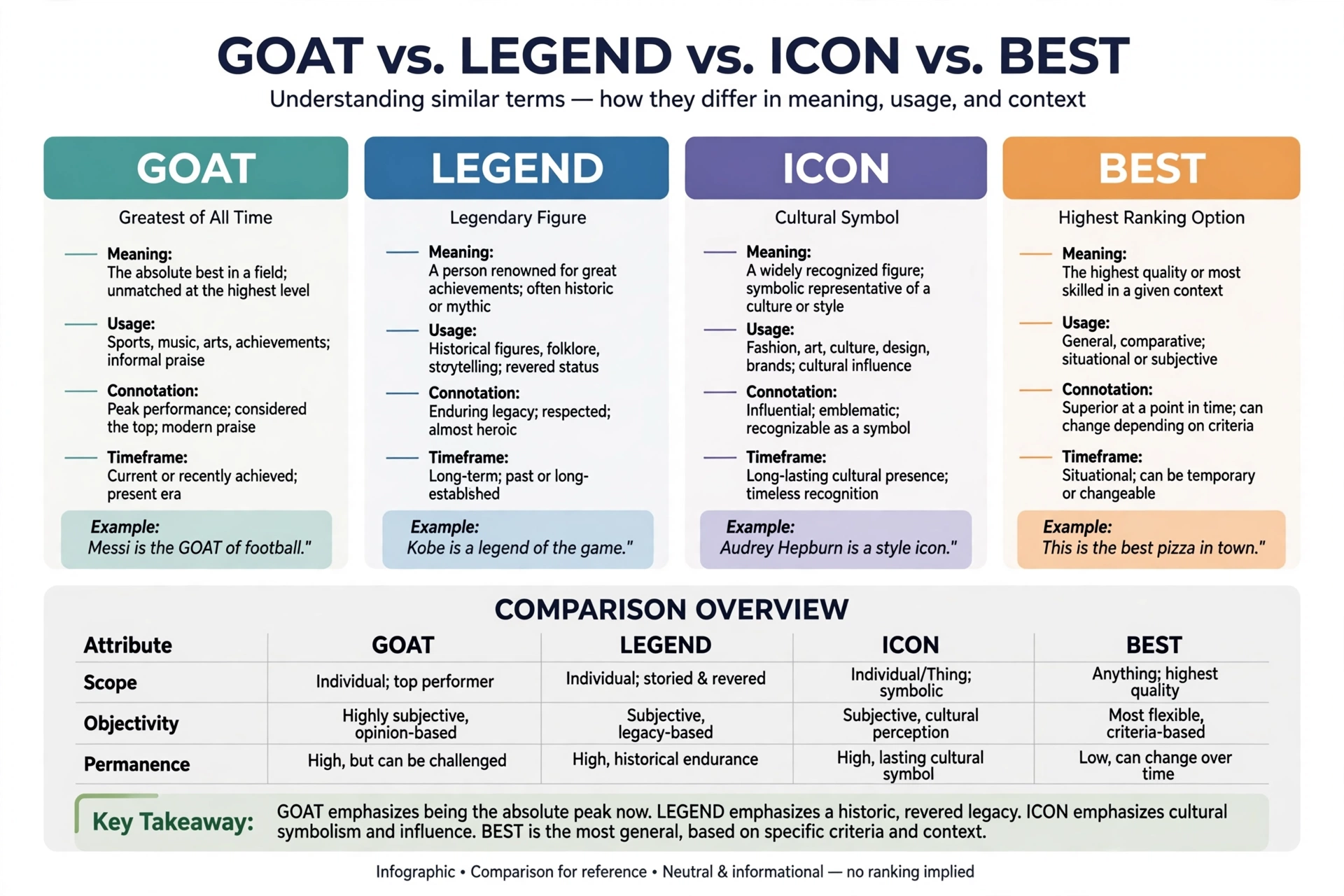
GOAT sits in a family of praise words, but it is stronger than almost all of them. Knowing the differences keeps you from overstating or understating what you mean.
| Term | Meaning | How it differs from GOAT |
|---|---|---|
| GOAT | Greatest of All Time | An all-time, history-wide claim. |
| Legend | Someone famous and admired over time | Warm and respected, but softer than GOAT. |
| Icon | A symbol of a field or era | About influence and image, not just skill. |
| Best | Top-ranked right now or in a group | Can be temporary; GOAT claims permanence. |
| Elite | Among the very top performers | A group label, not a single winner. |
| Cap / No cap | Lie / no lie | About truth, not greatness. |
| Mid | Mediocre, average | The opposite energy: faint praise, or none. |
Put simply, “best” can change next season. “Legend” can be shared by many people. GOAT, used seriously, leaves room for only one person at the top of a field. That is why fans argue about it so fiercely: there can be only one GOAT per sport, per genre, or per era in the strict sense, even if everyday chat hands the title out more generously.
GOAT also differs from hype words like drip, which praises style and confidence, or tuff, which praises toughness and coolness. Drip is about how you look. Tuff is about how you carry yourself. GOAT is about what you achieved and how it compares with everyone who ever tried.
Alternate Meanings
GOAT has two alternate meanings that are worth knowing so you do not misread a message.
First, the original sports meaning of “goat,” in lowercase, was the opposite of praise. In American sports in the early 1900s, a “goat” was the player blamed for losing a game, a scapegoat. A missed catch, a bad pitch, or a costly error could turn a player into “the goat” of the match. That negative sense still appears in old sports writing and in the word scapegoat itself, which comes from the same idea of blaming one figure for a group’s failure. Modern GOAT, in capitals, is a deliberate reversal of that old insult: from the blamed loser to the greatest winner.
Second, in everyday English, a goat is simply the animal, and jokes about GOAT often lean on that double meaning. Memes show actual goats wearing crowns, athletes posing next to goats in advertisements, and fans posting goat emojis under highlight videos. The pun is part of the fun, and it is why the goat emoji became a visual shorthand for the slang term. If someone posts only a goat emoji under a highlight reel, they are almost certainly calling that player the GOAT, not commenting on farm animals.
Outside slang, GOAT can also appear as an acronym in technical or organizational names, but in texts, comments, and captions, the slang meaning dominates. If the conversation is about sports, music, gaming, or praise, assume Greatest of All Time first.
Professional or Polite Alternatives
GOAT is casual, even when it is serious. In formal writing, a job reference, a speech, or a professional email, a more measured phrase usually works better. Here are natural alternatives, matched to the situation:
- For a career tribute: “the most accomplished athlete of her generation” or “widely regarded as the greatest in the history of the sport.”
- For work praise: “an outstanding performance” or “one of the strongest presentations I have seen.”
- For a thank-you note: “I am incredibly grateful for your help” instead of “You are the GOAT,” unless you know the reader enjoys slang.
- For a recommendation: “the leading voice in her field” or “a defining figure in modern music.”
- For a neutral article: “often described as the greatest of all time” keeps the claim attributed rather than stated as fact.
The rule is simple: use GOAT with friends, fans, and online audiences who speak the same slang. Use the fuller, formal version with employers, professors, clients, and anyone who might read the slang as too casual for the occasion. Both versions can be sincere. The difference is only the room you are standing in.
Common Mistakes
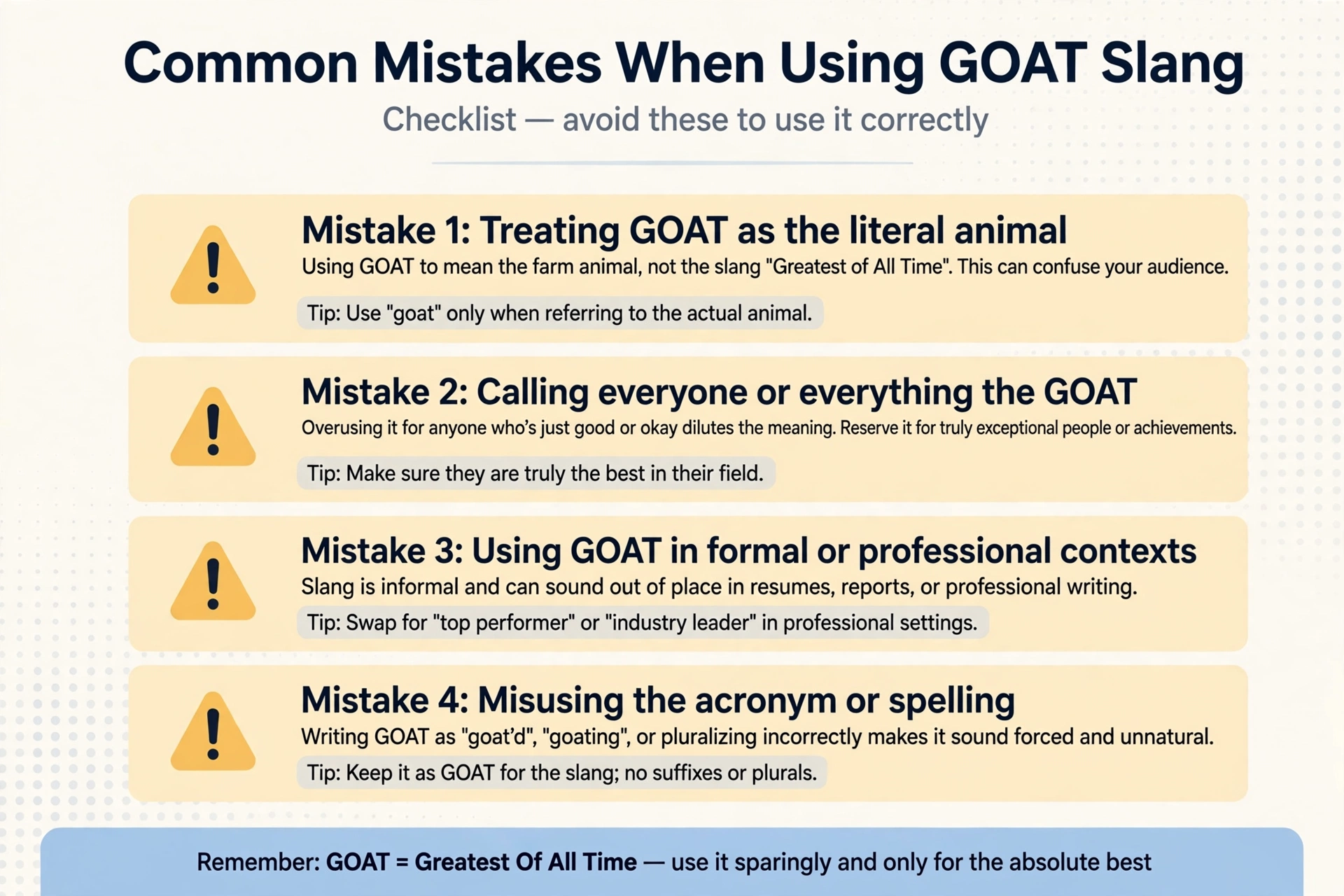
GOAT is easy to use, but a few common mistakes make the word land wrong. Avoiding them is what separates a natural user from someone forcing slang.
- Calling everything GOAT: If every song, meal, and haircut is the GOAT, none of them is. Save the serious version for genuinely historic moments, and make the everyday version clearly a joke.
- Writing it in lowercase for the slang meaning: “He is the goat” reads as an animal joke first. Capitalize it as GOAT when you mean Greatest of All Time.
- Using it in formal settings without thinking: A GOAT compliment in a wedding speech can be charming. The same line in a legal letter or a grant application looks careless.
- Starting a GOAT debate with no criteria: “Jordan is the GOAT” invites a real argument only if you say what you are measuring: rings, stats, longevity, or impact. Without criteria, the debate goes in circles.
- Confusing GOAT with “favorite”: Your favorite player is not automatically the GOAT. You can love a player, respect the GOAT, and admit they are two different people. Fans respect that honesty more than blind loyalty.
- Using it to insult someone: Calling yourself the GOAT as a joke is fine. Calling someone else a “goat” in the old scapegoat sense, to blame them for a loss, is a different word with a different history, and it will sting.
Quick Tips
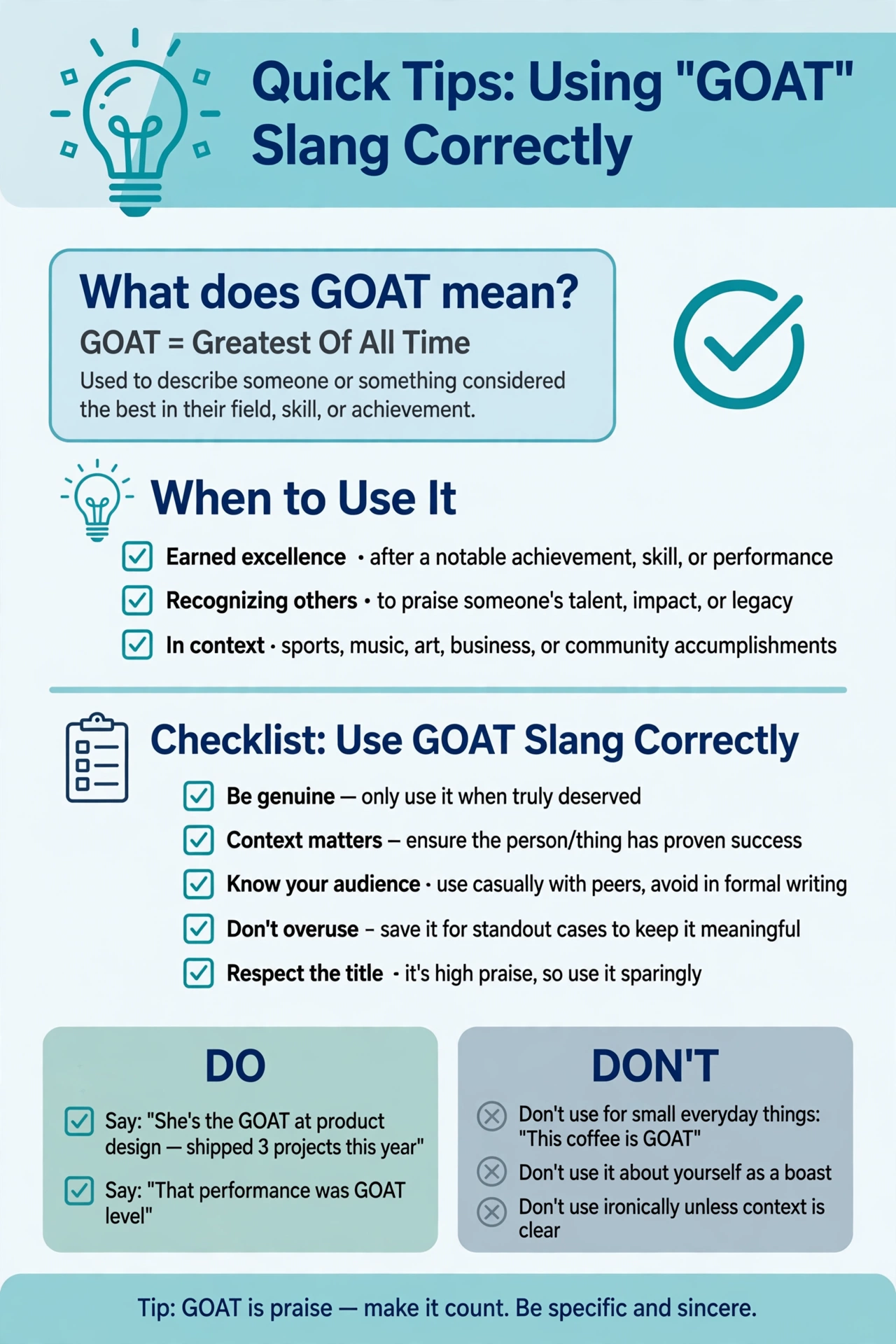
- Use “the” before GOAT for people: “The GOAT” sounds natural. Just “GOAT” alone can work in a comment, but in a sentence, the article helps.
- Pair it with a field: “The GOAT of tennis” is clearer than “the GOAT” with no context, especially when several GOAT debates are happening at once.
- Let the goat emoji do the work in comments: Under a highlight video, a goat emoji is a complete compliment. No caption needed.
- Use GOATed sparingly: It is newer and more informal than GOAT. It shines in chats and captions, and it can sound forced in serious writing.
- Know when to concede the joke: If you called a friend the GOAT for bringing pizza, accept the laugh. Do not defend it as a historical ranking.
- Read the room in GOAT debates: Some fans love arguing. Others find it exhausting. A quick “in my opinion” keeps a fun debate friendly.
FAQ
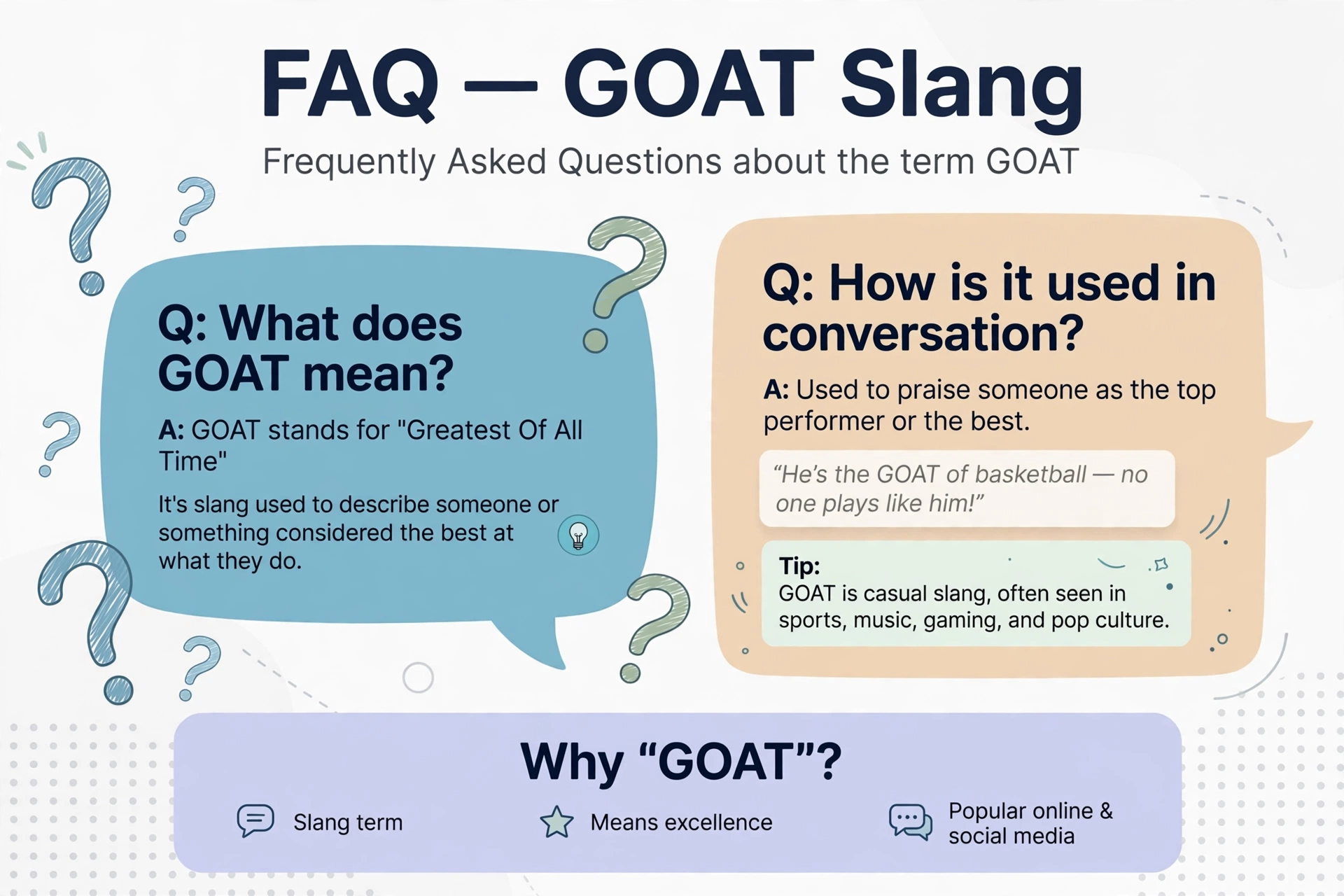
What does GOAT mean in slang?
GOAT means Greatest of All Time. In slang, it names the best person, performance, or thing in the entire history of a field, not just the best right now.
Where did GOAT slang come from?
It comes from Muhammad Ali’s world. Ali called himself “The Greatest,” and in 1992 his wife Lonnie incorporated G.O.A.T. Inc. to manage his brand. Hip-hop, especially LL Cool J’s 2000 album G.O.A.T., then spread the acronym into popular culture.
Is GOAT always written in capital letters?
Yes, when you mean the slang term. Capital GOAT separates the acronym from the animal. Lowercase “goat” usually means the animal, or, in old sports writing, the blamed player.
What does GOATed mean?
GOATed is a newer verb and adjective form. It means something was so good it reached all-time-great status, as in “That concert was GOATed.” It is informal and best used in chats, comments, and captions.
Who is the GOAT in basketball?
There is no official answer, which is the point of the debate. Most fans argue between Michael Jordan and LeBron James, weighing championships, statistics, longevity, and cultural impact. Your criteria decide your answer.
Can GOAT be used for things, not just people?
Yes. People call albums, movies, games, meals, and moments GOAT, usually as playful exaggeration. A “GOAT sandwich” is a joke compliment, while a “GOAT album” may be a serious claim about music history.
Is it rude to call someone the GOAT?
No, it is one of the strongest compliments in slang. It only becomes awkward if you use it sarcastically to mock someone, or if you use the old lowercase “goat” sense to blame a player for a loss.
What is the opposite of GOAT in slang?
There is no single exact opposite, but words like mid, meaning mediocre, and washed, meaning past one’s prime, sit at the other end of praise. In the old sports sense, a “goat” was also the scapegoat blamed for defeat, the mirror image of today’s GOAT.
Conclusion
GOAT meaning slang is one of the rare internet terms with a real history behind it. It started as a boxer’s boast, became a business name, traveled through hip-hop, and then became the internet’s favorite way to crown a champion or thank a friend with deliberate overstatement. Used seriously, it makes a bold claim about history. Used playfully, it turns an ordinary favor into a legendary one.
The key is to use it with intention. Save the serious GOAT for performances and careers that genuinely stand above the rest. Use the playful GOAT to hype your friends, celebrate a great moment, and join a debate without taking it too seriously. And when you want a quieter version of the same praise, remember that words like legend, icon, and all-time great carry much of the same respect without the slang edge.
Next time you see a highlight that stops you mid-scroll, or a friend who saves the day in a small, perfect way, you will know exactly what to say. Sometimes “great job” is enough. Sometimes, only GOAT will do.

1 thought on “GOAT Meaning Slang: What It Really Means and How to Use It”