Quick definition: Gen X slang is the casual, sarcastic, and often ironic vocabulary that grew up with Generation X — Americans born roughly between 1965 and 1980 — in the 1980s and 1990s. Words like rad, gnarly, bogus, and whatever did more than sound cool. They carried an attitude: skeptical, self-reliant, allergic to hype, and funny about it. Much of that language never really left. It simply moved from mall food courts and MTV into group chats, memes, and everyday American English.
Gen X Slang Meaning & Definition
Gen X slang means the informal words and phrases popularized by Generation X during their teens and twenties, roughly the 1980s through the late 1990s. It is not one single dialect. It is a mix of surfer and skater talk from California, Valley Girl speech, hip-hop vocabulary, grunge-era understatement, and plain old teenage sarcasm — all blended by a generation that grew up with cable television, the Walkman, and, eventually, the early internet.
What makes gen x slang different from the slang before and after it is its tone. Baby Boomer slang could be earnest and groovy. Millennial and Gen Z slang can be fast, ironic, and internet-native. Gen X slang sits in the middle: dry, skeptical, and deliberately unimpressed. A Gen X teenager did not say something was amazing. They said it was rad, or choice, or, with maximum enthusiasm, totally tubular — and then immediately undercut the enthusiasm with an eye roll. That push-and-pull is the whole personality of the generation in miniature.
It also helps to know who Generation X actually is. Researchers at the Pew Research Center define Generation X as people born from 1965 to 1980, and the University of New Hampshire Extension notes that the cohort is often called the “forgotten generation” — smaller than the Baby Boomers before it and the Millennials after it, and frequently described as latchkey kids who let themselves in after school and figured things out on their own. That independence shows up in the language: short, direct, and hard to impress. If you want the fuller picture, the University of New Hampshire Extension overview of Generation X is a useful, plain-English starting point for the dates, the nicknames, and the defining events of the cohort.
In short, when someone talks about gen x slang today, they usually mean one of two things: the original 1980s and 1990s vocabulary itself, or the attitude behind it — the shrug, the sarcasm, and the refusal to get too excited about anything, including the slang itself.
Introduction
Every generation gets a soundtrack, and every generation gets a vocabulary to go with it. For Generation X, the soundtrack was MTV, hair metal giving way to grunge, hip-hop going mainstream, and the mixtape — a labor of love recorded in real time off the radio, finger hovering over the record button. The vocabulary matched the music: loud when it needed to be, bored when it wanted to be, and always a little bit funny.
Think about the last time you heard someone say whatever with a full-body shrug, or call a bad decision bogus, or greet a friend with a drawn-out dude. You were hearing Gen X slang, whether the speaker was born in 1972 or 2002. Some of these words survived because they are useful. Whatever ends an argument in one syllable. Dude works for almost anyone, in almost any mood. Others survived because they are fun to say: gnarly, grody, psych. And a few survive mainly as nostalgia — words people pull out at a reunion, a themed party, or a text thread full of old friends, the way you might put on a song you have not heard in twenty years just to see if you still know every word.
This guide does what most short glossaries do not: it explains what the words mean, where they came from, how they were actually used, and how they sound today. You will get the big list of Gen X slang terms, examples in friendly, professional, and funny contexts, a comparison with the slang of the generations on either side, and honest advice about which terms still land and which ones will make you sound like you are wearing a costume. Along the way, you will see how this vocabulary connects to the slang that came after it — including Gen Alpha slang, which borrows the same instinct to compress a whole attitude into one short word.
Whether you are a Gen Xer reclaiming your own teenage vocabulary, a younger person trying to understand your parents’ texts, or a writer trying to make a character from 1994 sound like they actually lived in 1994, this is the full picture — definition first, then origin, then real usage.

Origin
Gen X slang did not come from one place, and that is exactly why it sounds the way it does. Generation X came of age in a country that was fragmenting into subcultures faster than ever before, and cable television, cheap cassette tapes, and the shopping mall gave those subcultures a shared stage.
Three tributaries fed the vocabulary. The first was California surf and skate culture, which gave American English gnarly, rad (short for radical), tubular, stoked, and wipeout. Surfers had used gnarly for a big, difficult wave; teenagers took it and applied it to everything intense, good or bad. A gnarly wave was impressive. A gnarly injury was horrifying. Context did the work, which is part of why the word lasted.
The second tributary was the Valley Girl phenomenon of the early 1980s — the like, totally, fer sure, gag me with a spoon speech of Southern California teenagers, amplified by the 1982 hit song “Valley Girl” and the 1983 film of the same name. It was parodied endlessly, which only spread it further. Even kids in Ohio and Florida were saying grody to the max within a year, whether they had ever seen the San Fernando Valley or not.
The third tributary was hip-hop, which moved from New York block parties into the national mainstream during the 1980s and gave the wider culture fresh, def, dope, fly, word, and diss. These words carried a different energy — confident, competitive, and rhythmic — and they balanced the surfer drawl and the Valley uptalk with something sharper.
On top of all three sat the defining technology of the era: MTV, which launched in 1981, and the 24-hour news cycle, which arrived with CNN in 1980. For the first time, teenagers in every part of the country were watching the same videos, hearing the same interviews, and copying the same phrases at the same time. A word could travel from a Los Angeles skate park to a Minnesota suburb in a weekend. That is why gen x slang feels so nationally consistent even though it was stitched together from very local scenes.
The name of the generation itself arrived later. Douglas Coupland’s 1991 novel Generation X: Tales for an Accelerated Culture popularized the label, and the “X” — an unknown variable, a refusal to be defined — fit the slang perfectly. The words of this generation do not try to explain themselves. They shrug, they joke, and they move on.
Popularity
Gen X slang peaked, in its original form, between the mid-1980s and the mid-1990s. That was the era of Clueless (1995), which turned as if into a national catchphrase; of Wayne’s World (1992), which made not, schwing, and excellent into playground currency; and of grunge, which gave the whole culture permission to sound unimpressed. If you were a teenager in 1994, you could not escape this vocabulary. It was in the movies, on the radio, in the mall, and in every school hallway in America.
What happened next is the interesting part. Most generational slang fades when its generation grows up. Gen X slang did not fade — it dissolved into the mainstream. Dude became a default greeting. Whatever became the universal conversation-ender. Chill became a verb, an adjective, and a whole philosophy. My bad, which began emerging in this era, is now so standard that most people who say it have no idea it was ever slang at all.
Then came the nostalgia wave. In the 2010s and 2020s, 1980s and 1990s culture came roaring back — through reboots, throwback playlists, vintage fashion, and social media accounts dedicated to the era. Younger generations started using Gen X terms ironically, then sincerely, then without thinking about it at all. That is the lifecycle of durable slang: first it is cool, then it is dated, then it is retro, then it is just English. Gen X slang is now somewhere between retro and just English, which is why a teenager can say that’s bogus today and sound current rather than costumed — as long as they do not stack five retro terms in one sentence.
The vocabulary also survives because the attitude behind it never went away. Every generation produces its own version of the shrug. Gen X just happened to produce the most quotable one. The dry, skeptical voice of whatever and as if is the direct ancestor of the deadpan humor that dominates social media today, from the ironic captions of Gen Z slang to the absurdist shorthand of the generation after that. The words changed. The shrug stayed.
How It Is Used
Gen X slang is used in three main ways today: sincerely, nostalgically, and ironically — and the same word can do all three depending on who is saying it and who is listening. A 50-year-old saying that concert was rad is probably being sincere. A 25-year-old saying it to a friend is probably being playful. A teenager saying it in a group chat is probably doing a bit. All three are correct uses. The meaning travels; the frame changes.
In everyday conversation, the most common pattern is the single-word verdict. Gen X slang loves a one-word judgment: rad (great), bogus (unfair or lame), wack (bad), dope (excellent), grody (gross). The word does the whole job of a sentence, and the tone of voice does the rest. Say gnarly with wide eyes and it means impressive. Say it while wincing and it means awful. This is why the vocabulary works so well in texts, where tone has to be carried by punctuation, capitalization, and the occasional emoji: the words were built for delivery to do the heavy lifting.
The second pattern is the dismissive phrase. Whatever, as if, talk to the hand, and bye, Felicia (which originated in the 1995 film Friday and belongs to the tail end of the era) all do the same social job: they end a conversation without quite ending a relationship. They say “I am done with this topic” in a way that is funny enough to soften the rejection. Used between friends, they are affectionate. Used with a stranger, they are a wall. Knowing the difference is the whole skill of using this slang well.
The third pattern is the filler-and-intensifier system: like, totally, so, to the max, and fer sure. These words do not add information; they add rhythm and emphasis. “That was, like, totally bogus” is not more informative than “that was unfair.” It is more performative — it signals that the speaker is in on the joke, that they know the register they are using, and that they expect you to know it too. In the 1980s, this system was the sound of teenage girl speech as portrayed (and parodied) in popular culture. Today, it reads as a period marker, which is why writers use it so carefully: a little goes a long way, and a lot reads as caricature.
In texting and social media, Gen X slang has adapted more gracefully than most people expected. Whatever compresses to wtv. Psych survives as a standalone reply. Dude works in any chat app ever made. The terms that adapted best are the shortest and most flexible ones — the same rule that governs slang survival in every generation, and one reason the vocabulary of the 2000s slang era, which grew directly out of Gen X speech, feels like a younger sibling rather than a stranger.
One more usage note matters: Gen X slang is rarely formal, and it is almost never used to show respect. It is the language of peers. Using it upward — to a boss, a teacher, or a client — is a deliberate choice, a signal of casual closeness. That is why the professional-alternatives section below exists. The slang is not rude by itself, but it is familiar, and familiarity has to be earned.
Examples
The best way to understand gen x slang is to hear it in context. The same word changes meaning with the situation, the relationship, and the delivery. The examples below show the vocabulary at work in three everyday registers.
Friendly Examples
Between friends, Gen X slang is warm, teasing, and fast. It is the language of group chats, road trips, and reunions — short words doing the work of long feelings.
- “Dude, that hike was totally gnarly. We have to do it again.” — Gnarly here means impressive and intense, in a good way. Dude is pure affection.
- “Your playlist is da bomb. Where did you even find half of these songs?” — Da bomb means excellent, outstanding. It is a compliment with confetti on it.
- “I’m just going to veg out on the couch tonight. I’ve had a whole week.” — Veg out means to lounge around doing nothing, like a vegetable. No judgment, just rest.
- “Don’t be a dweeb — come to the reunion. Everyone’s going to be there.” — Dweeb is a teasing word for someone socially awkward. Between friends, it lands as a nudge, not an insult.
- “That new taco place? Choice. We’re going back Friday, no debate.” — Choice means top quality, excellent. It is a quieter, cooler cousin of awesome.
Notice how little effort these sentences require. Nobody is performing. The slang is just the default setting of the friendship, which is exactly how it worked in 1989 and how it still works when old friends text each other today.
Professional Examples
In professional settings, Gen X slang mostly appears in its softened, mainstreamed forms — the words that have become so standard that nobody hears them as slang anymore. The rawer terms stay outside the office, and that restraint is itself very Gen X.
- “My bad — I sent the old version of the file. The corrected one is on its way.” — My bad is the classic Gen X apology: short, ownership-taking, and free of groveling. It is now standard business English.
- “Let’s chill on the new feature until the client signs off.” — Chill here means to pause or relax the pace. It sounds calmer than “delay,” which is the point.
- “That deadline is bogus, and everyone on the team knows it. Let’s propose a realistic one.” — Used carefully, in a trusted team, bogus names an unfair situation plainly. With a client, “unrealistic” would be the safer word.
- “The demo was rad — the client actually smiled during the walkthrough.” — Between colleagues who know each other well, rad is a perfectly good way to say “that went great.” In the meeting itself, “excellent” is still the better choice.
The rule of thumb: if the word has fully entered standard English — chill, my bad, dude in a creative workplace — it is safe. If it still sounds like a movie quote — gag me with a spoon, talk to the hand — save it for after hours.
Funny Examples
Gen X humor is dry, self-deprecating, and allergic to sincerity — and the slang is the delivery system. The joke is usually in the gap between the big feeling and the small word used to express it.
- “I just spent forty minutes looking for my glasses. They were on my head. I’m not trippin’, the glasses are.” — Trippin’ means acting foolish or overreacting. The joke lands because the speaker accuses the glasses, not themselves.
- “Oh, you’re going to run a marathon? As if! I get winded walking to the fridge.” — As if is the polite version of “not a chance,” delivered with maximum Clueless energy.
- “I told my kids I was cool in high school. Psych! I was the kid who alphabetized his cassette tapes.” — Psych is the fake-out reveal: everything before it was a joke. The confession after it is the real punchline.
- “This Wi-Fi is so bogus I’m about to write it a strongly worded letter. On paper. With a pen.” — The humor comes from the mismatch: ancient technology deployed against a modern annoyance, in the voice of a generation that remembers both.
- “Gag me with a spoon — the reunion playlist is nothing but songs I pretended to hate in 1991 and secretly loved.” — The Valley Girl catchphrase, deployed by someone old enough to remember it the first time around, is funny precisely because it is out of time.
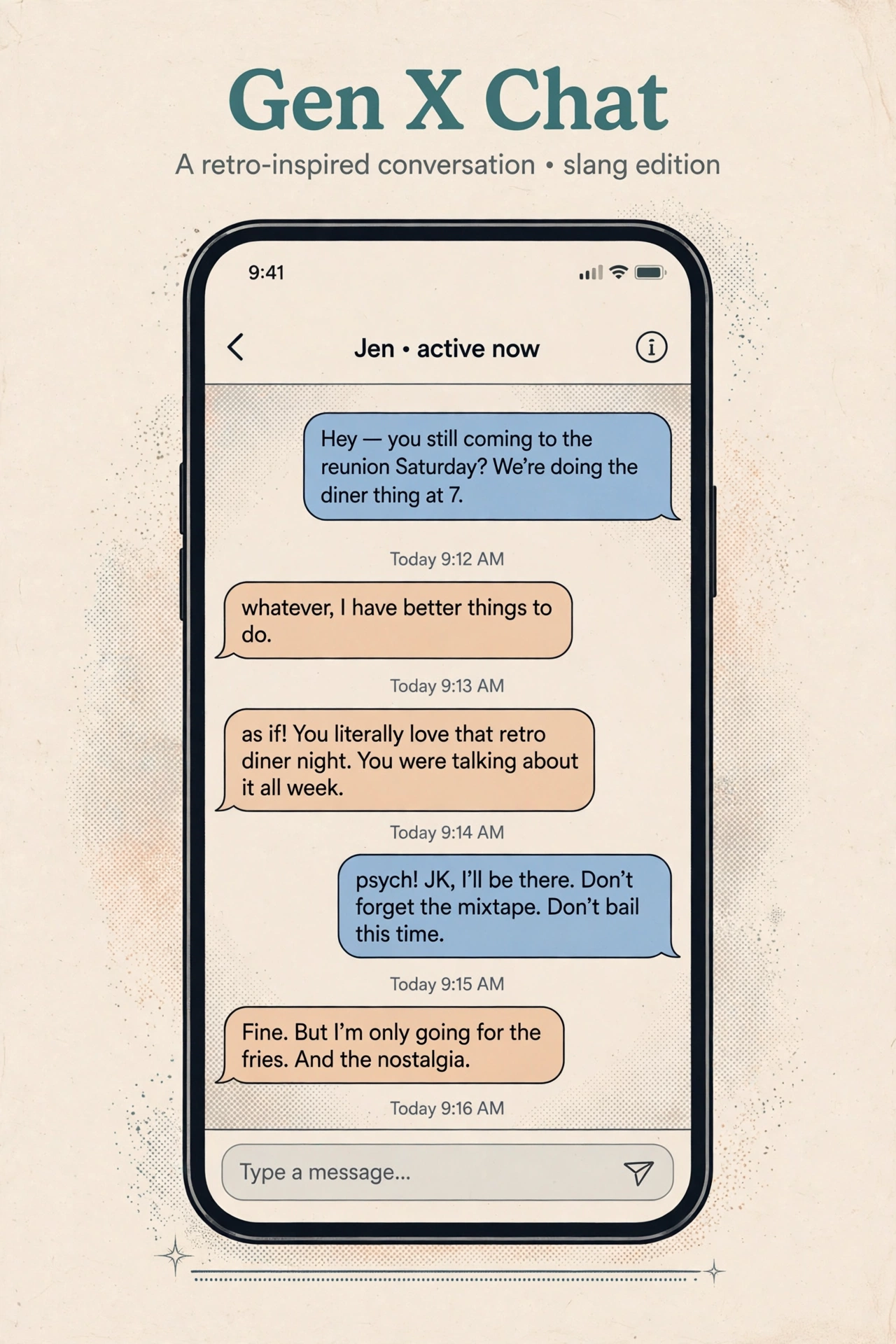
Comparison with Similar Terms
Gen X slang does not exist in isolation. It sits between the slang of the Baby Boomers, who came before, and the slang of Millennials and Gen Z, who came after. The comparison below shows how the same basic ideas — approval, disapproval, dismissal, and greeting — got a different word in each generation. The attitude is the giveaway: Boomer slang is groovy, Gen X slang is skeptical, Millennial slang is earnest and internet-shaped, and Gen Z slang is ironic and compressed.
| Idea | Gen X Slang | Similar Term (Other Generations) | Difference |
|---|---|---|---|
| Something is great | Rad, dope, da bomb | Groovy (Boomer); lit, fire (Millennial/Gen Z) | Gen X terms are understated praise; newer terms are louder and more visual. |
| Something is bad or unfair | Bogus, wack, lame | Uncool (Boomer); mid, trash (Gen Z) | Bogus carries a sense of injustice; mid is flatter and more dismissive. |
| Dismissing someone | Whatever, as if, talk to the hand | Bye, Felicia (Gen X/ Millennial crossover); periodt, bet (Gen Z) | Gen X dismissal is sarcastic and theatrical; Gen Z dismissal is shorter and final. |
| Greeting a friend | Dude, yo | Hey man (Boomer); bruh, bestie (Gen Z) | Dude is famously gender-neutral in practice; newer greetings are more specific. |
| Relaxing | Chill, chillax, veg out | Hang loose (Boomer); vibe, rot (Gen Z) | Gen X relaxation words suggest deliberate doing-nothing; Gen Z words frame it as a mood. |
| Just kidding | Psych! | Just kidding (all generations); jk, /s (internet) | Psych is a performed fake-out; jk is a typed footnote. |
A second comparison is just as useful: Gen X slang versus the slang that grew directly out of it. Many words people think of as “90s slang” or “2000s slang” are Gen X words with a new haircut. Chill became chillax and then just chill again. Dude never left. Whatever became wtv. The vocabulary did not get replaced so much as compressed, which is the fate of all slang that is too useful to die.
It is also worth comparing Gen X slang with the slang of the generation that most visibly reacted against it. Millennial slang — adulting, epic fail, YOLO — is often earnest where Gen X slang is ironic. A Millennial says this is everything; a Gen Xer says it’s rad and changes the subject. Neither is better. They are just different defenses against the same problem: how to sound like yourself when everyone is watching.

Alternate Meanings
Most Gen X slang terms have one dominant meaning, but several have alternate senses that depend on context — and a few have meanings that have nothing to do with slang at all. Getting these right is the difference between using a word well and using it confusingly.
Gnarly is the classic two-way word. In surf culture it meant a large, difficult wave, and by extension anything extreme or impressive. But it can also mean disgusting or disturbing: a gnarly wound, a gnarly smell. The tone of voice and the noun it modifies tell you which meaning is in play. “That trick was gnarly” is praise. “That injury looked gnarly” is not.
Bad is the famous inversion: in Gen X and hip-hop usage, bad can mean good. “That car is bad” means the car is impressive. This is not a Gen X invention — it goes back further, through jazz and Black American English — but the 1980s mainstreamed it, and Michael Jackson’s 1987 album Bad put it on every radio in America. Context is everything: “the news is bad” still means the news is bad. “Those shoes are bad” probably means the shoes are great.
Fresh has a similar double life. In slang it means stylish, new, impressive — “a fresh pair of sneakers.” In ordinary English it means recently made or not stale. The slang sense is almost always about appearance or style, not about food.
Chill has quietly become one of the most flexible words in English. It can mean to relax (“let’s just chill tonight”), to calm down (“chill out”), to be easygoing (“she’s really chill”), or, as a noun, a relaxed mood (“I’m here for the chill”). The Gen X contribution was the verb and adjective senses; the internet era added the rest.
Dude deserves a note of its own. Originally a word for a fancy dresser, then a generic word for a man, it became in Gen X usage a near-universal address term — used for men, women, friends, strangers, and, famously, inanimate objects and situations (“dude, the traffic”). Today it is one of the most gender-neutral greetings in American English, which is a strange fate for a word that started out meaning a dandy in a suit.
Finally, there is the alternate meaning of the phrase gen x slang itself. In search and in conversation, people sometimes use it to mean “slang from the 1980s” specifically, and sometimes to mean “slang used by Gen Xers,” which stretches into the 1990s and beyond. This guide covers both, because the 1980s vocabulary and the 1990s vocabulary overlap heavily — rad and whatever belong to the same continuous conversation, even if they peaked a decade apart.
Professional or Polite Alternatives
Gen X slang is wonderful with friends and risky with strangers. The table below gives you a clean swap for the most common terms, so you can keep the meaning and lose the informality when the situation calls for it.
| Gen X Slang | What It Means | Professional / Polite Alternative |
|---|---|---|
| Whatever | I don’t care / I disagree, but I’m done arguing | “Let’s agree to disagree” / “I’ll go with your call on this one” |
| Bogus | Unfair, fake, disappointing | Unfair, unreasonable, disappointing |
| As if! | Not a chance / I don’t believe it | “I’m not sure that’s realistic” / “That seems unlikely” |
| My bad | My mistake, sorry | “That was my mistake — I apologize” |
| Chill / chill out | Relax, slow down | “Let’s take a step back” / “Let’s pause here” |
| Talk to the hand | I’m not listening | “I need to end this conversation here” (only if you must) |
| Dude | Friend / hey you | Use the person’s name |
| Wack | Bad, disappointing | Disappointing, not up to standard |
The guiding principle is simple: keep the slang where the relationship is already warm, and translate it where the relationship is still being built. Nobody ever lost a client by saying “that was my mistake” instead of “my bad,” and nobody ever won a friendship by being formal with an old friend. Match the word to the room.
Common Mistakes
Gen X slang is easy to use badly, mostly because the words are so familiar that people forget they have rules. These are the mistakes that make the difference between sounding like you grew up with the vocabulary and sounding like you are doing an impression of someone who did.
Mistake 1: Stacking too many retro terms in one sentence. “Dude, that was totally rad and gnarly, like, fer sure, no duh” is not how anyone ever talked. Real speakers used one or two slang terms per sentence and let the rest of the sentence be ordinary English. The slang was seasoning, not the whole meal. One retro word per sentence is plenty; two is a lot; three is a costume.
Mistake 2: Using dismissive phrases with people who do not know you are joking. Whatever and as if are affectionate between friends and hostile between strangers. The words do not change; the relationship does. If you would not roll your eyes at the person in real life, do not type the eye roll at them either.
Mistake 3: Getting psych wrong. Psych is not a general exclamation. It is a specific move: you say something shocking or generous, pause just long enough for the other person to react, and then say psych to reveal it was a joke. Saying it at random — “Psych, I’m hungry” — makes no sense, because there is no fake-out to reveal.
Mistake 4: Treating every Gen X word as interchangeable praise. Rad, dope, fresh, choice, and da bomb all mean something good, but they are not the same word. Fresh is about style. Dope is about quality with an edge. Da bomb is about enthusiasm. Using them interchangeably flattens the vocabulary into a generic “good,” which is exactly what the original speakers were too bored to do.
Mistake 5: Using gnarly without checking the context. Because gnarly can mean impressive or disgusting, it needs a clear noun and a clear tone. “That was gnarly” on its own, in a text with no context, can genuinely confuse the reader. Add the noun — “that wave was gnarly,” “that injury was gnarly” — and the meaning is obvious.
Mistake 6: Forcing the Valley Girl voice. The like, totally, oh my god register was a specific, parodied style even in its own time, and it reads today as caricature when it is sustained. A single like, totally in a nostalgic story is funny. A whole paragraph of it is a sketch. Use it as a quote, not as a voice.
Mistake 7: Assuming every 1980s word is Gen X slang. Some of the most famous “80s words” — cowabunga, bodacious, tubular — belong more to surf culture and to the early 1980s than to the whole generation. They are part of the story, but they are not the whole story. The durable core of gen x slang is the skeptical vocabulary — whatever, dude, chill, bogus — the words that survived because they were useful, not just because they were funny.

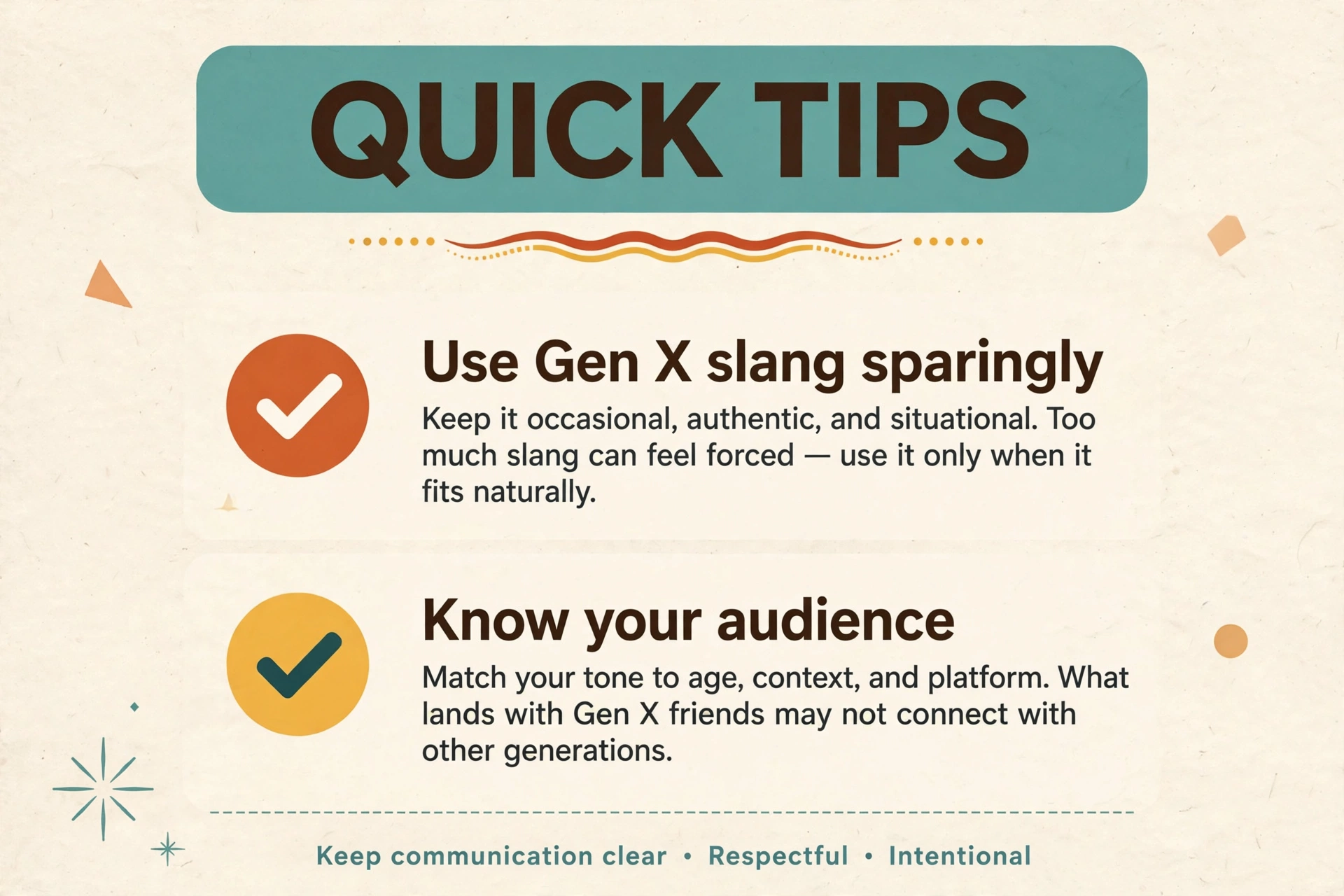
Quick Tips
If you want to use Gen X slang well — in a text, in a story, or in a conversation with an actual Gen Xer — these tips will keep you on the right side of the line between fluent and forced.
- Start with the survivors. Dude, chill, whatever, my bad, and bogus are still in everyday use. They are the safest entry points, because nobody will hear them as a performance.
- One retro word at a time. Let a single slang term do the work in a sentence. The rest of the sentence should sound like you.
- Match the audience. With Gen Xers, the full vocabulary is fair game. With younger people, the survivors and one well-placed psych will get a laugh. With older people or in formal settings, translate first.
- Let tone do the work. Most Gen X slang depends on delivery. In a text, use punctuation to carry the tone: whatever. with a period is dismissal; whatever! with an exclamation mark is playful; whatever with no punctuation is a shrug.
- Use psych sparingly. It is a great joke exactly because it is rare. If you use it three times in one conversation, it stops being a fake-out and starts being a tic.
- Learn the origin before you quote the word. Knowing that gnarly came from surfing, that as if came from Clueless, and that bye, Felicia came from Friday will keep you from using the words in contexts where they do not belong.
- When in doubt, understate. The Gen X instinct is to make the big thing small. If you are tempted to say something is “absolutely incredible,” try “it’s rad” and see how much more believable it sounds.
FAQ
What is gen x slang?
Gen x slang is the informal vocabulary popularized by Generation X — people born roughly between 1965 and 1980 — in the 1980s and 1990s. It includes words like rad, gnarly, bogus, dude, chill, and whatever, and it is known for a dry, sarcastic, skeptical tone. Many of its terms are still used in everyday American English today.
What years are Generation X?
The Pew Research Center defines Generation X as people born from 1965 to 1980. Some sources use slightly different boundaries, such as 1965 to 1979, but 1965–1980 is the most widely used definition. Gen Xers are the generation between the Baby Boomers and the Millennials, and in 2026 they are roughly 45 to 61 years old.
What are the most popular Gen X slang words?
The most popular and durable Gen X slang words are rad (awesome), gnarly (extreme or impressive), bogus (unfair or lame), dude (friend or greeting), chill (relaxed), whatever (dismissive indifference), as if (not a chance), psych (just kidding, after a fake-out), dope (excellent), fresh (stylish), grody (gross), and veg out (lounge around doing nothing).
Is “whatever” Gen X slang?
Yes. Whatever as a dismissive, sarcastic response — often accompanied by a shrug or an eye roll — is one of the defining phrases of Gen X slang. It was popularized in the 1980s and 1990s and remains one of the most widely used conversation-enders in English, in speech, in texts, and in the shortened form wtv.
What does “as if” mean in Gen X slang?
As if means “not a chance” or “I don’t believe you,” delivered with sarcasm. It was already in use before the 1995 film Clueless, but the film — in which Cher Horowitz uses it constantly — turned it into a national catchphrase. It is used to reject a suggestion, a claim, or a compliment that the speaker finds unbelievable.
Do people still use Gen X slang today?
Yes, extensively. Dude, chill, whatever, my bad, and bogus never left everyday English. Other terms, like rad, gnarly, and psych, come back in waves of 1980s and 1990s nostalgia and are used playfully by younger generations. The words that survived are the ones that are short, flexible, and useful — which is why they are still in group chats today.
What is the difference between Gen X slang and Gen Z slang?
Gen X slang is dry, sarcastic, and built for spoken conversation and television; Gen Z slang is ironic, compressed, and built for the internet. Gen X says whatever; Gen Z says wtv or periodt. Gen X says rad; Gen Z says fire or slay. The attitude is related — both generations love understatement and irony — but the delivery is different: Gen X slang sounds like a shrug, and Gen Z slang reads like a caption.
How can I use Gen X slang without sounding fake?
Use one term at a time, start with the words that are still in everyday use (dude, chill, whatever, my bad), and match the word to the audience. Save the full retro vocabulary — gag me with a spoon, talk to the hand, totally tubular — for jokes, nostalgia, and conversations with people who will recognize the reference. The quickest way to sound fake is to stack five retro terms in one sentence.
Conclusion
Gen X slang is more than a list of funny old words. It is the voice of a generation that learned to be independent early, watched its institutions disappoint it on live television, and answered with a shrug, a joke, and a vocabulary that refused to take anything too seriously — including itself. Rad, gnarly, bogus, whatever, dude, chill, psych: these are small words, but they carried a whole attitude, and that attitude turned out to be durable. The words that were useful became English. The words that were only funny became nostalgia. And the shrug behind all of them became the default tone of the internet.
That is why this vocabulary is worth learning properly rather than just quoting. Used well, gen x slang is precise: it can praise without gushing, reject without cruelty, and end an argument with a single syllable. Used badly, it is a costume — five retro words in a trench coat pretending to be a person. The difference is restraint, context, and respect for the audience. One word, well placed, beats a paragraph of period slang every time.
So the next time someone texts you whatever, hear it for what it is: not rudeness, but a whole generation’s philosophy in eight letters. And the next time you want to say something is great, try the Gen X way. Don’t oversell it. Just say it’s rad — and let the word do the rest. If you want to see how the same instinct evolved in the generations that followed, compare it with the shorthand of mid and the rest of today’s generational vocabulary: the words keep changing, but the need to say a lot with a little never does.

4 thoughts on “Gen X Slang: 25 Terms That Defined a Generation”