
Quick definition: Australian slang (nicknamed “Strine”) is the informal, playful vocabulary Australians use in everyday speech — famous for shortening everything (afternoon → arvo, breakfast → brekky, McDonald’s → Maccas), greetings like g’day mate and how ya going, and iconic phrases like fair dinkum and no worries. It mixes convict-era British dialect, Irish influence, Cockney rhyming slang, and words borrowed from Aboriginal languages.
Australian Slang Meaning & Definition
If you have ever watched an Australian movie and felt like you needed subtitles, you have run into Australian slang — the laid-back, creative way Aussies bend the English language. Technically called Strine (a joke on how “Australian” sounds in a broad Aussie accent), Australian slang is not a separate language, but it can feel like one to visitors.
The australian slang meaning question really has two layers:
- The vocabulary: hundreds of shortened words (the famous -o, -ie, and -y endings), greetings, phrases, and idioms that Australians use without thinking.
- The attitude: a culture of friendliness, humor, and “taking the mickey” (teasing) out of everything. In Australia, giving a friend a hard time is often a sign of affection — and the slang reflects it.
What makes Aussie slang special is how systematic it is. Australians do not just invent random words; they follow unwritten rules: chop words short, add a vowel ending, and you have a new term. Service station becomes servo. Ambulance worker becomes ambo. Postie, truckie, sparky (electrician), chippy (carpenter) — entire professions get the treatment.
In this guide, you will learn exactly what Australian slang is, where it came from, the 100+ most-used terms with meanings, how to use them without embarrassing yourself, and the mistakes every visitor makes. By the end, you will understand why Aussies say yeah nah when they mean no — and nah yeah when they mean yes.
Introduction
Picture this: you land in Sydney, jump in a cab, and the driver says, “G’day mate, how ya going? Chuck your stuff in the boot and we’ll shoot through this arvo — no worries.” You understood maybe half of that. The driver was not speaking another language — he was speaking Strine, the nickname linguists and comedians alike use for the Australian take on English.
Australians are famous for their relaxed, friendly attitude, and their slang is the verbal version of it. Where Americans might say “no problem” formally, an Aussie says “no worries” with a grin. Where a Brit might complain, an Aussie says “she’ll be right” — it will all work out. The slang carries the national personality: optimistic, irreverent, and allergic to taking things too seriously.
But do not mistake casual for simple. Australian slang has a 200-year history stretching back to the convict ships of 1788, shaped by British and Irish dialects, Cockney rhyming slang, waves of immigration, Aboriginal languages, and even American pop culture. It is studied by real linguists at the Australian National Dictionary Centre at the Australian National University — and the Australian National Dictionary catalogues over 16,000 Aussie words and their origins.
Just like decoding internet shorthand such as mewing or op meaning slang helps you survive comment sections, learning Australian slang helps you survive an actual conversation Down Under. This guide is your complete, 2026-updated crash course.

Origin
Australian slang was born on the convict ships. When the First Fleet arrived in Sydney in 1788, it carried thousands of British and Irish convicts, sailors, and soldiers — and with them, a stew of regional dialects, criminal cant, and working-class London speech. In the brutal early colony, this melting pot of English hardened into something distinctly Australian.
Several forces shaped it over the next two centuries:
- Convict and working-class British English: Many early terms came straight from British slang and dialect. The Australian National Dictionary traces words like bludger, sheila, and tucker (food) back to 19th-century British usage.
- Irish influence: A huge share of early settlers were Irish, and Irish sentence rhythms and humor still echo in Aussie speech — the famous rising intonation and the cheerful insult-as-affection style.
- Cockney rhyming slang: Brought by Londoners, it evolved into a uniquely Australian form. Barry Crocker means “shocker,” Noah’s Ark means “shark,” Dad ‘n Dave means “shave,” and Merv Hughes (the cricketer) means “shoes.”
- Aboriginal languages: Some of the most famous Aussie words are Indigenous in origin — kangaroo, boomerang, didgeridoo, koala, dingo, and modern borrowings like deadly (excellent, in Aboriginal English).
- American influence: WWII brought US soldiers and their slang; post-war American media cemented it. Words like dude sit comfortably next to mate now.
- Multicultural migration: Post-war Greek, Italian, Lebanese, and later Asian communities all added flavor to the mix.
One famous rule emerged early: shorten everything. Linguists note that abbreviations with -ie, -y, and -o endings were the classic Aussie pattern (brekky, Maccas, arvo), while younger Gen Z Aussies now favor -s endings — uggies (Ugg boots), firies (firefighters), mobes (mobiles). The tradition keeps evolving.
Popularity
Australian slang is everywhere — and not just in Australia. Thanks to tourism campaigns, movies like Crocodile Dundee, and stars from Hugh Jackman to the Hemsworths, phrases like g’day mate are recognized worldwide. Australia’s slang has become a cultural export as famous as Vegemite and the outback.
Online, Aussie slang thrives. Travel blogs, expat forums, and TikTok creators regularly go viral explaining terms like yeah nah to confused Americans. “Australian slang” is one of the most-searched travel-language queries every year, and international students are routinely handed slang cheat sheets by universities before they arrive.
Inside Australia, slang is a genuine marker of identity. Using it well signals you belong; using it badly (or forcing it) marks you instantly as a tourist. A 2020s study on abbreviation patterns found older Australians stick to the classic -o/-ie forms while younger Aussies innovate — proof the slang is alive and changing, not a museum piece.
Even McDonald’s bowed to it: in Australia, the chain is universally called Maccas — so much so that the company has temporarily rebranded store signs to “Macca’s” during Australia Day promotions. When a global brand surrenders its own name to your slang, your slang has won.
How It Is Used
Australian slang is not formal language — it lives in conversation, text messages, pubs, barbecues, and workplaces. Here is how Aussies actually deploy it:
- Greetings: G’day mate works morning, noon, and night. How ya going? means “how are you?” — and nobody expects a detailed answer. Cheers means thanks.
- Softeners: No worries answers everything from “thanks” to “sorry.” She’ll be right means “it’ll be fine.” Too easy means “no problem at all.”
- The yes/no puzzle: Yeah nah = no. Nah yeah = yes. The first word is the softener; the second is the answer. It confuses every visitor, without exception.
- Insults as affection: Calling a mate a drongo (fool), galah (silly person, after the pink cockatoo), or dag (dorky but lovable) is usually friendly. Context and tone decide everything.
- Praise: Legend, champion, good on ya, onya — Aussies praise generously and casually.
- At work: Flat out (very busy), smoko (break), chuck a sickie (take a dubious day off), tradie (tradesperson).
- Food and drink: Barbie (barbecue), snags (sausages), chook (chicken), cuppa (cup of tea), grog (alcohol), goon (cheap cask wine), brekky.
One unwritten rule: Australians shorten words even when the result is longer — barbecue (3 syllables) becomes barbie (also 2, fine), but afternoon becomes arvo, and McDonald’s becomes Maccas. Logic is optional; rhythm is everything.
Examples
The best way to learn Australian slang is to see it in action. Here are real-world-style examples across friendly, professional, and funny contexts.
Friendly Examples
- “G’day mate! How ya going? Come in for a cuppa.” — The warmest Australian welcome there is: hello friend, how are you, let’s have tea.
- “We’re having a barbie this arvo — bring some snags and your bathers.” — We’re having a barbecue this afternoon — bring sausages and your swimsuit.
- “You beaut! That goal was an absolute ripper.” — You beauty! That goal was fantastic.
- “Good on ya, legend. I owe you a beer.” — Well done, you’re great. I owe you a drink.
- “Let’s grab some Maccas after footy.” — Let’s get McDonald’s after the football game.
Professional Examples
- “I’m flat out today, but I’ll get that docket to you by arvo.” — I’m extremely busy, but I’ll send the receipt/invoice this afternoon.
- “Give the sparky a bell about the wiring.” — Call the electrician about the wiring.
- “The new starter’s a real battler — good attitude.” — The new hire works hard — great attitude. (High praise!)
- “We’ll need a fair go on the timeline for this one.” — We’ll need a reasonable chance/fair timeframe.
Funny Examples
- “It’s hotter than a shearer’s armpit out there.” — It’s extremely hot. (Classic outback exaggeration.)
- “He’s got a few roos loose in the top paddock.” — He’s a bit crazy. (Literally: kangaroos loose upstairs.)
- “Mad as a cut snake!” — Very angry. (An angry snake is a vivid image.)
- “Dry as a dead dingo’s donger.” — Extremely dry/thirsty. (Crude, outback, unforgettable.)
- “Flat out like a lizard drinking.” — Extremely busy. (Deliberately comic — lizards drink lying flat.)

Comparison with Similar Terms
Australian slang is often confused with British or American slang — it shares DNA with both but has its own flavor. Here is how the three compare on everyday words:
| Meaning | Australian Slang | British Slang | American Slang |
|---|---|---|---|
| Greeting | G’day mate | Alright, mate? | What’s up? |
| Friend | Mate | Mate | Dude / bro |
| Afternoon | Arvo | — (afternoon) | — (afternoon) |
| Flip-flops | Thongs | Flip-flops | Flip-flops |
| McDonald’s | Maccas | Maccy D’s | Mickey D’s |
| Petrol station | Servo | Petrol station | Gas station |
| Toilet | Dunny / loo | Loo | Bathroom |
| Very busy | Flat out | Swamped | Swamped |
| Excellent | Ripper / grouse / beaut | Brilliant | Awesome |
| Complaining | Whinge / whingeing | Moaning | Whining |
| Sunglasses | Sunnies | Shades | Shades |
| Swimsuit | Bathers / cossie / togs | Swimming costume | Swimsuit |
The key difference: Aussie slang abbreviates far more aggressively than either British or American slang. Brits and Americans shorten some words, but only Australians seem determined to clip nearly every word over two syllables. And where American slang often comes from pop culture and hip-hop, Aussie slang comes from the pub, the worksite, and the beach.
Note the regional twist even within Australia: swimsuits are bathers in Victoria, cossies elsewhere, and togs in Queensland and NSW. Get it wrong and an Aussie will correct you with delight.

Alternate Meanings
Some Australian slang terms have surprising second meanings — or mean something completely different outside Australia. Watch out for these:
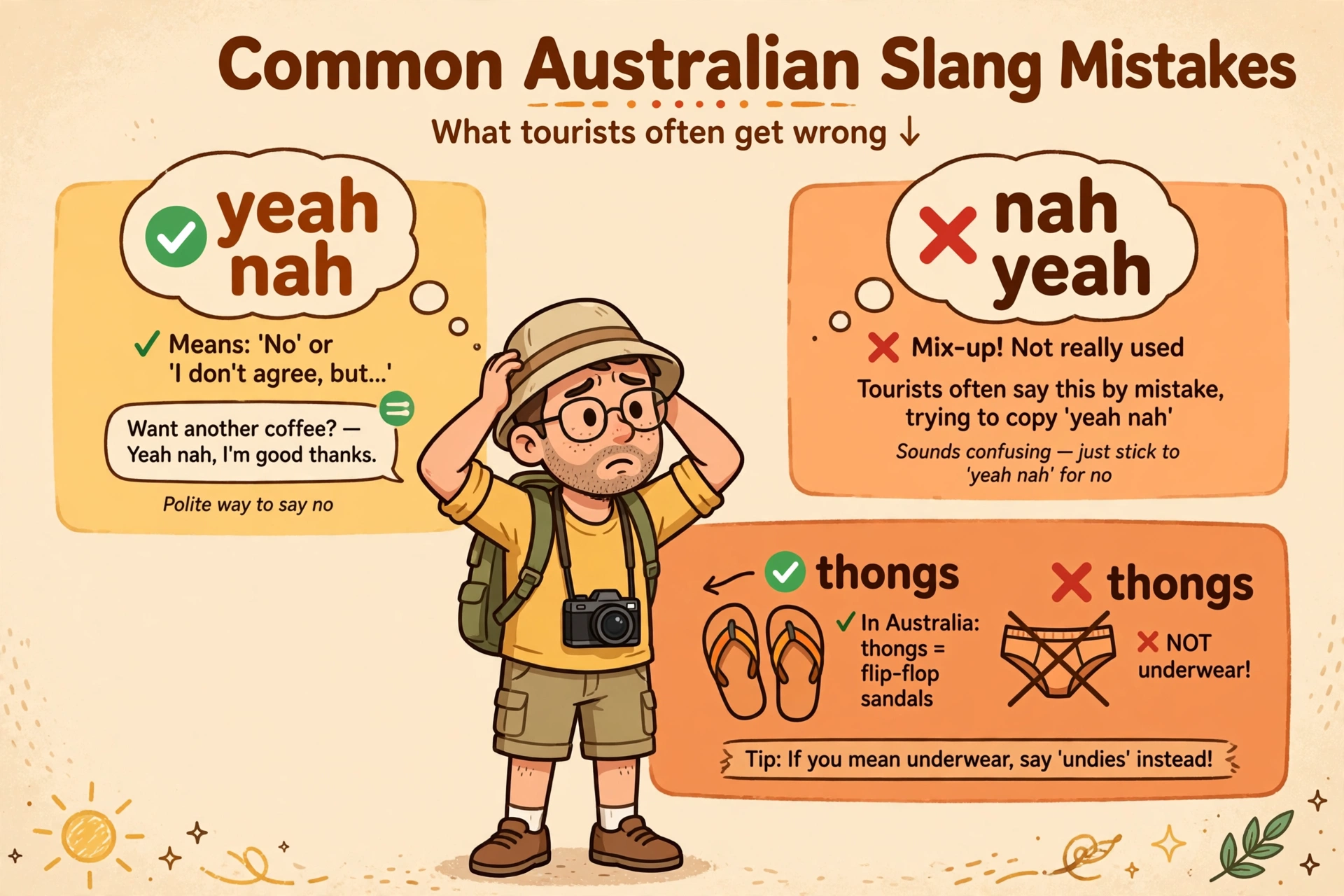
- Thongs — In Australia: flip-flop sandals, worn everywhere including fancy restaurants (controversially). In America: underwear. Mixing these up causes legendary misunderstandings.
- Root — In Australia, “to root for” a team means to support them — but “root” alone is also crude slang for sex. Visitors cheering “I’m rooting for you!” get giggles.
- Strine — The nickname for Australian slang itself (from “Australian” in a broad accent). Also the title of classic comedy books documenting it.
- Bogan — Roughly the Aussie equivalent of “redneck”: unsophisticated in dress, speech, or behavior. It can be affectionate or insulting depending on tone — and “bogan chic” is practically a fashion statement in some circles.
- Blue — Can mean a fight or argument (“they had a blue”), a mistake (“he made a blue”), or the color. Context is everything.
- Cactus — As slang: dead or broken (“the car’s cactus” = the car is dead). Nothing to do with plants.
- Buckley’s chance — Means no chance (from a convict named Buckley who supposedly had none). “You’ve got Buckley’s” = forget it.
- Furphy — A false rumor or tall tale, named after WWI water carts (made by the Furphy family) around which soldiers swapped gossip.
Professional or Polite Alternatives
Australian slang is casual by nature. In formal settings — job interviews, business emails, ceremonies — swap the slang for standard English:
| Slang | Polite / Professional Alternative |
|---|---|
| G’day mate | Hello / Good morning |
| No worries | You’re welcome / No problem at all |
| She’ll be right | It will be fine / We’ll manage |
| Arvo | This afternoon |
| Chuck a sickie | Take a sick day |
| Flat out | Extremely busy |
| Bloke / Sheila | Gentleman / Woman (or just “person”) |
| Give it a burl | Give it a try |
| Too easy | Certainly / Happy to help |
| Reckon | Believe / Think |
That said, Australia is famously informal — even CEOs say no worries and cheers. The trick is to mirror the room: if your Aussie colleagues are saying arvo in a meeting, you are safe to join in. If they switch to full sentences, follow suit.
Common Mistakes
Visitors make the same Australian slang mistakes over and over. Avoid these and you will sound far more natural:
- Forcing it. The #1 mistake. Dropping g’day mate and fair dinkum into every sentence sounds like a costume, not conversation. Aussies use slang naturally and sparingly — imitate that, not a movie script.
- Mixing up yeah nah and nah yeah. Yeah nah = no. Nah yeah = yes. Get it backwards and you will agree to things you meant to refuse.
- Calling a woman “sheila.” It is dated and can sound patronizing now. Mate works for everyone.
- Using “mate” aggressively. Mate is warm between friends — but a sharp “listen, mate” from a stranger is a warning, not friendliness. Tone matters enormously.
- Assuming insults are insults. Being called a drongo or galah by a friend is affection. Being called one by a stranger in a pub is not. Read the room.
- The thongs trap. Never announce you are “wearing thongs to the beach” to Americans without clarifying you mean footwear.
- Overusing “bloody.” Bloody is a mild intensifier in Australia (“bloody oath!”), far milder than in Britain — but it is still swearing. Keep it out of formal settings.
- Rhyming slang roulette. Do not attempt rhyming slang (Barry Crocker, septic tank = Yank) unless you are sure of the meaning — some of it is rude, and getting it wrong is worse than not trying.
Quick Tips
- Start with the big five: g’day, mate, no worries, cheers, how ya going. These five cover 80% of daily Aussie interaction.
- Learn the -o words: arvo, servo, bottle-o, maccas, ambo, smoko. Spotting the pattern unlocks dozens of terms at once.
- Listen before you speak: Spend a day just listening to how locals use slang — the rhythm and placement matter more than the vocabulary.
- When in doubt, smile: If someone fires slang at you, a grin and “sorry mate, I’m still learning the lingo” earns instant goodwill. Aussies love explaining their slang.
- Watch the footy: AFL and NRL commentary is a masterclass in Aussie slang — ripper, spewin, blinder — all in their natural habitat.
- Do not translate literally: She’ll be right is philosophy, not grammar. Learn phrases as whole units.
- Regional words differ: Potato cakes vs. potato scallops, bathers vs. togs — ask a local rather than assuming.


FAQ
What does Australian slang mean in simple terms?
Australian slang — nicknamed “Strine” — is the informal vocabulary Australians use daily: shortened words like arvo (afternoon) and brekky (breakfast), greetings like g’day mate, and phrases like no worries and fair dinkum. It reflects Australia’s relaxed, humorous culture.
What is the most famous Australian slang word?
G’day (hello) and mate (friend) are the most recognized worldwide. No worries is probably the most used — it covers thanks, sorry, and no problem in one phrase.
What does “yeah nah” mean in Australian slang?
Yeah nah means no — the “yeah” softens the refusal. Its twin, nah yeah, means yes. The second word is the real answer.
Why do Australians shorten every word?
It is a 200-year-old habit from convict-era British and Irish dialects: clip words and add -o, -ie, or -y endings. Linguists say it signals friendliness and informality — long formal words feel stiff in Aussie culture.
What is Strine?
Strine is the joking nickname for Australian slang itself — it is how “Australian” sounds in a broad Aussie accent. The term was popularized by comedy books in the 1960s documenting Aussie speech.
Is Australian slang rude?
Mostly no — it is casual, not rude. But some terms (bogan, drongo, rhyming slang) can insult depending on tone and context, and sheila is now considered dated. When unsure, stick to mate and no worries.
How is Australian slang different from British slang?
They share roots, but Aussie slang abbreviates far more aggressively (arvo, servo, Maccas) and leans on unique phrases like fair dinkum and she’ll be right. British slang keeps more Cockney rhyming slang in daily use.
Where can I learn real Australian slang from experts?
The Australian National Dictionary Centre at the Australian National University researches Australian English and publishes the Australian National Dictionary — the authoritative record of Aussie words and their origins, now with over 16,000 entries.
Conclusion
Australian slang is more than funny words — it is the sound of a culture that values mateship, humor, and not taking life too seriously. From g’day mate to fair dinkum, from arvo to yeah nah, these terms pack two centuries of convict history, outback life, and beach culture into everyday chat.
The good news: you do not need all 100+ terms to get by. Master the big five — g’day, mate, no worries, cheers, how ya going — learn the shortening pattern, and remember that a smile covers every mistake. Australians genuinely enjoy teaching their slang to visitors, so the fastest way to learn is to ask.
So next time someone says “no worries, she’ll be right — chuck us a cuppa this arvo,” you will know exactly what they mean. And if you want to keep decoding the way English evolves online too, check out our guides to glizzy and sigma slang — the internet’s own ever-growing slang dictionary.

11 thoughts on “Australian Slang: 100+ Aussie Terms, Meanings & Real Examples (2026)”