Quick definition: Canadian slang is the friendly, everyday vocabulary Canadians use in conversation, at work, at the rink, and in text messages — words like eh, toque, loonie, double-double, and hoser that sound ordinary in Canada and slightly mysterious everywhere else. It is not a separate language. It is Canadian English with its own shortcuts, jokes, and habits, shaped by cold winters, hockey culture, French influence, and a national talent for understatement. Learn the words below and you will understand the joke, the coffee order, and the weather complaint — usually all in the same sentence.
Canadian Slang Meaning & Definition
Canadian slang means the informal words and phrases that are widely understood across Canada but are uncommon, or mean something different, in the United States, the United Kingdom, or Australia. Some Canadian slang is truly national: almost anyone from Victoria to St. John’s will know what a loonie is, what a double-double is, and why you should grab your toque before you go outside in January. Other Canadian slang is regional, and that is part of the fun. A bunnyhug is a hooded sweatshirt in Saskatchewan, a dep is a corner store in Quebec, and what’re you at? is how people in Newfoundland and Labrador ask how you are doing.
Canadian slang is best understood as three layers working together. The first layer is practical vocabulary for Canadian life: money (loonie, toonie), weather and winter (toque, chinook), and getting around (clicks for kilometres, parkade for a parking garage). The second layer is social language: softeners and invitations that keep conversation friendly and low-pressure, led by the famous eh and the warm, slightly teasing bud and beauty. The third layer is cultural shorthand: hockey words, Tim Hortons orders, and phrases borrowed from French, Indigenous languages, and immigrant communities that have become part of everyday Canadian speech.
What Canadian slang is not is important too. It is not a dialect you need to learn from scratch, and most Canadians do not use every term on this list every day. A person in downtown Toronto may never say give’r, and a teenager in Vancouver may say skookum without ever having heard chesterfield. Canadian slang works like a shared toolbox: people reach for the word that fits the place, the people, and the moment. Used naturally, it signals warmth and belonging. Used as a costume — every sentence ending in eh, every Canadian called a hoser — it sounds like an impression, and Canadians will hear the difference immediately.
Introduction
Picture this: you land in Canada in February, step outside, and a stranger smiles and says, “Cold out today, eh? Don’t forget your toque.” You nod, smile back, and quietly wonder whether you were just asked a question, given advice, or welcomed to the country. The answer is all three, and that is Canadian slang in a nutshell. It is practical, it is polite, and it is usually delivered with a grin.
For visitors, newcomers, and anyone who talks to Canadians online, Canadian slang matters because it shows up in exactly the places formal English lessons do not prepare you for: group chats, hockey broadcasts, coffee orders, workplace jokes, and small talk about the weather — which, in Canada, is never really small talk. Knowing that pop means a soft drink, that washroom is the polite word for bathroom, and that hydro on a bill means electricity will save you real confusion in your first week. Knowing that keener can be affectionate or mildly mocking, depending on tone, will save you from misreading a compliment.
This guide covers 40 Canadian slang words and phrases with plain meanings, real examples, and the context that makes each one work. You will learn the national essentials first, then regional favourites, hockey and everyday expressions, and the mistakes to avoid. By the end, you will not only know what the words mean — you will know when Canadians actually use them, when they do not, and how to use a few yourself without sounding like you learned them from a comedy sketch.

Origin
Canadian slang grew out of the same mix that built Canada itself: British English, French, Indigenous languages, and wave after wave of immigration, all adapted to a cold climate and a very large country. Early Canadian English kept British spellings and words — serviette for a napkin, chesterfield for a couch, eavestrough for a gutter — while inventing new words for things Britain did not have, like a one-dollar coin with a loon on it or a knitted winter hat that had to do serious work. French gave Canadian English words like toque and, in Quebec and beyond, dep (short for dépanneur, a corner store). Indigenous languages contributed place names and words that entered everyday speech, and later immigrant communities added their own flavour to city slang in Toronto, Vancouver, and Montreal.
Hockey shaped Canadian slang more than any other sport. Rinks were community centres, and rink language became national language: hoser, from the days when the losing team had to hose down the ice, celly for a goal celebration, beauty for a great play or a great person, and give’r for putting in full effort. Television spread those words far beyond the rink. So did comedy. The sketch characters Bob and Doug McKenzie made hoser, eh, and take off famous around the world in the 1980s, turning a few regional jokes into the global image of how Canadians talk. Canadians laughed along — and kept using the words at home, where they had always belonged.
More recently, the internet and texting have done for Canadian slang what television did a generation earlier. Terms like the 6ix for Toronto, popularised by Drake, travelled from local slang to global slang in a few years. At the same time, older words have quietly faded: younger Canadians are more likely to say couch than chesterfield and sneakers than runners, while eh, toque, and double-double show no sign of going anywhere. Canadian slang, in other words, is a living record — part history lesson, part weather report, and part group chat. For background on how Canadian English developed its own character, the history of Canadian English is a useful starting point.
Popularity
Canadian slang is popular in a quiet way. It rarely dominates global trends, but it is instantly recognisable, and Canadians abroad use it as a kind of handshake. Say eh in a London pub or order a double-double in a New York coffee shop and you will usually get a smile and a question about where in Canada you are from. Inside Canada, the most popular terms are the useful ones. Eh tops every list because it does so many jobs at once. Toque, loonie, toonie, pop, and washroom are popular because they name everyday things and there is no simpler Canadian alternative. Double-double and Timbits are popular because Tim Hortons is everywhere, and ordering in its language is part of the ritual.
Popularity is also regional, and Canadians enjoy arguing about it. People in the Prairies will defend bunnyhug with real passion. People in British Columbia will tell you skookum is the best word in the country. People in Newfoundland and Labrador have an entire vocabulary — b’y, what’re you at?, stay where you’re to — that sounds like a different country to other Canadians, which is exactly the point. On social media, Canadian slang has a second life as identity content: videos explaining eh, lists of “things only Canadians say,” and jokes about apologising too much travel far because they are affectionate, not mean. The words are popular because they make Canada feel smaller, warmer, and funnier than its geography suggests.
It is worth noting what has not happened. Canadian slang has not been replaced by American slang, even though Canadians watch the same shows, use the same apps, and live next door to the United States. Canadians still say washroom instead of restroom, pop instead of soda, and clicks instead of miles. That stubbornness is part of the appeal. In a country that shares a language and a border with a much larger neighbour, slang is one of the easiest ways to say: this is us.
How It Is Used
Canadian slang is used the way most slang is used: to be understood faster, to be friendlier, and to show you belong. The difference is tone. Canadian slang is rarely aggressive and rarely showy. Its default setting is warm, self-deprecating, and practical. Here is how it shows up in the main parts of Canadian life:
- Everyday conversation: Eh turns a statement into a friendly check-in (“Nice day, eh?”). Bud, buddy, and beauty address people warmly. Sorry appears constantly, often before any apology is needed, as a social softener.
- Food, drink, and errands: Ordering a double-double, grabbing Timbits, asking for pop, and paying with a loonie or toonie are all everyday transactions where the slang word is simply the normal word.
- Hockey and sport: Give’r, hoser, beauty, and celly come from the rink and the dressing room. They are used by fans and players alike, and they carry a tone of effort, humour, and team spirit.
- Work and school: A keener is the eager student or colleague who finishes early and volunteers first. Hydro is the electricity bill. A subbie is a substitute teacher. None of these words is formal, but all of them are normal.
- Texting and social media: Canadians text eh, lol, and haha together, shorten Toronto to the 6ix, and joke about the weather in the same breath as they complain about it. Online, Canadian slang is often used playfully, with the speaker fully aware that outsiders are watching.
- Regional pride: Using a local word — bunnyhug in Saskatchewan, dep in Quebec, skookum in British Columbia — is a small way of saying where you are from and that you are proud of it.
Tone does most of the work. Bud from a friend is warm; bud from a stranger who has just cut you off in traffic is not. Keener said with a laugh is affectionate; keener said flatly can be a put-down. Hoser is almost always a joke, but it is a joke you tell about a friend, not a stranger. If you are unsure, listen first, copy the tone you hear, and keep it light. Canadian slang rewards understatement: one eh per conversation goes a long way.
Examples
The fastest way to learn Canadian slang is to hear it in context. The examples below show the same words doing different jobs — friendly, professional, and funny — so you can hear the tone shift.
Friendly Examples
- “Pretty cold out today, eh? Grab your toque before we go.”
- “Thanks for the ride, bud. You’re a real beauty.”
- “Want anything from Timmies? I’m grabbing a double-double and some Timbits.”
- “We’re heading to the cottage this weekend if you want to come along, eh?”
- “Sorry I’m late — I was stuck behind a snowplow for ten clicks.”
Professional Examples
- “Could you check the hydro bill for last month? It looks higher than usual.”
- “The meeting is in the boardroom on the second floor, just past the washroom.”
- “She’s a real keener — she had the draft finished two days early.”
- “Let’s give’r this week and get the project over the line before Friday.”
- “I’ll be working from the cottage on Monday, but I’m reachable by email.”
Funny Examples
- “Don’t be a hoser — share the last Timbit.”
- “It’s so cold my toque has a toque. And my car won’t start, eh?”
- “I went to the dep for milk and came back with snacks, a lottery ticket, and no milk.”
- “He showed up in runners in a snowstorm. Classic keener energy, zero winter planning.”
- “Welcome to Raincouver — bring an umbrella, a raincoat, and a backup umbrella.”
Here is a quick-reference table of the most useful Canadian slang words, with a short example for each. Keep it open while you read the rest of the guide.
| Term | Meaning | Example |
|---|---|---|
| Eh | Right? / Do you agree? | “Nice day, eh?” |
| Toque | Knitted winter hat | “Don’t forget your toque.” |
| Double-double | Coffee, two cream, two sugar | “One double-double, please.” |
| Loonie | One-dollar coin | “All I have is a loonie.” |
| Toonie | Two-dollar coin | “Parking is two bucks — got a toonie?” |
| Pop | Soft drink / soda | “Grab me a pop from the fridge.” |
| Hoser | Playful insult; a goof | “Don’t be a hoser.” |
| Keener | Overly eager person | “She’s such a keener.” |
| Beauty | A great person or thing | “What a beauty of a goal!” |
| Give’r | Give it your all | “Let’s give’r and finish this.” |
| Timbits | Doughnut holes (Tim Hortons) | “Bring a box of Timbits.” |
| Hydro | Electricity / power bill | “The hydro is out again.” |
| Washroom | Bathroom / restroom | “Where’s the washroom?” |
| Clicks | Kilometres | “It’s about five clicks away.” |
| Bunnyhug | Hooded sweatshirt (Saskatchewan) | “Grab your bunnyhug, it’s cold.” |

Comparison with Similar Terms
Canadian slang is easiest to understand next to its neighbours. Canada shares a language with the United States and the United Kingdom, but it kept some British words, invented some of its own, and borrowed freely from French. The result is a vocabulary that looks familiar and then surprises you. The table below compares common Canadian terms with what Americans, Brits, and Australians usually say instead.
| Thing | Canada | United States | United Kingdom / Australia |
|---|---|---|---|
| Soft drink | Pop | Soda | Fizzy drink / soft drink |
| Bathroom | Washroom | Restroom / bathroom | Loo / toilet |
| Knitted winter hat | Toque | Beanie / stocking cap | Bobble hat / beanie |
| Sneakers | Runners | Sneakers / tennis shoes | Trainers |
| Paper napkin | Serviette | Napkin | Napkin / serviette |
| Parking garage | Parkade | Parking garage | Multi-storey car park |
| Electricity | Hydro | Electric / power | Electricity / leccy |
| Kilometres (informal) | Clicks | Miles | Klicks (military) / km |
| Hooded sweatshirt | Bunnyhug (SK) | Hoodie | Hoodie |
| Corner store | Dep (Quebec) | Bodega / corner store | Corner shop / off-licence |
Canadian slang also differs from other English slang in attitude. Australian slang is famously blunt and full of shortenings — arvo, brekkie, mate — while Canadian slang leans polite and understated. British slang is rich in rhyming slang and class-coded jokes; Canadian slang is more likely to be a weather report, a hockey reference, or a gentle tease. American slang moves fast and is driven by pop culture and the internet; Canadian slang moves slower and holds on to practical words because the winters are long and the distances are large. None of this means Canadians do not use American or internet slang — they do, constantly. It means Canadian slang sits alongside it, doing the local work: naming Canadian money, Canadian weather, Canadian coffee, and Canadian cities in Canadian words.
Within Canada, the biggest comparison is regional. Toronto slang has its own flavour — the 6ix, waste yute, tings — shaped by the city’s multicultural neighbourhoods and hip-hop culture. Montreal slang mixes English and French freely. The Prairies keep words like bunnyhug and give’r alive. The East Coast, especially Newfoundland and Labrador, has a vocabulary so distinct that other Canadians sometimes need a translation too. And hockey slang deserves its own mention: it started on the ice, but words like beauty, celly, and hoser now belong to everyone. Learning Canadian slang, then, is not learning one list. It is learning which list fits the room you are in.

Alternate Meanings
Like most slang, Canadian slang words often have more than one meaning, and context is everything. Eh is the best example: it can ask for agreement (“Cold, eh?”), express surprise (“Eh? You did what?”), soften a command (“Slow down, eh?”), or simply keep a story going (“So I’m standing there, eh, and…”). The spelling and the sound stay the same; the job changes. Bud can be a friendly address (“Thanks, bud”), a slightly annoyed one (“Listen, bud”), or, in other contexts, short for buddy in the same warm sense Americans use it. Tone and relationship decide which one you heard.
Beauty is another flexible word. It can describe a person (“He’s a real beauty”), a play in a game (“What a beauty of a pass”), or an object (“That truck is a beauty”). Canuck is usually affectionate — a nickname for a Canadian, and the name of Vancouver’s hockey team — but it can sound dismissive if a non-Canadian uses it with a sneer, so most people use it warmly or not at all. Two-four means a case of 24 beers, but it is also the nickname for the Victoria Day long weekend in May, the “May two-four,” when Canadians traditionally open their cottages. Mickey is a small bottle of liquor in Canada; in the United States it is a name, a cartoon mouse, or something else entirely. And chesterfield once meant a couch everywhere in Canada; today it mostly means a couch to older Canadians, while younger people just say couch — the word itself has become a marker of generation.
There is also a second, more serious sense of “Canadian slang” worth knowing. Linguists and dictionaries use the term for Canadianisms generally — not just jokes and hockey words, but the everyday vocabulary that makes Canadian English distinct, from serviette and eavestrough to parkade and garburator. If you search for Canadian slang expecting only funny phrases, you will miss half the picture. The funny phrases are the surface. Underneath is a whole vocabulary for living in a cold, bilingual, widely spread-out country — and that vocabulary is used in kitchens, classrooms, and offices every day, not just at parties.
Professional or Polite Alternatives
Most Canadian slang is already polite — Canadians invented much of it to be friendly. But slang is still informal, and there are moments when a plainer word works better: a job interview, a formal email, a first meeting with a client, or any conversation where you are not sure the other person knows the term. The table below gives you a safe swap for the most common situations.
| Canadian slang | Formal / polite alternative | When to swap |
|---|---|---|
| Eh? | “Don’t you think?” / “Isn’t that right?” | Formal presentations, written reports |
| Double-double | “Coffee with two cream and two sugar” | Outside Canada, or with a new coffee shop |
| Washroom | “Restroom” (US) / “Bathroom” | Actually keep washroom in Canada — it is the polite word there |
| Keener | “Enthusiastic” / “Highly motivated” | Performance reviews, references |
| Hoser | Nothing — just don’t use it | Any formal setting; it is a joke word only |
| Give’r | “Let’s put in our best effort” | Client emails, formal meetings |
| Bud / buddy | Use the person’s name | First introductions, senior colleagues |
| Pop | “Soft drink” / name the drink | Outside Canada |
The rule is simple: slang is for connection, plain language is for clarity. In Canada, washroom, toque, loonie, and double-double are so normal that using the “formal” version can sound odd — nobody in a Tim Hortons expects you to say “coffee with two cream and two sugar” like a tourist reading a phrasebook. Save the swaps for writing and for strangers. In speech, follow the room: if the person across from you says eh, you are allowed to say it back.
Common Mistakes
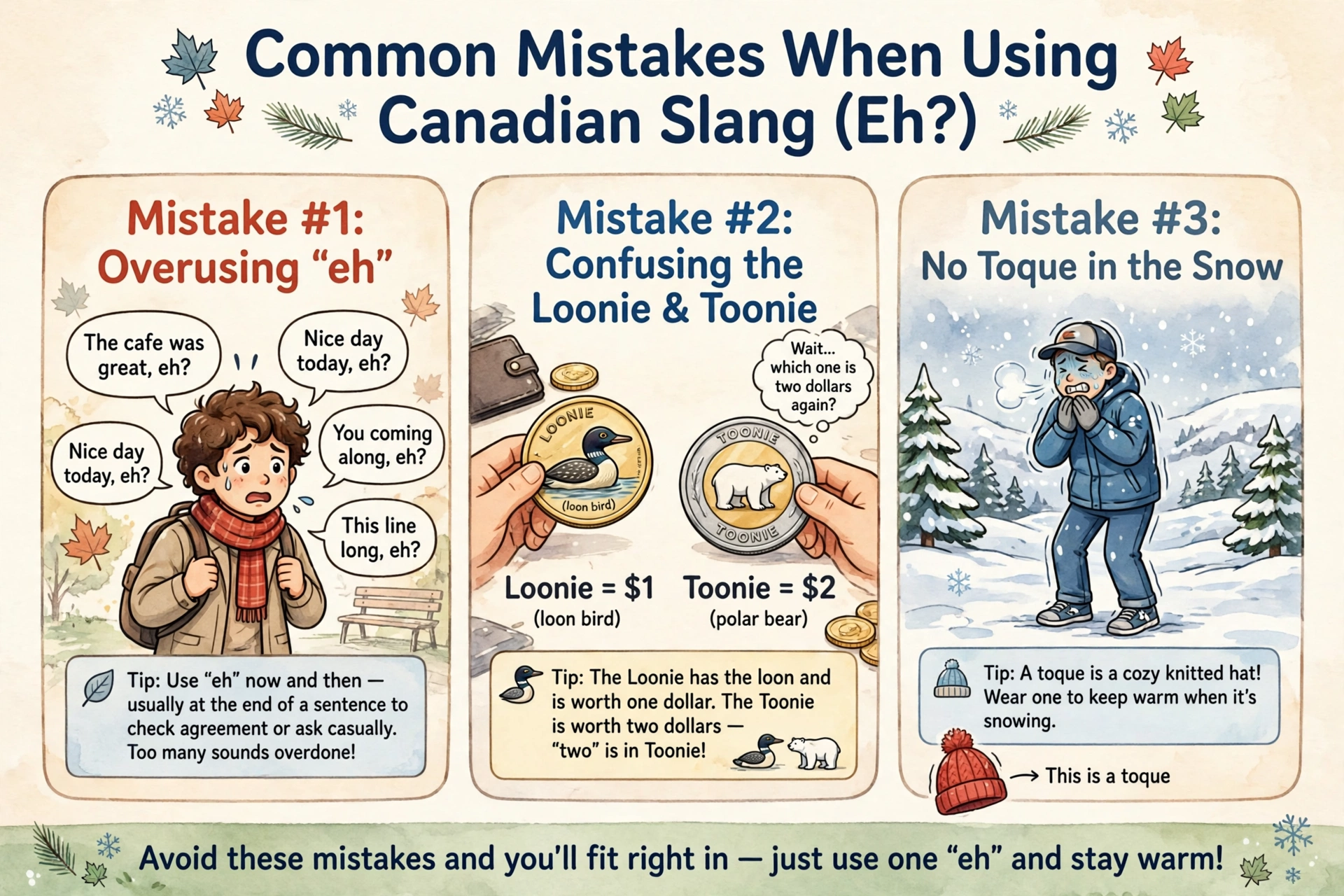
Canadian slang is forgiving — Canadians are delighted when visitors try it — but a few mistakes come up again and again. Avoid these and you will sound natural instead of rehearsed.
- Ending every sentence with “eh.” Real Canadians use eh sparingly, once or twice in a conversation, not as punctuation. Overusing it is the fastest way to sound like a comedy impression. Use it when you genuinely want agreement or a reaction, then stop.
- Calling everyone a hoser. Hoser is a joke between friends. Calling a stranger, a boss, or a new acquaintance a hoser is not funny; it is rude. Keep it for people who already know you are teasing.
- Mixing up loonie and toonie. The loonie is the one-dollar coin, the toonie is the two-dollar coin. Mixing them up at a till is a small mistake, but it marks you as new. Remember: loonie has one syllable of value in its name — one dollar, one bird. The twonie is two.
- Asking for “soda” and expecting instant understanding. Canadians will understand soda, but the normal word is pop. The same goes for restroom (say washroom), beanie (say toque), and sneakers (say runners if you want to sound local).
- Using regional words in the wrong region. Saying bunnyhug in Vancouver or dep in Calgary will get you a blank look, not because the words are wrong, but because they belong somewhere else. Regional slang is a badge of home. Admire it, learn it, but do not deploy it where it does not live.
- Pronouncing toque wrong. It is pronounced “took” (rhymes with book), not “toh-kay” or “toque” like a chef’s hat in French. Getting it right is a small thing that earns a lot of goodwill.
- Assuming all Canadian slang is hockey slang. Hockey gave Canada some of its best words, but most Canadian slang is about weather, money, food, and politeness. If every example you know involves a rink, your picture of Canada is too narrow — and Canadians will gently tell you so.
- Treating “sorry” as an apology. Canadians say sorry when someone else bumps into them, when they need to get past you, and when they are about to disagree. It is a social lubricant, not always an admission of fault. Do not over-apologise in return; a smile and a “no worries” is usually enough.
Quick Tips
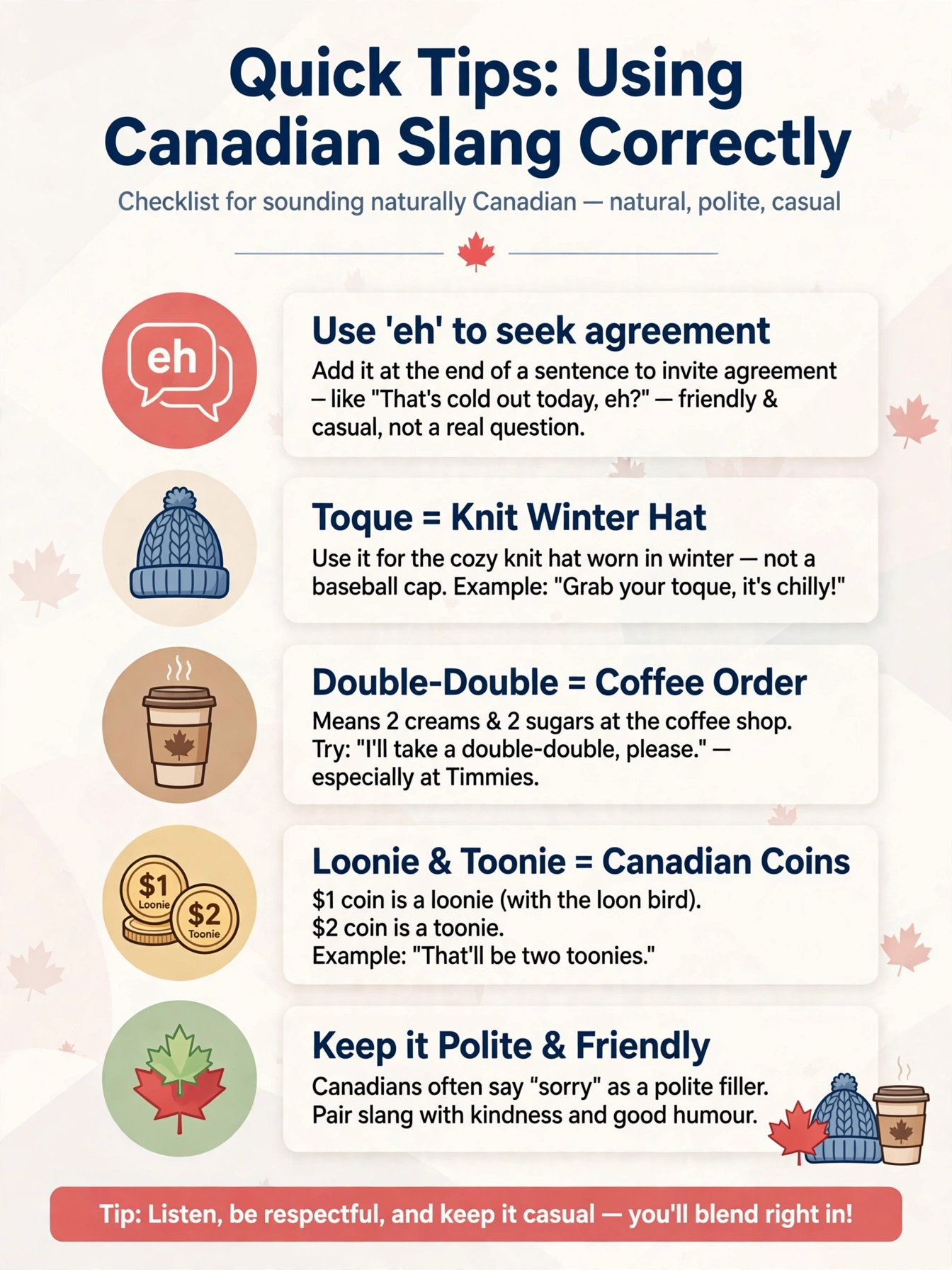
You do not need to memorise all 40 terms to use Canadian slang well. Start with the essentials, listen more than you speak, and let the rest arrive naturally. These tips will get you there faster:
- Learn five words first: eh, toque, loonie, double-double, and pop. They cover conversation, weather, money, coffee, and food — the five things you will talk about in your first week in Canada.
- Listen for the word before you use it. If a Canadian in the room says keener or give’r, it is safe for you to say it back in the same tone. If nobody has said it, it may not belong in that room.
- Match the season. Toque, chinook, and two-four are seasonal words. Using them in season sounds natural; using them out of season sounds like you learned them from a list. (This list included.)
- Keep it to one slang word per sentence. “Cold out, eh? Grab your toque” sounds Canadian. “Cold out, eh, bud? Grab your toque, you beauty, and give’r” sounds like a sketch. Less is more.
- Ask when you are curious. Canadians love explaining their slang. “What does bunnyhug mean?” is a great conversation starter, and the answer usually comes with a story about Saskatchewan.
- Read the room on teasing words. Hoser, keener, and bud (in the annoyed sense) are tone words. If the room is laughing, join in. If it is not, stay warm and plain.
- Use Canadian spellings when you write. Colour, favourite, and centre are Canadian spellings, and they pair naturally with Canadian slang in emails and messages. It is a small signal that you are paying attention.
- Remember the polite core. Canadian slang works because it is friendly. Keep your tone warm, keep your jokes gentle, and keep saying sorry and thank you — and the slang will take care of itself.
More Canadian Slang Words Worth Knowing
Beyond the essentials in the table above, here are 25 more Canadian slang words and phrases that fill out the picture. Some are national, some are proudly regional, and all of them are still heard in Canada today:
- Canuck — a Canadian, usually affectionate. “Proud Canuck, eh?”
- Chesterfield — a couch or sofa, mostly used by older Canadians.
- Skookum — strong, impressive, excellent (British Columbia). “That’s a skookum truck.”
- Chinook — a warm wind in Alberta that melts the snow and lifts everyone’s mood.
- Dep — a corner store in Quebec, from the French dépanneur.
- The 6ix — Toronto, from its 416 and 647 area codes, popularised by Drake.
- Two-four — a case of 24 beers; also the May long weekend.
- Mickey — a small (375 ml) bottle of liquor.
- Caesar — Canada’s national cocktail: vodka, Clamato juice, and spices.
- Poutine — fries with cheese curds and gravy, invented in Quebec and loved everywhere.
- KD — Kraft Dinner, the boxed macaroni and cheese that is practically a Canadian food group.
- Timmies / Timmy’s — Tim Hortons, the coffee-and-doughnut chain.
- Serviette — a paper napkin.
- Eavestrough — a roof gutter.
- Garburator — an in-sink garbage disposal unit.
- Parkade — a multi-level parking garage.
- Runners — athletic shoes; sneakers.
- Kerfuffle — a commotion or fuss, usually a minor one. “Quite the kerfuffle over parking.”
- B’y — “boy,” a term of address in Newfoundland and Labrador. “How’s it going, b’y?”
- What’re you at? — “How are you?” / “What are you up to?” in Newfoundland and Labrador.
- Stay where you’re to — “stay where you are” in Newfoundland English: “Stay where you’re to, I’ll come to you.”
- Raincouver — a joking nickname for rainy Vancouver.
- Molson muscle — a beer belly, jokingly named after Molson beer.
- Celly — a goal celebration in hockey, now used for any big celebration.
- Take off — to leave, or, famously, “take off, eh?” meaning “get lost” — always said as a joke between friends.
Notice how many of these words are tied to a place: a province, a city, a rink, a coffee chain. That is the pattern of Canadian slang. It is local language for a very large country, and learning it is really learning Canada, one neighbourhood at a time. If you enjoy this kind of regional vocabulary, you will also enjoy exploring Gen Alpha slang — a very different list, from a very different generation, that shows how quickly slang can change.

FAQ
What does Canadian slang mean?
Canadian slang means the informal words and phrases widely used in Canada — like eh, toque, loonie, and double-double — that describe everyday Canadian life, from winter weather and hockey to coffee orders and money. It is part of Canadian English, not a separate language.
What is the most famous Canadian slang word?
Eh is the most famous Canadian slang word. Canadians add it to the end of sentences to invite agreement (“Nice day, eh?”), express surprise, or soften a statement. It is used far less often in real life than in comedy sketches, but it is genuinely everywhere in Canada.
What does “eh” mean in Canadian slang?
Eh usually means “right?” or “do you agree?” It can also mean “what?” when someone did not hear you, or “really?” when they are surprised. The meaning depends on tone and context, which is why listening to how Canadians use it matters more than memorising a definition.
What is a toque in Canada?
A toque (pronounced “took”) is a knitted winter hat, what Americans call a beanie. It is essential winter clothing in Canada, worn from late autumn through early spring, and the word itself comes from French. Forgetting your toque in January is a classic Canadian mistake.
What is a double-double?
A double-double is a coffee with two creams and two sugars, ordered that way at Tim Hortons and other Canadian coffee shops. The name is so well known that most Canadians simply say “double-double” and the person behind the counter knows exactly what they mean.
What is the difference between a loonie and a toonie?
A loonie is the Canadian one-dollar coin, named for the loon pictured on it. A toonie is the two-dollar coin, named by combining “two” with “loonie.” The loonie arrived in 1987 and the toonie in 1996, replacing one- and two-dollar paper bills.
Is Canadian slang the same everywhere in Canada?
No. Some Canadian slang is national (eh, toque, loonie), but much of it is regional. Saskatchewan says bunnyhug, Quebec says dep, British Columbia says skookum, and Newfoundland and Labrador has its own rich vocabulary. Regional words are a source of local pride.
How can I use Canadian slang without sounding rude?
Start with the friendly, practical words — eh, toque, double-double, pop — and use them sparingly. Avoid teasing words like hoser with strangers, listen to the tone Canadians use, and keep it light. One slang word per sentence, a warm tone, and a willingness to laugh at yourself will take you a long way.
Conclusion
Canadian slang is more than a list of funny words. It is a record of how Canadians live: long winters that demand a good toque, a coffee culture built around the double-double, a hockey culture that gave the country beauty, celly, and give’r, and a national habit of softening everything with eh and sorry. The 40 terms in this guide cover the essentials — the money, the weather, the food, the rink, and the regional favourites that make each province sound like itself.
The best way to learn Canadian slang is the Canadian way: use a little, listen a lot, and do not take yourself too seriously. Start with eh, toque, and double-double. Add loonie, pop, and washroom when you need them. Save bunnyhug, dep, and skookum for the places they belong. And the next time someone says “Cold out today, eh?”, you will know exactly what they mean — and you will know exactly what to say back. Something like: “Sure is. Good thing I brought my toque.” That, right there, is Canadian slang doing its job.
