
Quick definition: Florida slang is the informal, everyday vocabulary of the Sunshine State — words and phrases like jit, dale, and acere that Floridians use with friends, family, and online. It blends Southern English, Cuban Spanish, Caribbean influence, and hip-hop culture, and it changes from Miami to Jacksonville, from the beach to the swamp.
Florida Slang Meaning & Definition
Florida slang means the casual words, expressions, and shortcuts that are distinctive to how people talk in Florida. It is not one single dialect. Florida is a long, diverse state, and its slang works more like a playlist than a dictionary: South Florida sounds Cuban and Caribbean, Central Florida sounds Southern and theme-park tourist, and North Florida sounds deep Southern, with Jacksonville proudly shouting its own word, Duval.
When someone says they want to learn Florida slang, they usually mean two things at once. First, they want the vocabulary: the words for “kid,” “friend,” “hurry up,” and “delicious” that you will hear on Miami streets, in Orlando group chats, and in Florida rap lyrics. Second, they want the feeling behind the words. Florida slang is warm, fast, funny, and a little wild — just like the state itself. A single word like dale can mean “let’s go,” “okay,” “hurry up,” and “goodbye,” all depending on the moment. And a phrase like “Florida Man” can make a whole room laugh before anyone has even heard the story.
Unlike the slang of some other states, Florida slang is shaped by who moved there. Waves of Cuban, Haitian, Jamaican, and Puerto Rican families, retirees and seasonal visitors from the North, and generations of Southern families all mixed their speech together under the same hot sun. The result is a vocabulary that borrows from Spanish, from Southern English, and from Black American culture and hip-hop — and then remixes it into something unmistakably Floridian. If you are comparing regional vocabularies, Australian slang works the same way: local words that only make full sense once you know the place that produced them.
Introduction
Florida has a reputation problem and a personality problem — in the best possible way. It is the state of alligators in swimming pools, afternoon thunderstorms that arrive like clockwork, and headlines that start with “Florida Man.” It is also the state of cafecito at a walk-up window, Pub Subs eaten on the beach, and neighbors who call a kid a jit with real affection. The slang captures all of it: the sunshine, the strangeness, and the mix of cultures that makes Florida feel like several states in one.
This guide explains Florida slang the way people actually use it. You will get the meanings, the origins, and real examples for 25+ terms, plus the regional differences that matter — because a word that is everyday language in Miami might get a blank stare in Tallahassee. You will also learn the common mistakes outsiders make, polite alternatives for formal settings, and quick tips for using Florida slang naturally instead of sounding like you memorized a list. By the end, you will understand what Floridians mean when they say dale, why a snowbird is not a bird, and why nobody in Florida is surprised when lunch is a sandwich from a grocery store.

Origin
Florida slang did not come from one place. It grew over more than a century as different groups of people arrived in Florida and their speech mixed together. The oldest layer is Southern English. Florida was a Southern, agricultural state long before it was a tourist destination, and older Floridian speech carries classic Southern features: y’all, softened consonants, and expressions like “bless your heart” that can be sincere sympathy or the politest insult in the English language, depending entirely on tone.
The second great influence arrived with Cuban migration to South Florida, especially after 1959 and the Mariel boatlift of 1980. Miami became a bilingual city, and Spanish words crossed into everyday English speech. Dale (go ahead, let’s go), acere (friend, buddy), and cafecito (a small, strong Cuban coffee) are Cuban gifts to Florida English. Singer Pitbull, born in Miami, carried dale around the world in his songs, and today people who have never been to Miami shout it at parties. Haitian, Jamaican, and other Caribbean communities added their own words and rhythms, and Puerto Rican families — whose own vocabulary is covered in our guide to Puerto Rican slang — added more.
The third influence is hip-hop and Black American culture. Miami bass music in the 1980s and 90s, and later Florida rappers from Broward and Miami-Dade counties, spread words like jit, bih, and bussin far beyond Florida. Social media finished the job: TikTok, Instagram Reels, and “Florida Man” memes turned local words into national jokes and national vocabulary. Florida slang today is therefore a living mix — Southern roots, Spanish heart, Caribbean rhythm, and internet speed.
Popularity
Florida slang is popular for a simple reason: Florida itself is impossible to ignore. It is the third-most-populous US state, it hosts tens of millions of visitors a year, and its news headlines travel further than almost any other state’s. When a headline begins “Florida Man…,” millions of people read it, laugh, and share it — and the state’s vocabulary rides along. The “Florida Man” phenomenon alone has done more for Florida slang than any dictionary ever could, turning the state into a character in American pop culture.
Music keeps the slang moving. Pitbull built a global career on dale. Miami bass, Florida drill, and the state’s huge Latin music scene keep South Florida words in rotation on streaming playlists. On TikTok, creators from the 305 (Miami’s area code) and the 407 (Orlando) post “things only Floridians understand” videos that rack up millions of views: the afternoon rain, the Pub Sub loyalty, the no-see-ums at dusk. Every viral video teaches a new audience a word or two, and search interest follows.
Tourism spreads it in person. Snowbirds — Northern visitors who spend the winter in Florida — pick up local words and carry them home. College students who move to Florida for school absorb the slang in their first semester. And because so much of Florida life happens outdoors and online at the same time, the slang stays current: new words appear on social media every season, while older words like jit and dale stay in daily use. Florida slang is not a fad. It is the everyday language of one of America’s most-watched states.
How It Is Used
Florida slang is used the way all good slang is used: fast, casual, and among people who already share context. Most Florida slang words are nouns and greetings that slot straight into everyday sentences. You call a younger person a jit, you greet a friend with acere, you answer a plan with dale, and you describe great food as bussin. The words do heavy social work with very little effort — they signal that you belong, that you are relaxed, and that you get the joke.
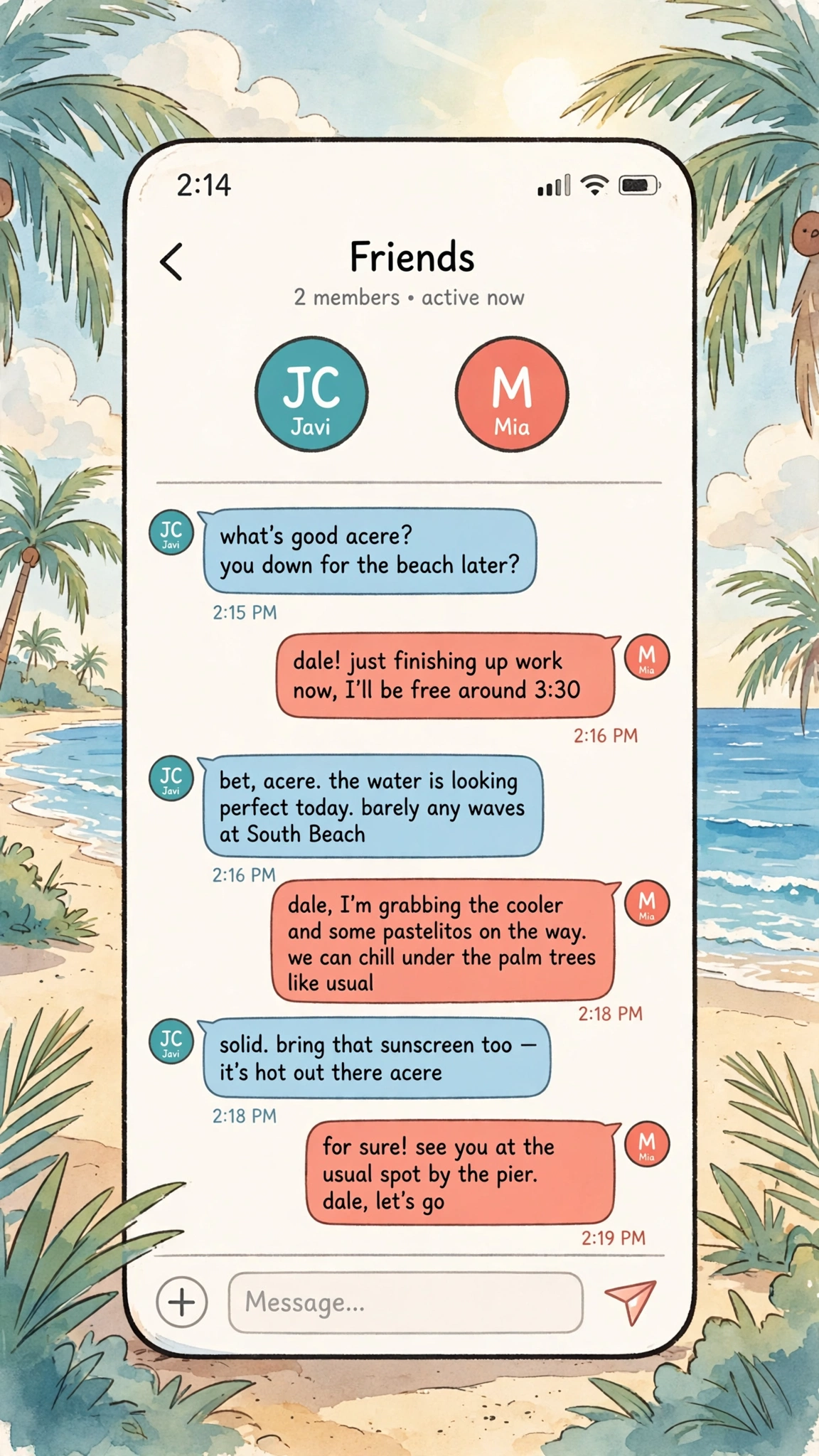
Tone matters more than vocabulary. Bih, for example, is a flexible noun that can mean a person, a place, or a thing, and it can sound affectionate, annoyed, or funny depending on how it is said. “Look at this bih!” can be delight or disbelief. The same is true of wildin’ out, which describes acting crazy or over the top — it can be a complaint or a compliment at a party. Floridians read tone instantly, and visitors should listen for a while before copying the words. In texting and on social media, Florida slang shows up in captions, comments, and memes, often mixed with Spanish: “Dale, acere, let’s go to the beach” is a perfectly normal South Florida text message.
Region matters too. In Miami and South Florida, Spanish-inflected slang dominates: dale, acere, cafecito, SoFlo. In Central Florida, you will hear more theme-park and tourist language, plus general Southern slang. In North Florida and Jacksonville, the speech is more traditionally Southern, and local pride words like Duval rule. A good rule of thumb: the further south you go, the more Spanish you will hear in the slang, and the further north you go, the more Southern you will hear. The table below gives you the core vocabulary every visitor should know.
25+ Florida Slang Words and Meanings
| Term | Meaning | Example |
|---|---|---|
| Jit | A young person; a kid or youngster, usually someone younger than the speaker | “That jit is always skateboarding around the neighborhood.” |
| Dale | Go ahead, let’s go, hurry up, okay, or bye — an all-purpose Miami word from Spanish | “Come on, dale. We’ve got to get home.” |
| Acere | Friend, buddy, pal — a Cuban term common in South Florida | “Acere, what’s up?” |
| Bih | A flexible noun: a person, place, or thing, used with attitude | “What’s wrong with that bih over there?” |
| Bussin / Buss | Incredibly delicious, especially food | “That burrito place was bussin.” |
| Vibin’ | Relaxing, chilling, enjoying the moment | “We’re just vibin’ by the pool today.” |
| Snowbird | A visitor from the North who spends the winter in Florida and returns home for summer | “The roads get busier when the snowbirds arrive.” |
| No-see-ums | Tiny, nearly invisible biting insects that swarm at dusk near beaches and marshes | “Bring bug spray; the no-see-ums are out.” |
| Pub Sub | A sandwich from Publix, Florida’s beloved grocery chain | “Let’s pick up a Pub Sub for the beach.” |
| Florida bath | Cleaning off by jumping in a pool instead of taking a shower | “I don’t need a shower, Mom; I already had a Florida bath.” |
| Floridabulous | Weird, bizarre, or inexplicable behavior typical of a “Florida Man” headline | “Oh, man! That story was Floridabulous.” |
| Florida Man | A joking reference to wild news headlines that begin “Florida Man…” | “Florida Man strikes again — you won’t believe this one.” |
| The 305 | Miami, from its original area code; also a badge of Miami identity | “I’m heading down to the 305 this weekend.” |
| SoFlo / SoFla | South Florida: the Miami, Fort Lauderdale, and Palm Beach area | “SoFlo traffic can be brutal on a Friday.” |
| Cafecito | A tiny, strong, sweet Cuban coffee, shared from a ventanita (walk-up window) | “Grab a cafecito and let’s keep going.” |
| Duval | Jacksonville (Duval County), shouted with pride — “Duuuuval!” | “Duuuuval! Let’s go, Jags!” |
| The Keys | The Florida Keys, the island chain from Key Largo to Key West | “We’re headin’ to the Keys this weekend.” |
| Gator | An alligator, or a Florida Gators fan; also “Gator Country” for Gainesville | “Don’t swim there — that’s gator country.” |
| Wildin’ / Wildin’ out | Acting crazy, over the top, or out of control | “Y’all were wildin’ out at the party last night.” |
| Wicked up | Messed up, broken, or not working right | “My phone is all wicked up since the rain.” |
| Bap | Busted or broken; something that no longer works | “The AC is bap again.” |
| Florida Happy Meal | A joking “meal” of beer, cigarettes, and lottery tickets from a gas station | “She ran up to the store for a Florida Happy Meal.” |
| Que bola | “What’s up?” in Cuban Spanish, common in Miami greetings | “Que bola, acere?” |
| Finna | Going to; about to (shared Southern/AAVE usage, very common in Florida) | “I’m finna head to the beach before the storm.” |
| Cracker | “Florida cracker”: a native, often rural Floridian; a term of local pride with a complicated history — use with care | “He’s a true Florida cracker, born and raised.” |
Examples
Florida slang makes the most sense in context. The same word can be warm, funny, or teasing depending on who says it and where. These examples show how Floridians actually use the vocabulary in friendly chats, at work, and when they are joking around.
Friendly Examples
- “Dale, acere! I haven’t seen you in forever — que bola?”
- “That jit just learned to surf. He’s out there every morning before school.”
- “We’re vibin’ at the beach till sunset. Come through if you’re free.”
- “The Pub Sub was bussin, bih. I need another one tomorrow.”
- “Grab a cafecito from the ventanita and let’s walk the neighborhood.”
Professional Examples
Most Florida slang stays out of formal workplaces, but the milder local vocabulary is fine in casual professional settings, especially with Florida colleagues. “Snowbird season” is standard business language in Florida tourism, hospitality, and real estate — nobody blinks at it in a meeting. “SoFlo” and “the 305” appear in marketing copy all the time. A safe professional example: “Our snowbird guests arrive in November, so let’s have the winter schedule ready by October.” Keep bih, jit, and wildin’ out for friends, not for clients — they are warm among peers and risky with strangers.
Funny Examples
- “Florida Man tried to pay for his Pub Sub with a lottery ticket. Floridabulous.”
- “I took a Florida bath and then got eaten alive by no-see-ums. Classic Tuesday.”
- “My grandpa is a snowbird, my cousin is a jit, and I’m just here vibin’.”
- “Duuuuval! My neighbor shouted it so loud the gators heard him.”
Comparison with Similar Terms
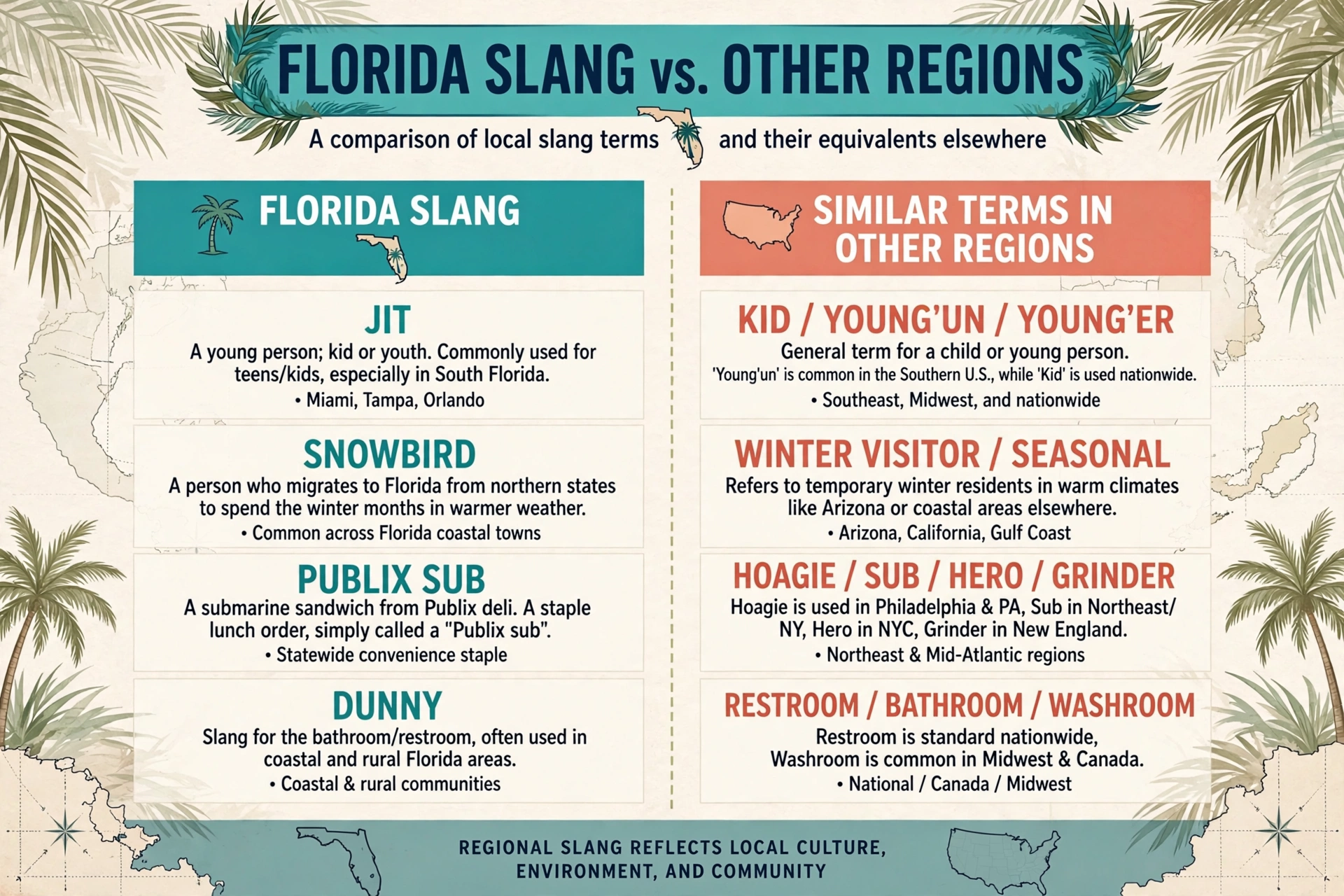
Florida slang overlaps with Southern slang, general Gen Z internet slang, and Spanish loanwords — but the Florida versions have their own flavor. This comparison clears up the most common mix-ups. If you want to see how another state builds its own vocabulary, our guide to Ohio slang shows the same pattern: local pride words, internet jokes, and a whole lot of regional identity packed into a few syllables.
| Florida term | Similar term | Difference |
|---|---|---|
| Jit | Kid, youngster | Jit is specifically South Florida and can be affectionate or teasing; “kid” is neutral everywhere. |
| Dale | Let’s go, okay | Dale covers agreement, encouragement, hurry up, and goodbye in one word; “let’s go” only covers one of those. |
| Acere | Bro, homie, dude | Acere is Cuban and Miami-specific; “bro” is used nationwide. |
| Bussin | Delicious, fire | Bussin is almost always about food; “fire” can describe anything good. |
| Snowbird | Tourist, snowbird (Arizona too) | In Florida it means a seasonal winter resident, not a short holiday visitor — and locals use it year-round. |
| Florida Man | Internet meme, headline joke | “Florida Man” is a whole genre of news jokes tied to Florida’s public-records laws and wild headlines, not just one meme. |
| Finna | Gonna, about to | Finna is shared Southern and AAVE speech, not Florida-only — but it is everywhere in Florida conversation. |
Alternate Meanings
A few Florida slang terms have alternate meanings worth knowing. Dale is the biggest one: in Spanish it literally means “give it,” and in Miami it stretches from “go ahead” to “hurry up” to “bye.” Context does all the work — if someone says it while waving, it means goodbye; if they say it while you hesitate, it means “go for it.” Bih is another shape-shifter: it can refer to a person, a place, or a thing, and it can be affectionate (“my bih”) or confrontational depending on tone, so listen before you repeat it.
Gator has three lives in Florida: the animal, a University of Florida fan, and a warning (“gator country” means you are in alligator territory). Cracker is the most sensitive alternate: “Florida cracker” historically described Florida-born cattle herders and is used with pride by many native Floridians, but the word “cracker” has a different, offensive history elsewhere in the US, so outsiders should not use it casually. And wicked up in Florida means messed up or broken, which is very different from New England’s “wicked” (very) — another reminder that American slang is deeply local.
Professional or Polite Alternatives
Florida slang is wonderful with friends and risky in formal settings. Use these polite alternatives when you are writing an email, meeting a client, or talking to someone you do not know well:
- Instead of jit: “young person,” “teenager,” or “kid.”
- Instead of dale: “Sounds good,” “Let’s do it,” or “Go ahead.”
- Instead of acere: “friend,” “buddy,” or simply the person’s name.
- Instead of bih: “person,” “thing,” or drop the word entirely.
- Instead of bussin: “delicious,” “excellent,” or “really good.”
- Instead of wildin’ out: “getting carried away” or “being over the top.”
- Instead of Florida Man jokes: keep them for social settings — in a work context they can sound like mocking the state you are doing business in.
The one exception is snowbird: it is so established in Florida business and tourism language that it is perfectly professional. “Snowbird season” appears in hotel reports, rental listings, and city planning documents without anyone smiling.
Common Mistakes
Visitors make the same handful of mistakes with Florida slang. Avoid these and you will sound like someone who listened first.
- Using dale for everything, everywhere. Dale is a Miami and South Florida word. Using it in Jacksonville or Tallahassee will not offend anyone, but it will mark you as a tourist who learned Florida from a Pitbull song.
- Calling everyone a jit. Jit means someone younger than you. Calling an older person a jit is confusing at best and rude at worst.
- Overusing bih. It is a tone word. Said warmly among friends it is funny; said to a stranger it can land as an insult. If you are not sure of the tone, leave it out.
- Treating “Florida Man” as an insult to all Floridians. Locals laugh at the headlines themselves, but a steady diet of Florida Man jokes from an outsider gets old fast. Laugh with Floridians, not at them.
- Mixing up snowbird and tourist. A snowbird lives in Florida for months each winter. A tourist visits for a week. Floridians use the words differently, and so do their landlords.
- Assuming all Florida slang is Spanish. Half of it is Southern English and hip-hop culture. Saying “dale” with a perfect Miami accent will not help you understand Duval, gator country, or no-see-ums.
- Using cracker casually. “Florida cracker” is an insider pride term with a complicated history. Leave it to native Floridians who claim it themselves.

Quick Tips
- Listen first, then copy. Spend a day hearing how locals use dale and jit before you try them yourself. Tone is the whole game.
- Start with the safe five: dale, jit, bussin, vibin’, and snowbird. They are friendly, widely understood, and hard to get wrong.
- Match the region. Use Spanish-flavored slang in Miami and South Florida, Southern slang in North Florida, and neutral words everywhere else.
- Pair slang with the real thing. Order a cafecito at a ventanita, grab a Pub Sub for the beach, and the words will stick because the experience sticks.
- Keep it light in texts. Florida slang shines in captions and group chats. One or two slang words per message sounds natural; a whole sentence of slang sounds like a performance.
- Watch the weather words too. Floridians talk about afternoon storms, hurricane season, and no-see-ums the way other states talk about traffic. Knowing those words is half of sounding local.


FAQ
What does Florida slang mean?
Florida slang is the informal vocabulary of Florida — words like jit (young person), dale (let’s go / okay), and acere (friend) — shaped by Southern English, Cuban Spanish, Caribbean culture, and hip-hop.
What is a jit in Florida slang?
A jit is a young person, a kid or youngster, usually someone younger than the speaker. It is a South Florida term used affectionately or teasingly, as in “That jit is always skateboarding around the neighborhood.”
What does dale mean in Florida?
Dale is an all-purpose Miami word from Spanish. It can mean “go ahead,” “let’s go,” “hurry up,” “okay,” or “bye,” depending on context and tone. Pitbull popularized it worldwide, but it is everyday language in South Florida.
What does acere mean?
Acere is a Cuban Spanish term meaning “friend,” “buddy,” or “pal.” It is common in Miami and South Florida, especially in Cuban-American communities: “Acere, what’s up?”
What is a snowbird in Florida?
A snowbird is a person from a colder northern state or Canada who spends the winter months in Florida and returns north for the summer. The term is standard in Florida tourism, hospitality, and real estate.
What is a Pub Sub?
A Pub Sub is a sandwich from Publix, the grocery chain strongly associated with Florida. Floridians treat the Pub Sub — fresh bread, deli meats, and loyal fans — as something close to the state sandwich.
What does Florida Man mean?
“Florida Man” is a joking reference to sensational news headlines that begin “Florida Man…” and describe bizarre incidents. It is a beloved and teasing part of modern Florida lore, helped by Florida’s broad public-records laws that make police reports easy to find.
Is Florida slang the same everywhere in Florida?
No. South Florida slang is heavily Cuban and Caribbean (dale, acere, cafecito), Central Florida mixes Southern and tourist language, and North Florida is more traditionally Southern, with local pride words like Duval in Jacksonville. The slang changes as you drive the state.
Conclusion
Florida slang is the Sunshine State talking the way it lives: warm, mixed, a little wild, and proud of it. From jit and dale in Miami to Duval in Jacksonville, from cafecito at a ventanita to a Pub Sub on the beach, these words carry the history of everyone who moved to Florida and made it home. Learn the meanings, respect the regional differences, and listen for tone before you copy the words — and you will understand Floridians a whole lot better than any headline ever could.
Start with the safe five, try them with friends, and keep exploring: every region of Florida has its own vocabulary waiting to be learned, just as Dominican slang and Gen Alpha slang each open up a different world of words. For more Florida terms and examples from an independent reference, see this guide to Florida slang terms. Dale, acere — now you know what Floridians are really saying.

1 thought on “Florida Slang: 25+ Words, Meanings and Real Examples”