Quick Definition: Jamaican slang is the everyday, informal vocabulary of Jamaican Patois (Patwa), the English-based creole language spoken by most Jamaicans as their first language. It covers greetings like “wah gwaan,” praise like “irie” and “big up,” party words like “bashment” and “tun up,” and blunt insults like “wasteman.” Many of these words sound like English, but their grammar, pronunciation, and tone work differently — which is exactly why a word-for-word translation often misses the point.
Introduction
Hear a dancehall track, land in Montego Bay, or scroll through a comment section under a Jamaican creator, and the same feeling hits: you recognise half the words, but you cannot quite follow the conversation. That is Jamaican slang doing its job. It is fast, musical, funny, and deeply expressive — a language shaped by history, music, and everyday island life, not by a textbook.
Jamaican slang is also one of the most borrowed slang systems in the world. Words that started on Kingston street corners now turn up in London grime, Toronto hip-hop, New York drill, and TikTok captions everywhere. Some travellers learn three phrases and think they are fluent. Some fans repeat lyrics without knowing which words are warm, which are rude, and which should never leave a song. This guide fixes that, in the same complete style as our australian slang guide — dozens of terms, grouped by real-life situation, with plain meanings, real examples, and honest notes on tone.
Whether you are visiting Jamaica, trying to understand a song, chatting with Jamaican friends, or just curious about how Patois works, this is the full breakdown: what Jamaican slang is, where it came from, how to pronounce and use it, the essential words in context, the mistakes outsiders make, and quick tips for sounding natural instead of forced.

Jamaican Slang Meaning & Definition
Jamaican slang means the informal words and phrases of Jamaican Patois, also spelled Patwa or Patwah and called Jamaican Creole by linguists. Patois is not “broken English.” It is a complete language with its own grammar, vocabulary, and sound system, built from English mixed heavily with West African languages — especially Akan — plus influences from Spanish, French, and the Indigenous Arawak language.
Most Jamaicans grow up speaking Patois at home and in the community, while Standard Jamaican English is the language of school, government, and formal writing. Many people switch between the two all day, depending on who they are talking to. That switching is normal, and it is one reason Jamaican slang feels so flexible: the same speaker can sound formal in a meeting and completely different with friends ten minutes later.
Two things confuse newcomers most. First, familiar-looking words can mean something else entirely: “bad” can mean excellent, “wicked” can mean brilliant, and “soon come” does not mean “coming right now.” Second, tone and context change everything. A word that is a compliment among friends can be an insult from a stranger, and a greeting that sounds aggressive on paper is often warm in person. The tables below always pair a meaning with an example so you can hear the tone, not just read a definition.
Origin
Jamaican Patois developed in the 17th century, when enslaved people from West and Central Africa were brought to Jamaica and had to communicate across different African languages and the English spoken by British enslavers, overseers, and later Irish and Scottish workers. Out of that pressure, a new language formed: English words as the base, African grammar and sounds underneath, and new expressions created to say things English alone could not say. You can still hear that history today — for example, “nyam” (to eat) traces back to West African languages, and many Patois sentence patterns follow African grammar rather than English grammar.
For a long time, Patois was dismissed by outsiders as slang or bad English, even though Jamaicans used it for poetry, storytelling, church life, and everyday talk. That began to change in the 20th century, thanks in large part to cultural giants like Louise Bennett-Coverley, known as Miss Lou, who performed and published in Patois and proved it was a literary language in its own right. Reggae and dancehall then carried it worldwide: Bob Marley made “irie,” “Jah,” and “one love” global, and dancehall artists in the 1990s and 2000s turned Kingston street slang into international chart language.
Today, Jamaican slang keeps evolving through dancehall, social media, and the diaspora in London, Toronto, New York, and Miami. New words appear every year — “zeen” (understood, agreed) is a recent twist on “seen” — while older words like “irie” and “wah gwaan” stay evergreen. That mix of old and new is the point: Jamaican slang is a living language, not a frozen list of holiday phrases. For background on how linguists classify the language, see the overview of Jamaican Patois.
Popularity
Jamaican slang is popular for a simple reason: Jamaican music is popular. Reggae gave the world a spiritual, laid-back vocabulary. Dancehall gave it a faster, bolder, more playful one. Sean Paul, Beenie Man, Shaggy, Vybz Kartel, Popcaan, and Shenseea have all put Patois phrases into songs that topped charts far from Jamaica, and listeners picked up the words even when they did not know the full grammar.
Social media finished the job. Short dancehall clips, comedy skits, and travel videos now teach phrases like “wah gwaan” and “mi deh yah” to millions of people who have never been to Jamaica. In the UK, Jamaican slang has deeply influenced Multicultural London English, so words like “wasteman,” “gyal,” and “yute” are now everyday London speech for many young people, whatever their background. In the US, Jamaican slang pops up in hip-hop, in Caribbean-American communities in New York and Miami, and in comment sections under almost any dancehall post.
Popularity has a downside, too. Because Jamaican slang sounds fun and musical, people sometimes treat it as a costume — copying an accent, overusing phrases, or using words in the wrong setting. Jamaicans are generally warm and proud when outsiders show genuine interest, but respect matters: learn the meaning, use a little, and listen more than you perform. That attitude will get you much further than memorising fifty phrases and firing them all at once.
How It Is Used
You do not need to master Patois grammar to use Jamaican slang well, but a few patterns will instantly make the phrases below easier to read. First, “mi” often means “I” or “my” (“mi deh yah” = “I am here”), “yuh” means “you,” “dem” means “them” or “they,” and “nuh” is a negator (“mi nuh know” = “I do not know”). Second, verbs often do not change for tense the way English verbs do — time comes from context or a small helper word, such as “a” for ongoing action (“mi a guh” = “I am going”).
Pronunciation is musical and rhythmic. The “th” sound often becomes “d” or “t” (“dem” for “them,” “ting” for “thing”), final consonants can soften, and stress falls in a way that makes even ordinary sentences sound like lyrics. Do not force an exaggerated accent — that reads as mockery, not fluency. Say the words clearly, at normal speed, and let Jamaicans correct you with a smile if you get a sound wrong.
Finally, Jamaican slang is highly situational. The same word can be a greeting, a compliment, or a warning depending on who says it and how. “Gwaan bad,” for example, can mean “act up” or “do very well” depending on tone. When in doubt, watch the reaction, ask what a word means before you reuse it, and stick to the warm, neutral phrases in the greetings and everyday tables until you know people well. That is the difference between using slang and just quoting it.
Examples
Friendly Examples
Most everyday Jamaican slang is warm and social. These are the phrases you will hear first, and the safest ones to learn:
- Wah gwaan? — “What is going on?” A standard greeting. Reply: “Mi deh yah” or “Everyting criss.”
- Mi deh yah. — “I am here / I am doing fine.” The classic relaxed answer to “wah gwaan?”
- Everyting criss. — “Everything is good / all is well.”
- Nuttin nah gwaan. — “Nothing is happening.” A chill, nothing-much reply.
- Walk good. — “Take care / travel safely.” A warm goodbye, even if nobody is literally walking anywhere.
- Big up yuhself. — “Respect to you / well done.” Praise and encouragement in one phrase.
- Respect. — “Thanks / I acknowledge you.” Short, sincere, and widely used as a farewell or thank-you.
Professional Examples
Jamaican slang is casual by nature, so in formal settings most Jamaicans switch toward Standard English. Still, a few phrases cross over safely in friendly workplaces, creative teams, and community settings:
- Big up the team. — Public praise for a group that did good work.
- Mi soon forward. — “I will be there shortly / coming soon.” Useful and polite in informal messages.
- No problem, mon. — “Do not worry about it.” Friendly, but save it for relaxed workplaces, not formal emails.
- Walk good. — A warm, professional-friendly goodbye among colleagues who know each other well.
Funny Examples
Jamaican humour is direct, vivid, and often self-deprecating. These examples show the playful side — note that some are teasing, so only use them with friends:
- “Di party tun up!” — “The party is lively / at a high level!”
- “Small up yuhself, mi a pass.” — “Squeeze up a bit, I am coming through.” Said with a grin in a crowded room.
- “Yuh too stush.” — “You are acting too posh / stuck-up.” Playful teasing between friends.
- “Wah nuh kill yuh, fatten yuh.” — “What does not kill you makes you stronger.” A classic Jamaican proverb, said with a laugh after a hard day.
Greetings & Everyday Phrases
| Jamaican slang | Meaning | Example |
|---|---|---|
| Wah gwaan? | What is going on? (greeting) | “Wah gwaan, bredda?” — “What is up, brother?” |
| Mi deh yah | I am here / doing fine | “Wah gwaan?” “Mi deh yah, yuh know.” |
| Everyting criss | Everything is good | “How yuh stay?” “Everyting criss.” |
| Mi soon come | I will be right back | “Mi soon come, wait deh.” |
| Mi soon forward | Coming soon / arriving shortly | “Di food soon forward.” |
| Mi soon reach | I will arrive soon | “Mi soon reach di party.” |
| Walk good | Take care / goodbye | “Mi a guh now. Walk good!” |
| Mi a guh | I am going / leaving | “Mi a guh home now.” |
| Touch road | Head out / hit the road | “Time fi touch road.” |
| Yuh dun know | You already know | “Di food nice? Yuh dun know!” |
| Zeen | Understood / agreed (newer slang) | “Wi link up tomorrow.” “Zeen.” |
| Mi nuh know | I do not know | “Weh di keys deh?” “Mi nuh know.” |
People, Friends & Family
| Jamaican slang | Meaning | Example |
|---|---|---|
| Bredda / Bredren | Brother / close male friend | “Mi bredda, yuh alright?” |
| Sistren | Sister / close female friend | “Mi sistren, long time!” |
| Yute | Young person / teen | “Di yute dem a play ball.” |
| Pickney | Child / children | “Di pickney dem hungry.” |
| Gyal | Girl / woman (casual) | “Di gyal dem a dance.” |
| Dawta | Daughter / young woman | “Come yah, dawta.” |
| Yardie / Yard man | A Jamaican person | “Him a real yardie.” |
| Jamrock / Jamdown / Yard | Jamaica / home | “Mi love Jamrock.” |
| Gyallis (gyalis) | A man who chases many women | “Him a gyallis, watch him.” |
| Wash belly | The youngest child in a family | “She a di wash belly.” |
Good Vibes, Praise & Party Talk
| Jamaican slang | Meaning | Example |
|---|---|---|
| Irie | Good / fine / feeling great | “Mi feel irie today.” |
| Big up | Respect / recognition / praise | “Big up everybody who help!” |
| Tun up | Lively / exciting / at a high level | “Di party tun up!” |
| Bashment | A party / dance; also showy and loud | “Wi a guh bashment tonight.” |
| Bruk out | Let loose, especially dancing | “She bruk out pon di floor.” |
| Fiyah | Fire — excellent (song, meal, performance) | “Dat tune fiyah!” |
| Bad / Wicked | Excellent / brilliant (opposite of literal) | “Dat tune bad!” |
| Tallawah | Strong / brave / small but mighty | “Wi likkle but wi tallawah.” |
| Boasy | Proud / showing off (admiring or a dig) | “Him too boasy today.” |
| Vibes | Mood / energy | “Di vibes nice tonight.” |
| Nyam | To eat | “Wi a guh nyam jerk chicken.” |
| Brawta | Something extra / a bonus | “Di vendor gi mi brawta.” |
Insults, Teasing & Words to Handle With Care
| Jamaican slang | Meaning | Note on tone |
|---|---|---|
| Wasteman | A useless, unserious person | Pointed insult — do not use lightly. |
| Stush | Stuck-up / not humble | Teasing among friends; rude to strangers. |
| Butu / Bhutu | Someone lacking manners or polish | Insulting — understand it, do not throw it around. |
| Mawga | Small / scrawny | Can be teasing or body-shaming — avoid as a label. |
| Screw face | A scowl / annoyed look | “Im screw” = he is annoyed. |
| Bangarang | Trouble / a disturbance | “Nuh bring bangarang come yah.” |
| Chaka-chaka | Messy / disorganised | Light teasing: “Yuh room chaka-chaka.” |
| Suss | Gossip / rumours | “Nuh listen to suss.” |
| Mi nuh business | I do not care / not my concern | Blunt — can sound dismissive. |
| Gwaan bad | Act up — or do very well | Tone decides it. Ask if unsure. |
Rastafari & Spiritual Words in Everyday Slang
Rastafari speech, sometimes called Iyaric, has shaped everyday Patois. You will hear “I and I” for “we” or “me” (stressing unity), “Jah” for God, “ital” for natural, pure food, “livity” for a righteous way of life, “overstand” for a deeper understanding, “earthstrong” for a birthday, and “Babylon” for a corrupt system or, sometimes, the police. These words carry spiritual weight for many Jamaicans. Use them respectfully, and do not reduce them to party slogans — “ital” food, for example, is a real dietary and spiritual practice, not just a trendy menu label.

Comparison with Similar Terms
| Term | What it means | How it differs from Jamaican slang |
|---|---|---|
| Jamaican slang / Patois | Informal vocabulary of Jamaican Creole | A full language system with African grammar roots — not just English with an accent. |
| Jamaican English | Standard English as spoken in Jamaica | Formal, school and official use; grammar follows Standard English. |
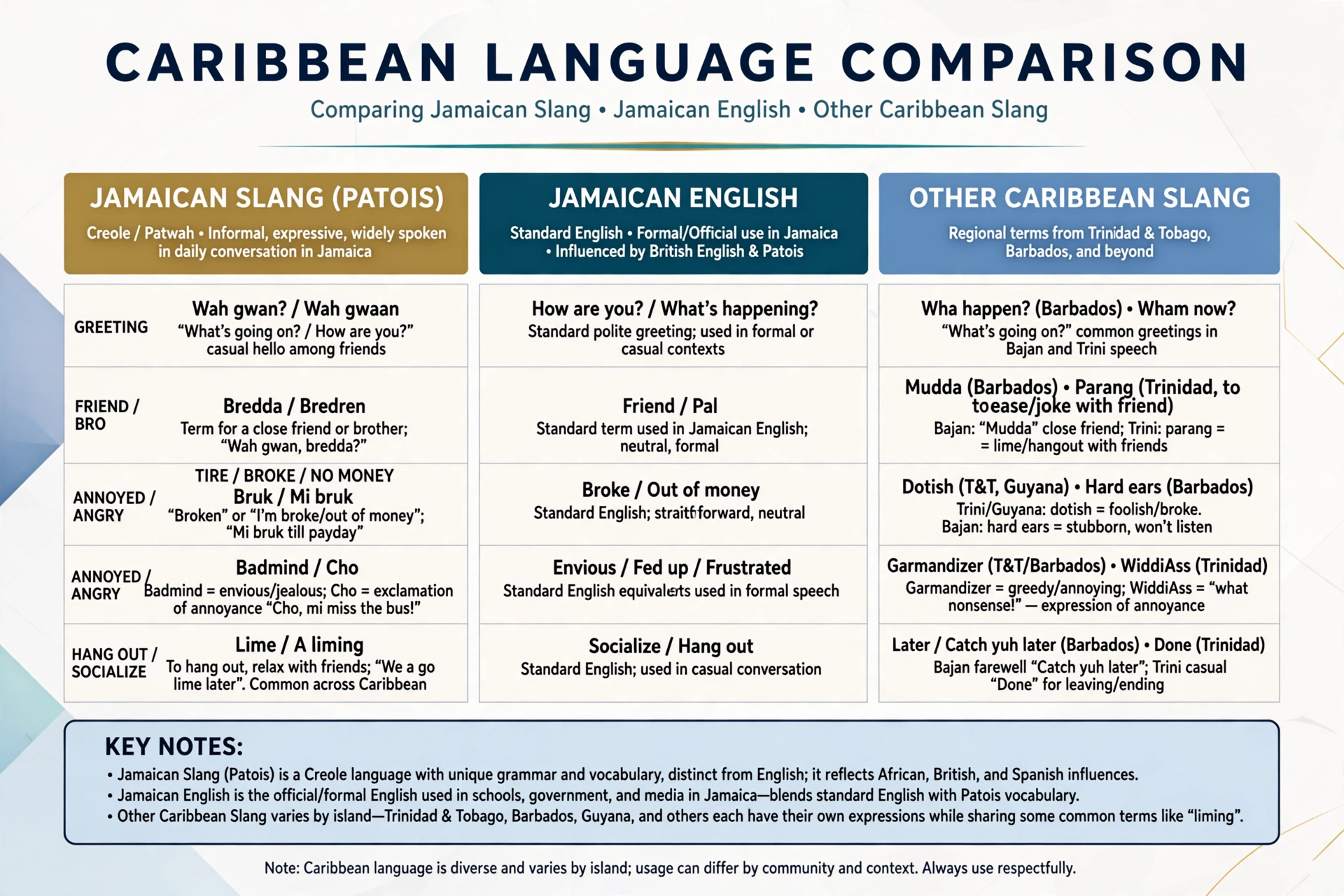
| Caribbean slang (general) | Slang from across the Caribbean | Shares some words (like “lime” in Trinidad), but each island has its own system. |
| UK roadman slang | London street slang | Borrows heavily from Jamaican slang (wasteman, gyal, yute) but is a London creation, not Jamaican speech. |
| US Gen Z slang | Internet-age American slang | Overlaps in music and TikTok, but words like “slay” or “no cap” have different roots — see our guides to similar internet terms, like sigma meaning slang and ohio slang meaning. |
The key difference is depth. A single borrowed word like “wasteman” in London is slang. In Jamaica, that word sits inside a whole language — with its own greetings, proverbs, humour, and history. Learning the list is fun; learning the system is what makes you actually understand it.
Alternate Meanings
Many Jamaican slang words change meaning with context, and a few have completely different meanings outside Jamaica. “Bad” is the famous one: in Jamaica, “dat tune bad” is high praise, while in Standard English it sounds like criticism. “Wicked” works the same way — “wicked tune” means a brilliant song. “Soon come” is another trap for visitors: it can mean “in a little while,” but in Jamaica it often means “eventually, when I get to it,” not “in two minutes.” If someone says “mi soon come,” relax — rushing them will not help.
“Yard” also shifts meaning. In Jamaica it can mean home, Jamaica itself, or your neighbourhood. Abroad, “yardie” became a label for Jamaican immigrants — sometimes neutral, sometimes stereotyped in 1990s crime reporting. Context matters, so listen for how Jamaicans themselves use the word before you adopt it. Similarly, “gyal” is casual and normal among friends, but calling a stranger “gyal” can come across as rude or overly familiar, especially from a man to a woman he does not know.
Finally, some words that sound like Jamaican slang are not Jamaican at all. “Lime” (hanging out) is Trinidadian, “wagwan” spelled with a “w” is just a spelling variant of “wah gwaan,” and “irie” is sometimes wrongly used as a generic Caribbean greeting. Getting the island right matters to people who live there — Jamaica, Trinidad, Barbados, and Haiti each have distinct languages and slang traditions.
Professional or Polite Alternatives
If you are speaking formally, writing an email, or talking to someone you do not know well, swap the slang for plain English. This is not about hiding Jamaican culture — Jamaicans themselves code-switch this way every day. It is about matching the setting:
- Instead of “Wah gwaan?” say “Hello, how are you?” in formal settings.
- Instead of “Mi deh yah / Everyting criss” say “I am doing well, thank you.”
- Instead of “Walk good” say “Take care” or “Have a safe trip.”
- Instead of “Big up” say “Well done” or “Thank you for your help.”
- Instead of “Mi soon come” say “I will be back shortly” — and mean a short time.
- Instead of “No problem, mon” say “You are welcome” or “No problem at all.”
- Instead of insults like “wasteman” say nothing at all in professional settings — there is no polite version, and using one at work will damage trust fast.
Common Mistakes
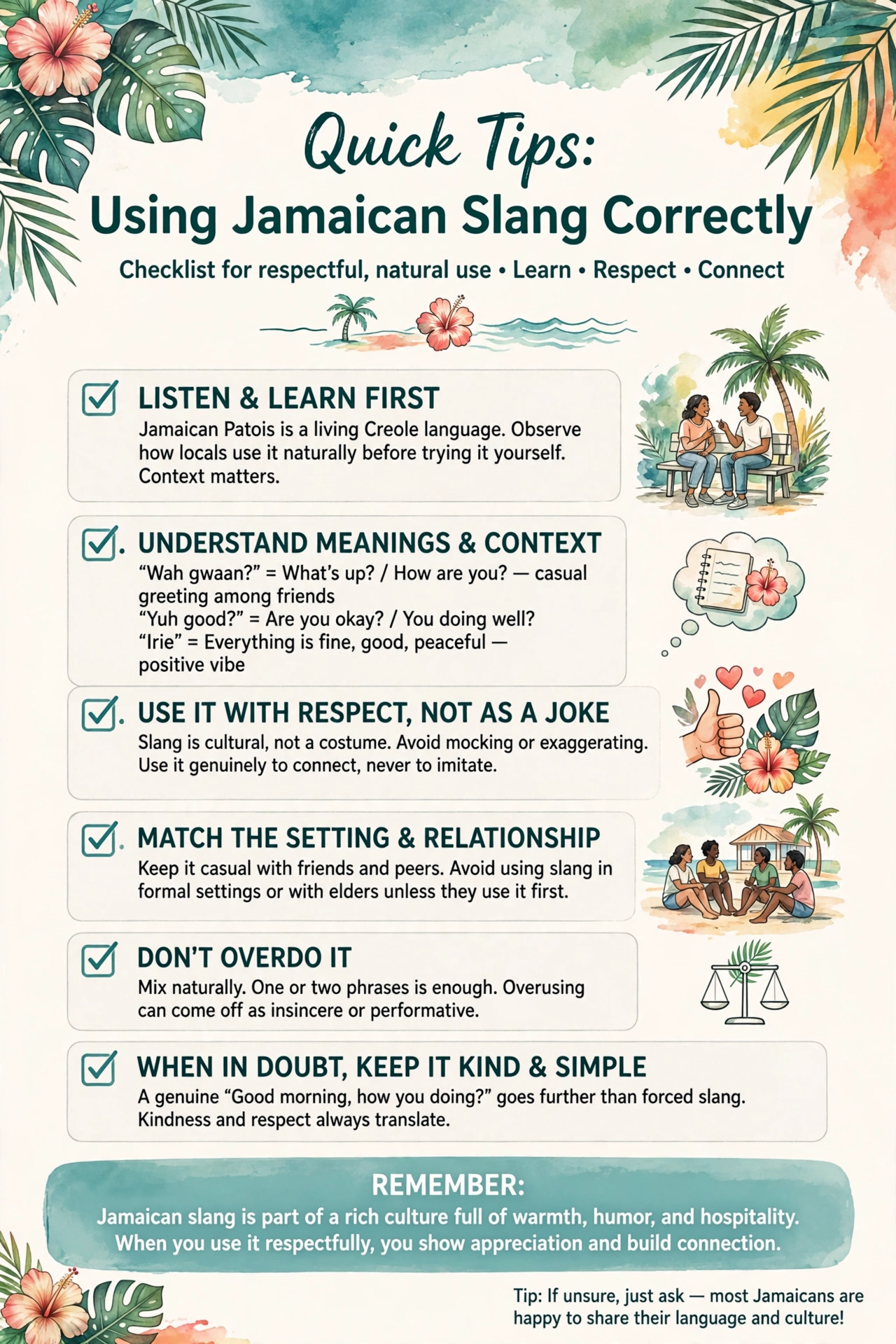
- Using “bad” and “wicked” literally. In Jamaican slang they are compliments. Saying “that song is bad” to praise it is correct in Patois — but confusing if your listener does not know the code. Check your audience first.
- Treating “soon come” as “right now.” It means “in a while.” Visitors who expect instant service get frustrated over a phrase that was never a promise of speed.
- Copying an exaggerated accent. Repeating phrases in a mock Jamaican accent is not fluency — it reads as mockery. Speak clearly in your own voice and let the words, not an imitation, do the work.
- Using insults with strangers. Words like “wasteman,” “butu,” and “stush” are sharp. Between friends they are teasing; from a stranger they are a confrontation.
- Calling everything “irie” and “yeah mon.” Travel guides overuse these two phrases, and Jamaicans notice. “Irie” is real, but it is not a greeting for every sentence, and “yeah mon” is not how most Jamaicans actually talk day to day.
- Mixing up Caribbean islands. Jamaican slang is not Trinidadian, Barbadian, or Haitian slang. Using one island’s words for another is the fastest way to look like you learned everything from a song.
- Overusing slang in one conversation. Dropping twenty new phrases into a single chat sounds rehearsed. Learn three or four well, use them naturally, and build from there.
- Assuming Patois is “broken English.” It is a language with grammar and history. Calling it broken English is dismissive, and it closes down exactly the conversations that teach you the most.
Quick Tips
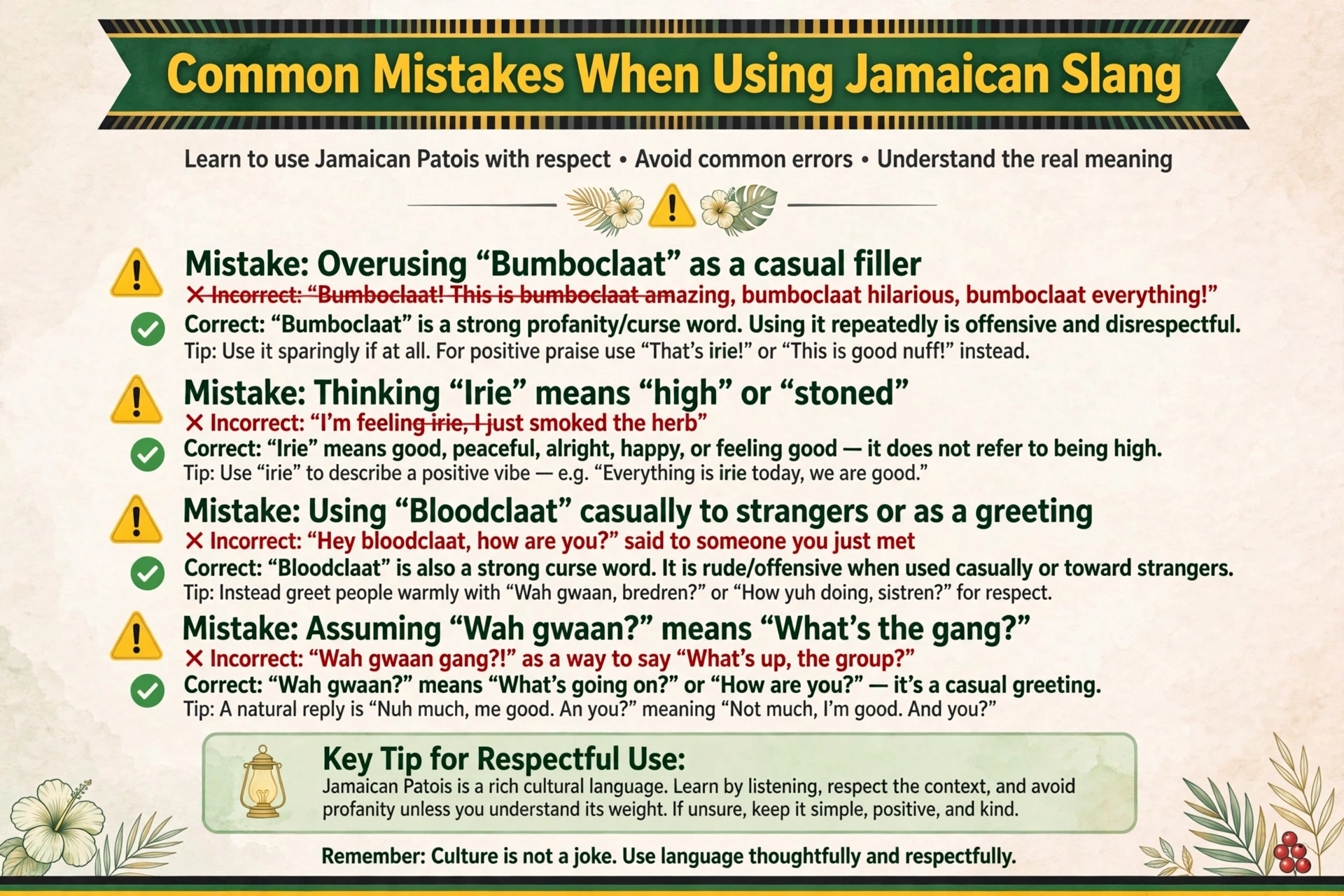
- Start with five phrases: wah gwaan, mi deh yah, everyting criss, walk good, and big up. They cover greeting, replying, leaving, and praising — most daily conversations.
- Listen before you speak. Spend a day hearing how Jamaicans use a word before you try it yourself. Tone, timing, and audience matter more than vocabulary size.
- Learn the reply pairs. “Wah gwaan?” pairs with “mi deh yah.” “Big up” pairs with “respect.” Phrases work in pairs, not alone.
- Use slang with people, not at them. Slang builds closeness when the relationship is already warm. It does not create closeness on its own.
- Ask, do not guess. “What does that mean?” is always better than using a word wrong. Jamaicans are usually happy to explain — asking shows respect, not ignorance.
- Keep formal settings formal. In emails, interviews, and official meetings, use Standard English. Save slang for friends, music, and relaxed social settings.
- Enjoy the proverbs. Sayings like “wah nuh kill yuh, fatten yuh” and “wi likkle but wi tallawah” (we are small but mighty) carry Jamaican philosophy in one line — they are the best window into the culture behind the slang.

FAQ
What does wah gwaan mean in Jamaican slang?
Wah gwaan means “what is going on?” It is the standard Jamaican greeting, used between friends, family, and acquaintances. A common reply is “mi deh yah” (I am here / doing fine) or “everyting criss” (everything is good).
What does irie mean?
Irie means good, fine, or feeling great. “Mi feel irie” means “I feel good.” It comes from Rastafari culture and reggae, and it describes a peaceful, positive state — not just “okay,” but genuinely good.
Is Jamaican Patois a real language or just slang?
Jamaican Patois is a real language — an English-based creole with West African grammar and vocabulary, spoken by most Jamaicans as a first language. Jamaican slang is the informal, everyday vocabulary inside that language, just as English slang sits inside English.
What does bashment mean?
Bashment means a party or dance, especially a big, loud, showy one. It can also describe anything showy and high-energy. “Wi a guh bashment tonight” means “We are going to a party tonight.”
What does wasteman mean in Jamaican slang?
Wasteman means a useless or unserious person — someone who wastes time, talk, or opportunity. It is a pointed insult, popularised in the UK through Jamaican influence, and it should not be used lightly or with strangers.
How do you say goodbye in Jamaican slang?
“Walk good” is the warm Jamaican goodbye — it means “take care” or “travel safely.” “Respect” is also used as a farewell, meaning thanks and mutual acknowledgement. “Mi a guh” means “I am going” and often opens a goodbye.
What does mi deh yah mean?
Mi deh yah means “I am here” or “I am doing fine.” It is the classic relaxed answer to “wah gwaan?” — a way of saying you are present, alive, and all right, without making a big deal of it.
Can non-Jamaicans use Jamaican slang?
Yes, with respect and restraint. Learn the real meanings, use the warm and neutral phrases, avoid insults and exaggerated accents, and listen more than you perform. Jamaicans generally welcome genuine interest — what they dislike is mockery, stereotyping, or treating their language as a costume.
Conclusion
Jamaican slang is more than a list of fun words. It is the sound of a language that survived slavery, crossed oceans in music, and still reinvents itself every year on dancehall stages and phone screens. From “wah gwaan” to “walk good,” from “irie” to “tallawah,” these phrases carry history, humour, warmth, and bluntness in a handful of syllables — and they only work when you understand the tone behind them.
Start small: greet people properly, answer with “mi deh yah,” praise with “big up,” and leave with “walk good.” Learn the reply pairs, respect the words that carry weight, and keep formal settings formal. Do that, and Jamaican slang stops being something you quote from a song and becomes something you actually understand. And if you want to keep exploring how English grows new slang around the world, check out our australian slang guide, our gen z slang 2024 roundup, and our sigma meaning slang breakdown — because, as Jamaicans would say, wi likkle but wi tallawah, and the slang never stops moving.

3 thoughts on “Jamaican Slang: 60+ Patois Words, Meanings & Examples (2026)”