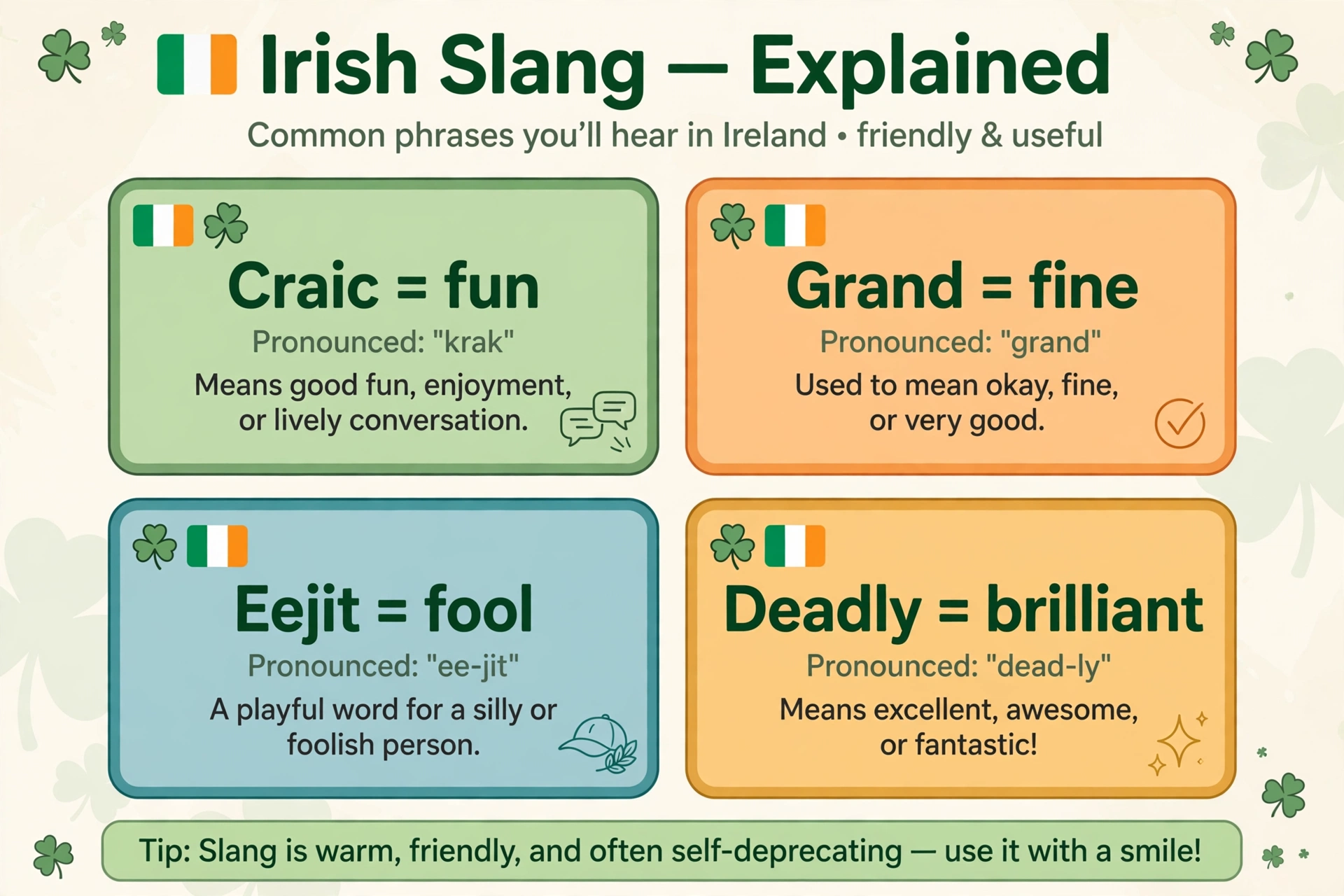
Quick Definition: Irish slang is the colourful, witty everyday language of Ireland — words and phrases like craic (fun), grand (fine), eejit (fool), and deadly (brilliant) that come from Irish English, Gaelic roots, and centuries of pub, street, and family talk. If you have ever heard someone say “the craic was mighty” and wondered what on earth they meant, this guide explains it all.
Irish Slang Meaning & Definition
When people talk about Irish slang, they usually mean the informal vocabulary and expressions used in everyday conversation across Ireland — in Dublin, Cork, Galway, Belfast, and everywhere in between. It is not a separate language. It is English, but English that has been bent, stretched, and seasoned by Irish culture: by the Irish language (Gaeilge), by Catholic and rural traditions, by the pub, by the GAA pitch, and by a national sense of humour that prizes quick wit over politeness.
Irish slang is famously warm and funny. Where British slang can sound clipped and American slang can sound blunt, Irish slang sounds like a story being told by a friend. A bad day becomes “a disaster altogether.” A good night out becomes “the craic was ninety.” A fool is not just a fool — he is an “eejit,” a “gobshite,” or a “muppet,” depending on how much affection you feel for him. The words carry tone, and tone is everything in Ireland.
That is also why Irish slang confuses visitors so much. Many Irish words sound like ordinary English words but mean something completely different. “Grand” does not mean impressive — it means fine, okay, no problem. “Gas” does not come from a stove — it means funny. “Deadly” does not mean dangerous — it means brilliant. And “sound” is not a noise — it is a compliment for a decent person. This guide decodes the whole system, word by word, so you can understand the Irish people around you — and even join in without embarrassing yourself.
Introduction
Picture a Friday night in a Dublin pub: a trad band in the corner, a fire going, and a group of friends roaring with laughter over pints. Someone raises a glass and says, “Well, lads, the craic is mighty tonight!” Nobody stops to translate. Nobody needs to. In Ireland, slang is not decoration — it is the main way people bond, tease each other, and show affection.
Irish slang has travelled far beyond Ireland. With millions of Irish emigrants and their descendants in the United States, Britain, Canada, and Australia, words like craic and grand now pop up in bars from Boston to Brisbane. Irish TV shows, comedians, and musicians — from Father Ted to Derry Girls to Kneecap — have carried the slang to global audiences. And yet, for all its fame, Irish slang remains one of the most misunderstood dialects in the English-speaking world, because so much of it relies on context, delivery, and irony.
This article is the complete breakdown: what Irish slang means, where it came from, the 50+ words and phrases you will actually hear, how to use them correctly, the mistakes tourists always make, and the polite alternatives for formal settings. Whether you are visiting Ireland, chatting with Irish friends online, writing Irish characters, or just trying to understand what your Irish coworker meant by “I’m grand, sure,” this is the full guide.
Origin
Irish slang has three main roots, and understanding them explains why it sounds the way it does.
1. The Irish language (Gaeilge). For centuries, most Irish people spoke Irish, not English. When English spread across Ireland in the 18th and 19th centuries, people carried Irish grammar, sounds, and words into their English. That is why Irish English says “I’m after eating” (from the Irish tar éis) instead of “I have just eaten,” and why words like smithereens, galore (from go leor, meaning plenty), shenanigans, and brogue entered English from Irish. The word craic itself comes from the Irish craic, meaning fun, enjoyment, and good conversation.
2. Rural and working-class life. Much Irish slang comes from farming, the pub, and the parish. Words like gaff (house), yoke (thing), kip (a messy place or a nap), and gossoon (young lad) describe ordinary life. Farming gave us “scarce” and “lashing” (heavy rain). The pub gave us rounds, “shifts,” and half the insults in the language.
3. British and American influence — filtered through Irish humour. Ireland absorbed words from Britain and America but gave them an Irish twist. “Grand” came from standard English but narrowed into the all-purpose Irish “fine.” “Savage” went from meaning cruel to meaning excellent. And modern Irish slang keeps absorbing new words from the internet and hip-hop, then remixing them — just as Australian slang remixes British English into something unmistakably Aussie.
The result is a dialect linguists call Hiberno-English: English with Irish grammar patterns, Irish pronunciation, and a vocabulary all its own. Irish slang is the informal, funny, everyday layer of that dialect.
Popularity
Irish slang has never been more popular — or more visible — than it is right now, for several reasons:
- TV and film: Derry Girls turned “wise up,” “catch yourself on,” and “wee” into global catchphrases. Father Ted made “feck” famous. Normal People and Bad Sisters brought modern Dublin speech to streaming audiences.
- Music: Irish rappers Kneecap rap in Belfast slang and Irish, winning international fans. Fontaines D.C., The Pogues, and Hozier all weave Irish speech into their lyrics.
- Social media: Irish TikTok and Instagram creators post daily “Irish slang explained” videos that rack up millions of views, especially from Americans planning trips to Ireland.
- Tourism: Ireland welcomes over 10 million visitors a year, and most of them come home with at least one Irish word in their vocabulary — usually craic.
- The diaspora: Around 70 million people worldwide claim Irish ancestry. In cities like Boston, New York, and Chicago, Irish slang survives in pubs, parishes, and family gatherings generations after emigration.
Search interest in Irish slang spikes every March around St. Patrick’s Day, when everyone suddenly wants to know what “top of the morning” really means (spoiler: almost nobody in Ireland actually says it) and how to order a pint without sounding like a tourist.
How It Is Used
Irish slang is used in almost every informal situation in Ireland — but almost never in formal writing. Here is where you will hear it:
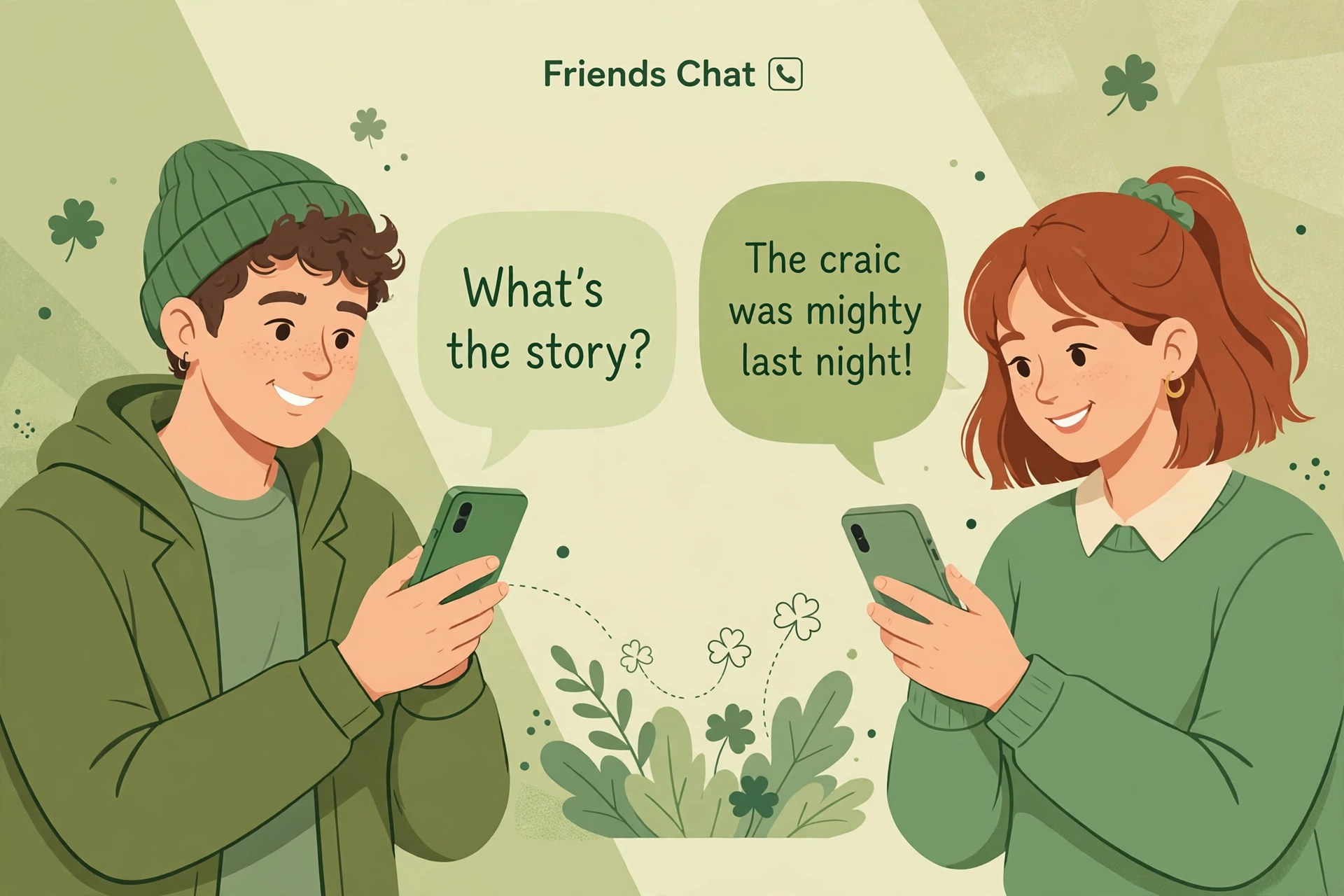
- Among friends: This is its natural home. Friends greet each other with “What’s the story?” and “How’s she cuttin’?” and insult each other affectionately all evening.
- In the pub: The pub is the university of Irish slang. Rounds are bought, stories are told, and “one for the road” famously means at least three more.
- At work (informally): Irish offices run on “grand,” “no bother,” and “I’ll sort it.” Colleagues are “sound” or “a legend” — or, behind their backs, “a dose.”
- In sport: GAA, rugby, and football commentary is thick with slang: “a savage point,” “a monster of a game,” “he’s some man for one man.”
- Online: Irish Twitter, TikTok, and WhatsApp groups use the same slang, plus abbreviations like “lmk” and “ngl” mixed with distinctly Irish words.
One golden rule: Irish slang is almost always softened by humour. Even the insults are usually affectionate. Calling your best friend an “eejit” means you love him. Calling a stranger one means something very different. Tone, relationship, and a grin do most of the work.
Examples
Here are the core Irish slang words, grouped by the situations you will actually use them in.
Friendly Examples
- “The craic was mighty last night — we didn’t get home till four!” (The fun was amazing.)
- “Ah, you’re grand, don’t worry about it at all.” (You’re fine, no problem.)
- “She’s a sound girl, she’d give you the shirt off her back.” (She’s a genuinely good person.)
- “What’s the story, bud? Long time no see!” (What’s up? How are things?)
- “That gig was deadly, best night in ages.” (That gig was brilliant.)
Professional Examples
- “No bother, I’ll have that report over to you by lunch.” (No problem.)
- “Fair play to you, that was a savage presentation.” (Well done, that was excellent.)
- “We’re grand for time, sure, take another coffee.” (We have plenty of time.)
- “Thanks a million for sorting that — you’re a legend.” (Thanks so much.)
- “I’ll run it by the boss and let you know, no worries.” (Standard polite Irish office talk, with slang softening the edges.)
Funny Examples
- “He went out for one quiet pint and came home banjaxed at 3am.” (Completely drunk and broken.)
- “Don’t be such a gobshite, you put the milk in the cupboard again.” (Don’t be such an idiot.)
- “It’s lashing rain outside and I’m after forgetting my umbrella — typical!” (Pouring rain, and I just forgot my umbrella.)
- “That fella is a gas man, he had the whole pub in stitches.” (That guy is hilarious.)
- “Away with the fairies, that one — she forgot her own wedding anniversary.” (Dreamy, not paying attention, living in her own world.)
Comparison with Similar Terms
Irish slang is often confused with British slang, but the two are very different in tone and vocabulary. Here is how Irish slang stacks up against its closest cousins.
| Meaning | Irish Slang | British Slang | American Slang | Australian Slang |
|---|---|---|---|---|
| Fun / good time | Craic | Banter | A blast | A ripper |
| Fine / okay | Grand | Alright | All good | She’ll be right |
| Brilliant | Deadly / savage | Brilliant / wicked | Awesome / lit | Beaut / sick |
| Idiot | Eejit / gobshite | Muppet / plonker | Moron / doofus | Drongo / galah |
| House | Gaff | Gaff | Pad / crib | Pad |
| Drunk | Banjaxed / langered | Plastered / trollied | Wasted / hammered | Blotto / maggotted |
| Friend (male) | Lad / fella | Mate / lad | Dude / bro | Mate / bloke |
| Very / extremely | Quare (Cork: “quare good”) | Well / dead | Hella / mad | Deadset / heaps |
Notice the pattern: Irish slang is warmer and more story-like than British slang, and more ironic than American slang. Where an American says “that’s awesome,” an Irish person says “that’s savage” — the same praise, delivered with a wink. If you enjoy regional English, compare this guide with our Jamaican slang and Toronto slang guides — every city bends English its own way.

Alternate Meanings
Several Irish slang words change meaning completely depending on context — which is exactly why visitors get confused:
- Craic: Usually means fun (“the craic was great”), but “what’s the craic?” simply means “what’s happening?” or “what’s the news?” — no fun is required.
- Grand: Usually means fine (“I’m grand”), but said slowly with a sigh — “Ah, grand” — it can mean resigned acceptance: fine, but not really.
- Gas: Means funny (“he’s gas”), but “a gas man” in older usage could also mean an eccentric. Context decides.
- Deadly: Means brilliant, never dangerous, in slang use. “A deadly night” is a great night.
- Sound: As slang it means a good person (“a sound lad”), not a noise — though “sound out” can also mean to test someone’s opinion.
- Shift: In Irish slang, “getting a shift” means kissing someone at a party or nightclub — not working a work shift.
- Yoke: Means any unnamed thing (“pass me that yoke”), but in Northern Ireland it can also mean an ecstasy tablet — so be careful with context.
- Feck: A softened version of a much stronger swear word, made famous by Father Ted. It expresses frustration (“feck it!”) without the full force of the original.
Professional or Polite Alternatives
Irish slang is wonderful among friends, but it does not belong in a job interview, a formal email, or a first meeting with a client. Here are polite swaps:
| Irish Slang | Polite Alternative |
|---|---|
| I’m grand | I’m doing well, thank you |
| No bother | No problem at all |
| Fair play to you | Well done / congratulations |
| Thanks a million | Thank you very much |
| That’s savage / deadly | That’s excellent / wonderful |
| Don’t be an eejit | That might not be the best idea |
| What’s the story? | How are you? / How are things? |
| Stall the ball | Please wait a moment |
| I’m banjaxed | I’m exhausted |
| Give us a shout | Please let me know / contact me |
The trick is code-switching: Irish people do it constantly, dropping into slang with friends and sliding into standard English at work. Visitors who learn both registers come across as respectful, not stiff — and Irish people genuinely appreciate the effort.
Common Mistakes
- Saying “top of the morning to you”: Almost nobody in Ireland says this. It is a stage-Irish phrase from old movies. Real greetings are “morning,” “how’s it going,” or “what’s the story?”
- Pronouncing “craic” as “crack”: It rhymes with “crack,” actually — that part is fine. The mistake is thinking it means drugs. In Ireland, craic means fun, full stop.
- Using “grand” to mean impressive: Telling an Irish person their house is “grand” does not compliment it — it just says it is fine. Use “lovely” or “gorgeous” for real praise.
- Calling everyone “lad”: “Lad” is for male friends and peers. Calling your boss or an older woman “lad” will get you a very Irish stare.
- Overusing the slang: Dropping twenty Irish words into one sentence (“the craic was savage, grand, deadly, gas altogether, boy”) sounds like a parody. Irish people use a few words naturally, not all of them at once.
- Using insults with strangers: “Eejit” and “gobshite” are affectionate among friends and offensive from strangers. Earn the right to tease first.
- Assuming one Ireland, one slang: Dublin slang (“jackeen,” “gaff”), Cork slang (“langer,” “like”), Belfast slang (“wee,” “catch yourself on”), and Galway slang all differ. What works in Cork may draw blank looks in Donegal.
- Confusing “feck” with a harmless word everywhere: It is mild in Ireland thanks to Father Ted, but outside Ireland people may hear the stronger word it softens. Use it in Ireland, not in a London boardroom.

Quick Tips
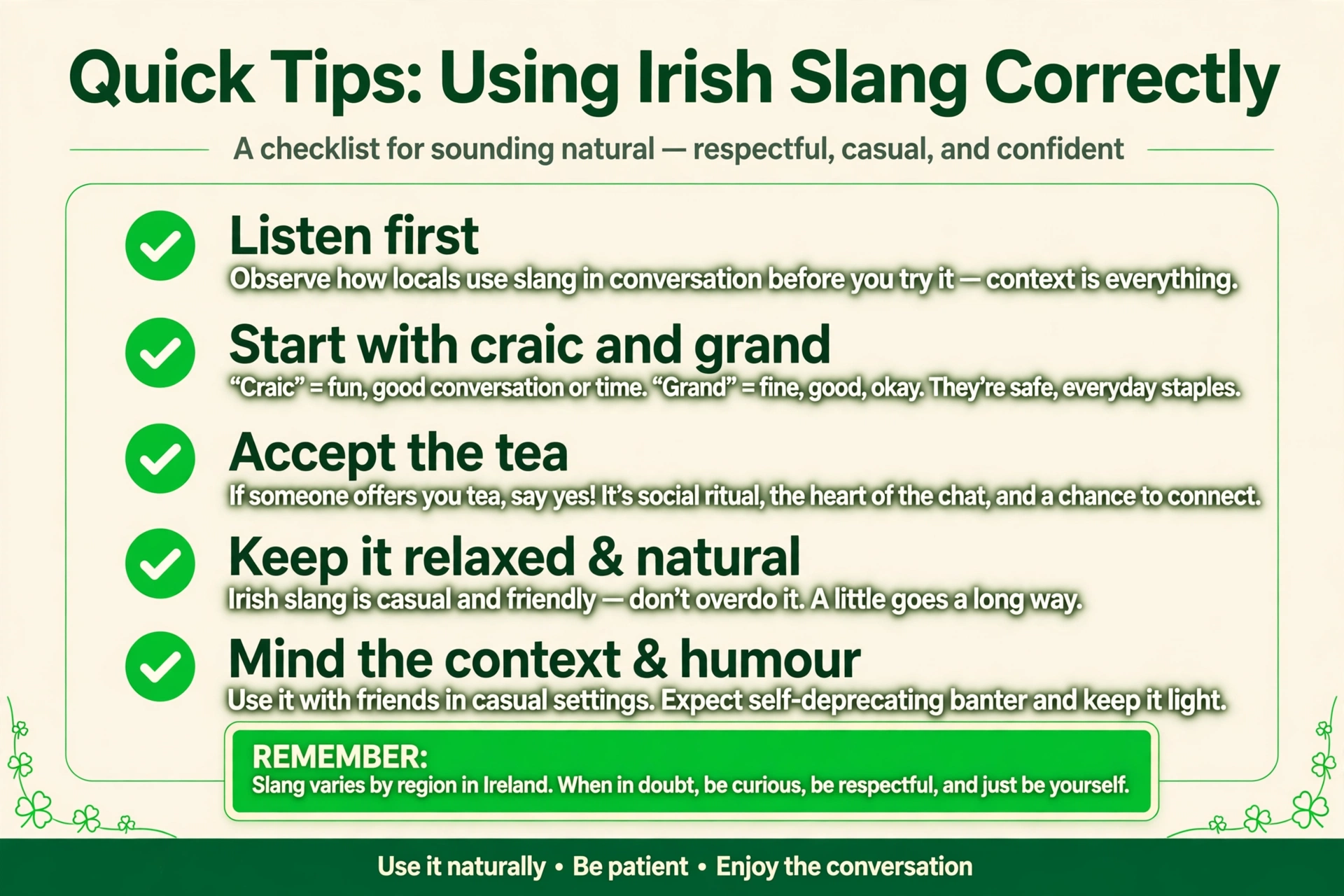
- Start with five words: Learn craic, grand, sound, fair play, and thanks a million. Those five alone will carry you through most Irish conversations.
- Listen before you speak: Spend a day noticing which words locals actually use in each region, then mirror them. Cork people say “like” constantly; Dubliners say “yeah, no” — meaning yes, actually.
- Use “grand” as your safety net: Asked how you are? “Grand.” Offered help? “I’m grand, thanks.” Running late? “Grand, no rush.” It answers almost everything.
- Accept the tea: If an Irish person offers tea, say yes. Refusing tea is a minor social offence. “A cuppa” solves most awkward silences.
- Do not correct the grammar: “I’m after doing it” and “she does be working” are correct Hiberno-English, not mistakes. Correcting them marks you as the outsider.
- Learn the county words: If you visit Cork, learn “langer” and “pure.” In Belfast, learn “wee” and “bout ye.” In Galway, learn “savage” and “well.” Locals love it when visitors know the local flavour.
- Watch Derry Girls with subtitles first: Then without. It is the fastest crash course in Northern Irish slang ever made — and it is hilarious.
The Full 50+ Irish Slang Word List
Here is the rapid-fire reference list — the words you will hear most, with short meanings. Keep it bookmarked for your trip.
| Word / Phrase | Meaning | Example |
|---|---|---|
| Craic | Fun, good times | “The craic was ninety.” |
| Grand | Fine, okay | “I’m grand, thanks.” |
| Eejit | Fool, idiot (often affectionate) | “You absolute eejit!” |
| Gobshite | Idiot, fool (stronger) | “Don’t be a gobshite.” |
| Deadly | Brilliant, excellent | “That film was deadly.” |
| Savage | Excellent, intense | “A savage goal!” |
| Sound | Good person, decent | “He’s a sound lad.” |
| Gas | Funny, hilarious | “She’s a gas woman.” |
| Banjaxed | Broken, exhausted, drunk | “I’m banjaxed after that hike.” |
| Langered | Very drunk | “He got langered at the wedding.” |
| Gaff | House, home | “Come back to my gaff.” |
| Yoke | Thing, gadget (unnamed object) | “Hand me that yoke.” |
| Feck | Mild swear, frustration | “Ah, feck it!” |
| Arse | Backside; also “arseways” (wrong) | “It went arseways.” |
| Quare | Very, strange (esp. Cork/Waterford) | “That’s quare good.” |
| Wee | Small, little (esp. Northern Ireland) | “A wee cup of tea.” |
| Lad / Lass | Boy / girl, friend | “Good lad yourself!” |
| Fella | Man, guy | “That fella over there.” |
| Mot | Girlfriend (Dublin, old-fashioned) | “He’s out with his mot.” |
| Goss / Gossoon | Young boy | “That gossoon is trouble.” |
| Kip | Nap, or a messy place | “I need a kip.” |
| Lash | Heavy rain; also to drink fast | “It’s lashing out there.” |
| Stall the ball | Wait, hold on | “Stall the ball a minute!” |
| Fair play | Well done, respect | “Fair play to you.” |
| What’s the story? | What’s up? What’s new? | “What’s the story, bud?” |
| How’s she cuttin’? | How are things going? | “How’s she cuttin’, lads?” |
| Thanks a million | Thank you very much | “Thanks a million, love.” |
| No bother | No problem | “No bother at all.” |
| Give us a shout | Contact me, let me know | “Give us a shout later.” |
| Catch yourself on | Wise up, get real | “Catch yourself on!” |
| Wise up | Be sensible, stop messing | “Wise up, would you?” |
| Away with the fairies | Dreamy, not paying attention | “She’s away with the fairies.” |
| A dose | An annoying person | “He’s an awful dose.” |
| A legend | A hero, a great person | “You’re an absolute legend.” |
| Some man for one man | Remarkable person | “He’s some man for one man.” |
| Acting the maggot | Messing around, fooling | “Stop acting the maggot.” |
| Delira and excira | Delighted and excited | “I’m delira and excira!” |
| Pure (Cork) | Very, really | “That’s pure savage.” |
| Langer (Cork) | Annoying person; also drunk | “He’s a langer.” |
| Jackeen (Dublin) | Dubliner (used by country people) | “A Jackeen through and through.” |
| Culchie | Country person (Dublin slang) | “A culchie from Mayo.” |
| Scarlet | Embarrassed | “I was scarlet for you.” |
| Fluthered | Very drunk | “Fluthered after the match.” |
| Locked | Very drunk | “Locked out of his head.” |
| A jar | A pint (a drink) | “Fancy a jar?” |
| A session | A long drinking night | “We had a session.” |
| One for the road | One last drink (never just one) | “Just one for the road.” |
| Shifting | Kissing at a party | “They were shifting all night.” |
| Snog | Kiss | “A quick snog at the disco.” |
| Donkey’s years | A very long time | “I haven’t seen you in donkey’s years.” |
| Grand stretch | Long distance / long time | “It’s a grand stretch to Cork.” |
| Happy out | Very content, pleased | “I’m happy out here.” |
| Full of beans | Full of energy | “The kids are full of beans.” |
| Chancer | Opportunist, someone who tries it on | “That chancer got in free.” |
| Scut | Annoying person (Northern Ireland) | “That wee scut!” |
| Bout ye? | How are you? (Belfast) | “Bout ye, mate?” |
| Hallion | Troublemaker, rascal | “That hallion broke the gate.” |
That is more than 50 Irish slang words and phrases in one list — and it still leaves out regional gems like “c’mere to me” (listen here), “stop the lights” (no way!), and “I will yeah” (which, said with enough sarcasm, means absolutely not). Irish slang rewards the curious: the deeper you dig, the funnier it gets. For another regional tour, see our Spanish slang guide — same idea, completely different flavour.

FAQ
What does craic mean in Irish slang?
Craic (pronounced “crack”) means fun, good conversation, and a good time. “The craic was mighty” means the night was brilliant. “What’s the craic?” means “what’s happening?” or “what’s the news?” It has nothing to do with drugs.
What does grand mean in Ireland?
Grand means fine, okay, or no problem. “I’m grand” means “I’m fine.” “Grand, thanks” politely declines an offer. It does not mean impressive or magnificent, even though that is what it means in standard English.
What does eejit mean?
Eejit is the Irish spelling of “idiot,” but it is usually softer and often affectionate. Friends call each other eejits all day long. From a stranger, though, it is an insult — tone and relationship decide everything.
Is Irish slang the same as British slang?
No. Irish slang comes from Hiberno-English, with Irish-language roots and its own vocabulary (craic, grand, eejit, gaff). British slang is different, and many Irish words sound strange or mean different things in Britain.
Do Irish people really say “top of the morning”?
Almost never. It is a stage-Irish phrase from old films, not real Irish speech. Real greetings include “morning,” “how’s it going,” “what’s the story,” and “bout ye” in Belfast.
What is the difference between craic and banter?
Craic covers fun, atmosphere, conversation, and the whole good-time experience. Banter is mainly playful teasing and joking between friends. A night can have great craic even without much banter, and banter is one ingredient of craic.
What does “I’m after doing it” mean?
It means “I have just done it.” The construction comes from the Irish language (tar éis) and is standard in Hiberno-English. “I’m after forgetting my keys” means “I’ve just forgotten my keys.”
Is it rude to use Irish slang as a tourist?
Not at all — Irish people love it when visitors try, as long as you keep it light. Use friendly words like craic, grand, fair play, and thanks a million. Avoid insults like gobshite until you are genuinely among friends, and do not overdo it.
Conclusion
Irish slang is more than a list of funny words. It is the sound of Irish culture itself: warm, ironic, story-driven, and built for connection. A single word like craic carries an entire philosophy — that the best part of any night is not the drink or the venue, but the company and the conversation. Grand is not just “fine”; it is a whole attitude of easy-going resilience. And fair play is not just praise; it is a small act of generosity, handed out freely to anyone who earns it.
If you take one thing from this guide, let it be this: start small, listen hard, and do not be afraid to try. Learn craic, grand, sound, and thanks a million, and you will already understand more Irish conversation than most visitors ever do. Use them with a smile, accept the tea, and when someone asks “what’s the story?” — you will finally have an answer.
Want to keep decoding the English-speaking world, one region at a time? Explore our guides to Australian slang, Jamaican slang, Toronto slang, and Spanish slang — the whole world, in its own words.

1 thought on “Irish Slang: 50+ Words, Meanings & Examples (2026)”