
Philly Slang Meaning & Definition
Philly slang is the everyday vocabulary of Philadelphia, Pennsylvania — the words, phrases, and pronunciations that locals use in corner stores, on SEPTA buses, in cheesesteak shops, and in group chats across the City of Brotherly Love. From “jawn” (a word that can mean almost anything) to “wooder” (the Philly way of saying “water”) and “yo” (a greeting, an attention-getter, and a punctuation mark all in one), Philly slang is direct, warm, funny, and unmistakably local. It grows out of Philadelphia English, a distinct regional dialect shaped by the city’s working-class neighbourhoods, its African American, Italian American, Irish American, and Latino communities, and generations of street culture.
If you have ever watched a Philadelphia Eagles game, ordered a cheesesteak, or scrolled through a Philly TikTok and felt like everyone was speaking a slightly different English, you were hearing Philly slang in action. This guide breaks down the most important words, explains where they came from, shows you exactly how to use them, and warns you about the mistakes outsiders always make.
Introduction
Philadelphia does not whisper. It talks loud, talks fast, and talks with its whole chest — and its slang reflects that attitude perfectly. Where other cities soften their language, Philly sharpens it. A stranger becomes a “boul.” A thing you cannot name becomes a “jawn.” A question becomes “jeet yet?” And somehow, everyone in the room understands exactly what you mean.
Philly slang is having a moment far beyond South Philly. Eagles fans chant it on national television, Philly-born rappers and comedians carry it into mainstream music and TV, and TikTok creators post “Philly slang check” videos that rack up millions of views. But going viral has a downside: the words get flattened into jokes, stripped of their context, and used wrong by people who learned them from a meme. That is why this guide exists. You will learn what each term really means, who actually says it, and when to use it — and when to leave it alone.
Whether you are visiting Philadelphia for the first time, moving to the city, dating a Philadelphian, or just trying to understand your favourite Philly creator online, this is your complete, plain-English guide. For more regional American English, check out our guides to New York slang, Australian slang, and Jamaican slang.

Origin
Philly slang did not appear overnight. It is the product of more than 300 years of Philadelphia history, layered neighbourhood by neighbourhood. The city’s dialect, often called Philadelphia English, developed its own vowel sounds, grammar, and vocabulary, distinct from both New York and Baltimore speech. Linguists trace features like the famous “wooder” pronunciation to the city’s early settlers and its long history as a working port and manufacturing hub, where immigrant communities mixed their speech together on factory floors and street corners.
Many of the most famous Philly slang words come from African American Vernacular English (AAVE), which has shaped American slang for generations and remains the engine of much of Philadelphia’s street vocabulary. Words like “jawn” and “boul” spread from Black Philadelphia neighbourhoods into the wider city’s speech, then into hip-hop, sports culture, and social media. Other terms come from the city’s Italian American community (“hoagie” for the long sandwich that Philadelphia claims as its own), its Irish American roots, and its Latino communities, whose Spanish-influenced phrases now colour everyday Philly speech.
Sports gave Philly slang its loudest megaphone. Eagles, Phillies, Flyers, and 76ers fans turned phrases like “Go Birds” into city-wide battle cries, and the passion of Philly sports talk radio carried local words into living rooms across Pennsylvania, New Jersey, and Delaware. You can read more about the dialect’s history in the overview of Philadelphia English, which traces how the city’s accent and vocabulary evolved.
Popularity
So why is Philly slang everywhere right now? Three forces pushed it into the mainstream. First, Philadelphia sports: the Eagles’ Super Bowl runs turned “Go Birds” and “E-A-G-L-E-S” chants into national moments, and every playoff run sends Philly phrases trending. Second, Philly’s music and comedy scene: artists from Meek Mill to Lil Uzi Vert to comedians like Kevin Hart have carried Philly speech into lyrics, interviews, and stand-up that millions of people hear. Third, TikTok and Instagram Reels: short “Philly slang explained” videos, cheesesteak-ordering skits, and “things only Philly people say” lists constantly go viral, introducing words like “jawn” to audiences who have never set foot in Pennsylvania.
The result is a strange kind of fame. Millions of people now know the word “jawn,” but far fewer know how to use it correctly. That gap — between recognising a word and actually understanding it — is exactly what this guide closes.
How It Is Used
Philly slang works differently from textbook English because it is built for speed, warmth, and attitude. A few patterns explain most of it:
- One word, many jobs. “Jawn” is the ultimate utility word. It can be a thing (“Pass me that jawn”), a person (“That jawn is funny”), a place (“We going to that jawn later”), or an event (“That party was a jawn”). Context does all the work.
- Greetings double as grammar. “Yo” opens conversations, grabs attention, agrees with you, and expresses surprise — sometimes all in one sentence. “Yo, yo, did you see that jawn?” is a perfectly normal Philly sentence.
- Food is language. Ordering a cheesesteak is a vocabulary test. “Wit” means with fried onions, “witout” means without, and getting it wrong marks you as a tourist instantly.
- Pronunciation is part of the word. “Wooder” is not a mispronunciation of “water” to a Philadelphian — it is the correct local form, and saying “wah-ter” in a corner store will get you a look.
- Loyalty is built in. Sports phrases like “Go Birds” are not just about football. They are a way of saying “I am from here, and I am proud of it.”
The tone matters as much as the words. Philly slang is usually friendly and playful among friends, but it can turn sharp fast. The same word that sounds affectionate between two old friends can sound confrontational from a stranger. When in doubt, listen first, match the energy of the room, and never use a word you could not explain if someone asked you what it meant.
Examples
Here is how the most important Philly slang words actually sound in real conversation, broken down by tone and situation.
Friendly Examples
- “Yo, what’s good, boul? You coming to the cookout or what?” — “Boul” (pronounced “bool”) means brother or close friend, and “what’s good” is the standard Philly greeting.
- “Pass me that jawn over there, the one next to the wooder ice.” — A “jawn” here is a thing, and “wooder ice” is the beloved Philly frozen treat, water ice.
- “Jeet yet? I got an extra hoagie if you hungry.” — “Jeet yet” is Philly shorthand for “Did you eat yet?” Asking it is a genuine sign of care.
- “Yo, that cheesesteak jawn was ard!” — “Ard” (pronounced like “are” with a hard edge) means alright, good, or “I agree.”
Professional Examples
Philly slang does show up at work, but in softened form. A manager might say “Yo, team, let’s lock in” to get attention without sounding formal. A coworker might call a shared project “that jawn we working on” in a casual meeting. In customer service, “Youse guys need anything else?” uses “youse” — the Philly plural “you” — to sound warm rather than corporate. The rule is simple: keep it light, keep it friendly, and drop the slang entirely in formal emails, presentations, or conversations with clients who are not from the area.
Funny Examples
- “Youse guys went to Pat’s AND Geno’s? That’s a tourist jawn if I ever saw one.” — Visiting both rival cheesesteak shops back-to-back is a classic outsider move, and locals will lovingly roast you for it.
- “He tried to order a cheesesteak ‘witout’ and then asked where the onions were. Boul, that’s what witout means!” — The cheesesteak ordering system is a rite of passage, and getting it wrong is a running joke.
- “My cousin from Ohio said ‘wah-ter’ at the corner store and the whole line turned around. Yo, you in Philly now!” — Pronunciation jokes are a Philly staple, told with affection, not cruelty.

Comparison with Similar Terms
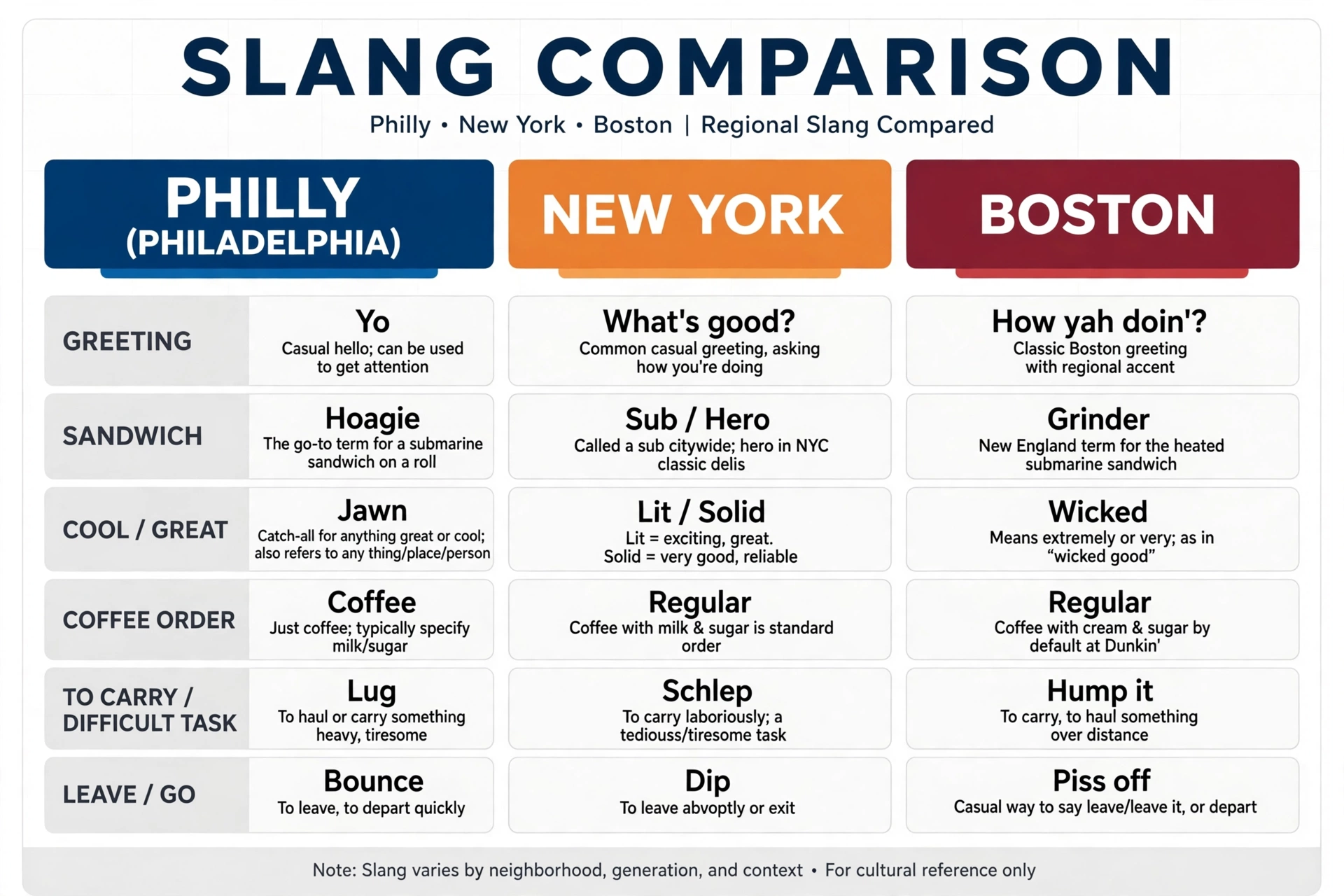
Philly slang is often confused with New York, Boston, and Baltimore slang because the cities are close and share some history. But the words are distinct, and mixing them up is a quick way to lose credibility. This table clears up the differences.
| Philly Term | Meaning | Closest Equivalent Elsewhere | Key Difference |
|---|---|---|---|
| Jawn | Any thing, person, place, or event | “Thing” (general), “joint” (NYC) | Jawn is far more flexible — it replaces almost any noun |
| Yo | Hello, attention, agreement, surprise | “Hey” (general), “Yo” (NYC) | Philly “yo” carries more grammatical jobs than NYC “yo” |
| Wooder | Water | “Wah-ter” (standard), “wata” (Baltimore) | The “oo” vowel sound is uniquely Philly |
| Boul | Brother, close friend | “Bro” (general), “B” (NYC) | “Boul” is warmer and more specifically Philly |
| Youse | Plural “you” | “Y’all” (South), “Youse” (NYC/Boston too) | Philly “youse” is everyday speech, not just a joke word |
| Hoagie | Long sandwich on a roll | “Sub” (general), “Hero” (NYC), “Grinder” (Boston) | Only Philly calls it a hoagie, and locals defend the name fiercely |
| Jimmies | Chocolate sprinkles | “Sprinkles” (everywhere else) | In Philly, “jimmies” specifically means chocolate sprinkles |
The biggest difference is attitude. New York slang often sounds fast and transactional; Boston slang leans on its accent for humour; Philly slang sounds like a neighbourhood conversation — direct, loyal, and funny, with an edge that says “we take care of our own.” If you want to compare further, see our guide to Gen Alpha slang, which overlaps with Philly speech on TikTok but is a different world from the city’s street vocabulary.
Alternate Meanings
Like all slang, Philly words shift meaning with context, and a few have alternate meanings worth knowing:
- Jawn — Most often a thing, but it can also describe a person (“a bad jawn” can mean an attractive person), a song, or an event. The meaning always comes from context, never from the word alone.
- Yo — A greeting, but also a warning (“Yo, watch out!”), an expression of disbelief (“Yo, are you serious?”), and a way to agree (“Yo, facts.”).
- John — In Philly, “john” is another utility noun like “jawn,” often used for a thing or a person (“That john right there”). It is not related to the bathroom meaning, though outsiders often assume it is.
- Ard — Usually means alright or okay, but it can also mean “I understand” or “sounds good,” depending on tone.
- Go Birds — Literally about the Eagles, but used year-round as a general Philly greeting, goodbye, and statement of civic pride, even in the middle of baseball season.
Professional or Polite Alternatives
Philly slang is wonderful among friends, but it does not belong everywhere. Here is how to translate the most common terms for professional or formal settings:
| Philly Slang | Polite / Professional Alternative |
|---|---|
| Yo, what’s good, boul? | Hey, how are you doing? |
| Pass me that jawn | Could you pass me that item, please? |
| Jeet yet? | Have you had a chance to eat? |
| Youse guys | All of you / everyone |
| That’s ard | That sounds good / that works for me |
| Go Birds! | Go Eagles! (only in casual sports contexts) |
The golden rule: in a job interview, a formal email, or a first meeting with someone outside Philadelphia, use standard English. Save the slang for when the relationship is warm and the setting is casual — that is when it lands best anyway.
Common Mistakes
Outsiders make the same handful of Philly slang mistakes again and again. Avoid these and you will already sound more local than most visitors:
- Overusing “jawn.” Locals use it naturally, once or twice in a conversation, not in every sentence. Forcing it into every clause is the fastest way to sound like you learned it from a meme.
- Saying “wah-ter” and correcting locals. “Wooder” is not wrong. Correcting a Philadelphian’s pronunciation is rude and will not win you any friends.
- Ordering a cheesesteak wrong. Know “wit” (with onions) and “witout” (without) before you reach the counter. Hesitating while a line waits behind you is a Philly faux pas.
- Using “boul” with strangers. It implies closeness. Calling a stranger “boul” in a tense moment can come across as confrontational, not friendly.
- Treating Philly slang as a costume. Dropping five slang words into one sentence to sound local usually has the opposite effect. One natural word, used correctly, beats five forced ones.
- Assuming all Philly slang is Gen Alpha slang. Words like “jawn” and “boul” are decades older than TikTok. Treating them as brand-new internet slang erases the neighbourhoods that created them.

Quick Tips
- Listen first. Spend a day hearing how locals actually use these words before you try them yourself. Context is everything.
- Start with “yo” and “jawn.” They are the safest, most flexible entry points, and they are hard to use badly in friendly conversation.
- Learn the cheesesteak order. “One whiz wit” (Cheez Whiz with onions) is the classic order, and knowing it earns instant respect at any steak shop.
- Match the room. With friends, go for it. At work or with strangers, keep it to a light touch.
- Never fake the accent. You can use Philly words without forcing the “wooder” vowel sound. Locals appreciate the effort, not the impression.
- Ask when unsure. Philadelphians love explaining their city. “What does that mean?” is always better than guessing and getting it wrong.

FAQ
What is Philly slang?
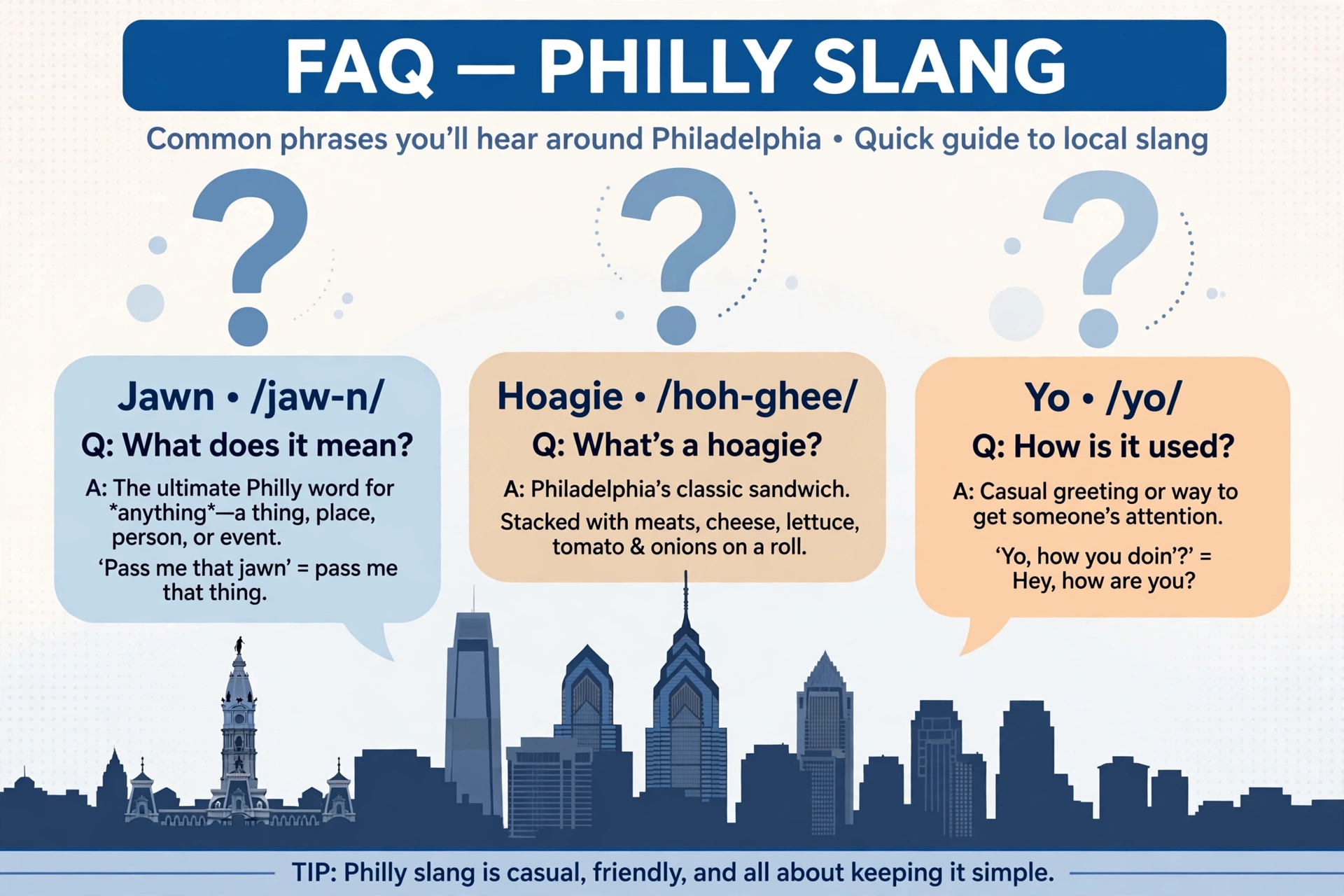
Philly slang is the informal vocabulary and pronunciation of Philadelphia, including words like jawn, yo, boul, wooder, and hoagie. It comes from Philadelphia English and the city’s neighbourhood cultures, and it is used in everyday conversation, sports fandom, music, and social media.
What does “jawn” mean in Philly slang?
“Jawn” is a universal Philly noun that can mean a thing, a person, a place, or an event, depending on context. “Pass me that jawn” means pass me that thing; “that jawn was crazy” means that event was wild. It is the most flexible and famous word in Philly slang.
What does “wooder” mean?
“Wooder” is simply the Philadelphia pronunciation of “water.” It is not slang in the usual sense — it is how the local dialect pronounces the word — but outsiders treat it as a signature Philly term, and it is a quick marker of local speech.
What does “boul” mean?
“Boul” (pronounced “bool”) means brother or close friend. It is a warm, loyal term used between people who know each other well, similar to “bro” but more specifically Philadelphian in flavour.
What does “wit” and “witout” mean when ordering a cheesesteak?
“Wit” means your cheesesteak comes with fried onions; “witout” means without onions. You will also pick a cheese — Whiz, provolone, or American — so a full classic order sounds like “One whiz wit.”
Is Philly slang the same as Gen Alpha slang?
No. Some Philly words, especially “jawn,” appear in Gen Alpha slang online, but Philly slang is a regional dialect decades older than TikTok. Gen Alpha slang is internet-age youth language; Philly slang is neighbourhood language that the internet discovered, not invented.
Can non-Philadelphians use Philly slang?
Yes, respectfully and sparingly. Use words you understand, in friendly settings, without forcing an accent or overusing them. Listening first and asking questions is the best way to use Philly slang without sounding like a tourist performing it.
Where can I hear real Philly slang?
Listen to Philadelphia sports talk radio, Philly hip-hop, local TikTok creators, and — best of all — visit the city. Corner stores, barbershops, steak shops, and SEPTA rides are where Philly slang lives in its natural habitat.
Conclusion
Philly slang is more than a list of funny words. It is the sound of a city that is proud, loyal, direct, and funny — a place where a stranger can become a “boul” over a shared cheesesteak and where one word, “jawn,” can carry an entire conversation. Learn the core words, respect where they came from, use them naturally, and avoid the common mistakes, and you will understand Philadelphia a little better every time you hear them.
Start small: greet someone with “yo,” learn your cheesesteak order, and listen for “jawn” the next time you watch an Eagles game or scroll through Philly TikTok. Before long, you will not just recognise Philly slang — you will feel like part of the conversation. And if you ever visit, remember the two most important Philly phrases of all: order “wit” if you like onions, and always, always say “Go Birds.” Keep exploring regional English with our guides to Scottish slang, Australian slang, Jamaican slang, and Gen Alpha slang.

1 thought on “Philly Slang: The Ultimate Guide to Philadelphia’s Words, Meanings & Real Examples (2026)”