
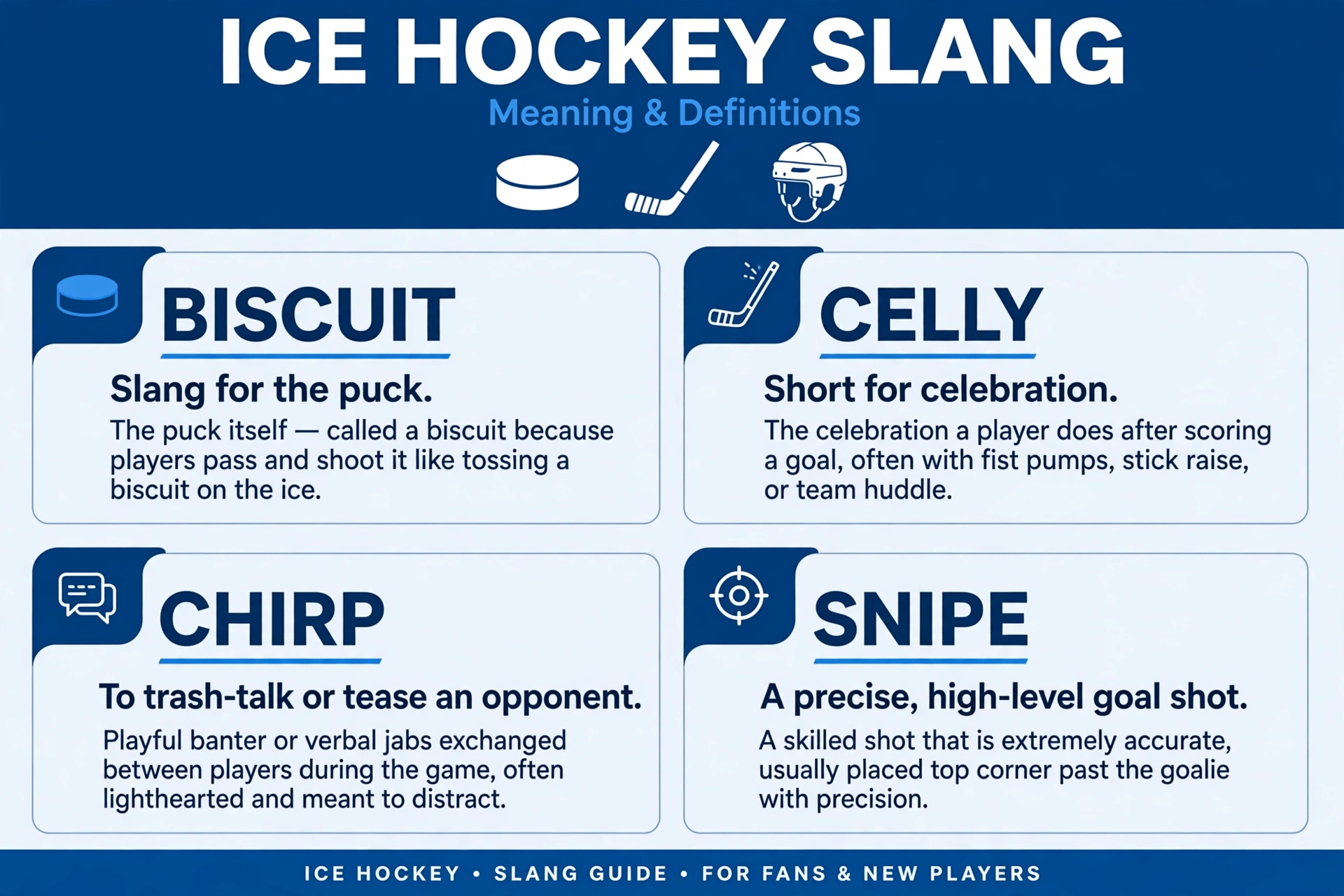
Quick definition: Hockey slang is the informal, colorful vocabulary that hockey players, coaches, broadcasters, and fans use to talk about the game — words like celly for a goal celebration, chirp for trash talk, biscuit for the puck, and snipe for a perfectly placed shot. It grew out of Canadian rinks and locker rooms, spread through the NHL, and now shows up everywhere from broadcasts and group chats to TikTok clips and youth-league benches. If you know the slang, you do not just watch hockey. You hear it the way insiders do.
Hockey Slang Meaning & Definition
Hockey slang means the unofficial language of ice hockey: the nicknames, shortcuts, jokes, and expressions that describe players, plays, equipment, and behavior on and off the ice. It is not the language of the official rulebook. The rulebook talks about icing, offside, and goaltender interference. Hockey slang talks about putting the biscuit in the basket, throwing sauce over a defender’s stick, and a goalie who stands like a brick wall. Both describe the same game. Only one of them sounds like it was invented in a locker room at midnight after a long bus ride — because it was.
At its core, hockey slang does three jobs at once. First, it compresses information. Saying a player “sniped one bar down” tells a knowledgeable listener, in five words, that the shot was accurate, hard, and hit the underside of the crossbar before going in. Second, it signals belonging. Using celly, dangle, and flow correctly tells other fans you have spent time around the game. Third, it keeps the mood light. Hockey is fast, physical, and sometimes painful, and its language answers that with humor: teeth are chiclets, a weak shot is a muffin, and a player who never leaves the bench is a duster who is collecting dust.
It is also worth understanding what hockey slang is not. It is not one fixed dictionary. A term that means one thing in Toronto might carry a slightly different shade of meaning in Minnesota, in a Swedish dressing room, or in a college program in Boston. Some words are universal across the hockey world — biscuit, apple, celly — while others are local, generational, or tied to a single team, league, or television show. And the vocabulary keeps moving. New terms arrive from social media and video games every season, while older ones fade or survive only as jokes. This guide gives you the durable core: the terms you will actually hear on broadcasts, in arenas, and in fan conversations in the United States and Canada in 2026, plus the history that explains why they sound the way they do.
One more distinction matters for new fans. Hockey slang overlaps with, but is not the same as, hockey terminology. Power play, faceoff, and blue line are standard terms that any rulebook or broadcast graphic will use. Barn burner, gongshow, and beauty are slang: unofficial, vivid, and often funny. You need the standard terms to follow the score. You need the slang to follow the conversation around the score — the jokes in the stands, the postgame interviews, and the comments under every highlight clip.
Introduction
Imagine watching your first NHL game with a lifelong fan. The puck drops, and within thirty seconds you hear that a winger “dangled through two guys, went bar down, and the celly was unreal,” while the goalie who let it in “got chirped by his own bench” and the losing coach is “not happy with the pizza his defenseman served up in the slot.” Nothing in that sentence is in the rulebook. Everything in it makes perfect sense to the person sitting next to you. That gap — between watching hockey and understanding hockey people — is exactly what hockey slang fills.
Hockey has one of the richest slang vocabularies in all of sports, and there is a good reason for that. The game is played at speed, in a cold building, by people who spend enormous amounts of time together on buses, in hotels, and in dressing rooms. That kind of life breeds shorthand. Players need words that are fast to say, funny to hear, and clear to everyone on the bench. Fans pick those words up from broadcasts, copy them into group chats, and carry them into schoolyards and office leagues. Before long, a word invented by one dressing room belongs to millions of people who have never laced up skates.
This guide does what most short glossaries do not: it explains what the words mean, where they came from, how they are actually used, and how they sound today. You will get the full list of hockey slang terms, grouped so you can learn them in context, examples in friendly, professional, and funny situations, a comparison with other kinds of slang, and honest advice about the mistakes that mark out a newcomer. Along the way, you will see how hockey slang connects to the regional slang of the game’s heartland — including Toronto slang, from the city that has lived and breathed hockey for more than a century — and why a sport played on ice produced a language this warm, funny, and stubbornly Canadian at heart.
Whether you are a new fan trying to survive your first playoff watch party, a parent learning the language of your child’s youth league, a fantasy hockey manager decoding a podcast, or a writer trying to make a hockey character sound real, this is the full picture — definition first, then origin, then real usage, then the complete glossary.
Origin
Hockey slang begins where hockey itself begins: on frozen ponds and outdoor rinks in Canada in the nineteenth century. The first organized indoor game is usually dated to Montreal in 1875, and the sport grew out of a mix of winter pastimes — shinny, bandy, and field hockey adapted to ice — played by students, soldiers, and working men in cold-weather towns. The language grew the same way the game did: locally, orally, and without anyone writing it down. There was no official glossary. There were just players, in cold dressing rooms, inventing faster ways to describe what had just happened on the ice.
That Canadian, small-town, winter origin explains a lot about the tone of hockey slang. Many of the oldest terms are practical and visual. The puck looks a little like a biscuit, so it became the biscuit. A stick is a twig. A helmet is a bucket. Hair flowing out from under a helmet looks like lettuce or salad, so great hair became flow. Other terms come from the work of the game itself. A grinder is named for grinding, unglamorous labor along the boards. A duster is named for the dust a player collects by sitting on the bench. The metaphors are rarely fancy. They are the metaphors of people who work with their hands and skate in the cold.
The professional era gave the slang a bigger stage. The NHL was founded in 1917, and as radio and then television carried games across Canada and into the United States, dressing-room words became broadcast words. The Original Six era — the Boston Bruins, Chicago Black Hawks, Detroit Red Wings, Montreal Canadiens, New York Rangers, and Toronto Maple Leafs — fixed many terms in the shared vocabulary of fans. Gordie Howe, the Detroit legend whose name lives on in the Gordie Howe hat trick (a goal, an assist, and a fight in the same game), played from the 1940s into the 1980s, and his era helped carry locker-room language into living rooms. Broadcasters, especially the long-running Hockey Night in Canada, then did what broadcasters always do: they repeated the vivid words, explained them once, and let fans adopt them.
Later waves added their own layers. The rough, fighting-heavy hockey of the 1970s — the Philadelphia Flyers’ Broad Street Bullies, the movie Slap Shot (1977), and the minor-league culture it affectionately mocked — cemented terms for toughness, chirping, and goons. The high-scoring 1980s, with Wayne Gretzky and the Edmonton Oilers, added a vocabulary of skill: dangles, saucer passes, and highlight-reel snipes. The 1990s and 2000s brought European stars, goalie equipment that grew enormous, and a faster, more technical game, along with new words for the new styles. And in the last fifteen years, social media, podcasts, video games, and comedy — most famously the Canadian series Letterkenny, whose hockey players turned dressing-room talk into a national catchphrase factory — have spread hockey slang far beyond people who play the sport. A term that once needed a rink to survive can now travel the world in a fifteen-second clip.
That history also explains why so much hockey slang sounds Canadian even when it is spoken in Florida or Arizona. The words carry the accent of their birthplace: modest, self-deprecating, fond of understatement, and quick to turn hardship into a joke. A player who loses his teeth is not a victim; he spit chiclets. A terrible player is not analyzed; he is a bender or a pylon. The humor is the point. In a sport where you can be hit into the boards at full speed, laughing at yourself is a survival skill, and the language reflects it.
Popularity
Hockey slang is more visible in the United States in 2026 than it has ever been, and the reasons go well beyond the NHL’s traditional markets. The league has expanded into Sun Belt cities, the Stanley Cup Playoffs reliably produce viral moments every spring, and the Winter Olympics put the sport in front of casual viewers who would never otherwise watch a regular-season game. Each of those moments creates new slang learners: people who hear a word on a broadcast, look it up, and start using it the next day.
Television and streaming deserve much of the credit. Modern broadcasts do not just show the game; they mic up players, replay chirps, and celebrate great cellies in slow motion. Analysts who played the game use the slang naturally, and younger broadcasters explain it on air rather than avoiding it. When a star scores a bar-down snipe in overtime and the whole bench empties for the celebration, the word and the image arrive together, and the word sticks. The NCAA’s list of 35 hockey slang words shows how far that process has gone: college hockey now publishes its own glossary for new fans, because the demand for plain-English explanations is real and growing.
Pop culture has pushed the vocabulary even further. Letterkenny made phrases like “pitter patter, let’s get at ‘er” and long, loving riffs on hockey-player talk famous well outside Canada, and its spinoff Shoresy doubled down on dressing-room dialogue. The Mighty Ducks films introduced a generation of American kids to youth-hockey language in the 1990s. The EA Sports NHL video game series taught millions of players the words as they played, and fantasy hockey podcasts, betting shows, and hockey TikTok and YouTube channels now use the slang as their default register. A fan today is as likely to learn apple and dangle from a clip as from a rink.
Youth and amateur hockey keep the language grounded. In the United States, USA Hockey registrations, high-school programs, and girls’ and women’s hockey have all grown, and every new locker room becomes a small slang factory of its own. Kids copy NHL players, invent variations, and bring them home. Parents learn the words at the rink boards because they have to: when your ten-year-old says the goalie “stood on his head” or a teammate “served up a pizza,” you either learn the language or spend the car ride home asking questions. That everyday, family-level spread is why hockey slang feels less like jargon and more like a dialect — something people live in, not something they study.
Search interest tells the same story. Fans do not only search for scores and standings. They search for what the words mean, how to use them, and which ones are safe to say at work. That is the gap this article is built to close: not a bare list of definitions, but the context that turns a definition into usable knowledge. The short glossaries that rank today typically offer thirty-odd terms with one line each and no origin, no tone, and no guidance on what not to say. The sections below fix all three gaps.
How Hockey Slang Is Used
Hockey slang lives in four main places, and the same word can sound slightly different in each of them. In the dressing room and on the bench, it is fast, teasing, and heavily ironic — players chirp each other constantly, and the chirps are a form of affection as much as provocation. A teammate who is called a beauty is being praised. A teammate who is called a bender after falling over for no reason is being teased, and is expected to laugh. The rule is simple: you can say almost anything to someone you have bled with, as long as the tone says you are on their side.
On broadcasts, the slang is cleaner and more explanatory. Commentators use it to add color — “what a snipe,” “a beautiful saucer pass,” “he dangles the goalie” — and they usually choose words that a casual viewer can decode from the replay. Broadcast slang is the safest version of the language, and it is the best model for new fans. If a broadcaster would say it on national television, you can say it at a watch party.
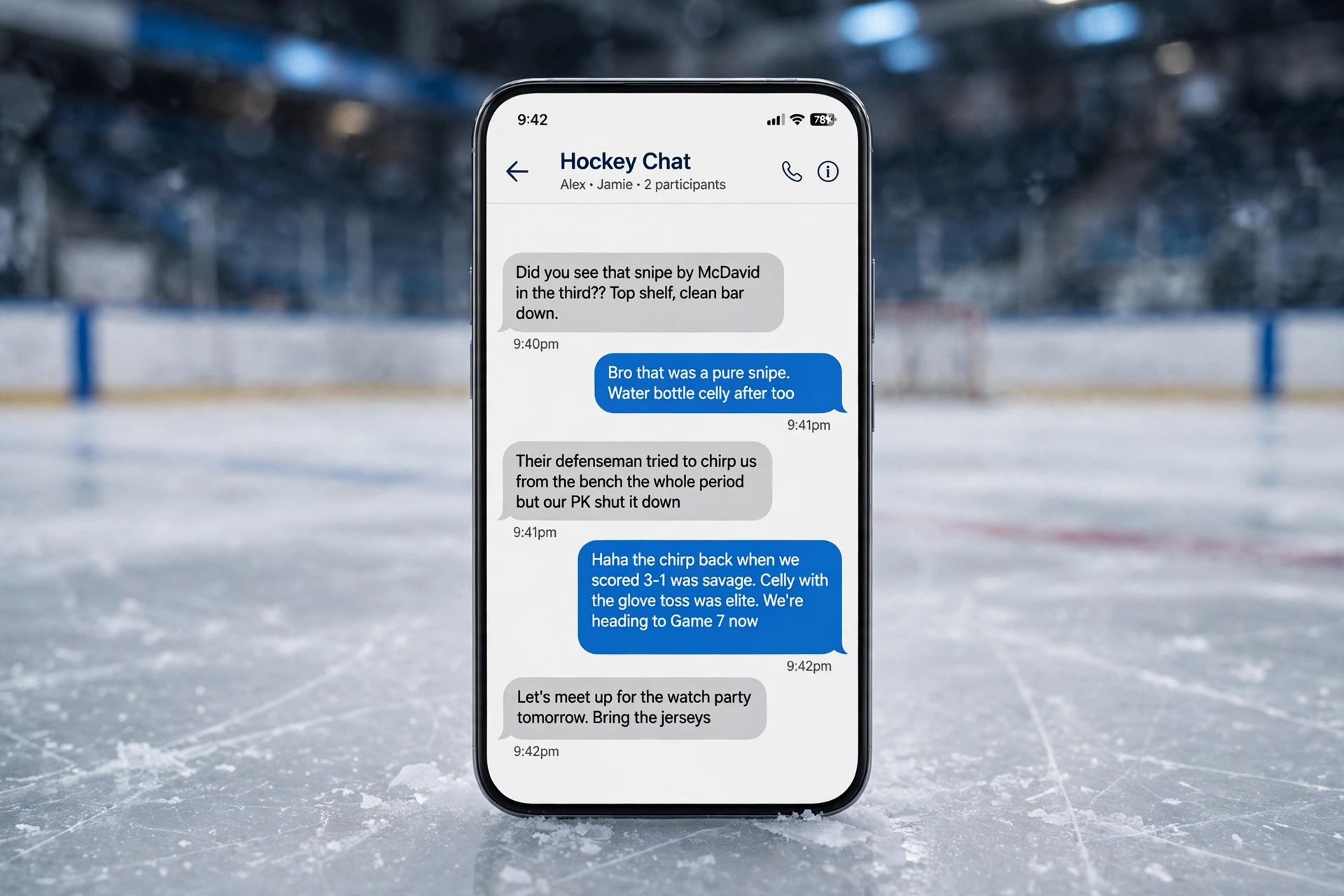
Among fans, hockey slang is social glue. It fills group chats during games (“BARN BURNER tonight,” “that celly was filthy”), captions highlight clips, and turns strangers in an arena into temporary friends. Fans also use it to perform fandom: dropping a well-timed bar down or five-hole into a conversation signals that you were paying attention. The risk, as with any in-group language, is overuse. One slang term in a sentence sounds natural. Five in a row sounds like a performance, and experienced fans can hear the difference instantly.
In writing and online, hockey slang is looser and more creative. Headlines, memes, and social posts stretch the words for jokes — a great goal becomes a bottle rocket, a bad turnover becomes a pizza delivery — and new combinations appear every season. Written slang also travels across sports: a basketball fan might borrow snipe for a three-pointer, and a gamer might borrow celly for a victory dance. That borrowing is a compliment, but it is also why context matters. In a hockey conversation, sauce is a pass. In a cooking conversation, it is dinner. The word is the same. The rink is what makes it slang.
Tone is the final key, and it is the one new learners get wrong most often. Most hockey slang is positive or affectionately teasing, even when it sounds like an insult. Chirp, grinder, and duster can all be friendly in the right mouth and cruel in the wrong one. The difference is relationship, volume, and timing — the same three things that govern teasing in any friendship. When in doubt, start with the celebratory words (celly, snipe, beauty), use the teasing words only about people who would laugh, and leave the genuinely insulting uses of bender, plug, and pylon for describing plays and performances, not people you actually like.
Examples
The fastest way to learn hockey slang is to see it in sentences that sound like real people. The examples below are grouped by tone, because the same vocabulary behaves very differently when friends are joking, professionals are working, and someone is trying to be funny. Notice how little explanation each sentence needs once you know the key word — that compression is the whole point of slang.
Friendly Examples
- “Did you see that snipe? Top shelf, bar down, goalie never even moved.”
- “He got the apple on both goals tonight — quietly the best passer on the team.”
- “What a celly! He jumped into the glass and the whole barn went wild.”
- “Your kid has serious flow this season. The lettuce is out of control.”
- “Great sauce from the blue line — that pass floated right over the defender’s twig.”
- “He’s such a beauty. He stayed after practice to help the rookies with their shot.”
- “We are going to the barn early tonight. First game of the playoffs — it is going to be a barn burner.”
- “She can really wheel. She went coast to coast and nobody caught her.”
Friendly hockey slang is warm, admiring, and a little bit awestruck. It praises skill (snipe, dangle), celebrates personality (beauty, flow), and shares excitement (barn burner, celly). If you are learning the language, start here. These are the words that make other fans smile, and they are almost impossible to use offensively.
Professional Examples
- “The winger’s dangle through the neutral zone created the odd-man rush that decided the game.”
- “The goaltender was a brick wall in the third period, stopping all fourteen shots he faced.”
- “The coach praised his grinders for winning battles along the boards, even though they did not appear on the scoresheet.”
- “The defenseman’s saucer pass over the opponent’s stick set up the breakaway goal.”
- “The team needs to stop serving up pizzas in the middle of the ice — those turnovers are becoming goals against.”
- “After two periods in the sin bin, the veteran forward returned and scored the tying goal.”
- “The rookie’s five-hole goal was his first in the league, and the bench reaction said everything about the dressing room.”
Professional uses keep the slang but add precision. Broadcasters, coaches, and analysts use hockey slang the way a chef uses a nickname for a knife: it is informal, but everyone in the trade knows exactly what it means. In a work or media setting, prefer the descriptive terms — saucer pass, brick wall, grinder — over the teasing ones, and always pair slang with the plain meaning the first time a general audience will hear it.
Funny Examples
- “He blew a tire at the blue line, fell over nothing, and somehow still got the puck to his teammate. Beauty.”
- “The backup goalie has been a duster all season — his jersey is cleaner than the bench itself.”
- “That shot was a muffin. The goalie could have stopped it with his water bottle, and nearly did.”
- “He chirped the ref, got sent to the sin bin, and spent two minutes apologizing to the glass.”
- “My fantasy team is a gongshow. My star winger is out, my goalie let in a beach ball, and my captain is serving pizzas.”
- “He tried to dangle, lost the biscuit, and got walked like a pylon. The crowd loved every second of it.”
Funny hockey slang works because it exaggerates without lying. A muffin really is a soft, harmless shot. A duster really does sit. A pylon really does get skated around. The joke lands because the image is accurate. That is also why the humor has a limit: jokes about a player’s skill are part of the game, but jokes that turn into personal cruelty are not funny slang anymore. They are just cruelty, and hockey fans are usually the first to say so.
| Situation | Hockey slang version | Plain-English version |
|---|---|---|
| A great goal | “What a bar-down snipe!” | “What a perfectly placed shot off the crossbar!” |
| An assist | “He picked up an apple.” | “He recorded an assist.” |
| A celebration | “That celly was unreal.” | “That goal celebration was amazing.” |
| Trash talk | “They were chirping all night.” | “They were exchanging taunts all night.” |
| A bad pass | “He served up a pizza.” | “He made a careless turnover pass.” |
| A great save | “The tendy stood on his head.” | “The goalie played brilliantly.” |
| A bench player | “He rode the pine all game.” | “He barely played at all.” |
| A fast skater | “She can really wheel.” | “She skates very fast.” |
Comparison with Similar Terms
Hockey slang is easiest to master when you compare it with the language around it. The table below gives you the complete core glossary — forty-two terms, grouped by what they describe — and the comparisons that follow it show how hockey slang differs from general sports slang, from other regional slang, and from the formal language of the game itself.
| Term | Meaning |
|---|---|
| Apple | An assist — the pass that sets up a goal. |
| Bar down | A goal scored off the underside of the crossbar, usually with a distinctive “ding.” |
| Barn | The arena or rink. |
| Barn burner | A fast, high-scoring, exciting game. |
| Beauty / beautician | A well-liked, talented player with personality — or a beautiful play. |
| Bender | A weak skater whose ankles bend inward; by extension, a poor player. |
| Biscuit | The puck. |
| Bottle rocket | A shot so hard it knocks the goalie’s water bottle off the net. |
| Breadbasket | The goalie’s chest or midsection, where a shot is easiest to stop. |
| Breakaway | A scoring chance with no defenders between the puck carrier and the goalie. |
| Brick wall | A goalie who stops everything; an unbeatable performance. |
| Bucket | A helmet. |
| Cage | The face mask attached to a helmet. |
| Celly | A goal celebration (short for “celebration”). |
| Cheese / top cheddar | The top part of the net; a goal scored high, or “top shelf.” |
| Cherry picker | A player who hangs back near the opponent’s goal waiting for a breakaway instead of backchecking. |
| Chiclets | Teeth — famously, teeth lost to the game (“spitting chiclets”). |
| Chippy | Rough, physical, and bad-tempered — a game full of hits and scrums after the whistle. |
| Chirp | Trash talk aimed at an opponent, the referee, or a teammate (in fun). |
| Clapper | A slap shot. |
| Dangle | Skillful stickhandling that beats a defender; the moves themselves. |
| Deke | A fake or feint to fool a defender or goalie (from “decoy”). |
| Duster | A player who rarely plays and collects dust on the bench. |
| Face wash | Rubbing a glove in an opponent’s face to annoy them after a whistle. |
| Five-hole | The gap between a goalie’s legs; a goal scored through it. |
| Flow / lettuce / salad | Long hair flowing out from under a helmet. |
| Gino | A goal. |
| Gordie Howe hat trick | A goal, an assist, and a fight in the same game. |
| Grinder | A hard-working forward who does physical work along the boards rather than scoring. |
| Hatty | A hat trick — three goals by one player in one game. |
| Mitts | Hands or gloves; “good mitts” means soft, skilled hands with the puck. |
| Muffin | A weak, slow, easily stopped shot. |
| Pizza | A careless turnover pass through the middle of the ice that gives the other team a scoring chance. |
| Plug | A poor or slow player, similar to a bender or pylon. |
| Pylon | A very slow player who gets skated around easily. |
| Rink rat | Someone who lives at the rink and loves being around hockey. |
| Sauce | A saucer pass — a pass that floats flat over a stick and lands back on the ice. |
| Shinny | Informal pickup hockey, often outdoors, in the game’s purest form. |
| Sin bin | The penalty box. |
| Snipe | A perfectly placed, accurate shot that beats the goalie, usually into a corner. |
| Tendy | A goaltender (short for “goaltender”). |
| Wheel | To skate fast; “he can wheel” means he has serious speed. |
Two pairs in that list confuse newcomers more than any others. Dangle vs. deke: a deke is a single fake, while a dangle is the whole display of stickhandling — you can deke once, but you dangle your way through traffic. Snipe vs. clapper: a snipe is about placement and precision, while a clapper is about power; the most memorable goals are often both, a hard slap shot placed perfectly. Learning those two distinctions alone will make you sound noticeably more fluent.
Hockey slang also differs from other slang families in useful ways. Compared with general sports slang, it is more visual and more self-mocking — baseball has its own rich language, but few baseball terms are as funny as spitting chiclets or as vivid as bottle rocket. Compared with internet slang, it is older, slower-moving, and more tied to a physical place: you can learn hockey slang from clips, but you understand it best when you have felt how cold a rink is and how fast the game looks from the boards. And compared with other regional slang — the subject of guides like Australian slang or Gen Alpha slang — hockey slang is a working dialect rather than a generational fashion. It changes, but it changes at the speed of a sport, not at the speed of a feed. Sports shorthand in general, from football to the world of D1 slang, shares hockey’s love of compression, but hockey’s version is unusually complete: it has words for the equipment, the building, the hair, the fights, the jokes, and the celebrations, all in one system.
| Hockey slang | Formal hockey term | What changes |
|---|---|---|
| Biscuit in the basket | Goal | Slang adds the image and the celebration |
| Apple | Assist | Slang is shorter and friendlier on air |
| Sin bin | Penalty box | Slang adds humor to punishment |
| Tendy | Goaltender | Slang is affectionate shorthand |
| Chirp | Unsportsmanlike conduct (sometimes) | Slang covers teasing that is not a penalty at all |
| Barn burner | High-scoring game | Slang carries excitement, not just the score |

Alternate Meanings
Like all slang, hockey slang borrows ordinary English words and gives them rink-specific jobs. Outside a hockey conversation, most of these words mean something completely different, and that is exactly why context matters. If someone says “pass the sauce” at dinner, they want gravy. If a winger says it on a breakaway, they want a saucer pass. The word did not change. The room did.
- Sauce — in hockey, a floating pass. Everywhere else, a condiment, or in other slang, style and confidence. A hockey fan hearing “he’s got sauce” on a broadcast should think “great passer,” not “great cook.”
- Flow — in hockey, long hair under a helmet. In music, a rapper’s rhythm. In everyday speech, the general feeling of something going smoothly. All three uses share the idea of movement, which is why the word travels so well.
- Bender — in hockey, a poor skater. In everyday slang, a drinking binge. Never mix the two up in a conversation about a person: one is a teasing hockey insult, the other is a serious comment about someone’s health.
- Beauty — in hockey, a great player or a great play. Everywhere else, physical attractiveness or a beautiful thing. A hockey beauty might be a fourth-line grinder with a great personality and terrible hair. The hockey meaning is about character, not looks.
- Apple — in hockey, an assist. Everywhere else, a fruit or a technology company. The hockey origin is debated — some say it comes from the idea of an assist as a small reward, others from older North American expressions — but the meaning on the ice is settled: an apple is a helper’s point.
- Bucket — in hockey, a helmet. In basketball, a basket. In everyday speech, a container. A hockey player who “lost his bucket” in a fight lost his helmet, not his lunch pail.
- Celly — in hockey, a goal celebration. In texting, celly is sometimes short for a cell phone. If the message is about a game, it is almost always the celebration.
- Chirp — in hockey, trash talk. In nature, a bird’s sound. The hockey use borrows the bird image — quick, sharp, constant noise — and aims it at opponents. It is almost never literal birdsong, no matter how much noise the crowd makes.
- Biscuit — in hockey, the puck. In baking, a small bread. In British English, a cookie. A “biscuit in the basket” is a goal, not a snack, and no one at the rink is confused about which one you mean.
There are also alternate meanings within hockey itself. Top shelf and top cheddar both mean the upper part of the net, but cheese can also describe a shot’s quality in other contexts. Gongshow can mean a chaotic game, a chaotic dressing room, or a chaotic lifestyle, depending on who is talking. Goon once meant a player whose main job was fighting; today it is often used critically, and many teams prefer enforcer or physical player. When a word has two hockey meanings, the sentence around it almost always tells you which one is meant — another reason to learn the slang in examples, not just in lists.
Professional or Polite Alternatives
Hockey slang is wonderful with friends and fans, but it is not always the right register for a classroom, a workplace, a formal article, or a conversation with someone who has never watched a game. The table below gives you clean, professional substitutes that keep the meaning and lose the risk. Use the slang version when the audience is hockey people. Use the professional version when the audience is everyone else.
| Hockey slang | Professional / polite alternative | When to switch |
|---|---|---|
| Chirp (trash talk) | Good-natured teasing / verbal sparring | Work, school, or mixed audiences |
| Bender / plug / pylon | Struggling skater / player with limited minutes | Any time you are describing a real person respectfully |
| Duster | Depth player / player seeing limited ice time | Coaching, reporting, or youth hockey |
| Goon | Enforcer / physical player | Formal writing or broadcasts |
| Sin bin | Penalty box | Official reports and rule explanations |
| Biscuit in the basket | Scored a goal | Headlines for general readers |
| Spitting chiclets | Lost teeth in the game | Medical, school, or family contexts |
| Gongshow | Chaotic / disorganized game | Professional settings of any kind |
The polite alternatives are not a criticism of the slang. They are a translation layer, and good translators know when to use each language. A coach who tells a youth team to “stop chirping the ref” is speaking the team’s language. A teacher who writes home to parents about “verbal sparring with officials” is speaking the parents’ language. Both are correct. The skill is knowing which room you are in — and hockey slang, learned properly, teaches exactly that skill, because it is itself a language of rooms: dressing room, broadcast booth, arena, and group chat, each with its own rules.
Common Mistakes
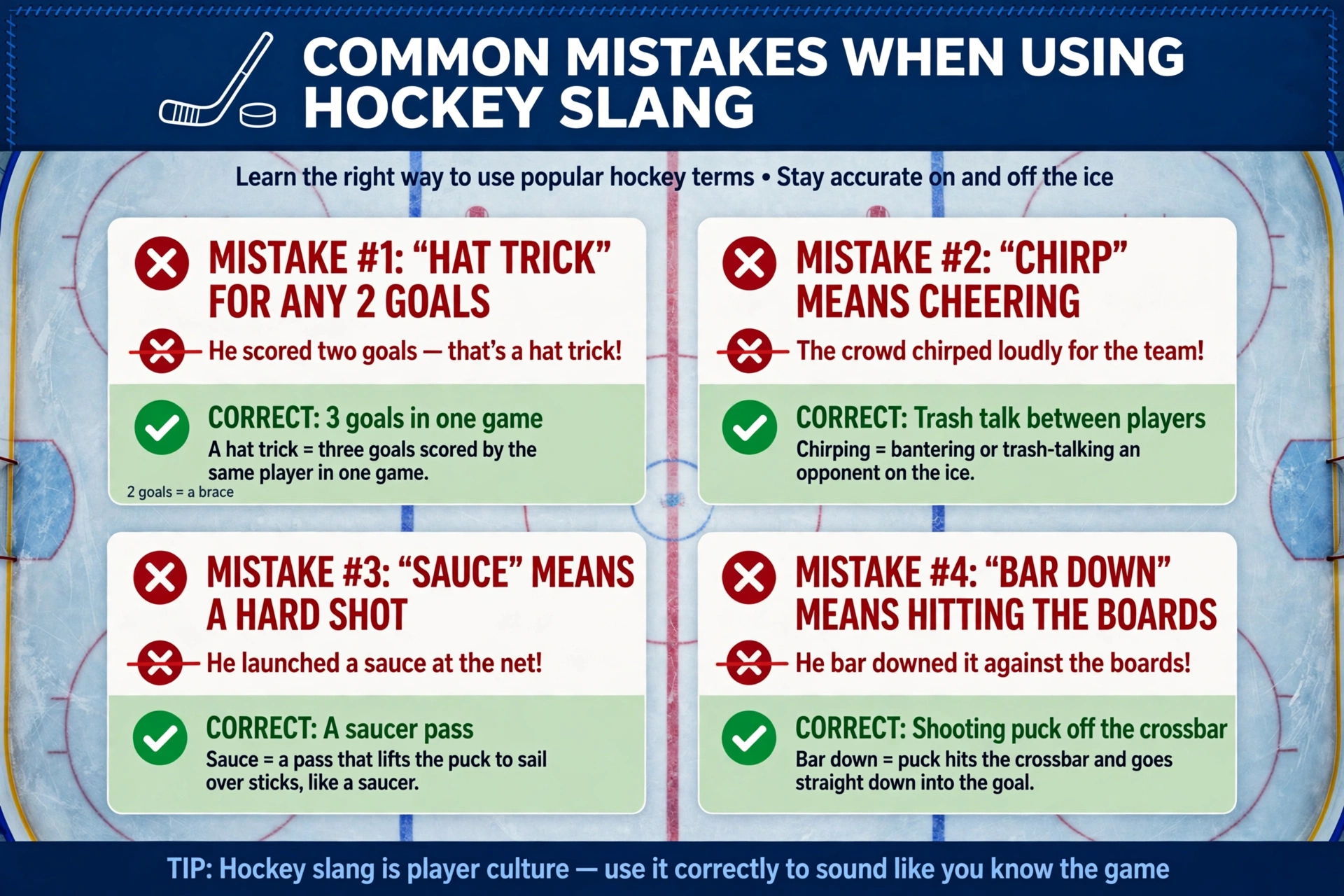
Mistake 1: Calling every good shot a snipe. A snipe is a precisely placed shot, usually into a corner or just under the bar. A hard shot into the goalie’s chest is a goal, but it is not a snipe. A shot from the blue line that bounces in is not a snipe either. Save the word for placement, and it will mean more when you use it.
Mistake 2: Mixing up dangle and deke. A deke is one fake. A dangle is a sequence of stickhandling moves. Saying a player “deked through the whole team” is understandable, but saying he “dangled through the whole team” is the version that sounds right to hockey ears. Keep the single fake and the full display separate.
Mistake 3: Using “hatty” for two goals. A hat trick is three goals by one player in one game, and a hatty is the slang for it. Two goals is a brace in soccer language and simply “a two-goal game” in hockey. Calling two goals a hatty is the fastest way to announce that you are new, and fans will correct you with a smile.
Mistake 4: Chirping strangers. Chirping is teasing among people who share trust — teammates, rivals who respect each other, friends in the stands. Chirping a stranger online, a youth player, or a referee you have never met is not hockey culture. It is just being rude with borrowed vocabulary. Keep the chirps for people who would chirp you back.
Mistake 5: Calling the goalie “tendy” in a formal setting. Tendy is affectionate and informal, perfect for a fan chat or a postgame joke. In a formal report, a coaching evaluation, or a conversation with a goalie’s parents, use goaltender or goalie. The slang version is not disrespectful, but the formal version is safer when the stakes are real.
Mistake 6: Overusing slang in one sentence. “He dangled, sniped bar down, and the celly in the barn was filthy, what a beauty” is grammatically possible and socially exhausting. Real hockey talk spaces the slang out. One vivid word per sentence, supported by plain language, sounds natural. Five vivid words in a row sounds like you memorized a list — which, if you just did, is understandable, but it is not how fluent fans talk.
Mistake 7: Using insulting terms about real people. Bender, plug, and pylon are funny about a play or a performance. Aimed at a child learning the game, a coworker, or a player you dislike, they stop being funny. Hockey’s own culture draws this line clearly: tease the play, praise the person, and save the harshest words for the highlight reel, not the human being.
Mistake 8: Assuming every hockey term is slang. Icing, offside, and power play are official terms, not slang, and using them correctly matters more than any slang word. Learn the rules language first, then add the slang on top. A fan who understands icing and uses celly once in a while sounds far more knowledgeable than a fan who knows forty slang words and cannot explain a penalty.
Quick Tips
- Learn ten core terms first. Start with biscuit, apple, celly, chirp, snipe, dangle, sauce, barn, five-hole, and flow. Those ten cover most of what you will hear in a single broadcast, and everything else builds on them.
- Listen before you speak. Watch two or three games with the sound up and notice which words the broadcasters use and which words the crowd uses. Broadcast slang is your safe starter set. Crowd slang is your advanced course.
- Use one term at a time. Drop a single slang word into an otherwise normal sentence — “great snipe” instead of “great shot” — and let it land. Fluency is built one natural sentence at a time, not by reciting the glossary.
- Match the room. Dressing-room talk, broadcast talk, and group-chat talk are three different registers. The same word can be affectionate in one and awkward in another. When you are unsure, choose the celebratory words and leave the teasing words for people you know well.
- Learn the rules alongside the slang. A bar-down snipe is more impressive when you know how small the target is, and a sin bin joke is funnier when you know what the penalty was. Rules knowledge turns slang from decoration into understanding.
- Ask a fan, once, in person. Hockey fans love explaining their language, and one friendly question — “what does chirp actually mean?” — will teach you more than ten lists. Ask once, remember the answer, and you will never need to ask again.
- Keep it kind with kids. Youth hockey is where most people first meet this language. Praise with slang freely (beauty, great celly), tease with slang carefully, and never use the insulting terms about a young player. The language should welcome kids into the game, not push them out of it.


FAQ
What is hockey slang?
Hockey slang is the informal vocabulary of ice hockey — words like celly, chirp, biscuit, and snipe — used by players, broadcasters, and fans to describe the puck, the plays, the players, and the celebrations. It grew out of Canadian rinks and locker rooms and is now part of how fans talk about the game in the United States and Canada.
What does “celly” mean in hockey?
Celly is short for “celebration.” It means the celebration after a goal — the raised arms, the jump into the glass, the pile-up on the ice. Fans say “what a celly” the way they would say “what a celebration,” and the best cellies become part of a player’s reputation.
What does “chirp” mean in hockey slang?
Chirp means trash talk: quick, sharp teasing aimed at an opponent, a referee, or a teammate in fun. It can be affectionate between teammates and provocative between rivals. The tone and the relationship decide whether a chirp is funny or hostile.
What is a “snipe” in hockey?
A snipe is a perfectly placed shot that beats the goalie, usually into a corner of the net or just under the crossbar. It is about accuracy more than power. A hard shot straight into the goalie’s chest is a goal, but it is not usually called a snipe.
What does “biscuit” mean in hockey?
Biscuit is slang for the puck. The phrase “biscuit in the basket” means a goal — the puck in the net. The nickname comes from the puck’s shape and size, and it is one of the oldest and most universal terms in hockey slang.
What is “flow” in hockey slang?
Flow is long hair flowing out from under a player’s helmet. It is also called lettuce or salad. Great flow is a point of pride in hockey culture, celebrated in dressing rooms, fan polls, and hair-themed highlight reels every season.
Is hockey slang Canadian?
Mostly, yes — in origin. Hockey slang grew out of Canadian rinks, and many of its words, attitudes, and jokes are Canadian in character: modest, funny, and self-deprecating. Today it is used across the United States as well, in every NHL market and in youth leagues from Minnesota to Florida, and American fans have added their own regional twists to it.
How can I use hockey slang without sounding fake?
Start with the ten core terms, use one at a time, and match the room. Listen to broadcasts first, copy the celebratory words before the teasing ones, and never use the insulting terms about real people. Fluency comes from hearing the words in real games and real conversations, not from reciting a list all at once.
Conclusion
Hockey slang is more than a list of funny words. It is the sound of a sport that grew up in the cold, learned to laugh at itself, and never lost the habit. Biscuit, apple, celly, chirp, snipe, and flow are not just shortcuts. They are small stories: about a puck that looked like a biscuit, a pass that deserved a reward, a celebration that deserved a name, and hair that refused to stay under a helmet. Learning them is learning how hockey people see their game — fast, funny, physical, and full of affection for the people who play it.
The best way to keep learning is to watch, listen, and use the words a little at a time. Start with the ten core terms in this guide, add a new one each game, and let the glossary table above be your reference when a broadcaster says something you do not recognize. Compare what you hear with the slang of other worlds — the regional color of Toronto slang, the generational energy of Gen Alpha slang, and the far-flung flavor of Australian slang — and you will see what makes hockey slang special: it is old enough to have history, funny enough to survive, and useful enough that fans reach for it every single game.
So the next time you hear that someone “dangled, sniped bar down, and the celly brought the barn down,” you will not need a translation. You will already be smiling — because you will know exactly what happened, exactly how good it was, and exactly why the person next to you is on their feet. That is what hockey slang is for. Now go watch a game, listen for the words, and try one out yourself. Just remember the golden rule of the rink: praise loudly, chirp kindly, and never, ever call two goals a hatty.
