
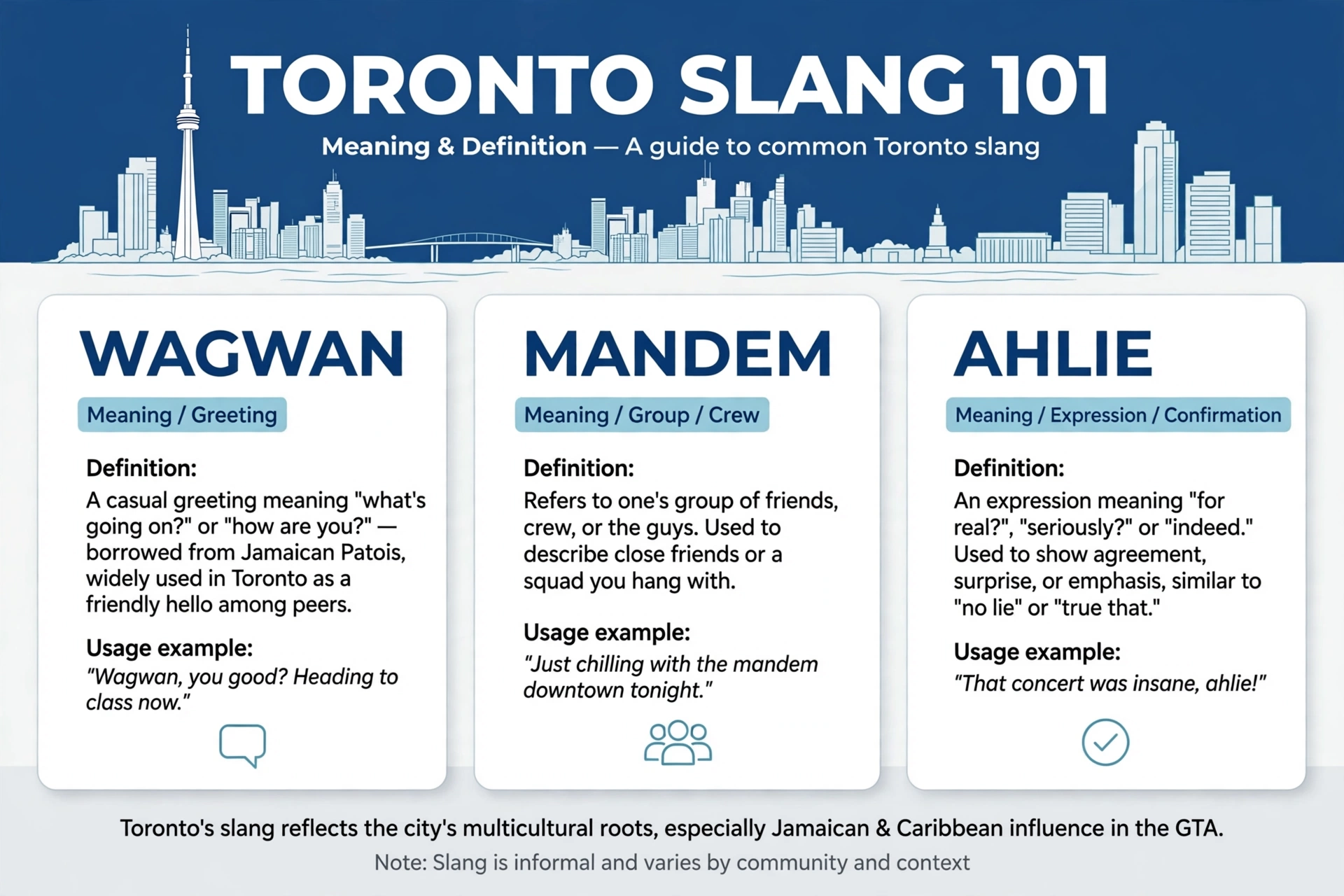
Quick definition: Toronto slang is the distinctive street and everyday vocabulary spoken in Toronto, Canada — a mix of Jamaican Patois, Somali, Caribbean, American hip-hop, and good old Canadian English. Words like “wagwan,” “mandem,” “ahlie,” and “bucktee” are not just jokes from rap songs; they are how many Torontonians actually greet friends, agree, joke around, and describe their city, from Scarborough to Etobicoke and everywhere in between.
Toronto Slang Meaning & Definition
So what exactly is Toronto slang? At its core, it is the informal language of Canada’s biggest city. Toronto is one of the most multicultural cities on Earth, and its slang reflects that mix. Jamaican immigrants brought Patois words like “wagwan” (what’s going on) and “tings” (things). Somali, Ethiopian, and other East African communities added their own flavour. Caribbean, South Asian, and Middle Eastern Torontonians added more. Then Toronto hip-hop — from Drake to Pressa, Smiley, and the city’s drill scene — carried those words from neighbourhood corners onto the world stage.
The result is a dialect that sounds nothing like textbook Canadian English. A Torontonian might say, “Ahlie, the mandem were posted at the Rabba last night, it was a whole movie.” To an outsider, that sentence is almost a foreign language. To a local, it is perfectly clear: honestly, the friend group was hanging out at the corner store last night, and it was an unforgettable time.
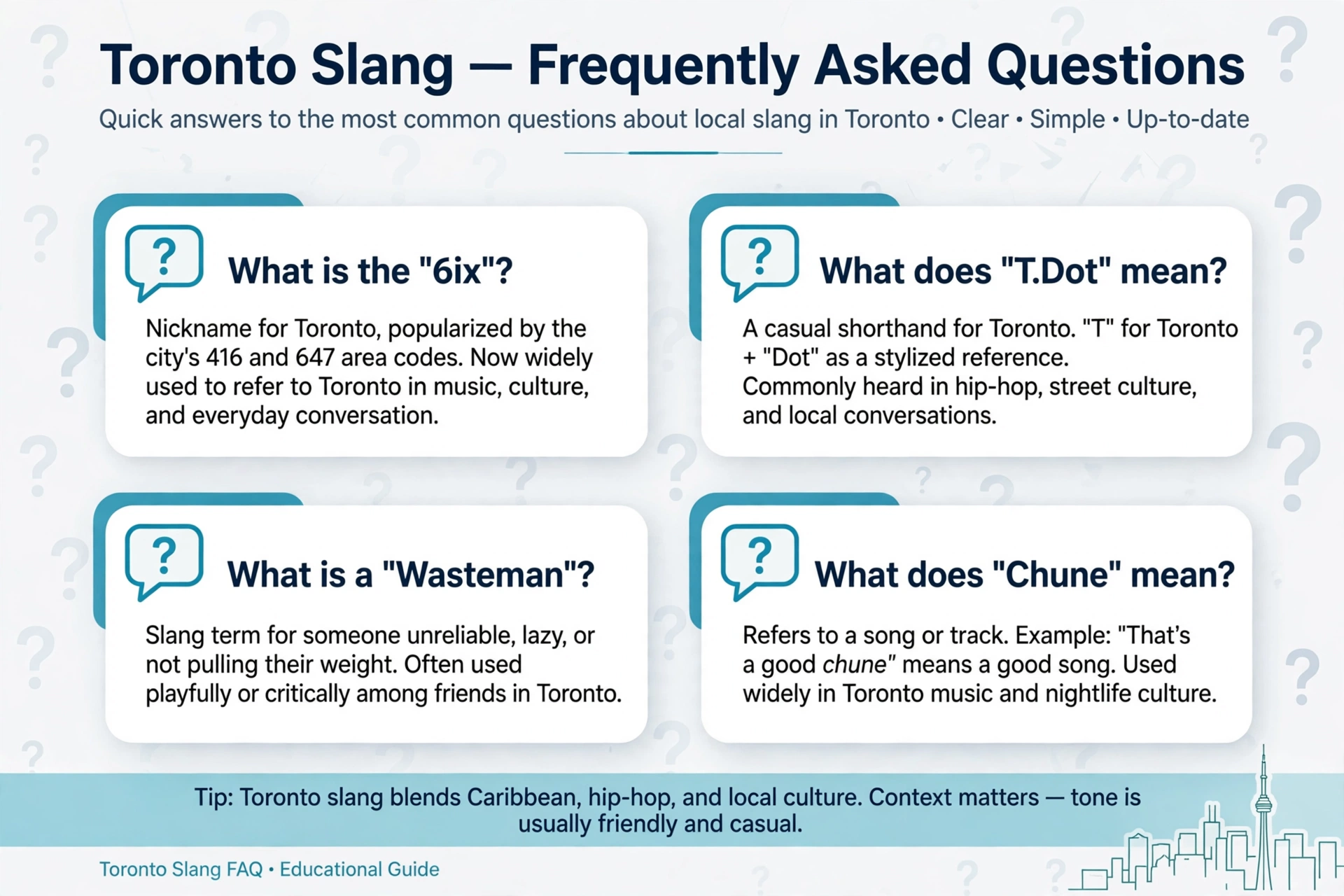
Toronto slang is also known as “6ix slang,” “the 6 slang,” or “Toronto mans slang,” because “the 6ix” is Toronto’s most famous nickname — a nod to the city’s 416 and 647 area codes, popularised by Drake. When people search for Toronto slang, they usually want one of two things: a dictionary of the words, or an explanation of what their Toronto friends, favourite rapper, or TikTok creator actually means. This guide gives you both.
Introduction
Imagine landing at Toronto Pearson Airport, hopping on the UP Express downtown, and overhearing two teenagers on the TTC. One says, “Yo, wagwan fam, you coming to the ting tonight or what?” The other replies, “Ahlie, I’m there, just gotta run a quick ting first.” You understand the English words, but the meaning slips away. Are they going to a party? A thing? What is a “ting,” and why does everyone keep saying “ahlie”?
That confusion is exactly why Toronto slang has exploded online. Drake’s lyrics, Toronto drill music, TikTok creators from Scarborough, and viral memes have pushed words like “wagwan” and “mandem” far beyond the city limits. Fans in the United States, the United Kingdom, and Australia now hear Toronto slang in songs and want to know what it means — and whether they can use it themselves without sounding ridiculous.
This guide breaks down Toronto slang properly: where it comes from, what the most important words mean, how locals really use them, and the mistakes outsiders make. Whether you are visiting Toronto, chatting with Toronto friends online, decoding a Drake lyric, or just curious about Canadian street culture, you will leave here speaking — and understanding — the 6ix a whole lot better. If you enjoy regional slang guides, our Australian slang guide is a fun comparison, because it shows how another English-speaking country built a totally different vocabulary from its own history.
Origin
Toronto slang did not appear overnight, and it did not come from one community alone. Its roots run through several waves of immigration and music. In the 1960s and 1970s, Jamaican and Caribbean immigrants settled in Toronto neighbourhoods like Jane and Finch, Scarborough, and Eglinton West — the area locals call Little Jamaica. They brought Jamaican Patois with them, and words like “wagwan,” “bloodclaat,” “waste yute,” and “tings” entered everyday Toronto speech.
Later waves added more layers. Somali Canadians, one of the largest Somali diaspora communities in the world, live in large numbers in Toronto and contributed words and rhythms of their own. South Asian, Filipino, Ethiopian, and Middle Eastern communities added phrases, food references, and humour. At the same time, American hip-hop gave Toronto youth a shared vocabulary of street slang, which Toronto then remixed into something local.
The turning point for global fame was Drake. When the Toronto rapper started calling the city “the 6ix” and dropping local words into chart-topping songs, the world started paying attention. Songs, interviews, and social media turned neighbourhood slang into internet slang. Toronto drill artists, TikTok creators, and streamers pushed it further, and today a word born on a Scarborough basketball court can trend worldwide within a day.
Popularity
Toronto slang is popular for three reasons: music, memes, and migration. First, music. Drake is the most-streamed rapper of his generation, and his Toronto references are constant. When he says “the 6ix” or uses a local word, millions of listeners Google it. Toronto drill and trap artists — many rapping in full Toronto slang — have huge YouTube and TikTok audiences too.
Second, memes and social media. Toronto slang is funny, punchy, and quotable, which makes it perfect for TikTok captions, Instagram reels, and Twitter jokes. A clip of someone saying “ahlie” with perfect Toronto timing can rack up millions of views, and viewers immediately want a translation.
Third, Toronto itself keeps growing. It is Canada’s largest city and one of the fastest-growing cities in North America. Students, newcomers, and tourists arrive every year and pick up the slang fast, because using it is a quick way to feel like a local. That is why searches for Toronto slang spike every summer — festival season, new Drake releases, and viral Toronto TikToks all drive curiosity at the same time.
How It Is Used
Toronto slang is mostly spoken, not written in formal places. You will hear it in friendly conversations, group chats, rap lyrics, TikTok videos, and sports talk — not in a job interview, a university essay, or an email to your boss. It is casual, playful, and often humorous, but some words are also used for real emphasis, frustration, or disrespect, so tone matters a lot.
A few patterns will help you decode almost any Toronto sentence:
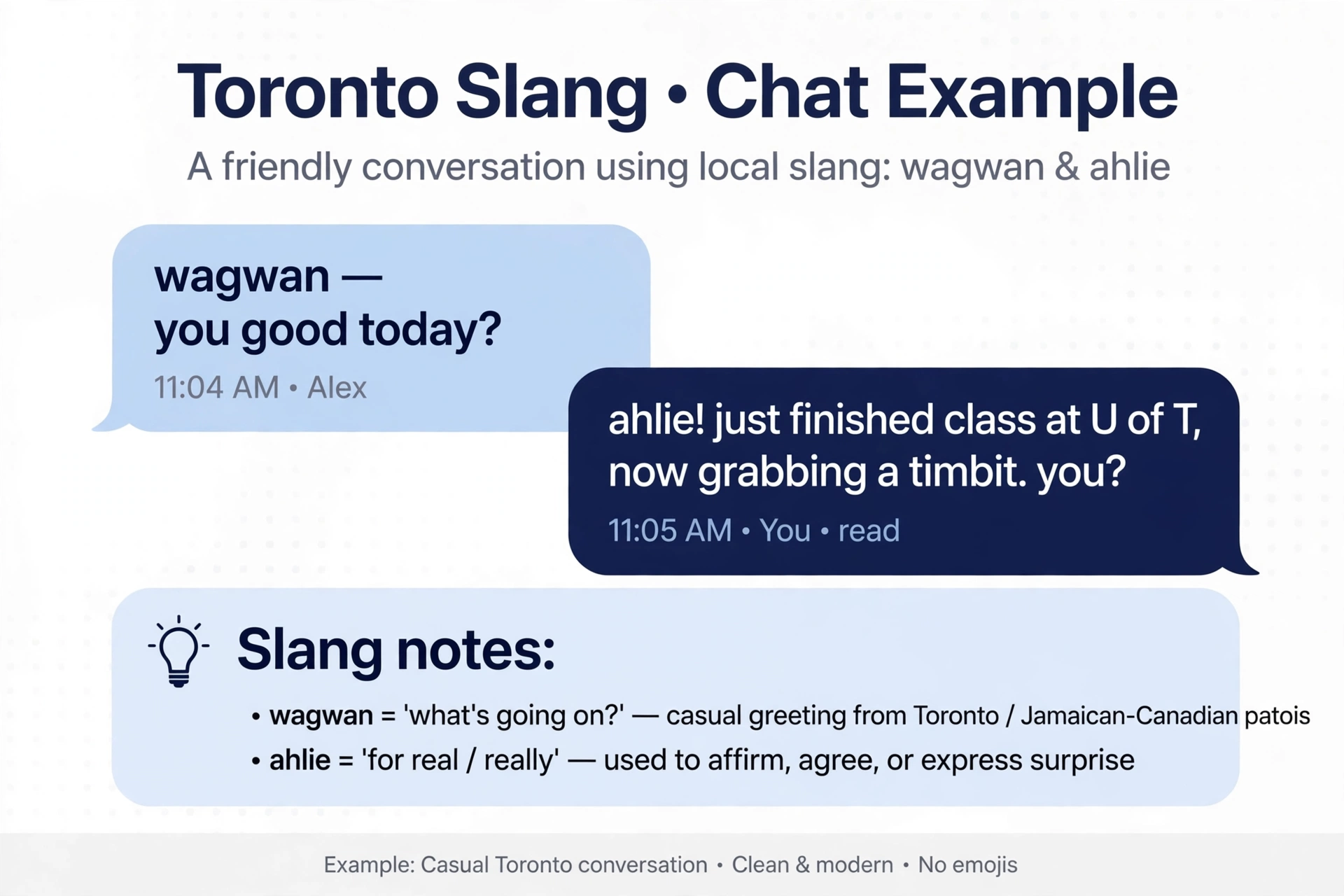
- Greetings: “Wagwan” replaces “what’s up.” “Yo, wagwan fam?” simply means “Hey, what’s going on, friend?”
- Agreement: “Ahlie” means “really?” or “for real?” and also “I agree.” It is Toronto’s version of “for real” or “no way.”
- Groups: “Mandem” means “the guys” or “my friends.” “The mandem are outside” means the friend group is out together.
- Things and events: “Ting” is a wildly flexible word. It can mean a thing, an event, a party, or even a person, depending on context.
- Places: “The 6ix” means Toronto. “The 6” is a shorter version. “Scarborough” is often shortened to “Scarbs” or “Scarlem.”
- Intensity: Adding “styll” (still) or “lowkey” changes the vibe. “I’m lowkey tired, styll” means “I’m honestly pretty tired.”
Toronto slang also loves shortening and repurposing everyday words. A corner store becomes “the Rabba” (from the Rabba Fine Foods chain). A police officer might be called “the feds.” A foolish or unreliable person might be called a “waste yute.” None of these are random — each one has a story in Toronto’s streets, stores, and schools.
Examples
The best way to learn Toronto slang is to see it in real sentences. Here are the most common words with examples you might actually hear.
| Toronto slang word | Meaning | Example sentence |
|---|---|---|
| Wagwan | What’s going on / what’s up | “Wagwan fam, long time no see.” |
| Mandem | The guys / my friend group | “The mandem are linking up tonight.” |
| Ahlie | For real? / I agree / really | “Ahlie? That party was crazy.” |
| Ting | Thing / event / party / person | “Are you going to the ting on Friday?” |
| Bucktee | A clown / a fool / someone unreliable | “Don’t be a bucktee, just show up on time.” |
| Waste yute | A useless or annoying person | “He ditched us again — waste yute.” |
| Styll | Still / honestly / anyway | “I’m tired, styll I’m coming out.” |
| Cheesed | Angry / annoyed / upset | “I’m cheesed, the TTC was late again.” |
| Wallahi | I swear (Arabic origin, very common) | “Wallahi, that game was unreal.” |
| Yute / Yout | A young person / kid / friend | “The yutes are all over TikTok now.” |
| Deadass | Seriously / for real | “Deadass, that food was the best in the city.” |
| No long talk | No need to explain / enough talking | “No long talk, let’s just go.” |
Friendly Examples
Toronto slang shines in friendly chats. “Yo, wagwan my guy, we still good for Raptors night?” is a warm, normal greeting between friends. “Ahlie, that’s jokes!” means “Honestly, that’s hilarious!” And “Link me later, fam” simply means “Message me later, friend.” In friendly use, the slang builds closeness — it signals that you belong to the same circle.
Professional Examples
Here is the honest truth: Toronto slang does not belong in professional settings, and locals know it. A Torontonian would not email a manager saying, “Wagwan, mandem, the ting is due Friday.” Instead, they code-switch — they use Toronto slang with friends and standard English at work. The closest professional use is light and careful: a Toronto creator might use “the 6ix” in a marketing post, or a sports broadcaster might drop “wagwan Toronto” to hype a crowd. Even then, it is a deliberate style choice, not everyday office talk.
Funny Examples
Toronto slang is naturally funny because it is dramatic. “My TTC bus ghosted me again, I’m cheesed styll” turns a boring commute into a joke. “Bro said he’s from the 6ix but he’s really from Mississauga — bucktee behaviour” is a classic Toronto roast, because locals love debating who is truly from Toronto and who is from the suburbs. And “Ahlie, the mandem ordered pizza at 2 a.m. again” is funny precisely because it is so relatable.
Comparison with Similar Terms
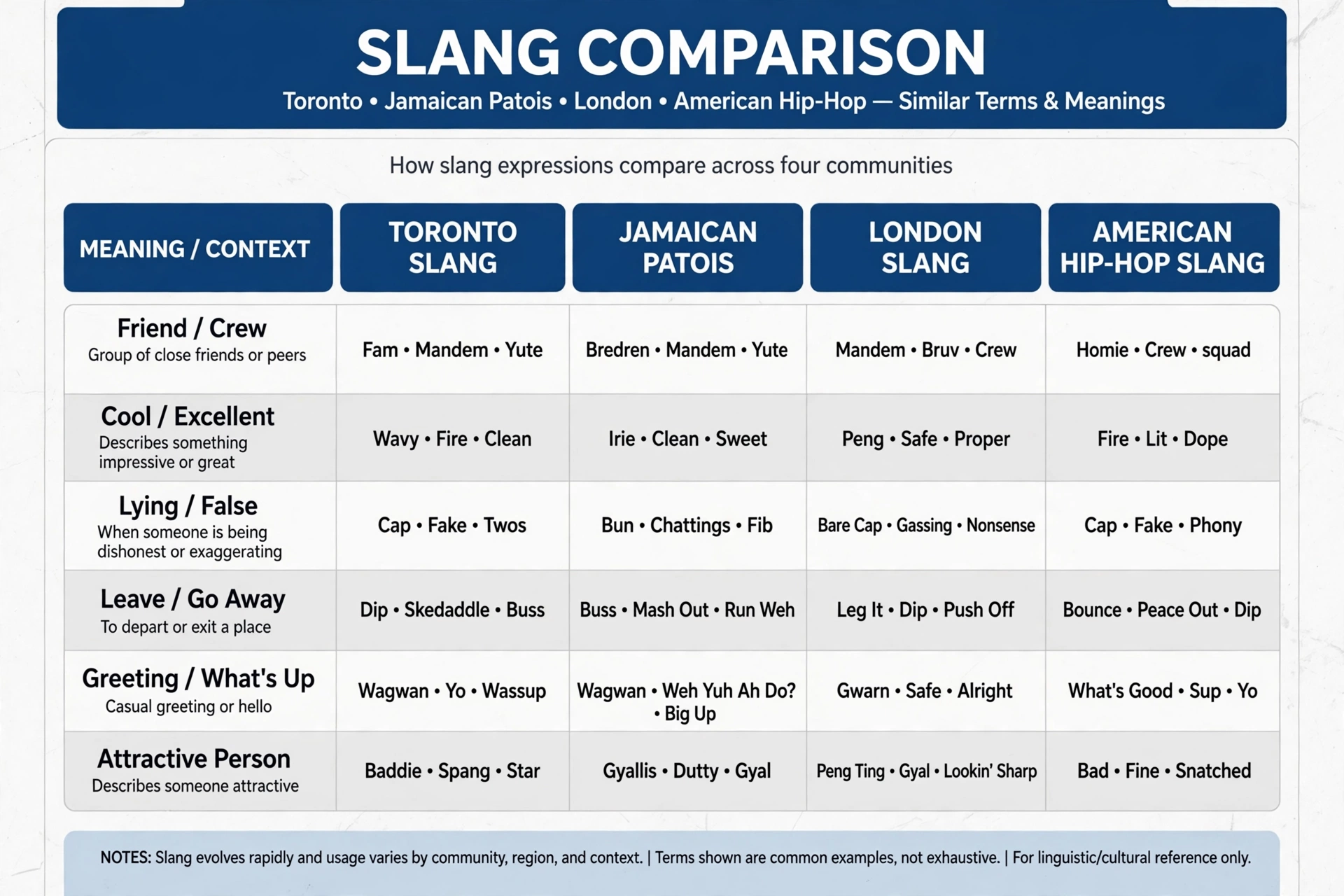
Toronto slang is often confused with other English slang, especially Jamaican Patois, American hip-hop slang, and other Canadian slang. The table below clears up the differences.
| Term or dialect | Where it comes from | How it differs from Toronto slang |
|---|---|---|
| Jamaican Patois | Jamaica | The root of many Toronto words, but a full language system, not just slang. |
| Toronto slang | Toronto, Canada | Patois + Somali + Canadian + hip-hop mix, tied to Toronto places and culture. |
| American hip-hop slang | United States | Shares words like “deadass,” but lacks Toronto-specific words like “ahlie” and “bucktee.” |
| London slang | London, UK | Also uses “mandem” and “wagwan,” but with different accents, words, and meanings. |
| General Canadian slang | Canada-wide | Words like “eh,” “toque,” and “double-double” — polite and nationwide, not Toronto street slang. |
| Ohio slang | Ohio, USA (internet meme slang) | Mostly an internet joke about weirdness, while Toronto slang is real everyday speech. |
The London comparison is especially interesting. London and Toronto both use “mandem” and “wagwan” because both cities have large Jamaican diaspora communities. But a Londoner and a Torontonian saying the same word will pronounce it differently, use it in different sentences, and pair it with totally different local references. If you want to see how a US city built its own meme-driven slang, our Ohio slang guide shows the contrast perfectly.
Alternate Meanings
Many Toronto slang words change meaning with context, which is why outsiders get confused. “Ting” is the biggest example: it can mean a thing (“pass me that ting”), an event (“the ting was lit”), or a person (“she’s a nice ting,” which can be respectful or objectifying depending on tone — best avoided). “Yute” can be affectionate (“my yute”) or dismissive (“these yutes don’t know anything”). “Cheesed” can mean mildly annoyed or genuinely angry.
Even “the 6ix” has layers. It started as a Drake nickname for Toronto, but now it also appears in business names, sports chants, and tourism slogans. And “fam” in Toronto slang does not mean family in the literal sense — it means a close friend, the same way “bro” does. Always read the sentence around the word before deciding what it means.
Professional or Polite Alternatives
If you like Toronto slang but need to sound professional, use these swaps:
- Instead of “Wagwan fam?” say “Hey, how’s it going?”
- Instead of “Ahlie?” say “Really? That’s interesting.”
- Instead of “The mandem are outside” say “My friends are out tonight.”
- Instead of “Don’t be a bucktee” say “Please don’t let us down.”
- Instead of “I’m cheesed” say “I’m frustrated.”
- Instead of “No long talk” say “Let’s get straight to it.”
- Instead of “Wallahi, that’s crazy” say “Honestly, that’s unbelievable.”
These alternatives keep the meaning and the friendliness while removing the street edge. They are the right choice for work, school, customer service, and any first meeting with someone you do not know well.
Common Mistakes
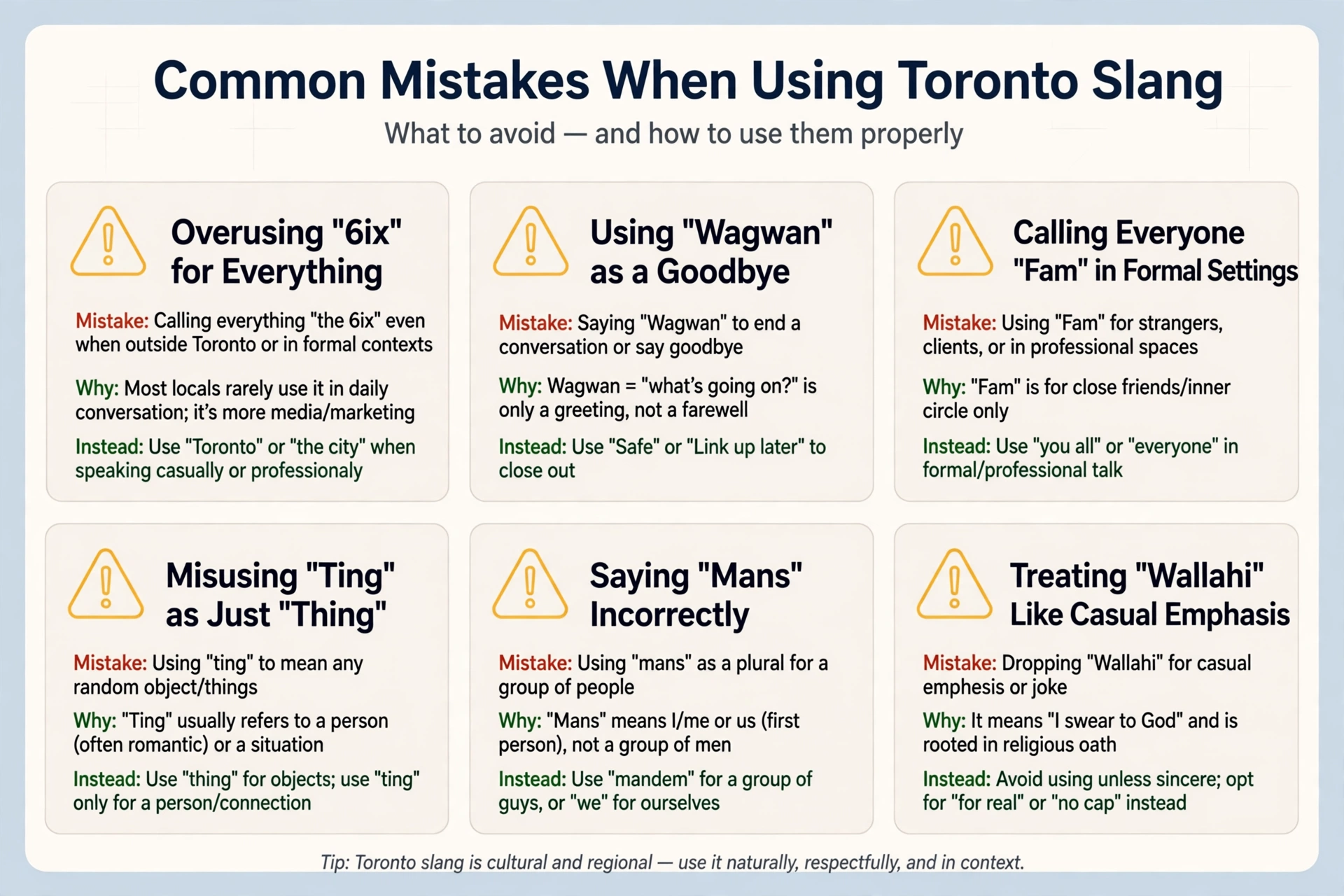
Outsiders make the same Toronto slang mistakes again and again. Avoid these and you will already sound more natural than most people online.
- Using every word at once. Cramming “wagwan mandem ahlie styll bucktee” into one sentence does not sound like Toronto — it sounds like a parody. Locals use one or two slang words per sentence, not ten.
- Copying accents you do not have. Toronto slang is tied to a real accent and rhythm. Forcing a Jamaican or Toronto accent when you do not speak that way usually comes across as mocking, not fluent.
- Using insults casually. Words like “bucktee” and “waste yute” are insults. Calling a stranger or a coworker one is rude, even if you heard it in a song.
- Calling everywhere Toronto “the 6ix” incorrectly. Mississauga, Brampton, and Vaughan are part of the Greater Toronto Area, but locals will roast you for calling them Toronto itself. The 6ix means the city of Toronto.
- Using slang in formal settings. Toronto slang in a job interview, a presentation, or a formal email reads as unprofessional, even to Torontonians who use it daily with friends.
- Assuming all Canadians talk this way. Toronto slang is Toronto slang. Someone from Vancouver, Montreal, or Halifax will not necessarily understand it, and may find it strange.
Quick Tips
- Start with three words. Learn “wagwan,” “ahlie,” and “mandem” first. They cover greetings, agreement, and groups — most Toronto conversations.
- Listen before you speak. Watch Toronto TikTok creators, Drake interviews, and Toronto streamers to hear the rhythm and tone, not just the definitions.
- Use slang with friends, not strangers. Toronto slang works best when the other person already knows you are being friendly.
- Learn the places. Knowing Scarborough, Etobicoke, Jane and Finch, and the TTC makes Toronto slang make sense, because so many jokes reference them.
- Do not force it. If a word feels unnatural coming out of your mouth, skip it. One natural “ahlie” beats five forced slang words.
- Keep learning the culture. Toronto slang comes from real communities. Respecting where it came from matters more than sounding cool. For a broader look at how internet generations build their own slang, our Gen Alpha slang guide is a great next read.

FAQ
What is Toronto slang?
Toronto slang is the informal vocabulary of Toronto, Canada, mixing Jamaican Patois, Somali, Caribbean, hip-hop, and Canadian English. Common words include wagwan, mandem, ahlie, ting, and bucktee.
What does wagwan mean in Toronto slang?
Wagwan means “what’s going on” or “what’s up.” It comes from Jamaican Patois and is the standard friendly greeting in Toronto slang.
What does mandem mean?
Mandem means “the guys” or “my friend group.” For example, “the mandem are outside” means the friends are out together.
What does ahlie mean?
Ahlie means “for real,” “really,” or “I agree.” It can be a question (“Ahlie?”) or an agreement (“Ahlie, that was amazing”).
Why is Toronto called the 6ix?
Toronto is called the 6ix because of its 416 and 647 area codes, a nickname popularised by Drake. It is now the city’s most famous slang name.
Is Toronto slang the same as Jamaican Patois?
No. Toronto slang borrows many words from Jamaican Patois, but it also includes Somali, Canadian, and hip-hop influences, and it is tied to Toronto places and culture. Patois itself is a much fuller language system.
Can non-Torontonians use Toronto slang?
Yes, but carefully. Use it lightly with friends, avoid insults and forced accents, and never use it in formal settings. Listening first and using just a few words naturally works best.
What is a bucktee in Toronto slang?
A bucktee is a clown, a fool, or someone unreliable — for example, a friend who always cancels plans. It is an insult, so do not use it casually with strangers.
Conclusion
Toronto slang is more than a list of funny words — it is the sound of one of the world’s most diverse cities talking to itself. From Jamaican Patois roots in Little Jamaica to Drake’s global stage, from Scarborough basketball courts to TikTok feeds everywhere, words like wagwan, mandem, ahlie, and ting carry real history, humour, and identity.
Here are the key takeaways: Toronto slang is casual and community-based, not formal English. Start with wagwan, ahlie, and mandem, use one or two slang words at a time, and keep insults out of friendly conversation. Learn the places behind the words — the 6ix, Scarborough, the TTC, the Rabba — and the slang will start to feel natural instead of memorised.
Whether you are visiting Toronto, decoding a song, or chatting with Toronto friends, you now have the meanings, examples, and cultural context to keep up. Use it respectfully, use it lightly, and when in doubt, just ask a local — Torontonians love explaining their city. And if you want to keep exploring regional slang, from heartfelt abbreviations to everyday chat shortcuts, there is always another code worth cracking properly. For the broader Canadian context, Wikipedia’s overview of Canadian slang is a useful place to continue.

2 thoughts on “Toronto Slang: The Ultimate Guide to Talking Like a True Torontonian”