
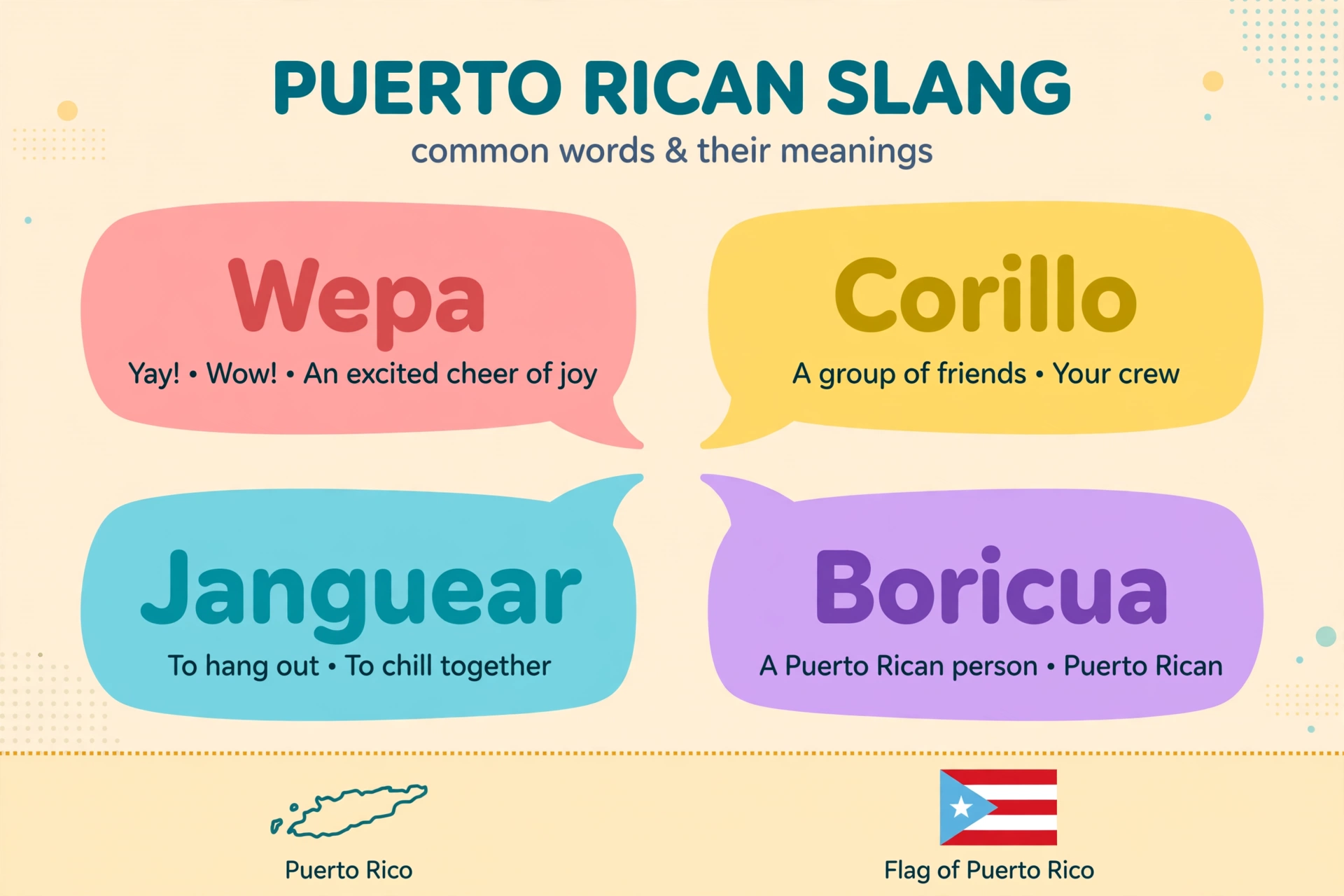
Quick definition: Puerto Rican slang is the informal, everyday vocabulary of Puerto Rican Spanish — words and phrases like wepa, corillo, and janguear that Boricuas use with friends, family, and online. It mixes Spanish, Taíno and African influences, and English loanwords, and it carries a strong sense of island pride and identity.
Puerto Rican Slang Meaning & Definition
Puerto Rican slang means the casual words, expressions, and shortcuts that are distinctive to how people speak in Puerto Rico. It is not a separate language. It is Spanish spoken with a Puerto Rican accent, rhythm, and attitude, plus a set of local words that often have a different meaning — or no meaning at all — in other Spanish-speaking countries.
When someone says they are learning Puerto Rican slang, they usually mean two things at once. First, they want the vocabulary: the words for “cool,” “friend group,” “hang out,” and “what’s up” that you will hear in San Juan, in reggaeton lyrics, and in Puerto Rican group chats everywhere. Second, they want the feeling behind the words. Puerto Rican slang is warm, fast, funny, and proud. A single word like wepa can carry the energy of a whole celebration, and a greeting like ¿qué es la que hay? can turn a stranger into a conversation in seconds.
The word at the centre of it all is Boricua. A Boricua is a Puerto Rican person, and the word comes from Borikén (also spelled Borinquen), the Taíno name for the island. Puerto Ricans use Boricua with deep pride, at home on the island and across the large Puerto Rican diaspora in the United States. You will see it on flags, T-shirts, song lyrics, and social media bios, and it is the key to understanding why this slang matters so much: it is not just wordplay, it is identity.
It also helps to know what Puerto Rican slang is not. It is not formal Spanish, and it is not the right register for a job interview, a legal letter, or a first email to a professor. It is the language of friendship, family, music, food, and fun. Used in the right place, it signals warmth and belonging. Used in the wrong place, it can sound too casual or even confusing. That balance — knowing the word and knowing the moment — is what this guide is really about.
Introduction
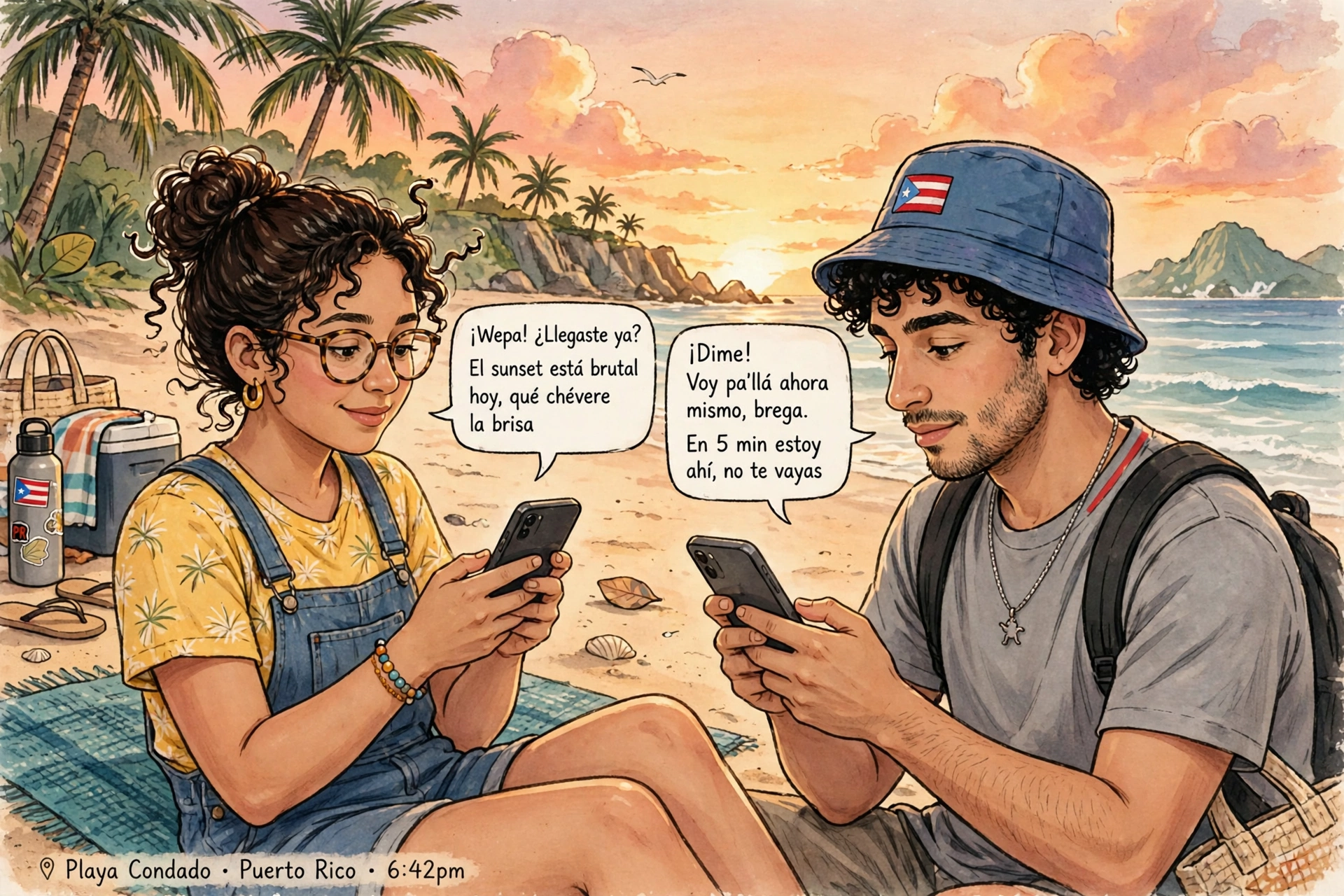
Imagine you land in San Juan, step out of the airport, and a driver grins and says, “¡Wepa! ¿Qué es la que hay?” A friend texts, “Vamos a janguear con el corillo esta noche.” At dinner someone says the food is brutal — and means it as a compliment. If you only know classroom Spanish, every one of those sentences will feel slightly off. The words look familiar, but they are doing a different job.
That is the experience Puerto Rican slang creates for learners, visitors, and even fluent Spanish speakers from other countries. The island’s Spanish has its own sound — fast, musical, full of contractions and softened consonants — and its own vocabulary, shaped by Taíno roots, African heritage, centuries of Spanish colonial history, a close relationship with the United States, and the worldwide explosion of reggaeton. The result is one of the most recognisable and most imitated varieties of Spanish in the world.
This guide explains Puerto Rican slang from the ground up. You will get the 25 most useful words and phrases, with clear meanings, pronunciation hints, and real examples. You will learn where the slang came from, why reggaeton and migration made it famous, how it compares with Dominican slang and other Caribbean varieties, and which words to avoid in formal settings. By the end, you will understand what you hear in songs and group chats — and you will know how to use a few expressions yourself without sounding forced.
One honest note before we start: slang belongs to the people who live it. The best way to learn it is to listen first. Use the words in this guide with friends who welcome it, pay attention to how Boricuas actually say them, and do not force a word into every sentence. A little slang, used naturally and respectfully, goes much further than a lot of slang used all at once.
Origin
Puerto Rican slang grew out of the island’s layered history. The Taíno people, the island’s Indigenous inhabitants, gave Puerto Rico its older name, Borikén, and left words in everyday speech. Spanish colonisation from 1493 onward made Spanish the island’s language, and enslaved Africans brought to the island added words, rhythms, and expressions that still live in Puerto Rican music, food, and speech. Those three roots — Taíno, African, and Spanish — are the foundation of the island’s culture, and slang carries all three.
The twentieth century added a fourth influence: English. Puerto Rico became a United States territory in 1898, and the island’s close political, economic, and family ties with the mainland United States have shaped its language ever since. Millions of Puerto Ricans live in the US mainland, families move back and forth constantly, and English words flow into everyday Spanish and get reshaped with Spanish endings. That process is called Spanglish, and Puerto Rico is one of its great centres. Words like janguear (from “hang out”), parquear (to park), and lonchar (to have lunch) are not mistakes. They are the natural result of two languages living side by side for generations.
Geography matters too. Puerto Rico is an island, and island speech tends to develop its own shortcuts. Words get shortened — muchacho becomes chacho and then acho, para becomes pa’, está becomes ta’ in fast speech. Sounds soften: the final s often fades, and the r sound can soften toward an l in some areas. None of this makes the Spanish “wrong.” It is the same kind of natural change that gives every region its accent. But it does mean that Puerto Rican slang often arrives in a package with Puerto Rican pronunciation, and learners should expect to hear words that look different from how they are spelled.
Finally, there is the jíbaro tradition. A jíbaro is a person from the Puerto Rican countryside, especially the mountain interior, and jíbaro culture — its music, its food, its way of speaking — is a source of enormous pride. Many slang words and sayings trace back to rural life and to the countryside’s direct, colourful way of talking. When a Boricua calls someone jíbaro today, it is usually affectionate: a claim of roots, not an insult.
Popularity
For most of the twentieth century, Puerto Rican slang was mainly an island and diaspora phenomenon. You heard it in Puerto Rican neighbourhoods in New York, Chicago, Philadelphia, and Orlando, and you heard it when family came home for the holidays. Then reggaeton changed everything. The genre was born in Puerto Rico in the 1990s and 2000s, drawing on Jamaican dancehall, Panamanian reggae en español, hip-hop, and Puerto Rican street culture, and its stars — Daddy Yankee, Don Omar, Wisin & Yandel, and later Bad Bunny, Rauw Alejandro, and many more — carried island slang to every Spanish-speaking country and far beyond.
Reggaeton lyrics are packed with Puerto Rican slang. When Bad Bunny shouts wepa, calls his friends his corillo, or sings about a jangueo, millions of listeners learn the words without ever opening a dictionary. Social media did the rest. TikTok sounds, Instagram captions, and YouTube interviews spread expressions like brutal, chévere, and ¿qué es la que hay? to learners who may never have visited the island. Today, Puerto Rican slang is one of the most searched and most taught varieties of Spanish slang online, and language apps, YouTube teachers, and slang dictionaries all give it a prominent place.
Migration keeps it alive and growing. The Puerto Rican diaspora in the United States is larger than the island’s population, and families, music, food, and social media keep the language moving in both directions. A word that starts on the island can be trending in Orlando within a week, and a Spanglish expression from New York can be back on the island just as fast. That two-way flow is why Puerto Rican slang never stands still: new words arrive with every generation, while the classics — wepa, corillo, bendito — stay in use for decades.
There is also a pride factor that outsiders sometimes miss. After centuries in which Puerto Rican Spanish was looked down on by some outsiders as “incorrect,” Boricuas have claimed their variety loudly and joyfully. Using the slang is a way of saying who you are. For learners, that means the slang deserves respect. Learn it, enjoy it, and remember that you are borrowing something people are proud of.
How It Is Used
Puerto Rican slang is used in the same places all slang is used: among friends, in family group chats, at parties, at the beach, at chinchorros (roadside food kiosks), and in comments and captions online. It is the language of closeness. A Boricua speaking to a close friend will use far more slang than the same person speaking to a bank manager, a doctor, or a stranger in a formal setting. Tone, relationship, and place decide how much slang fits.
Three patterns will help you recognise it in the wild. First, greetings and exclamations do a lot of work. Puerto Rican conversation opens with energy: ¿qué es la que hay?, ¡wepa!, ¡dale!, and acho all appear in the first seconds of a chat. Second, words get shortened and softened in fast speech, so voy para la playa can sound like voy pa’ la playa, and está chévere can sound like ta’ chévere. Third, English and Spanish mix freely. A sentence can start in Spanish, borrow an English verb with a Spanish ending, and finish in Spanish again, and nobody in the conversation will notice anything unusual about it.
Slang also changes with age and place. Younger Boricuas online use more reggaeton and social-media vocabulary, older speakers use more classic sayings and countryside expressions, and people from San Juan, Ponce, Mayagüez, and the mountain towns each have local favourites. The words in this guide are the widely understood core — the ones you will hear across the island and the diaspora — but no list can capture every local variation, and that is part of the fun of learning it.
A word of caution about register: some Puerto Rican slang is playful, some is affectionate, and a small number of words are vulgar or suggestive. This guide focuses on the words you can safely use with friends and in public. Where a word has a rude or flirtatious edge, we say so plainly. If you are unsure about a word, listen to how Boricuas use it before you try it yourself, and never use slang to imitate or mock an accent. The goal is connection, not performance.
Examples
The best way to learn slang is to see it in context. The examples below show Puerto Rican slang in friendly conversation, in a professional setting (where standard Spanish usually takes over), and in funny everyday moments. Read them aloud if you can — slang is meant to be heard, and the rhythm is half the meaning.
Friendly Examples
- “¡Wepa! ¡Llegó el corillo!” — “Wepa! The crew is here!” Said when friends arrive at a party or the beach.
- “Mano, ¿qué es la que hay? ¿Vamos a janguear esta noche?” — “Bro, what’s up? Are we hanging out tonight?”
- “Esa canción está brutal, mano. La tengo en repeat.” — “That song is awesome, bro. I have it on repeat.”
- “Acho, no tengo chavos. Pichea, vamos pa’ la playa igual.” — “Man, I don’t have money. Forget it, let’s go to the beach anyway.”
- “El jangueo de anoche estuvo nítido. Bailamos hasta tarde.” — “Last night’s hangout was great. We danced until late.”
- “¡Ay, bendito! Se me quedó la guagua.” — “Oh no! I missed the bus.” Said with sympathy, not anger.
Professional Examples
In a workplace, a classroom, or any formal setting, Boricuas generally switch to standard Spanish. Slang does not disappear, but it shrinks to a friendly word here and there with colleagues you know well. The examples below show what that switch sounds like.
- Formal: “Buenos días, ¿cómo está usted? ¿En qué puedo ayudarle?” — Standard Spanish, no slang. Use this with clients, managers, and strangers in formal settings.
- With a trusted colleague: “¡Dale, lo bregamos ahora mismo!” — “Let’s go, we’ll deal with it right now!” Bregar is acceptable among coworkers who know each other, but keep it out of a first email to a client.
- After a successful presentation: “Quedó nítido.” — “It came out great.” Short, warm, and safe with colleagues.
- What to avoid at work: opening a meeting with “¿Qué es la que hay, corillo?” or describing a report as “brutal.” Both will confuse or amuse people in a formal room, and neither sounds professional.
The rule is simple: the more formal the setting, the more standard your Spanish should be. Slang is a closeness signal, and closeness has to be earned. Earn it first, then use the slang.
Funny Examples
- “Fui a parquear y el parking estaba hasta el tope. ¡Qué revolú!” — “I went to park and the parking lot was completely full. What a mess!” The Spanglish pile-up is part of the joke.
- “Me comí dos platos de lechón y ahora tengo una jartera brutal.” — “I ate two plates of roast pork and now I’m stuffed in a big way.” Jartera is the delicious aftermath of a Puerto Rican feast.
- “El GPS me mandó al garete y terminé en un chinchorro sin señal.” — “The GPS sent me off course and I ended up at a roadside kiosk with no signal.” Al garete means adrift, out of control, or gone wrong — and it is funnier every time it happens to someone else.
- “Mi abuela me vio jangueando y me dijo: ‘¡Ay, bendito, nene, vete a dormir!’” — “My grandmother caught me hanging out and said: ‘Oh my goodness, kid, go to sleep!’” Grandmothers and ay bendito are a perfect pair.
Comparison with Similar Terms
Puerto Rican slang shares a Caribbean family resemblance with Dominican and Cuban slang, and a wider resemblance with slang across the Spanish-speaking world. The words overlap, but the meanings and the flavour often differ, and mixing them up is one of the fastest ways to sound confused. The table below compares Puerto Rican words with their closest equivalents elsewhere, so you can see both the similarities and the differences.
| Meaning | Puerto Rican slang | Dominican / Cuban equivalent | Standard Spanish |
|---|---|---|---|
| Friend group / crew | Corillo | El coro (Dominican) | Grupo de amigos |
| Hang out | Janguear | Janguear (also Dominican) | Pasar el rato |
| Cool / awesome | Chévere, nítido, brutal | Chévere (widespread), bacano (Colombian) | Genial, estupendo |
| Money | Chavos | Cuartos (Dominican), plata (South America) | Dinero |
| Bus | Guagua | Guagua (Cuban too) | Autobús |
| What’s up? | ¿Qué es la que hay? | ¿Qué lo qué? (Dominican) | ¿Qué tal? / ¿Cómo estás? |
| Bro / dude | Mano, acho, chacho | Mano, loco (Dominican) | Hermano, amigo |
| Gossip | Bochinche | Bochinche (commotion elsewhere) | Chisme |
| Party / bar hop | Chinchorrear | — (distinctly Puerto Rican) | Ir de bar en bar |
| Forget it / ignore it | Pichea | — (distinctly Puerto Rican) | Olvídalo / ignóralo |
Two comparisons deserve extra attention. First, janguear is shared with the Dominican Republic, which makes sense: the two islands are neighbours, families move between them, and both have deep ties to the United States. If you already know Dominican slang, janguear will feel familiar, but the accent and the surrounding words will still tell you which island you are on. Second, guagua is a classic false friend. In Puerto Rico and Cuba it means “bus.” In parts of the Andes, guagua means “baby.” Context saves you here, as it does with so much slang: if someone says “se me fue la guagua,” they missed the bus, not a baby.
Compared with the slang of other regions, Puerto Rican slang stands out for its Spanglish. Australian slang shortens English words, and Gen Alpha slang invents new English terms online, but Puerto Rican slang does something different: it takes English verbs and rebuilds them with Spanish endings, so the two languages share a single sentence. That habit is a direct record of the island’s bilingual life, and it is one of the first things learners notice — and one of the hardest to copy without hearing it first.
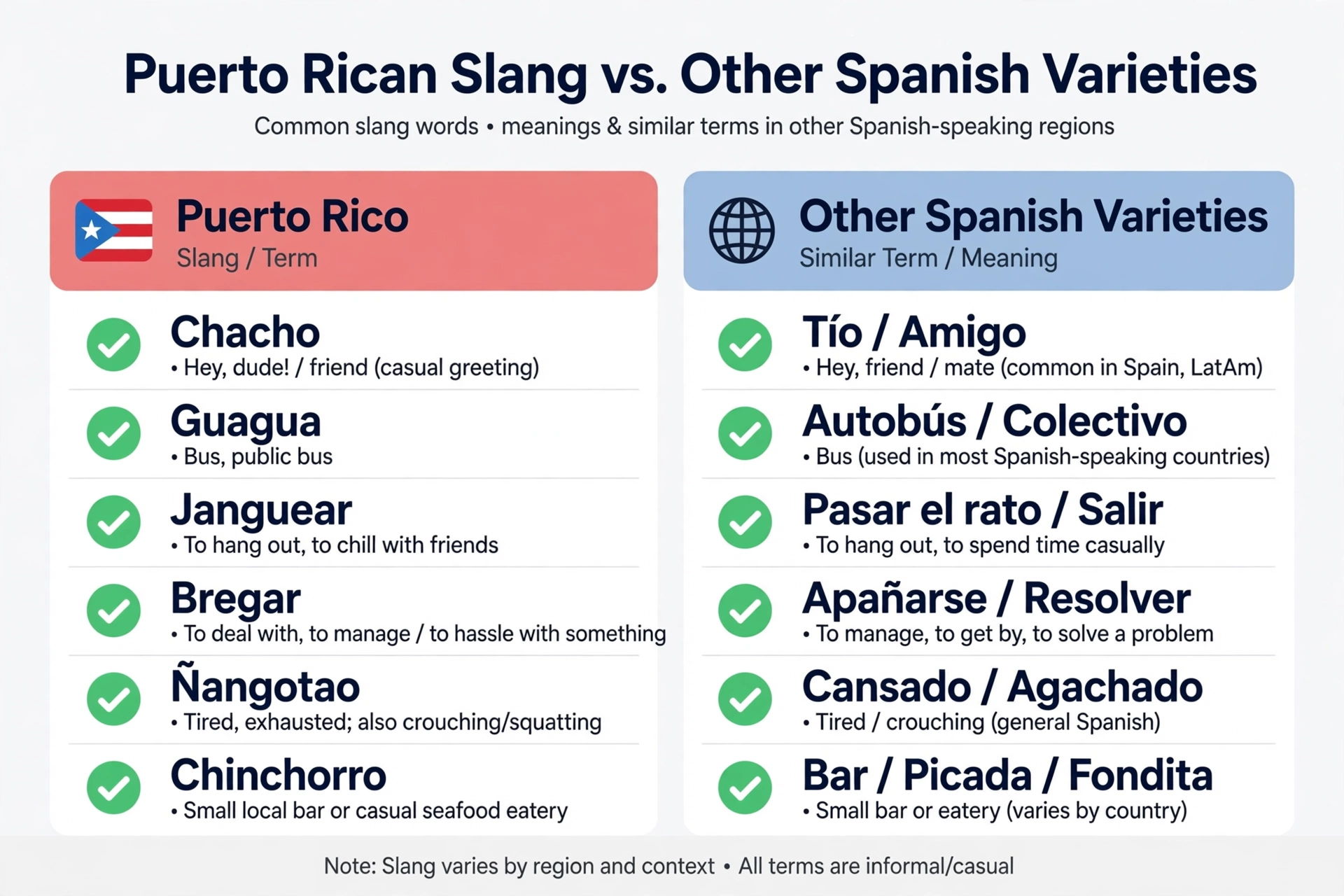
Before we move on, here is the core vocabulary in one place. These 25 Puerto Rican slang words are the ones you are most likely to hear, and learning them will unlock most everyday conversations, songs, and group chats.
| Word or phrase | Meaning | Example |
|---|---|---|
| Boricua | A Puerto Rican person; a term of pride | “Yo soy Boricua, pa’ que tú lo sepas.” |
| ¡Wepa! | Joy, excitement, celebration — “Woohoo!” | “¡Wepa! ¡Ganamos el juego!” |
| ¿Qué es la que hay? | What’s up? What’s going on? | “Mano, ¿qué es la que hay?” |
| Corillo | Crew, squad, group of close friends | “Voy pa’ la playa con el corillo.” |
| Janguear | To hang out | “¿Vamos a janguear esta noche?” |
| Chévere / Nítido | Cool, awesome, great | “Esa película estuvo nítida.” |
| Brutal | Amazing, intense, incredible | “Esa canción está brutal.” |
| Chacho / Acho | Man, dude, wow (from muchacho) | “Acho, hace calor.” |
| Mano | Bro (short for hermano) | “Mano, ayúdame con esto.” |
| ¡Dale! | Let’s go! Go ahead! | “¡Dale, vamos a la playa!” |
| Bregar | To deal with, work on, hustle | “Estoy bregando con el proyecto.” |
| Revolú | A mess, commotion, chaos | “Mi casa es un revolú.” |
| Al garete | Adrift, out of control, gone wrong | “El plan se fue al garete.” |
| Pichea / Pichear | Ignore it, forget about it | “Pichea eso, no vale la pena.” |
| Bochinche | Gossip | “No me meto en bochinches.” |
| ¡Ay, bendito! | Oh my goodness! Poor thing! (sympathy or surprise) | “¡Ay, bendito, qué pena!” |
| Chavos | Money | “No tengo chavos hoy.” |
| Guagua | Bus | “Se me fue la guagua.” |
| Zafacón | Trash can | “Tíralo en el zafacón.” |
| Chinchorrear | To hop between roadside food kiosks (chinchorros) | “Vamos a chinchorrear por la isla.” |
| Jíbaro | Person from the countryside; rural pride | “Mi abuelo es jíbaro de las montañas.” |
| Pana | Close friend, buddy | “Ella es mi pana de siempre.” |
| Jartera | Feeling stuffed after eating a lot | “Tengo una jartera.” |
| Enfogonarse | To get angry, worked up | “No te enfogones por eso.” |
| Parquear | To park (Spanglish) | “Voy a parquear el carro.” |
Alternate Meanings
Many Puerto Rican slang words have a second life. Sometimes the slang meaning is completely different from the standard Spanish meaning, and sometimes the same word means something else in another country. Knowing the alternates will save you from the most common misunderstandings.
Brutal is the best example. In standard Spanish, brutal means brutal or violent, just as in English. In Puerto Rican slang, it usually means the opposite in feeling: something is brutal when it is amazing, intense, or incredibly good. “La fiesta estuvo brutal” is praise, not a police report. Tone and context make the meaning obvious to native speakers, but learners should pause before translating it literally.
Bochinche is another. In most of the Spanish-speaking world, a bochinche is a commotion, a noisy disturbance. In Puerto Rico, it most often means gossip — the talk itself, not the noise. “No me gusta el bochinche” means “I don’t like gossip,” not “I don’t like noise.” The two meanings are related (gossip causes a commotion), but they are not the same, and using the wrong one will confuse your listener.
Guagua has the sharpest geographic split. As noted above, in Puerto Rico, Cuba, and the Canary Islands it means “bus.” In the Andean region, it means “baby” or “child.” Both meanings are correct in their own place, and both are everyday words. If you are in Puerto Rico, guagua is transport. If you are in Ecuador, it is a child. Always let the place decide.
Corillo also has a quieter alternate life. In some contexts it can simply mean a small group or gathering, without the close-friendship feeling of “my crew.” And janguear has a noun form, jangueo, which means the hangout itself or the outing: “el jangueo de anoche” is “last night’s hangout.” Learning the noun and verb together doubles the value of one word.
Finally, be careful with words you meet in reggaeton that this guide does not list. Song lyrics use street language, double meanings, and flirtatious or suggestive words that are not appropriate in everyday conversation, especially with people you do not know well. A word that sounds fun in a chorus can sound rude in a family kitchen. If a lyric word is not in a dictionary you trust, treat it as “for listening only” until a Boricua friend explains it to you.
Professional or Polite Alternatives
Slang is wonderful with friends, but standard Spanish is the safe choice at work, at school, and with strangers in formal settings. The table below gives you a polite alternative for each common slang word, so you can switch registers without losing the meaning.
| Slang | What it means | Polite / professional alternative |
|---|---|---|
| ¿Qué es la que hay? | What’s up? | ¿Cómo está usted? / ¿Cómo estás? |
| ¡Wepa! | Celebration, excitement | ¡Qué bueno! / ¡Felicidades! |
| Corillo | My crew | Mis amigos / mis compañeros |
| Janguear | Hang out | Pasar el rato / reunirse |
| Brutal | Amazing | Excelente / increíble |
| Chavos | Money | Dinero |
| Bregar | Deal with / work on | Encargarse de / trabajar en |
| Pichea | Forget it | No se preocupe / olvídalo (only with friends) |
| Acho / Chacho | Man / dude | (Drop it — no equivalent needed) |
| Guagua | Bus | Autobús (understood everywhere) |
The most important alternative is not a word at all: it is a greeting. In formal Puerto Rico, as across the Spanish-speaking world, “Buenos días,” “Buenas tardes,” and “¿Cómo está usted?” open every door. Use them first. Slang comes later, after the relationship exists. Boricuas are famously warm and welcoming, and they will happily teach you the slang once they know you — usually within the first conversation.
For a deeper look at how slang and standard Spanish differ across the Caribbean, the StoryLearning guide to Puerto Rican slang is a useful, learner-friendly reference, and it confirms the same core vocabulary — wepa, janguear, corillo, bochinche — that you have learned here.
Common Mistakes
Learners make the same handful of mistakes with Puerto Rican slang. Avoid these, and you will already sound more natural than most beginners.
- Using slang everywhere. Slang in a job interview, a formal email, or a first meeting with an older stranger sounds careless. Match the register to the room.
- Using wepa as a greeting. Wepa is an exclamation of joy, not “hello.” Greet people with “Hola” or “¿Qué es la que hay?” and save wepa for the celebration.
- Overusing one word. Saying acho or brutal in every sentence sounds like an imitation, not a conversation. Native speakers vary their words. So should you.
- Translating brutal literally. In slang it means “amazing.” If you translate it as “violent,” you will misunderstand half the compliments you hear.
- Mixing up Caribbean slang. Puerto Rican, Dominican, and Cuban slang overlap, but they are not interchangeable. “¿Qué lo qué?” is Dominican; “¿Qué es la que hay?” is Puerto Rican. Using the wrong island’s greeting will not offend anyone, but it will mark you as a learner.
- Copying an accent you have not earned. The pronunciation — softened consonants, dropped final sounds, fast contractions — comes from listening, not from forcing it. Speak clearly, use the words correctly, and let the accent develop naturally.
- Repeating lyric slang in polite company. Reggaeton lyrics include suggestive and street language. Enjoy the music, but do not assume every lyric word is safe to say at a family dinner.
- Assuming all Spanish speakers know these words. A speaker from Mexico or Spain may never have heard corillo or pichea. If they look confused, switch to the standard Spanish alternative and carry on.
Quick Tips
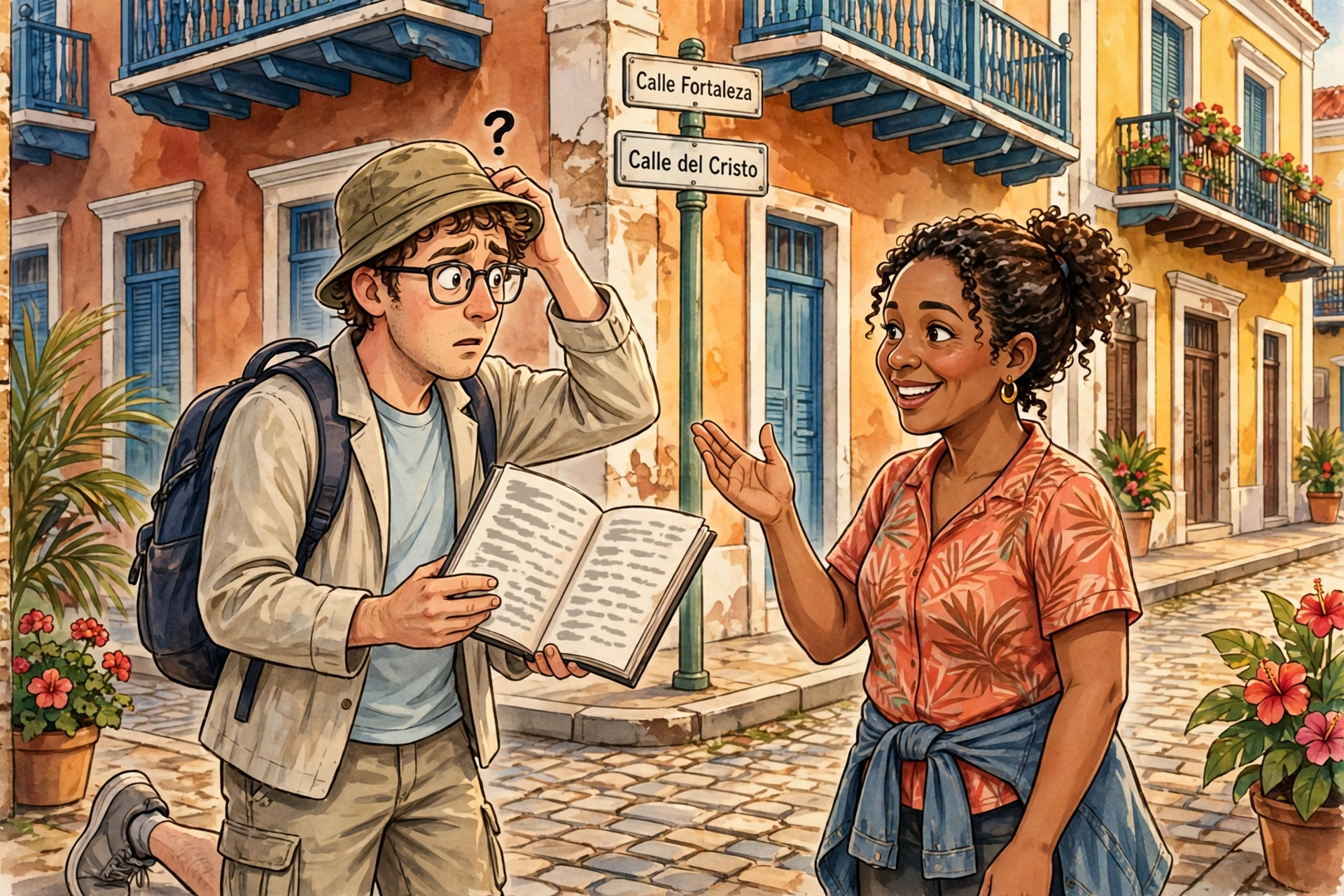
- Start with five words. Learn wepa, corillo, janguear, chévere, and ¿qué es la que hay? first. They cover greetings, plans, and praise — most of everyday conversation.
- Listen before you speak. Watch Puerto Rican creators, listen to reggaeton with lyrics in front of you, and notice which words appear in which situations. Listening builds the instinct for register.
- Learn the greeting, not just the word. “¿Qué es la que hay?” is a whole social skill in one sentence. Practise it until it sounds relaxed, not rehearsed.
- Use slang with one friend first. Try new words with a Boricua friend who will correct you kindly, not in a big group where a mistake feels embarrassing.
- Keep a small list. Write down each new word, its meaning, and the sentence where you heard it. Slang without context is easy to forget and easy to misuse.
- Respect the source. Puerto Rican slang is tied to Boricua identity and pride. Use it to connect, not to perform, and credit the culture when you share what you learn.
- Visit if you can. Nothing replaces hearing the slang in San Juan, at a chinchorro, or at a family gathering. The 2000s slang era shaped a lot of today’s internet language, but Puerto Rican slang is alive right now, on the island, and it rewards anyone who goes to hear it.
FAQ
What does Puerto Rican slang mean?
Puerto Rican slang is the informal vocabulary of Puerto Rican Spanish — words like wepa, corillo, and janguear that Boricuas use in casual conversation. It reflects Taíno, African, Spanish, and English influences, and it is closely tied to Puerto Rican identity and pride.
What does wepa mean in Puerto Rican slang?
Wepa is an exclamation of joy, excitement, or celebration, similar to “Woohoo!” or “Awesome!” You will hear it at parties, concerts, sports games, and family celebrations. It is not a greeting — it is the sound of a good moment.
What does Boricua mean?
Boricua means a Puerto Rican person. It comes from Borikén, the Taíno name for the island of Puerto Rico, and Puerto Ricans use it with pride, both on the island and in the diaspora.
How do Puerto Ricans say “what’s up?”
The classic Puerto Rican greeting is “¿Qué es la que hay?” It literally asks “What is it that there is?” but it means “What’s up?” or “What’s going on?” Friends often shorten the conversation opener to “¿Qué es la que?” in fast speech.
What does janguear mean?
Janguear means to hang out, from the English “hang out.” It is one of the most common Spanglish verbs in Puerto Rico. The noun form is jangueo, meaning the hangout or outing itself.
Is Puerto Rican Spanish different from other Spanish?
Yes, in accent, rhythm, and vocabulary, though it is fully mutually intelligible with other varieties of Spanish. Puerto Rican Spanish has distinctive pronunciation, many local words, and a lot of English influence, but a speaker from any Spanish-speaking country can understand it — and be understood in return — especially in standard Spanish.
Can non-Puerto Ricans use Puerto Rican slang?
Yes, respectfully and in the right context. Boricuas are generally happy when learners take an interest in their culture. Use the words with friends, listen first, avoid forcing them, and do not use slang to imitate or mock an accent. A little, used naturally, is always better than a lot, used awkwardly.
Is Puerto Rican slang appropriate at work?
Usually not. In formal settings, use standard Spanish: “Buenos días,” “¿Cómo está usted?” and the polite alternatives in this guide. A friendly word like nítido or bregar may be fine with close colleagues, but save the full slang for friends, family, and social settings.
Conclusion
Puerto Rican slang is much more than a list of funny words. It is the sound of an island that has turned a complicated history — Taíno roots, African heritage, Spanish colonisation, and a close American relationship — into a language full of warmth, humour, and pride. From wepa to corillo, from janguear to ¿qué es la que hay?, these words carry the rhythm of San Juan streets, chinchorros, family kitchens, and reggaeton stages around the world.
The practical takeaway is simple. Learn the core words in this guide, understand the difference between slang and standard Spanish, and match your language to the moment. Greet warmly, celebrate loudly, and keep the slang for the people and places where closeness is welcome. Listen more than you speak at first, and let Boricuas teach you the rest — they usually will, gladly, and often over food.
Start today with one sentence: “Mano, ¿qué es la que hay? ¿Vamos a janguear con el corillo?” Say it with a smile, mean it sincerely, and you have already understood the most important thing about Puerto Rican slang. It is not about sounding like someone else. It is about connecting, Boricua style — with joy, with pride, and with wepa energy.

1 thought on “Puerto Rican Slang: 25+ Boricua Words, Meanings and Real Examples”