Quick definition: 2000s slang is the informal vocabulary of the years roughly 2000 to 2009 — words and phrases like bling, crunk, fo’ shizzle, BFF, and noob that spread through hip-hop, reality TV, early social media, and texting. Much of it sounded playful and exaggerated, and while some terms faded with the decade, several quietly became permanent parts of everyday English.
2000s Slang Meaning & Definition
2000s slang means the casual, creative language that defined how young people talked, texted, and posted during the first decade of the twenty-first century. It was not one single dialect. It was a mix: African American Vernacular English (AAVE) and hip-hop vocabulary crossing into the mainstream, gamer and internet shorthand from forums and instant messaging, valley-girl and reality-TV catchphrases, and skate and surf culture holdovers from the 1990s. What tied it together was attitude. The decade loved excess — oversized everything, loud confidence, dramatic reactions — and the slang matched.
Some 2000s slang described approval. Baller, dope, tight, and bling all said, in different ways, that something was impressive. Some described people: a noob was a beginner, a hater was someone who criticised out of jealousy, and your BFF was your best friend forever. Some described action: you could bounce (leave), get crunk (get wild and have fun), or get owned (beaten badly, usually in a game). And some were pure performance — fo’ shizzle and whassup? were fun to say, which was half the point.
It helps to think of 2000s slang as a time capsule with two layers. The first layer is the vocabulary itself: the specific words. The second layer is the world that produced it — flip phones and T9 texting, AIM away messages, MySpace Top 8s, ringtone rap, American Idol, Paris Hilton’s “That’s hot,” and the long tail of TRL. You cannot fully explain one layer without the other, and that is why the words still trigger instant nostalgia even for people who were barely teenagers at the time.
Introduction
Say “fo’ shizzle” in a room full of millennials and watch what happens. Somebody laughs. Somebody else finishes the phrase before you do. A third person immediately says “my nizzle” in a Snoop Dogg voice they have not used since 2004. That reaction is exactly why 2000s slang still matters. These were not quiet, forgettable words. They were catchphrases, shouted greetings, AIM screen names, and ringtone lyrics — language designed to be noticed.
The 2000s were the last decade before smartphones took over completely, and the slang shows it. Texting existed, but it was slow and expensive, so abbreviations had to earn their place: LOL, BRB, OMG, TTYL. Social media existed, but it was MySpace and Friendster, not TikTok, so identity was built with glitter graphics, profile songs, and a carefully ranked Top 8. Music videos still ran on television, which meant a phrase from a Lil Jon hook or a Snoop Dogg interview could be nationwide slang by Monday morning. If you grew up then, you did not learn this vocabulary from a dictionary. You absorbed it from the hallway, the group chat, and the radio.
This guide covers the whole picture: what the biggest 2000s slang words meant, where they came from, how people actually used them in conversation, and which ones survived. You will find a full glossary table, example chats for friendly, professional, and funny contexts, a comparison with 90s slang and today’s Gen Alpha slang, the common mistakes people make when they try to revive these words, and quick tips for using them in 2026 without sounding like a costume. Whether you lived through the decade or you are decoding a throwback post, this is the complete breakdown.

Origin
The origins of 2000s slang are unusually well documented, because so much of it came from named, famous sources. Hip-hop was the single biggest engine. Bling (or bling-bling) came out of New Orleans rap — Cash Money Records used it for flashy jewellery — and by 2003 it had entered the Oxford English Dictionary. Crunk, a blend of “crazy” and “drunk” from Southern hip-hop, described wild, high-energy partying and became a whole subgenre, crunk music, led by Lil Jon and the East Side Boyz. Snoop Dogg’s playful “-izzle” infix — fo’ shizzle for “for sure,” hizzle, dizzle — turned a rap tic into a national joke that everyone, including your grandparents, eventually tried once.
Television and film supplied the second wave. The Budweiser “Whassup?” commercials (1999, peaking in the early 2000s) turned a stretched-out greeting into a catchphrase people performed in hallways. Paris Hilton’s deadpan “That’s hot” on The Simple Life became sarcastic shorthand for anything that was definitely not hot. Mean Girls (2004) gave the decade “fetch” — memorably declared never going to happen — plus “so fetch,” “grool,” and a whole vocabulary of Plastics-era put-downs. Reality TV, then brand new as a dominant force, made catchphrases travel faster than ever before: a contestant said it on Tuesday, and the whole school was saying it on Wednesday.
The third engine was the internet itself, still young enough to feel like a separate place. Gamers on forums and in early online multiplayer gave mainstream English noob, pwned (a typo of “owned” that became its own word), GG, and AFK. Instant messaging — AIM, MSN Messenger — rewarded short forms: LOL, ROFL, BRB, GTG, TTYL, ASL (age/sex/location, a question that now reads like a museum piece). The -izzle trend, the xoxo sign-off, and the emoticon <3 all belong to this world. T9 predictive text on numeric keypads even shaped spelling: typing anything took effort, so short won.
Underneath all three engines sits the deepest source, and it deserves to be named plainly: Black American language and culture. Much of what the mainstream called “2000s slang” — bling, crunk, baller, hater, fo’ shizzle, whassup, dawg — originated in Black communities and hip-hop culture before crossing over through music, TV, and advertising. That crossover pattern is not unique to the 2000s, but the decade made it unusually visible, and unusually profitable. Knowing the source matters, because it explains both the creativity of the vocabulary and why some of these words feel different when used as a joke by people far outside the culture that made them.
Popularity
At its peak, roughly 2003 to 2007, 2000s slang was unavoidable. It was in chart-topping songs (Yeah!, Get Low, Drop It Like It’s Hot), in blockbuster comedies, in advertising slogans, and in the mouths of news anchors trying — usually painfully — to sound current. Bling was so mainstream that politicians used it. BFF went from schoolyard shorthand to charm bracelets, T-shirts, and eventually the dictionary. Metrosexual, bling, and crunk all became the kind of words that year-end “words of the year” lists argued about. The slang was not a subculture. It was the culture.
Several forces kept it everywhere. First, monoculture was still real: a handful of TV channels, radio stations, and magazines reached almost everyone, so a phrase could go national in days. Second, ringtone rap and music videos made slang audible — you heard crunk before you ever saw it written down. Third, the early social web made slang copyable: an AIM away message, a MySpace bulletin, or a forum signature could carry a new phrase to thousands of people overnight. And fourth, the decade’s celebrity culture rewarded quotability. Paris Hilton, Flavor Flav, Borat (“Very nice!”), and the cast of Jackass all supplied lines that fans repeated like scripts.
Then, as with every slang era, the wave broke. By the late 2000s, smartphones, Twitter, and Facebook were changing how language spread — faster, more fragmented, more ironic. Words that had been cool in 2004 sounded dated by 2009, and saying them seriously marked you as stuck in the past. But nostalgia works on a roughly twenty-year cycle, and right on schedule, the 2020s brought the revival: Y2K fashion, throwback playlists, “2000s night” parties, and TikTok creators explaining 2000s slang to Gen Z and Gen Alpha audiences. The words came back as costume and comedy — and, for a few of them, as genuinely useful vocabulary that never actually left.
How It Is Used
2000s slang was mostly spoken and texted, not written formally, and its grammar was gloriously loose. Words doubled as nouns, adjectives, verbs, and whole reactions. That party was crunk. Let’s get crunk tonight. He’s so crunk right now. The same word flexed to fit the sentence. Bling worked the same way: the jewellery, the look, the lifestyle — “check out the bling,” “all blinged out,” “bling-bling.” If a word could be stretched, the 2000s stretched it.
Tone did most of the work. Many of these phrases were sarcastic by default. “That’s hot” almost never meant something was actually hot; it meant the opposite, delivered deadpan. “Word” could mean agreement, acknowledgement, or impressed approval depending on how you said it — flat, enthusiastic, or drawn out. “My bad” was an apology designed to sound like barely an apology, which was the point: casual, low-stakes, move on. Context, facial expression, and timing decided the meaning far more than the dictionary definition did, which is why these words are so hard to learn from a list alone.
In texts and chats, 2000s slang lived in abbreviations and punctuation. A message might read: “omg that party was crunk!!1 ttyl, gtg, xoxo.” The double exclamation marks, the stretched vowels (“whaaaassssuuuup”), the <3 heart, and the all-caps LOL were not sloppy writing — they were the performance. On AIM, your away message was a public statement, and loading it with slang, lyrics, and emoticons was how you told people who you were. On MySpace, the same job was done by your profile song, your glitter graphic, and your Top 8. The slang was social signalling as much as communication.
It also had clear social rules. Using hip-hop slang as a joke among friends who shared the reference was normal; using it to mock or perform a caricature was not, and people noticed the difference even then. Gamer slang stayed mostly in gaming spaces — calling a classmate a noob in the hallway was funny precisely because it imported game language into real life. And almost none of it belonged in formal settings: a teacher, a boss, or a grandparent hearing “fo’ shizzle” in 2005 would have heard a joke, not a register. That boundary is still the main rule today. The words are for casual, nostalgic, and humorous contexts — not for a job interview.
2000s Slang Words and Meanings: The Big Glossary
Here are the forty-plus terms that defined the decade, grouped by what they actually did in conversation. If you only learn ten, learn the first ten — they are the ones people still recognise instantly.
| Term | Meaning | Example |
|---|---|---|
| Bling / bling-bling | Flashy, expensive jewellery; anything sparkling and showy | “Check out all that bling-bling.” |
| Crunk | Wild, high-energy fun; crazy + drunk | “Let’s get crunk tonight!” |
| Fo’ shizzle | For sure; definitely (Snoop Dogg’s -izzle style) | “You coming Saturday?” “Fo’ shizzle.” |
| BFF | Best friends forever | “She’s my BFF since third grade.” |
| Noob | A beginner, especially in gaming; teasing tone | “You forgot to save? Total noob move.” |
| My bad | Casual apology; my mistake | “Oops, your seat. My bad.” |
| Whassup? | Stretched-out “what’s up?” greeting | “Whaaassssuuuup?!” |
| That’s hot | Usually sarcastic: that is definitely not impressive | “He tripped on stage.” “That’s hot.” |
| Baller | Cool, impressive, wealthy-looking; a high roller | “New car? Okay, baller.” |
| Word | Agreement, acknowledgement, or approval | “Meet at six?” “Word.” |
| Hater | Someone who criticises out of jealousy | “Don’t listen to the haters.” |
| Owned / pwned | Defeated badly, especially in a game | “I owned you at Mario Kart!” |
| Bounce | To leave a place quickly | “Let’s bounce, this party is dead.” |
| Dawg | Friend, buddy (from “dog”) | “What’s good, dawg?” |
| Stoked | Excited, thrilled (relaxed version of ecstatic) | “I’m stoked for the concert.” |
| Tight | Cool, impressive, well done | “That beat is tight.” |
| Dope | Excellent, cool (1990s holdover, huge in the 2000s) | “Those shoes are dope.” |
| Fly | Stylish, attractive, cool | “She looked fly last night.” |
| Peace out | Goodbye, often with a peace sign | “Peace out, see you tomorrow.” |
| Trashed | Very drunk, or completely wrecked | “He got trashed at the party.” |
| Off the chain / off the hook | Amazing, wild, out of control in a good way | “That concert was off the chain!” |
| Off the heezy | Over the top, crazy (with -izzle styling) | “That party was off the heezy.” |
| Shizzle / nizzle / dizzle | -izzle versions of sure, friend, and Dogg | “Fo’ shizzle, my nizzle.” |
| Blinged out | Covered in flashy jewellery or decoration | “He showed up all blinged out.” |
| Chill / chillax | Relax; calm down (chill + relax) | “Just chillax, it’s fine.” |
| Props | Respect, credit | “Props to her for that performance.” |
| Boo | Sweetheart, boyfriend/girlfriend | “That’s my boo.” |
| Shorty | A young woman, or a friend; term of address | “Hey shorty, what’s up?” |
| Holla | Call me; get in touch | “Holla at me later.” |
| What’s good? | What’s up? How are things? | “Yo, what’s good?” |
| Talk to the hand | Dismissive: I am not listening | “Talk to the hand!” |
| As if! | No way; yeah, right (Clueless-era holdover) | “Him? Dating her? As if!” |
| Duh | Obviously (sarcastic) | “Duh, of course I’m coming.” |
| Whatever | Dismissive indifference, often with a hand gesture | “Whatever. Do what you want.” |
| Totally / totes | Completely, absolutely | “I totes forgot.” |
| OMG / LOL / ROFL | Oh my God / laughing out loud / rolling on the floor laughing | “OMG LOL that is so true.” |
| BRB / GTG / TTYL | Be right back / got to go / talk to you later | “GTG, mom needs the phone. TTYL!” |
| XOXO / <3 | Hugs and kisses / a heart symbol in text | “Miss you! XOXO <3” |
| Emo | Emotional; the emo music/scene aesthetic | “He’s gone full emo with the hair.” |
| Scene / scenester | The MySpace-era alternative subculture | “Very scene kid energy.” |
| Metrosexual | A straight man very invested in grooming and style | “The metrosexual look was everywhere in 2004.” |
| Bling era / Y2K | The late-90s/early-2000s aesthetic itself | “That outfit is pure Y2K.” |
Examples
Lists only go so far. The examples below show how the same vocabulary sounded in different situations — because in the 2000s, the situation was the meaning.
Friendly Examples
- The hallway greeting: “Whaaassssuuuup?!” “Not much, dawg. You coming to the game?” “Fo’ shizzle. Wouldn’t miss it.” Warm, loud, performative — the greeting was a small show of friendship.
- The AIM check-in: “omg guess what” “what??” “i got the tickets!!” “no way!! that’s so tight!!” Lowercase, fast, exclamation-heavy. Typing like this was normal, not lazy.
- The compliment: “Okay, that outfit is fly. Props.” “Thanks, boo!” Short, direct praise between friends, with props doing the work of a whole paragraph.
- The apology: “Sorry I ate your fries.” “My bad, I thought they were mine.” “You’re good. Bounce with me to the store?” The apology is tiny on purpose; the friendship carries the rest.
- The sign-off: “gtg, dinner. ttyl! xoxo <3” Three abbreviations and a heart, and everyone in 2005 knew exactly what kind of friendship that was.
Professional Examples
Here is the honest truth: almost none of this vocabulary belonged at work, and that is itself useful to know. A 2005 office email that said “fo’ shizzle” would have been a joke, not a message. But a few terms crossed over in milder forms, and they are still the safe ones today:
- “My bad” in a meeting: “That was my bad — I sent the old file. Sending the new one now.” Acceptable in casual workplaces because it is brief, owns the mistake, and moves on. In a formal setting, “my mistake, apologies” is still better.
- “Word” as acknowledgement: In a creative or media workplace, a quick “Word” after a plan was fine. In most offices, “Got it” or “Agreed” landed better.
- “Props” as credit: “Props to the design team on this one” worked in casual team chats then, and it still works now — it is one of the few 2000s terms that aged into normal workplace slang.
- Everything else — keep it out: Crunk, bling, noob, hater, and -izzle words in a work email read as either a joke or a mistake. If you are using 2000s slang professionally in 2026, do it only in a nostalgia-themed post, a retro marketing campaign, or a conversation where everyone is clearly in on the joke.
Funny Examples
- The failed cool: “Fo’ shizzle, my nizzle, this meeting is off the heezy.” Said by a dad at a school fundraiser in 2006. The room went silent. The lesson: -izzle words had a very short shelf life outside their home turf.
- The sarcastic “That’s hot”: “I just spilled coffee all over my white shirt.” “That’s hot.” The deadpan delivery was the whole joke. Smile while saying it and it stops working.
- The gamer in real life: “You got owned!” shouted after winning a board game at family dinner. Funny once. Funny every time, if your family is that kind of family.
- The dramatic exit: “Talk to the hand — I’m bouncing. Peace out!” Three dismissals in one sentence. Maximum 2000s energy, zero subtlety, and everyone in the room knew you were performing.
- The emoji ancestor: “I <3 u 4eva, BFF.” Written in glitter text on a MySpace profile. It was sincere and ridiculous at the same time, which was exactly the aesthetic.

Comparison with Similar Terms
2000s slang is often confused with the slang of the decades on either side of it. The comparison below shows where each era’s vocabulary actually sits — and why a word like crunk could never have come from the 90s, and a word like rizz could never have come from the 2000s.
| Feature | 90s Slang | 2000s Slang | 2010s–2020s Slang |
|---|---|---|---|
| Home turf | MTV, sitcoms, skate/surf culture | Hip-hop, reality TV, AIM/MySpace | Social media, streaming, TikTok |
| Signature greeting | “What’s up?” / “Yo” | “Whassup?!” / “What’s good?” | “Heyyy” / “Wsg” |
| Approval word | Dope, phat, rad | Baller, tight, off the chain | Fire, lit, slay |
| Insult / tease | Loser, poser, wack | Noob, hater, owned | Mid, cooked, NPC |
| Friendship word | Homie, bestie (emerging) | BFF, dawg, boo | Bestie, bro, fam |
| Texting style | Early SMS, pagers | T9, AIM abbreviations, <3 | Autocorrect, emoji, voice notes |
| Comedy style | Snarky, ironic | Exaggerated, catchphrase-driven | Absurdist, meme-layered |
| Biggest influence | Grunge, hip-hop’s golden age | Crunk, ringtone rap, reality TV | Trap, streaming, creator culture |
A few closer comparisons are worth spelling out, because people mix these up constantly. Crunk and turnt both describe wild partying, but crunk is the 2000s original and turnt is its 2010s successor — using crunk in 2026 is nostalgia, using turnt is just dated in a different way. Baller and boujee both describe wealth and flash, but baller is admiring and masculine-coded sports/hip-hop language, while boujee (from the 2010s) is more ambivalent, often teasing. Noob and newbie look interchangeable, but newbie is neutral and noob is a tease — calling a new colleague a newbie is kind, calling them a noob is a joke that needs the right relationship. And bling is not just “jewellery”: it is jewellery as display, wealth as performance. A wedding ring is not bling. A diamond-encrusted grill is.
The closest living relative of 2000s slang is today’s Y2K revival vocabulary. When a TikTok creator says “very 2000s” about low-rise jeans and a flip phone, they are using the decade as an adjective — the same way people in 2005 used “very 80s” about neon. If you want to see how the two eras rhyme, our 90s slang guide pairs well with this one: read them together and the twenty-year cycle becomes obvious.

Alternate Meanings
Several 2000s slang words had second lives that can confuse readers, so here are the important ones:
- Crunk: Besides “wild fun,” crunk named a whole music genre (crunk music) and, in some contexts, simply meant drunk or intoxicated. “Let’s get crunk” at a party usually meant the fun version; “he got crunk last night” could mean either, and the speaker’s grin decided which.
- Baller: In sports contexts it literally meant a basketball player, and in older usage, someone who played ball well. The slang sense — a wealthy, flashy person — borrowed the sports image and ran with it.
- Tight: The standard English meaning (“fitting closely”) never went away. “Those jeans are tight” could be a fashion comment or a compliment about the jeans themselves, and only tone separated the two. The slang sense (“cool, impressive”) applied to music, performances, and plans: “that set was tight.”
- Trashed: “Trashed” could mean drunk, exhausted, or physically ruined. “I’m trashed” after a party meant drunk; “I’m trashed” after exams meant exhausted; “my car is trashed” meant the car was wrecked. Same word, three different mornings-after.
- Emo: Originally a music genre (emotional hardcore), emo became an adjective for the whole aesthetic — side-swept hair, skinny jeans, eyeliner — and then a teasing label for anyone who seemed overly emotional. “Don’t be so emo” was rarely kind.
- Word: Beyond agreement, “word?” with a rising tone meant “really? are you serious?” — a request for confirmation. “Word up” was the fuller, more enthusiastic version, and “word to your mother” was a Vanilla Ice-era phrase that survived into the 2000s as a joke.
- Shorty: Used as a term of address for a young woman, but also, in hip-hop, simply for a friend or a younger person of any gender. The meaning depended heavily on who said it, to whom, and whether they actually knew each other — a reminder that slang is always also social information.
Professional or Polite Alternatives
If you like the energy of 2000s slang but need language that works everywhere, here is a translation table. Keep the originals for friends and throwbacks; use the alternatives when the audience is mixed, older, or professional.
| 2000s Slang | Polite / Professional Alternative | When to Use It |
|---|---|---|
| My bad | My mistake — apologies | Work emails, formal apologies |
| Fo’ shizzle | Absolutely / definitely | Any agreement, anywhere |
| Baller / tight | Impressive / excellent | Praising work or a result |
| Noob | Beginner / new to this | Describing inexperience kindly |
| Hater | Critic / sceptic | Discussing disagreement fairly |
| Bounce | Head out / leave | Announcing a departure |
| That’s hot (sarcastic) | That did not go well | Reacting to a mishap politely |
| Word | Agreed / understood | Confirming a plan |
| Props | Credit / well done to… | Giving credit publicly |
| Whassup? | How are you? / Hi there | Greeting anyone, any age |
The pattern is simple: the polite version keeps the meaning and drops the performance. “My bad” and “my mistake” say the same thing; one sounds like a shrug and the other sounds like responsibility. In 2026, the shrug version is fine with friends and in casual chats. In anything that will be forwarded, filed, or read by someone’s grandmother, take the extra two seconds and use the full version.
Common Mistakes
Reviving 2000s slang is fun, and it is also very easy to get wrong. These are the mistakes that make a throwback post or a party joke fall flat — or, worse, make it sound like you are mocking the culture the words came from.
- Using every word at once. A sentence stuffed with fo’ shizzle, crunk, bling, and off the heezy does not sound like 2005. It sounds like a parody of 2005. Real people in the 2000s used one or two slang words per sentence, surrounded by normal English. Pick one, and let it breathe.
- Mixing decades carelessly. Saying “that’s so fetch, no cap, fo’ shizzle” mashes three eras together (fetch is 2004, no cap is 2010s, fo’ shizzle is early 2000s). Each word is fine alone; together they signal that the speaker learned slang from a list, not from living in it. If you are going for a 2000s bit, stay in the 2000s.
- Getting crunk wrong. Crunk described energy and wild fun, not just drinking. Saying “I got so crunk on lemonade” is a joke; saying “the concert was crunk” is correct. And using it to describe quiet, classy fun misses the point entirely — crunk was never quiet.
- Using “That’s hot” sincerely. In the 2000s, the phrase was almost always sarcastic. If you say it earnestly about something genuinely impressive, people will hear the sarcasm anyway and assume you are teasing. If you mean it sincerely, say “that’s amazing” and save “that’s hot” for the deadpan version.
- Calling everyone a noob. Noob was a tease among gamers who knew each other. Used on a stranger, a new colleague, or someone who is genuinely trying to learn, it reads as mean, not funny. The same warning applies to hater: calling a legitimate critic a “hater” does not win the argument, it ends the conversation.
- Performing -izzle words outside the joke. The “-izzle” style belonged to Snoop Dogg and to people quoting him. Used once, in the right crowd, it is a beloved reference. Used as a general way of speaking, it becomes a caricature — and, given the Black cultural roots of the style, a caricature that lands badly. Quote it; do not adopt it.
- Assuming “cooked” is 2000s slang. It is not. “I’m cooked” meaning “I’m done for” is Gen Z/Gen Alpha slang from the 2020s, even though it feels like it could be older. Our cooked slang breakdown explains the difference — and it is a good reminder that every decade thinks it invented being done for.
- Spelling bling as “bling-bling” every time. The doubled form was the early, hip-hop version; the single bling became the standard noun. Both are correct, but “bling-bling” in 2026 reads as deliberately retro, while bling still passes as a normal word. The dictionary entry for bling shows how thoroughly the word settled into English once the flash wore off.

Quick Tips
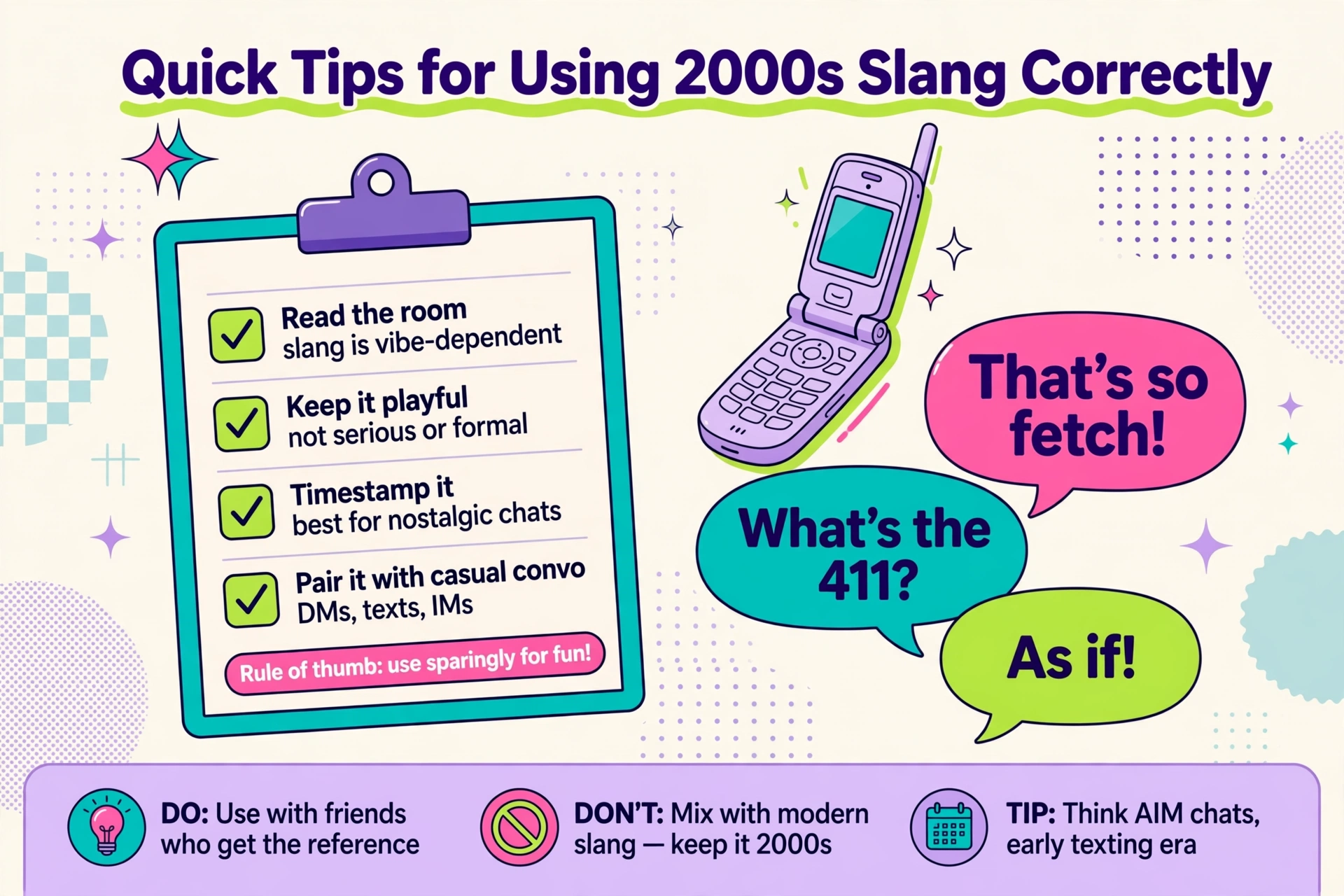
- One word per moment. Drop a single 2000s term — my bad, word, props — into an otherwise normal sentence. That is how the words sounded natural in 2005, and it is how they sound natural now.
- Match the room. With millennial friends, go big: the full “Whaaassssuuuup?!” greeting will land. With Gen Z colleagues, keep it to the survivors (my bad, BFF, props) and skip the catchphrases they only know from memes.
- Use the survivors, retire the rest. My bad, BFF, noob (in gaming), props, and bling never really left. Fo’ shizzle, off the heezy, and talk to the hand are costume now. Know which category your word is in before you wear it.
- Let sarcasm do its job. “That’s hot” and “whatever” only work deadpan. Deliver them flat, wait half a beat, and let the other person catch it. Over-explaining the joke kills it.
- Credit the source when it matters. If you are writing, teaching, or posting about 2000s slang, name hip-hop and Black culture as the source of much of it. It is accurate, it is respectful, and it makes your content more credible than a list that pretends slang appears from nowhere.
- Check the decade before you post. A quick search saves embarrassment: rizz, cooked, no cap, and slay are not 2000s words, however much they feel like they belong. When in doubt, leave it out of the throwback caption.
- Keep texts short and warm. The 2000s texting style — lowercase, abbreviations, xoxo, <3 — reads as affectionate nostalgia between friends. With anyone else, it reads as a formatting accident. Audience first, aesthetic second.
FAQ
What does 2000s slang mean?
2000s slang means the informal vocabulary of roughly 2000–2009 — words like bling, crunk, fo’ shizzle, BFF, and noob — spread through hip-hop, reality TV, early social media, and texting. It described approval, friendship, partying, and everyday life in the exaggerated, catchphrase-heavy style of the decade.
What is the most famous 2000s slang word?
Bling is probably the most famous, because it crossed from hip-hop into the dictionary (Oxford English Dictionary, 2003) and into mainstream advertising and politics. Fo’ shizzle is the most quoted, thanks to Snoop Dogg, and BFF is the most enduring — it never left everyday use at all.
What does “crunk” mean in 2000s slang?
Crunk means wild, high-energy fun — a blend of “crazy” and “drunk” from Southern hip-hop. “Let’s get crunk” meant let’s have a wild time. It also named a music genre, crunk music, led by Lil Jon. It described energy more than drinking, though the two often went together.
What does “fo’ shizzle” mean?
Fo’ shizzle means “for sure” or “definitely.” It is Snoop Dogg’s playful “-izzle” version of “for sure,” often completed as “fo’ shizzle, my nizzle” (“for sure, my friend”). It was a joke and a catchphrase, never a neutral way of agreeing — which is why it sounds like a costume when used seriously today.
Is “my bad” 2000s slang?
“My bad” became hugely popular in the 2000s, but it is older — it comes from basketball pickup games in the 1980s and 90s, where a player would claim a bad pass with “my bad.” The 2000s made it universal. Unlike most words on this list, it survived completely and is still normal casual English in 2026.
What 2000s slang words are still used today?
My bad, BFF, bling, props, noob (in gaming), hater, stoked, and chill are all still in use, some so normally that people forget they are slang. OMG and LOL also never left. The catchphrases — fo’ shizzle, whassup, talk to the hand — survive mainly as jokes and nostalgia.
What is the difference between 90s slang and 2000s slang?
90s slang was shaped by grunge, sitcoms, and skate culture (dope, phat, rad, as if), while 2000s slang was shaped by hip-hop, reality TV, and the early internet (bling, crunk, BFF, noob). The 2000s version was louder, more catchphrase-driven, and more tied to texting and social media. Several words, like dope, carried over from the 90s into the 2000s and belong to both decades.
How can I use 2000s slang without sounding cringe?
Use one word at a time, in casual or nostalgic contexts, with people who share the reference — and stick to the survivors like my bad and props for everyday use. Save the big catchphrases (fo’ shizzle, off the chain) for jokes, throwback posts, and themed parties, where everyone knows you are performing the decade on purpose. That self-awareness is the whole difference between a fun reference and a cringe one.
Conclusion
2000s slang was the sound of a decade that loved to be heard: loud greetings, diamond-bright vocabulary, catchphrases built for repetition, and abbreviations built for a keypad. It gave English bling, my bad, BFF, and crunk; it gave pop culture a decade of quotable lines; and it gave the internet its first real slang engine, in AIM away messages and MySpace profiles. Some of it faded on schedule, as all slang does. The best of it stayed, quietly, in the sentences we still use every day.
The practical takeaway is simple. If you want to sound like the 2000s on purpose — a throwback caption, a themed party, a nostalgia post — pick one word, deliver it with confidence, and know which decade it belongs to. If you want to sound like yourself in 2026, keep the survivors and let the catchphrases rest. Either way, you now know what the words meant, where they came from, and why a whole generation still laughs when somebody says “fo’ shizzle” in exactly the right voice.
Keep exploring the eras: our YOLO meaning slang guide covers the phrase that defined the late 2000s and early 2010s, and the tuff meaning slang breakdown shows how today’s slang still borrows the 2000s playbook — new spelling, same swagger. The decades change. The urge to invent a word for the feeling does not.

3 thoughts on “2000s Slang: 40+ Words That Defined the Decade, Explained”