
Quick Definition: Gen Z slang 2024 is the set of informal words, phrases, and abbreviations that people born roughly between 1997 and 2012 used most in 2024 — on TikTok, in texts, in gaming chats, and in everyday conversation. Words like rizz, slay, sigma, and gyatt packed whole attitudes into a few syllables, and knowing them is the fastest way to understand what young people actually meant online that year.
Gen Z Slang 2024 Meaning & Definition
Gen Z slang 2024 means the casual vocabulary that defined how Generation Z spoke in 2024. It is not a formal dialect and it is not written in any dictionary as a single language. Instead, it is a fast-moving collection of slang words that spread through TikTok videos, Instagram reels, YouTube shorts, Twitch streams, and group chats — and then spilled into classrooms, workplaces, and even TV shows.
What makes gen z slang 2024 different from older slang is speed. A word could be born in a single viral video on Monday, appear in millions of comments by Friday, and feel outdated by the next month. That is why a guide to gen z slang 2024 is really a snapshot of a year: the words that survived long enough to matter, the ones everyone recognised, and the ones that still make sense today.
At its core, gen z slang 2024 does three jobs. It shows belonging — using the right word tells a group you are one of them. It adds humour — many terms are deliberately exaggerated or ironic. And it saves time — a single word like “slay” can replace a whole sentence of praise. If you have ever read a comment like “no cap, she ate that” and felt lost, you were not missing English. You were missing the slang layer on top of it.
Introduction
Imagine opening TikTok in 2024. Within ten seconds you might hear that someone has “rizz,” that a performance “ate and left no crumbs,” that a friend is “delulu,” and that a situation is “giving main character energy.” None of those sentences work if you read them literally. Yet for millions of young people, they were perfectly clear — and often funnier than the plain version.
That is the world of gen z slang 2024. Generation Z grew up with smartphones in their hands, so their slang grew up on screens too. Unlike earlier generations, whose slang spread slowly through schoolyards and music, Gen Z slang spread globally in hours. A word invented by a teenager in Ohio could be trending in London, Sydney, and Toronto the same week — which is exactly how Ohio slang became a worldwide joke in its own right.
This guide breaks down gen z slang 2024 properly: the biggest words, what they really mean, where they came from, and how to use them without sounding like you are trying too hard. You will find real examples, a comparison with millennial and Gen Alpha slang, the mistakes everyone makes, and answers to the questions people actually search for. Whether you are a parent decoding your teen’s texts, a teacher, a marketer, or just curious, this is your complete 2024 slang cheat sheet.

Origin
Gen Z slang 2024 did not come from one place. It came from four overlapping sources, and most words can be traced to at least one of them.
African American Vernacular English (AAVE). Many of the most popular terms — including slay, no cap, and bussin — have roots in Black American culture and hip-hop. They travelled from music and Black Twitter into mainstream TikTok, sometimes without credit. Understanding this history matters: these words carry culture, not just comedy, and using them respectfully means knowing they did not start as internet jokes.
Gaming and streaming. Twitch streamers and YouTubers gave us words like “pog” (in earlier years) and kept terms like “NPC” and “GG” alive. Streamer Kai Cenat is widely credited with popularising “rizz” (short for charisma) in 2022, and by 2024 it was so mainstream that Oxford University Press named “rizz” its Word of the Year for 2023 — a title that carried straight into 2024 conversations.
TikTok and meme culture. TikTok’s short-video format rewards punchy, repeatable phrases. “Sigma,” “gyatt,” “skibidi,” and “Ohio” all exploded because they were funny to repeat, easy to remix, and perfect for comment sections. A single viral sound could turn an obscure word into a global trend overnight.
Music and celebrity culture. Songs, interviews, and celebrity moments constantly fed the slang machine. When a pop star or athlete used a word on camera, fans copied it instantly. That is why gen z slang 2024 feels so tied to specific viral moments rather than slow language change.
Popularity
Why did gen z slang 2024 become so huge? Three reasons explain it.
First, TikTok became the world’s slang factory. By 2024, more than a billion people used the app, and its algorithm pushed the same sounds and phrases to users everywhere at once. Slang no longer belonged to one city or school — it belonged to the feed.
Second, brands, news outlets, and even politicians started using Gen Z slang to sound relatable. When a word appears in an advert or a headline, it reaches people who never open TikTok at all. That mainstream exposure both spread the words and, ironically, made some of them feel less cool to the teens who invented them.
Third, 2024 was a peak year for “slang as identity.” Young people used these words to signal humour, irony, and in-group belonging in a digital world where tone is hard to read. A well-placed “no cap” or “it’s giving” told the reader exactly how a message should feel — something plain text struggles to do.
The result: by the end of 2024, gen z slang 2024 was not niche at all. It was in dictionaries, in classrooms, in marketing meetings, and in everyday conversation across the English-speaking world.
How It Is Used
Gen Z slang 2024 is used in very specific ways, and context decides everything. The same word can be a compliment, a joke, or an insult depending on tone and audience.
- In texts and DMs: Short, punchy, and often abbreviated. “You ate that, no cap” means “you did brilliantly, honestly.”
- In comments: Reactive and playful. Comments under a good video are full of “W,” “slay,” and “mother is mothering.”
- In speech: More selective. Teens often use fewer slang words out loud than online, saving the strongest ones for friends.
- Ironically: This is the secret level. Many Gen Z users say words like “sigma” or “skibidi” ironically, mocking the trend itself. If someone says “oh, very sigma of you” with a straight face, they are probably joking.
- As praise: Words like slay, ate, W, and “goated” (greatest of all time) are the go-to compliments.
- As criticism: Words like “cringe,” “mid,” “NPC,” and “L” (loss) deliver quick, sharp judgement.
The golden rule of gen z slang 2024 is simple: use one or two terms at a time. A sentence stuffed with five slang words does not sound fluent — it sounds like a parody. Real users mix slang into normal sentences, they do not replace every word with it.
Examples
Here are the words that defined gen z slang 2024, grouped by the tone they carry.
Friendly Examples
- Rizz — charm or flirting skill. “He has so much rizz, everyone in class likes him.” If you want the full breakdown, our guide to sigma slang covers a related confidence trend in detail.
- Slay — to do something brilliantly. “She slayed that presentation.”
- No cap — no lie, honestly. “No cap, that was the best concert ever.”
- Bussin — really good, especially food. “This pizza is bussin.”
- Vibe / vibes — a feeling or atmosphere. “This café has such good vibes.”
- Hits different — feels special or more emotional than usual. “Rainy-day coffee just hits different.”
- Main character energy — acting like the star of your own story. “Walking in with sunglasses on? Main character energy.”
- It’s giving… — it feels like or resembles. “It’s giving summer holiday.”
Professional Examples
Yes, gen z slang 2024 even reached the office — carefully. In a work chat, younger colleagues might say a launch was “a W” (a win), call a project “mid” (average), or say a new tool “slaps” (is excellent). The professional rule is restraint: one light term in a casual channel is fine; slang in a client email is not. Managers who understand these words can read team morale faster — “this rollout is giving chaos” is a warning, not just a joke.
Funny Examples
- Delulu — short for delusional, used affectionately for unrealistic crushes or dreams. “I’m so delulu, I think he smiled at me on purpose.” Our full guide explains why delulu meaning became TikTok’s favourite self-roast.
- Gyatt — an exclamation, originally about someone’s appearance, now mostly used as a joke or meme word. “GYATT! Did you see that?” (Use with care — it can be inappropriate.)
- Skibidi — a nonsense meme word from the Skibidi Toilet series. It means almost nothing and everything: “That’s so skibidi” is funny precisely because it makes no sense.
- Ohio — shorthand for “weird” or “cursed,” from the “only in Ohio” meme. “That video was so Ohio.”
- NPC — calling someone a non-player character, meaning boring or predictable. “He just repeats the same jokes — total NPC energy.”
- Ate and left no crumbs — performed perfectly, nothing to criticise. “Her outfit ate and left no crumbs.”
- Understood the assignment — nailed exactly what was needed. “That Halloween costume? She understood the assignment.”
- Touch grass — go outside, stop spending so much time online. Said jokingly to a friend who has been gaming all weekend.

Comparison with Similar Terms
Gen Z slang 2024 is often confused with millennial slang and Gen Alpha slang. The table below shows how the generations differ.
| Feature | Millennial Slang | Gen Z Slang 2024 | Gen Alpha Slang |
|---|---|---|---|
| Era | 2010s | 2020–2024 | 2024–present |
| Signature words | YOLO, lit, bae, on fleek | Rizz, slay, no cap, sigma | Skibidi, gyatt, Ohio, rizzler |
| Home platform | Facebook, early Instagram | TikTok, Instagram, Twitch | YouTube, TikTok, Roblox |
| Humour style | Earnest, meme captions | Ironic, self-aware | Absurdist, random |
| Lifespan of a word | Years | Months | Weeks |
| Example sentence | “That party was lit, no lie.” | “No cap, she slayed, it’s giving main character.” | “Skibidi Ohio rizz, what the sigma?” |
The key insight: gen z slang 2024 sits between two worlds. It kept the irony of internet culture but still used words with real meanings, unlike much of Gen Alpha slang, which leans into deliberate nonsense. That is why 2024’s words are easier to learn — and why they lasted longer.

Alternate Meanings
Many gen z slang 2024 words change meaning depending on where you see them.
- Slay originally meant to kill, then in drag culture meant to perform brilliantly, and in 2024 it means to excel at anything — an outfit, a speech, a comeback.
- Sigma started as a “lone wolf” personality label from online “manosphere” content, but by 2024 most teens used it ironically — calling anything “sigma” as a joke about trying too hard to look cool.
- Mid simply means mediocre, but online it became a weapon: calling a popular song “mid” is a deliberate provocation, not a neutral review.
- Cap in older slang meant a bullet or a hat; in gen z slang 2024, “cap” means a lie, and “no cap” means the truth.
- W / L come from gaming (win / loss) but now describe anything: “W outfit,” “huge L for that decision.”
- Ghost means to suddenly stop replying to someone — a dating term that became general slang for disappearing from any conversation.
When a word has alternate meanings, context is your only guide. “That’s sigma” from a friend who loves memes is a joke; the same word in a serious self-improvement video may be meant sincerely.
Professional or Polite Alternatives
You do not need slang to be understood — and in formal settings, plain language is always safer. Here are polite swaps for the most common gen z slang 2024 terms.
| Slang | Polite Alternative | When to Use It |
|---|---|---|
| Slay / ate | Did an excellent job | Work feedback, formal praise |
| No cap | Honestly / in all seriousness | Meetings, emails |
| Mid | Average / could be improved | Reviews, constructive feedback |
| Rizz | Charisma / charm | Describing social skill |
| Delulu | Unrealistic / overly optimistic | Gentle honesty with friends |
| Touch grass | Take a break / get some fresh air | Friendly advice |
| Ghost | Stop responding / lose contact | Explaining a situation calmly |
| It’s giving… | It reminds me of / it feels like | Describing a style or mood |
Common Mistakes
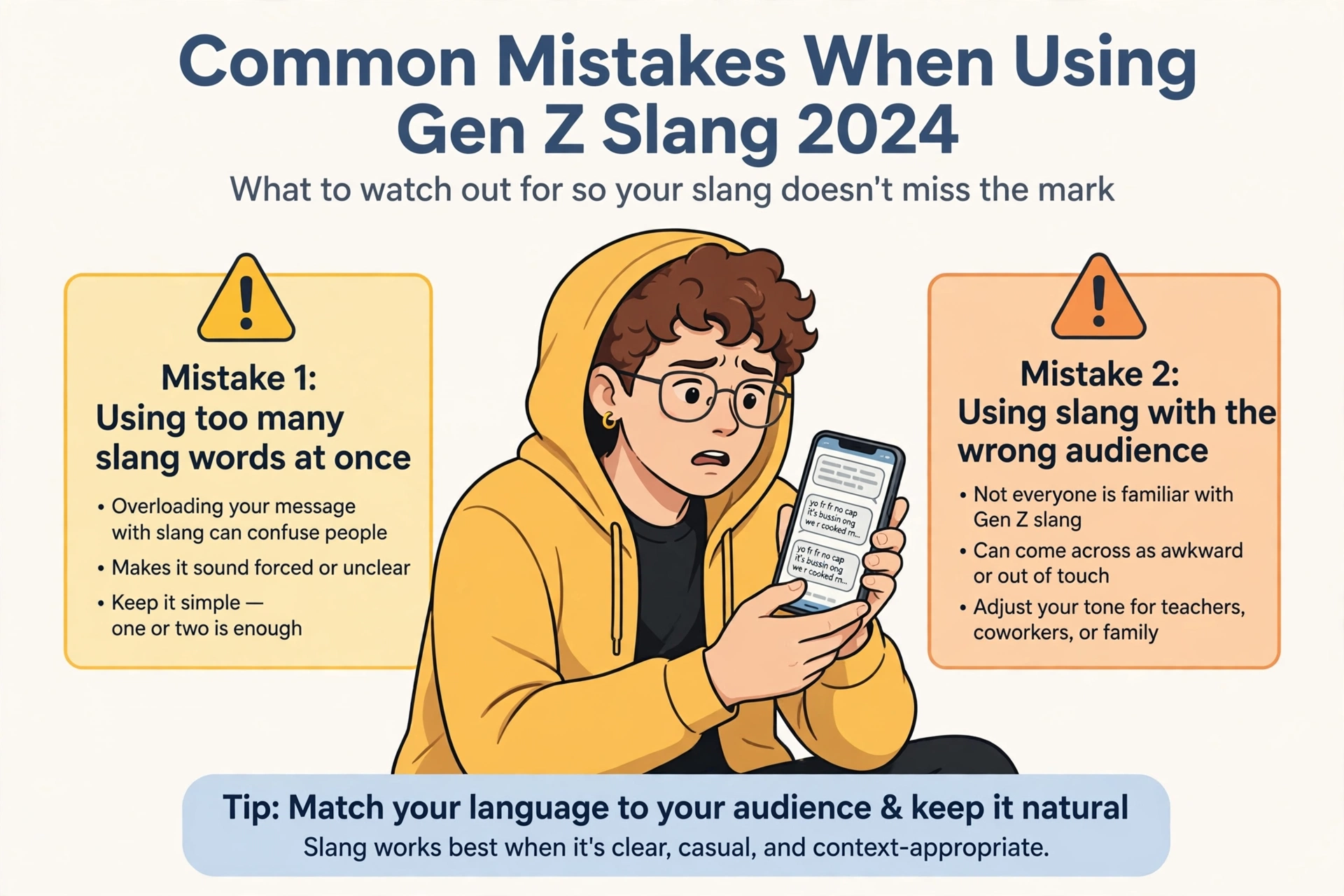
Most people do not misuse gen z slang 2024 because they do not know the words — they misuse it because they use the right words in the wrong way.
- Using too many at once. “No cap, that fit is bussin, she ate, slay, W rizz” sounds like a parody. Pick one.
- Using ironic words sincerely. Saying “very sigma” seriously in 2024 usually got you laughed at, because most users meant it as a joke by then.
- Using slang with the wrong audience. “Gyatt” and “NPC” can offend or confuse older colleagues, teachers, or strangers. Keep edgy terms for close friends.
- Copying words without knowing their roots. Many terms come from AAVE and Black culture. Using them while mocking the culture they came from is disrespectful, not funny.
- Forcing it to seem young. Nothing ages a sentence faster than slang used to impress. If a word does not feel natural to you, skip it — plain language is never cringe.
- Assuming slang is universal. A word that is huge on TikTok may mean nothing to your classmates or coworkers. Read the room before you drop a new term.
Quick Tips
- Learn five words deeply, not fifty shallowly. Master rizz, slay, no cap, delulu, and mid, and you will understand most 2024 content.
- Watch before you speak. Spend a week noticing how creators use a word before you use it yourself.
- Match the tone. Slang is casual by nature. Keep it out of job applications, formal emails, and serious conversations.
- Ask when unsure. “What does that mean?” is always cooler than pretending you know and getting it wrong.
- Let words expire gracefully. If everyone has moved on from a term, let it go. Chasing dead slang is the fastest way to sound out of touch.
- Use slang to connect, not to exclude. The best use of gen z slang 2024 is making a friend laugh or showing you understood the joke — not making someone else feel old.
- Keep a mental glossary. When you meet a new word, note the sentence it appeared in. Meaning lives in context, not in a dictionary definition alone.


FAQ
What is gen z slang 2024 in simple words?
Gen z slang 2024 is the informal vocabulary that Generation Z used most in 2024 — words like rizz, slay, sigma, no cap, and delulu — spread mainly through TikTok, gaming, and social media.
What does rizz mean in gen z slang 2024?
Rizz means charm or flirting ability, short for charisma. Someone with “W rizz” is good at attracting or impressing others; someone with “L rizz” is not.
What does slay mean?
Slay means to do something excellently. “She slayed that performance” means she performed brilliantly. It comes from drag culture, where “slaying” meant a show-stopping performance.
What does no cap mean?
No cap means “no lie” or “honestly.” It is used to emphasise that you are telling the truth: “No cap, that was amazing.”
What does sigma mean in 2024 slang?
Sigma originally described a lone-wolf, independent personality type. By 2024, most young people used it ironically, as a joke about someone trying too hard to seem cool and mysterious.
Is gen z slang 2024 still used today?
Some of it is. Words like slay, no cap, and rizz are still widely understood, while meme-heavy words like skibidi faded fast. Slang evolves quickly, so the most useful words are the ones with real meanings, not just meme value.
Is it okay for adults to use gen z slang?
Yes, in casual settings and in small doses. Use one term naturally with people who use it too, avoid edgy or culturally loaded terms you do not understand, and never use slang to mock young people.
Where can I learn more gen z slang?
TikTok, Urban Dictionary, and slang guides like this one are the fastest sources — but remember that TikTok trends change weekly, so always check the context and date of what you are reading. For the academic side, the Oxford English Dictionary tracks how words like rizz enter formal English.
Conclusion
Gen z slang 2024 was more than a list of funny words — it was a snapshot of how a generation talked, joked, flirted, and connected during a year when the internet set the pace of language itself. Words like rizz, slay, no cap, and delulu worked because they were short, expressive, and packed with feeling. They let people praise, tease, and belong in a single syllable.
The key takeaways are simple. Learn the big five words first, use slang lightly and in the right context, respect where the words came from, and never force a term just to sound young. Slang is at its best when it builds connection — a shared laugh, a quick compliment, a joke everyone gets.
Language will keep moving, and today’s slang will be tomorrow’s nostalgia. But if you understand gen z slang 2024, you understand something bigger: how fast culture moves now, and how a few small words can carry a whole generation’s sense of humour. Keep exploring — from regional trends like Australian slang to the newest TikTok terms — and you will never be lost in the comments again.

5 thoughts on “Gen Z Slang 2024: 60+ Words, Meanings & Examples That Ruled the Internet”