
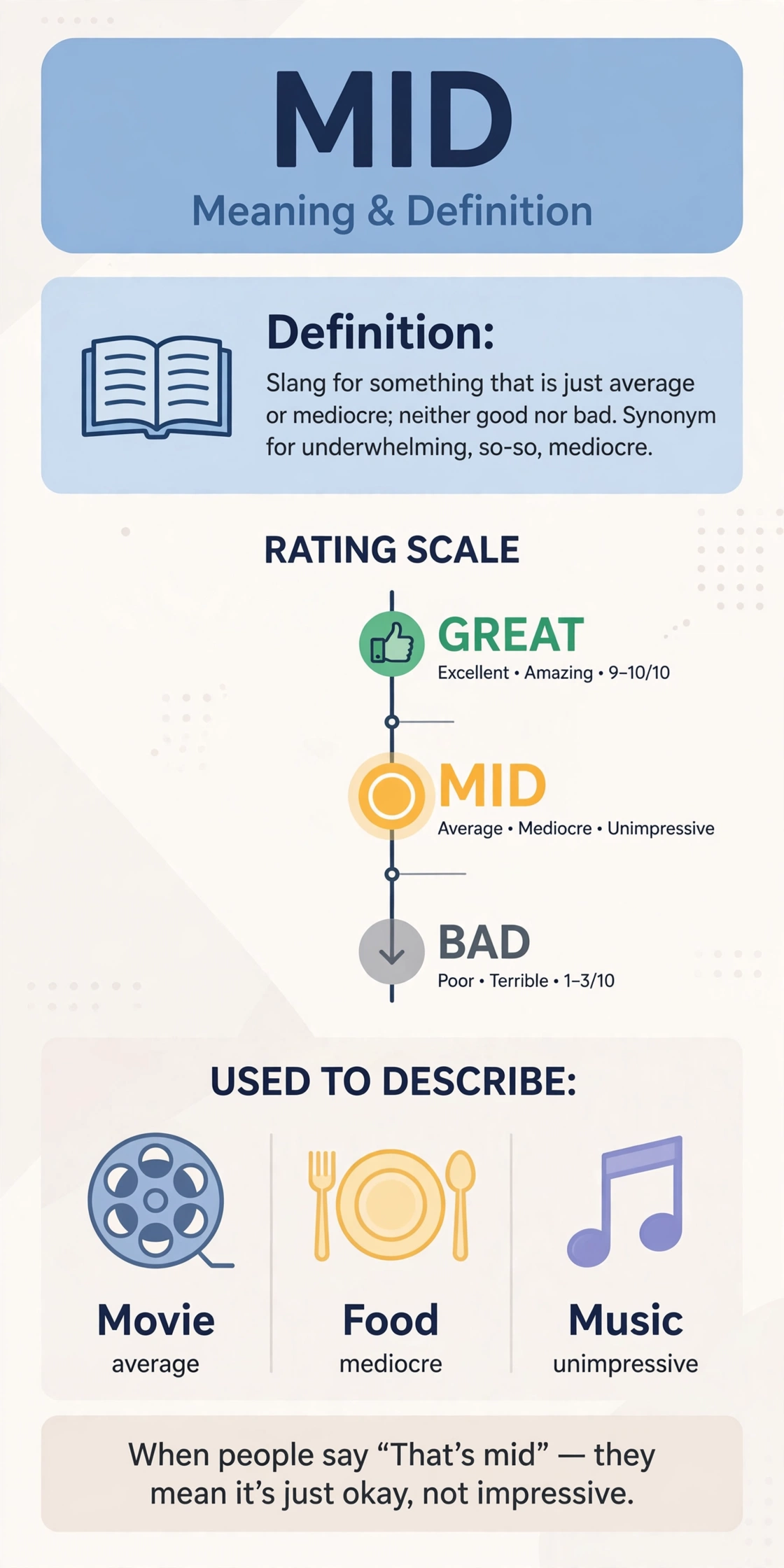
Quick definition: In slang, mid means average, mediocre, or unimpressive — something that is neither great nor terrible, just stuck in the middle. When someone calls a movie, a meal, a song, or an outfit “mid,” they are saying it failed to impress them, usually after they expected better. The word is short, blunt, and deliberately flat, and that flatness is exactly what gives it its sting.
Mid Meaning Slang & Definition
Mid meaning slang is simple on the surface: mid describes anything of middling quality. A mid movie is watchable but forgettable. A mid meal fills you up but earns no praise. A mid playlist has a few decent songs and a lot of skips. The word sits squarely between “bad” and “good,” and it refuses to pick a side.
What makes mid different from plain old “average” is the attitude behind it. Average is a neutral measurement. Mid is a verdict. It usually carries a note of disappointment, the feeling that something was hyped, anticipated, or supposed to be special, and then landed as ordinary. If a friend raves about a restaurant for a week and you finally go and find the food just okay, you do not call it terrible. You call it mid — and everyone in the group chat understands that the hype did not survive contact with reality.
Mid is also a word about expectations. A small neighborhood cafe with no reputation can serve a perfectly ordinary sandwich and nobody calls it mid, because nobody expected fireworks. But a blockbuster movie with a massive marketing campaign, a celebrity chef’s new restaurant, or an album everyone said would define the summer? Ordinary is not good enough there. Falling short of the hype is precisely what mid was made to describe. That is why the word shows up most often in reviews, reactions, and group-chat debates, where people are measuring things against what they were promised.
Grammatically, mid is flexible. It works as an adjective — “That game was mid” — and people also stretch it into comparative forms, calling something “midder” or “the middest,” especially online where the joke is part of the point. You will see it on its own as a one-word reply (“mid.”), paired with intensifiers (“so mid,” “kinda mid,” “lowkey mid”), and combined with other slang (“mid at best,” “mid, I’m not gonna lie”). In every form, the core meaning stays the same: not good enough to praise, not bad enough to hate, and not interesting enough to remember.
Introduction
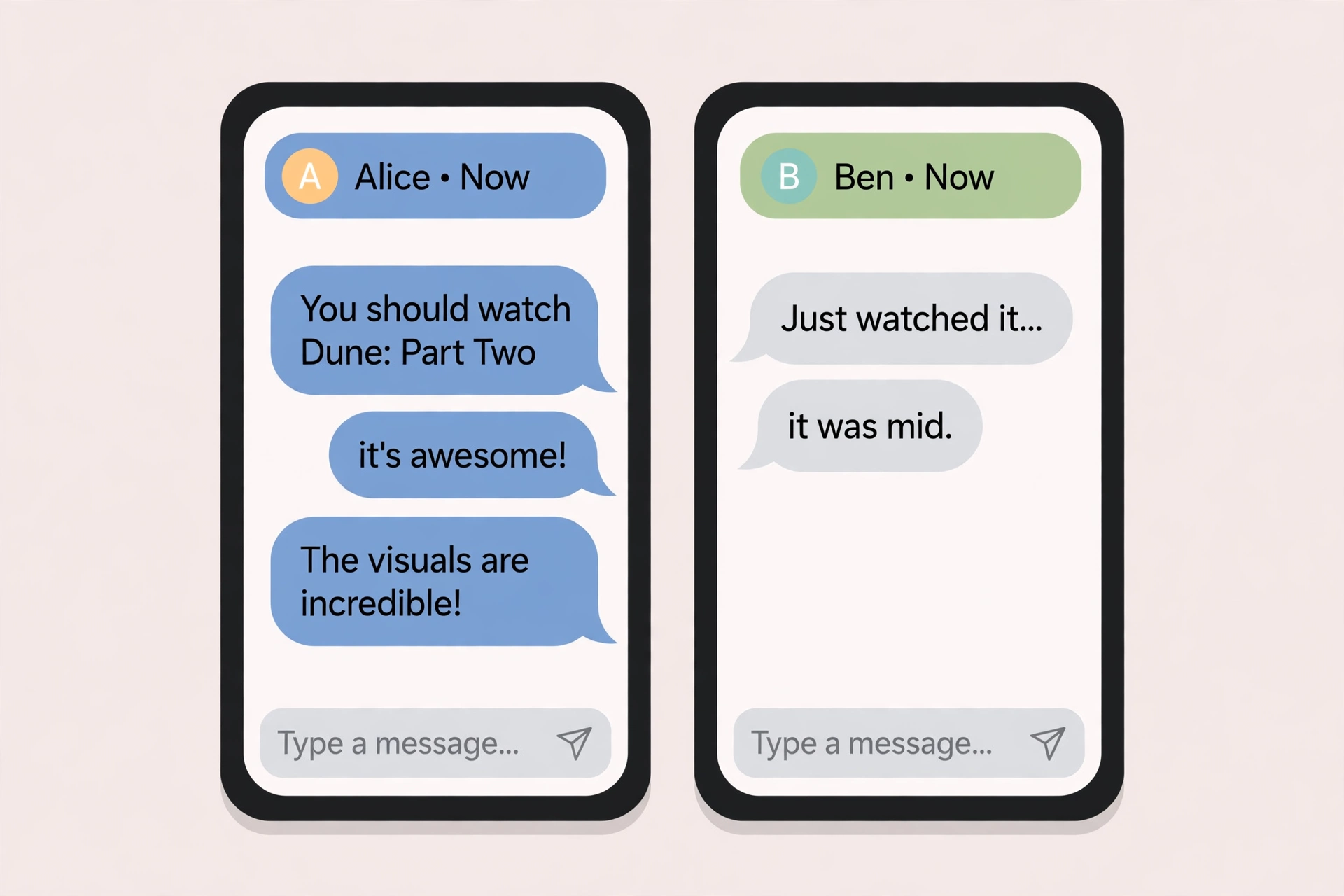
Some slang words shout. Mid whispers, and somehow that is worse. Imagine posting your favorite song of the year, waiting for your friends to agree, and getting a single reply: “mid.” No argument, no insult, no emoji. Just three letters that say your favorite thing barely registered. That tiny reply can end a debate faster than a paragraph of criticism, because there is nothing to argue with. Mid does not claim something is awful. It claims it is not worth strong feelings at all.
That is why mid has become one of the default review words of Gen Z and Gen Alpha internet culture. In a world of endless content — endless albums, shows, games, restaurants, outfits, and takes — people needed a fast way to sort the forgettable from the memorable. “Good” and “bad” are strong claims that invite debate. “Mid” is a shrug in word form. It says: I consumed it, I felt nothing, and I have already moved on. On TikTok, in Twitter replies, in Discord servers, and in text threads, mid has become shorthand for the most common verdict of all: it was fine, and fine was not enough.
This guide explains everything about mid meaning slang: what it means, where it came from, how people actually use it in texts and on social media, how it compares to words like “meh,” “basic,” and “trash,” what mistakes to avoid, and what to say when you want to be kinder — or sharper. Whether you saw it in a comment section, heard it from a teenager, or got hit with it yourself, you will leave knowing exactly what mid means and exactly how much it was meant to sting.
Origin
The slang sense of mid did not appear out of nowhere. It grew out of the oldest meaning of the word — middle — and traveled through several very different communities before it landed on TikTok. Understanding that journey explains why the word feels so natural as a quality judgment: it was always about being stuck in the middle.
The earliest slang use most language watchers point to comes from cannabis culture in the early 2000s. Dealers and buyers sorted weed into rough quality tiers, and “mid-grade” — shortened to “mids” or “mid” — meant the middle tier: not the premium, high-potency product, and not the lowest-quality stuff either. It was ordinary, unremarkable, and a little disappointing if you had paid expecting better. According to Merriam-Webster’s account of the word’s history, that “mid-grade” usage is where the modern sense of mid as “mediocre” began, and by the late 2010s it had broken out of drug slang and started describing anything at all that fell short of expectations. The dictionary now lists the informal sense outright: mid means “neither very good nor very bad,” a synonym for “so-so” and “meh.” You can read the full entry at Merriam-Webster’s definition of mid.
Around the same time, other communities were using mid in the same middle-of-the-pack way, which helped the word feel familiar everywhere at once. In competitive gaming, especially League of Legends, “mid” is the middle lane, and “mid-tier” describes characters, strategies, and players that are average — usable, but nothing special. In professional wrestling fandom, the “mid-card” is the middle of the show: not the opening matches, not the main event, just the solid, forgettable middle. In music and sports debates, fans had long called teams and albums “middle of the road.” All of these uses pointed the same direction. Mid was already the word for the unremarkable middle; slang just made it an insult.
The tipping point came in 2021. In September of that year, a wave of tweets calling Drake’s album Certified Lover Boy “mid” went viral, and suddenly the word was everywhere. The joke was not really about one album. It was that a word this small could dismiss something that huge. From there, TikTok did the rest. Creators started rating everything — movies, fast food orders, celebrity outfits, first dates, entire cities — as either “fire” or “mid,” and the format was irresistible. A one-word review is perfect for a short video, a comment, and a caption. By 2022, mid was no longer niche internet slang. It was the default word a whole generation used for “I expected more.”
Popularity
Mid exploded because it solved a communication problem. Before mid, if you wanted to say something was mediocre online, your options were clumsy. “Mediocre” sounds like a school report. “Meh” sounds bored but vague. “Not that good” takes four words and invites a reply. Mid takes three letters and ends the conversation. It is fast to type, easy to say, and instantly understood by anyone who lives online. In group chats and comment sections, speed is everything, and mid won on speed.
TikTok made mid visual. The classic format is simple: a creator shows a hyped thing — a viral restaurant, a new sneaker drop, a trending show — pauses, and delivers the verdict. Sometimes it is a deadpan “mid.” Sometimes it is a tier list with mid sitting in the exact middle, below “fire” and “goated” and above “trash.” Sometimes it is a duet or a stitch, where one person’s excitement gets answered with another person’s flat “mid.” The humor comes from the gap between the hype and the verdict, and the word carries that whole joke by itself.
Music and celebrity culture kept the word in circulation. Album-release weeks now come with an unofficial mid watch: within hours of a big drop, timelines fill with people declaring the record mid, fire, or — the worst possible combination — “mid with two good songs.” Sports fans use it for teams that are neither terrible nor contenders, the squads you forget exist until the schedule reminds you. Gamers use it for updates, characters, and seasons. Food reviewers use it for restaurants that photograph beautifully and taste ordinary. Each community found its own use for the same idea, and that is why mid has lasted longer than most viral slang. It is not tied to one platform, one fandom, or one joke. It is tied to disappointment, and disappointment is universal.
Mid has also survived the usual slang life cycle — the moment a word gets explained in mainstream articles, it often starts to feel uncool — because it keeps reinventing itself. People now use it ironically, calling their own cooking, outfits, and days “mid” before anyone else can. They use it affectionately, teasing friends about a mid fit the way they might tease them about a bad haircut. They use it as a compliment in reverse, where “not mid” has become genuine praise: saying something is “not mid” means it cleared the bar that most things fail to clear. A word that can be an insult, a joke, and a backhanded compliment all at once is not going away soon.
How It Is Used
In everyday use, mid almost always describes a thing, an experience, or a performance — not usually a person directly, though it can shade into that. You call a movie mid, a meal mid, a party mid, a fit mid, a song mid, a date mid. The pattern is “that [thing] was mid,” or simply “[thing] is mid.” The word comes after the verb, flat and final, like a judge’s scorecard.
Tone matters more than grammar. Said with a laugh among friends, mid is a joke and an invitation to debate: “That movie was mid, fight me.” Said flatly in a reply, it is a dismissal: “mid.” Said about your own work, it is self-deprecation: “My presentation was mid, honestly.” Said about someone’s appearance or effort in earnest, it can genuinely hurt, because it does not attack what they did — it denies that what they did mattered. The same three letters can be playful or cutting depending on who says them, to whom, and whether everyone is laughing.
Mid also loves company. People rarely use it alone in longer messages; they qualify it. “Kinda mid” softens it. “So mid” sharpens it. “Mid at best” is a full verdict — it caps the praise at average and refuses to go higher. “Lowkey mid” admits a disappointment you almost feel guilty about. “Highkey mid” owns it loudly. And “mid, I’m not gonna lie” or “mid, no lie” frames the word as honesty, as if the speaker is bravely telling an uncomfortable truth. These little combinations are how people tune the word’s force without changing its meaning.
Here is a quick reference for the most common patterns:
| Pattern | What It Signals | Example |
|---|---|---|
| “That was mid.” | Flat verdict, mildly disappointed | “The sequel was mid.” |
| “Kinda / pretty mid” | Softer, more forgiving | “The food was kinda mid, but the vibes were good.” |
| “So mid” / “Super mid” | Stronger disappointment | “That concert was so mid for the price.” |
| “Mid at best” | Maximum dismissal, caps all praise | “His new album is mid at best.” |
| “Mid, I’m not gonna lie” | Presented as honest truth-telling | “Mid, I’m not gonna lie. I expected way more.” |
| “Not mid” | Actual praise — it cleared the bar | “Okay, that finale was NOT mid.” |
Notice what mid never does: it never explains itself. Nobody writes “mid because the pacing dragged and the third act collapsed.” If they wanted to explain, they would use different words. Mid is the headline, not the review. That is its power and its limit. It is perfect for a reaction, and useless for feedback — unless the person on the receiving end already knows why.
Examples
Mid shows up in every corner of online life, but the examples below cover the situations where you will meet it most. Read them with the tone in mind: the same sentence can be a joke, a review, or a wound depending on context.
Friendly Examples
Among friends, mid is usually playful. It is the word you use when you are teasing, debating, or bonding over shared disappointment — and everyone knows nobody’s feelings are really on the line.
- “We waited two hours for that burger place and it was mid. Never again 😭”
- “Your fantasy team is mid and you know it. I’m saying it with love.”
- “The party was kinda mid but the playlist saved it.”
- “I finally watched that show everyone’s obsessed with. Mid. Sorry, I don’t make the rules.”
- “My fit today is mid at best, don’t look at me.”
In friendly use, mid often comes with laughter, emojis, or an obvious exaggeration that softens it. The speaker is performing a hot take, not delivering a judgment. If your friend calls your cooking mid while eating a second helping, they are joking. If they call it mid and put the fork down, they are not.
Professional Examples
Mid is casual slang, so it rarely belongs in a workplace email or a formal presentation. But it does appear in creative and informal professional settings — marketing chats, content reviews, team brainstorms — where people borrow internet language to keep feedback fast and honest. Even there, use it carefully: it is a verdict, not a critique, and it tells the person nothing about what to fix.
- “The first draft of the ad is a little mid. The hook needs more energy in the first three seconds.”
- “That thumbnail is mid compared to last week’s. Let’s try a bolder color.”
- “The client called the concept ‘mid’ — I think they mean it’s safe, not that it’s bad.”
- “Our Q3 campaign was mid, honestly. Good reach, zero memorable moments.”
The pattern in professional use is worth copying: mid plus a reason. “Mid, but here is the fix” turns a dismissal into feedback. “Mid” on its own, in a work chat, just sounds like you gave up on the idea — and on the person who made it.
Funny Examples
Mid is funniest when the gap between the hype and the reality is enormous. The bigger the buildup, the funnier the flat verdict.
- “Traveled 400 miles to try the ‘best pizza in America.’ Mid. I could cry.”
- “He talked about his cooking for a month. The pasta was mid. The garlic bread was elite, though.”
- “My New Year’s resolution was to become a morning person. Day one was mid. Day two didn’t happen.”
- “Bought the viral water bottle. It holds water. Mid. Five stars for holding water.”
- “Told my grandma my favorite rapper dropped a classic. She listened for ten seconds and said, ‘It’s mid, honey.’ She’s not wrong.”
The humor works because mid refuses to match the energy around it. Everyone else is excited, and the mid verdict is a bucket of cold water delivered in three letters. Used on yourself, it is even funnier, because self-aware mid — admitting your own thing was ordinary — reads as confidence. You cannot be hurt by a word you already used on yourself.
Mid also appears in text-message shorthand that is easy to miss if you are not used to it:
| Text / Comment | Meaning |
|---|---|
| “mid.” | One-word dismissal. The period makes it colder. |
| “mid af” | Very mid. The intensifier removes all doubt. |
| “mid 😴” | Mid and boring — it put the speaker to sleep. |
| “L + mid” | A loss, and the thing was mediocre too. Double dismissal. |
| “mid take” | An average, unoriginal opinion, not a bad one. |
| “mid diff” (gaming) | The middle-lane player made the difference — often used ironically. |
Comparison with Similar Terms
Mid has a lot of neighbors, and mixing them up changes the meaning. “Bad” is a clear negative. “Meh” is a shrug. “Basic” is an accusation of unoriginality. Mid is its own thing: a quality judgment wrapped in disappointment. The table below shows how it stacks up against the words people use in the same conversations.
| Word | Core Meaning | How It Differs from Mid |
|---|---|---|
| Mid | Average, mediocre, unimpressive | The baseline: disappointed by unremarkable quality. |
| Meh | Indifferent, bored, unimpressed | About your feeling, not the thing’s quality. “Meh” can mean you just don’t care. |
| Basic | Unoriginal, mainstream, predictable | Attacks taste and originality. A basic thing can be well made; a mid thing is just average. |
| Trash / Garbage | Terrible, worthless | Much harsher. Trash says it failed; mid says it never tried hard enough to matter. |
| Overrated | Praised more than deserved | About the hype, not just the quality. Something can be mid without being overrated if nobody hyped it. |
| Okay / Fine | Acceptable, adequate | Neutral or mildly positive. Mid adds disappointment — okay was not enough. |
| Boring | Unexciting, dull | About interest, not quality. A mid movie can be loud and busy and still be mid. |
| Fire / Goated | Excellent, the best | The opposite end of the scale. “Fire” is what mid wishes it was. |
Two comparisons deserve extra attention because they trip people up. First, mid versus cooked: cooked means finished, done for, or in trouble — “he’s cooked” means someone is in a bad spot or has embarrassed themselves. A cooked performance can be memorably terrible. A mid performance is forgettably average. Cooked is a disaster; mid is a shrug. Second, mid versus “mid-tier”: in gaming and ranking culture, “mid-tier” is a formal placement — middle of a ranked list. It sounds similar, but it is a measurement, not an insult. Calling a character mid-tier in a tier list is analysis. Calling a character mid in a comment is a roast. Context tells you which one you are hearing.
It also helps to see mid on a scale, because that is how most people actually use it — as one stop on a ladder of quality:
- Trash / Garbage: actively bad, a waste of time.
- Mid: average, forgettable, failed to impress.
- Decent / Solid: good enough, does its job, no complaints.
- Fire / Hard: genuinely great, worth the hype.
- Goated / Elite: the best of its kind, unforgettable.
Mid’s special cruelty is its position. Trash gets a reaction. Fire gets praise. Mid gets nothing — and in internet culture, being unworthy of a reaction is the worst verdict of all.

Alternate Meanings
Like most short slang words, mid has other lives. None of them is the slang meaning people usually mean online, but knowing them stops embarrassing mix-ups.
1. Middle, as a prefix or short form. The original, literal meaning. “Mid-August,” “mid-morning,” “mid-season,” “mid-century” — mid marks the middle of something. If someone says “let’s meet mid-afternoon,” they are talking about time, not quality. This is also the sense in “mid-size” and “mid-range,” which describe size and price, not disappointment.
2. The middle lane in gaming. In League of Legends, Dota 2, and other MOBA games, “mid” is the middle lane, and a “mid laner” is the player who plays it. “Mid diff” means the difference between the two mid laners decided the game. In this context, mid is a position, not a judgment — though players absolutely use it as a judgment too, which is half the joke.
3. Mid-card in wrestling. In professional wrestling, the mid-card is the middle section of a show, and a “mid-carder” is a wrestler booked in that section — not a jobber at the bottom, not a main-event star at the top. Fans borrowed the idea to describe anything stuck in the respectable middle, and it fed directly into the slang sense.
4. “Mids” in cannabis slang. The historical root of the modern meaning: “mids” or “mid-grade” weed is middle-quality cannabis — not premium (“gas” or “loud”), not the lowest grade (“regs” or “schwag”). This is where the quality-judgment sense began in the early 2000s, before it spread to everything else. You will still hear “mids” used this way in older hip-hop lyrics and drug-culture references.
5. MID as an acronym. In technical and professional contexts, MID can stand for many things — a merchant ID, a mobile internet device, a manufacturing or medical term — depending on the field. None of these has anything to do with slang. If you see MID in all caps in a document, a form, or a spec sheet, it is almost certainly an acronym, not a review.
6. Mid as a name or nickname. Rarely, “Mid” shows up as a shortened name or gamertag. Context makes this obvious: nobody reviews a person’s username as “mid” unless they are joking, and nobody introduces themselves as “Mid” expecting a quality debate.
The practical rule is simple. If mid describes a movie, a meal, a song, an outfit, or a take, it means mediocre. If it describes a time, a lane, a card position, or an acronym, it means middle. The sentence around it almost always tells you which one you are reading.
Professional or Polite Alternatives
Mid is honest, but honesty without kindness is just a verdict. In real life — at work, with family, or when someone poured real effort into something — you usually want words that say the same thing more gently, or words that actually help. Here are alternatives for every situation where “mid” would be too blunt.
| Situation | Instead of “Mid” | Why It Works |
|---|---|---|
| Reviewing a friend’s cooking | “It’s good — the seasoning could be a little stronger next time.” | Praises the effort, names one fix. |
| Feedback on a colleague’s work | “It’s a solid start. The opening needs a sharper hook.” | Respectful, specific, actionable. |
| Talking about a movie with family | “It wasn’t really for me, but I can see why people like it.” | Honest without dismissing others’ taste. |
| Replying to a creator you follow | “Not your best one, but I’m looking forward to the next.” | Supportive, keeps the relationship intact. |
| Formal writing or a review | “Uneven,” “underwhelming,” “doesn’t quite live up to its promise” | Professional vocabulary for the same judgment. |
Formal synonyms worth knowing: mediocre, average, middling, unremarkable, underwhelming, run-of-the-mill, so-so, nothing special. Each carries a slightly different shade. “Underwhelming” is perfect when hype was involved. “Unremarkable” is the kindest formal option — it says the thing left no impression without calling it bad. “Middling” is the closest formal cousin to mid, and it is the word to reach for when you want the slang meaning in grown-up language.
And if you want to keep the slang energy but stay kind, try flipping the sentence. Instead of “That party was mid,” say “The party needed a better playlist, but the food was great.” Instead of “Your fit is mid,” say “That jacket is fire — the rest of the outfit just needs to catch up.” The trick is the same one good reviewers use everywhere: pair the criticism with something specific and something true. Mid skips both. You do not have to.
Common Mistakes
Mid is a small word with a lot of ways to use it wrong. These are the mistakes that make people sound older, harsher, or more confused than they mean to be.
1. Using mid to mean “bad.” Mid is not a synonym for terrible. If a movie was unwatchable, a meal was inedible, or a song was genuinely awful, call it bad, trash, or awful. Calling it mid actually softens the criticism — it says it was merely average. Save mid for the large middle ground where things are fine and forgettable, and your words will land more accurately.
2. Calling a person “mid” to their face. Online, “she’s mid” or “he’s mid” usually means someone’s looks, style, or overall vibe is average. Said to a person directly, it is personal and it stings far more than calling a movie mid. Objects and experiences are fair game for the word; people’s appearance is a line most friendships do not want crossed. If you would not say “you’re average-looking” to someone’s face, do not say “you’re mid” either.
3. Using mid in formal or professional settings without a reason. Dropping “mid” in a client presentation, a job interview, or an email to your boss reads as careless, not cool. It tells the room you could not be bothered to explain your judgment. In those settings, use “underwhelming,” “needs work,” or “doesn’t meet the brief” — and always add the reason. Slang is a tool for speed; formal settings reward precision.
4. Overusing it until it means nothing. Mid is powerful because it is flat and rare in a conversation. If every movie, meal, song, and day is mid, the word stops being a verdict and becomes background noise. Worse, you start sounding like someone who is impossible to please. Use mid for the things that genuinely disappointed you after real hype. For everything else, a plain “it was okay” is more honest — and more believable.
5. Confusing mid with “mid-tier” in gaming and rankings. In a tier list, mid-tier is a neutral placement. It does not automatically mean the thing is bad or disappointing; it means it sits in the middle of a competitive ranking where the middle is still strong. Calling a top-tier fighting game character “mid-tier” is analysis. Calling them “mid” in a comment is trash talk. Know which conversation you are in before you pick the word.
6. Taking “mid” as a fact instead of an opinion. This is the mistake on the receiving end. When someone calls your favorite album mid, they are not reporting a measurement. They are reporting a feeling — theirs. Mid is one of the most subjective words in slang, because “average” depends entirely on what the speaker expected. A movie that is mid to a lifelong fan can be a delight to a first-time viewer. Let the word be a data point about the speaker, not a verdict on the thing you love. The healthiest reply to “mid” is often a question: “What were you expecting?” That turns a dismissal into a conversation, which is the one thing mid is designed to prevent.
7. Using mid about things you have not actually tried. The internet is full of people calling albums mid an hour after release, restaurants mid from photos, and games mid from trailers. Secondhand mid is the weakest kind — it borrows someone else’s disappointment without the experience to back it up. If you have not watched it, eaten it, or played it, the honest word is “I haven’t tried it yet,” not “mid.” Your credibility survives the wait.

Quick Tips
Want to use mid like someone who actually lives online — and not like someone who just read a slang dictionary? These tips will get you there.
- Use it as a reaction, not a review. Mid shines in replies, comments, and group chats. For a full opinion, add reasons: “Mid — the first half was great, then it fell apart.”
- Pair it with the hype. Mid hits hardest when expectations were high. “After all that hype? Mid.” is a complete sentence and a complete argument.
- Soften it with “kinda” when feelings matter. “Kinda mid” tells a friend the truth without starting a fight. “Mid.” with a period tells them the debate is over.
- Claim it for yourself first. Calling your own work, cooking, or outfit mid is disarming. It shows self-awareness, and it takes the word’s power away from anyone else.
- Never use it as your only feedback. At work or in creative groups, always follow mid with one specific fix. “Mid, but the ending needs one more scene” is useful. “Mid” alone is just rude.
- Read the room before calling a person mid. About a celebrity’s outfit in a group chat? Fine. About a friend’s appearance to their face? Don’t. The word’s sting scales with how personal the target is.
- Try “not mid” for real praise. In a world where mid is the default, “not mid” is high praise. Save it for the things that genuinely surprised you — it lands harder than “good.”
- Don’t force it. If “average,” “okay,” or “underwhelming” fits better, use those. Mid works because it is specific. Forcing it into every sentence makes you sound like you are performing slang, not speaking it.
One last tip, and it is the most important one: mid is a word for things, not a word for people’s worth. Use it on movies, meals, and albums all you want. The moment it starts describing human beings, slow down and choose your words like they matter — because to the person hearing them, they do.


Mid Meaning Slang FAQ
1. What does mid mean in slang?
In slang, mid means average, mediocre, or unimpressive. Something described as mid is neither great nor terrible — it is stuck in the middle, and it usually failed to live up to expectations or hype.
2. Is mid a compliment or an insult?
It is a mild insult, but a specific one. It does not mean something is awful; it means it was not worth getting excited about. Among friends it is often a joke, but said flatly about someone’s effort, it can genuinely sting because it denies the thing mattered at all.
3. Where did mid slang come from?
The modern sense comes from early-2000s cannabis slang, where “mid-grade” described middle-quality product. By the late 2010s it had spread to anything mediocre, and it exploded on TikTok and Twitter in 2021, when viral tweets calling Drake’s Certified Lover Boy “mid” made the word mainstream.
4. What does “mid at best” mean?
“Mid at best” is the strongest version of the verdict. It means that even being generous, the thing only reaches average. It caps all praise at mediocre and refuses to allow that it might be secretly good.
5. What is the difference between mid and meh?
Meh describes your feeling — boredom or indifference. Mid describes the thing’s quality — average and unimpressive. You can feel meh about something great, and you can call something mid while caring a lot about why it disappointed you.
6. Can mid describe a person?
It can, and online it often does, usually about looks, style, or overall vibe. But calling a person mid to their face is personal and hurtful in a way that calling a movie mid is not. Most people use it about things and experiences, not about people directly.
7. Is mid still popular in 2026?
Yes. Mid has outlasted most viral slang because it is not tied to one platform or joke — it is tied to disappointment, which never goes out of style. It is now a standard part of Gen Z and Gen Alpha vocabulary, used ironically, affectionately, and as a genuine review word, often alongside terms like tuff and 2000s slang in the same conversations about what is fire and what falls flat.
8. What should I say instead of mid?
In polite or formal settings, use “average,” “mediocre,” “underwhelming,” “unremarkable,” or “doesn’t quite live up to the hype.” If you want to be helpful instead of just blunt, add a reason: “It was underwhelming — the second half dragged.” That says everything mid says, plus the one thing mid never does: why.
Conclusion
Mid is the smallest review in the English language, and that is why it works. In three letters, it says: I expected more, I got average, and I have already moved on. It grew from a word for the middle — of a lane, a card, a grade of product — into the default verdict for a generation drowning in content and allergic to hype. It is funny, it is flat, and it is, when aimed at a person instead of a thing, genuinely unkind. That range is what makes it worth understanding.
The next time you see mid in a comment section or hear it in a group chat, you will know exactly what happened: something was promised, something arrived, and the gap between the two was the whole story. And the next time you reach for the word yourself, you will know how to use it well — as a reaction with a reason, a joke among friends, or a piece of feedback that actually helps. Use it on movies, meals, and albums. Go easy on people. And remember the quiet compliment hiding inside the insult: in a world where almost everything gets called mid, being called “not mid” might be the best review there is. Like much of Ohio slang and the wider wave of internet terms that traveled from niche communities to everyone’s group chat, mid earned its place by naming a feeling everyone already had — the feeling of expecting fireworks and getting a shrug.

2 thoughts on “Mid Meaning Slang: Why Calling Something Mid Hits Harder Than Bad”