
Quick definition: Chicago slang is the set of words, phrases, and pronunciations that mark someone as from Chicago, Illinois — from classic Chicagoese like da, pop, and gym shoes to modern South and West Side terms like foenem, goofy, and opp that spread worldwide through drill music and TikTok. It is not one single vocabulary. It is two histories living in the same city: an older, working-class neighborhood dialect shaped by immigration, and a newer Black Chicago street and music vocabulary shaped by the Great Migration, house music, and drill. Knowing which one you are hearing is the difference between sounding local and sounding like a tourist reading a list.
Chicago Slang Meaning & Definition
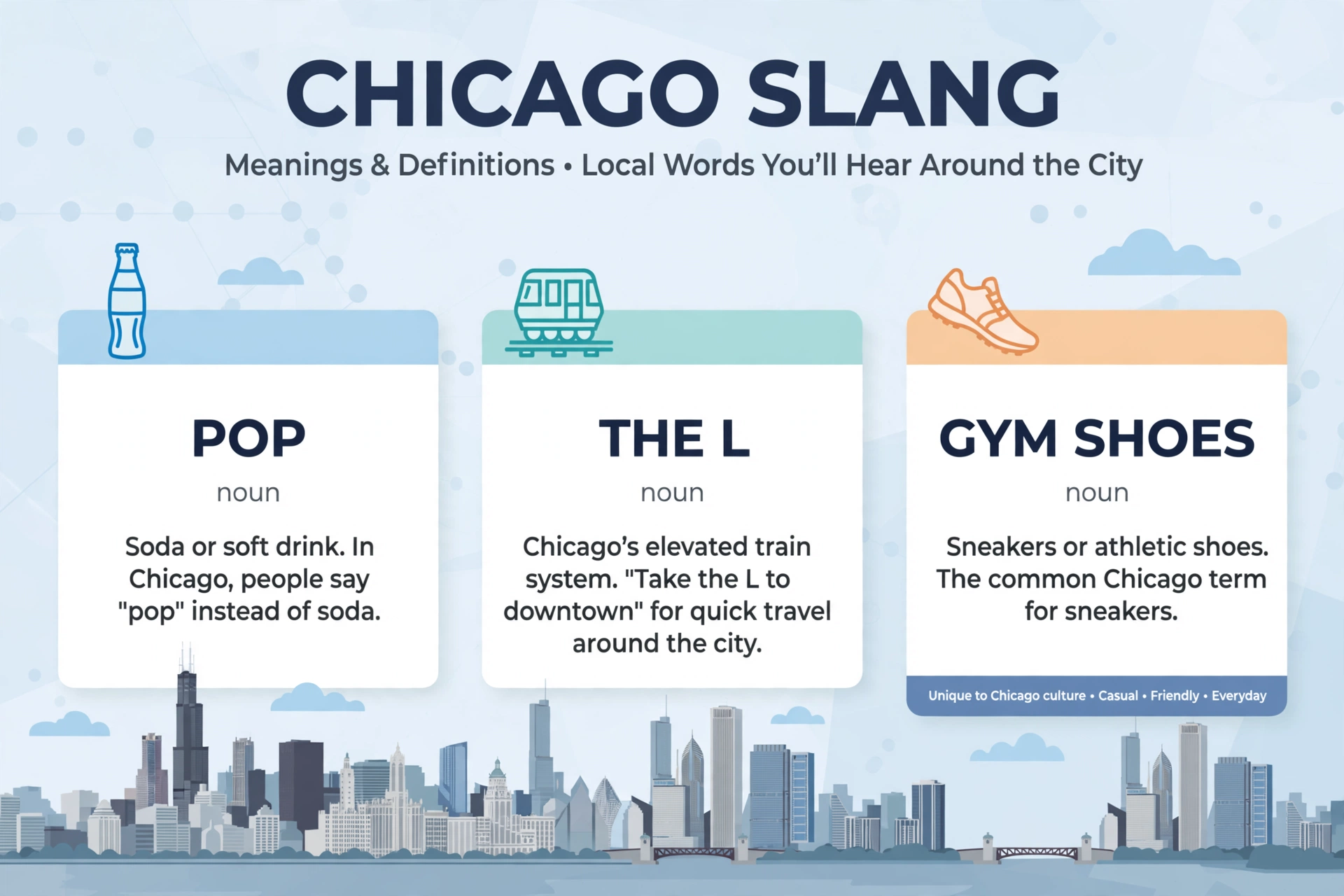
Chicago slang means the informal language associated with Chicago — its distinctive words for everyday things, its nicknames for places and teams, and its expressive phrases for people, attitudes, and situations. When someone searches for chicago slang, they usually want one of three things: a translation for a word they heard in a song, a caption, or a conversation; a list they can use without embarrassing themselves; or an explanation of why Chicagoans say da Bears instead of the Bears and insist that a soft drink is pop, never soda.
At its simplest, Chicago slang works like a local identity badge. Saying the L instead of the train, Jewels instead of the grocery store, or dibs for a parking space you shoveled out after a snowstorm tells a listener, instantly, that you know how the city actually works. The words are practical before they are funny. Gangway names the narrow passage between two brick buildings. Frunchroom names the front room of a bungalow where guests are received. Prairie names a vacant, weedy lot where kids play. Each term grew out of the city’s buildings, weather, transit, and neighborhoods — not out of a dictionary.
That is also why chicago slang can confuse outsiders. The same city that says over by dere and jeetyet? also says on foenem and stop tweakin. The first set comes largely from older European immigrant neighborhoods on the North, South, and Southwest Sides. The second comes largely from Black neighborhoods on the South and West Sides, and from the music those neighborhoods created. Both are real Chicago. Neither one, on its own, is the whole story. This article covers both, explains where each term comes from, and flags the ones that carry serious street weight and should not be thrown around casually.
Introduction
You hear it in the first five seconds of a drill track, in a TikTok caption, or from a friend who just moved to Wicker Park: a word that sounds familiar, used in a way that makes no sense. He goofy. That’s my foenem. Grab me a pop from Jewels. It’s brick outside. None of those sentences is hard once you know the code — but without the code, Chicago can sound like it is speaking a different language in the same English.
Chicago is a city of neighborhoods that stayed distinct for generations: Polish, Irish, Italian, Mexican, Puerto Rican, and Black communities, each with its own streets, churches, corner stores, and sounds, all pressed together by the lake, the expressways, and the elevated train. Chicago slang is what happens when those communities borrow from each other for a hundred years, and when the rest of the country starts listening through music, television, and social media. Some of it is warm and everyday — my guy, I got a guy, kickback. Some of it is sharp and territorial, and it arrived with a warning label that the internet often strips away. This guide keeps both sides in view, so you can understand what you hear, use the friendly terms with confidence, and leave the heavy ones alone unless you genuinely belong to the conversation.
If you are visiting, moving, writing, or just trying to understand a lyric, start here: learn the everyday words first, learn the drill-era words second, and never use a word as a joke before you know what it costs the people who live with it. That is the respectful way into any city’s slang, and Chicago rewards it. Locals are generous with explanations when they can tell you are actually listening.
Origin
The origin of chicago slang is the origin of Chicago itself: a railroad and stockyard city that drew wave after wave of newcomers, who then stayed in tight-knit neighborhoods. In the late nineteenth and early twentieth centuries, Irish, German, Polish, Italian, and Eastern European immigrants settled block by block. Their English mixed with their home languages, and with each other’s, producing the flat vowels and clipped phrases outsiders now call the Chicago accent — da for the, dese, dem, dose for these, them, those, and the famous Da Bears chant that Saturday Night Live turned into a national joke in the 1990s. The joke landed because the speech was real: working-class Chicagoans really did say it, especially older residents of South Side and Southwest Side neighborhoods.
A second great movement reshaped the city’s language from the 1910s through the 1970s: the Great Migration, when hundreds of thousands of Black Southerners moved to Chicago’s South and West Sides for factory and railroad work. They brought Southern Black English, church language, blues, and a storytelling style that would later feed Chicago house music in the 1980s and, three decades later, drill music. Words like finna (fixing to, about to), shorty, and juke have deep roots in Black American speech that Chicago made its own. When house DJs in Chicago warehouses needed a word for dancing, dodging, and messing around, juke was already there — and it later gave its name to footwork and juke music.
The third origin story is the city’s physical life. Chicago winters are brutal, its summers are humid, its buildings are brick bungalows and two-flats separated by gangways, and its transit is the L. Language followed the weather and the map. Dibs — claiming a shoveled parking space with a chair or a crate — only makes sense in a city that gets lake-effect snow and has more cars than plowed spots. The Lake means Lake Michigan, because what other lake is there? Expressways are known by name, not number: da Ryan, da Kennedy, da Stevenson, da Ike. Even food language is local: a sammich with Italian beef, a jumbo char-dog, mild sauce on fried chicken, and pop to drink. Chicago slang is, in large part, a map of how Chicagoans live.
The most recent origin is drill. In the early 2010s, young rappers from Chicago’s South Side — led by figures such as Chief Keef and King Louie — built a raw, minimalist rap sound and a vocabulary to match. Words that had circulated in neighborhood conversation for years, like opp, foenem, goofy, merch, and tweakin, suddenly traveled the world on YouTube and streaming. Chiraq, a portmanteau of Chicago and Iraq coined in that era, spread just as fast — and just as controversially, because it framed real neighborhoods as a war zone. Drill gave chicago slang its global moment, and it also gave the city a complicated argument about who profits when street language becomes content. That argument is still running, and any honest guide to the slang has to mention it.
Popularity
Chicago slang is more popular — and more misunderstood — than it has ever been. Drill music made it a global export: opp now appears in British drill, in TikTok captions from suburbs that have never seen the Dan Ryan, and in slang lists that strip the word of its neighborhood meaning. Foenem became a staple of captions and comments meaning my people, often used by people who have never heard it spoken in a Chicago living room. Goofy, tweakin, and slide followed the same path from neighborhood to timeline. Popularity, in other words, has outrun understanding, which is exactly why a clear, respectful explanation matters more than another bare list.
At the same time, the older Chicagoese never went away. Sports kept Da Bears, Da Bulls, and Da Sox alive. Food television kept pop, gym shoes, and Italian beef sammich in circulation. Chicago comedians, podcasters, and local news anchors still code-switch into over by dere and use guys when they want to signal that they are really from here. And every winter, a fresh viral video of a dibs chair in a shoveled parking space reminds the rest of America that Chicago has rules the rest of America does not have. If you want to see how chicago slang survives, watch what happens after the first big snow: the chairs come out, the arguments start, and the language does its work.
Social media changed the speed of it all. A phrase can go from a South Side block to a million For You pages in a day, and the comments will be full of people asking what it means, using it wrong, and arguing about who is allowed to use it. That is the modern life of chicago slang: hyper-visible, frequently misused, and still deeply local at its core. The terms in this article are the ones people actually search for, hear most often, and get wrong most often — explained with the context that makes them make sense.
How It Is Used
Chicago slang is used in three main settings, and the setting decides the meaning. In everyday neighborhood conversation, it is practical and warm: you ask for a pop, you meet at da Bean, you take da L to Wrigley, you tell a friend I got a guy who can fix the furnace. In music and online captions, it is performative and compressed: on foenem swears something is true, he tweakin says someone is overreacting, no lackin warns someone to stay alert. In comedy and sports talk, it is affectionate exaggeration: Da Bears, dese guys, frunchroom — a way of performing Chicago-ness for people who already get the joke.
Grammar matters too. Many Chicago terms work as nouns, adjectives, and verbs depending on placement. Goofy can describe a person (he goofy), an action (stop being goofy), or a situation. Tweakin can mean acting strangely, overreacting, or being under the influence, depending on tone and context. Slide can mean to visit (slide through), to dance, or — in drill lyrics — something far more serious, which is why you should never assume the lightest meaning is the intended one. Tone, relationship, and place do most of the work in chicago slang, just as they do in any living dialect. A word said warmly between friends can sound like a challenge from a stranger.
That is why the best rule for using chicago slang is simple: start with the everyday, place-based words, which are welcoming to anyone who uses them correctly, and treat the drill-era street terms as language to understand before you ever repeat it. If you are quoting a song, quote it. If you are talking to a Chicagoan friend, ask. If you are writing a caption, use the friendly terms and leave the heavy ones out. Nobody in Chicago ever lost respect for getting pop right and leaving opp alone.
For a sense of how regional vocabularies differ across the United States, compare this list with Florida slang, where sunshine, tourism, and a different migration history produced a very different set of local words — and with Gen X slang, which shows how a generation’s language can feel just as local, even when it traveled nationally.
Examples
The examples below show chicago slang in real sentences, grouped by tone. Read them aloud — Chicago slang is spoken language first, and it only sounds right when you hear the rhythm. Friendly examples are safe to use anywhere. Professional examples show how locals soften the slang for work and formal settings. Funny examples show the self-aware, exaggerated Chicago voice that locals use with each other, and that outsiders should enjoy rather than imitate too hard.
| Term | Meaning | Example sentence |
|---|---|---|
| Pop | A carbonated soft drink | “Grab me a pop from Jewels, I’m parched.” |
| The L | Chicago’s elevated train system (CTA) | “Take da L to Wrigley, driving is a nightmare.” |
| Foenem | Close friends, your people | “I’m with my foenem tonight, we good.” |
| Goofy | Foolish, fake, or crossing a line | “Stop being goofy, you know that ain’t right.” |
| Dibs | Claiming a shoveled parking space | “Don’t move that chair, that’s my dibs spot.” |
| Gym shoes | Sneakers, trainers | “Put on your gym shoes, we walking to the lakefront.” |
| Tweakin | Overreacting, acting strangely | “You tweakin, nobody even said that.” |
| Jagoff | A jerk, an inconsiderate person | “That jagoff cut me off on da Kennedy.” |
Friendly Examples
- “What up, my guy? You coming to the kickback tonight?” — My guy is a warm, general address for a friend, and a kickback is a small, relaxed get-together, not a big party.
- “I’m finna grab a pop, you want one?” — Finna means about to. The sentence is casual, generous, and completely ordinary in Chicago conversation.
- “Meet me over by dere, by the Jewels on Kedzie.” — Over by dere means over there, with the assumption that the listener knows the place. It is directional shorthand, not a joke.
- “Shorty from the neighborhood just opened a joint on 47th.” — Shorty is a familiar term for a young person or a girlfriend; a joint is a place, usually a restaurant or spot.
- “We sliding through the Taste later, you in?” — Slide through means to drop by or visit. The Taste is the Taste of Chicago food festival in Grant Park.
Professional Examples
- “Let’s take the L to the Loop meeting — parking downtown will eat our whole morning.” — Even in a work email, the L and the Loop are standard Chicago shorthand. Nobody translates them.
- “I got a guy who handles permits — I’ll connect you.” — I got a guy is Chicago’s way of saying I have a trusted contact. In business, it signals reliability, not anything shady.
- “It’s brick out, so the site walk is moved indoors.” — Brick for bitterly cold is understood in Chicago workplaces, though in a formal report you would write extremely cold.
- “Please don’t move the chairs in the lot — the crew is holding dibs spaces after the plow.” — Even a facilities note can use dibs, because in Chicago everyone knows the rule behind it.
- “The client is from out of town, so explain the Pedway route in plain terms.” — The Pedway is the downtown network of underground walkways. Using the local name, then explaining it, is the professional move.
Funny Examples (if applicable)
- “Da Bears. Dese guys. Frunchroom. Tree inches of snow. I rest my case.” — The greatest-hits version of Chicagoese, best delivered by an actual Chicagoan doing the SNL Superfans voice.
- “Jeetyet? No? Then get in the car, we going to Portillo’s.” — Jeetyet compresses did you eat yet? into one word. It is a question and an invitation at once.
- “He called it soda in front of everybody. In Chicago. On a Tuesday. The disrespect.” — Calling a soft drink soda instead of pop is the classic outsider tell, and locals will tease you for it forever.
- “My dibs chair has a name, a blanket, and a restraining order against your SUV.” — Dibs humor is sacred in February. Do not touch the chair. Do not joke about touching the chair.
- “I’m not saying the Kennedy is haunted, I’m saying I’ve aged three years on it today.” — Expressway traffic is a shared Chicago trauma, and joking about it is a bonding ritual.

Comparison with Similar Terms
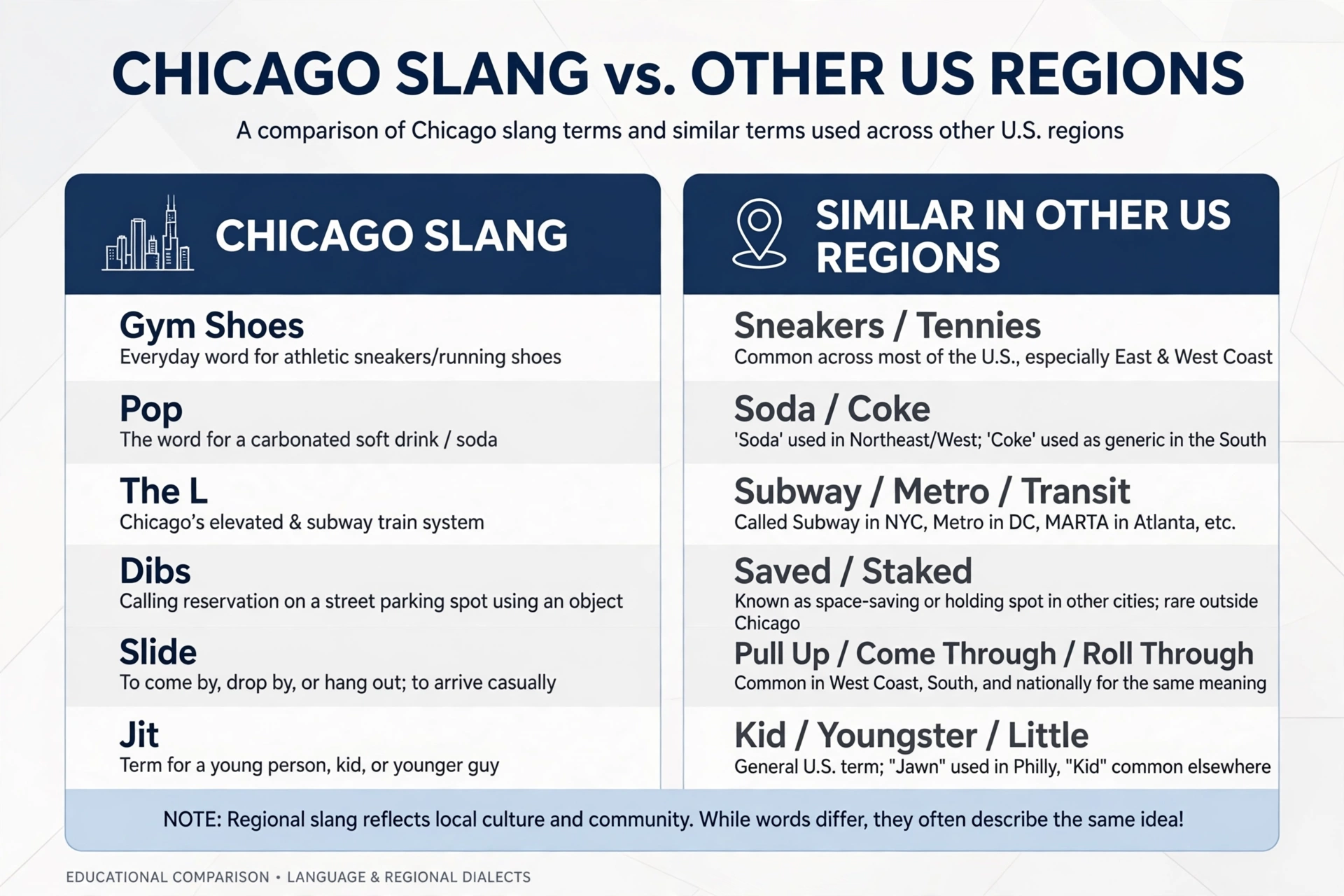
Chicago slang is often confused with general American slang, with other Midwestern slang, and with New York slang — and the differences matter. Pop versus soda versus Coke is the classic regional map: Chicago and much of the Midwest say pop, the Northeast and California say soda, and parts of the South say Coke for any soft drink. Using the wrong one in Chicago will not get you in trouble, but it will mark you instantly. Similarly, gym shoes in Chicago is what most of America calls sneakers or tennis shoes, and what New Yorkers might call sneakers too — but in Chicago, gym shoes is the default, everyday word, not a retro choice.
The drill-era terms need the most careful comparison, because similar words exist elsewhere with different weight. Opp in Chicago drill means an opponent or enemy, usually in a street or neighborhood conflict. In general internet slang it has softened into any rival — a sports rival, a hater, an ex. That softened use loses the original seriousness. Foenem is not quite the same as homies or my guys: it carries a tighter, family-like loyalty, closer to my brothers than to my acquaintances. Goofy in Chicago is harsher than the national meaning of silly: it can mean foolish, untrustworthy, or disrespectful, and calling someone goofy in the wrong setting is an insult, not a joke. And tweakin overlaps with trippin in general slang, but in Chicago it more often means overreacting or acting erratically in the moment, not just being dramatic.
Chicago’s older terms also have close cousins that are not quite the same. Dibs exists in other snowy cities, but Chicago’s version is a codified winter institution with chairs, crates, and unwritten enforcement. Gangway is used in other cities for a passageway, but in Chicago it specifically means the narrow side passage between brick buildings — a feature of the city’s lot-by-lot architecture. The L is not just the subway or the train: it is the elevated system, even for lines that run underground downtown, and Chicagoans will correct you if you call it the subway. For a broader regional comparison, Canadian slang shows how another cold-weather, lake-adjacent English developed its own everyday words — toque, double-double, washroom — from a different history, and 2000s slang shows how many terms that feel timeless actually arrived with a specific decade’s music and television.
| Chicago term | Similar term elsewhere | Key difference |
|---|---|---|
| Pop | Soda (Northeast, West Coast) | Chicago default; soda marks you as an outsider. |
| Gym shoes | Sneakers / trainers | Everyday Chicago word, not a style choice. |
| The L | Subway / metro | Elevated train system; never call it the subway. |
| Foenem | Homies / my guys | Tighter, family-like loyalty; not casual acquaintances. |
| Goofy | Silly / goofy (general) | Harsher in Chicago: foolish, fake, or disrespectful. |
| Opp | Rival / hater (internet) | Originally a serious street opponent; heavier weight. |
| Dibs | Saving a spot | Winter parking institution with chairs and unwritten rules. |
| Juke | Dodge / mess around | Also a Chicago house and footwork music tradition. |
Alternate Meanings
Many chicago slang terms have alternate meanings, and context decides which one applies. Slide is the best example: it can mean to visit casually (slide through), to dance or move smoothly, or, in drill lyrics, to retaliate violently. Never assume the friendly meaning when you hear it in a song — and never use the drill meaning casually. Merch usually means merchandise, but in Chicago drill-era slang it can also mean drugs or product being sold, and getting merch can mean getting money. Therm is Chicago slang for a firearm in some drill contexts, and for a thermometer or thermostat in ordinary speech; the difference is entirely in the sentence around it.
Older terms shift too. Joint can mean a restaurant or establishment (a new joint on Milwaukee), a marijuana cigarette in general slang, or a place to hang out. In Chicago conversation, the restaurant meaning is usually clear from context: that joint got the best mild sauce is about chicken, not anything else. Brick can mean extremely cold weather (it’s brick outside), a kilogram of drugs in street slang, or, in basketball, a badly missed shot. In everyday Chicago use, the weather meaning dominates, and it is the one visitors will hear most. Wild as an intensifier — that party was wild — is general slang now, but in Chicago it also survives as a description of someone unpredictable or out of control, closer to he wildin.
Place nicknames have alternate meanings as well. Chi-Town and the Chi are affectionate nicknames for the city, used by locals and visitors alike. Chiraq is different: it is a loaded, controversial nickname that compares parts of Chicago to a war zone. Many Chicagoans dislike it, especially when outsiders use it, because it reduces real neighborhoods to a headline. Second City sounds like a compliment — Chicago is second only to New York — but it began as an insult in a New Yorker series, and Chicagoans reclaimed it with irony. Knowing the alternate, heavier meaning of a nickname is part of knowing the city.
Even da has layers. As a pronunciation of the, it is everyday Chicagoese. As a chant — Da Bears! — it is sports identity. As a caricature, it is the thing outsiders imitate when they want to sound Chicagoan, which is why locals can hear it as affectionate or mocking depending on who says it and how. If you are not from Chicago, use da sparingly, and never as your opening impression of a Chicagoan. Listen first.
Professional or Polite Alternatives
You do not need to drop chicago slang entirely at work or in formal writing — you need to choose the register. The everyday, place-based terms are already professional in Chicago: the L, the Loop, the Pedway, Jewels, I got a guy, and kickback (in a social sense) all appear in offices, emails, and local news without raising an eyebrow. They are the city’s proper nouns in all but name. What changes in a formal setting is the drill-era and street vocabulary, which should be translated, not repeated.
- Instead of opp: say opponent, competitor, or critic, depending on whether you mean sports, business, or public debate. Opp in a work email will confuse people and, worse, trivialize a serious word.
- Instead of foenem: say close friends, my team, or my circle. The warmth survives; the street specificity, which is not yours to borrow casually, does not need to travel into a presentation.
- Instead of goofy (as an insult): say unreliable, unprofessional, or not taking this seriously. Direct, specific language is always more professional than a slang insult.
- Instead of tweakin: say overreacting, stressed, or not thinking clearly right now. It is kinder, clearer, and it does not imply anything about substances or mental state.
- Instead of jagoff: say inconsiderate driver, rude, or simply describe the behavior: he cut me off without signaling. Jagoff is funny among friends; it is not funny in a complaint letter.
- Instead of it’s brick: in a formal weather or facilities message, write extremely cold or give the temperature and wind chill. Save brick for the group chat, where everyone already knows.
- Instead of finna: say about to or planning to in formal writing. Finna is perfectly correct in conversation and in Black Chicago speech; it is simply informal, and formal writing has its own register.
The polite alternative is not about erasing Chicago. It is about matching language to audience, which is what good communicators in every city do. A Chicagoan who says the L in a board meeting and foenem at a kickback is not being inconsistent — they are being fluent. Fluency means knowing both registers and choosing on purpose.
Common Mistakes
The most common mistake with chicago slang is using drill-era street terms as if they were harmless internet slang. Opp, slide (in its retaliatory sense), merch, and therm describe real conflicts and real danger for the people who live with them. Repeating them in a caption, a joke, or a Halloween costume does not make you sound streetwise; it makes you sound like you learned a city from a playlist. If you would not say a word to a Chicagoan’s face, in their neighborhood, with their family listening, do not post it.
The second mistake is overdoing the accent. Da, dese, dem, dose, frunchroom, and grachki are real, but they belong to specific generations and neighborhoods, and they are not a costume. Walking into a Chicago bar and announcing Da Bears, jeetyet, over by dere in a thick accent will not earn you local status. It will earn you a polite smile and a story told about you later. Use the words naturally, in their normal spelling, and let the accent come from listening, not performing.
The third mistake is mixing up the two Chicagos. Calling a soft drink soda in front of a Chicagoan is a small, forgivable error — they will correct you and move on. Calling the L the subway, calling Lake Michigan a lake instead of the Lake, or asking where downtown Chicago is when you are already standing in the Loop, marks you as someone who has not yet learned the map. Learn the place names first: the Loop, the Magnificent Mile, Wrigleyville, Pilsen, Bronzeville, Hyde Park, Logan Square, Pilsen, the South Side, the West Side. The slang follows the map.
Other mistakes are smaller but common: using Chiraq casually, especially as an outsider; using goofy to mean merely silly when your listener hears an insult; using shorty for a stranger, when it is a term of familiarity; and using dibs language in summer, when there is no snow to shovel and no chair to defend. Chicago slang is seasonal, situational, and relational. The same word can be warm in February, wrong in July, and rude from a stranger at any time of year. When in doubt, ask a local what a word means to them — Chicagoans are usually happy to explain, and they would much rather explain than hear you get it wrong on the internet.

Quick Tips
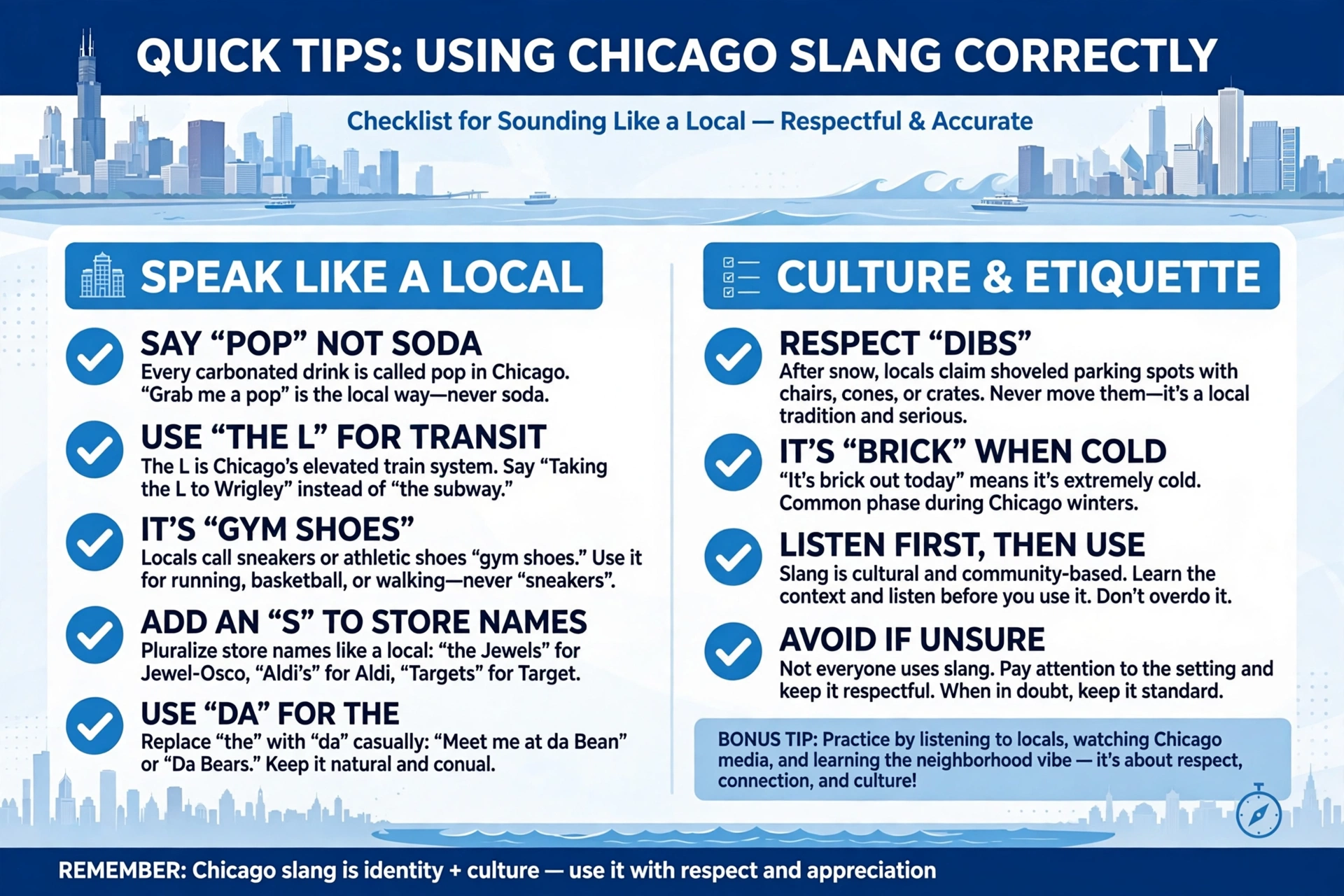
- Learn pop, the L, and gym shoes first. These three words alone will make you sound more local than any drill term, and they are safe in every setting.
- Say the Lake, not Lake Michigan, in conversation. Everyone knows which lake. The shorthand is the local signal.
- Never touch a dibs chair. If you see a chair, crate, or cone in a shoveled parking space after snow, that space is claimed. Move on. This is not a suggestion; it is Chicago law in all but statute.
- Listen before you repeat drill slang. Understand foenem, opp, goofy, and tweakin in context — in songs, in interviews, in conversation — before you use them yourself, and consider whether you need to use them at all.
- Use I got a guy with pride. It is Chicago’s highest compliment for a contact: reliable, vetted, and ready to help. Return the favor when you can.
- Match the term to the neighborhood. Jewels, gangway, and frunchroom belong to older Chicago; foenem and juke belong to Black Chicago and its music. Both are Chicago. Neither cancels the other.
- When writing, spell it normally. Write the in formal text, even if you say da aloud. Phonetic spelling in writing reads as mockery unless you are quoting speech directly.
- Check the weather meaning first. Brick means cold, wild can mean intense, and slide can mean visit. The lightest, most everyday meaning is usually the right one in conversation — but in lyrics, check again.
- Ask, don’t assume. “What does that mean where you’re from?” is a better Chicago sentence than any slang word used wrong. Locals respect curiosity more than performance.
- Leave Chiraq out of your vocabulary. Use Chicago, the South Side, or a neighborhood name instead. Specificity is more respectful, and more accurate.
FAQ
What does Chicago slang mean?
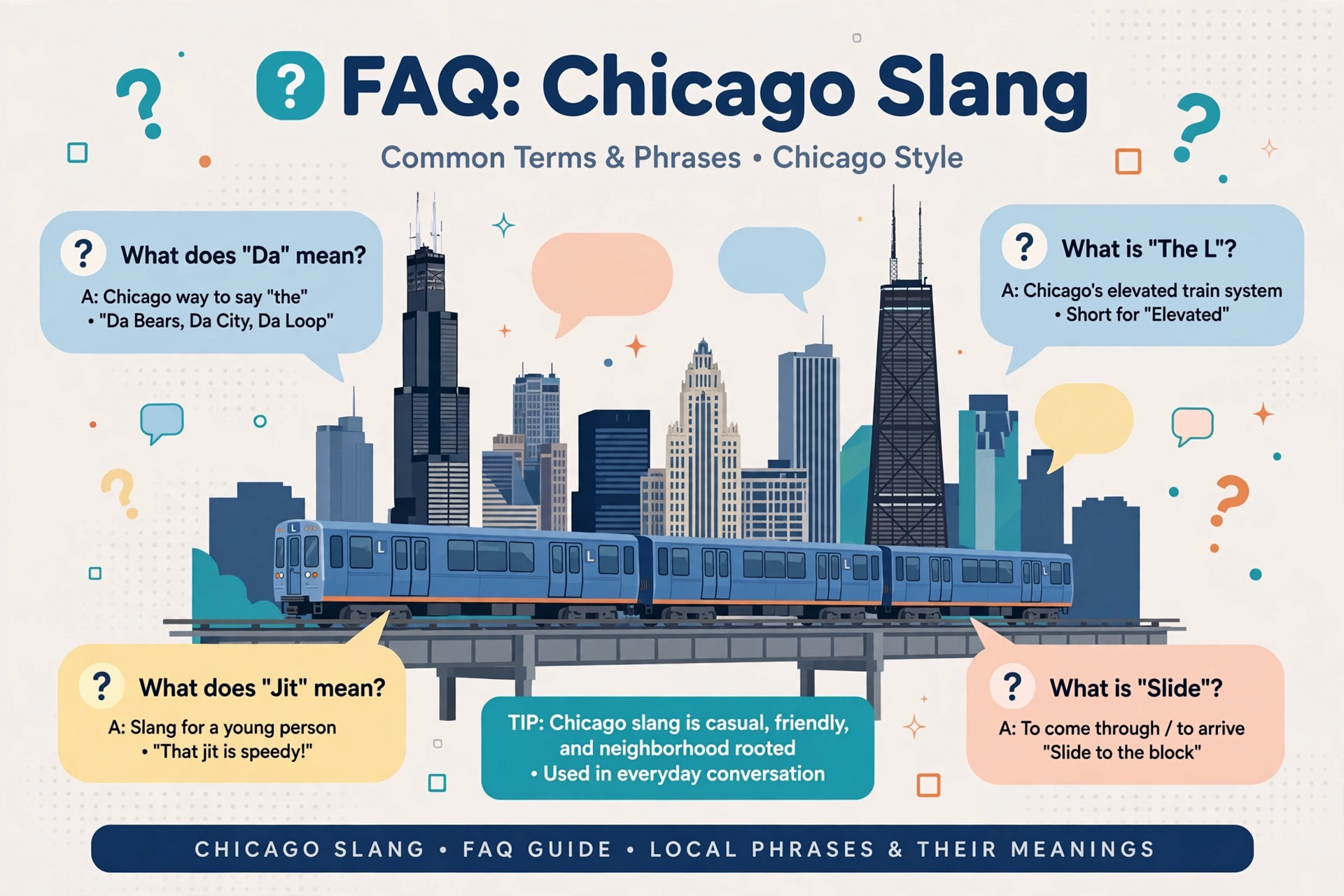
Chicago slang is the informal vocabulary of Chicago, Illinois — words like pop for soda, the L for the elevated train, gym shoes for sneakers, and modern terms like foenem and goofy from Black Chicago and drill music. It combines an older immigrant-neighborhood dialect (Chicagoese) with newer street and music language, and it functions as a local identity marker.
What is the most famous Chicago slang word?
Da, as in Da Bears, is probably the most famous, thanks to Saturday Night Live — but pop is the most used, and foenem and opp are the most searched today because of drill music and TikTok. The most famous depends on whether you mean classic Chicagoese, everyday life, or current internet slang.
What does foenem mean in Chicago slang?
Foenem (also spelled foe nem or foe n em) means your close friends, your people, your inner circle — closer to family than to acquaintances. It comes from foe and them, shortened in Black Chicago speech, and it is often used in the oath on foenem, meaning I swear on my people, this is true.
What does goofy mean in Chicago?
In Chicago, goofy is stronger than silly. It means foolish, fake, untrustworthy, or acting in a way that crosses a line. Stop being goofy can be friendly teasing between friends, or a serious warning, depending on tone and relationship. Do not use it lightly with strangers.
What does opp mean in Chicago slang?
Opp, short for opponent or opposition, means an enemy or rival, originally in street and neighborhood conflicts, and popularized by Chicago drill music. On the internet it has softened to mean any rival or hater, but its Chicago origin is serious, and it should not be used casually as a joke.
Why do Chicagoans say pop instead of soda?
Chicago is in the pop belt of the American Midwest, where carbonated drinks have been called pop — after the sound a cork or cap makes — for generations. Soda is the Northeast and West Coast term. In Chicago, asking for a pop is normal; asking for a soda will get you gently corrected, and probably teased.
What is dibs in Chicago?
Dibs is the unwritten Chicago rule that if you shovel a parking space out after a snowstorm, you may claim it by placing a chair, crate, or other object in it. Other drivers are expected to respect the claim. It is taken very seriously, it causes real arguments every winter, and visitors should never move a dibs marker.
Is Chiraq offensive?
Many Chicagoans find Chiraq offensive or at least reductive, especially when outsiders use it, because it compares their neighborhoods to a war zone and turns real violence into a brand. It originated in drill-era Chicago as a stark description, but as a casual nickname it is widely discouraged. Use Chicago or a specific neighborhood name instead.
Conclusion
Chicago slang is not a party trick. It is a living record of who built Chicago, who stayed, who sang about it, and who is still arguing about what it means. The older words — pop, the L, gym shoes, dibs, frunchroom, gangway — tell you how the city’s neighborhoods, winters, and transit shaped its speech. The newer words — foenem, goofy, opp, tweakin, finna, juke — tell you how Black Chicago’s music and conversation reshaped American slang, and how quickly the internet can carry a neighborhood word around the world without its context.
Use the everyday words freely and correctly, and you will be welcomed. Learn the drill-era words with respect, understand them before you repeat them, and leave the heaviest ones to the people who live with them. Ask questions, learn the map, never touch a dibs chair, and call it pop. Do that, and the next time someone says on foenem, it’s brick out, take da L, you will not need a list. You will just know — and that is what chicago slang is for. As Merriam-Webster defines slang in general terms, it is informal language that marks a group — and in Chicago, that group is a whole city, still talking, still inventing, and still very much itself. For one more regional comparison before you go, see how Florida slang grew from a very different climate and history, and why no two American cities sound quite the same.
