Quick definition: In slang, slime means a close, trusted friend — a brother, a day one, someone who has your back no matter what. When someone calls you “my slime,” they are not talking about goo. They are telling you that you belong to their inner circle, and that the bond between you is built on loyalty. The word comes from Atlanta hip-hop, where artists like Young Thug and Gunna turned it into a term of endearment, and it has since slid its way into group chats, TikTok captions, and everyday conversation far beyond rap music.
Slime Meaning Slang & Definition
Slime meaning slang is, at its heart, very simple: slime is a person you trust completely. A slime is not just a friend. A friend is someone you enjoy spending time with. A slime is someone you would vouch for, someone whose loyalty you never have to question, someone who was there before anything got good. That is why the word carries so much warmth. It is a small word doing a big job — it names a relationship, not just a feeling.
Think of it this way. Most friendship words describe how you feel about someone: buddy, pal, mate. Slime describes what you would do for someone. Calling a person your slime says, “We are locked in.” It says you share history, you share trust, and you share a code. Nobody calls a casual acquaintance their slime, because the word would sound wrong the moment it left their mouth. It belongs to the people who have earned it.
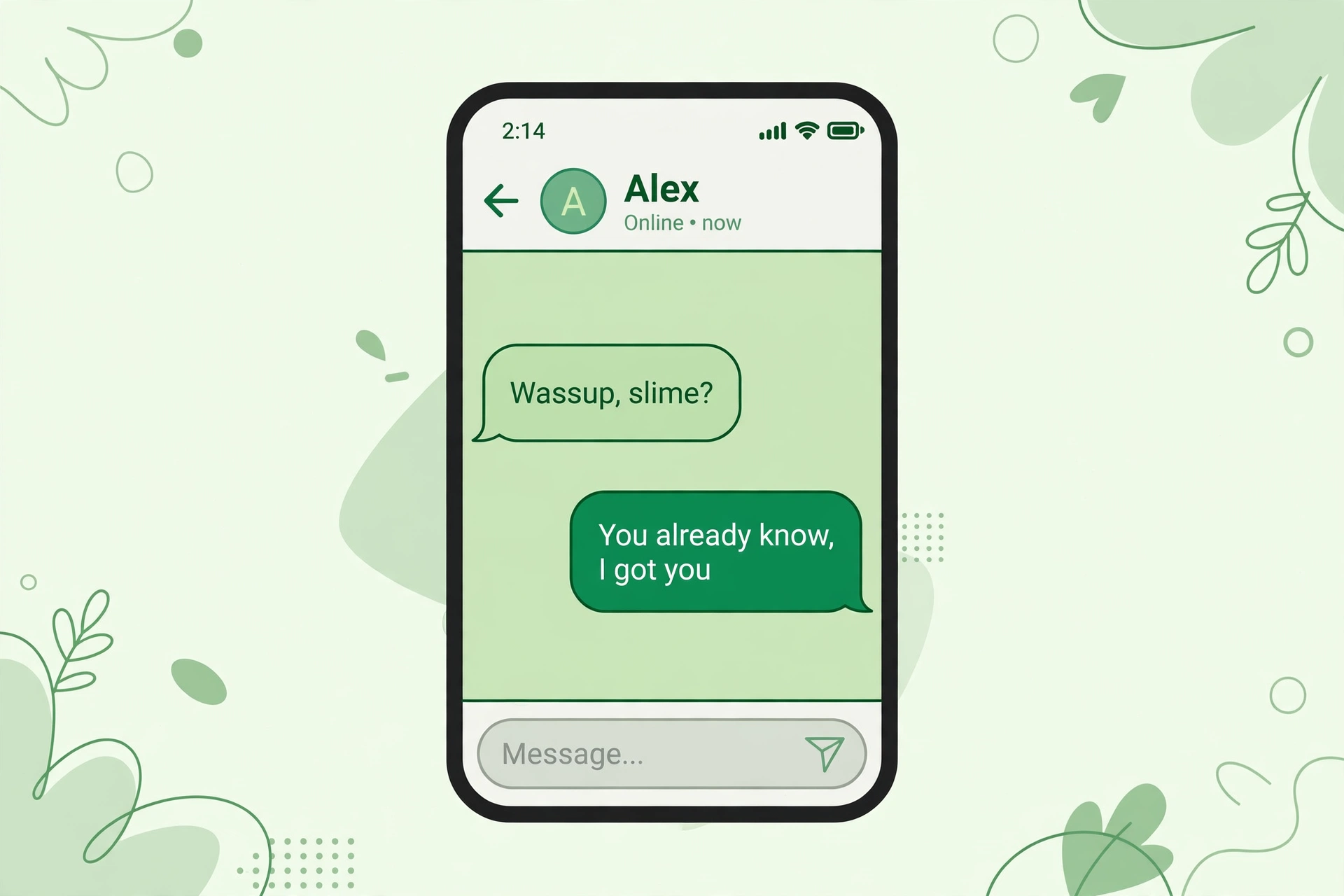
Slime can also work as a greeting and as an identity. “Wassup, slime?” is a hello reserved for the inner circle. “That is my slime right there” is an introduction and a warning at the same time: this person matters to me. And when someone says “I am slime,” in the sense Lil Keed once described it — something that is in you, not on you — they are claiming a way of carrying themselves: loyal, different, a trendsetter, someone others follow. The word is flexible, but its center never moves. Slime is always about closeness and loyalty.
It helps to know what slime is not. It is not a synonym for “dude” that you can throw at strangers. It is not an insult, even though the ordinary English word “slimy” means shady or slippery. And it is not the stretchy toy goo all over social media, even though that confusion is exactly why people search for the term. In slang, slime is a compliment of the highest order. It is the word you use when “friend” feels too small.
Introduction
Imagine opening your messages and seeing three words: “Wassup, my slime?” If you know the slang, you smile before you even reply. You know exactly who sent it, and you know exactly what it means. That person is not checking in out of politeness. They are reminding you that you are theirs, and they are yours. One little word carries the whole friendship in it.
That is the power of slime meaning slang. In a world where everyone online is a “bestie,” a “bro,” or a “fam,” slime survived because it stayed specific. It never became a generic hello. It stayed close to its roots in Atlanta hip-hop, where it meant the people you came up with, the people who were there on the hard days, the people you would never cross. When the word traveled to TikTok, Instagram captions, and school hallways, it brought that meaning with it — and that is why it still feels real when people use it well.
This article explains everything you need to know about slime meaning slang: where it came from, how Young Thug and Gunna made it famous, how people actually use it in texts and captions, how it compares to words like “bro” and “homie,” and the mistakes that make people sound like they are trying too hard. By the end, you will know not just what slime means, but when to use it, when to skip it, and why the people who use it best almost never explain it.

Origin
The story of slime meaning slang starts earlier than most people think. The term is widely credited with first surfacing in hip-hop in the late 1990s, when rapper N.O.R.E. used it in the music video for his 1999 single “Blood Money Pt. 3,” calling someone “slime” while ordering food. It was a small moment, but it planted the word in rap vocabulary: a casual, affectionate name for someone in your circle.
The word found its real home in Atlanta in the early 2010s. Atlanta has always been a factory for slang — words are born in studios, on street corners, and in group chats, and the best ones get carried around the world by the music. Slime was one of those words. It fit the city’s rap scene perfectly: short, sticky, easy to chant, and full of feeling. Rappers started using it in lyrics, in interviews, and on social media as a name for their crew, their day ones, their brothers.
Young Thug is the artist most responsible for making slime famous. Across his mixtapes, his social media, and his label YSL — whose name fans connect with the slime world — he used “slime” constantly, for friends, for collaborators, and for himself. His 2015 mixtape series Slime Season turned the word into a brand and a mood. Gunna, his close collaborator, used it just as naturally, and together they made “slime” sound like the most normal word in the world to millions of listeners. When Future and Young Thug released the joint mixtape Super Slimey in 2017, the word was no longer just Atlanta slang. It was national slang.
Young Thug himself has offered his own playful explanation of the word. In an Instagram post covered by HotNewHipHop, he said “slime” stands for “seeing lord in me everyday” — a positive backronym, in the same spirit as his explanations of other slang terms. Whether you treat that as the true origin or as Thugger being Thugger, it tells you something important: in his usage, slime was never meant as something dirty or shady. It was meant as something good. Reporters covering the story noted that his lawyer later made the same point in court, arguing that the slang in his music carried positive, social meanings rather than anything sinister. For everyday listeners, the takeaway is simpler. Slime, in the mouths of the artists who spread it, has always been a word about love and loyalty between friends.
From music, slime spread the way slang always spreads now: through captions, comments, memes, and videos. A lyric becomes a caption. A caption becomes a greeting. A greeting becomes a habit. By the late 2010s, teenagers who had never listened to a full Young Thug album were calling their best friends “slime” in the comments. The word had outgrown its birthplace without losing its meaning — a rare trick, and the reason it is still around.
Popularity
Slime meaning slang is popular today for a reason that has nothing to do with trends and everything to do with how people actually talk. Young people have always needed a word that separates real friends from everyone else. “Best friend” sounds like something from elementary school. “Bro” is so common it barely means anything anymore. Slime fills the gap. It sounds cool, it sounds exclusive, and it says something specific: this person is not just around, this person is mine.
On TikTok and Instagram, slime shows up in captions under photos with a best friend (“me and my slime”), in comments (“that is my slime fr”), and in videos where creators greet their crew. On X and in group chats, “wassup slime” works as a check-in that doubles as a compliment. In song lyrics, it is still everywhere — new artists keep using it because it instantly signals loyalty, street credibility, and closeness in a single syllable. The word has become part of what fans call “slime language,” the whole cluster of terms and phrases around Young Thug’s world: slime season, slime life, slime language, and the greeting itself.
Its popularity also got a boost from curiosity. When Young Thug’s trial put his lyrics and slang under a microscope, millions of people who had never thought about the word started searching for what it meant. News coverage explained the friendship meaning, and that coverage pushed slime from rap-fan vocabulary into general internet vocabulary. Like much of the slang that travels from Atlanta to the mainstream — the same wave that carried terms explained in guides to cooked slang and Ohio slang — slime arrived with its story attached, and the story made people want to use it correctly.
That said, slime is not as universal as “bro.” It still belongs mostly to people who listen to hip-hop, follow rap culture, or hang out in online spaces where that culture lives. Outside those spaces, it can confuse people — and that is part of its charm for the people who use it. Calling someone your slime is a small signal that you share a world. If the other person gets it instantly, you are in the same world. If they ask what it means, you just got to explain a friendship in one word, which is a pretty good conversation to have.
How It Is Used
Slime is mostly a noun, and it usually shows up in three patterns. Learn these three and you will understand almost every real-world use of the word.
First, as a direct address: “Wassup, slime?” / “What up, slime?” This is the greeting form. It replaces “bro,” “man,” or a person’s name at the start of a conversation, and it works because it flatters the person hearing it. You would not greet a stranger this way. You greet a slime this way because the greeting itself says, “You are one of mine.” In texts it often stands alone as an opener, sometimes with no other words at all: “Slime.” And the other person knows exactly what to do — reply like a friend.
Second, as a possessive: “my slime,” “my slimes,” “that is my slime.” This is the introduction form. It tells everyone listening that this person is claimed, protected, and trusted. “Me and my slime are going to the party” is not just a plan. It is a statement about who you move with. The plural, “my slimes,” refers to the whole crew, the inner circle as a group. It is less common than the singular, but you will hear it in lyrics and captions about a group of friends together.
Third, as a label for the lifestyle or the season: “slime season,” “slime life,” “it is slime season.” This is the branding form, borrowed directly from Young Thug’s mixtape titles. It does not describe one person. It describes a period, a mood, or a way of living — usually a period when you and your crew are winning, together, and unbothered. A caption that says “slime season” under a photo of friends on vacation means, roughly, “we are in our moment, and we are in it together.”
Slime also appears in a few common combinations. “Slime language” refers to the slang itself, the way of talking that comes with the word. “Slime talk” is similar: conversation full of this vocabulary. “Slime for life” or “slime ’til the end” is a loyalty pledge, the slang version of “friends forever.” And “real slime” or “true slime” separates the genuine article from people who just use the word — a reminder that the word is supposed to mean something, and that calling yourself slime does not make you slime. Behavior does.
Grammatically, slime is simple. It does not change form. You do not say “sliming” or “slimed” when you mean the friendship sense. You say “my slime” today, tomorrow, and next year, and it stays the same. That simplicity is part of why it caught on. It is one syllable, it hits hard, and it needs no explanation among the people who use it.
Here is a quick reference for the most common patterns:
| Pattern | What It Means | Example |
|---|---|---|
| “Wassup, slime?” | Greeting for a close friend | “Wassup, slime? You good?” |
| “My slime” | My trusted friend / brother | “That is my slime right there.” |
| “My slimes” | My inner circle, my crew | “All my slimes pulled up tonight.” |
| “Slime season” | Our moment; we are winning together | “Summer ’25: slime season.” |
| “Slime for life” | Loyalty pledge | “Slime for life, no matter what.” |
| “Real slime” | A genuinely loyal person | “He is real slime. He never switched up.” |
Tone matters a lot with slime. Said warmly, between friends, it is affection. Said proudly, in a caption, it is identity. Said coldly, about someone who betrayed the circle, it can turn sharp — because the worst thing you can say about a slime is that they stopped acting like one. The word carries expectations. Use it, and you are signing up for them.
Examples
Slime shows up in every corner of online life, but the examples below cover the situations where you will meet it most. Read them with the tone in mind: the same word can be a greeting, a compliment, or a test, depending on who says it and where.
Friendly Examples
Among friends, slime is almost always warm. It is the word you use when you are hyping someone up, checking in, or reminding them where they stand with you.
- “Wassup, slime? Long time no talk. We need to link up.”
- “Happy birthday to my slime. My brother for life, no debate.”
- “Me and my slime pulled up and shut the whole function down 😂”
- “You already know, slime. I got you, always.”
- “That is my slime. Do not play with him.”
- “Slime, you will not believe what just happened to me.”
In friendly use, slime often comes with laughter, emojis, or an inside joke that only the two of you understand. The word itself does half the work — it tells the other person, before anything else is said, that this conversation is between insiders. If a stranger called you “slime” in your messages out of nowhere, it would feel strange. From your best friend, it feels like home.
Professional Examples
Slime is casual slang, so it does not belong in a workplace email, a job interview, or a formal presentation. Nobody should call their manager “slime” and expect it to go well. But it does appear in informal professional settings connected to music, content, and youth culture — a studio session, a creative team chat, a caption for a brand that speaks to a young audience. Even there, it works only when everyone in the room already shares the culture. A rapper greeting a collaborator with “wassup, slime” in the studio is natural. A marketing executive using it in a pitch meeting is trying too hard, and everyone can tell.
- “Shoutout to my slime on the beat. This one is ours.” (studio / music caption)
- “Me and my slime built this brand from nothing.” (founder post about a close partner)
- “New drop with my slime. Go run it up.” (creator collaboration announcement)
The rule is simple: if you would not call the person “bro” in that setting, do not call them “slime” either. Slime is more intimate than bro, not less. Save it for the people and places where real friendship is the whole point.
Funny Examples
Slime is funny precisely because it sounds so serious and so silly at the same time. A word that means “my most trusted brother” also happens to be the name of a gooey green toy. That contrast is comedy gold, and the internet has mined it thoroughly.
- “My slime said he would pay me back. It has been six months. Slime season is over.”
- “POV: your slime asks for gas money but his car is a spaceship.”
- “He called me slime and then asked me to help him move. The loyalty test is real.”
- “Me: ‘wassup slime.’ My grandma: ‘Why are you calling him goo?’”
- “Slime for life — unless it is my turn to pay for food. Then I do not know him.”
The humor works because everyone knows the rule underneath the joke: real slimes show up. A slime who disappears when the bill arrives, or when moving day comes, is the punchline. The joke is never really about the word. It is about friendship, and about how quickly loyalty gets tested by small, everyday things.
Comparison with Similar Terms
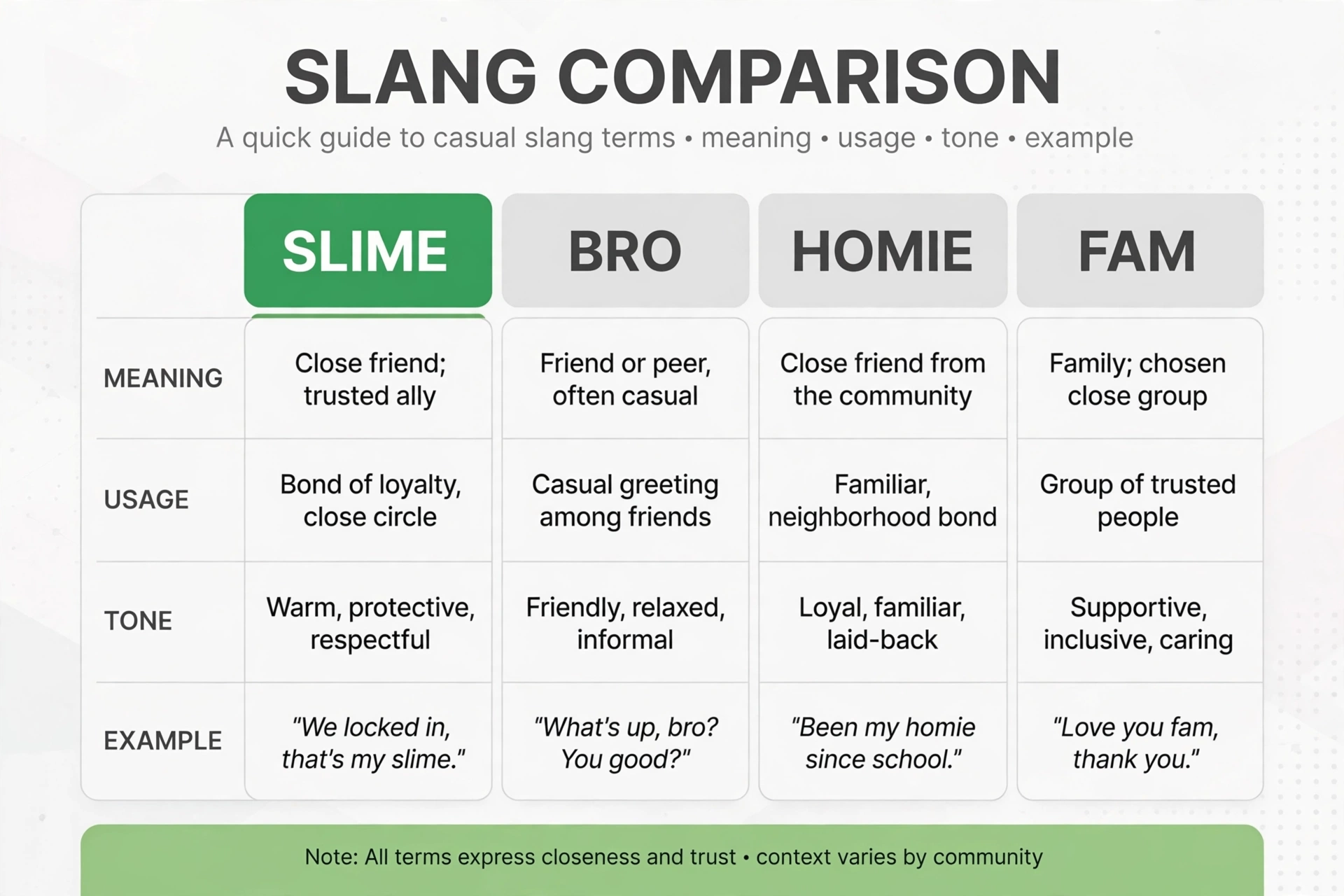
Slime overlaps with a lot of friendship words, but it is not interchangeable with any of them. Each word draws the circle a little differently. Understanding the differences is what keeps you from using the wrong word with the wrong person.
| Term | Core Meaning | How It Differs from Slime |
|---|---|---|
| Bro | Friend, guy, general greeting | Bro is for almost anyone. Slime is only for the inner circle. |
| Homie | Close friend, often from the same neighborhood | Homie is about shared roots. Slime is about proven loyalty. |
| Fam | Family-like friend | Fam stresses chosen family. Slime stresses loyalty and trust. |
| Day one | Friend from the very beginning | Day one stresses history. Slime stresses the bond right now. |
| Twin | Someone very similar to you | Twin is about sameness. Slime is about trust, not similarity. |
| Dawg | Close friend, loyal companion | Dawg is the closest cousin to slime, but slime is tied to hip-hop culture specifically. |
| My guy | Friend, approval, respect | My guy is lighter and more casual. Slime is heavier — it is a commitment. |
The closest comparisons are “dawg” and “homie.” All three say “you are my people.” But slime carries a specific cultural signature that the others do not. When someone says “slime,” they are usually signaling a connection to Atlanta rap culture, to Young Thug’s world, to a particular way of talking about loyalty. “Dawg” could come from anywhere. “Slime” comes from somewhere, and the people who use it know where.
There is also a difference in direction. “Bro” and “my guy” can be used upward, downward, or sideways — to a stranger, a fan, a coworker. Slime almost always goes sideways, between equals who have already proven themselves to each other. That is why it sounds wrong when a brand, a politician, or a stranger uses it. The word is a membership card, and you cannot print your own.
Alternate Meanings
Slime is a word with a double life, and the other life is much older than the slang. Knowing the alternate meanings keeps you from misunderstanding a sentence — and from accidentally using the wrong one.
The original meaning is the substance: a thick, gooey, slippery material. Toy slime — the stretchy, colorful putty that took over YouTube and TikTok in the mid-2010s — is the version most young people picture first. ASMR slime videos, slime-making tutorials, and slime shops turned a science-class material into a whole hobby. Nickelodeon’s green slime, dumped on celebrities for decades, is the pop-culture version. None of this has anything to do with friendship. If someone says “I made slime last night,” they almost certainly mean the toy, not a new best friend.
The second alternate meaning comes from the adjective “slimy.” In ordinary English, a slimy person is shady, slippery, or untrustworthy — someone who slides out of responsibility. This is the exact opposite of the slang meaning, which is why context is everything. “He is slime” in slang means he is loyal and loved. “He is slimy” in ordinary English means he cannot be trusted. The two uses live side by side, and native speakers tell them apart by the form of the word and the situation. Slime, the noun, as a name for a friend: positive. Slimy, the adjective, describing character: negative. Keep them separate and you will never confuse them.
A third, smaller meaning lives in gaming. In Minecraft, a Slime is a green, cube-shaped mob that bounces around and splits into smaller slimes when defeated. Gamers talking about “farming slimes” are talking about the mob, not their friends. The same goes for “slime” in other games and cartoons, where it is usually a cute or gross blob creature. These uses are harmless, but they are another reason the slang needs context to land.
Finally, there is the verb sense that floats around the edges of the slang. In some rap lyrics and street talk, “to slime someone out” can suggest betraying or setting someone up — playing on the slippery, untrustworthy side of the word. This usage is much rarer than the friendship meaning, it is heavily context-dependent, and it is not how most people use the word in texts or captions today. If you hear it, the surrounding sentence will usually make the meaning clear. When in doubt, assume the friendship meaning first: it is by far the most common one in everyday conversation.
The practical rule: if slime is used as a name for a person, with warmth, it is slang. If it is used to describe a substance, a toy, or a creature, it is literal. If it is used as “slimy” to describe someone’s character, it is the negative English sense. Three meanings, one word, and the sentence around it always tells you which one you are looking at.
Professional or Polite Alternatives
Slime is a great word for your inner circle and a bad word for almost everywhere else. When you need to express the same feeling in a setting where slang would sound wrong, these alternatives carry the meaning without the risk.
- Close friend: The safe, universal choice. “He is a close friend of mine” works in any setting, from a wedding speech to a work introduction.
- Trusted friend: Adds the loyalty element that makes slime special. “She is someone I trust completely” says what slime says, in plain language.
- Brother / sister: For the chosen-family feeling. “He is like a brother to me” is the formal version of “he is my slime,” and everyone understands it.
- Day one: Still slang, but softer and more widely understood. It works in casual conversation with people who may not know slime slang.
- Best friend: Simple, warm, and appropriate for school, family, and social media captions aimed at a general audience.
- Confidant: The formal option. Use it in writing or in professional settings where “trusted friend” sounds too casual.
The trick is matching the alternative to the audience, not just the meaning. With your crew, say slime. With your grandmother, say “my best friend.” With a colleague, say “a close friend I trust.” The feeling stays the same. Only the packaging changes — and good communicators always adjust the packaging.
Common Mistakes
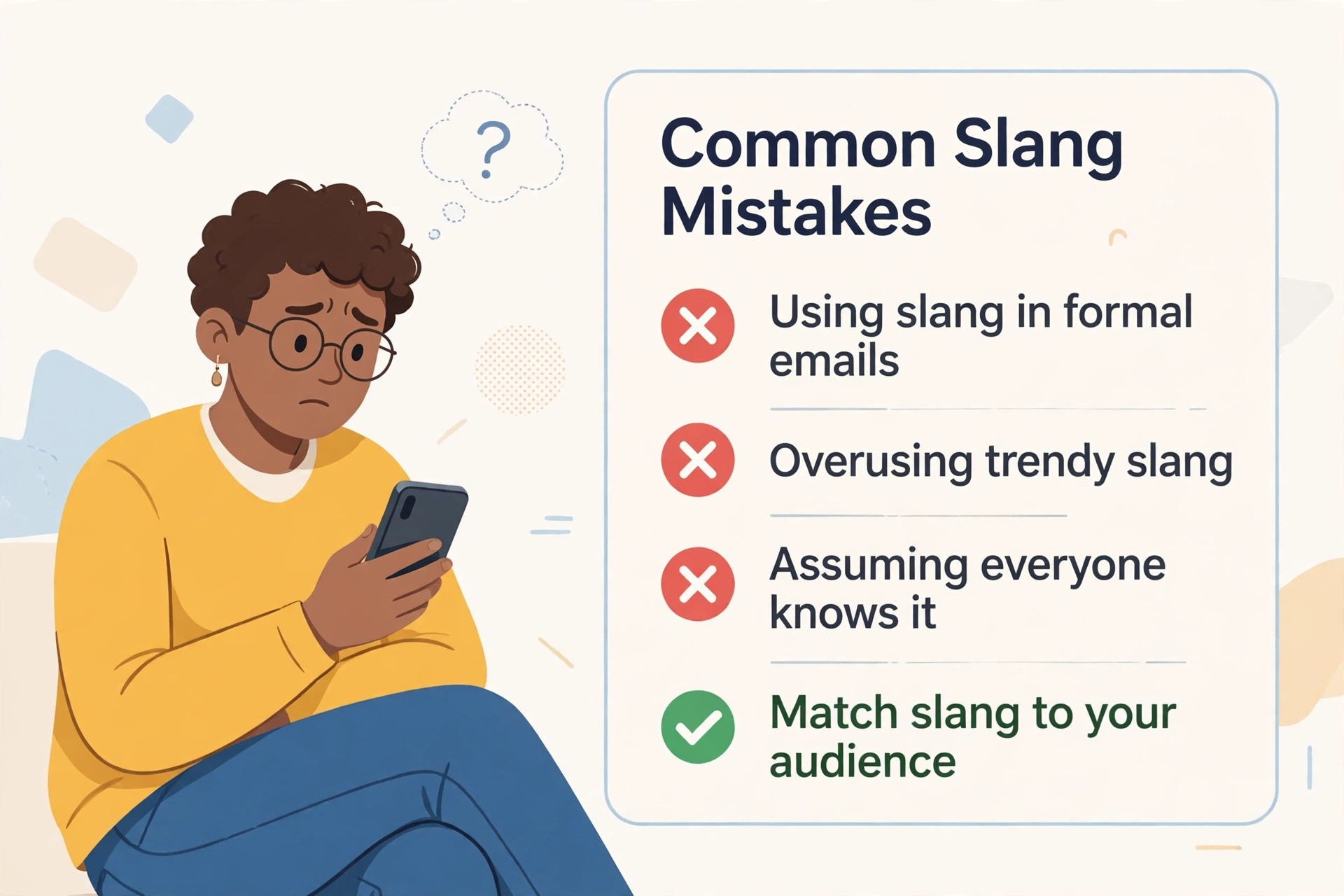
Most mistakes with slime meaning slang come from using a very specific word in a very general way. Avoid these, and you will sound like someone who actually knows the culture instead of someone who just heard the word yesterday.
- Calling everyone slime. The word means something because it is selective. Call your barista, your classmate, and your cousin all “slime” in the same day, and the word stops meaning anything. Reserve it for the people who have earned it.
- Using it with strangers. “Wassup, slime?” to someone you just met online is not friendly — it is confusing, and sometimes a little creepy. The greeting assumes a history you do not have yet. Earn the history first.
- Using it at work or school formally. Calling a teacher, a boss, or a client “slime” is a fast way to sound unserious. Slime lives in friendship. Keep it there.
- Confusing slime with slimy. “He is slime” (friend, positive) and “he is slimy” (shady, negative) are opposites. Mixing them up flips your sentence upside down.
- Explaining the joke. Nothing kills slang faster than a footnote. If you have to say “slime means my friend, it is from Young Thug,” you are talking to the wrong audience for the word. Use a plain alternative instead, and save slime for people who already get it.
- Forcing it into every sentence. Slime is a spice, not a main course. One “wassup, slime” in a conversation is natural. Five in a row sounds like a performance. People notice when a word is doing all the work.
- Using it to claim a crew you do not have. Posting “slime season” with people you barely know invites exactly the reaction you do not want: eye rolls from the people who actually live the word. The culture around slime values proof over claims.
Here is a quick table of the most common mix-ups:
| Mistake | Why It Fails | Say This Instead |
|---|---|---|
| Calling a stranger “slime” | Assumes a closeness that is not there | Use their name, or “hey” |
| “He is so slimy” (meaning loyal) | Slimy means shady, the opposite | “He is my slime” or “he is solid” |
| Using slime in a formal email | Too casual and too intimate | “Close friend” or “trusted colleague” |
| Calling the toy “slime slang” | Different meaning entirely | Just “slime” for the toy, in context |
| Using it five times per message | Sounds forced and performative | Once per conversation is plenty |
Quick Tips
Want to use slime meaning slang well? These five tips cover almost everything.
- Listen before you use it. Hear how the people around you use slime — who they say it to, when, and in what tone. Copy the pattern, not just the word. Slang is a social skill, and listening is how you learn it.
- Start with “my slime,” not “slime” alone. “My slime” is the safest entry point. It is clearly affectionate, clearly about a specific person, and hard to misunderstand. The bare greeting (“wassup, slime”) comes naturally once the friendship is obvious to everyone.
- Match the relationship. If you would trust this person with your phone passcode, your secrets, and your worst day, they can be your slime. If you would not, use a lighter word. The word should fit the friendship, not the other way around.
- Keep it in the right rooms. Group chats, captions, lyrics, and hangouts: yes. Classrooms, offices, and formal messages: no. Good slang is partly about knowing where it does not belong.
- Let actions carry it. The fastest way to sound like a real slime is to act like one — show up, keep confidences, defend your people. The word is a label for behavior. Behavior first, label second, always.
One more tip, and it is the most important one: do not chase the word. Slang that is chased always sounds a little desperate. The people who use slime best never think about it. They are just talking to their friends, and the word slips out because it is the truest word they have for the person on the other end of the message. If you are thinking hard about whether to say it, you probably do not need to. When the friendship is real, the word will take care of itself.

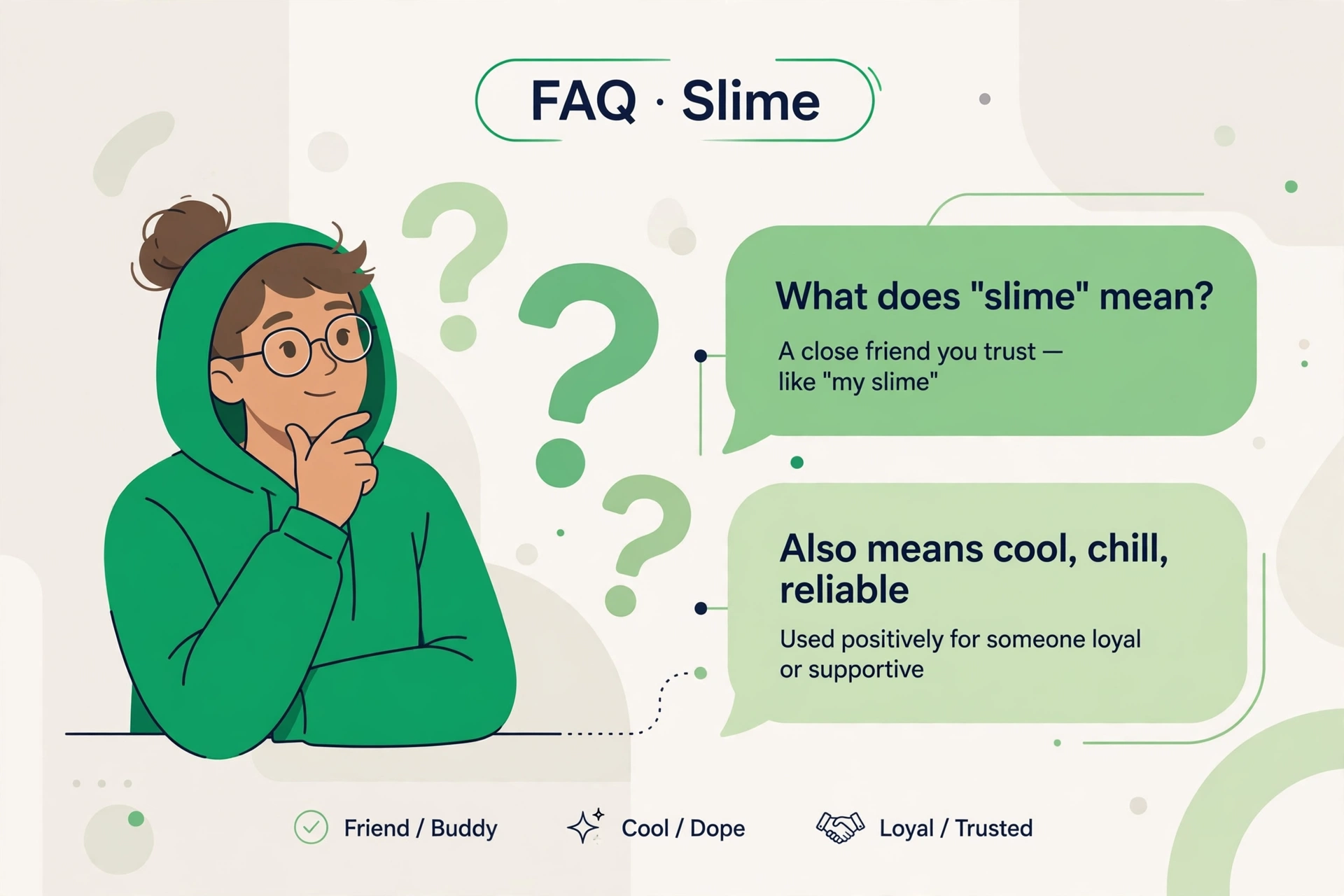
FAQ
1. What does slime mean in slang?
In slang, slime means a close, trusted friend — a brother or day one. Calling someone your slime says they are in your inner circle and you trust them completely. The term comes from Atlanta hip-hop culture.
2. What does “wassup slime” mean?
“Wassup, slime?” is a greeting for a close friend. It means “hello, my trusted person” and works like “what is up, bro?” but with more intimacy. Use it only with people you are genuinely close to.
3. Where did slime slang come from?
Slime slang is credited with early use in 1990s hip-hop, including N.O.R.E., and was popularized in the 2010s by Atlanta artists, above all Young Thug and Gunna. Young Thug’s Slime Season mixtapes and the YSL world spread the word far beyond Atlanta.
4. Is slime a good word or a bad word?
As slang for a friend, slime is a good word — warm, loyal, and affectionate. But “slimy” as an adjective is negative in ordinary English, meaning shady or untrustworthy. The form of the word and the context tell you which meaning is intended.
5. What is the difference between slime and homie?
Homie usually stresses shared roots or neighborhood ties, while slime stresses proven loyalty and trust. They overlap a lot, but slime carries a specific Atlanta hip-hop signature that homie does not.
6. Can girls use slime slang?
Yes. Slime is not gendered. Anyone can call a close friend their slime, and anyone can be called slime. What matters is the closeness of the friendship, not the gender of the people in it.
7. What does “slime season” mean?
“Slime season” means a period when you and your crew are winning together — a mood, a summer, a run of good times shared with your inner circle. It comes from Young Thug’s Slime Season mixtape series.
8. Should I use slime at work or school?
No. Slime is informal friendship slang. In professional or formal settings, say “close friend” or “trusted friend” instead. Save slime for group chats, captions, and conversations with people who share the culture.
Conclusion
Slime meaning slang is a small word with a large heart. It means a friend who is more than a friend: a brother, a day one, a person whose loyalty you would bet on. It traveled from a 1990s rap video through Atlanta studios, through Young Thug and Gunna and a whole generation of listeners, and into the group chats of people who may never have heard the songs that made it famous — and it arrived intact, because the feeling it names is universal. Everyone needs a word for the people who show up. For a lot of people right now, that word is slime.
Use it well and it does something no other friendship word quite does: it tells the person hearing it that they are chosen. Not liked, not tolerated, not followed — chosen. That is a powerful thing to say in one syllable, and it is worth protecting. Do not spend it on strangers. Do not waste it on performances. Save it for the people who have earned it, say it like you mean it, and then do the harder part: be the kind of friend the word describes.
Like the rest of the slang that defines this era — from the blunt verdicts in guides to mid meaning slang and 2000s slang to the loyalty language of tuff meaning slang — slime earned its place by naming something real. The goo will dry up. The toy will go back in its container. The friendship the word describes is the part that lasts. So the next time your phone lights up with “wassup, slime?” — smile, reply fast, and remember that somebody just told you, in the shortest way possible, that you matter to them. There is no better text to get.

1 thought on “Slime Meaning Slang: Why Your Closest Friend Is Your Slime”