Quick definition: snow bunny meaning slang — today, “snow bunny” is a loaded slang term most commonly used to describe a white woman who dates or is attracted to Black men. It can be used playfully in some circles, but it is widely considered derogatory, objectifying, and offensive. The phrase also has an older, innocent meaning: a woman (or beginner) who enjoys skiing or other winter sports.
Snow Bunny Meaning & Definition
The snow bunny meaning slang definition most people are looking for is the modern, charged one: a white woman, especially one known for dating Black men. The term carries heavy racial and sexual baggage, and many people find it demeaning no matter who says it. Unlike playful slang such as “cap” in internet slang, “snow bunny” is not a word you can throw around casually without consequences — it is rooted in fetishization, racial stereotyping, and reduction of a person to a category.
Here is the full picture, because this phrase genuinely has two lives:
- Modern slang sense (loaded): a white woman who dates Black men, often said with a sneer, a joke, or a fetishizing wink. This is the meaning that dominates TikTok, Twitter/X, and comment sections today.
- Original winter-sports sense (benign): a woman who frequents ski resorts — or more broadly, a novice skier/snowboarder. Think cozy lodge aesthetics, not racial commentary.
Understanding both meanings matters, because confusing them is one of the most common mistakes people make with this term. According to Merriam-Webster, dictionaries themselves have had to expand their entries over the years as slang terms shift from niche subcultures into mainstream conversation — and “snow bunny” is a textbook example of a word whose primary meaning has migrated.
Introduction
You heard it in a TikTok comment, a rap lyric, or a late-night group chat, and now you’re here: what does “snow bunny” actually mean? The short answer is complicated, because this two-word phrase has lived at least two very different lives. In the 1960s, it belonged to ski lodges. Today, it belongs to meme culture, hip-hop lyrics, and heated arguments about race, respect, and relationships.
This article gives you the complete, honest breakdown: where the phrase came from, how its meaning changed, how people use it now (and why you probably shouldn’t), what the harmless alternate meaning is, and what to say instead when you want to be respectful.

Origin
The phrase “snow bunny” began its life on the ski slopes. In the 1950s and 1960s, ski resorts were playgrounds for the affluent, and a whole vocabulary grew up around lodge culture. A “snow bunny” was an attractive young woman who spent time at ski resorts — often one who was there more for the social scene (and the après-ski parties) than for serious skiing. It was lighthearted, mildly sexist by today’s standards, but fundamentally about winter sports culture.
From there, “bunny” language spread: beach bunny for surfers’ girlfriends, ski bunny, and so on. The rabbit metaphor suggested something cute, playful, and quick-moving. For decades, “snow bunny” sat comfortably in this innocent territory, appearing in films, songs, and advertising with zero racial implication.
The racialized meaning emerged much later, primarily through hip-hop and Black American vernacular in the 2000s and 2010s. In lyrics and casual speech, “snow bunny” (sometimes “snowbunny” as one word) began to appear as slang for a white woman romantically or sexually associated with Black men. The “snow” referred to whiteness; the term often carried a mocking or possessive edge — sometimes as a joke among friends, sometimes as an insult hurled at the woman, sometimes as a taunt toward the man.
The 2010s and 2020s supercharged the shift. Viral TikToks, memes, and comment-section pile-ons turned “snow bunny” into a recurring punchline and insult online. By the early 2020s, the racialized meaning had almost completely eclipsed the skiing meaning in general internet usage — which is why the winter-sports definition now catches people off guard.
Popularity
So how popular is “snow bunny” today? Very — but not in a wholesome way. Here is a timeline of its cultural footprint:
- 1960s–1990s: Primarily a ski-culture term. Found in movies, songs about ski trips, and resort advertising.
- 2000s–2010s: The racialized sense grows through hip-hop lyrics and urban slang, spreading online via forums and social media.
- Late 2010s: Meme culture adopts the term; “snow bunny” appears in viral posts, often in jokes about interracial dating.
- 2020s: TikTok makes it inescapable. Comment sections use it constantly — sometimes playfully, often cruelly. The term also becomes a flashpoint in debates about fetishization and racism.
Search interest reflects this: people look up “snow bunny meaning slang” most often after encountering it in a comment thread, a lyric, or a heated discussion. The popularity of the phrase is inseparable from its controversy — it trends precisely because it is provocative.
It is also worth noting that the term’s popularity has drawn pushback. Many commentators, creators, and everyday users argue that it reduces women to racialized objects and reinforces harmful stereotypes about interracial relationships. That pushback is part of the story of the word today.
How It Is Used
Usage depends heavily on who is speaking, who is listening, and the platform. Here are the main contexts:
- In hip-hop lyrics and music culture: Artists have used “snow bunny” to refer to white women in their orbit — sometimes boastfully, sometimes dismissively. Listeners who repeat the lyric often miss the layered, sometimes hostile connotation.
- In memes and TikTok comments: The most common modern usage. A video of an interracial couple can attract hundreds of “snow bunny” comments — ranging from teasing to outright harassment.
- As an insult: Used to shame a white woman for dating Black men, implying she is fetishized, easy, or a traitor to some imagined racial loyalty. This is the ugliest usage and, frankly, the most common one.
- Reclaimed or ironic: Some white women in interracial relationships use the term about themselves jokingly. Even so, it remains offensive to many listeners, and self-application doesn’t make it safe in mixed company.
- The innocent sense (rare online now): In skiing forums and older contexts, it still means a woman who loves the slopes. If someone in a ski group chat says it, they probably mean this — but online, assume the loaded meaning unless context clearly says otherwise.
A good rule of thumb: if you are not 100% sure how your audience will take it, do not use it. Slang like “drip” can be used freely by almost anyone; “snow bunny” cannot.
Examples
Because the term is loaded, the “examples” below are labeled by tone so you can see how the same two words land completely differently depending on context. Several of these illustrate why the term is problematic, not an endorsement of using it.
Friendly Examples
- On the ski lift: “Look at Maya — third run already! Total snow bunny, she lives for powder days.” (Here it means a skiing enthusiast; harmless in this context, though some still find “bunny” patronizing.)
- Self-deprecating: “I’m basically a snow bunny in December — I can’t resist a ski trip.” (Self-applied, winter-sports meaning; fine.)
- Between close friends joking about winter plans: “We’re turning into full snow bunnies this season.” (Group self-reference; the innocent meaning.)
Professional Examples
Here is the honest truth: there is no professional context in which “snow bunny” is appropriate when used in its modern slang sense. You would never use it in a workplace email, a classroom, a newsroom, or a customer-facing role. The closest “professional” examples are people discussing the term, not using it:
- A sociologist in a lecture: “The term ‘snow bunny’ illustrates how slang can encode racial and gender hierarchies within dating discourse.”
- A content moderator’s guideline: “‘Snow bunny’ should be flagged when directed at a person, as it is frequently used as racialized harassment.”
- A journalist quoting a source: “She said the comments calling her a ‘snow bunny’ made her stop posting couple videos.” (Reporting, not endorsing.)
Funny Examples
- A ski-resort meme page: “POV: You said you’d ‘just do one run’ — certified snow bunny behavior.” (Winter-sports humor; the safe lane.)
- A comedian’s stand-up bit about dating apps: “My profile says ‘aspiring snow bunny — but only for ski season, calm down.'” (Plays on the double meaning; works because it defuses the loaded sense.)
- A friend teasing another about winter obsession: “Bro, you bought a third puffer jacket. Snow bunny arc confirmed.” (Clearly about skiing culture.)
Notice the pattern: the funny, safe uses all lean on the skiing meaning. The moment the racialized meaning enters, the humor curdles into something mean — and that is exactly the line to watch.

Comparison with Similar Terms
“Snow bunny” sits in a family of slang terms that categorize people by race, gender, or dating patterns. Comparing them helps clarify what makes this particular phrase so charged.
| Term | What it describes | Tone / connotation | Safe to use? |
|---|---|---|---|
| Snow bunny | White woman dating Black men (modern sense); ski enthusiast (original sense) | Loaded, often derogatory and fetishizing | No — avoid in mixed company |
| Jungle fever | Attraction between people of different races, esp. Black and white | Widely considered offensive and outdated | No |
| Yellow fever | Fetishization of Asian women by non-Asian men | Offensive; rooted in fetishization | No |
| Beach bunny | Woman who hangs out at the beach / surfer culture | Mildly dated, generally harmless | Usually fine, but a bit patronizing |
| Ski bunny | Woman enthusiastic about skiing | Playful, mild | Generally fine |
| Swirler | Person in an interracial relationship (“swirl” = interracial dating) | Can be neutral or mocking depending on context | Risky — context-dependent |
The key difference: terms like “ski bunny” and “beach bunny” describe a hobby, while “snow bunny” in its modern sense describes a person’s race and dating life — which is why it stings. Reducing someone to a racial dating category is inherently dehumanizing, whatever the speaker’s intent.
Another comparison worth making is with neutral dating slang. Words like “nmms” in texting slang

Alternate Meanings
Because the phrase has genuinely split into two meanings, here is a clear breakdown of each.
1. The Winter-Sports Enthusiast (Original, Benign Meaning)
This is the OG meaning: a woman who loves skiing, snowboarding, or simply the ski-resort lifestyle. In this sense, “snow bunny” conjures images of cozy lodges, hot cocoa, and fresh powder. It dates back to mid-20th-century ski culture and is still used this way in skiing communities, retro films, and winter fashion marketing.
Even here, a small caveat: some people find the “bunny” part diminutive, like being called “sweetie” by a stranger. It is not offensive in the way the modern slang sense is, but “skier” or “snowboarder” is more respectful if you are unsure.
2. The Relationship / TikTok Sense (Modern, Loaded Meaning)
This is the meaning most people encounter today: a white woman who dates or is perceived as preferring Black men. On TikTok and in comment sections, it functions as:
- A label slapped on women in interracial relationships, often without their consent.
- A joke that trades on stereotypes about attraction and race.
- An insult meant to shame or harass.
- Occasionally, an ironic self-label used by the women themselves.
The TikTok-era usage is where the term gets its edge. Comment sections under interracial-couple videos are ground zero: the phrase appears as praise (“snow bunny W”), mockery, or outright abuse — sometimes all three in the same thread. The algorithmic nature of the platform means a single viral video can attach the label to a real person overnight, which is part of why the term is considered harmful.
Disambiguation tip: context is everything. On a skiing forum or in a 1970s movie, it means the slopes. On TikTok, in a rap lyric, or under a couple’s photo, it means the loaded racial sense. When in doubt about which meaning someone intends, the loaded one is the safer assumption — and the better reason to steer clear.
Professional or Polite Alternatives
If you need to talk about any of the concepts near this term without the baggage, here is what to say instead:
| Instead of… | Say… | When to use it |
|---|---|---|
| “Snow bunny” (racial sense) | Nothing — just describe the person normally | Always. There is no polite version of a slur-adjacent label. |
| “Snow bunny” (skiing sense) | “Skier,” “snowboarder,” “ski enthusiast” | When talking about winter sports. |
| Commenting on an interracial couple | “Couple,” or simply don’t comment on their races | Social media, conversation, journalism. |
| Discussing attraction patterns | “Dating preferences” | Academic or thoughtful discussion. |
| Discussing the slang term itself | “The term ‘snow bunny'” (in quotes, as a subject of discussion) | Education, journalism, moderation. |
The broader principle: you never need this word. Every legitimate thing you might want to express — enthusiasm for skiing, discussion of dating culture, analysis of slang — has a clearer, kinder alternative. That is not censorship; it is just good communication.
Common Mistakes
People trip over this term constantly. Here are the mistakes to avoid:
- Assuming it only means skiing. The most common mistake. If you use “snow bunny” online thinking of ski lodges, most readers will hear the racialized meaning. The innocent sense has been eclipsed.
- Using it as a “compliment.” Calling a woman in an interracial relationship a “snow bunny” as praise still reduces her to a racial category. Compliments should be about the person, not the stereotype.
- Repeating lyrics without understanding them. Hip-hop verses use the term with layers of irony, bravado, and context you may not share. Quoting them at a party is not the same as the artist’s intent.
- Thinking self-application makes it universally fine. Some women use it about themselves ironically. That is their choice — it does not give everyone else a pass, and it still makes many listeners uncomfortable.
- Using it to “joke” about a friend’s relationship. Even among friends, labeling someone’s partner by race-as-punchline can land badly and signal attitudes you may not intend.
- Confusing it with “ski bunny.” “Ski bunny” is the safer, still-hobby-related cousin. They are not interchangeable online.
- Posting it in comment sections. Directing the term at a real person — especially a stranger — is harassment, whatever you meant by it. Platforms increasingly treat it that way.

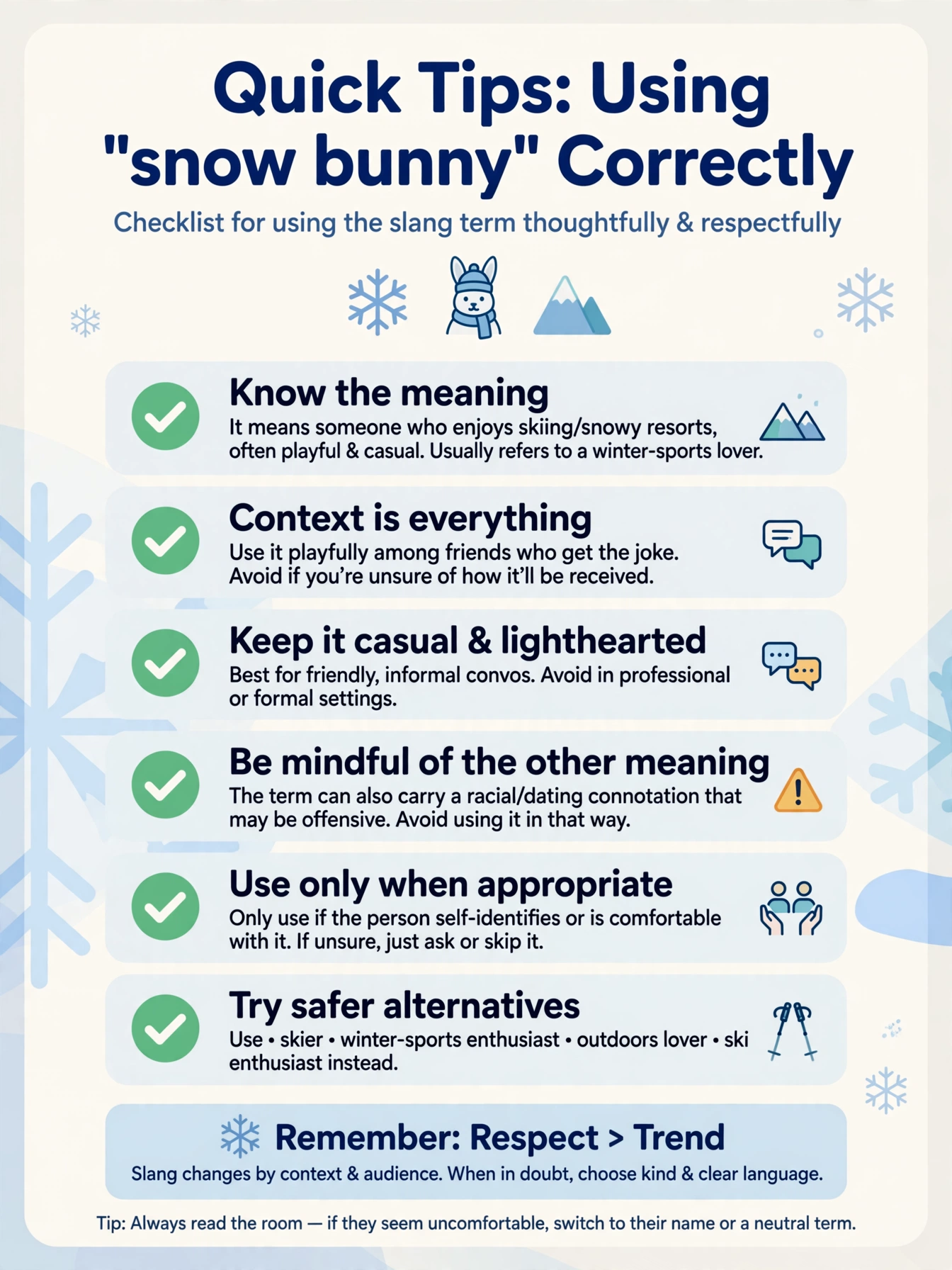
Quick Tips
- Default to not using it. This is the single most useful tip. The term’s risk-to-reward ratio is terrible.
- Read the room — then read it again. If there is any chance your audience hears the loaded meaning, skip the word entirely.
- Talking about skiing? Say “skier,” “snowboarder,” or “ski enthusiast.” Clearer and kinder.
- Discussing the term academically? Put it in quotation marks and name it as a subject of discussion, not as a label for a person.
- See it used as harassment? Don’t pile on. On your own posts, consider deleting or reporting harassing comments.
- Heard it in a song? Enjoy the music; don’t adopt the vocabulary. Artists’ artistic context is not your conversational context.
- Writing about slang? Define it accurately, note that it is offensive to many, and give the alternatives — exactly like this article does.
- If someone asks what it means: Explain both meanings honestly, and add the caution. Knowledge without the warning is incomplete.

FAQ
1. What does “snow bunny” mean in slang?
In modern slang, “snow bunny” most commonly refers to a white woman who dates Black men. It is a loaded, often derogatory term rooted in racial and sexual stereotyping, and many people find it offensive.
2. Is “snow bunny” offensive?
Yes, in its modern slang sense it is widely considered offensive. It reduces a woman to a racialized dating category and is frequently used to mock, shame, or harass. Even when meant as a joke, it offends many listeners.
3. What did “snow bunny” originally mean?
The original meaning comes from 1950s–60s ski culture: an attractive young woman who frequented ski resorts. This innocent, winter-sports meaning still exists in skiing contexts but has been largely overtaken online by the racialized slang sense.
4. Why is “snow bunny” considered derogatory?
Because it categorizes a person by race and dating life, carries a history of fetishization and mockery, and is routinely used to harass women in interracial relationships. The power imbalance — labeling someone without their consent — is what makes it demeaning.
5. Can I say “snow bunny” if I’m talking about skiing?
In a clearly ski-related context (a ski forum, a conversation about a resort trip), most people will understand the innocent meaning. Online, however, the loaded meaning dominates, so “skier” or “snowboarder” is the safer choice.
6. What is the difference between “snow bunny” and “ski bunny”?
“Ski bunny” is the milder, hobby-focused term for a woman who loves skiing, with little racial baggage. “Snow bunny” carries the heavy modern slang meaning about interracial dating, making it far more loaded.
7. Where did the TikTok “snow bunny” trend come from?
TikTok amplified a term that already existed in hip-hop and urban slang. Viral interracial-couple videos drew floods of “snow bunny” comments — some playful, many harassing — and the algorithm spread the phrase to millions who had never heard it.
8. What should I say instead of “snow bunny”?
For skiing, say “skier” or “snowboarder.” For everything else, there is no polite substitute because the concept itself — labeling a woman by her race and dating life — is the problem. Just describe people normally, without the label.
Conclusion
The snow bunny meaning slang story is really two stories: a harmless ski-lodge nickname from the 1960s, and a loaded modern label for white women in interracial relationships. The second story has won — at least online — and it comes with a clear warning attached.
Key takeaways:
- “Snow bunny” has two meanings: the original winter-sports sense and the modern, racialized slang sense that dominates today.
- The modern sense is widely considered derogatory, fetishizing, and offensive — even when used “as a joke.”
- Context decides which meaning people hear, and online the loaded meaning almost always wins.
- You never need this word: “skier,” “couple,” or a normal description covers every legitimate use case.
- If you are explaining the term to someone, explain both meanings and the caution — the warning is part of the definition.
Slang is always evolving, and staying fluent means knowing not just what words mean, but what they cost. If this guide helped, keep exploring — from regional flavor like Spanish slang terms and other regional slang guides, there’s always another term worth understanding properly.
