
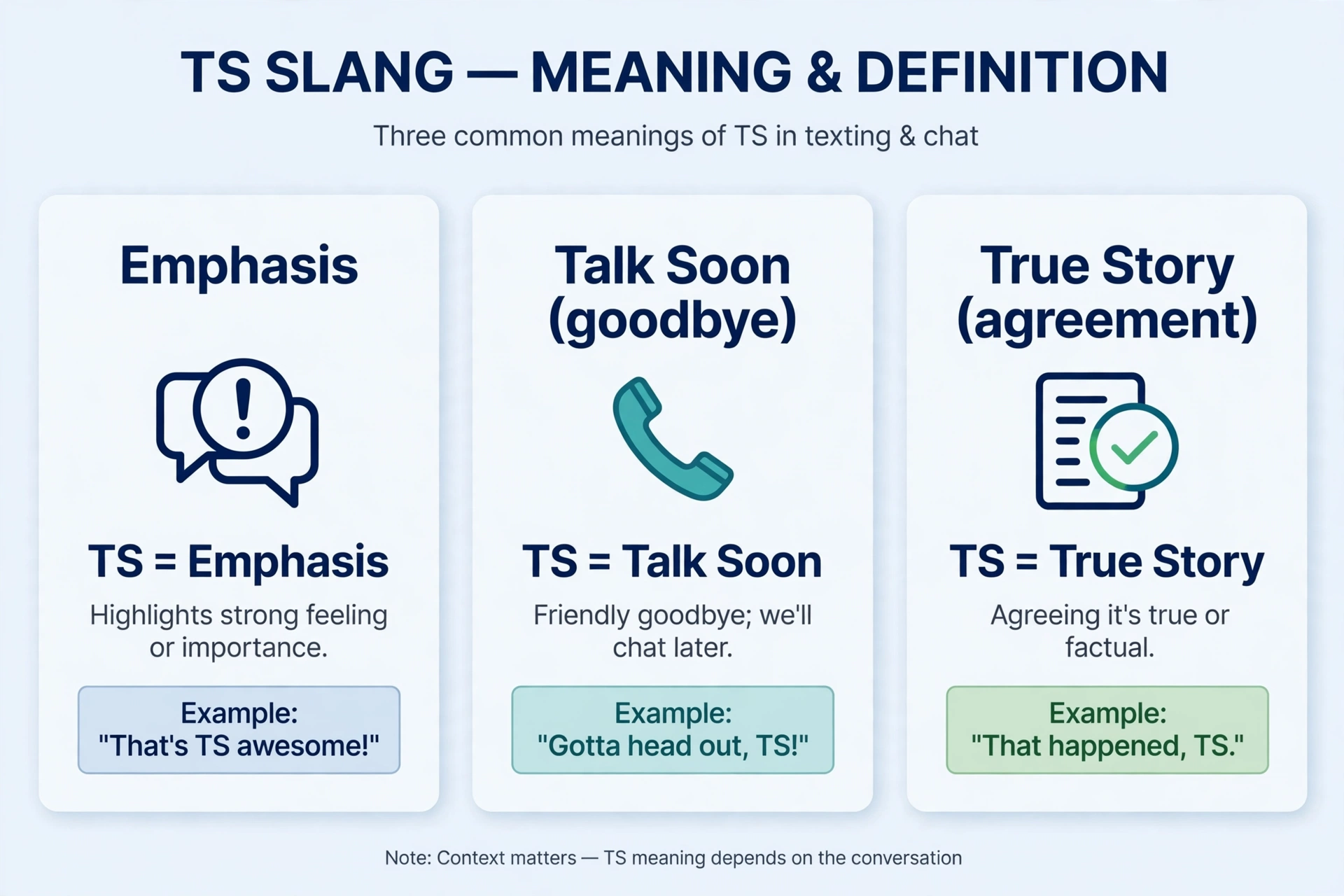
Quick definition: In today’s texting and TikTok slang, TS most often stands for “this shit” (or “that shit”), used for emphasis — as in “ts pmo,” meaning “this shit pisses me off.” But ts meaning slang is not a one-meaning abbreviation. Depending on where it sits in a message, TS can also mean “talk soon,” “true story,” or “tough shit.” Position is the clue: TS in the middle of a sentence usually means “this shit,” TS at the end of a chat usually means “talk soon,” and a standalone “ts” after bad news usually means “tough shit.” This guide ranks every meaning, shows how to decode each one in seconds, and explains the famous “TS means this” mix-up that turned into a meme of its own.
TS Meaning Slang Meaning & Definition
TS meaning slang covers a small set of expansions that share two letters and almost nothing else. The abbreviation is a chameleon: the same two letters can emphasize a reaction, close a conversation, agree with a story, or dismiss a complaint. What makes TS unusual, even among slang abbreviations, is that its most common meaning today is also its newest and most argued-about one, while its older meanings have not gone away. A reader who knows only one expansion will misread a large share of real messages.
The dominant meaning in 2025–2026 texting and TikTok is “this shit” (sometimes “that shit,” depending on whether the speaker is pointing at something present or something already mentioned). It works as an emphasis word, not as a subject on its own. “Ts so funny” means “this shit is so funny.” “Ts pmo” means “this shit pisses me off.” “Ts hits different” means “this thing is genuinely impressive.” The word “shit” here is doing emotional work — surprise, frustration, delight, disbelief — rather than naming anything literal. That is why the phrase survives censoring, paraphrase, and translation badly: remove the bluntness and you remove the feeling.
The older meanings are still alive in the right positions. “Talk soon” is a friendly sign-off, the modern cousin of “TTYL.” “True story” is an agreement marker, close to “facts” or “so real,” used under relatable posts. “Tough shit” is a blunt dismissal — “too bad, deal with it” — and it is the meaning most likely to start an argument, because it can sound cold even when the sender meant it as a joke between friends. A fourth, rarer slang expansion, “type shit,” means roughly “that kind of thing” or “I agree, that is exactly the vibe,” and it appears in the same slang-heavy sentences as the “this shit” meaning.
| Expansion | Meaning in plain words | How common now | Typical position |
|---|---|---|---|
| This shit / that shit | Emphasis: this thing, this situation | Most common on TikTok and in Gen Z texts | Start or middle of a sentence |
| Talk soon | Friendly goodbye, “catch you later” | Common in everyday chats | End of a conversation |
| True story | Agreement: “that really happened / so real” | Common in comments and reactions | Standalone reply |
| Tough shit | Dismissal: “too bad, deal with it” | Common, but risky | Standalone reply after a complaint |
| Type shit | “That kind of thing” / agreement | Less common, slang-heavy circles | After a statement, often with “icl” or “fr” |
Pronunciation is simply the two letters: “tee-ess.” In speech, people usually expand it — they say “this shit pisses me off,” not “tee-ess pee-em-oh” — but in writing, the letters are the whole point: fast, compact, and instantly recognizable to anyone who lives in the same slang world. TS is almost always written lowercase (“ts”) in chats and comments, and either case in headlines and explanations. Capitalization does not change the meaning.
Introduction
Open TikTok, scroll the comments, and you will meet TS within minutes: “ts pmo icl,” “ts so tuff,” “ts fr.” Open a family group chat and you may meet a completely different TS: “Gotta run, ts!” from an aunt who means “talk soon.” Both writers are using the same two letters correctly, in their own world, and both will confuse the other’s audience. That collision — one abbreviation, several generations of internet, several meanings at once — is the whole story of ts meaning slang.
This article gives you the full picture without the guesswork. It traces where TS came from, ranks its meanings by how often you will actually meet them, teaches the position rule that decodes almost every message, explains the viral “TS means this” misunderstanding, and shows real examples in friendly, professional, and funny contexts. It also covers the slang-overload sentences that stack TS with PMO, ICL, FR, and ONB until they look like alphabet soup, and gives you polite alternatives for every situation where TS would be unclear, rude, or simply wrong.
If you only need one sentence to take away, it is this: never read TS alone. Read the sentence around it, the place it sits in the conversation, and the person who sent it. Those three clues resolve nearly every case, and the rest of this guide shows you exactly how to use them.
Origin
The “this shit” meaning of TS comes from African American Vernacular English (AAVE), where the full phrase “this shit” has been spoken for decades as an emphatic way to point at a thing, a situation, or a feeling. The two-letter abbreviation is much newer. It exploded on TikTok, X, and Instagram in late 2024 and early 2025, carried by the same wave of compressed slang that made PMO (“piss me off”), ICL (“I can’t lie”), and SYBAU (“shut your bitch ass up”) part of everyday comment-section language. Short, stackable, and easy to type with one thumb, TS fit the platform perfectly.
The older meanings predate the TikTok wave by years. “Talk soon” and “true story” come from the general texting shorthand of the 2000s and 2010s, when every farewell and reaction got compressed: TTYL, BRB, LOL, and their cousins. “Tough shit” is older still as a spoken phrase, and its abbreviation followed the same path as other blunt dismissals into text. “Type shit” comes from the same AAVE-rooted slang world as “this shit,” and the two expansions are related: both use “shit” as a flexible, emphatic noun, and both travel in the same sentences. The Wikipedia glossary of 2020s slang lists TS as an abbreviation for “this shit,” also used as an initialism for “type shit,” often accompanied by PMO and ICL — a neat summary of how the abbreviation actually circulates.
The most interesting part of the origin story is the mistake. As TS spread beyond the communities that created it, many new users assumed it was simply a short form of “this.” “Ts so cool” was read as “this so cool,” and the misreading became so common that it turned into a joke in its own right: people began writing “ts (this)” in parentheses to mock the wrong usage — a gloss that uses more letters than the word it explains. That joke, in turn, became a running commentary on how slang travels online: a phrase is borrowed, its meaning is guessed, the guess becomes a meme, and the original community watches its own language come back changed. Knowing this history matters because it explains why some readers react strongly to TS. For them, the abbreviation is not just a shortcut; it is a piece of their language, and the “this” misreading is evidence that it was taken without being understood.
Outside slang, TS has a long list of unrelated expansions that occasionally collide with the texting meaning. In programming, TS is TypeScript. In fan communities, TS can be Taylor Swift. On old forums, TS meant “thread starter,” the person who opened a discussion. In offices, it can mean “timestamp” or “technical support.” None of these is slang, and none of them is what a TikTok comment means — but they are a useful reminder that two letters can hold a dozen jobs, and that context, not the letters themselves, does the deciding.
Popularity
TS became unavoidable in late 2024 and 2025, when the “slang overload” meme format took over TikTok. Creators stacked abbreviations — “ts pmo icl,” “ts pmo nlg r u fr rn onb” — until the caption itself became the joke: a wall of letters that only insiders could read, satirizing how fast slang was piling up. The format spread because it was both funny and true. Real comment sections really do look like that now, and a reader who cannot decode TS is locked out of a large part of online conversation.
Popularity also brought pushback. Black creators and commenters pointed out that much of this slang comes from AAVE, and that its mainstreaming often strips away credit and context. The TS discourse — including the “this” mix-up — became a case study in that argument: a term is borrowed, misread, memed, and then treated as generic internet language, while the community that made it watches from the sidelines. That debate has not settled the usage, but it has made thoughtful users more careful about where slang comes from, and it is part of why guides like this one name the origin plainly instead of presenting TS as slang that simply appeared.
Search interest reflects the confusion. People search “ts meaning slang” not because the phrase is rare, but because it is common and contradictory: a parent sees it in a child’s chat, a coworker sees it in a group message, a viewer sees it under a video, and each of them gets a different answer from the first result they click. Some glossaries still lead with “talk soon,” because that was the most common meaning when they were written. Others lead with “tough shit.” The current TikTok-first answer — “this shit” — is the one most readers need first, with the older meanings close behind. A guide that leads with only one of them will mislead a third of its readers, which is exactly the gap this article is built to close.
Demographically, TS is Gen Z slang first and everyone-else slang second. Teenagers and people in their twenties use the “this shit” meaning fluently and stack it with other abbreviations without thinking. Older users meet it through their children, through social media, or through work chats, and they are more likely to know “talk soon” or “true story.” That age split is a practical decoding clue: in a chat full of abbreviations, assume the new meaning; in a chat with someone who texts in full sentences and signs off warmly, assume the old one. The same pattern shows up across generational slang, and comparing eras helps — Gen X slang lists, for example, show an earlier generation’s abbreviations doing the same job with different letters.
How It Is Used
TS is used in three grammatical jobs, and each job points to a different meaning. Learn the jobs and you can decode almost any message without asking.
Job 1: Emphasis at the start or middle of a sentence. Here TS almost always means “this shit” or “that shit.” It behaves like a noun phrase pointing at the situation being discussed. “Ts is crazy” means “this situation is wild.” “Ts pmo” means “this shit pisses me off.” “Ts so funny I can’t breathe” means “this thing is so funny.” The sentence is usually incomplete by formal standards — there is no verb “is” in “ts so funny” — and that incompleteness is itself a clue: the slang register drops the verb and lets the emphasis carry the sentence.
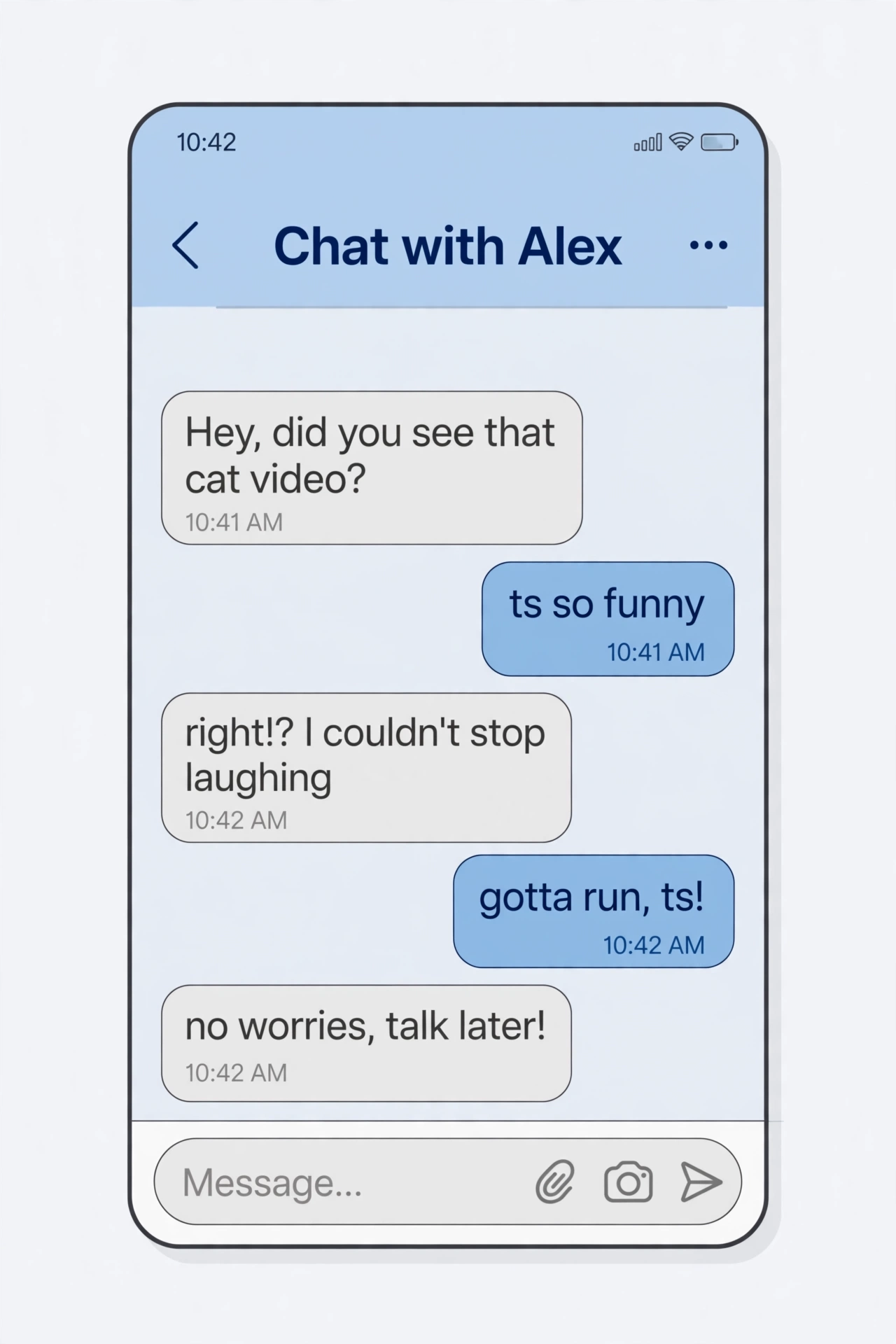
Job 2: Sign-off at the end of a conversation. Here TS almost always means “talk soon.” It appears after a goodbye, a plan, or a thank-you: “Gotta run, ts!” “Okay, ts later!” “Thanks for the help, ts!” The tone is warm and forward-looking, the opposite of the blunt emphasis meaning. If the message is closing a conversation, the sign-off meaning wins, even in a chat where the “this shit” meaning appeared earlier.
Job 3: Standalone reaction. A lone “ts” as a whole reply is the hardest case, and tone decides it. After a funny or relatable story, “ts” usually means “true story” — agreement, like “facts.” After a complaint or a piece of bad luck, “ts” usually means “tough shit” — dismissal, like “too bad.” The difference is the message it answers. “I failed my driving test again” followed by “ts” is dismissal. “I once cried at a dog food commercial” followed by “ts” is agreement. If you cannot see the message it answers, you cannot decode a standalone TS, and asking is the only honest move.
- With other slang: “icl ts pmo” = “I can’t lie, this shit pisses me off.” The stack reads left to right, each abbreviation adding one piece of feeling.
- In comments: “ts tuff” = “this shit is tough (impressive).” The slang-overload register praises by stacking.
- As “type shit”: “Yeah, ts” after a plan can mean “yeah, that kind of thing, I agree.” This use is rarer and needs a slang-heavy conversation to be readable.
- In gaming and Discord: TS can also be a username, a team tag, or a server shorthand. In those rooms, ask what the local meaning is before assuming any slang expansion.
Two habits will keep you out of trouble. First, never use TS in a message where the reader might not know the slang — the abbreviation saves two seconds of typing and can cost a whole misunderstanding. Second, never stack TS with three other abbreviations when writing to someone outside the slang world. Slang overload is funny as a meme and unreadable as a message.
Examples
The examples below are grouped by tone, and each group uses the meaning that fits that tone. Notice how the same two letters change jobs between groups.
Friendly Examples
Friendly uses are usually the “this shit” emphasis among friends, or the “talk soon” sign-off at the end of a warm chat.
- “Ts so funny, I just sent it to the whole group chat.” (This shit / this thing is so funny.)
- “Ts hits different when you hear it live.” (This song, this moment, is special.)
- “Okay I have to go, ts later!” (Talk soon — friendly sign-off.)
- “Thanks for listening, ts! You are the best.” (Talk soon, with thanks.)
- “Ts fr, that movie was perfect.” (This shit, for real — emphatic agreement.)
In friendly chats, TS is a warmth and energy marker. The “this shit” uses are enthusiastic, the “talk soon” uses are affectionate, and the two never collide because the position in the message keeps them apart.
Professional Examples
There is no professional use of TS in its slang senses. It is informal, ambiguous, and in two of its meanings profane or dismissive. In a workplace, a classroom, or a formal message, write the full words instead.
- Instead of: “Ts pmo, the build broke again.” Say: “This issue is really frustrating — the build broke again.”
- Instead of: “Ts, gotta run.” Say: “I have to run — talk soon!”
- Instead of: “TS, that is true.” Say: “True story — that really happened.” (Or simply: “That really happened.”)
- If you are quoting a message in a report or a presentation, expand TS on first use: “TS (‘this shit,’ in the sender’s slang) pmo.” Your reader should never have to guess.
The one professional-adjacent exception is technical writing, where TS means TypeScript. In code, documentation, and engineering chats, “TS” is a programming language, not slang — and that is precisely why engineers should avoid the slang meaning in work channels. Two meanings in one workplace is one too many.
Funny Examples (if applicable)
Humor around TS usually plays on the overload itself: stacking so many abbreviations that the sentence becomes a puzzle, or on the “this” mix-up.
- “Ts pmo icl, my charger is at 1% and I am tweaking.” (Slang overload, played straight — funny because it is real.)
- “He typed ‘ts (this)’ and the whole chat lost it. The gloss was longer than the word.”
- “My mom texted ‘ts!’ and meant talk soon. My little brother read it as this shit. Dinner was awkward.”
- “I used ts in a work chat once. Once. I now write ‘talk soon’ like a person from 2009.”
The “mom” joke works because it is the real confusion, exaggerated only slightly. Generations genuinely do read the same two letters differently, and the funniest TS stories are the ones where both readings were reasonable.
| Example | Meaning | Clue that decides it |
|---|---|---|
| “Ts pmo fr” | This shit pisses me off, for real | Mid-sentence, stacked with PMO and FR |
| “Gotta run, ts!” | Talk soon | End of conversation, after a goodbye |
| “Ts.” (after a relatable story) | True story | Standalone reply agreeing with a story |
| “Ts.” (after a complaint) | Tough shit | Standalone reply to bad news, dismissive tone |
| “Ts tuff” | This shit is tough (impressive) | Slang stack, praising something |
| “We rewrote it in TS.” | TypeScript (not slang) | Programming context |
Comparison with Similar Terms
TS sits in a family of two-letter and three-letter emphasis and reaction abbreviations. The table below separates the ones it is most often confused with.
| Term | Meaning | How it differs from TS |
|---|---|---|
| FR | For real | Confirms truth; TS emphasizes the thing itself |
| ICL | I can’t lie | Introduces an honest opinion; TS points at the situation |
| PMO | Piss me off / put me on | Names the feeling or the request; TS names the trigger |
| NGL | Not gonna lie | Like ICL; a framing phrase, not a noun phrase |
| TTYL | Talk to you later | Same job as “talk soon” TS, but unambiguous |
| TBH | To be honest | Frames honesty; TS does not frame, it emphasizes |
| ONB | On bro / on God (oath) | Swears truth; TS does not swear, it points |
| Tuff | Tough / impressive (eye-dialect spelling) | An adjective praising something; TS is the thing being praised |
The most useful comparison is with FR and ICL, because the three appear together so often. In “icl ts pmo fr,” each abbreviation does one job: ICL frames (“I can’t lie”), TS points (“this shit”), PMO feels (“pisses me off”), FR confirms (“for real”). Remove any one and the sentence loses a layer. That division of labor is why slang overload works as a style: it is not random letters, it is a compressed sentence with a grammar of its own. Readers who learn the grammar can decode the stack; readers who treat it as noise cannot.
TS also differs from its fellow sign-offs in ambiguity. TTYL can only mean “talk to you later.” “Talk soon” TS can mean four other things. That is the price of the two-letter form: it is faster to type and slower to understand. In any message where the sign-off matters — a plan, a thank-you, a goodbye to someone you respect — the longer form is the better choice. Speed is not worth a misread farewell.
For the “tough” family, the contrast is with tuff meaning slang: “tuff” praises by respelling “tough,” while “ts tuff” uses TS to point at the thing being praised. The two terms travel together in comments — “ts tuff” is a complete verdict in two words — but they are not synonyms, and swapping them breaks the sentence. A similar pairing logic runs through other slang clusters, including mid meaning slang, where a single judgment word carries a whole review, and jit slang, where a single noun carries a whole social label.

Alternate Meanings
Beyond the four slang expansions, TS has a long tail of alternate meanings. Most of them are not slang at all, but they explain a share of confusing sightings, especially in search results and in mixed-age chats.
- TypeScript: In programming, TS is the TypeScript language. “Written in TS” has nothing to do with texting slang, and this is the most common non-slang meaning online.
- Taylor Swift: In fan communities, TS is Taylor Swift. “TS tickets” and “TS eras” are about music, not messages.
- Thread starter: On older forums, TS is the person who started a thread. “TS, what model do you own?” addresses the original poster. Most modern platforms use OP instead.
- Top secret: Playful use for confidential information. “This is TS, don’t tell anyone” borrows the military classification as a joke. Rare in everyday texting, common in spy-movie humor.
- Timestamp: In logs, transcripts, and video editing, TS marks a time. “TS 02:15” is a position in a recording, not a reaction.
- Trans / transgender: In LGBTQ+ contexts, TS has been used as an abbreviation for transsexual/transgender, as in older dating-profile shorthand. This usage involves identity, needs more care than slang, and is falling out of favor as language changes. Never use it as a label for a person; use the words the person uses for themselves.
- That sucks / tough situation: Some glossaries list these as TS expansions. They are real readings in specific chats — “ts, that exam was brutal” can be heard as “that sucks” — but they are less standardized than the four main meanings, and they overlap with “tough shit” enough that position and tone usually decide between them.
- Too serious / too sweet: Listed in some glossaries, rarely used in the wild. If a message only makes sense with one of these, the sender is probably using a private or community-specific shorthand, and asking is faster than guessing.
The practical rule for alternate meanings is domain first. Programming room? TypeScript. Fan community? Taylor Swift. Forum thread? Thread starter. Identity discussion? Careful, respectful language, not slang. Only in a casual texting or TikTok context should you reach for the slang expansions — and there, the position rule from the How It Is Used section does the rest.
Professional or Polite Alternatives
Every meaning of TS has a plain alternative that is clearer and safer. Use the table when the reader might not share your slang world, when the message matters, or when the tone needs to stay warm.
| If you mean… | Say instead | Example |
|---|---|---|
| This shit (emphasis) | This thing, this situation, this is… | “This situation is so frustrating.” |
| This shit pisses me off | This really frustrates me / annoys me | “This really frustrates me, I can’t lie.” |
| Talk soon | Talk soon, catch you later, TTYL | “I have to run — talk soon!” |
| True story | True story, that really happened, so real | “True story, that really happened to me too.” |
| Tough shit (dismissal) | Usually: nothing, or a kinder response | “That’s rough, I’m sorry” instead of a dismissal. |
| Type shit (agreement) | Exactly, that kind of thing, I agree | “Exactly, that’s the kind of thing I mean.” |
The “tough shit” row deserves a special note. There is almost no situation where the polite alternative is a softer version of the same dismissal. If someone tells you bad news, the kind response is empathy, not a polished brush-off. “That’s rough” or “I’m sorry that happened” does the human work that “ts” refuses to do. If you are teasing a close friend and the friendship can carry a blunt joke, the joke belongs in that friendship, in person or in a chat where the tone is unmistakable — not in a text where a period and two letters are all the reader has to go on.
In formal writing, the rule is absolute: expand everything. A report, an email, or a school assignment that contains “ts” will confuse or alienate part of its audience, and no amount of context will fix an abbreviation with five live meanings. Write “this situation,” “talk soon,” or “true story” in full, and your sentence will survive every reader, including the ones who have never opened TikTok.
Common Mistakes
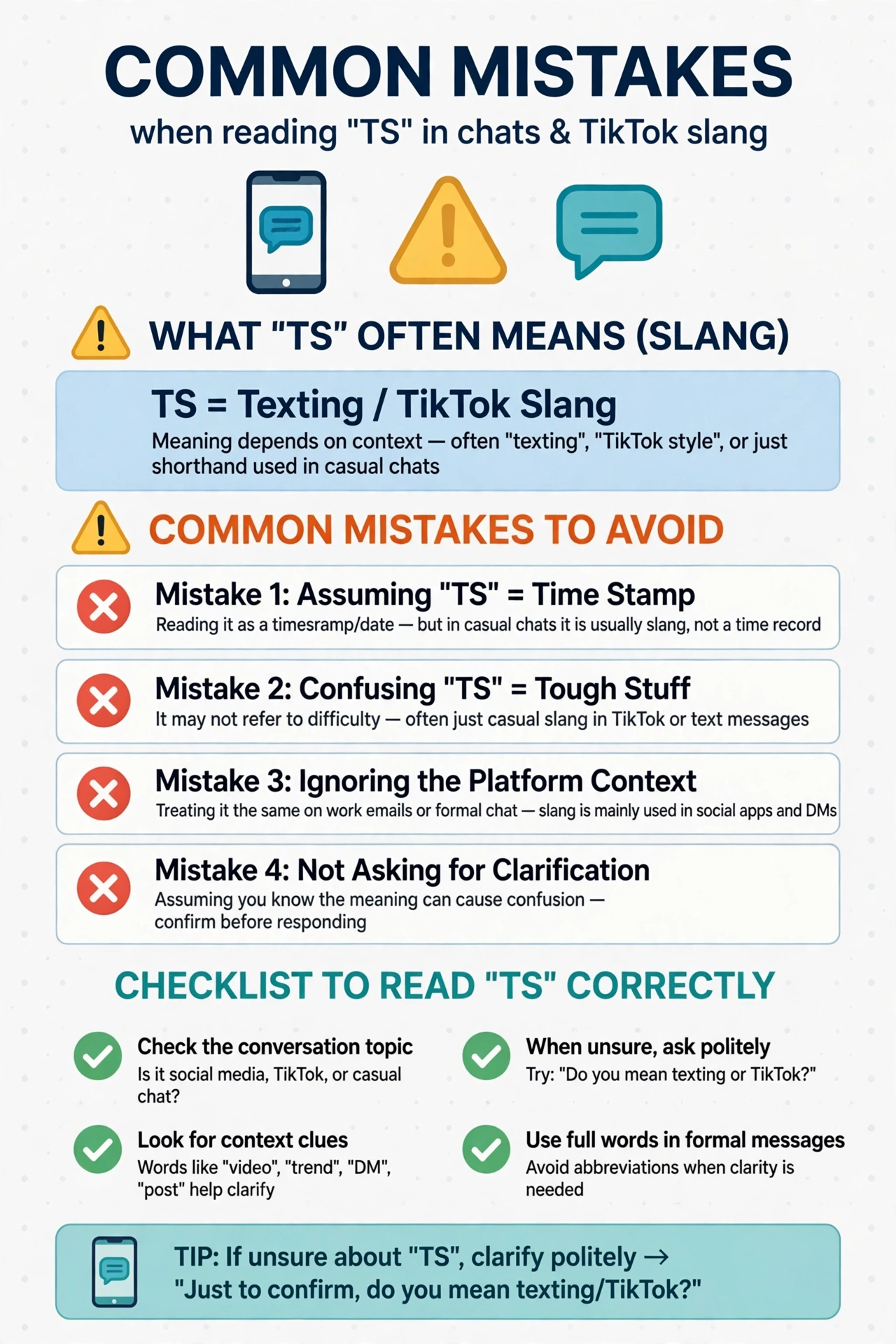
Most TS mistakes are not spelling mistakes. They are meaning mistakes: the writer meant one expansion, the reader heard another, and neither of them noticed until the conversation went wrong.
| Common mistake | Why it goes wrong | Do this instead |
|---|---|---|
| Reading TS as “this” | The famous misreading: TS means “this shit,” not “this” | Expand it as “this shit” and check the sentence still works |
| Using TS with people who don’t know the slang | They will guess “talk soon” or nothing at all | Write the full words for mixed audiences |
| Sending a standalone “ts” after bad news | It reads as “tough shit” — cold and dismissive | Reply with empathy, or ask what happened |
| Using TS at work or in formal writing | Ambiguous, and two meanings are profane or rude | Use full words; in code contexts, TS is TypeScript |
| Stacking four abbreviations in one message | Slang overload is unreadable outside the in-group | Use one abbreviation, or write the sentence out |
| Assuming “ts pmo” means “put me on” | PMO has two meanings; with TS it is “piss me off” | Read the pair together: TS + PMO = frustration |
| Using TS as a label for a person’s identity | Identity abbreviations need the person’s own words | Use the language the person uses for themselves |
| Correcting someone’s TS in public | It embarrasses them and starts a slang argument | Ask privately, or let the context do the teaching |
The “this” mistake is worth one more look, because it is the mistake that became a meme. It happened at scale: thousands of users, mostly outside the AAVE communities where the phrase originated, read TS as a two-letter “this” and used it that way in sentences where “this shit” would have been the meaning. The result was sentences that were grammatically odd (“ts so cool”) and culturally telling (a borrowed phrase, used without its history). The meme response — “ts (this)” — was funny, but it was also a correction: a reminder that slang has an origin, and that borrowing it without learning it shows. If you use TS, learn the expansion. It costs nothing and it respects the people who made the phrase.
Quick Tips
Use these rules as a fast decoder before you reply to, or send, a TS message.
- Check the position. Start or middle of a sentence: “this shit.” End of a chat: “talk soon.” Standalone reply: check the message it answers.
- Check the company it keeps. Next to PMO, ICL, or FR, TS is almost certainly “this shit.” Next to a goodbye, it is “talk soon.”
- Check the sender. A Gen Z friend in a slang-heavy chat: new meaning. An older relative signing off: old meaning. A programmer in a code channel: TypeScript.
- When in doubt, ask. “Did you mean talk soon or something else?” takes five seconds and prevents a misread conversation.
- Expand in mixed company. If any reader might not know the slang, write “this situation,” “talk soon,” or “true story” in full.
- Never send a lone “ts” to bad news. It reads as dismissal. Send empathy instead.
- Keep slang out of work chats. TS is ambiguous in exactly the place where clarity matters most.
- Learn the expansion before you use the abbreviation. “This shit” is the meaning; “this” is the mistake. Knowing the difference is the whole game.
A final decoding trick: try each expansion in the sentence and see which one makes sense. “Ts pmo” as “talk soon piss me off” is nonsense; as “this shit pisses me off” it is perfect. “Gotta run, ts” as “this shit” is nonsense; as “talk soon” it is perfect. The sentence itself usually votes, if you let it. When two expansions both fit, the conversation’s tone and the sender’s habits break the tie — and when they do not, a question does.


FAQ
These are the questions people search for most often about ts meaning slang, answered with the position rule in mind.
What does TS mean in slang?
In current texting and TikTok slang, TS most often means “this shit” (or “that shit”), used for emphasis, as in “ts pmo” (“this shit pisses me off”). It can also mean “talk soon,” “true story,” or “tough shit,” depending on where it sits in the message. Position and context decide which expansion is meant.
What does TS PMO mean?
“TS PMO” means “this shit pisses me off.” TS is “this shit” and PMO is “piss me off” (in this pairing, not “put me on”). It is a compact way to vent about something frustrating, often with exaggerated drama for comic effect, and it is usually followed by ICL (“I can’t lie”) or FR (“for real”) in slang-overload sentences.
Does TS mean “this”?
No. That is the famous misreading. TS is not a short form of “this”; it is a short form of “this shit.” People who read it as “this” produce sentences like “ts so cool” that only make sense if you supply the missing word. The misreading became a meme — people writing “ts (this)” — precisely because the gloss is longer than the word it explains.
What does TS mean in a text from a girl?
It depends on the message, not on the sender. At the end of a chat, TS usually means “talk soon” — friendly, not necessarily flirtatious. Reacting to a story, it can mean “true story.” In a slang-heavy vent like “icl ts pmo fr,” it means “this shit” and she is venting, not hinting at anything romantic. Read the sentence, not the sender.
What does TS mean on TikTok?
On TikTok, TS almost always means “this shit” in comments and captions, often stacked with PMO, ICL, and FR in slang-overload memes. In fan or music content it can also mean Taylor Swift, so check the topic of the video: a dance or dating video points to slang, a concert or album video points to the artist.
What does TS mean on Snapchat?
On Snapchat, TS is most often a sign-off meaning “talk soon,” used to pause a chat or keep a streak alive without a long goodbye. It can also mean “true story” as a reaction to a snap. The slang-heavy “this shit” meaning appears there too, especially in group chats that share TikTok slang.
Is TS rude?
It can be. The “this shit” and “tough shit” meanings are blunt and profane, and a standalone “ts” after someone’s bad news reads as dismissive. The “talk soon” and “true story” meanings are friendly. The rudeness is in the expansion and the situation, not in the letters themselves — which is why expanding the abbreviation in your head before reacting is always worth doing.
Can I use TS in professional messages?
No. TS is ambiguous — it has at least four slang meanings plus TypeScript and other technical uses — and two of its meanings are profane or dismissive. In professional messages, write the full words: “talk soon,” “this situation,” or “true story.” In programming contexts, TS already means TypeScript, so the slang meaning would only add confusion.
Conclusion
TS meaning slang is a reminder that the shortest words can carry the most history. Two letters hold a 1950s sign-off, a 2000s reaction, a blunt dismissal, and a 2020s TikTok emphasis phrase that traveled from AAVE into the global comment section — plus a programming language, a pop star, and a forum role for good measure. No single expansion tells the whole story, and any guide that offers only one is selling certainty it does not have.
The skill that matters is not memorizing a list. It is reading a message the way its sender wrote it: checking the position, the company the abbreviation keeps, and the conversation it belongs to. “Ts pmo” in a vent is frustration. “Gotta run, ts” at the end of a chat is warmth. A lone “ts” after a story is agreement, and after a complaint it is dismissal. Those four readings cover nearly every message you will meet, and the position rule that separates them takes seconds to learn and a lifetime of chats to forget.
Use TS the way fluent speakers do: among people who share the slang, where the meaning is unmistakable, and with the history in mind. Everywhere else, write the words out. “This situation frustrates me,” “talk soon,” and “true story” cost a few more keystrokes and buy you something no abbreviation can: the certainty that your reader heard what you meant. In a language that moves as fast as internet slang, that certainty is the rarest thing of all — and the most worth keeping.

1 thought on “TS Meaning Slang: What TS Really Means in Texts, TikTok, and Chats”