
Quick definition: In jit slang, jit means a young person, usually a kid or teenager, and often someone who is new to something or still learning. It comes from Florida slang and African American Vernacular English, where it has been used for decades to talk about a younger person with a mix of affection, teasing, and sometimes dismissal. Tone does most of the work: said warmly, it sounds like kiddo; said sharply, it sounds like rookie, sit down. Context, age, and relationship decide which one the listener hears.
Jit Slang Meaning & Definition
Jit slang uses the word jit as a noun for a young person. At its simplest, jit is a synonym for kid. A parent might call a teenager a jit, an older cousin might greet a younger cousin with “what’s good, jit?”, and a friend might laugh and say “that jit is funny” about someone younger in the group. In each case, youth is the point. The person being described is younger than the speaker, or at least younger than the people around them.
But jit almost always carries a second meaning as well: inexperience. A jit is not only young, but also new. That is why the word works so well as a gentle put-down. Calling someone a jit can mean “you do not know yet,” “you have not been here long enough to talk like that,” or “you are acting younger than you are.” Merriam-Webster puts it plainly, describing jit as a word for a young person and sometimes specifically for a young person who is new to something or otherwise inexperienced, like a rookie. That double meaning — young and untested — is what separates jit from a neutral word like teenager.
It helps to think of jit as a status word, not just an age word. When someone says “don’t listen to him, he’s just a jit,” they are not giving the person’s age. They are placing them lower in an unspoken ranking: older, more experienced people talk; younger, less experienced people listen and learn. The same sentence between close friends can be a joke. From a stranger, or said in an argument, it can land as disrespect. The word itself does not change. The relationship and the tone change what it means.
Grammar is simple. Jit is usually a countable noun, and the plural is jits: “these jits don’t know anything about that.” It can be used as a direct address — “hey, jit, pass the ball” — and as a label — “he’s a jit.” It is rarely used as a verb or an adjective, and it does not need capitalisation unless it starts a sentence. In text messages and captions it is almost always written lowercase, just like most slang. You will also see it spelled JIT in all caps for emphasis, especially in captions and comments, but the meaning is the same.
Introduction
You are scrolling TikTok, watching a Florida rapper talk about his neighbourhood, when the caption reads: “Been a jit, now I run the block.” A few videos later, a gamer types “this jit doesn’t know how to build” in a chat. Then a comment under a basketball clip says “that jit can really play.” Same word, three different feelings — pride, mockery, and admiration — and if you grew up outside Florida, it is fair to wonder how one short word can do all three jobs.
The short answer is that jit travelled. It started as local Florida slang, rooted in Black youth culture in the southern United States, and stayed mostly regional for years. Florida rap carried it further. Social media carried it everywhere else. By the mid-2020s, teenagers far from Miami were using jit in group chats, gaming lobbies, and comment sections, sometimes correctly and sometimes as a generic insult for anyone acting young, soft, or clueless. Like a lot of slang that escapes its home region, jit kept its core meaning — young and inexperienced — while picking up new shades along the way.
This guide explains jit slang properly: what it means, where it came from, how Floridians actually use it, how it sounds in rap lyrics and on TikTok, and where it can go wrong. You will get friendly, professional, and funny examples, a comparison with similar words like youngin, lil bro, and shorty, the alternate meanings of JIT you should not confuse with the slang, and practical tips for using the word without sounding rude, fake, or ten years too late. If you only remember one rule, make it this one: jit is a word about youth and experience, so never use it to talk down to someone you do not know well.

Origin
The origin of jit is Florida, and its roots are older than social media. Most accounts trace it to African American English in Florida, where it has been in everyday use for decades. Evidence of the word in Florida newspapers goes back to at least the early 1990s: a 1993 profile in the St. Petersburg Times described a 23-year-old Tampa man who was still young enough to be called a jit, and a 1994 South Florida Sun-Sentinel report used Jit as a nickname, short for Jitterbug. A 2010 Florida newspaper piece used jits, glossed as jitterbugs, for people younger than 30. In other words, jit was already normal Florida speech long before it became internet slang.
Where did the word itself come from? The most widely accepted explanation is that jit is a clipping of jitterbug. In the swing era, a jitterbug was an energetic dancer, and over time the word came to describe a hyperactive, energetic young person — someone always moving, always buzzing. Shorten jitterbug down and you get jit: the energy, the youth, and the sense of someone who has not settled down yet. A second explanation connects jit to juvenile, shortened in the same way many slang words are shortened. Both explanations point to the same idea, and both may have fed into the word’s history. What matters for understanding the slang today is that jit was never just a synonym for child. From the start, it described a young person who was lively, unproven, and a little wild.
Florida hip-hop is what pushed jit beyond Florida. Florida rappers including YNW Melly, Kodak Black, and Smokepurpp have used the word in lyrics, and XXXTentacion helped carry it to a national audience in the late 2010s. Lil Pump even released a track called “Jit” in 2018, using the term again and again for younger characters and younger energy. For listeners outside Florida, rap was the first dictionary. Fans heard the word, worked out from context that it meant a young person or a newcomer, and started using it themselves. That is a familiar path for slang: a regional word rides a song, then a feed, then a group chat, until people forget it ever belonged to one place. For background on how the word is defined by a mainstream dictionary, the Merriam-Webster entry for jit slang traces the Florida origin and the early newspaper evidence.
TikTok finished the job. Short videos, captions, and comment sections reward short, punchy words, and jit is as short as slang gets. Creators used it to tease younger siblings, to describe rookie mistakes in games, and to tell “when I was a jit” stories about growing up. The word spread fastest among teenagers and young adults, which makes sense: slang about youth is usually spread by the young. But that spread also loosened the meaning. Online, jit is now sometimes used for anyone acting immature, regardless of age — a 25-year-old can be called a jit for doing something reckless — and sometimes as a plain insult, with the youth meaning faded out. Floridians still use the older, more specific sense. The internet uses a broader one. Knowing both is the key to reading the word correctly when you meet it.
Popularity
Jit is popular in a particular way: it is very well known in some circles and completely unknown in others. In Florida, especially in South Florida and in Black communities across the state, it is everyday vocabulary. People grow up hearing it from older relatives, friends, and neighbours, and they use it without thinking. In hip-hop and gaming communities, it is familiar because lyrics and streams keep repeating it. Among teenagers on TikTok and Instagram, recognition is high — surveys of youth slang in the early 2020s found a clear majority of urban teens familiar with the term — even if not everyone uses it out loud.
Outside those circles, popularity drops sharply. Many adults over 40 have never heard jit used this way, and if they know the letters J-I-T at all, they know them from computing, where JIT stands for “just in time” compilation. That gap is part of why the word keeps showing up in “what does jit mean?” searches and slang explainers. It is a word that feels obvious once you know it and baffling until you do. It is also why jit works as an in-group signal: using it correctly tells listeners you know Florida slang and youth slang; using it wrongly tells them you learned it from a meme five minutes ago.
The word’s popularity is also tied to Florida’s cultural moment. Florida rap, Florida memes, and Florida sports content all travel far beyond the state, and jit travels with them. Like slime meaning slang, another term that spread through rap before it spread through group chats, jit arrived in most people’s feeds through music and video first and through explanation second. That is worth remembering when you use it: for many listeners, jit does not sound like a neutral dictionary word. It sounds like Florida, like rap, and like youth culture. Used in the wrong setting — a work email, a formal presentation, a conversation with someone’s grandparents — it will sound out of place even if the meaning is clear.
How It Is Used
Jit is used in four main ways, and tone separates them. First, as a neutral label for a young person: “That jit over there just started high school.” Nothing hostile is happening here; the speaker is simply pointing out youth. Second, as an affectionate address, close to kiddo or little bro: “Hey jit, how was school today?” Parents, older siblings, and coaches use it this way, and the warmth comes from the relationship, not the word alone. Third, as a teasing call-out for inexperience: “Chill, jit, you’re too young for this conversation.” This is the most common online use — playful, but with a small sting. Fourth, as a dismissive insult: “Man, don’t listen to him, he’s just a jit.” Here the speaker is using youth to cancel someone’s opinion, and the word does real social work.
Where you hear it tells you a lot about which use is intended. In group chats and comment sections, the teasing and dismissive uses dominate, because text strips away the smile and the voice that would soften the word. In gaming, jit usually means a younger, less skilled player: “This jit doesn’t even know how to build properly.” In sports, it can be admiring — a young player doing something impressive is “that jit” in a good way — or corrective, when an older player tells a rookie to slow down. In music, it is often nostalgic or proud: rappers describe themselves as former jits who grew up, learned, and earned their place. “Since a jit, I’ve been trying” is a claim about a long journey, not an insult.
Age and power matter more than grammar. An older person calling a younger person a jit is normal in the communities where the word lives. A younger person calling an older person a jit is a deliberate challenge — it says “you are acting like a child,” and it will usually be heard that way. The same is true between strangers: a stranger has not earned the affectionate use, so the teasing use is what lands. If you are not sure whether you have that standing with someone, do not use the word to their face. Use it to describe a situation, or not at all. Slang is a social tool, and jit is a tool that cuts both ways.
- As a label: “The jit asked for help with his homework.” Neutral, descriptive, about age.
- As an address: “Wusgood witchu, jit?” Friendly, informal, between people who know each other.
- As a tease: “Look at that jit trying to act all tough.” Playful, but pointing at inexperience.
- As a dismissal: “He’s just a jit, he doesn’t know what he’s talking about.” Rude if said to a stranger or an equal.
- As self-description: “Back when I was a jit, I thought I knew everything.” Nostalgic, self-deprecating, safe.
One more usage note: jit is most often used for young men and boys in its Florida hip-hop sense, though it is not strictly gendered. You will hear it used for girls and young women too, especially online, where the word has loosened into a general term for a young person. If you are describing a specific person, follow how they and their friends use it. And remember that jit belongs to casual speech. It does not belong in a job interview, a school essay, a customer-service message, or any setting where you would not also say kiddo. The generational angle is similar to other slang guides on this site: just as Gen X slang belongs to a particular generation’s shared references, jit belongs to a particular age relationship, and using it outside that relationship is where misunderstandings start.
Examples
The fastest way to learn jit slang is to hear it in context. The examples below show the same word doing different jobs — friendly, professional-adjacent, and funny — so you can hear the tone shift before you try it yourself.
Friendly Examples
- “That jit over there just started high school, give him a break.”
- “Hey jit, pass me the ball! You’re open!”
- “That’s my jit, always following me around everywhere I go.”
- “The jit can really play basketball — watch him next season.”
- “When I was a jit, I used to love playing outside until dark.”
- “Don’t worry about him, he’s just a jit and doesn’t know much yet. He’ll learn.”
Professional Examples
Jit is casual slang, so there are no truly formal examples — and that is the point. The closest thing to a professional use is a workplace or coaching setting where everyone already speaks casually. A youth coach might say “easy, jit, listen first” to a teenage player. A mentor might say “I was a jit once too” to build rapport with a young colleague. In both cases, the word is doing relationship work, not business work. Do not use jit in emails, reports, presentations, or messages to clients. If you would not write kiddo in that message, do not write jit either. The professional alternative is simply the person’s name, or a neutral word like young colleague, trainee, or newcomer.
- Coach to a teenage player: “Slow down, jit. Watch the play develop first.”
- Mentor to a new hire: “I made the same mistake when I was a jit in this job. Here’s the shortcut.”
- Team chat, informal: “Our jit on the night shift handled his first rush really well.”
Funny Examples
- “Just saw some jit trying to show off at the skate park. Classic jit behaviour.”
- “The jit didn’t even know what TikTok was. That kid’s stuck in 2010.”
- “Look at that jit trying to act all tough with his older brother standing right there.”
- “Tell that jit to chill before he gets himself into trouble.”
- “Bruh, that jit tried to flex his cooking skills on me — and burned the toast.”
Notice the pattern in the funny examples: the humour comes from the gap between how big the jit is acting and how young or inexperienced they actually are. That gap is the joke. It is funny when friends share it. It stops being funny when the person being laughed at is not in on the joke, or when the word is used to shut someone down in a serious conversation. Read the room first; the word is only as funny as the relationship allows.

Comparison with Similar Terms
Jit overlaps with several other words for young people, but each one has a different flavour. The table below shows the closest neighbours and when to pick each one.
| Term | Core meaning | Tone | When to use it |
|---|---|---|---|
| Jit | Young, inexperienced person | Affectionate to dismissive, depending on tone | Florida / youth slang, casual speech, rap and gaming contexts |
| Youngin / young’un | Young person, often a child | Warm, Southern, familiar | Friendly address, especially in Southern US speech |
| Lil bro | Younger brother, or someone treated like one | Affectionate, protective | Close friends and family; implies a bond, not just age |
| Kiddo | Child or young person | Warm, slightly old-fashioned | Safe, general use; works with strangers’ children and in families |
| Shorty | Young woman, girlfriend, or a young person | Flirtatious or familiar; can be rude | Mostly hip-hop and dating contexts; avoid with strangers |
| Rookie / newbie | Someone new to an activity | Neutral to teasing | Sports, work, and gaming; about experience, not age |
| Punk / little punk | Disrespectful young person | Insulting | Arguments and confrontations; much harsher than jit |
The closest cousins are youngin and lil bro. Youngin is warmer and more Southern, with less of the “you don’t know anything yet” edge. Lil bro implies closeness: you call someone lil bro because you care about them, even if they are not your brother. Jit is cooler and more distant than both. It can be affectionate, but it keeps a little judgement in it — the speaker knows more, has been around longer, and is reminding the jit of that fact. Shorty is a false friend: in some contexts it means a young person, but it is usually about attraction or familiarity with a woman, and using it the way you would use jit will confuse people. Rookie is the safest swap when you only mean “new here” and do not want any age implication at all. If the person is 30 and new to a job, they are a rookie, not a jit.

Alternate Meanings
Jit has a few alternate meanings, and the most important one has nothing to do with slang. In computing, JIT is an acronym for just-in-time, as in just-in-time compilation: a way of compiling computer code at the moment it is needed, while a program is running. You will see “JIT compiler” in programming articles, and it is always written in capitals. If a search result or a document is about software, that is the JIT it means. The slang jit is almost always lowercase, and it never means compilation. Context — a code forum versus a TikTok caption — tells you which one you are looking at in a second.
There are two smaller alternate senses worth knowing. In older prison slang, recorded in dictionaries as the word’s earliest sense in the United States, jit could mean an inexperienced, foolhardy young man — a harsher version of the modern meaning, with more danger in it. That sense explains why the dismissive use of jit still stings: the word has always carried a hint of “young and reckless.” And in some very local uses, jit has been a nickname, short for Jitterbug as a personal name for an energetic kid. None of these senses changes the main meaning. If someone says “jit” in a conversation about young people, music, or social media in 2026, they mean a young, inexperienced person. If they say “JIT” in a conversation about JavaScript engines or game performance, they mean just-in-time compilation. Do not mix the two, and do not correct a programmer by telling them JIT means a kid.
Professional or Polite Alternatives
Because jit is informal and can sound dismissive, it helps to have polite replacements ready. The right alternative depends on what you actually mean: age, inexperience, or affection.
- Young person / teenager / young adult: neutral and safe everywhere, including formal writing. “The programme is designed for young people aged 14 to 18.”
- Newcomer / trainee / rookie: use these when you mean “new to this,” not “young.” They carry no age judgement.
- Kiddo: warm and familiar, good for family and coaching settings, but still too casual for formal writing.
- Little brother / younger sibling: use the real relationship word when family is what you mean. It is warmer and clearer than slang.
- The person’s name: in any professional setting, a name beats a label every time. “Alex is new to the team” is kinder and clearer than “that jit.”
A good test is the email test. If you would not put the word in an email to a client, a teacher, or a manager, it is not a professional word. Jit fails that test, and that is fine — slang is not supposed to pass it. Keep jit for friends, family, fandom, and casual online spaces where everyone understands the tone. Everywhere else, use the neutral words above. Regional slang guides make the same point in different settings: Canadian slang terms like eh and toque are beloved at home and confusing in a formal report, and jit works the same way.
Common Mistakes
Most mistakes with jit are social, not grammatical. The word is easy to spell and easy to say. It is hard to aim correctly.
- Using it on a stranger. Calling someone you do not know a jit sounds like a judgement, not a greeting. Save the word for people who know you are joking.
- Using it to win an argument. “You’re just a jit” ends conversations. It tells the other person their age matters more than their point, and they will hear the disrespect even if you meant it lightly.
- Using it for an adult who is simply new. A 35-year-old starting a new job is not a jit. Age is part of the meaning. Use newcomer or rookie instead.
- Confusing it with the computing acronym. “JIT” in capitals in a tech article means just-in-time compilation. Do not reply to a programming post with slang definitions.
- Overusing it to sound young. Dropping jit into every sentence, especially if you are not from Florida or youth slang is not your normal speech, sounds forced. One natural use beats ten performed ones.
- Using it in formal settings. School essays, work messages, and customer-facing writing need neutral language. Slang in those places reads as careless, not cool.
- Assuming it is gender-neutral in every community. Online it is used broadly, but in its Florida hip-hop sense it most often describes young men. Follow local usage when you are describing a real person.
The biggest mistake is forgetting the word’s history. Jit comes from Black Florida culture, and it travelled through Black music and youth culture before it reached the wider internet. Using it respectfully means using it the way its home community uses it — as a word about youth and experience, with affection or honest teasing, not as a generic insult for anyone you want to dismiss. If you would not say it to a younger cousin’s face with a smile, do not type it to a stranger.

Quick Tips
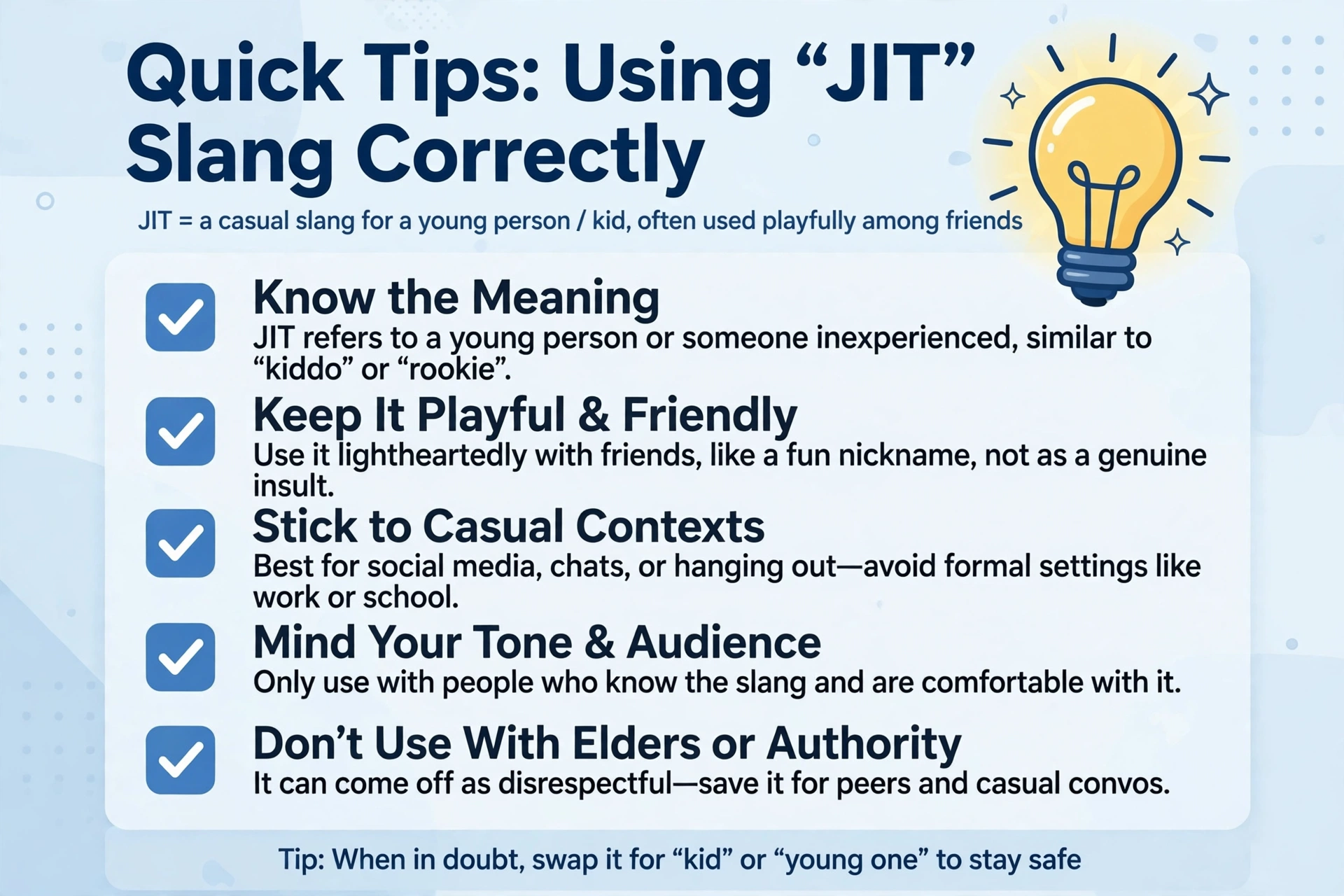
- Learn the tone before the word. Listen to how Floridians and rappers use jit in context — warm, teasing, proud — and copy the tone, not just the spelling.
- Use it with people who know you. Friends, siblings, teammates, and gaming squads are the safe zone. Strangers are not.
- Self-description is always safe. “When I was a jit” can never insult anyone else, and it often gets a laugh.
- Pair it with warmth. A smile, a laugh, or a kind follow-up sentence turns a tease into a joke. Text alone has no smile, so add one in words.
- Drop it in formal writing. Use young person, newcomer, or the person’s name instead.
- Do not use it to shut someone down. If you disagree with a younger person, answer their point. Calling them a jit avoids the argument instead of winning it.
- Check the age implication. If the person is not actually younger or newer than you, jit will sound like an insult, not a description.
- Keep it rare. Slang lands hardest when it is occasional. If every sentence has a slang word, none of them sounds natural.
A final tip from sports, where the word shows up a lot: coaches and older players use jit most effectively as encouragement. “Good play, jit — do it again” tells a young player they belong. That is the best version of the word: it notices youth, respects effort, and leaves the door open. Sports slang in general works this way — even a guide like hockey slang shows how locker-room words build belonging when they are used to include people, not to push them out — and jit is at its best when it does the same.
FAQ
What does jit mean in slang?
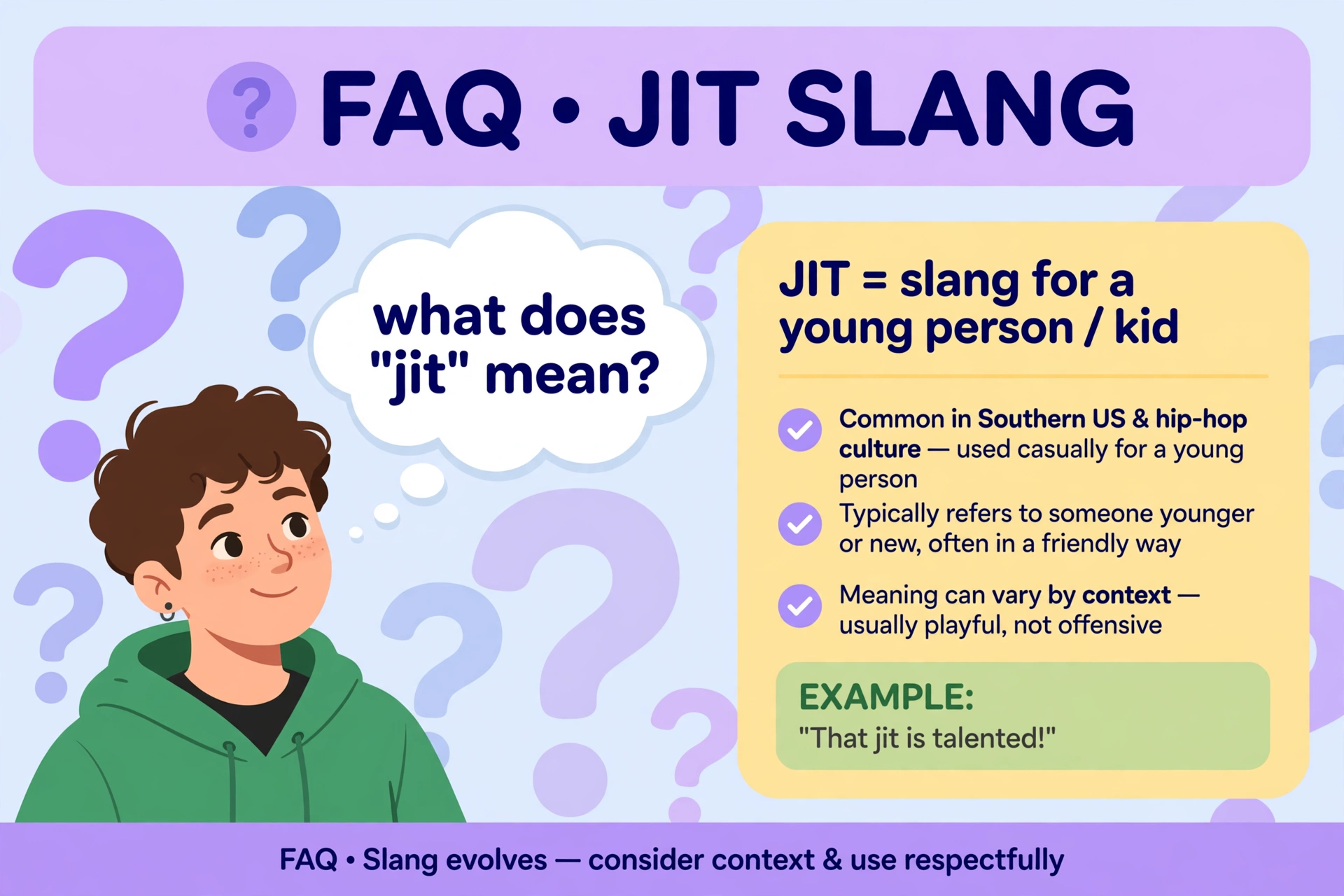
In slang, jit means a young person, usually a kid or teenager, and often someone who is inexperienced or new to something. It comes from Florida slang and African American Vernacular English. Tone decides whether it sounds affectionate, teasing, or dismissive.
Where did jit slang come from?
Jit comes from Florida, rooted in Black youth culture in the southern United States. It is most likely a clipping of jitterbug, a word for an energetic young person, with a possible link to juvenile. Florida newspapers used it in the early 1990s, Florida rap spread it nationally, and TikTok spread it worldwide.
Is jit an insult?
It can be, but it is not always one. Between friends and family, jit is often affectionate or teasing, like kiddo. Said coldly, or used to dismiss someone’s opinion because of their age, it is an insult. The relationship and the tone decide. If you are unsure, do not use it to someone’s face.
What is the difference between jit and youngin?
Both mean a young person, but youngin is warmer and more Southern, with little judgement attached. Jit is cooler and sharper: it adds the idea of inexperience or rookie energy, and it can carry a small put-down. Lil bro is warmer still, because it implies a close, protective bond.
Can girls be called jits?
Online, yes — the word is often used for any young person regardless of gender. In its Florida hip-hop sense, though, it most often describes young men and boys. Follow how the people around you use it, and use a person’s name or a neutral word if you are not sure how it will land.
What does JIT mean in texting?
In texting and social media, jit means a young, inexperienced person, or someone acting young or clueless. Examples: “that jit doesn’t know how to build” in gaming, or “chill, jit” as a teasing reply. In capital letters in a tech context, JIT means just-in-time compilation, which is unrelated.
Is jit slang only from Florida?
It started in Florida and is still most at home there, but it is no longer only Floridian. Rap, TikTok, gaming, and comment sections have carried it across the United States and beyond. People outside Florida now use it, though Floridians use the older, more specific sense, and online users often use a broader, looser sense.
Should I use jit slang at work or school?
No. Jit is casual slang and it can sound dismissive, so keep it out of work emails, school essays, presentations, and formal messages. Use young person, newcomer, trainee, or the person’s name instead. Save jit for friends, family, and casual online spaces.
Conclusion
Jit slang is a small word with a long history. It began in Florida as a way to talk about young, energetic, unproven people — jits, short for jitterbugs — and it travelled through rap lyrics, TikTok videos, and gaming chats until it became part of youth slang far beyond the state where it started. Its core meaning has stayed steady: a young person, and often a person who is still learning. What changes is the tone. Warm, it is kiddo. Teasing, it is rookie. Sharp, it is a dismissal.
Use it well by remembering where it comes from and who you are talking to. Use it with people who know you, use it to encourage as often as you use it to tease, and use the self-deprecating version — “when I was a jit” — whenever you want the word with none of the risk. In formal settings, choose the neutral words: young person, newcomer, trainee, or simply a name. Slang is at its best when it fits the moment, and jit fits the moment when youth, energy, and a little rookie spirit are exactly what you are describing. The next time you see a caption that says “that jit can really play,” you will know it is not an insult. It is Florida slang doing what it has done for decades: pointing at a young person, and saying — watch this one.
