
Quick definition: Slang in Spanish means the informal words and expressions that native speakers use in everyday conversation instead of formal textbook Spanish — words like guay (cool, in Spain), órale (wow or okay, in Mexico), and che (hey or mate, in Argentina). Spanish slang changes by country, region, and generation, so the same word can sound friendly in one place and rude in another.
Slang in Spanish Meaning & Definition
Slang in Spanish refers to the casual, unofficial vocabulary of the Spanish language. Linguists call it argot or jerga, but most learners simply call it Spanish slang. It includes shortened words, playful insults between friends, borrowed English terms, and expressions that only make sense in a specific country or city. Unlike formal Spanish, which stays fairly stable across the Spanish-speaking world, slang moves fast: new words appear on TikTok, in reggaeton lyrics, and in group chats, while older words fade or change meaning.
Understanding slang in Spanish matters because it is how real people actually talk. A student who only knows classroom Spanish can read a newspaper in Madrid or Mexico City, but may feel lost watching a Spanish Netflix series, listening to a podcast, or chatting with friends from Buenos Aires. Slang fills that gap. It signals closeness, humour, and belonging — when someone calls you tío in Spain or parce in Colombia, they are treating you like an insider, not a stranger.
Introduction
Picture this: you land in Madrid, order a coffee, and the waiter says, “¡Qué guay!” You studied Spanish for two years, yet you have no idea what he just said. Later, a friend in Mexico texts you “¡Órale, qué padre!” and a cousin in Argentina writes “Che, boludo, ¿vamos?” All three people are speaking Spanish, but they are using completely different slang. That is the beauty — and the challenge — of slang in Spanish.
Spanish is spoken by more than 500 million people across Spain, Mexico, Central and South America, the Caribbean, and the United States. Every region has built its own slang over decades, shaped by local history, music, migration, and the internet. This guide brings it all together: the most useful Spanish slang words by country, what they really mean, how to use them without sounding awkward, and the mistakes learners should avoid. Whether you are travelling, texting a friend, or watching a Spanish-language show, these words will help you sound natural instead of textbook-perfect.
If you enjoy regional language guides, you will also like our breakdowns of Mexican slang and Scottish slang — both show how much local flavour a language can carry.

Origin
Spanish slang has many roots. Some words come from old regional dialects: vale (okay) in Spain comes from the verb valer (to be worth), while che in Argentina and Uruguay traces back to the Guaraní language spoken by Indigenous peoples of the region. Other words arrived with waves of migration. Lunfardo, the famous slang of Buenos Aires, borrowed heavily from Italian because millions of Italians settled in Argentina in the late 1800s and early 1900s. Words like laburo (work, from Italian lavoro) and mina (woman) come from that era.
More recent slang comes from English, African diaspora culture, and the internet. In the Caribbean, words like janguear (to hang out, from English “hang out”) show how English and Spanish mix in Puerto Rico and the Dominican Republic. In Mexico, chido (cool) is believed to come from the Romani word for “beautiful,” while güey (dude) evolved from an old insult into a friendly word between mates. Reggaeton, trap, and social media now spread slang across borders faster than ever: a word born in a Colombian neighbourhood can trend in Spain within a week.
Popularity
Spanish slang has exploded in popularity with learners, and for good reason. Streaming hits like La Casa de Papel (Money Heist), Élite, and Narcos introduced millions of viewers to words like tronco, flipar, and parce. On TikTok and Instagram, creators post “Spanish slang you need to know” videos that regularly reach millions of views, and language learners now search for slang almost as often as they search for grammar rules.
Search interest also follows travel and migration. Spain remains one of the world’s most visited countries, Mexico is a top destination for American travellers, and Spanish is the second most spoken language in the United States. Each of these trends pushes learners toward informal Spanish. People do not just want to pass an exam — they want to joke with a host family in Seville, understand a Mexican friend’s memes, or follow an Argentine football chant without subtitles.
How It Is Used
Spanish slang is used in relaxed, informal settings: among friends, in family group chats, on social media, in music, and in comedy. It is rarely used in job interviews, formal emails, or academic writing. Tone matters enormously. The same word can be warm between friends and insulting to a stranger. Boludo in Argentina is a friendly “mate” among friends but can be an insult (“idiot”) if said with anger. Cabrón in Mexico can mean “dude” among close friends, yet it is a serious insult in other contexts.
Age matters too. Teenagers and young adults drive most new slang, while older speakers may use regional classics their grandparents used. A safe rule for learners: use slang only after you have heard a native speaker use it in that exact situation, and mirror the warmth of the relationship. Start with neutral, widely loved words like guay, vale, and ¡qué padre! before trying edgier terms.
Examples
Here are the most useful Spanish slang words, grouped by tone and region. Learn the country tag next to each word — it is the difference between sounding local and sounding confused.
Friendly Examples
- Guay (Spain): Cool, great. “¡Qué guay tu camiseta!” — “Your T-shirt is so cool!”
- Vale (Spain): Okay, all right. “¿Quedamos a las ocho?” “¡Vale!”
- Tío / tía (Spain): Mate, dude (literally “uncle/aunt”). “¡Eh, tío, mira esto!”
- Órale (Mexico): Wow, okay, come on. “¡Órale, qué rápido!”
- Qué padre (Mexico): How cool. “¡Qué padre tu coche nuevo!”
- Chido / chida (Mexico): Cool, awesome. “Está chido el concierto.”
- Parce / parcero (Colombia): Friend, buddy. “¿Qué más, parce?”
- Bacano (Colombia): Cool, great. “¡Qué bacano el plan!”
- Che (Argentina/Uruguay): Hey, mate. “Che, ¿vamos a tomar algo?”
- Boludo (Argentina): Mate, dude (friendly among friends). “¡Dale, boludo!”
- Copado (Argentina): Cool, nice. “¡Qué copado el lugar!”
- Pana (Venezuela/Caribbean): Friend, buddy. “¿Qué lo qué, pana?”
- Chévere (Venezuela/Colombia/Caribbean): Cool, great. “¡Qué chévere!”
- ¡Dale! (Argentina/Uruguay): Let’s go, okay, deal. “¿Vamos?” “¡Dale!”
- ¡Pura vida! (Costa Rica): Pure life — hello, goodbye, and “all good.”
Professional Examples
Even in semi-professional settings, light slang can build rapport — as long as it stays polite and neutral. In a friendly office in Madrid, “¡Vale, perfecto!” is completely normal. In Mexico, “¡Órale, pues!” can soften an agreement. In Colombia, greeting a colleague with “¿Qué más?” is warmer than a stiff “¿Cómo está usted?” but still respectful. The key is to keep it to greetings, agreements, and positive reactions, and to avoid insults, swearing, or overly casual terms like güey or boludo until you know the workplace culture well. When in doubt, formal Spanish is always safe, and a single friendly slang word is usually enough.
Funny Examples
- Flipar (Spain): To be amazed or freak out. “¡Estoy flipando con este precio!”
- Mola (Spain): It’s cool (literally “it rocks”). “¡Mola un montón!”
- Pasarlo pipa (Spain): To have a great time. “¡Lo pasamos pipa en la playa!”
- No manches (Mexico): No way! (polite version of a ruder phrase). “¡No manches, en serio?”
- Qué onda (Mexico/Argentina): What’s up? “¡Qué onda, güey!”
- Está cañón (Mexico): It’s tough or intense. “El examen estuvo cañón.”
- Janguear (Puerto Rico): To hang out. “Vamos a janguear esta noche.”
- Guagua (Caribbean/Canary Islands): Bus — a classic false-friend word that surprises learners.
- ¡Vaya tela! (Spain): Wow, unbelievable (literally “what a cloth!”).
- Re copado (Argentina): Really cool — re is Argentina’s favourite intensifier.

Comparison with Similar Terms
Spanish slang overlaps with several related ideas, but they are not the same thing. This table clears up the confusion:
| Term | What it means | Example | Key difference |
|---|---|---|---|
| Slang (jerga/argot) | Informal, group-specific vocabulary | guay, órale, parce | Changes fast; marks group identity |
| Colloquial Spanish | Everyday spoken Spanish, still widely understood | vale, ¿qué tal? | Broader and more stable than slang |
| Regional dialect | A whole local variety of Spanish | Rioplatense Spanish | Includes accent, grammar, and vocabulary |
| Spanglish | Mixing Spanish and English | janguear, parquear | Bilingual blend, common in the US and Caribbean |
| Formal Spanish | Standard, neutral, written Spanish | excelente, de acuerdo | Understood everywhere; safe in any setting |
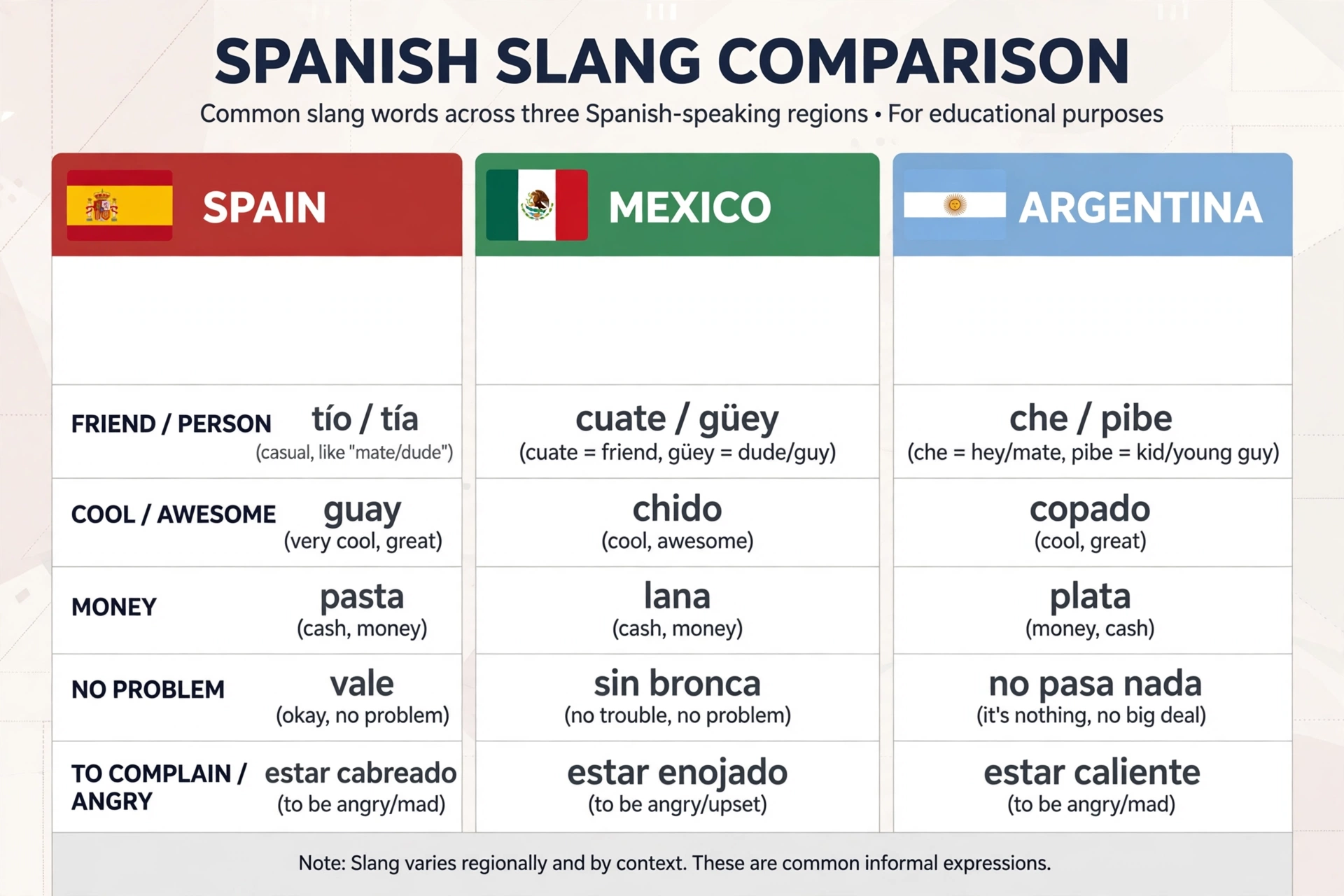
One practical takeaway: colloquial words like vale travel well, while true slang like boludo or güey can confuse or even offend outside their home region. When travelling between countries, reset your slang the way you reset your plug adapter.
Alternate Meanings
Many Spanish slang words carry a second, formal meaning — and that is where learners get tripped up. Tío formally means “uncle,” but as slang it means “mate.” Mola formally relates to “molar” (a tooth) in older usage, but as slang it means “it’s cool.” Padre formally means “father,” yet qué padre in Mexico means “how cool.” Coger means “to take” in Spain, but in much of Latin America it is a vulgar word — one of the most famous traps in Spanish slang.
Context is everything. Chingar in Mexico is a strong swear word, while in other countries it barely registers. Concha means “shell” in Spain but is vulgar in Argentina. Fresa means “strawberry” everywhere, but in Mexico a fresa is also a preppy, snobbish person. Before using any word you learned from a song or a meme, check its meaning in the specific country where you plan to use it.
Professional or Polite Alternatives
When you need to sound polite, swap slang for these neutral alternatives. They work in every Spanish-speaking country:
| Slang | Polite alternative | When to use it |
|---|---|---|
| ¡Qué guay! / ¡Qué padre! | ¡Qué bien! / ¡Excelente! | Work, school, formal events |
| Vale | De acuerdo / Perfecto | Meetings, emails, customer service |
| ¡Órale! | ¡Claro! / ¡Por supuesto! | Agreeing politely |
| ¿Qué onda? | ¿Cómo estás? / ¿Qué tal? | Greeting colleagues or elders |
| Tío / güey / parce | Amigo / compañero | Addressing someone respectfully |
| ¡No manches! | ¡No me digas! / ¡En serio! | Reacting with surprise politely |
A good habit: learn each slang word together with its polite twin. That way you can switch registers instantly — slang with friends, neutral Spanish with everyone else.
Common Mistakes
Learners make the same five mistakes with slang in Spanish again and again:
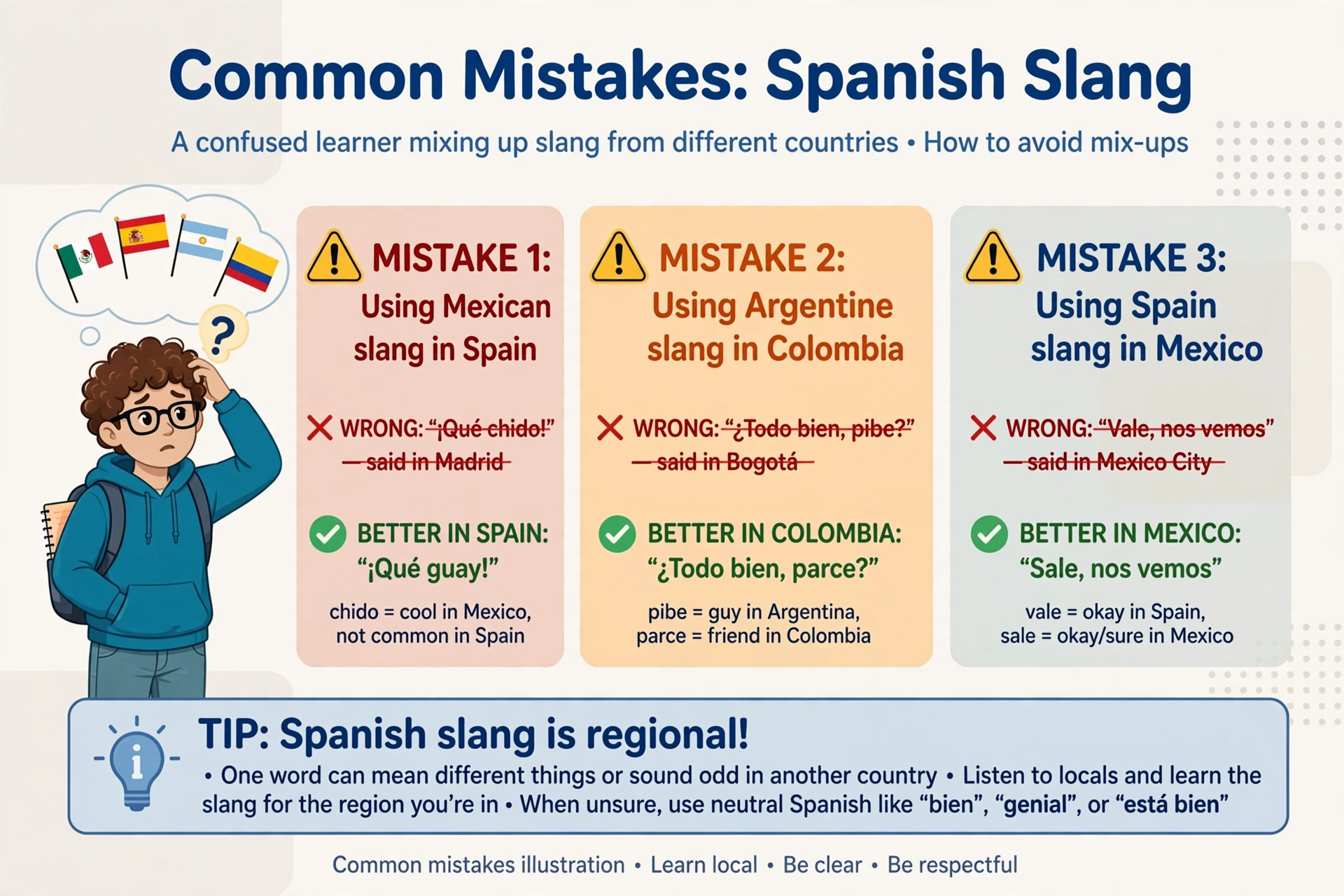
- Using one country’s slang everywhere. Saying vale in Mexico or órale in Spain will earn you a confused smile. Match the word to the country.
- Overusing slang to sound fluent. Dropping güey into every sentence does not sound native — it sounds like a parody. One or two slang words per conversation is plenty.
- Using insults as friendly words. Words like boludo, cabrón, and pendejo are friendly only between close friends. With strangers, they are insults.
- Ignoring gender and agreement. Chido becomes chida for a feminine noun, and tío becomes tía for a woman. Getting this wrong sounds careless.
- Learning slang only from songs. Reggaeton and trap lyrics are full of exaggeration, swearing, and words you should never say to your teacher, boss, or host family.
Quick Tips
- Listen first, speak second. Spend a week hearing how locals use a word before you try it yourself.
- Learn by country, not by list. Pick one country’s slang to master first — Spain, Mexico, or Argentina — then branch out.
- Watch shows with subtitles. Spanish series and telenovelas are the fastest way to hear slang in natural context.
- Keep a slang notebook. Write the word, the country, an example sentence, and whether it is friendly or rude.
- Ask a native speaker. “¿Esto se dice aquí?” (“Do people say this here?”) will save you from many awkward moments.
- Mix slang with good grammar. Slang sounds best on top of solid Spanish — it is seasoning, not the whole meal.
- Follow creators from the region. A Madrid creator teaches different slang than a Mexico City creator, and both are worth following.


FAQ
What is slang in Spanish called?
Spanish slang is generally called jerga or argot. In Argentina it is famously known as lunfardo, while everyday informal speech is often called habla coloquial.
What is the most common Spanish slang word?
There is no single winner because slang varies by country, but vale (Spain), órale (Mexico), and che (Argentina) are among the most widely recognised. For learners, guay and qué padre are safe, popular starting points.
Is Spanish slang the same in Spain and Mexico?
No. Spain and Mexico share formal Spanish but use very different slang. Spain says guay, vale, and mola; Mexico says chido, órale, and qué padre. Using one country’s slang in the other usually causes confusion.
How do you say “cool” in Spanish slang?
It depends on the country: guay or mola in Spain, chido or qué padre in Mexico, bacano or chévere in Colombia and Venezuela, and copado in Argentina.
What does “órale” mean in Spanish slang?
Órale is a versatile Mexican expression meaning “okay,” “wow,” “come on,” or “hurry up,” depending on tone. Said warmly it shows agreement; said sharply it shows surprise or impatience.
Is it rude to use Spanish slang as a learner?
Not if you choose friendly, neutral words and use them with the right people. Words like guay, vale, and qué padre are welcoming. Avoid insults and swear words until a native speaker confirms they are friendly in that context.
What is “che” in Argentina?
Che is Argentina and Uruguay’s famous attention word, similar to “hey” or “mate.” “Che, ¿vamos?” means “Hey, shall we go?” It is friendly, iconic, and instantly identifies Rioplatense Spanish.
How can I learn Spanish slang fast?
Watch Spanish-language shows with subtitles, follow creators from one region, keep a notebook of words with their country and tone, and practise with native speakers. Focus on one country first, then expand to others.
Conclusion
Slang in Spanish is the difference between speaking Spanish and sounding Spanish. Words like guay, órale, parce, and che carry history, humour, and local pride — and they open doors that grammar alone cannot. The secret is respect for region and tone: learn where each word belongs, use it sparingly, and keep a polite alternative ready for formal moments.
Start with five friendly words from the country you care about most, listen to how locals use them, and build from there. Before long, you will not just understand Spanish slang — you will enjoy it. Keep exploring regional English and Spanish with our guides to Mexican slang, Australian slang, and Jamaican slang, and remember the golden rule of slang in Spanish: when in doubt, listen first — and when a word feels right, ¡dale! For authoritative background on the language itself, see Spanish language.
