| Term | Stands For | Means | Example |
|---|---|---|---|
| IMK | In My Knowledge | “As far as I know” / “To my knowledge” — sharing info you’re fairly sure about, with a small caveat | “The cafe opens at 9, imk.” |
IMK Meaning in Text & Definition
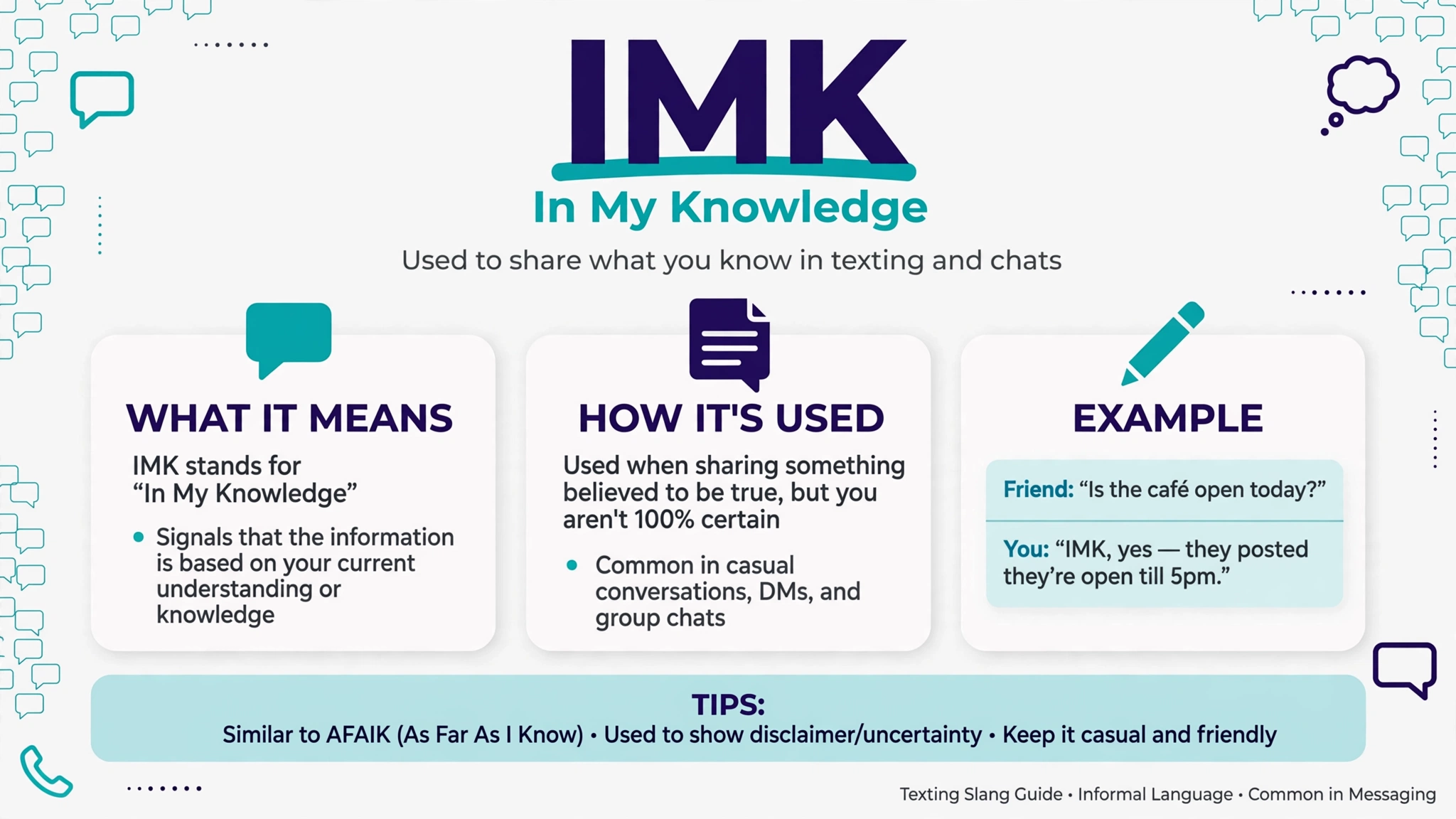
Quick Answer: Searching for the imk meaning in text? In texting, IMK stands for “in my knowledge” — the casual texting equivalent of “as far as I know” or “to my knowledge.” People use it when they’re sharing information they believe is correct but can’t fully guarantee. For example: “Imk the game got moved to Saturday” means “As far as I know, the game got moved to Saturday — but double-check.”
Here’s the nuance most short guides skip: IMK is a hedge. It doesn’t just deliver information — it quietly lowers the speaker’s commitment to it. When someone adds “imk” to a sentence, they’re really saying three things at once: here’s what I know, I believe it’s right, and I’m not staking my reputation on it. That’s the entire reason the abbreviation exists. Without it, “The meeting is at 10” sounds like a confirmed fact. With it — “The meeting is at 10, imk” — the reader instantly understands there’s a small margin of error and should verify if it matters.
IMK belongs to the big family of knowledge-based texting abbreviations, alongside AFAIK (as far as I know), IIRC (if I recall correctly), and IMO (in my opinion). But it has one trait none of the others share: it looks almost identical to LMK (“let me know”) in many fonts, which causes one of the most common mix-ups in all of texting. We’ll untangle that confusion completely in the comparison section below.
Introduction
You’re in a group chat and someone drops a line like “imk she’s already left” — and you freeze. Is that good news? Bad news? Are they sure? And wait… did they actually mean LMK? Welcome to the small but surprisingly tricky world of IMK, a three-letter abbreviation that quietly carries a lot of social intelligence.
Most slang is about speed — typing fewer letters to say the same thing faster. IMK is different. It’s not just shorter than “to the best of my knowledge”; it’s smarter. It lets the sender share something useful while honestly flagging that they might be wrong. In a world of group chats, forwarded rumors, and half-remembered plans, that little honesty flag is genuinely useful. That’s why IMK has stuck around for over two decades while hundreds of other abbreviations died off.
In this guide, we’ll decode exactly what IMK means in texting and on Snapchat, TikTok, and Instagram — much like our guide to what TYSM means in text — trace where it came from, and show you how to tell it apart from its evil twin LMK in under three seconds. You’ll get real chat examples for friendly, professional, and funny situations, a side-by-side comparison with every similar abbreviation, the polite alternatives for work emails, and the mistakes that make people look careless. By the end, you’ll not only read IMK like a native — you’ll know exactly when to use it yourself.
Origin
IMK’s story starts in the era of dial-up internet and blinking chatroom cursors — the late 1990s and early 2000s. Before smartphones, before WhatsApp, people gathered in internet relay chats, forums, and message boards, where long written discussions moved fast and typing speed mattered. In those spaces, phrases like “as far as I know” and “to the best of my knowledge” came up constantly — especially in tech support forums and gaming communities, where people shared advice they couldn’t fully verify.
Naturally, the community compressed it. “As far as I know” became AFAIK; “to my knowledge” condensed further into IMK. Neither was invented by any single person or platform — they spread organically because they solved a real communication problem: how do you share something helpful without getting blamed if it turns out wrong? Slang references such as Urban Dictionary’s entry for IMK document the same “in my knowledge” meaning that texters still use today.
The SMS era (2000s): When texting exploded with its brutal 160-character limits, IMK migrated from forums to phones. Teens and young adults adopted it for everyday coordination — party times, homework answers, ride plans — anywhere a little uncertainty was normal.
The social media era (2010s–today): Snapchat, Instagram, and TikTok gave IMK a second life. On TikTok comments and Instagram DMs, you’ll see “imk” tacked onto claims people believe but haven’t verified: “imk that song is from 2019”. It’s become part of the standard Gen Z and millennial texting vocabulary — a tiny piece of internet culture that quietly signals honesty.
Popularity
IMK will never be as famous as LOL or OMG, and that’s fine — it’s not trying to be. Its popularity comes from utility, not virality. Three forces keep it alive:
- Information overload: Group chats are full of secondhand info — forwarded messages, screenshots, rumors. IMK is the perfect tool for passing something along without vouching for it completely.
- Politeness culture: Stating uncertain things as facts can feel arrogant or get you in trouble. IMK softens the claim. It’s the texting equivalent of a modest shrug, and in many friend groups, that humility reads as respectful.
- Platform fit: Snapchat streaks, TikTok comments, Discord servers — every fast-moving platform rewards short, honest hedges. IMK fits the rhythm of rapid chat better than any formal phrase could.
Search interest in the “imk meaning in text” query has stayed remarkably steady year after year. Unlike flash-in-the-pan slang that spikes and vanishes, IMK behaves like permanent vocabulary — it solves a problem that isn’t going away. And here’s a fun detail: much of its search traffic actually comes from people who saw LMK in a weird font and want to figure out what “imk” means. The confusion itself keeps the term relevant.
How It Is Used
The imk meaning in text is stable — it almost always means “in my knowledge” — so the real skill isn’t decoding the letters, it’s reading the sentence around them. Here’s how IMK actually behaves in the wild.
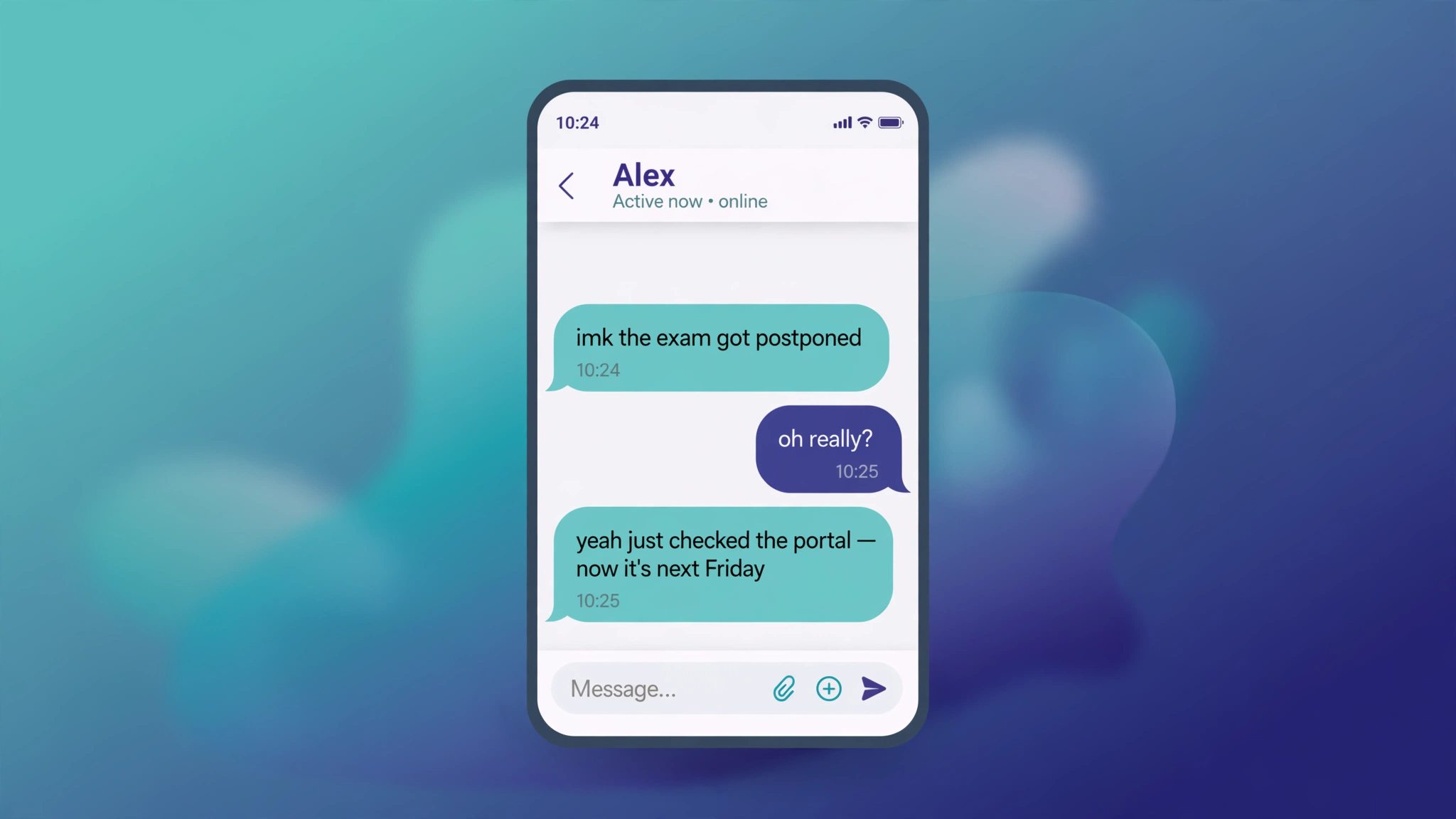
1. As a softener at the end of a claim. This is the #1 usage. The fact comes first, IMK comes last, like a verbal asterisk: “The bus leaves at 6:30, imk.” The position matters — trailing IMK specifically marks the preceding statement as “pretty sure, not certain.”
2. As a lead-in before answering a question. When someone asks for info, IMK opens the answer: “Imk yeah, she’s still working there.” This is the polite way to answer when you haven’t checked recently. It says “I’ll help, but I’m not the official source.”
3. In group chats, to pass along secondhand info. “Imk the venue changed, someone just posted it in the other group.” Group chats run on forwarded news, and IMK is the standard disclaimer. It tells everyone: treat this as a heads-up, not an announcement.
4. On social media, as a comment caveat. On TikTok and Instagram, people add “imk” when correcting or informing strangers: “imk this is the same actor from Wednesday”. It keeps the tone friendly instead of know-it-all — nobody likes being corrected by a stranger, but a hedged correction feels helpful.
The 3-second LMK test: Since IMK and LMK look nearly identical, always run this check. Read the sentence and ask: is the sender giving me information, or asking me for it? Giving = IMK (“imk the party moved to Saturday” — they’re telling you). Asking = LMK (“lmk if you’re coming” — they want a reply). If the sentence makes zero sense with “in my knowledge,” it’s LMK. This one test resolves 95% of confusion instantly.
Examples
Nothing teaches slang like seeing it in real conversations. Here are natural examples for every tone.
Friendly Examples
- “Are we still on for Friday?” — “Imk yeah! Haven’t heard otherwise” — confirming plans with a friendly hedge.
- “Do you know if the library is open today?” — “Imk it closes at 5 on Sundays.” — sharing what you remember without promising.
- “Who’s bringing snacks?” — “Imk Sarah said she’d grab chips.” — passing along secondhand info in a group chat.
- “Is that restaurant expensive?” — “Imk it’s pretty reasonable, we went last month.” — answering from personal experience, honestly flagged as memory.
- “What time does the movie start?” — “Imk 7:30, but check the app to be safe.” — the classic hedge + verify combo.
Professional Examples
- “Imk the client approved the draft, waiting on final confirmation.” — internal team chat; shares progress without overstating it.
- “Has the invoice been sent?” — “Imk finance handled it yesterday.” — answers a work question while signaling you didn’t do it personally.
- “Do we have the report from Q3?” — “Imk it’s in the shared drive.” — points someone in the right direction without guaranteeing.
Workplace note: IMK is acceptable in internal chats (Slack, Teams, WhatsApp groups) where everyone texts casually. Never use it in client emails, contracts, or official documents — write “to my knowledge” or “as far as I’m aware” instead.
Funny Examples
- “Imk the diet starts tomorrow. It has started tomorrow every day since 2021.”
- “Her: Are you sure he’s coming? Him: Imk. Her: That’s not an answer. Him: It’s the only answer I have.”
- “Imk I left my keys on the table. The table has betrayed me before.”
- “Imk this is a great idea. Imk is doing a lot of heavy lifting in that sentence.”
Notice the running joke in that last one: experienced texters know IMK is a dodge, and they play with it. Self-aware hedging is part of the fun.
Comparison with Similar Terms
IMK sits in a crowded neighborhood of lookalike abbreviations. Here’s the full map so you never mix them up:
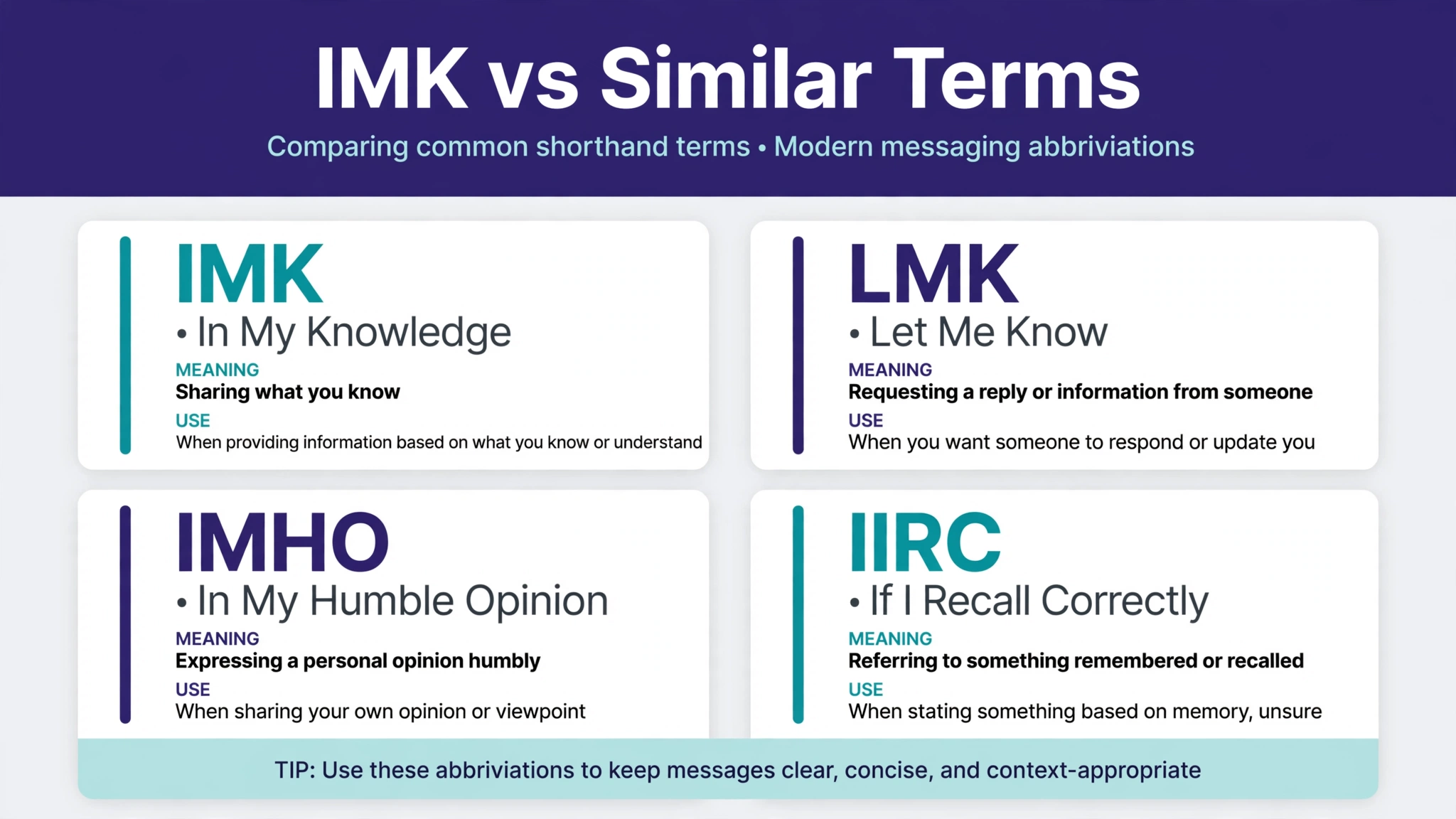
| Abbreviation | Stands For | What It Does | IMK vs This Term |
|---|---|---|---|
| IMK | In My Knowledge | Gives info with a small caveat | — |
| LMK | Let Me Know | Asks YOU for info or updates | Opposite direction. IMK gives, LMK requests. The #1 confusion — check the sentence, not the letters. |
| IMO | In My Opinion | Shares a subjective view | IMK = facts (“imk it starts at 7”). IMO = taste (“imo it’s overrated”). Don’t swap them. |
| IMHO | In My Humble Opinion | Softened opinion | Same split as IMO — opinion, not knowledge. Use for judgments, not facts. |
| AFAIK | As Far As I Know | Same job as IMK | Near-synonyms. AFAIK is slightly more common and reads a touch more formal. |
| IIRC | If I Recall Correctly | Flags memory uncertainty specifically | Overlaps with IMK, but IIRC points at memory (“iirc we met in 2019”). IMK is broader. |
| IDK | I Don’t Know | Admits zero knowledge | The opposite end of the scale: IDK = no info, IMK = probable info. |
| FYI | For Your Information | Shares info as fact | FYI states confidently; IMK adds the caveat. “FYI, doors open at 8” vs “Doors open at 8, imk.” |
| TBH | To Be Honest | Signals candor | TBH is about honesty of feeling; IMK is about certainty of facts. Different jobs. |
The one-line memory trick: IMK informs, LMK inquires, IMO opines. If you remember that sentence, you’ll never confuse the big three again.
Alternate Meanings
IMK has a few rare alternate readings. They come up occasionally, so here’s how to spot them:
- “I’m okay” (typo/shorthand): In very fast, typo-prone mobile typing, “imk” sometimes slips out when someone meant “I’m okay” or “I’m k.” Example: “You good?” — “yeah imk”. It’s uncommon, but if the conversation is about feelings or health rather than facts, this is probably what they meant.
- A typo for LMK: This isn’t a real “meaning” — it’s the famous lookalike error. A lowercase L and capital I look identical in many fonts, so “lmk when you land” can easily be typed or read as “imk.” If the sentence is clearly asking you for something, treat it as LMK regardless of which letter you think you see.
- “I might know”: Very rarely, people stretch IMK to mean “I might know” — as in “imk a guy who can fix that.” This usage is nonstandard and confusing; most readers will parse it as “in my knowledge,” so it’s better avoided.
Bottom line: In 95%+ of real messages, IMK = “in my knowledge.” Only reach for the alternates when the sentence genuinely makes no sense with the main meaning.
Professional or Polite Alternatives
IMK is informal by design. When the setting demands polish, use one of these instead:
| Setting | Say This Instead | Example |
|---|---|---|
| Client email | “To my knowledge” | “To my knowledge, the shipment arrives Thursday.” |
| Work report | “As far as I’m aware” | “As far as I’m aware, all milestones are on track.” |
| Formal document | “To the best of my knowledge” | “To the best of my knowledge, the figures are accurate.” |
| Meeting | “If I recall correctly” | “If I recall correctly, we agreed on the 15th.” |
| Customer support | “Based on the information I have” | “Based on the information I have, your order ships today.” |
| Academic writing | “According to available information” | “According to available information, the trend began in 2020.” |
Rule of thumb: IMK is fine with friends, teammates in chat, and social media. In job applications, client emails, legal writing, or anything official — always write it out. The hedge is professional; the abbreviation isn’t.
Common Mistakes
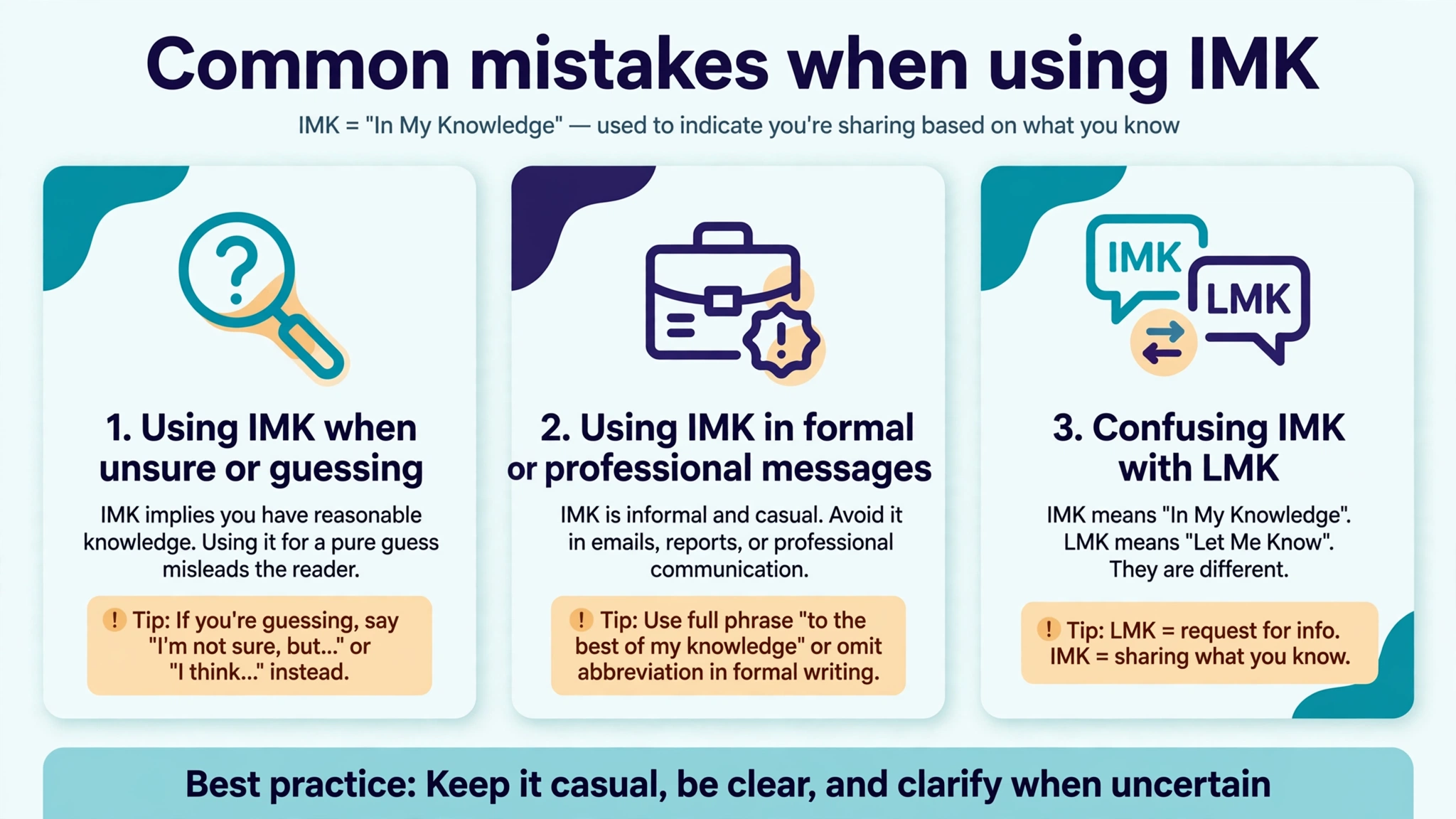
- Confusing IMK with LMK. The single most common error. “Imk when you land” makes no sense as “in my knowledge when you land” — it’s a typo for LMK (“let me know”). Always run the 3-second test: is the sentence giving info or asking for it?
- Using IMK for opinions. “IMK pizza is the best food” sounds off because pizza quality isn’t knowledge — it’s taste. Opinions want IMO. IMK is for facts you could theoretically verify: times, dates, names, events.
- Treating “imk” as a guarantee. On the receiving end, remember IMK literally means “I might be wrong.” If the info matters — a flight time, a deadline, an address — verify it. IMK is a soft “probably,” not a confirmation.
- Using IMK in formal writing. It reads as careless in client emails, job applications, and official documents. The hedge itself is fine and even professional — just spell it out: “to my knowledge.”
- Over-hedging everything. Sprinkling “imk” on every sentence makes you sound unsure of your own name. Use it only where genuine uncertainty exists. Confident statements don’t need a disclaimer.
- Assuming IMK means “I’m okay.” This reading is rare. If someone answers a factual question with “imk,” they’re hedging an answer, not telling you their emotional state. Don’t ask “okay about what?” — just read the sentence.
Quick Tips
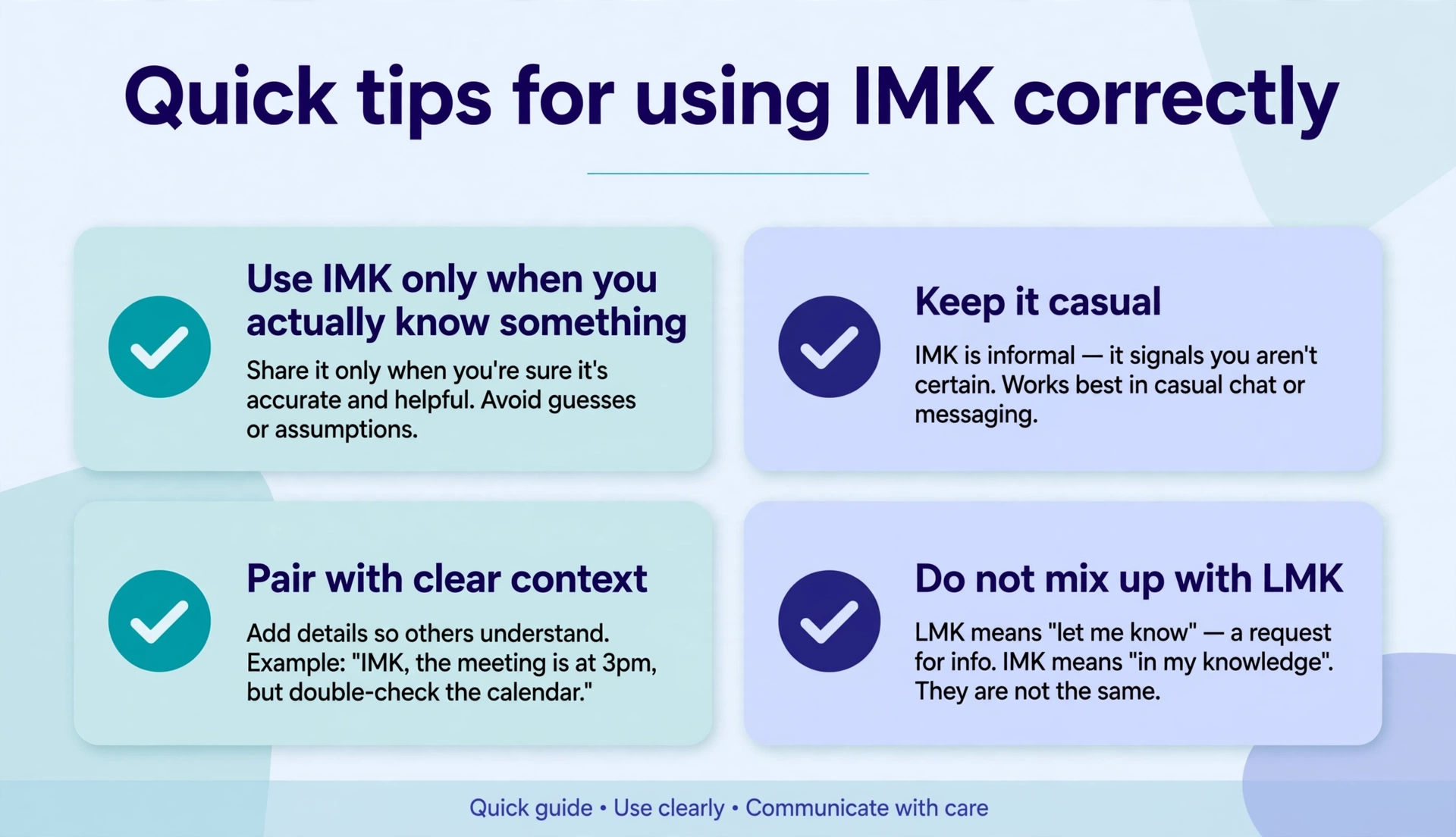
- Placement matters: Put IMK at the end of the claim it modifies (“Doors open at 8, imk”) so readers know exactly what’s uncertain.
- Pair it with a verify nudge: “Imk 7:30, but check the app” is the gold standard — helpful and honest.
- Match the energy: If your friend writes “imk?”, they want your best guess, not a research paper. A quick hedged answer is perfect.
- In group chats: Cite your source when you can — “Imk the venue changed, saw it in the other group” beats a bare “imk” every time.
- Don’t hedge twice: “Imk maybe possibly” is overkill. One hedge per sentence is plenty.
- When receiving IMK: Treat it as “probably true, worth a quick check” — especially for anything time-sensitive or expensive.
- Teach the LMK test: The next time a friend is confused, share the rule: giving info = IMK, asking for info = LMK. You’ll look like a texting genius.
FAQ
1. What is the IMK meaning in text?
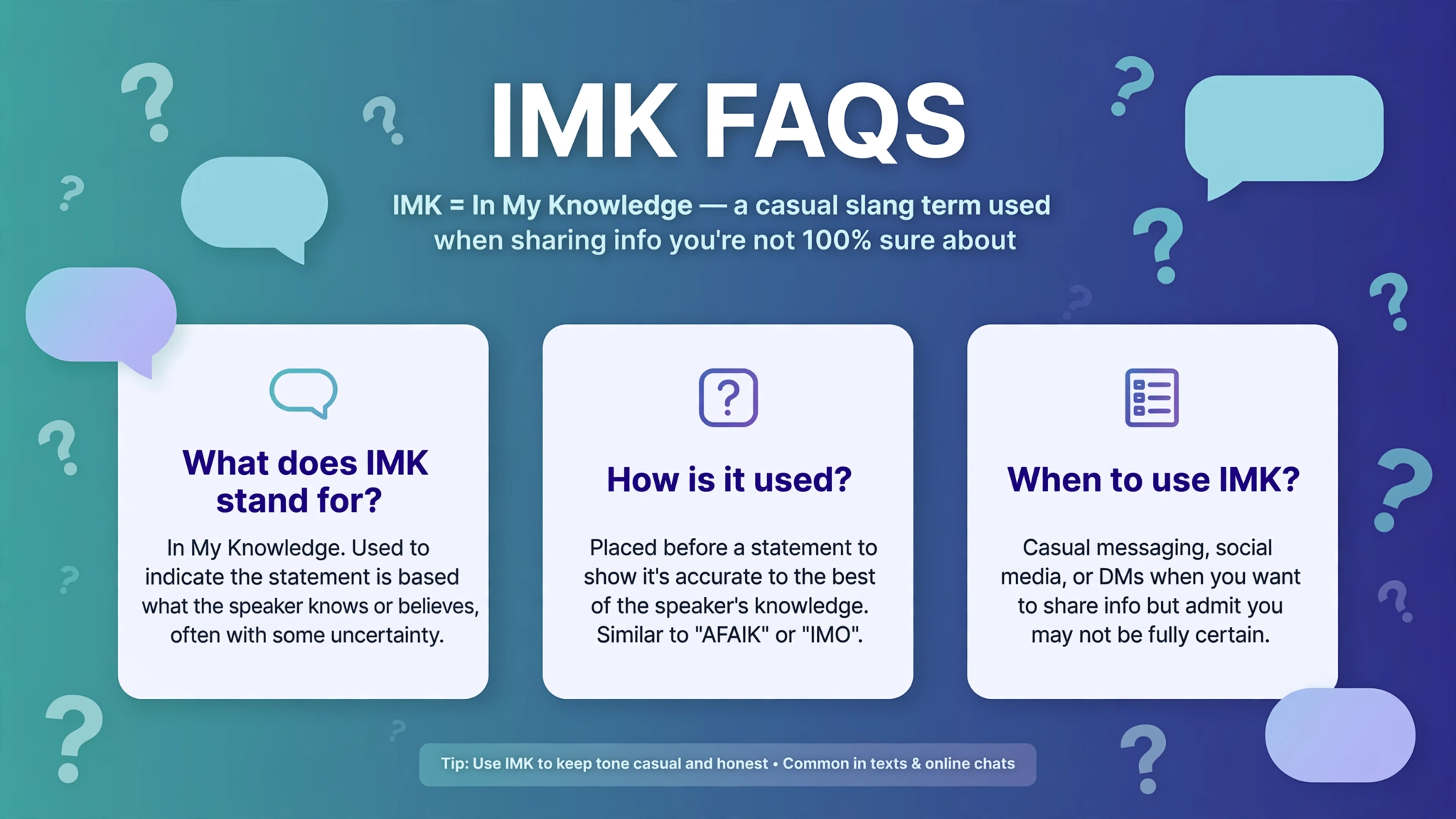
IMK stands for “in my knowledge” — the texting version of “as far as I know” or “to my knowledge.” It means the sender believes the information is correct but isn’t 100% certain. Example: “Imk the store closes at 9.”
2. What is the difference between IMK and LMK?
They’re opposites. IMK (“in my knowledge”) gives information with a small caveat: “imk she’s already left.” LMK (“let me know”) asks for information: “lmk when you land.” They get confused because a capital I and lowercase l look identical in many fonts. Read the sentence — giving = IMK, asking = LMK.
3. What does IMK mean on Snapchat, TikTok, and Instagram?
The same as in texting: “in my knowledge” / “as far as I know.” On TikTok and Instagram, it often appears in comments when someone shares info they believe but haven’t verified (“imk this song is from 2019”). On Snapchat, it shows up in quick chats the same way — occasionally as a fast-typed “I’m okay,” depending on context.
4. Is IMK rude or unprofessional?
No — IMK is polite, not rude. Hedging uncertain info is actually respectful; it avoids misleading people. It’s informal, though, so keep it to friends, casual chats, and internal team messages. In client emails or formal documents, write “to my knowledge” instead.
5. What’s the difference between IMK and IMO?
IMK is about knowledge (facts you could check: “imk it starts at 7”). IMO is about opinion (taste and judgment: “imo it’s overrated”). Mixing them up creates confusion — “IMO the meeting is at 10” makes people wonder if you’re guessing or arguing.
6. Can I use IMK at work?
In internal chats (Slack, Teams, work WhatsApp groups), yes — it’s a normal, honest way to share uncertain info: “Imk finance sent it yesterday.” In client-facing or formal communication, no — use “to my knowledge” or “as far as I’m aware.”
7. How should I reply when someone texts “imk”?
Treat it as a helpful but unverified answer. If it matters, verify: “Thanks! I’ll double-check the time.” If it’s casual, just respond to the info itself. And if their “imk” actually looks like a request (“imk when you’re free”), they probably meant LMK — answer accordingly.
8. What are good alternatives to IMK?
For the same meaning in fuller form: AFAIK (as far as I know), IIRC (if I recall correctly), “to my knowledge,” “as far as I’m aware,” or “don’t quote me on this.” AFAIK is the closest true synonym; IIRC specifically flags memory uncertainty.
Conclusion
IMK may be small, but it’s one of the smartest abbreviations in texting: three letters that deliver information and honesty at the same time. The key takeaway is simple — the imk meaning in text is “in my knowledge,” a friendly hedge for “as far as I know.” It softens claims, keeps group chats honest, and saves you from stating uncertain things as facts.
The one thing to burn into memory is the IMK vs LMK rule: giving information = IMK, asking for information = LMK. That single test untangles the most common confusion in texting abbreviations, and now you own it. You’ll also know to treat “imk” as a soft probably (verify when it matters), to keep it out of formal emails, and to pair it with a quick “but double-check” when you’re feeling extra helpful.
Quick recap: IMK = in my knowledge = “as far as I know.” Use it to share probable info with an honest caveat. Don’t confuse it with LMK (let me know) or IMO (in my opinion). If you enjoyed this breakdown, explore more slang decoded the same way: what FN means in text, what TM means in text, and what PTSO means in text. And the next time someone texts you “imk the party moved to Saturday,” you’ll know exactly what they mean — and exactly how much to trust it.

7 thoughts on “IMK Meaning in Text: What Does IMK Stand For? Chat Examples & 2026 Guide”