
Quick definition: In text slang, OTP means “one true pairing” — a fan’s favorite romantic couple from a show, movie, book, anime, or game, the pairing they support above every other ship. In a completely different context, OTP can also mean a “one-time password,” the temporary security code your bank or app sends you.
OTP Meaning Text Slang Meaning & Definition
OTP meaning in text slang is almost always “one true pairing.” It is a fandom word. When someone says “they are my OTP,” they are not talking about a password or a phone call. They are saying that out of every possible couple in a story, these two characters belong together — at least in their heart. The pairing might be canon, meaning it actually happens in the story, or it might exist only in fanfiction, fan art, and daydreams. Either way, the feeling is real.
The word “pairing” is the key. A pairing is any two characters that fans imagine as a couple. A “ship” is short for relationship, and “shipping” is the act of supporting a pairing. Your OTP is the ship you care about most. You might enjoy several ships in one fandom, but your OTP is the one you would defend in the comments at 2 a.m., the one whose scenes you rewatch, and the one whose fanfiction you actually finish.
OTP is also used as a verb. Fans say “I OTP them” or “I OTP them so hard,” which means they strongly support the pairing. You will also see OTP used jokingly for non-romantic perfect matches: a character and their coffee, a singer and a high note, or you and your bed on a Sunday morning. The joke works because everyone knows the original meaning is about a beloved couple.
Introduction
Scroll through TikTok comments, a fanfiction tag list, or a group chat about last night’s episode, and you will run into OTP sooner or later. “They are literally my OTP.” “This scene just made them my OTP.” “I don’t care what the writers do, they will always be my OTP.” If you have ever wondered what those three letters mean, you are not alone — OTP was even ranked among the most searched text abbreviations in the United States, because the same letters also show up in a totally different place: your login screen.
That double life is what makes OTP confusing. In a fandom post, OTP is emotional and playful. In a message from your bank, OTP is technical and urgent: “Your OTP is 482913.” Both uses are correct, and context almost always tells you which one you are looking at. A six-digit code next to the letters means security. A character name next to the letters means shipping.
This guide explains OTP meaning in text slang in full: where the term came from, how fans use it today, how it differs from similar words like ship, NOTP, and BroTP, and how to tell it apart from a one-time password and “on the phone.” By the end, you will read OTP the way fluent fans do — instantly, and with the right meaning every time. If you are still building your texting vocabulary, our guide to fn meaning in text covers another abbreviation that changes meaning with context, just like OTP does.

Origin
OTP was born in online fandom in the late 1990s and early 2000s, when fans of TV shows gathered on forums, mailing lists, and fanfiction archives to argue — lovingly — about which characters should end up together. The word “ship” itself came from fans of The X-Files, who called themselves “relationshippers” because they wanted Fox Mulder and Dana Scully to be in a relationship. As shipping culture grew, fans needed a way to say “not just a ship I like, but the ship.” OTP, short for “one true pairing,” was the answer.
The phrase “one true” was deliberately dramatic. It borrowed the language of destiny — soulmates, true love, meant to be — and applied it to fictional couples. That drama was the point. Calling a pairing your OTP was a declaration of loyalty. It said: other ships are fine, but this one is the real one. Early fan communities took OTP seriously, and “OTP wars” — long debates between fans of rival pairings — became a defining feature of fandom life.
Over time, OTP escaped its original fandoms and spread across Tumblr, Twitter, TikTok, and Wattpad. Today it is used far beyond the shows that invented it. Fans apply it to K-pop idols, anime characters, book couples, video game characters, and even real-life celebrity couples. The meaning loosened a little along the way: many fans now have one OTP per fandom rather than one OTP for life, and the word is often used lightly, even jokingly. But the core idea has not changed: an OTP is a favorite pairing, held above the rest.
Popularity
OTP is popular because fandom itself is popular. Shipping is one of the biggest engines of online fan culture: fanfiction archives are organized by pairing, TikTok edits are built around couples, and entire fan events revolve around which ship will become canon. OTP gives all of that energy a single label. Instead of writing a paragraph about why two characters belong together, a fan can write three letters and be instantly understood by millions of other fans.
The word also stays popular because it is flexible. It works as a noun (“They are my OTP”), a verb (“I OTP them”), and a joke (“Me and my blanket are OTP”). It works in captions, comments, bios, and fanfiction tags. A fanfiction site lets writers tag a story with its OTP so readers can find exactly the pairing they want. A TikTok creator can caption a couple’s edit “OTP energy” and the audience knows immediately that the video is a celebration, not a critique.
OTP’s other meanings keep it in the spotlight too. Because “one-time password” is now part of everyday digital life, the letters OTP appear in millions of phones every day. That overlap creates constant curiosity — people search for OTP meaning, find the fandom definition, and discover a whole subculture they did not know existed. Search interest has stayed strong for years, and every new hit show creates a new generation of OTPs: the couple everyone ships, the pairing that dominates the timeline, the ship that fans refuse to give up on even when the writers say otherwise.
How It Is Used
OTP is used in a few consistent ways, and once you know the patterns, it is easy to spot:
- As a declaration of a favorite ship: “Ron and Hermione are my OTP.” This is the classic use. The speaker is naming the pairing they support most.
- As a verb for shipping: “I OTP them so hard after that episode.” Here OTP works like “ship” — it describes the act of supporting a couple.
- As praise for chemistry: “That scene was pure OTP material.” The speaker is saying the characters’ interaction proved they belong together.
- As a joke about a perfect match: “My cat and that sunbeam are OTP.” The romantic meaning is borrowed for humor; nobody thinks the cat is dating the sunbeam.
- As a loyalty statement: “I don’t care what the finale did, they are still my OTP.” This is the stubborn, emotional core of the word — canon cannot break it.
Tone matters. In fandom, OTP is almost always warm, enthusiastic, or playful. It is a word of affection. Even in ship wars, where fans argue passionately for rival pairings, OTP is used to express love for one’s own ship, not hate for someone else’s — although fans do have a separate word, NOTP, for a pairing they actively reject. If you are learning how fans talk online, you will notice OTP often appears next to other fandom words like “canon,” “fanon,” “ship,” and “stan,” and next to honest-opinion openers like the one explained in our guide to ngl meaning in text.
Outside fandom, read the sentence around OTP before assuming anything. “OTP, call you back” means on the phone. “Enter the OTP sent to your mobile” means one-time password. “They are my OTP” in a post about a TV show means one true pairing. The surrounding words — character names, a code, a phone — will almost always give it away.
Examples
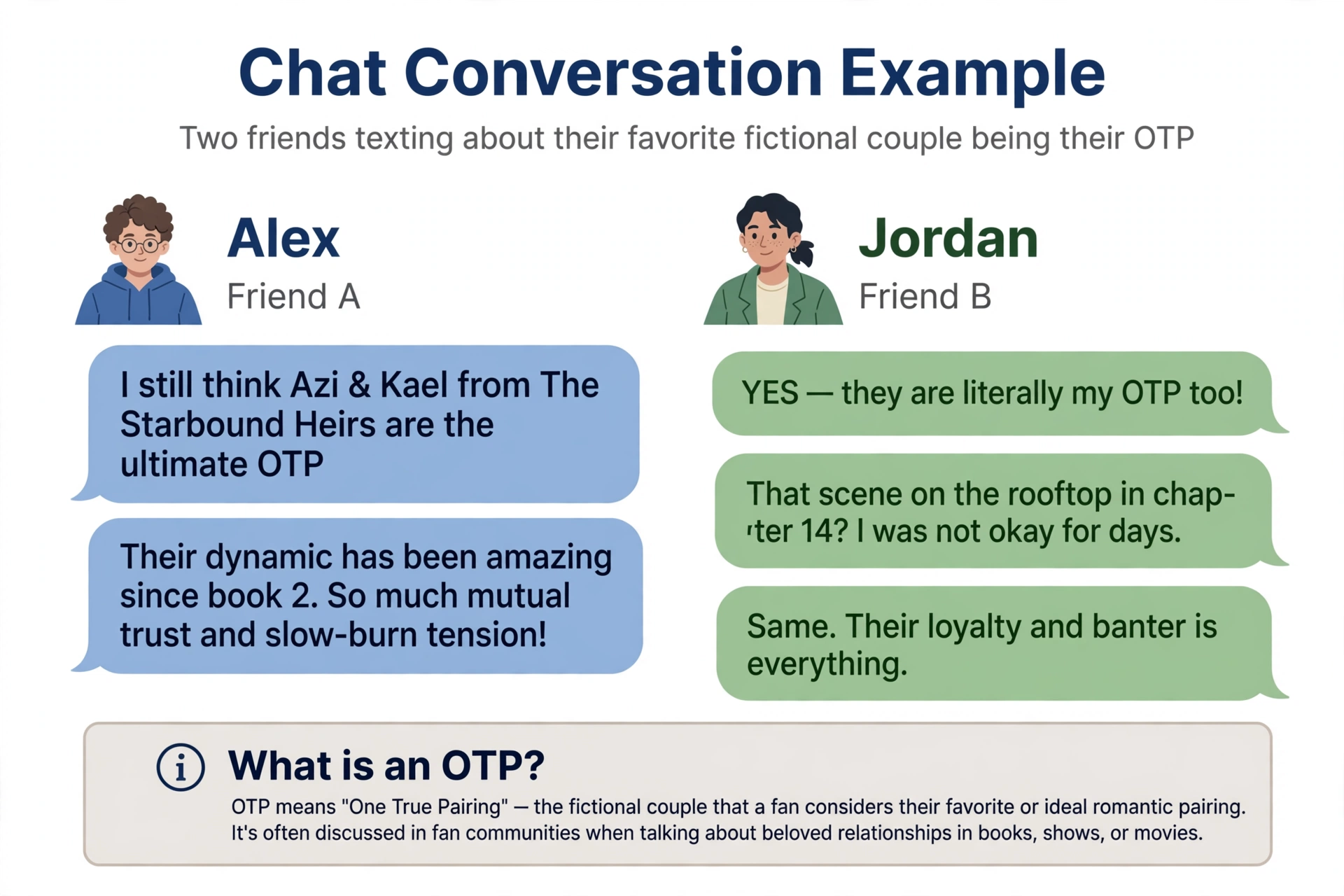
Here are real-world examples of OTP meaning in text slang, sorted by tone and context.
Friendly Examples
- “Just finished the season and they are still my OTP. Nobody else even comes close.”
- “That finale scene? I cried. They have been my OTP since episode one.”
- “You have to watch this edit — it is literally OTP perfection.”
Professional Examples
- “In our fan survey, 62% of respondents named the lead couple as their OTP.”
- “The article explores why audiences keep shipping the same OTP across reboots.”
- “For tagging purposes, please list the story’s OTP in the summary.”
Funny Examples
- “Me and my bed are OTP. Do not disturb us.”
- “My OTP is my coffee and a rainy day. We just work.”
- “I OTP my left sock and my right sock. They were clearly made for each other.”
Notice how the friendly examples are emotional, the professional examples are analytical, and the funny examples borrow the romantic meaning for an obviously non-romantic pair. That range is why OTP has lasted so long: it can be sincere, analytical, or silly, and fans understand all three instantly. The same flexibility shows up in newer praise slang too — for example, our guide to glazing slang explained covers another fandom-born word that moved from sincere praise to playful exaggeration.
Comparison with Similar Terms
OTP sits in a family of fandom words, and mixing them up is easy. Here is how they compare:
| Term | What it means | How it differs from OTP |
|---|---|---|
| Ship | Any pairing fans support | A ship is any couple you like; an OTP is your number-one ship. |
| NOTP | A pairing a fan rejects | The opposite of OTP — a couple you actively do not want together. |
| BroTP | A favorite friendship pairing | Platonic by definition; OTP is usually romantic. |
| OT3 | A favorite trio | Three people instead of two; OTP is a pair. |
| Canon ship | A pairing confirmed in the story | Canon is about what the story says; OTP is about what the fan feels. |
| Stan | To be an obsessed fan of someone | Stan is about a person; OTP is about a pairing. |
The most important distinction is between a ship and an OTP. Every OTP is a ship, but not every ship is an OTP. You can ship five couples in one show and enjoy all of them, but if someone asks for your OTP, they are asking for the one you would pick above the rest. NOTP is the mirror image: if OTP is loyalty, NOTP is refusal. Fans use NOTP when a pairing feels wrong to them — bad chemistry, a betrayal of the story, or simply a rival to their OTP. BroTP deserves a special note because it shows how fandom language adapts: fans wanted a word for a beloved friendship that should stay platonic, so they built one from OTP’s pattern.
Outside fandom, the comparison that matters most is OTP versus one-time password. The two share letters and nothing else. A one-time password is a temporary numeric code, usually six digits, sent by text or email to verify your identity. It expires in minutes, it is never shared publicly, and it has nothing to do with romance. If a message contains a code, it is the password meaning. If a message contains character names, it is the pairing meaning.

Alternate Meanings
OTP has three main alternate meanings, and knowing them prevents the most common misunderstandings:
- One-time password (security): A temporary code used to log in or confirm a payment. Example: “Your OTP is 482913. Do not share it with anyone.” This is the most common non-fandom meaning, and the one most people meet first.
- On the phone (texting status): A quick way to say you are busy on a call. Example: “otp, call u back in 10.” This use is older and less common today, but it still appears in chats.
- One-trick pony (gaming): In competitive games like League of Legends, an OTP is a player who plays only one champion or character. Example: “He OTPs Yasuo every single game.” This use is mostly confined to gaming communities and is usually mildly mocking.
How do you tell them apart? Look at the neighborhood of the word. Codes, banks, logins, and “do not share” warnings mean one-time password. “Call you back,” missed calls, and busy statuses mean on the phone. Champion names, ranked games, and gaming chats mean one-trick pony. Character names, show titles, hearts, and fan edits mean one true pairing. In practice, the fandom meaning and the security meaning cover nearly all real uses, and context separates them cleanly.
Professional or Polite Alternatives
OTP is informal internet slang, so it does not belong in formal writing. If you are writing professionally about fandom, use the full phrase instead:
- Instead of “my OTP,” write “my favorite pairing” or “the couple I most support.”
- Instead of “I OTP them,” write “I support their relationship” or “I ship them.”
- In academic or journalistic writing, “preferred romantic pairing” is the clearest neutral option.
- For the security meaning, always write “one-time password” in full on first use, then “OTP code” after that — never leave a reader guessing which OTP you mean.
- For “on the phone,” simply write “I’m on the phone” or “I’m on a call.”
In casual fan spaces, though, there is no need to replace OTP at all. Fans expect it, search for it, and tag with it. Using the full phrase in a fanfiction tag would actually make your story harder to find, because readers search for OTP. Match your language to your audience: full phrases for formal readers, OTP for fandom readers.
Common Mistakes
Here are the mistakes people make most often with OTP:
- Confusing it with a password in fandom posts: If someone posts “they are my OTP” with a heart emoji, they are not asking for a code. Replying with a security warning will confuse everyone.
- Sharing a real OTP code: A one-time password is secret. Never post it, forward it, or read it aloud to someone who calls asking for it. Banks never ask for your OTP.
- Assuming OTP means a real-life couple: In fandom, OTP usually refers to fictional characters. A fan saying “they are my OTP” about two actors is usually still talking about the characters those actors play.
- Using OTP for any couple you mildly like: Fans reserve OTP for a top favorite. Calling every ship your OTP waters the word down and can start friendly arguments.
- Using OTP in formal writing: A work email or essay should spell out “one true pairing” or “one-time password” instead of dropping in unexplained letters.
- Forgetting the gaming meaning: In a gaming lobby, calling someone an OTP is a comment on their playstyle, not their love life. Context is everything.

Quick Tips
- Check the context first: Character names mean one true pairing; digits mean one-time password; a call-back note means on the phone.
- Use OTP proudly in fandom spaces: It is the fastest way to find your people — fellow fans of the same pairing.
- Tag your fanfiction with its OTP: Readers search by pairing, so a clear OTP tag brings your story to the right audience.
- Never share a security OTP: Treat a one-time password like a house key. If someone asks for it, that is a scam warning sign.
- Keep OTP and NOTP straight: OTP is love, NOTP is rejection. Mixing them up in a fandom debate will be noticed immediately.
- Let your OTP survive canon: If the writers take your pairing in another direction, your OTP does not have to change. That loyalty is the whole point of the word.

FAQ
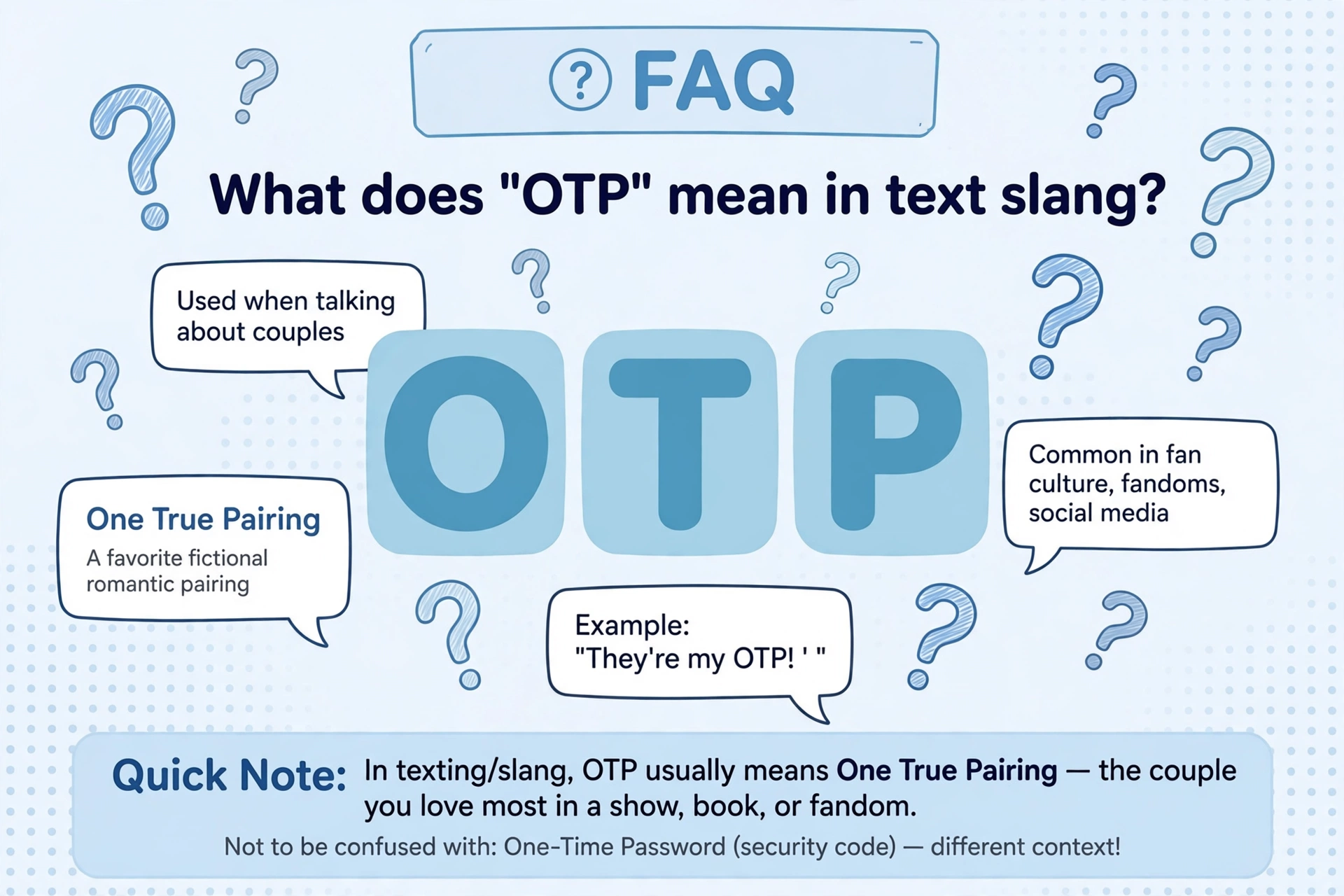
What does OTP mean in text slang?
In text slang, OTP means “one true pairing” — a fan’s favorite romantic couple from a show, movie, book, anime, or game. It is the pairing a fan supports above all others.
Is OTP the same as a one-time password?
No, they just share the same letters. A one-time password is a temporary security code sent to verify your identity, while a fandom OTP is a favorite fictional couple. Context tells you which one is meant.
What does “they are my OTP” mean?
It means the speaker considers those two characters their favorite pairing — the couple they believe belongs together more than any other ship in that fandom.
Can OTP be used for real people?
Yes, fans sometimes use OTP for real-life celebrity couples or even friends, but the classic use is fictional characters. When it is used for real people, it is usually playful rather than literal.
What is the difference between OTP and ship?
A ship is any pairing fans support. An OTP is the single favorite ship — the one ranked above the rest. Every OTP is a ship, but not every ship is an OTP.
What does NOTP mean?
NOTP is the opposite of OTP: a pairing a fan actively rejects or does not want to see together. If OTP is loyalty, NOTP is refusal.
What does OTP mean on the phone?
In older texting slang, “otp” can mean “on the phone,” as in “otp, call you back.” This use is less common today than the fandom and security meanings.
Is OTP still popular in 2026?
Yes. OTP remains one of the most searched texting abbreviations, driven both by fandom culture on TikTok and fanfiction sites and by the everyday use of one-time passwords for logins and payments.
Conclusion
OTP meaning in text slang comes down to one idea: a favorite pairing, held above all others. In fandom, OTP means “one true pairing” — the couple you ship hardest, defend longest, and return to no matter what the writers do. It is a small word with a big emotional job, and that is why it has survived for more than two decades of internet culture, from early forums to today’s TikTok edits and fanfiction tags.
Just remember the other lives of those three letters. When a message contains a code, OTP is a one-time password — secret, temporary, and never to be shared. When a message says someone is otp and will call back, it means on the phone. And in a gaming lobby, it might mean a one-trick pony. Context is the decoder ring, and it almost never fails.
So the next time you see “they are my OTP,” you will know exactly what it means — and you will probably know which pairing it is, too. Want to keep building your slang vocabulary? Next, check out our guide to fn meaning in text for another context-dependent abbreviation, and our guide to ngl meaning in text for the honest-opinion opener that pairs perfectly with a strong OTP take. For the deeper story of how internet language like this evolves, Internet slang on Wikipedia is a solid place to explore further.

1 thought on “OTP Meaning in Text Slang: What Does OTP Mean in Texts and Fandom?”