
Quick definition: Southern slang is the warm, colorful everyday language of the American South — words and phrases like y’all, bless your heart, fixin’ to, and I reckon that grew out of Southern American English. It is not one fixed dictionary. It is a living way of talking that mixes old English, Scots-Irish speech, African American Vernacular English, and rural farming life, and it changes from Texas to Tennessee to the Carolina Lowcountry. If you have ever been told you are “fixin’ to” do something, or been answered with a sweet-sounding “bless your heart” that did not feel sweet at all, you have already met southern slang face to face.
Southern Slang Meaning & Definition
At its simplest, southern slang means the informal words, phrases, and sayings people in the Southern United States use in everyday conversation. Linguists usually describe the bigger system behind it as Southern American English, a regional dialect with its own sounds, grammar, and vocabulary. Southern slang is the vocabulary part of that system — the part you notice first, because it sounds different from the English you hear on national news.
Three things make southern slang easy to recognize. First, it is practical. A lot of it fills gaps in standard English. English has no common plural for “you,” so the South made one: y’all. It needed a soft way to say “about to,” so it kept fixin’ to. Second, it is polite on purpose. Southern speech values hospitality and saving face, so many sayings soften a “no,” a criticism, or bad news — sometimes so softly that outsiders miss the criticism entirely. Third, it is picture-driven. Instead of saying “very angry,” a Southerner might say someone is “madder than a wet hen.” Instead of “a long way away,” it is “over yonder.” The image does the work.
| Southern slang term | Plain meaning | Typical tone |
|---|---|---|
| Y’all | You all; plural “you” | Friendly, warm, everyday |
| Bless your heart | Sympathy — or a polite insult, depending on context | Sweet, teasing, or pitying |
| Fixin’ to | About to; getting ready to | Casual, unhurried |
| I reckon | I think; I suppose | Thoughtful, measured |
| Over yonder | Over there, at some distance | Relaxed, vague on purpose |
| Cattywampus | Crooked, askew, out of order | Playful, descriptive |
| Hissy fit | A sudden temper tantrum | Amused, scolding |
| Might could | Might be able to | Polite, non-committal |
It helps to remember that southern slang is a dialect, not broken English. Its grammar has rules of its own — double modals like “might could,” the completive “done” in “I done told you,” and the famous “y’all” all follow patterns that millions of educated, professional Southerners use every day. People code-switch, too: the same person may use heavy southern slang at a family cookout and much plainer English in a work meeting. The slang is a choice, a signal of home, humor, and belonging — not a lack of vocabulary.
Introduction
You do not have to live below the Mason-Dixon line to run into southern slang. It is in country songs, in movies set in small-town Georgia, in TikTok captions from Texas creators, and in the group chat when a friend from Alabama types “y’all” and suddenly the whole conversation feels warmer. Southern phrases travel well because they are funny, vivid, and useful. They say in five words what plain English takes a sentence to explain.
This guide untangles southern slang the way a local would explain it: plain meaning first, the story behind the phrase second, and real examples throughout. You will get the core vocabulary, the history of where it came from, why it is suddenly everywhere again, how it is actually used in texts and conversation, and where visitors most often go wrong with it. The approach is the same plain-first method used in our other regional guides, like our Scottish slang explainer — start with what the words mean, then learn how people really use them. By the end, you will know what “bless your heart” really means in each situation, when “fixin’ to” is a promise and when it is just a plan, and how to use a few Southern phrases yourself without sounding like you are doing an impression.

Origin
Southern slang did not come from one place. It grew over three centuries as different groups of people settled the South and their speech mixed together. English settlers brought older British words and phrases, many of which later died out in Britain but survived in the American South. Scots-Irish settlers arriving through Pennsylvania into Appalachia brought words and speech patterns that still show up in mountain speech today. Enslaved African Americans contributed words, rhythms, and expressions that became part of Southern speech as a whole, and later flowed into American English generally. French influence in Louisiana, Spanish influence in Texas and Florida, and Native American place names and words all added their own layers.
That mixing is why southern slang feels both old and familiar. Y’all is a straightforward contraction of “you all,” the kind of practical shortening that happens in spoken language everywhere. Reckon comes from an old English word meaning to count or think, once common across the English-speaking world. Tote (to carry) and poke (a paper sack) are old regional words that survived in the South while fading elsewhere. Hankering, a strong craving, has roots in Dutch and German speech brought by early settlers. And cattywampus — crooked, askew — is a playful American invention from the 1800s, built from “cata-” (crooked, as in catacorner) and “wampus,” with no single clear ancestor, which is fitting for a word that means “all out of order.”
The farming and rural life of the old South shaped the imagery, too. Sayings compare feelings to weather, animals, and work: “madder than a wet hen,” “hotter than a goat’s butt in a pepper patch,” “busier than a one-armed paper hanger,” “living in high cotton” (doing well, from the days when cotton was king). When most people lived close to the land, those comparisons were instantly understood. They still work today because the pictures are so strong — you do not need to have seen a wet hen to feel the anger in the phrase. Reference works on the dialect describe Southern English as a collection of geographic and social varieties sharing features like y’all and double modals, which is a useful reminder that “the South” was never one accent or one vocabulary: Encyclopedia.com’s entry on Southern English lays out the Coastal Southern and South Midland varieties and how settlement routes shaped them.
Popularity
Southern slang has never really gone away in the South, but its national popularity comes in waves. Country music has carried it for decades — from Hank Williams to Dolly Parton to today’s country and country-pop stars, the vocabulary of the South is the vocabulary of the genre. Television and film helped, too: a well-written Southern character can make a phrase like “bless your heart” famous far beyond the region, even when viewers only half understand it.
The internet gave southern slang its biggest second act. Short-form video rewards exactly what Southern speech does best: short, vivid, funny lines that land in seconds. Creators from Texas, Georgia, Alabama, and the Carolinas use phrases like “y’all,” “I reckon,” and “fixin’ to” naturally in videos about food, family, and daily life, and viewers across the country pick them up. “Bless your heart” became a meme precisely because of its double meaning — sweet on the surface, sharp underneath — which makes it perfect for captions and reaction videos. Meanwhile, “y’all” has spread well beyond the South as a genuinely useful, gender-neutral plural “you,” adopted by people who have never lived in the region and may never visit.
There is also a pride factor. For a long time, Southern speech was unfairly mocked as a sign of poor education, and many Southerners felt pressure to hide their accents in professional settings. That attitude has shifted. Younger Southerners now treat their slang as cultural identity — something to celebrate in music, comedy, and social media rather than apologize for. The result is that southern slang is more visible, more written down, and more searched for than ever before, by Southerners explaining their own speech and by outsiders who want to understand what their Southern friends, coworkers, and favorite creators actually mean.
How Southern Slang Is Used
Southern slang is mostly spoken, casual language, but it shows up in writing wherever people write the way they talk: texts, group chats, social media captions, song lyrics, and dialogue in books and shows. In conversation, it does a few specific jobs. It builds warmth fast — opening with “Hey, y’all” signals friendliness in a way “Hey, everyone” does not quite manage. It softens hard messages — “bless your heart” can deliver sympathy or criticism without a confrontation. It adds humor — a dramatic comparison like “colder than a well-digger’s backside in January” gets a laugh while also saying it is genuinely freezing. And it marks belonging: using the local phrases correctly tells listeners you are from there, or at least that you respect the place.
Context decides the meaning more than the dictionary does. “Bless your heart” from a grandmother after you scrape your knee is pure kindness. The same words after you announce a spectacularly bad plan are a gentle way of calling you foolish. “I reckon” can be agreement (“I reckon so”), a guess (“I reckon it’ll rain”), or a polite disagreement (“I reckon not”). Tone, facial expression, and the relationship between the speakers do the heavy lifting, which is why Southern slang can confuse newcomers even when every individual word is familiar.
In texts and online, southern slang is usually spelled the way it sounds: “fixin’ to,” “y’all,” “ain’t,” “gonna,” “gotta.” That spelling is part of the flavor, not a mistake. A text that reads “I’m fixin’ to head over yonder, y’all want anything?” is doing three things at once: announcing a plan, locating it vaguely, and inviting the group along. The informality is the point. You would not use heavy southern slang in a formal business email or a legal letter, and Southerners themselves usually do not. The register matters: slang for friends, family, and fun; plainer English for formal settings. Knowing when to switch is part of knowing the slang.
Examples
The best way to learn southern slang is to see it in real sentences, with the situation attached. The same phrase can be warm, funny, or cutting depending on who says it and why. These examples cover the range: friendly chats, work and professional settings, and the funny, exaggerated comparisons the South is famous for.
Friendly Examples
- “Hey y’all, dinner’s ready — come and get it while it’s hot!” — A warm invitation to a group. Y’all includes everyone, no one left out.
- “I’m fixin’ to make some sweet tea. Y’all want a glass?” — A plan announced casually. Nobody is in a rush; the tea will happen.
- “Well, I reckon we can make it by suppertime if the creek don’t rise.” — A hopeful plan with a built-in excuse. “If the creek don’t rise” means “unless something out of our control stops us.”
- “Give your grandma some sugar before you go, baby.” — Sugar here means a kiss or a hug. It is affection, not a snack.
- “You’re sweet as pie, honey, thank you for thinking of us.” — A genuine compliment. Sweetness, in Southern praise, is a high compliment.
- “That dog won’t hunt.” — Friendly disagreement. Your plan will not work, said without making it a fight.
- “Come sit a spell and tell me all about it.” — Sit a spell means stay a while and chat. An invitation to slow down.
Professional Examples
Southern slang in professional settings is usually lighter and more deliberate. A manager in Atlanta might open a meeting with “Morning, y’all” and nobody blinks. A salesperson might say “I might could get that to you by Friday,” which is softer than a flat promise and leaves room for reality. A colleague might write, “I reckon we should double-check those numbers before we send them,” which is a polite way of raising a concern. The key is restraint: one or two familiar phrases read as warm and local; a full barrage of slang in a formal presentation reads as a performance. In client-facing writing, most Southerners keep the slang out entirely and save it for spoken conversation, where tone makes the meaning clear.
- “Morning, y’all — let’s get started.” — Warm, inclusive, completely normal in a Southern office.
- “I might could move that meeting to Thursday, if that helps.” — A qualified offer. It means “I probably can,” with room to maneuver.
- “I reckon the client will want the revised version first.” — A measured opinion, offered without steamrolling anyone.
- “Hold your horses — let’s look at the contract once more before we sign.” — “Slow down and be patient,” said with humor instead of bossiness.
- “Well, I’ll be — that actually worked!” — A mild, polite exclamation of surprise. The Southern equivalent of “Wow, would you look at that.”
Funny Examples
Southern humor loves exaggeration, and southern slang is built for it. The funniest sayings compare ordinary things to absurd pictures, and the straighter the delivery, the funnier they land.
- “It’s hotter than the hinges of hell out here.” — It is extremely hot. Possibly the most-quoted Southern weather report in history.
- “She pitched a hissy fit when they ran out of peach cobbler.” — A dramatic overreaction to a minor disappointment.
- “That picture is hanging all cattywampus.” — Crooked, tilted, not straight — and somehow funnier than just saying “crooked.”
- “I’m so hungry I could eat the south end of a northbound mule.” — Extremely hungry. Do not take this literally, and do not ask follow-up questions.
- “He’s all hat and no cattle.” — All show, no substance. Someone who dresses the part but has nothing to back it up.
- “She’s busier than a one-armed paper hanger.” — Extremely busy. The image does all the explaining.
- “Well, butter my butt and call me a biscuit!” — Pure surprise, said for comic effect. Nobody is actually requesting butter.
- “That boy ain’t got a lick of sense.” — He has no common sense at all. Said with exasperation, often with affection underneath.
| Situation | What to say | What it really means |
|---|---|---|
| Someone did something foolish | “Bless your heart.” | “You poor thing — that was not smart.” |
| Someone did something kind | “Bless your heart.” | “Thank you, that was genuinely sweet.” |
| You are about to leave | “I’m fixin’ to head out.” | “I am getting ready to leave.” |
| You agree, tentatively | “I reckon so.” | “I think so, probably.” |
| Something is crooked | “It’s all cattywampus.” | “It is crooked and out of order.” |
| Someone is furious | “She’s madder than a wet hen.” | “She is extremely angry.” |
| You are doing great | “We’re living in high cotton.” | “We are successful and comfortable.” |
| It will not work | “That dog won’t hunt.” | “That plan is not going to work.” |

Comparison with Similar Terms
Southern slang overlaps with other American regional speech, and the differences are worth knowing — especially for the phrases that look similar but work differently. The table below compares southern slang with its closest cousins: general American slang, other regional dialects, and the formal English equivalents.
| Southern slang | Similar term elsewhere | Key difference |
|---|---|---|
| Y’all | You guys (Midwest/North), youse (Philadelphia area) | Y’all is the South’s standard plural “you”; “you guys” is regional too, but y’all has spread nationally as a neutral option. |
| Fixin’ to | About to, finna (AAVE, now widespread online) | Fixin’ to is the older Southern form; “finna” comes from “fixing to” via African American speech and is more common in online slang today. |
| I reckon | I guess, I suppose | Reckon sounds more thoughtful and old-fashioned; “I guess” sounds less certain. |
| Bless your heart | Bless you, poor thing | Only “bless your heart” carries the famous double meaning — kindness or a polite insult. |
| Might could | Might be able to | The double modal is standard in Southern grammar but sounds wrong in formal standard English. |
| Over yonder | Over there | Yonder is deliberately vague about distance; “over there” usually points to something visible. |
| Cattywampus | Crooked, askew, catawampus | Cattywampus and catawampus are the same word with two spellings; both are Southern favorites. |
| Hissy fit | Tantrum, meltdown | Hissy fit is more playful and old-fashioned; “meltdown” is the modern, more serious version. |
| Hankering | Craving, hankering (general) | Hankering is shared with general American English but is far more common in Southern speech. |
| High cotton | Doing well, on top of the world | High cotton is specifically Southern and agricultural; the others are general idioms. |
Within the South itself, there is plenty of variation. Texas slang leans toward ranch and cowboy imagery (“all hat and no cattle,” “howdy”), Appalachian speech keeps older Scots-Irish words and forms, Louisiana adds French and Cajun flavor (“lagniappe,” a little something extra), and the Lowcountry around Charleston and Savannah has Gullah influences you will not hear in Nashville. The same pattern shows up on the other side of the Atlantic: one broad label, many local flavors underneath. Treating “southern slang” as one uniform dialect is the first mistake outsiders make; the second is assuming every Southerner uses all of it. Most people use a personal mix — a few family phrases, a few regional favorites, and the big shared ones like y’all that everyone understands.

Alternate Meanings
Most southern slang terms have one main meaning and a few side uses, and a handful have genuinely different meanings depending on where you hear them. Knowing the alternates saves you from the most embarrassing misunderstandings.
- Bless your heart: (1) Genuine sympathy or thanks. (2) A polite insult for someone who is sweet but foolish. (3) A softener before bad news: “Bless your heart, but that dress is not doing you any favors.” The tone and the sentence that follows tell you which one you got.
- Y’all: (1) Plural “you,” addressing a group. (2) Singular, in some areas, as a warm way of addressing one person: “How are y’all doing?” to a single friend. (3) Possessive in “y’all’s”: “Is that y’all’s truck?”
- Ugly: In Southern speech, “ugly” often means behaving badly, not looking bad: “Y’all need to stop being ugly to each other” means stop being rude or mean.
- Directly / directly: “I’ll be there directly” can mean soon, but in older Southern usage it can mean the opposite of immediate — “in a while, when I get to it.” Context and the speaker’s generation decide.
- Sugar: (1) A kiss or affection, as in “give me some sugar.” (2) A term of address, like “honey”: “What can I get you, sugar?” (3) The sweetener, obviously — but in the South, tea is sweet by default, and “unsweet tea” is the marked, unusual order.
- Carry: In parts of the South, “carry” means to escort or take someone somewhere: “I’ll carry you to the store” means “I’ll drive you,” not “I’ll lift you.”
- Tote: To carry, especially in a bag or container. It survives in “tote bag,” which the rest of the country adopted without knowing its Southern roots.
- Poke: A paper sack or bag. “A pig in a poke” — buying something sight unseen — comes from this older meaning, and it is still heard in rural Southern speech.
- Mash: To press or push, as in “mash the button” for an elevator or a remote. It sounds odd to Northern ears and perfectly normal in the South.
Professional or Polite Alternatives
Southern slang is wonderful in the right setting and wrong in others. When you need the same meaning in a formal email, a job interview, a classroom presentation, or a conversation with someone who does not know the slang, use the plain alternatives below. They keep the warmth without the risk of being misunderstood.
| Southern slang | Polite / professional alternative | When to switch |
|---|---|---|
| Y’all | Everyone, all of you, team | Formal emails and presentations |
| Fixin’ to | About to, planning to, preparing to | Written reports, client messages |
| I reckon | I believe, I think, in my view | Meetings with people outside the region |
| Bless your heart (as criticism) | Just say the concern kindly and directly | Always — the insult version does not translate |
| Might could | I may be able to, I might be able to | Any formal writing |
| Over yonder | Over there, in that direction, a short distance away | Giving directions to a visitor |
| Hissy fit | Overreaction, outburst, strong reaction | Describing a colleague or client |
| That dog won’t hunt | That approach won’t work, that plan isn’t viable | Work discussions, especially in writing |
| Hold your horses | Let’s slow down, let’s pause a moment | Formal settings — the meaning is fine, the idiom is casual |
The polite version of “bless your heart” deserves special attention, because there is no polite alternative that keeps the insult. If you mean sympathy, say “I’m so sorry to hear that” or “Thank you, that was kind of you.” If you mean criticism, Southern manners would still rather you softened it — but outsiders should say what they mean plainly and kindly, rather than borrowing a phrase whose second meaning the listener may or may not catch. The most respectful way to use southern slang is to use the friendly phrases generously and leave the teasing ones to people who grew up with them.
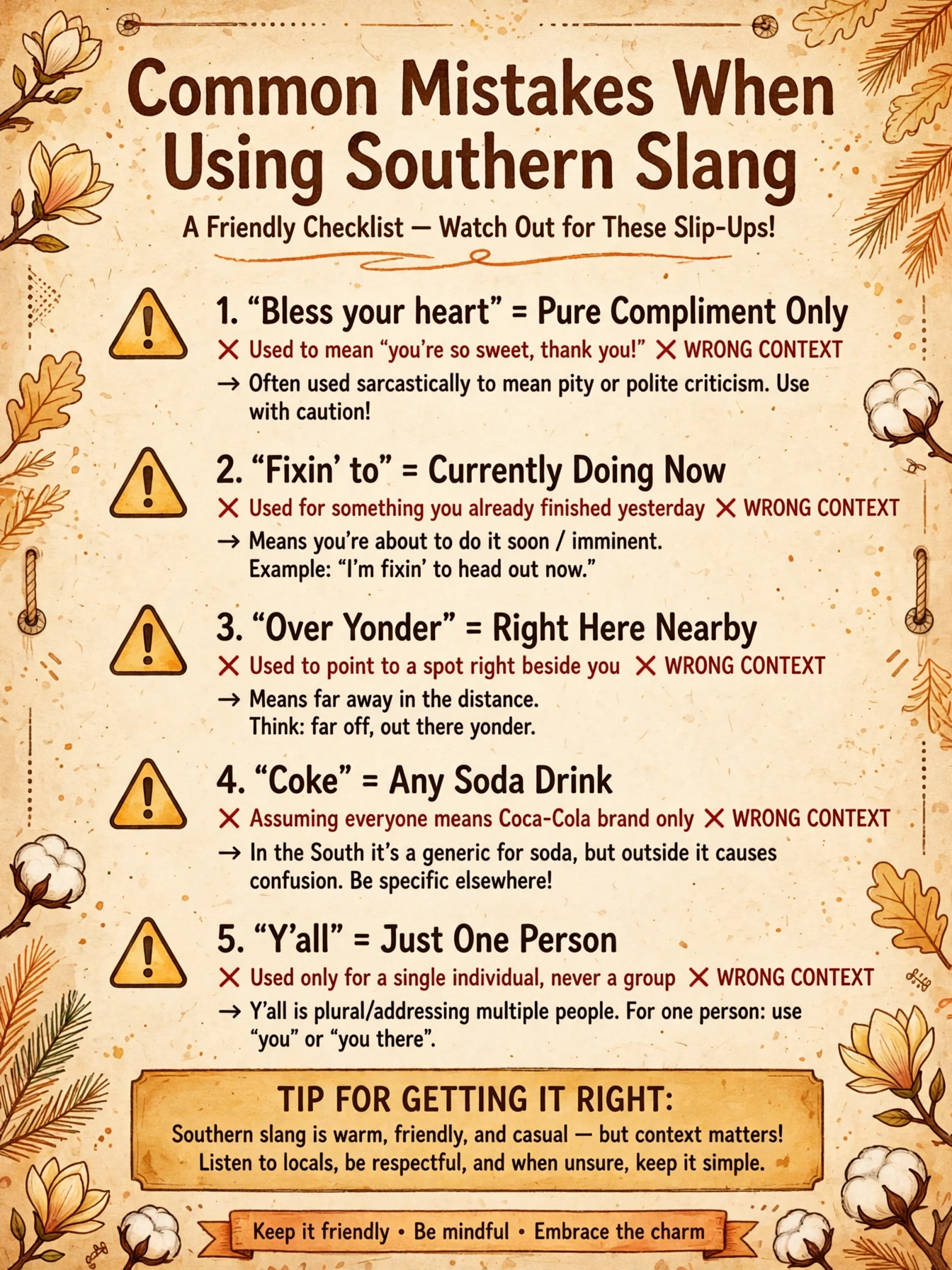
Common Mistakes
Visitors and new fans of southern slang make the same handful of mistakes. Most are harmless, but a few can make you sound mocking when you meant to sound friendly. Here are the ones to avoid.
- Using “bless your heart” as an insult to a Southerner’s face. If you did not grow up with it, do not deploy the insult version. It lands as rude, not clever, and Southerners can tell the difference between a local teasing and an outsider mocking.
- Overdoing the accent in writing. Writing every word phonetically — “Ah’m fixin’ tuh” — reads as caricature. Real Southerners writing casually use a few spelled-out forms (“fixin’,” “y’all”) and otherwise spell normally.
- Treating “fixin’ to” as “eventually, maybe.” It means about to, imminently. If someone says they are fixin’ to leave, they are leaving soon. Do not hear it as vague and keep waiting an hour.
- Calling everything “Southern” that is actually from somewhere else. “Finna” is widely used online, but it comes through African American Vernacular English; “yinz” is Pittsburgh; “wicked” is New England. Giving the South credit for everyone’s slang is a fast way to annoy everyone.
- Assuming one Southern accent. A Charleston drawl, a Texas twang, an Appalachian lilt, and a New Orleans Yat accent sound nothing alike. Do not imitate one and claim it covers the whole region.
- Using “y’all” for one person in front of Southerners who use it only for groups. In some areas the singular use is normal; in others it confuses people. With a group, you are always safe.
- Quoting the exaggerated comparisons in serious moments. “Madder than a wet hen” is funny at a cookout and wrong in a condolence message. The humor is the point, and humor has a time and place.
- Correcting Southern grammar. “Might could” and “y’all” are not errors. Correcting a Southerner’s dialect is rude, and it is also wrong linguistically — these forms follow their own consistent rules.
Quick Tips
- Start with three phrases. Learn y’all, fixin’ to, and I reckon properly before you touch the rest. They are the most common, the most useful, and the hardest to get wrong.
- Listen before you speak. Watch how a Southerner uses “bless your heart” in a real conversation — the pause before it, the smile, the sentence after it — before you try it yourself.
- Match the room. Heavy slang at a family gathering is perfect. Heavy slang in a job interview in the same town may still be fine, but let the interviewer set the register first.
- Use “y’all” generously. It is the safest, warmest Southern word there is, and it is now understood everywhere in the United States. It is also genuinely useful — English needs a plural “you.”
- Keep the comparisons for fun. Save “hotter than the hinges of hell” and “busier than a one-armed paper hanger” for casual, funny moments. They are jokes with a meaning attached, not neutral descriptions.
- When in doubt, ask. Southerners generally love explaining their sayings. “What does that mean, exactly?” is a better move than guessing and using a phrase wrong for a week.
- Read Southern writers. A few pages of Flannery O’Connor, Eudora Welty, or a modern Southern humorist will teach you more about how the language works than any list of phrases, because you will see it in context, with tone intact.
- Remember the politeness rule. Southern slang exists to keep things warm and avoid direct confrontation. If your use of it makes someone feel mocked or cornered, you are using it wrong — dial it back and be plain.


FAQ
What does southern slang mean?
Southern slang is the informal vocabulary and sayings of the American South — words like y’all, bless your heart, fixin’ to, and I reckon — that grew out of Southern American English. It is a regional dialect with its own grammar and history, not incorrect English, and it varies by state and community across the South.
What is the most famous southern slang word?
Y’all is the most famous and most widely used southern slang word. It is the South’s plural form of “you,” it is understood across the United States, and it has spread far beyond the region because English has no other common plural “you.” Close behind are “bless your heart” and “fixin’ to,” which are the phrases outsiders ask about most.
Is “bless your heart” an insult or a compliment?
It can be either, and that is the point. Said with warmth after good news or bad luck, it is genuine sympathy or thanks. Said with a pause and a shake of the head after a foolish statement, it is a polite way of calling someone sweet but misguided. Tone, facial expression, and what is said next tell you which version you heard.
What does “fixin’ to” mean in southern slang?
“Fixin’ to” means about to or getting ready to do something, imminently. “I’m fixin’ to head home” means you are getting ready to leave right now, not at some vague point in the future. It is one of the most practical phrases in southern slang because it announces an intention before the action happens.
What does “I reckon” mean?
“I reckon” means “I think,” “I suppose,” or “I believe.” It offers an opinion in a thoughtful, measured way, and it can also mean agreement (“I reckon so”) or a guess about what will happen (“I reckon it’ll rain”). It comes from an older English word for counting or thinking something through.
Is southern slang the same in Texas, Georgia, and Tennessee?
No. Southern slang varies a lot by region. Texas has ranch and cowboy-flavored speech, Appalachian areas keep older Scots-Irish words, Louisiana adds French and Cajun terms, and the Lowcountry has Gullah influences. The big shared phrases — y’all, bless your heart, fixin’ to, reckon — are understood everywhere in the South, but the local vocabulary around them changes from place to place.
Can non-Southerners use southern slang?
Yes, if you use it respectfully and accurately. The friendly phrases — y’all, fixin’ to, I reckon — are welcome from anyone who uses them correctly. Avoid the teasing uses, like the insult version of “bless your heart,” and avoid imitating an accent or writing every word phonetically, which reads as mockery. Listen first, use a few phrases well, and you will be fine.
What is the difference between southern slang and a Southern accent?
Slang is the vocabulary — the words and phrases. Accent is the sound system — how the vowels and consonants are pronounced. You can use southern slang in writing without any accent at all, and you can speak with a Southern accent using perfectly standard vocabulary. People often mix them up, but they are two different parts of the same regional dialect, Southern American English.
Conclusion
Southern slang is more than a list of funny phrases. It is a record of who settled the South, how they lived, and what they valued: hospitality, humor, patience, and a good story told well. Y’all solves a real problem in English. Fixin’ to announces a plan the friendly way. I reckon offers an opinion without forcing it on anyone. And bless your heart — in both its meanings — shows how much work a few polite words can do when a community decides that kindness and honesty should share the same sentence.
The best way to keep learning is to keep listening. Notice which phrases your Southern friends use with family and which they drop at work. Try “y’all” in your next group message and see how warm the reply feels. And if you enjoy decoding regional speech, keep going with our other guides — Philly slang, 1920s slang, and New York slang each show how one country can hold a dozen different ways of saying the same thing. Southern slang rewards the same habit that unlocks every dialect: listen for the meaning underneath the music, and you will understand far more than the words alone.

1 thought on “Southern Slang: What Y’all Really Mean Down South”