
Quick Definition: Cap slang is internet and hip-hop slang where “cap” means a lie, an exaggeration, or a boast, and “no cap” means “no lie” or “for real.” If someone says “that’s cap,” they are calling something fake. If they say “no cap,” they are swearing that what they just said is completely true. It is one of the most used slang words on TikTok, in texts, and in everyday Gen Z conversation.
Introduction
Scroll through TikTok comments for thirty seconds and you will see it: “no cap, this song is actually elite.” Open a group chat and someone will reply “that’s cap” to a friend’s wild story. Cap slang has become the internet’s built-in lie detector — a tiny word that tells everyone whether a claim is real or just talk.
But cap slang is older and deeper than most people realise. It did not start on TikTok. It comes from Black American speech and hip-hop culture, where “capping” has meant bragging, exaggerating, and trading playful insults for over a century. TikTok simply gave an old word a global stage, and now millions of people use it every day — sometimes without knowing what it actually means.
This guide explains cap slang properly: what “cap” and “no cap” mean, where the words came from, how people use them in texts, comments, and real conversations, and the mistakes that make you sound like you are trying too hard. Whether you are a parent decoding your teen’s messages, a teacher, a marketer, or just someone who keeps seeing “no cap” everywhere, this is the complete breakdown — the same kind of full-slang guide as our gen z slang 2024 roundup, zoomed in on one word.

Cap Slang Meaning & Definition
Cap slang centres on one root word: cap. As a noun and a verb in slang, “cap” means a lie, a boast, or an exaggeration. To “cap” about something is to lie about it or to talk it up beyond the truth. “That’s cap” is a flat, direct way of saying “that’s not true.” “Stop capping” means “stop lying” or “stop exaggerating.”
“No cap” flips the meaning. It is a promise of honesty, roughly equal to “no lie,” “for real,” “seriously,” or “I’m not even joking.” People add it before or after a claim they expect others to doubt: “No cap, that was the best concert of my life.” It works like a stamp of truth on a statement that sounds unbelievable.
There is also a third, related use. Because “cap” connects to the idea of a top or a limit, “no cap” can sometimes mean “no limit” — for example, talking about spending with no cap, or a player with no cap on their potential. This sense is much rarer in everyday chat, but it explains why athletes and musicians use the phrase about money and ceilings.
In short, cap slang gives you two tools in one word: “cap” to call out something fake, and “no cap” to swear something is real. Everything else — the jokes, the comments, the captions — is built on that pair.
Origin
The roots of cap slang run deep into African American Vernacular English (AAVE). Dictionary.com’s slang entry traces “to cap” — meaning to brag, exaggerate, or lie — back to at least the early 1900s. In the 1940s, “cap” was recorded as slang for “to surpass,” connected to “capping,” the ritualised exchange of playful insults that became a tradition in Black communities in the 1960s. The logic is simple: a cap sits on top, so “capping” on someone means going one better than them, topping their insult or their story.
From that insult-game tradition, the meaning shifted. If capping meant topping someone with a bigger claim, then a “cap” became the exaggerated claim itself — the lie or boast you told to win the exchange. By the late 20th century, hip-hop carried the word forward. Rappers used “capping” and “high cap” in lyrics through the 1980s and 1990s, keeping the word alive in music long before social media existed.
The modern phrase “no cap” spread through Southern hip-hop in the 2010s. It appears on Twitter by at least 2012, and it exploded in 2017 when Atlanta rappers Young Thug and Future released their track “No Cap.” In the song, the rappers boast about wealth, clothes, cars, and jewellery — no cap — and the phrase rode the song straight into mainstream youth culture. For a deeper look at the documented history, Dictionary.com’s slang entry on “no cap” traces the word from early-1900s Black slang to its 2017 breakout.
From there, TikTok did the rest. Short videos, comment sections, and captions turned “no cap” into a global catchphrase. By the early 2020s it was everywhere: in song lyrics, in memes, in brand posts, and in everyday texts far beyond the communities that created it. That history matters — cap slang is not a TikTok invention, it is a piece of Black American language that the internet adopted.
Popularity
Why did cap slang get so big? Three forces pushed it further than almost any other slang word of its generation.
First, it is useful. Most slang words describe one thing. Cap slang does a job that plain English does awkwardly: it lets you flag honesty in two syllables. “No cap” replaces “I am being completely serious and I am not exaggerating” with a phrase that fits in a comment, a caption, or a fast reply. Utility is why it stuck.
Second, music and TikTok amplified it together. The 2017 “No Cap” track gave the phrase a soundtrack, and TikTok’s comment culture gave it a home. Creators used it to react to unbelievable videos, fans used it to agree with each other, and the algorithm pushed the same phrase to millions of feeds at once. Once a word is in every comment section, it stops feeling niche.
Third, it crossed over without losing its edge. Unlike some slang that fades when brands and parents adopt it, “no cap” survived mainstream exposure because it still feels natural to say. Celebrities, athletes, and even news headlines use it, yet teenagers still use it sincerely with friends. That staying power is rare — and it is why cap slang is still going strong in 2026 while dozens of trendier words have already vanished.
How It Is Used
Cap slang shows up in a few predictable shapes, and each one has its own tone:
- “That’s cap” — a flat statement that something is false. “He said he scored 40 points? That’s cap.”
- “No cap” — added to a claim to say it is honest. It can go before the claim (“No cap, that movie was amazing”) or after it (“That movie was amazing, no cap”).
- “Stop capping” / “stop the cap” — telling someone to quit exaggerating. Playful between friends, sharper with strangers.
- “Cap” alone — a one-word reply to a doubtful claim, common in comments and chats.
- “Cap or no cap?” — a question asking whether someone is telling the truth, often used as a game or a challenge.
- “Capping” as a verb — “He’s always capping about his car” means he is always exaggerating about it.
Context decides the tone. Between friends, “stop capping” is light teasing. In a heated argument, “that’s cap” is a direct accusation of lying. In a comment section, a lone “cap” is usually a joke — a quick, low-effort way to doubt a video without starting a fight. And “no cap” in a sincere post is the opposite: it is someone going out of their way to say “believe me, this is real.”
One rule covers almost every use: cap slang lives in casual settings. Texts, DMs, comments, captions, gaming chats, and conversations with friends are its natural home. It sounds out of place in a job interview, a formal email, or a school essay — not because it is rude, but because it is informal by design.
Examples
Real examples show how flexible cap slang is. The same two words can praise, doubt, joke, or confess, depending on the sentence around them.
Friendly Examples
- “No cap, you looked amazing last night. That outfit was perfect.”
- “This pizza place is the best in the city, no cap.”
- “Bro, no cap, I missed you. We need to hang out soon.”
- “Her voice is unreal, no cap. I listened to that song five times.”
Professional Examples
Cap slang rarely belongs at work, but it does appear in casual creative and social-media jobs — and in quotes from athletes and musicians:
- A social media manager captioning a behind-the-scenes video: “No cap, this shoot took twelve hours.”
- A streamer reacting live: “Chat, no cap, that was the hardest win of the season.”
- A friend hyping a colleague’s portfolio: “No cap, her designs carried that whole project.”
Even here, keep it to informal channels. A client email that says “no cap” will read as unprofessional, while the same line in a team Slack channel reads as friendly.
Funny Examples
- “Me: I’m going to bed early tonight. Also me at 3 a.m.: that’s cap.”
- “He said he’s ‘just going to watch one episode.’ Cap. We all know how this ends.”
- “My bank account after the weekend: no cap, I’m broke.”
- “‘I’m not addicted to this game,’ he said, capping, while opening the game.”

Comparison with Similar Terms
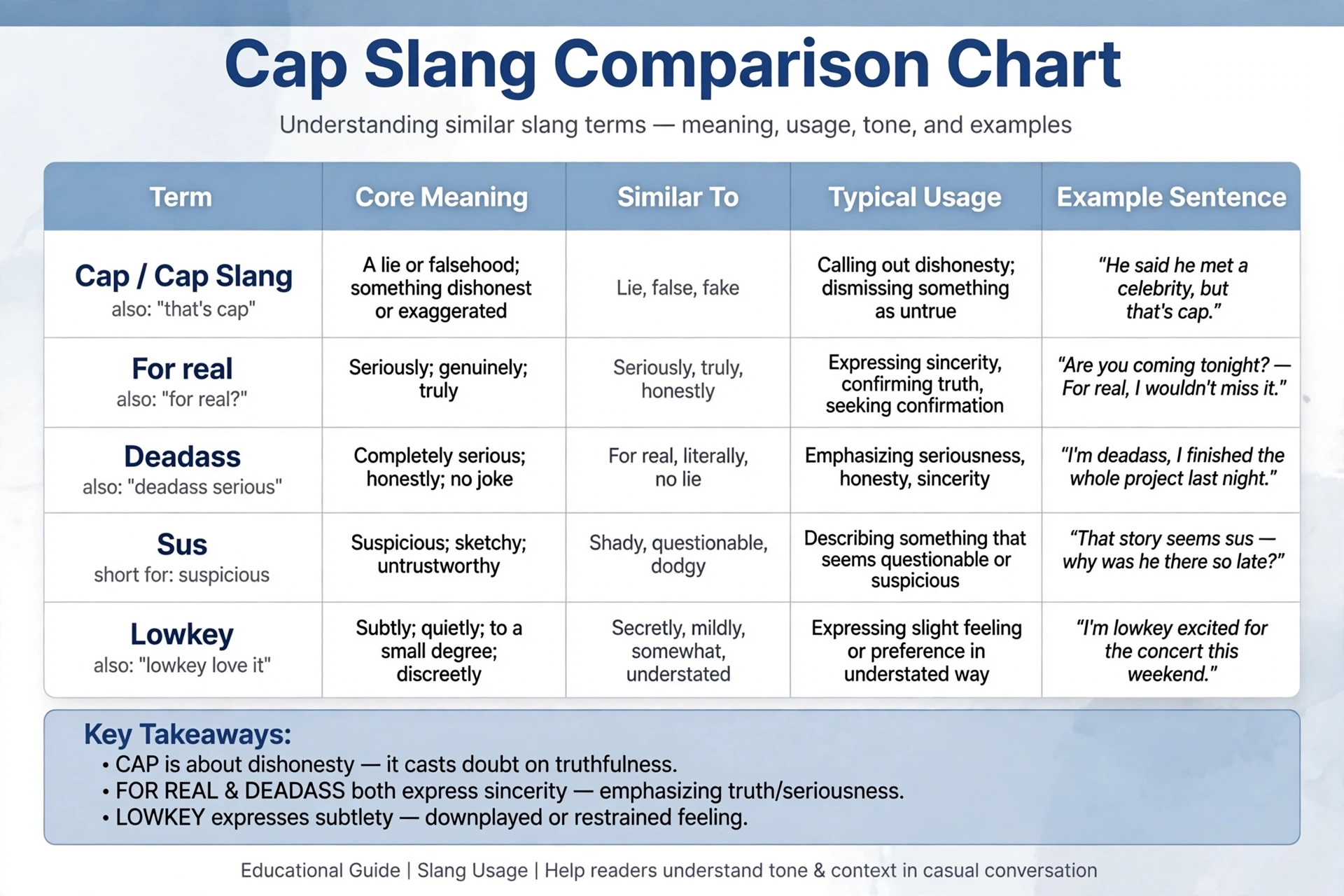
Cap slang overlaps with several other words for honesty and lying. Here is how it compares:
| Term | Meaning | How it differs from cap slang |
|---|---|---|
| No cap | No lie, for real | The core honesty stamp; casual and emphatic |
| For real / fr | Seriously, truly | Similar meaning, but less tied to hip-hop culture and less emphatic |
| Deadass | Seriously, no joke | Stronger and more regional (New York slang); can sound aggressive |
| On God | I swear, truly | A vow-style emphasis; invokes swearing rather than calling out lies |
| Facts / fax | That is true, agreed | Agrees with someone else’s claim; “no cap” makes your own claim |
| Cap (as a lie) | A lie or exaggeration | The negative side of the same word — “that’s cap” calls something out |
| Sus | Suspicious, shady | Doubts someone’s behaviour, not whether their words are true |
| Lowkey | Secretly, quietly | Describes how you feel or act, not whether something is true |
The key difference is direction. “Facts” agrees with a claim someone else made. “No cap” backs up a claim you are making yourself. “Sus” questions motives. “Cap” questions truth. That is why “that’s cap” lands harder than “that’s sus” — it does not just say something feels off, it says it is false.
Alternate Meanings
Outside slang, “cap” has several ordinary meanings that can cause confusion:
- A hat or head covering — a baseball cap, a bottle cap, a graduation cap.
- A limit or maximum — a salary cap in sports, a price cap, a spending cap. This is where the slang sense of “no cap” as “no limit” comes from.
- A limit on a device or account — a data cap on a phone plan.
- To cap off — to finish or complete something, as in “to cap off a great evening.”
- CAP as an abbreviation — in different fields it can stand for things like the Civil Air Patrol or College Admissions Profile, but none of these relate to the slang.
In slang contexts, though, the lie/truth meaning dominates. If someone writes “no cap” under a TikTok video, they are not talking about hats or salary limits — they are swearing the video is real.
Professional or Polite Alternatives
When you need the same meaning in a formal or professional setting, swap cap slang for plain language:
- Instead of “no cap” — “honestly,” “to be completely honest,” “in all seriousness,” “I mean it.”
- Instead of “that’s cap” — “I don’t think that’s accurate,” “that doesn’t sound right,” “I’m not sure that’s true.”
- Instead of “stop capping” — “let’s stick to the facts,” “let’s be realistic here.”
- Instead of “cap or no cap?” — “is that actually true?” or “are you serious?”
The polite versions lose the punch, but they keep the meaning — and they work in emails, meetings, essays, and any place where slang would distract from your point.
Common Mistakes
Most cap slang mistakes come from using it in the wrong place, or forcing it where it does not fit:
- Using it in formal writing. “No cap” in a school essay or a job application reads as careless, not cool.
- Overusing it. Every sentence does not need a “no cap.” One per message is plenty; more than that sounds like a parody.
- Getting the direction wrong. “No cap” means you are telling the truth. Saying “no cap, that’s a lie” contradicts itself — you are swearing honesty about a falsehood.
- Using “cap” as a general insult. “That’s cap” challenges a specific claim. Calling a person “cap” makes no sense; the word targets statements, not people.
- Mixing it with every other slang word. “No cap fr deadass on God” in one sentence sounds forced. Pick one emphasis word and let it do the job.
- Using it with people who will not get it. With grandparents, clients, or anyone outside internet culture, plain language lands better than slang they have to decode.

Quick Tips
- Use it to emphasise, not to decorate. Save “no cap” for claims that actually sound unbelievable — that is when it works hardest.
- Match your audience. Friends, comments, and casual chats are perfect. Bosses, teachers, and formal emails are not.
- Let one slang word carry the sentence. “No cap, that was incredible” beats a sentence stuffed with five trend words.
- Read the room in comments. A lone “cap” under a stranger’s video is a joke to some and a provocation to others — keep it friendly.
- Know the history. Cap slang comes from Black American speech and hip-hop. Using it with that respect — and not mocking its origins — is part of using it well.
- When in doubt, say it plainly. “Honestly, that was amazing” always works, in every setting, with every audience.


FAQ
What does cap slang mean?
Cap slang means slang built around the word “cap,” where “cap” is a lie, exaggeration, or boast, and “no cap” means “no lie” or “for real.” It is used to call out false claims or to swear that a claim is true.
What does “no cap” mean in texting?
In texting, “no cap” means “I’m not lying” or “seriously.” People add it to a message to emphasise that what they just said is completely true, especially when it sounds surprising.
What does “that’s cap” mean?
“That’s cap” means “that’s a lie” or “that’s not true.” It is a direct way to say you do not believe someone’s claim, often used playfully between friends.
Where did cap slang come from?
Cap slang comes from African American Vernacular English, where “to cap” has meant to brag, exaggerate, or lie since at least the early 1900s. It spread through hip-hop and exploded in 2017 with Young Thug and Future’s track “No Cap,” then went global on TikTok.
Is “no cap” still popular in 2026?
Yes. Unlike many trend words that fade within months, “no cap” has stayed in everyday use because it is genuinely useful — it does a job plain English does awkwardly. It remains common on TikTok, in texts, and in casual speech in 2026.
Can I use cap slang at work?
Only in very casual workplaces, like creative teams or social-media roles, and only in informal channels. In emails, meetings, and formal documents, use plain alternatives like “honestly” or “in all seriousness” instead.
What is the difference between “cap” and “sus”?
“Cap” questions whether something is true — it calls a claim a lie. “Sus” questions whether someone’s behaviour is suspicious or shady. “That’s cap” says “you’re lying”; “that’s sus” says “something feels off.”
What does “stop capping” mean?
“Stop capping” means “stop lying” or “stop exaggerating.” It is usually playful between friends, telling someone to drop the tall story and tell the truth.
Conclusion
Cap slang is small, but it carries a big history. From early-1900s Black American speech to ritualised insult games, from 1980s hip-hop lyrics to a 2017 Atlanta rap track, and from there to every TikTok comment section on earth — “cap” and “no cap” have travelled further than almost any slang pair of their generation. They survived because they are useful: two syllables that settle whether something is real or just talk.
Use “no cap” when you mean it, use “that’s cap” when a claim genuinely does not add up, and skip both when the setting calls for plain language. That balance — casual with friends, clear everywhere else — is the whole trick to using cap slang well. And if you want to keep decoding internet language, explore more guides like sigma meaning slang, ohio slang meaning, and australian slang — because no cap, the slang never stops moving.

2 thoughts on “Cap Slang: What “No Cap” Really Means in 2026”