
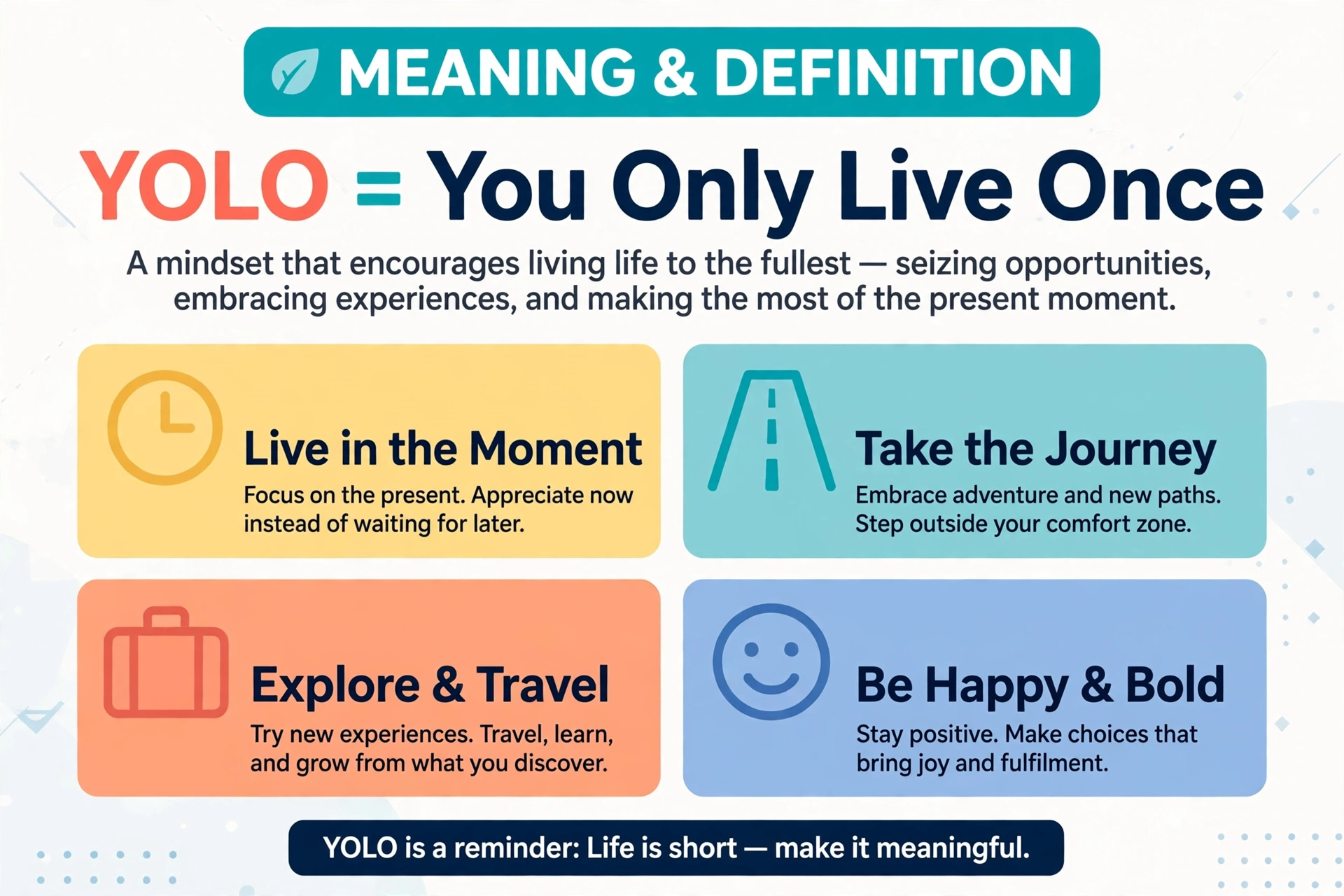
Quick definition: YOLO meaning slang is simple: YOLO stands for “you only live once.” People say it right before — or right after — doing something bold, spontaneous, or slightly reckless, as a way of saying life is short, so take the chance. It can sound brave, funny, or like a joke about a bad decision, and the tone, the timing, and the person saying it decide which one you hear.
YOLO Meaning Slang: Definition and Quick Answer
In texting and social media slang, YOLO is an acronym for “you only live once.” It is pronounced “YOH-loh,” usually written in capital letters, and often used as a hashtag, a caption, or a one-word comment at the end of a sentence. When someone writes “YOLO,” they are usually doing one of three things: justifying a decision they know is impulsive, encouraging someone else to take a chance, or joking about a choice that was probably not the wisest one.
The core idea is older than the acronym. It is the same thought behind the Latin phrase carpe diem, “seize the day”: life is short, the moment will pass, and waiting for a perfect time can mean missing the chance altogether. YOLO packs that whole philosophy into four letters, which is exactly why it spread so fast in texts, tweets, and captions. It is short enough to type in a second, strong enough to end an argument with yourself, and flexible enough to work as encouragement, as an excuse, or as a punchline.
Here is the quick answer most people are looking for:
| Question | Short answer |
|---|---|
| What does YOLO stand for? | You Only Live Once |
| How is it pronounced? | YOH-loh |
| Where do people use it? | Texts, group chats, Instagram and TikTok captions, comments, and spoken jokes |
| What tone does it carry? | Usually playful, bold, or ironic — rarely formal or serious |
| Is it still used in 2026? | Yes, mostly ironically or nostalgically, and it is still widely understood |
If you only remember one thing, remember this: YOLO is almost never a careful, serious argument. It is a shrug, a laugh, and a push forward, all at once. Someone who says “YOLO” is not usually presenting a philosophy paper. They are telling you — and themselves — that the risk feels worth it, or at least that it will make a good story later.
Introduction
Picture the scene. A friend is staring at the checkout page for concert tickets that cost far more than the plan allowed. The group chat goes quiet for a moment. Then one message lands: “Just buy them. YOLO.” Everyone laughs, the tickets get bought, and nobody pretends it was a careful financial decision. That is YOLO doing its real job in modern slang: it turns hesitation into action, and it gives a bold choice a name that everyone in the chat already understands.
YOLO works because it answers the voice in your head that says “what if this goes wrong?” with a louder voice that says “what if you never try?” Sometimes that is genuinely good advice. A last-minute road trip, a dance class you have always wanted to try, a message to someone you have been meaning to call — those are the moments where “you only live once” feels true and kind. Other times, YOLO is the joke you tell yourself while ordering a third dessert at midnight or booking a flight the night before an exam. The words are the same. The difference is whether you are smiling when you say them.
That double life is why YOLO has lasted far longer than most slang from the same era. Plenty of words from the early 2010s faded into jokes about the past, but YOLO stayed useful. It survived because it is not really about one trend, one app, or one song. It is about a feeling everyone recognizes: the pull between playing it safe and living a little. Like mewing and other terms that jumped from a small corner of the internet into everyday chats, YOLO became a shorthand that outgrew its origin story and turned into a piece of ordinary English.
This guide covers the full picture: the exact meaning of YOLO in slang, where it came from before and after Drake made it famous, how it is used in texts and captions today, real examples in different tones, how it compares with similar terms like FOMO and carpe diem, the alternate meanings you should know, polite alternatives for work and formal settings, the mistakes that make it sound dated or careless, and quick tips for using it well. By the end, you will know not just what YOLO means, but when it helps, when it hurts, and when it is better to leave it out entirely.
Origin
The sentiment behind YOLO is ancient, but the four-letter acronym took a long road to fame. The phrase “you only live once” had been used in English for decades, and the idea behind it goes back much further — to the Roman poet Horace and carpe diem, and to every version of “seize the day” that has followed since. What changed in the 2010s was not the idea. It was the packaging: four capital letters that fit perfectly in a tweet, a caption, or a text.
The acronym itself was floating around well before it became a global catchphrase. Lexicographers have traced early uses of the YOLO acronym back to the 1990s, including a 1993 trademark filing for YOLO gear. In the early 2000s, Adam Mesh, a contestant on the reality show Average Joe, sold a line of YOLO-branded clothing and accessories. Grateful Dead drummer Mickey Hart and his wife Caryl Orbach had even used the acronym to name their ranch before 1996, describing it as their whole mindset at the time. None of that made YOLO famous. It was known in small circles, not in group chats everywhere.
Everything changed in 2011. Canadian rapper Drake released “The Motto,” featuring Lil Wayne, and the hook repeated the acronym until it was impossible to forget: “You only live once, that’s the motto, YOLO.” The song was a hit, the phrase was everywhere within months, and YOLO jumped from song lyrics into memes, T-shirts, Twitter bios, tattoos, and television jokes. Drake later said he had no idea it would become so big — in his opening monologue on Saturday Night Live in January 2014, he apologized for how pop culture had adopted the phrase. By then, of course, it was far too late to take it back. You can read the fuller history of the acronym, including its pre-Drake uses, on Wikipedia’s YOLO page.
Dictionaries followed the culture. YOLO was shortlisted for Oxford American Dictionaries’ Word of the Year in 2012, losing to “GIF,” and in 2014 it was added to the online edition of the Oxford English Dictionary, alongside other internet-era terms of the moment. That is a remarkable journey for a word that, only a few years earlier, most people had never seen written down. A song hook had become a dictionary entry, and a piece of slang had become part of the language itself.
The backlash arrived almost as fast as the fame. By 2013, YOLO was already being parodied. The Lonely Island released a song called “YOLO” that flipped the acronym to “You Oughta Look Out,” mocking the reckless version of the motto with jokes about safety and caution. The parody only proved how huge the original had become: you cannot parody a word nobody knows. YOLO had passed the point where it needed Drake, or anyone else, to keep it alive. It belonged to the internet now, and the internet kept using it, joking about it, and arguing about it for years.
Popularity
YOLO’s peak came fast. In 2012, the year after “The Motto,” the word was everywhere: hashtags on Twitter, captions on Instagram, graffiti, pranks, merchandise in stores, and references in shows like The Simpsons and Family Guy. If you were online in 2012, you could not avoid it. It was the default caption for anything adventurous, the default joke for anything impulsive, and the default excuse for anything that probably needed a second thought.
That kind of saturation has a cost. Words that are everywhere quickly start to feel overused, and YOLO was no exception. By the mid-2010s, saying YOLO sincerely in a text could sound dated, like quoting a joke everyone had already heard. People still understood it instantly — that never went away — but the cool factor faded. The word moved from “fresh slang” to “classic slang”: recognizable, useful, and a little nostalgic, like a song from high school that still makes everyone in the room smile.
What kept YOLO alive was irony. As sincere use faded, ironic use grew. People started saying YOLO precisely because it sounded like 2012, using it to joke about small, ordinary risks: eating the last slice of pizza, staying up too late on a weeknight, buying the slightly more expensive coffee. The joke works because everyone knows the original meaning, and everyone knows the gap between “you only live once” and a midnight snack is funny. Irony gave the word a second career, and that second career has lasted longer than the first.
On TikTok and Instagram today, YOLO still appears, usually in three places: nostalgic posts about the 2010s, captions for travel and adventure content, and jokes where the word itself is the punchline. Creators use #YOLO to tag bold or spontaneous moments, and commenters drop it under videos of stunts, surprises, and last-minute plans. It is rarely the newest word in the caption — newer slang like zesty or “no cap” takes that role — but it is the word everyone’s parents, older siblings, and younger cousins all understand. That shared understanding is YOLO’s real staying power. Slang usually divides generations. YOLO, for once, connects them.
Search interest tells the same story. People still search for what YOLO means, especially younger users meeting it in old posts, song lyrics, or captions, and older users hearing it from their kids. It is no longer a word people use to sound current. It is a word people use because it is clear, and because the feeling behind it — life is short, take the chance — never really goes out of date.
How It Is Used
YOLO is used in a few clear patterns, and recognizing the pattern tells you the tone. Most uses fall into one of five jobs, and the same four letters can do all of them depending on the sentence around them.
- As a justification: placed after a bold decision, as if to close the debate. “I booked the flight. YOLO.” The decision is already made. YOLO is the period at the end of it.
- As encouragement: placed before or after advice to someone else. “Just send the message — YOLO!” Here it is a push, not an excuse. It says the risk is worth it.
- As a caption or hashtag: used to label a photo or video. “Sunset hike, no plan, no regrets. #YOLO.” The word frames the moment as spontaneous and worth remembering.
- As a joke: used ironically for a tiny, harmless risk. “I ate the whole cake. YOLO.” Nobody thinks cake is dangerous. That is the joke.
- As a warning in reverse: used sarcastically when someone is clearly about to make a bad choice. “Sure, spend your rent money on sneakers. YOLO.” The tone says the opposite of encouragement.
Grammar around YOLO is loose, because it is slang, not formal English. It usually appears at the end of a sentence, on its own line in a chat, or as a standalone comment. It can also be used as a verb in jokes — “we’ve been YOLOing all night” — although that form is playful and uncommon. In captions, it often appears with an exclamation mark, an emoji, or a string of laughing emojis. In texts, it is often lowercase — “yolo” — which softens it and makes it feel more casual.
One rule matters more than the rest: YOLO needs context. On its own, in a serious conversation, it can sound dismissive, as if you are brushing off a real concern. With a joke, a laugh, or a clear sense of fun around it, it lands as intended. The word is short, so the context has to do the heavy lifting. If the person you are talking to cannot tell whether you are joking, add the context yourself: an emoji, a follow-up line, or a plain version of what you mean.
YOLO in texts and chats
In texts, YOLO usually comes last, like a signature. “Road trip tomorrow, no plan. YOLO.” It works well in group chats because it invites a reaction — laughter, agreement, or a teasing reply — without needing a long explanation. It is also common as a reply on its own: someone announces a bold plan, and a friend replies with a single word, “YOLO,” which means “go for it, I support this, and I want to hear how it goes.”
YOLO on social media
On Instagram and TikTok, YOLO is mostly a caption word. Travel photos, festival videos, spontaneous adventures, and “day in my life” clips use it to signal that the moment was unplanned and worth it. The hashtag #YOLO still collects this kind of content, mixing sincere adventure posts with ironic jokes about everyday risks. On TikTok, it also appears in comments, usually under videos of stunts, surprises, or bold fashion choices, where it functions as applause.
YOLO in speech
Spoken aloud, YOLO is almost always a joke or a rallying cry, rarely a serious statement. Someone shouts it before jumping into a pool, trying a strange food, or attempting a dance move they have not practiced. Said with a grin, it invites everyone nearby to laugh along. Said flatly in a serious meeting, it would sound strange — and that mismatch is the point. YOLO belongs to informal, playful moments, and it knows it.
Examples
The best way to understand YOLO is to see it in context. The examples below show the same word in different tones, because tone is everything with this acronym. Read the sentence, then read the feeling behind it. That feeling is the real meaning.
Friendly Examples
- “Let’s take the long way home and stop at every viewpoint. YOLO!” — Spontaneous, warm, and encouraging. The plan is fun, not risky.
- “You’ve been talking about that class for months. Sign up. YOLO.” — A friend pushing another friend toward something they actually want.
- “We made it to the top! Best decision ever. YOLO!” — Celebration after the risk paid off.
- “First time trying sushi. Wish me luck — YOLO!” — Light and self-aware. The “risk” is tiny, and everyone knows it.
- “Group chat, we’re all going. No excuses. YOLO.” — Playful peer pressure for a fun plan.
Professional Examples
YOLO is not a professional word, and it should not appear in work emails, presentations, or formal messages. The examples below show the closest professional equivalents — the moments where the feeling fits, but the word itself does not — and the rare informal work settings where a joking YOLO might appear among close colleagues.
- “I finally submitted the proposal I’ve been revising for weeks. You only live once, right?” — The full phrase, softened, among trusted colleagues. Still informal, but warmer than the acronym.
- “Team lunch, I’m trying the spiciest thing on the menu. YOLO.” — Only in a casual team chat, never in a client message.
- “I took the chance and pitched the idea in the meeting. Glad I did.” — The professional version: same courage, no slang.
The rule is simple: if the message could be read by a client, a manager you do not know well, or anyone who expects formal language, do not use YOLO. Use the alternatives in the section below instead. They carry the same encouragement without the slang.
Funny Examples
- “I bought the shoes. My bank account is crying. YOLO.” — The classic joke: a purchase that was fun and slightly regrettable, told with a laugh.
- “Ate the entire pizza by myself. No regrets. YOLO.” — Ironic, because the “risk” is delicious and harmless.
- “Stayed up until 3 a.m. watching videos. Tomorrow-me is going to be furious. YOLO.” — Self-aware humor about a choice everyone has made.
- “Wore white to a spaghetti dinner. YOLO.” — A tiny, funny risk, played for laughs.
- “Texted my crush. No turning back now. YOLO.” — Nervous excitement, turned into a joke to make it feel lighter.
| Situation | What YOLO sounds like | Tone |
|---|---|---|
| Booking a last-minute trip | “Flights are expensive, but YOLO.” | Bold, excited |
| Encouraging a friend | “Just do it — YOLO!” | Supportive |
| Joking about dessert | “Third slice. YOLO.” | Ironic, funny |
| Warning about a bad idea | “Sure. YOLO, I guess.” | Sarcastic |
| Captioning an adventure photo | “No plan, no regrets. #YOLO” | Celebratory |

YOLO Meaning Slang vs Similar Terms
YOLO has close cousins, and mixing them up changes the meaning. FOMO, carpe diem, “send it,” and “no regrets” all live in the same neighborhood, but each one points at a different feeling. The table below shows how they differ, and the notes underneath explain when to use each one.
| Term | What it means | How it differs from YOLO | Example |
|---|---|---|---|
| YOLO | You only live once — take the chance | The original: bold, playful, often ironic | “Booked the trip. YOLO.” |
| FOMO | Fear of missing out | About anxiety, not courage — you act because others might have fun without you | “I went because of FOMO, honestly.” |
| Carpe diem | Seize the day | Formal and literary; the same idea in serious language | “Carpe diem — I finally applied.” |
| No regrets | Live without wishing you had chosen differently | A result or a motto, not a push to act right now | “No regrets. Best trip ever.” |
| Send it | Go for it, fully, without holding back | More physical and extreme — stunts, sports, dares | “Send it! Jump in!” |
| Live your best life | Enjoy life fully, on your own terms | Broader and more positive; about a lifestyle, not one decision | “Living my best life this summer.” |
| Seize the moment | Grab the opportunity now | Serious and motivational, without the joke | “Seize the moment and audition.” |
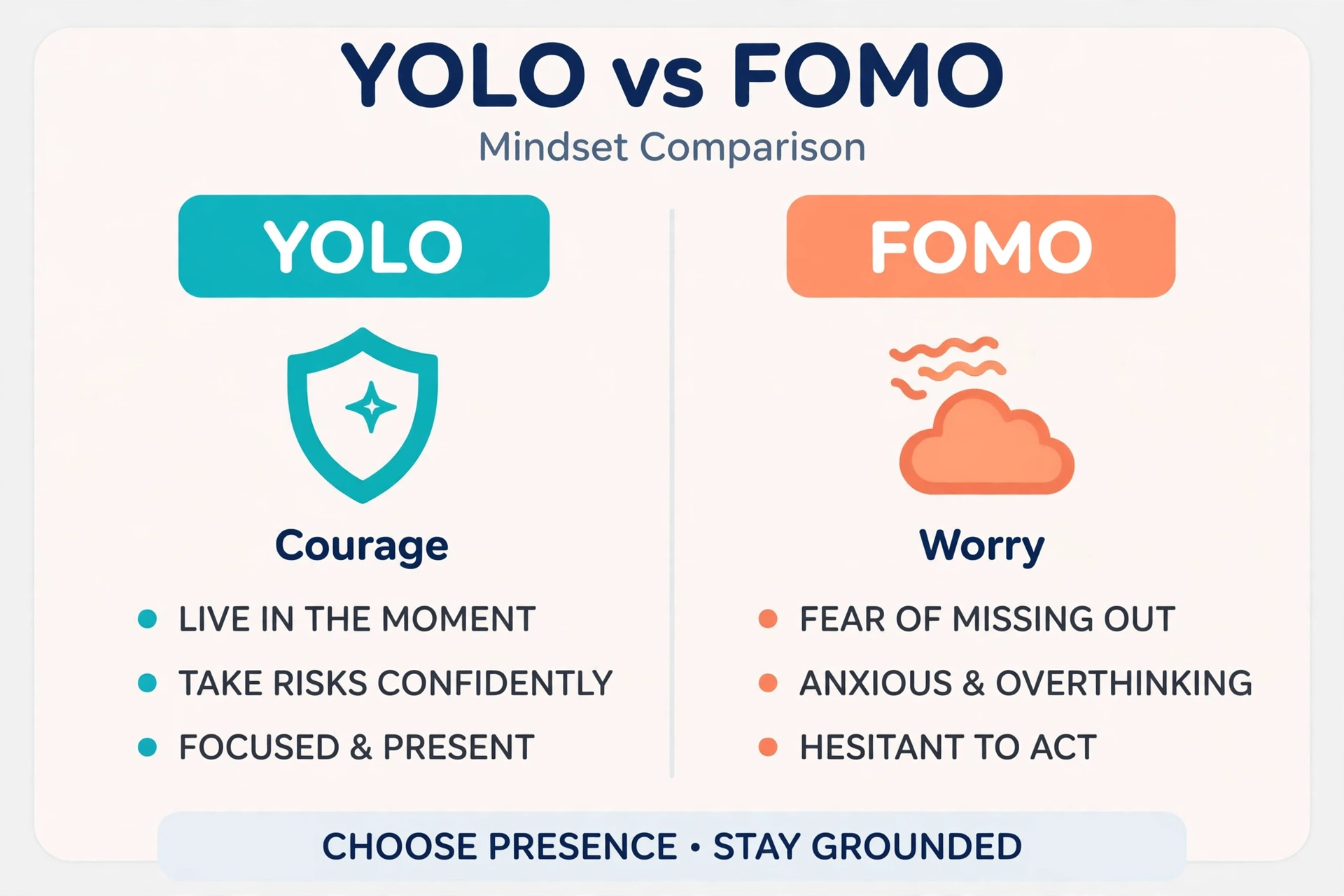
FOMO is the most common confusion. FOMO pushes you because you are afraid of being left out. YOLO pushes you because life is short and the chance is in front of you. The actions can look the same — both might get you to a party you were unsure about — but the feeling is different. FOMO is anxious. YOLO is, at least on the surface, confident. If you are going because everyone else is going and you will feel terrible scrolling through their photos later, that is FOMO. If you are going because you want the story, the laugh, and the memory, that is YOLO.
“Send it” is closer to YOLO, but louder. It belongs to sports, stunts, and dares, where the risk is physical and the crowd is watching. YOLO works for a much wider range of moments, from travel to food to a brave text message. And “carpe diem” is YOLO in a suit: the same idea, dressed for a formal occasion. If YOLO would sound wrong in the room you are in, “carpe diem” or “seize the moment” will usually sound right.
Alternate Meanings
YOLO almost always means “you only live once” in slang. There are a few other uses, but they are rare, and context makes them easy to spot.
- You Oughta Look Out: The Lonely Island’s 2013 parody flipped YOLO into a safety joke. People still quote it — “YOLO, you oughta look out” — but only as a joke about the original. If someone says this version, they are almost certainly being funny, not using a separate slang meaning.
- A name or username: YOLO appears as a brand name, a username, a team name, and a product name. In those cases, it is a label, not a message. The capitalization and the context — a profile, a logo, a shop sign — make that clear.
- “Yolo” as a place or surname: Yolo is also a county in California and a surname in some languages. If you see “Yolo County” or a person named Yolo, the slang meaning does not apply. The sentence around it will tell you immediately.
- In machine learning: “YOLO” is also the name of a well-known object-detection system, short for “You Only Look Once.” This is a completely separate, technical use. It appears in research papers, code, and tech discussions, never in a text about weekend plans. If the conversation is about cameras and software, it is the technical meaning. Everywhere else, it is the slang meaning.
For everyday texting and social media, you can safely assume YOLO means “you only live once.” The alternate meanings live in their own worlds — comedy, geography, and technology — and they rarely cross into a group chat.
Professional or Polite Alternatives
YOLO is informal, and informal words have a cost in formal settings. The alternatives below carry the same encouragement or the same shrug, without the slang. Choose the one that matches the moment: encouragement for a decision, celebration after a good outcome, or a light joke about a small risk.
| Instead of YOLO, say | When it works | Example |
|---|---|---|
| “Life’s short — go for it.” | Encouraging a friend or colleague informally | “Life’s short — go for it. Apply.” |
| “Seize the opportunity.” | Work, school, or formal encouragement | “Seize the opportunity and present your idea.” |
| “No regrets.” | Celebrating a decision after it worked out | “No regrets — best choice I made.” |
| “Why not?” | Light, casual encouragement among friends | “Why not? Try it once.” |
| “Make the most of it.” | Warm, general advice for any age | “Make the most of it — the trip won’t wait.” |
| “Treat yourself.” | Joking about a small indulgence | “Treat yourself — you earned it.” |
In a work message, the safest choice is to drop the acronym and keep the meaning. “I decided to take the chance and pitch the idea” says everything YOLO says, without asking the reader to decode slang. In a message to a friend, “why not?” or “go for it” does the same job, and it never sounds dated. Save YOLO for the chats where everyone is already joking, and use the plain version everywhere else. Like cooked and other internet terms that sound natural in a group chat and strange in an office, YOLO’s home is informal English.
Common Mistakes
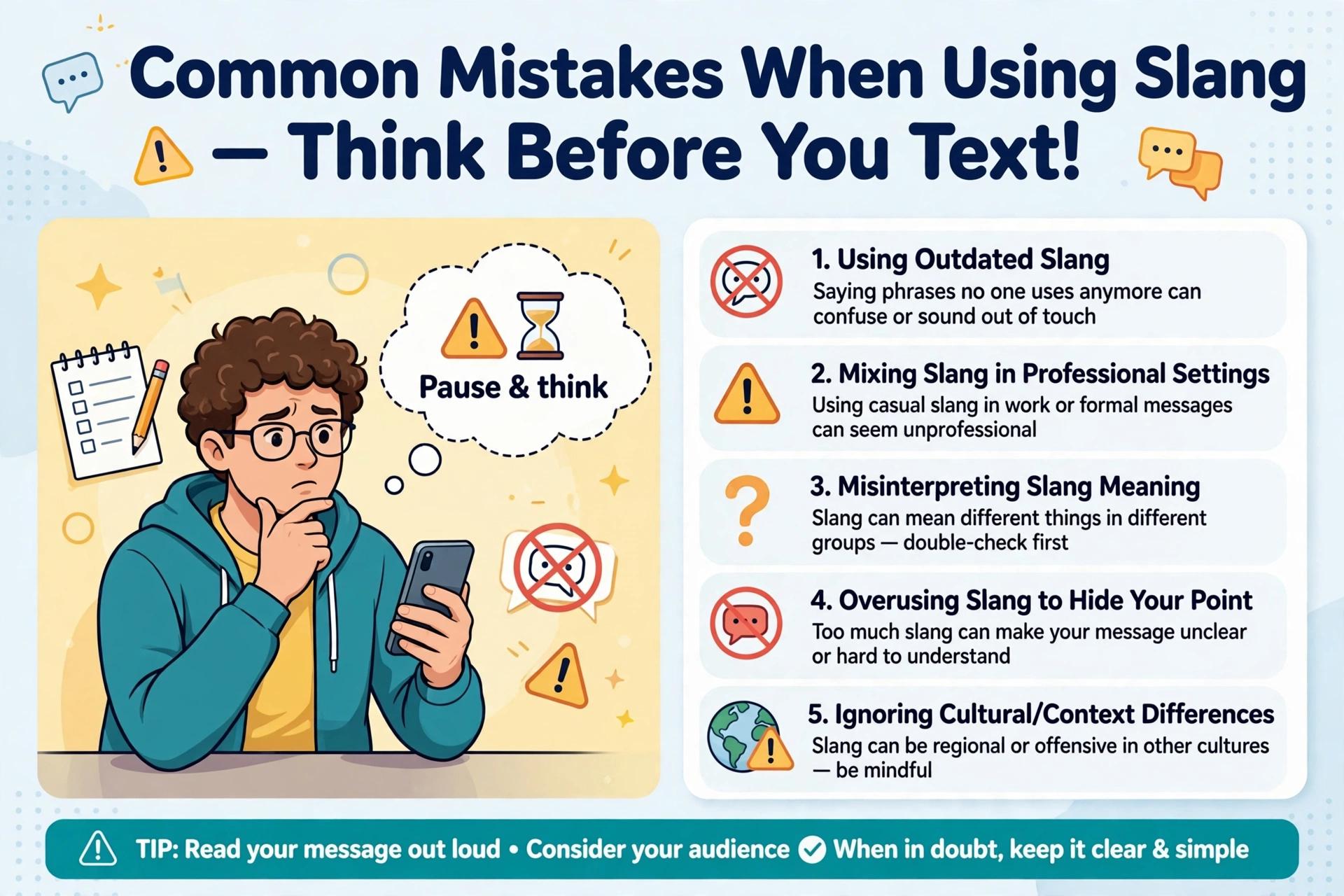
Most YOLO mistakes are not about the definition. People know what it means. The mistakes are about timing, tone, and audience — using a playful word in a serious moment, or using it so often that it stops meaning anything.
- Using it for genuinely serious or dangerous decisions: YOLO is a poor response to a real risk — a health decision, a major financial choice, or something unsafe. Saying it there sounds careless, and it can make the other person feel unheard. Serious moments deserve serious words.
- Using it to pressure someone: “Come on, YOLO” can turn encouragement into pressure, especially if the person has already said no. If someone hesitates, respect the hesitation. A joke should not be a lever.
- Using it in formal writing: Work emails, school essays, cover letters, and official messages are the wrong place for YOLO. Readers may see it as unprofessional, and the joke will not land the way it does in a chat.
- Using it after every decision: YOLO loses its punch when it follows everything, from buying coffee to booking a holiday. Save it for moments that actually feel bold or funny. Repetition turns a punchline into background noise.
- Using it without a joke or context: A bare “YOLO” in a serious conversation can read as dismissive, as if you are brushing off a concern. Add the context — an emoji, a laugh, or a follow-up sentence — so the other person knows you are joking.
- Confusing it with FOMO: Going to an event because you are afraid of missing out is FOMO, not YOLO. Using YOLO there mislabels the feeling, and it can make the decision sound braver than it is.
- Spelling or pronouncing it as a word in formal contexts: In texts, “yolo” in lowercase is fine. In any setting that expects standard English, write the full phrase — “you only live once” — or use an alternative from the section above.
Quick Tips
- Use it at the end, not the start: “I booked the tickets. YOLO.” lands better than “YOLO, I booked the tickets.” The decision comes first, the joke closes it.
- Match the size of the word to the size of the risk: YOLO works best for medium risks and small jokes. For tiny risks, it is ironic and funny. For huge risks, say what you really mean instead.
- Add a laugh when the tone could be unclear: An emoji, a “haha,” or a follow-up line prevents a joke from reading as pressure or dismissal in a text.
- Keep it rare: Once in a while, YOLO is a punchline. Every day, it is a habit. The less often you use it, the more it means when you do.
- Know your audience: With friends who share the joke, YOLO is instant shorthand. With older relatives, new colleagues, or anyone who might not know the slang, use the full phrase or a plain alternative.
- Pair it with a real reason when it matters: “I’m going because I’ve wanted this for a year. YOLO.” is stronger than YOLO alone. The reason makes it brave. The acronym makes it fun.
- Never use it to end a serious discussion: If someone is worried, upset, or asking for real advice, answer them properly first. A joke can come later, once they feel heard.
- Use the hashtag for captions, not for conversations: #YOLO works on a photo. In a one-to-one chat, the word without the hashtag feels more natural.

FAQ
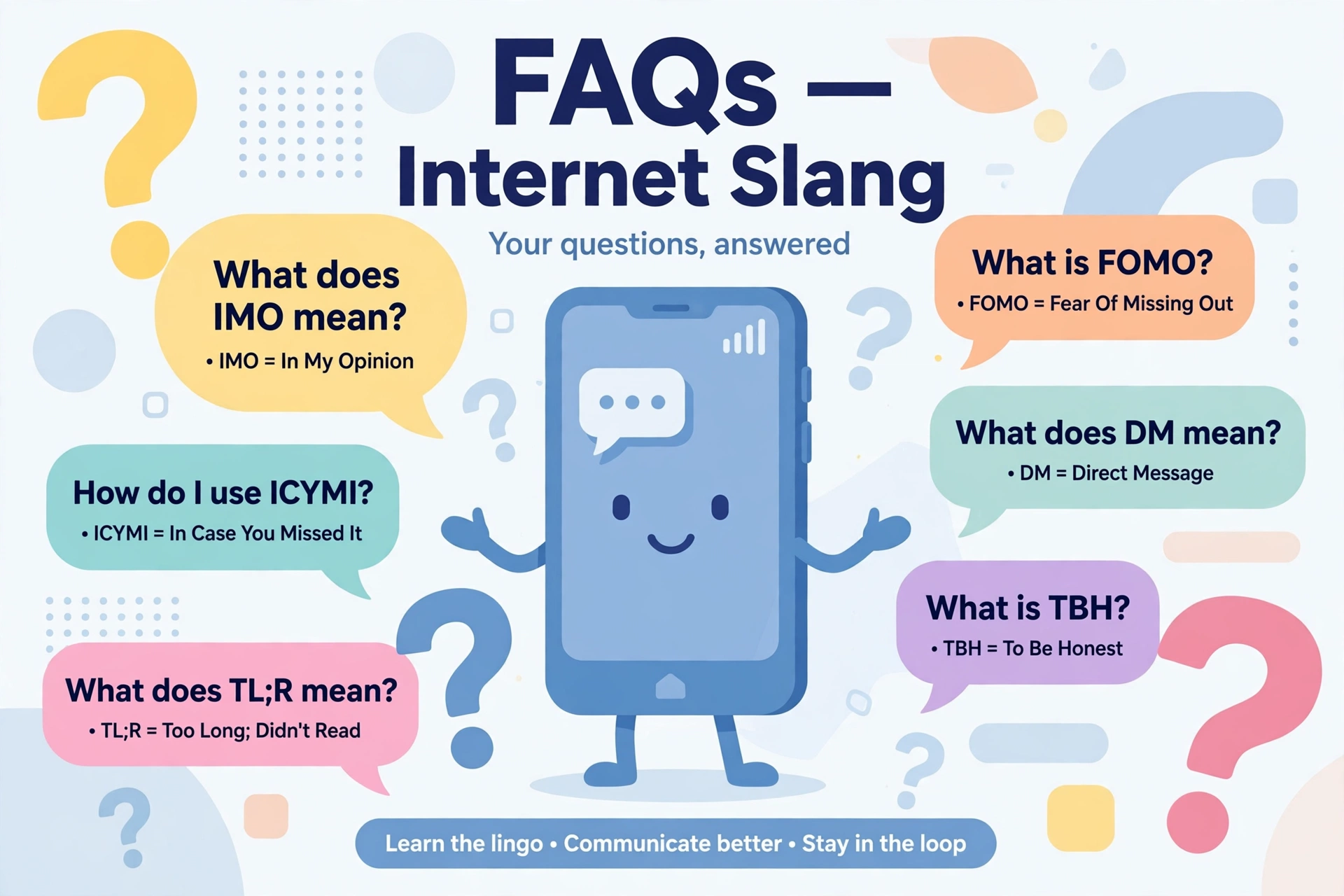
What does YOLO mean in slang?
YOLO stands for “you only live once.” In slang, people use it to justify a bold or spontaneous decision, to encourage someone to take a chance, or to joke about a slightly reckless choice. It means life is short, so take the opportunity while you have it.
What is the full form of YOLO?
The full form of YOLO is “You Only Live Once.” Each letter stands for one word: Y for You, O for Only, L for Live, and O for Once. It is usually written in capital letters, although lowercase “yolo” is common in casual texts.
Where did YOLO come from?
The phrase “you only live once” is much older than the acronym, but YOLO became famous through Drake’s 2011 song “The Motto,” featuring Lil Wayne. The hook repeated the acronym until it spread into memes, captions, merchandise, and everyday speech. Early uses of the acronym existed before Drake, but the song made it a global catchphrase.
Is YOLO still used in 2026?
Yes, but mostly ironically or nostalgically. People still use YOLO in captions, jokes, and comments, and everyone still understands it. Sincere, unironic use is less common than it was in 2012, because the word now carries a sense of nostalgia for the early 2010s. It survives because the feeling behind it never goes out of date.
What does YOLO mean in texting?
In texting, YOLO usually appears at the end of a message to add a playful, bold tone to a decision. “Just sent the text. YOLO.” means the sender took a chance and is laughing about the nerves. As a standalone reply, “YOLO” means “go for it” or “I support this.”
Is YOLO rude or offensive?
No, YOLO is not rude or offensive on its own. It is informal and playful. It can sound careless or dismissive if it is used in response to a serious worry, a dangerous choice, or a decision someone is genuinely anxious about. In those moments, the problem is the timing, not the word itself.
What is the difference between YOLO and FOMO?
YOLO is about courage: you act because life is short and the chance is worth taking. FOMO, the fear of missing out, is about anxiety: you act because you are afraid others will have fun without you. YOLO pushes you toward what you want. FOMO pushes you away from what you might miss. The actions can look similar, but the feelings are opposites.
How do you reply to YOLO?
Reply in the tone the sender used. If they are excited, match it: “Yes! Go for it!” or “Let’s gooo.” If they are joking, laugh along: “No regrets” or a laughing emoji. If they seem to be using YOLO to justify something risky, it is fine to pause the joke and ask, gently, whether they have thought it through. A good reply honors the feeling, not just the word.
Conclusion
YOLO meaning slang comes down to four words: you only live once. It is a joke, a push, and a philosophy, packed into four letters that anyone who texts can understand in a second. Drake made it famous in 2011, dictionaries recorded it, the internet parodied it, and irony kept it alive long after the first wave of fame faded. That staying power is rare for slang, and it says something about the word itself: it names a feeling that does not belong to one generation, one app, or one song.
Use YOLO well, and it does real work. It turns hesitation into a story, it gives a friend the push they needed, and it makes a small risk feel like an adventure. Use it carelessly, and it does the opposite: it makes a serious moment sound like a joke, or a joke sound like pressure. The difference is not in the letters. It is in the moment, the audience, and the honesty behind it. Say it when the risk is worth laughing about, say the plain version when the moment deserves plain words, and let the feeling — not the fashion — decide.
Life really is short, and the best version of YOLO has never been about being reckless. It is about noticing the chances that matter, taking the ones you will be glad you took, and telling the story afterward with a smile. The next time you catch yourself hesitating over a trip, a message, a class, or a new beginning, ask the simple question behind the acronym: will future-you be glad you tried? If the answer is yes, you already know what to do. For more slang explained the same way, our guides to glazing slang and mewing follow the same journey, from a niche corner of the internet to words everyone online seems to know.
