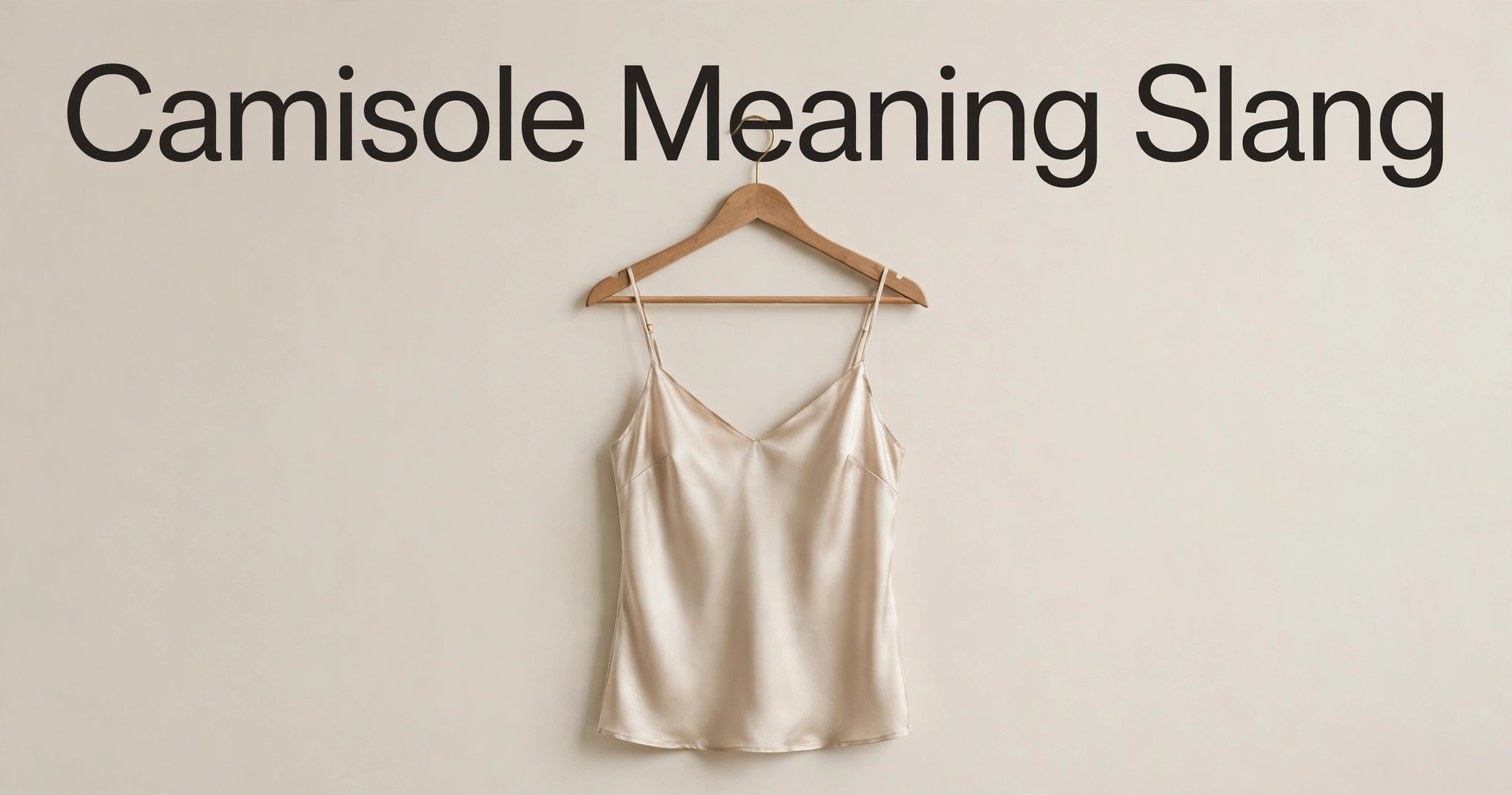
Quick definition: Camisole meaning slang starts with a real piece of clothing: a camisole — usually shortened to “cami” — is a light, sleeveless top with thin spaghetti straps, worn as underwear, sleepwear, or a layering top. In slang and social media captions, “camisole” is mostly used the same way, as a fashion word, and “camisole energy” has come to mean a soft, delicate, elegant vibe. A much smaller, niche meme use treats “camisole” as a playful tease for someone acting extra soft or dramatic. Context tells you which one you are reading.
Camisole Meaning Slang & Definition
A camisole is one of those words that sounds fancy because it is borrowed from French, but the thing itself is simple and familiar. Picture a sleeveless top with thin straps, a straight or slightly fitted body, and fabric that is usually silk, satin, lace-trimmed cotton, or a soft stretch knit. It sits close to the body, it layers easily under a blazer or an open shirt, and on its own it reads as a dressy, delicate top. That is the literal meaning, and it is the meaning behind almost every use you will meet online.
When people search for camisole meaning slang, they are usually not confused about the garment. They are confused because they saw the word somewhere it did not look like a shopping page: in a TikTok caption, a text message, a meme, or a comment like “total camisole energy.” There, the word has drifted from naming a top to describing a feeling — softness, femininity, polish, and a kind of quiet confidence. It is the same drift that turns other clothing words into personality words. Nobody thinks a person literally is a camisole. They are saying the person, the outfit, or the mood has the qualities people associate with one.
| Use of “camisole” | What it means | Where you will see it |
|---|---|---|
| Literal garment | A sleeveless top with thin straps, often silk or satin | Shops, outfit posts, wardrobe guides |
| Short form “cami” | The same top, in everyday speech | Texts, shopping lists, friend chats |
| “Camisole energy” / aesthetic slang | Soft, delicate, elegant, feminine vibe | TikTok captions, Instagram comments, Pinterest |
| Niche meme tease | Playfully calling someone extra soft or dramatic | Meme threads, close-friend group chats |
| Historical sense | A straitjacket (19th-century use, now dated) | Old books, word-history pages |
The safest way to read the word is also the simplest: assume the garment first. If the sentence is about an outfit, a shop, layering, or getting dressed, it means the top. If the sentence is about a vibe, a mood, or a person’s energy, it is using the garment as a metaphor. Only in a joking chat between friends who already share the meme should you read it as a tease — and even then, the joke only works because everyone knows how delicate a camisole is supposed to be.
Introduction
Most slang words arrive with a bang: a viral video, a celebrity catchphrase, a gaming abbreviation that escapes into group chats. “Camisole” arrived quietly, the way fashion words usually do. It was already sitting in wardrobes and shop filters for a century before TikTok captions and texting gave it a second life as a vibe word. That quiet history is exactly why it confuses people. There is no single viral moment to point to, no dictionary entry that says “camisole (slang): be soft.” Instead there is a slow, ordinary process: a delicate garment becomes shorthand for delicacy itself.
This guide untangles all of it in the order that helps most. You will get the plain definition, the word’s history, why it is suddenly everywhere in fashion content, how it is actually used in texts and captions, and where people go wrong with it. It works the same way as our other slang explainers — plain meaning first, slang second, real examples throughout — so if you have ever puzzled over an abbreviation like the one in our OTP meaning in text slang guide, the approach here will feel familiar. By the end, you will be able to spot a camisole in a shop, read “camisole energy” in a caption without guessing, and use the word yourself without sounding like you borrowed it from a meme you only half understood.

Origin
The word “camisole” comes from French camisole, from Provençal camisola, a diminutive of camisa, meaning “shirt,” which traces back to Late Latin camisia, “shirt” or “nightgown.” It entered English in 1816, when it described a short, light garment with sleeves worn by women as morning dress. Over the 19th and 20th centuries the shape changed — sleeves disappeared, the cut grew lighter, the fabric grew finer — until by about 1900 the modern sense had settled: a sleeveless undergarment for women. You can read the full word history in the Etymonline entry for camisole, which also records the word’s darker 19th-century sense.
That darker sense is worth knowing, because it still turns up in word-history lists and confuses searchers. In the late 1800s, “camisole” was also used for a straitjacket — in French, a camisole de force, literally a “force camisole.” The garment restrained the arms, the way a camisole’s straps and close fit wrap the upper body, and the name stuck for a while in medical and asylum writing. The sense is dated now and nobody uses it in everyday speech, but it explains why an old dictionary or an etymology page might list “straitjacket” as a meaning. If you meet it, you are reading history, not slang.
The short form “cami” is much newer and much more casual. It follows the same pattern as other clipped fashion words: say the first syllable, drop the rest, and the word becomes something you can text quickly. “Cami top,” “cami dress,” and “cami with a built-in bra” are all shop-filter language now, and “cami” is the form most people actually say out loud. When a friend texts “wear the black cami,” she is not using slang at all. She is just using the short, normal name for the top.
Popularity
Camisoles never really went away, but they come back into fashion conversation in waves, and the current wave has been running for several years. The slip-dress revival of the 1990s put satin camisoles back on red carpets and in street style. The layering boom of the 2010s made the cami a default base layer under sheer tops, open shirts, and blazers. And the TikTok era did the rest: “cami top” hauls, “how to style a satin camisole” videos, and capsule-wardrobe lists all pushed the word into feeds where people who never shopped for one started seeing it daily.
Social media also did something subtler. Aesthetic labels — “soft girl,” “clean girl,” “old money,” “coquette” — each need a wardrobe shorthand, and the silk camisole became one of the most-shared images in that whole conversation. A single photo of a champagne satin cami with jeans and a blazer can carry a whole mood board’s worth of meaning: polished, feminine, effortless, a little luxurious. Once an image carries that much meaning, the word starts carrying it too. That is how “camisole energy” was born — not from a dictionary, but from thousands of captions, comments, and outfit posts all pointing at the same feeling.
Search interest follows the same pattern. People rarely search “camisole” because they want a lecture on fashion history. They search because they saw the word in a caption, a product title, or a friend’s message and want to be sure they understood it. The slang-flavored searches — “camisole meaning slang,” “what does camisole mean in text,” “camisole energy meaning” — are people checking a vibe word, not a garment. The gap in most existing pages is that they answer only one of those questions: either the garment, or the joke. This guide answers both, and says plainly which one is common and which one is niche.
How It Is Used
In everyday use, “camisole” behaves like any other clothing noun. You buy one, you wear one, you layer one, you wash one carefully because satin is unforgiving. The sentences are practical: “The white cami is in the wash,” “She wore a lace camisole under her suit,” “Do they sell this camisole in petite?” Nobody in those sentences is being clever. The word is doing the ordinary job of naming a thing, and that is still its main job by a wide margin.
The slang-adjacent use is different in kind, not just in degree. It takes the qualities of the garment — thin, soft, delicate, smooth, a little intimate because it began life as underwear — and applies them to people, moods, and moments. “She walked in with total camisole energy” does not mean she was wearing one, although she might have been. It means she carried herself the way a satin camisole looks: smooth, composed, quietly confident, feminine without trying hard. “I’m in a camisole mood today” means the speaker wants softness and ease: slow morning, gentle plans, nothing scratchy, literal or otherwise.
Then there is the teasing use, and honesty matters here. A handful of meme and slang-content sites describe “camisole” as a playful roast for someone acting fragile, dramatic, or “extra” — as in “stop being such a camisole.” That use exists in niche meme circles, and the examples those sites give are consistent with each other. But it is not in mainstream slang dictionaries, it is not what most people mean when they write the word, and using it that way with someone who does not already know the joke will mostly produce confusion. Treat it as an in-joke with a small audience, not as an established slang meaning. If you are not sure your listener knows the joke, do not lead with it.
- Fashion talk: naming the garment, shopping, styling, layering. The default meaning.
- Aesthetic captions: “camisole energy,” “silk camisole mood,” “soft like a camisole.” The vibe meaning.
- Everyday texting: “cami” as the short name for the top. Not slang, just shorthand.
- Meme teasing: calling a friend “a camisole” for acting soft or dramatic. Niche, friends-only.
- Word history: the dated straitjacket sense. Only in old texts and etymology pages.
Examples
Examples are where a word like this finally clicks, because the same letters do very different work depending on the sentence around them. Read each set for its tone, not just its words: the garment examples are practical, the caption examples are admiring, and the teasing examples only work between people who already trust each other. Notice, too, how often the slang uses need a helper word — “energy,” “mood,” “vibes” — to signal that a metaphor is happening. Without the helper, the sentence usually snaps back to the literal garment.
Friendly Examples
Friendly use is where “camisole” is at its easiest. Between friends, the word usually means the top, and the conversation is about getting dressed, borrowing clothes, or complimenting an outfit. The vibe use shows up here too, as a compliment: telling a friend she has “camisole energy” is a soft, admiring way of saying she looks elegant and at ease. It lands like “you look lovely today,” with a fashion reference tucked inside.
- “Can I borrow your black cami for Saturday? Mine is still in the laundry.”
- “That satin camisole with the jeans — you look amazing, honestly.”
- “You walked in with full camisole energy today and I am taking notes.”
- “I’m in a camisole mood today: soft music, slow morning, no scratchy sweaters.”
- “Her whole outfit is so camisole — delicate, simple, and it just works.”
Professional Examples
In professional settings, “camisole” is a garment word, full stop. It appears in dress codes, retail copy, wardrobe guidance, and styling notes. Nobody uses the meme tease at work, and the aesthetic slang only appears in fashion and media workplaces where vibe language is part of the job. The professional rule is simple: if you mean the top, say “camisole” or “layering top”; if you mean the feeling, say the feeling — “elegant,” “polished,” “understated” — and leave the metaphor out of the email.
- “A neutral camisole under a blazer keeps the look polished without adding bulk.”
- “Please note: camisoles count as layering pieces, not standalone tops, under the dress code.”
- “For the shoot, we need three camisoles: black, champagne, and ivory, all in silk.”
- “The product page should say ‘satin camisole top with adjustable straps,’ not just ‘cami.’”
- “She styled the outfit beautifully — the camisole softened the whole tailored suit.”
Funny Examples
Funny use is almost entirely the niche tease, so these examples come with a warning label: they are only funny inside a friendship that already runs on roasts. Said to a friend who just performed a five-minute dramatic monologue about a delayed text reply, “okay, camisole” is a gentle way of saying “you are being a lot right now, and we both know it.” Said to a stranger, the same line is just confusing, and said to someone who is genuinely upset, it is unkind. The humor depends on shared context, and without it the joke has no floor to stand on.
- “Bro, you sighed three times before telling us the Wi-Fi was slow. Full camisole behavior.”
- “Me after one sad song: total camisole vibes, crying into my tea like it is a movie scene.”
- “He put on his softest voice to ask for the last slice. The camisole energy was unreal.”
- “She said ‘I’m fine’ in the most dramatic way possible. Somebody hand her a camisole.”
- “Our group chat has one rule: you can call someone a camisole, but only if they laughed first.”
| Example sentence | Tone | Meaning in context |
|---|---|---|
| “Wear the silk cami tonight.” | Practical | The garment; getting dressed |
| “She has real camisole energy.” | Admiring | Soft, elegant, composed vibe |
| “I’m in a camisole mood.” | Gentle, self-describing | Wanting softness and ease |
| “Stop being such a camisole.” | Teasing (friends only) | Acting extra soft or dramatic |
| “A camisole under a sheer top.” | Styling advice | Layering piece |

Comparison with Similar Terms
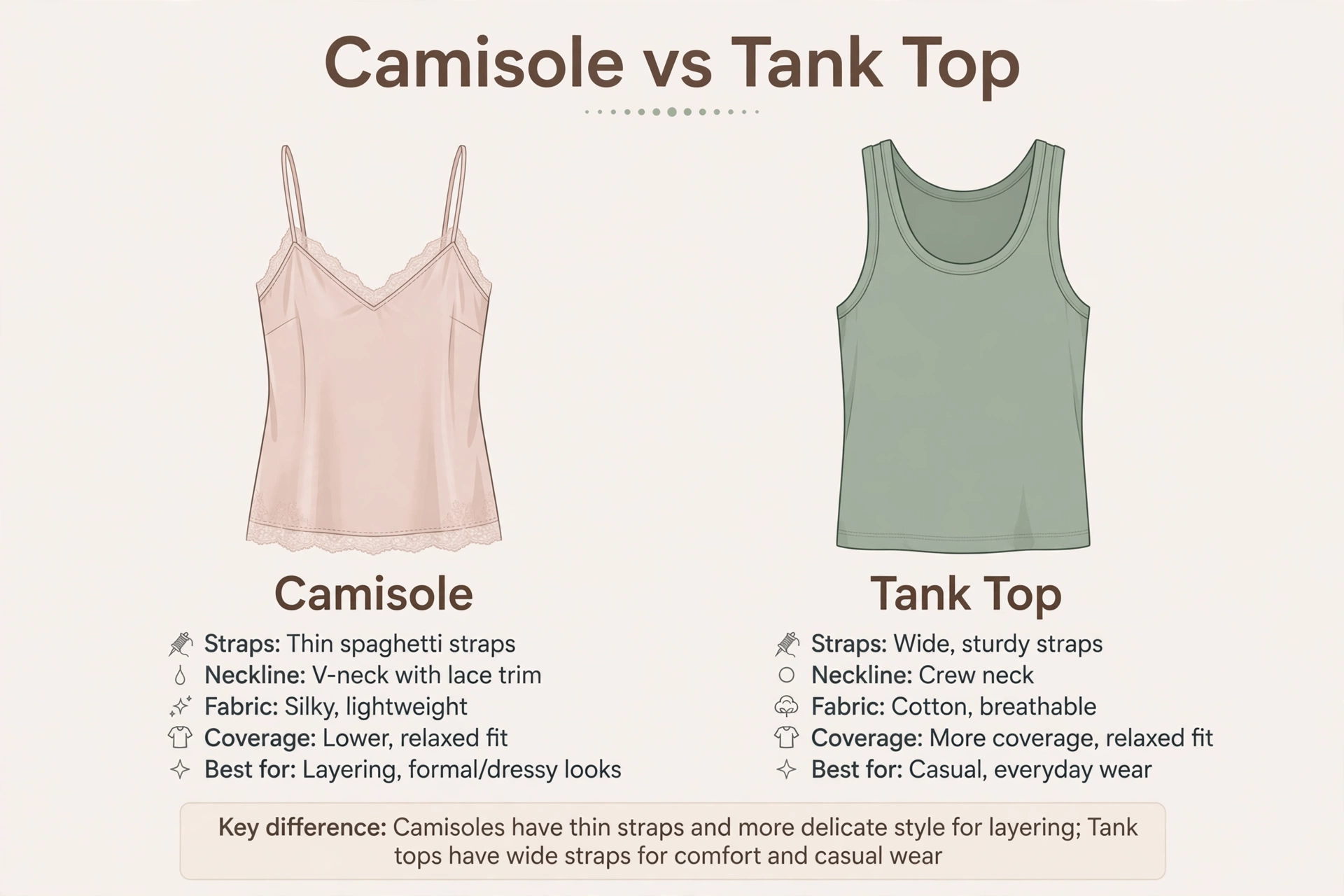
The most common confusion is not slang at all: it is shoppers and readers mixing up the camisole with its close neighbors. A camisole, a tank top, a chemise, and a slip dress all live in the same drawer, and shops do not help by labeling hybrids “cami tanks” and “tank camis.” The differences are small but real, and they come down to straps, fabric, and job. A camisole has thin spaghetti straps and a soft, often silky fabric, and its first job is layering or intimate wear. A tank top has wider straps and a sturdier knit, and its first job is being worn on its own. If you can see the bra strap, it is probably a cami. If the straps cover the bra strap, it is probably a tank.
| Garment | Straps | Typical fabric | Main job |
|---|---|---|---|
| Camisole (cami) | Thin, spaghetti, often adjustable | Silk, satin, lace, fine knit | Layering, sleepwear, dressy top |
| Tank top | Wide, sometimes racerback | Cotton jersey, rib knit | Casual standalone top, workouts |
| Chemise | Thin straps | Silk, satin, lace | Lingerie, nightwear, usually shorter and looser |
| Slip dress | Thin straps | Satin, silk, bias-cut fabric | Dress in its own right, worn out |
| Bralette | Thin or wide straps | Lace, soft knit | Light support, often shown under sheer tops |
| Spaghetti-strap top | Thin straps | Varies | General term; a camisole is one kind of it |
The slang comparison is simpler, because the vibe words around “camisole” mostly agree with each other. “Camisole energy” sits next to “soft girl energy” and “clean girl aesthetic” — all of them praise a polished, gentle, put-together softness. The difference is that “camisole energy” is narrower and more visual: it points at the silk-and-lace image specifically, while “soft girl” covers makeup, manner, and mood as well. And the teasing use sits on the opposite side of the same idea: where the compliment says “soft in a lovely way,” the roast says “soft in a dramatic way.” Same metaphor, opposite spin, and only the relationship between the speakers decides which one is meant. If you are unsure, read the compliment version first. It is far more common, and far safer.
Alternate Meanings
Besides the garment and the slang uses, “camisole” carries two alternate meanings that belong to history books rather than group chats. The first is the straitjacket sense, covered in the Origin section: in the 19th century, a camisole could be a restraint garment, and the French phrase camisole de force is the source of that use. You will still find it in etymology entries and historical writing, and it is the reason some dictionary pages list a meaning that sounds alarming next to a lingerie definition. It is not a meaning anyone uses in 2026 conversation.
The second is an older, lighter sense: in early use, a camisole could be a short, light jacket or loose gown, closer to a shirt than to underwear. That sense faded as the sleeveless garment took over the word, but it survives in the etymology — remember that the word’s ancestors all mean “shirt.” A third, marginal use is the verb “to camisole,” meaning to put someone in a straitjacket, which appears in 19th-century asylum reports and nowhere in modern speech. None of these should change how you read a text or a caption today. They matter only because they explain why a word search can return such different-looking results for one short word.
Professional or Polite Alternatives
Knowing the polite alternative matters most in two situations: at work, where the garment word itself can be awkward, and in the teasing use, where the joke can land badly. At work, “camisole” is not rude — it is an ordinary clothing term — but in dress codes and emails, neutral phrasing reads better. “Sleeveless layering top,” “satin top,” or simply “top” all do the same job without drawing attention to underwear history. In a retail or styling context, keep the precise word, because precision is the point: a customer searching for a camisole does not want a tank top.
For the vibe meaning, the polite alternatives are the feelings themselves: “elegant,” “polished,” “graceful,” “understated,” “soft-spoken.” If you want to compliment someone’s “camisole energy” in a setting where fashion slang would sound out of place — a work message, a message to someone older, a first conversation — say “you looked really elegant today” and keep the metaphor to yourself. And for the teasing use, the polite alternative is not a different word; it is not saying it. “You’re being dramatic” is already blunt enough between friends, and it has the advantage of being understood. A joke that needs a footnote is not doing its job.
- Instead of “camisole” (at work): “sleeveless layering top,” “satin top,” “top.”
- Instead of “camisole energy” (formal): “elegant,” “polished,” “graceful,” “composed.”
- Instead of the tease (with strangers): say nothing, or say plainly “take it easy.”
- In shops: keep “camisole” and “cami” — precision helps the search.
Common Mistakes
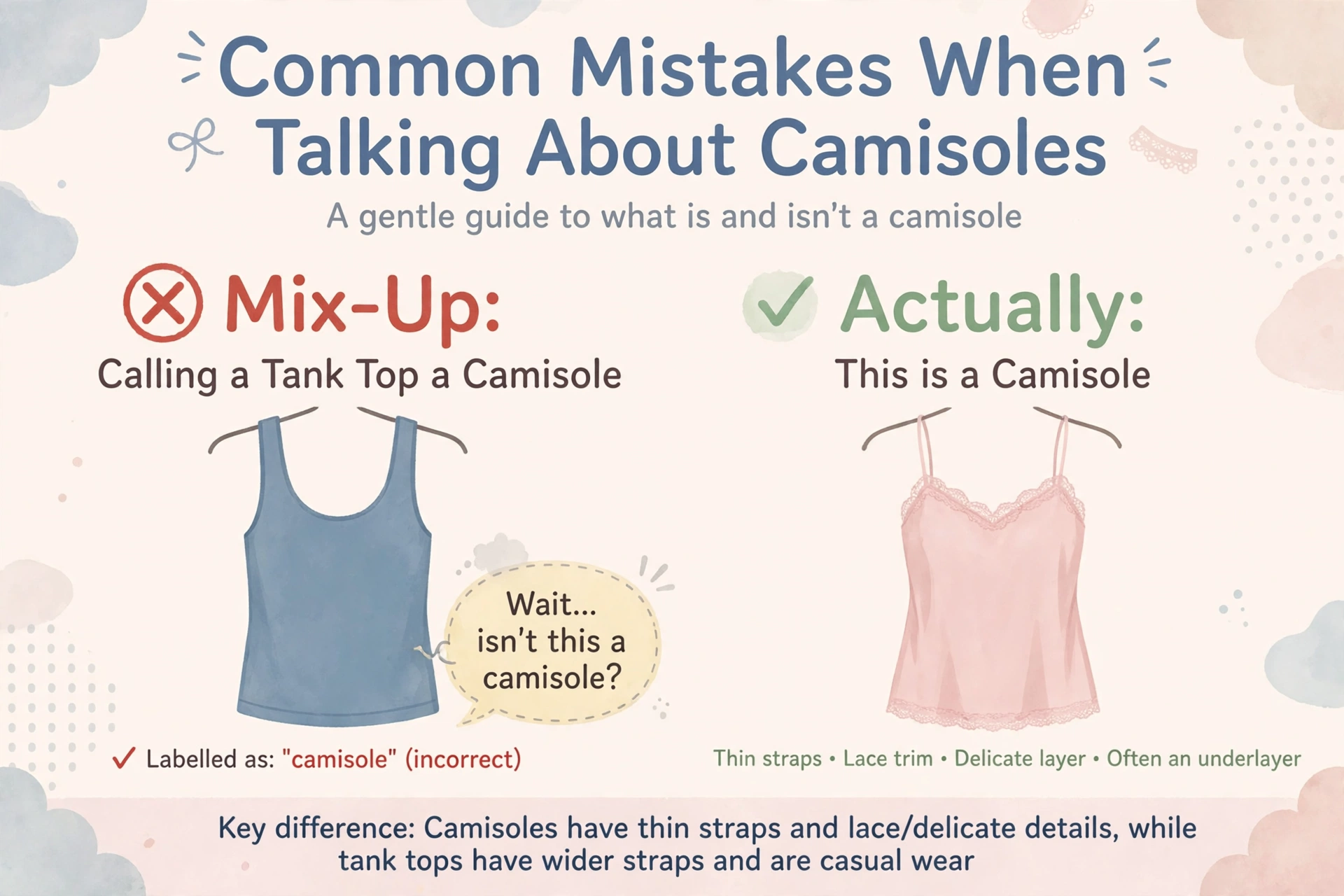
The mistakes people make with “camisole” are rarely about spelling, although “camisol” and “camisol” both turn up in searches. They are about assuming one meaning covers every sentence. The most frequent error is calling every thin-strapped top a camisole: a ribbed cotton tank with spaghetti straps is still closer to a tank, and a slip dress is a dress, not a top. Shops blur the lines, but the strap-and-fabric check in the comparison table settles most cases in seconds.
The second mistake is the slang one: reading the niche roast as the main slang meaning. Because a few slang-content pages repeat the teasing definition confidently, a reader can come away thinking “camisole” is an insult. It is not, in general use. The garment meaning and the admiring vibe meaning dominate, and the tease is a small meme with a small audience. Leading with the tease in the wrong room makes the speaker look confused, not funny, and it can genuinely puzzle or offend the listener.
The third mistake is tone-deafness about intimacy. A camisole began as underwear, and even as outerwear it keeps a lingerie association: lace, satin, a neckline that shows more skin than a T-shirt. Comments about someone else’s camisole — especially from strangers, especially about a real person’s body — can read as intimate in a way the speaker did not intend. Compliment the outfit if you must, briefly and respectfully, and never use the word to guess at what someone is wearing underneath. The fourth mistake is smaller but common: using “cami” for a camisole dress. “Cami” usually means the top. For the dress, say “cami dress” or “slip dress,” or the listener will picture the wrong garment.
- Calling any thin-strapped top a camisole — check straps and fabric first.
- Treating the niche roast as the main slang meaning — it is not.
- Using the tease with strangers or someone who is genuinely upset.
- Commenting on someone else’s camisole in an intimate or guessing way.
- Mixing up “cami” (the top) with “cami dress” or “slip dress.”
- Assuming every caption that says “camisole” is slang — most mean the garment.
Quick Tips
If you remember nothing else, remember the order: garment first, vibe second, joke last. That one habit will get you through almost every sentence containing this word. The rest is practical: how to use the word well in writing, how to shop for the thing, and how to keep the slang use friendly.
- Read the sentence around it. Outfit, shop, or getting dressed? It is the garment. Caption about energy or mood? It is the vibe.
- Use “cami” with friends, “camisole” in writing. Both are correct; the full word reads more polished in articles and product copy.
- Signal the metaphor. Say “camisole energy” or “camisole mood,” not bare “camisole,” when you mean the vibe.
- Keep the tease in the friend group. If the listener has to ask what you meant, the joke already failed.
- Shopping? Filter by “camisole” for silk and satin, “tank” for cotton and rib. Check strap width in the photo.
- Styling? A satin cami under a blazer is the easiest polished look in the whole wardrobe. Start with black or champagne.
- Writing captions? Pair the word with the feeling — “soft,” “slow morning,” “silk” — so readers get the metaphor instantly.
- Unsure about tone? Default to the compliment reading. It is more common and never rude.


FAQ
What does camisole mean in slang?
In slang and social media use, “camisole” usually means the garment used as a metaphor: “camisole energy” describes a soft, delicate, elegant vibe, like the feeling of a silk camisole. A smaller, niche meme use treats it as a playful tease for someone acting extra soft or dramatic, but that use is uncommon and only works between friends who share the joke.
Is camisole a rude word?
No. “Camisole” is an ordinary, polite clothing word. It can feel intimate in some contexts because the garment began as underwear and is associated with lace and satin, so comments about someone else’s camisole should stay brief and respectful — but the word itself is not rude, crude, or offensive.
What is a cami?
“Cami” is simply the short form of “camisole”: a light, sleeveless top with thin spaghetti straps. People say “cami top” in everyday speech and texting. It is not slang in the secret-code sense; it is just the clipped, casual name for the same garment.
What is the difference between a camisole and a tank top?
Straps and fabric. A camisole has thin spaghetti straps and a soft, often silky fabric, and is mainly for layering or dressy wear. A tank top has wider straps and a sturdier cotton or ribbed knit, and is mainly worn on its own as a casual top. If the straps cover the bra strap, it is usually a tank; if they are thin and adjustable, it is usually a cami.
Can men wear camisoles?
Anyone can wear any top, and camisoles are sold and worn across genders, especially as layering pieces and sleepwear. In practice the garment is marketed overwhelmingly to women, so men’s versions are usually labeled as undershirts, vests, or layering tanks. The word itself has no gender rule — the shopping categories do.
Is “camisole energy” a compliment?
Yes, in the way it is normally used. “Camisole energy” praises softness, elegance, polish, and quiet confidence. Like any vibe label, it depends on tone and relationship, but as captions and compliments go, it is an admiring phrase, not a mocking one. The mocking version needs a joking context to be read that way.
What does camisole mean on TikTok?
On TikTok, “camisole” almost always means the garment or the aesthetic around it: styling videos, hauls, “get ready with me” clips, and captions about silk camisoles, layering, and soft-girl outfits. The niche teasing sense barely registers there. If a TikTok caption says “camisole,” picture the top, the outfit, or the vibe — in that order.
Is a camisole the same as a straitjacket?
Not anymore. In the 19th century, “camisole” was also used for a straitjacket (French camisole de force), and that sense still appears in etymology entries. In modern English, a camisole is a sleeveless top, and “straitjacket” is the word for the restraint garment. The old sense is history, not current usage.
Conclusion
Camisole meaning slang turns out to be simpler than the search results make it look, and that is good news. The word has one solid, everyday meaning — a delicate sleeveless top with thin straps — and one graceful metaphorical life, in which “camisole energy” names a soft, elegant, composed vibe. The dramatic meme tease exists, but it is a footnote with a small audience, and the straitjacket sense is a history lesson. Read garment first, vibe second, joke last, and you will almost never misread the word.
That reading habit is the whole trick, and it travels well. The next time a fashion word shows up in a caption or a text and you are not sure whether it is literal or slang, apply the same test: what is the sentence about, what does the word literally name, and what qualities is the writer borrowing from it? If you enjoy decoding words this way, our guides to other slang terms — like SYFM meaning slang, tungsten meaning slang, and DL meaning slang — use the same plain-first approach. And if you buy one thing from this article, make it a good satin cami in a neutral color: it layers under everything, it never really goes out of style, and it is the easiest way to understand, firsthand, why a whole corner of the internet decided this little top deserved to be a vibe.
