
Quick definition: 90s slang is the informal vocabulary that defined American youth culture in the 1990s — words and phrases like “da bomb,” “as if,” “talk to the hand,” and “all that” that came from hip-hop, TV sitcoms, teen movies, and skate culture, and that are now making a comeback in memes, TikTok captions, and nostalgic throwback posts.
90s Slang Meaning & Definition
When people search for 90s slang, they usually want one of two things: a list of the words everyone used back in the decade, or the meaning of one specific phrase they heard in an old movie, a song, or a viral TikTok. In both cases, the answer starts with the same idea: 90s slang was the casual, playful language of a generation that grew up between the end of the Cold War and the start of the internet age.
Unlike formal English, slang is not taught in school. It spreads the way culture spreads — through music videos on MTV, lines in hit sitcoms like The Fresh Prince of Bel-Air and Seinfeld, lyrics from West Coast and East Coast hip-hop, and, of course, the school hallway. A word could go from a rap verse to a classroom to a national catchphrase in a matter of weeks.
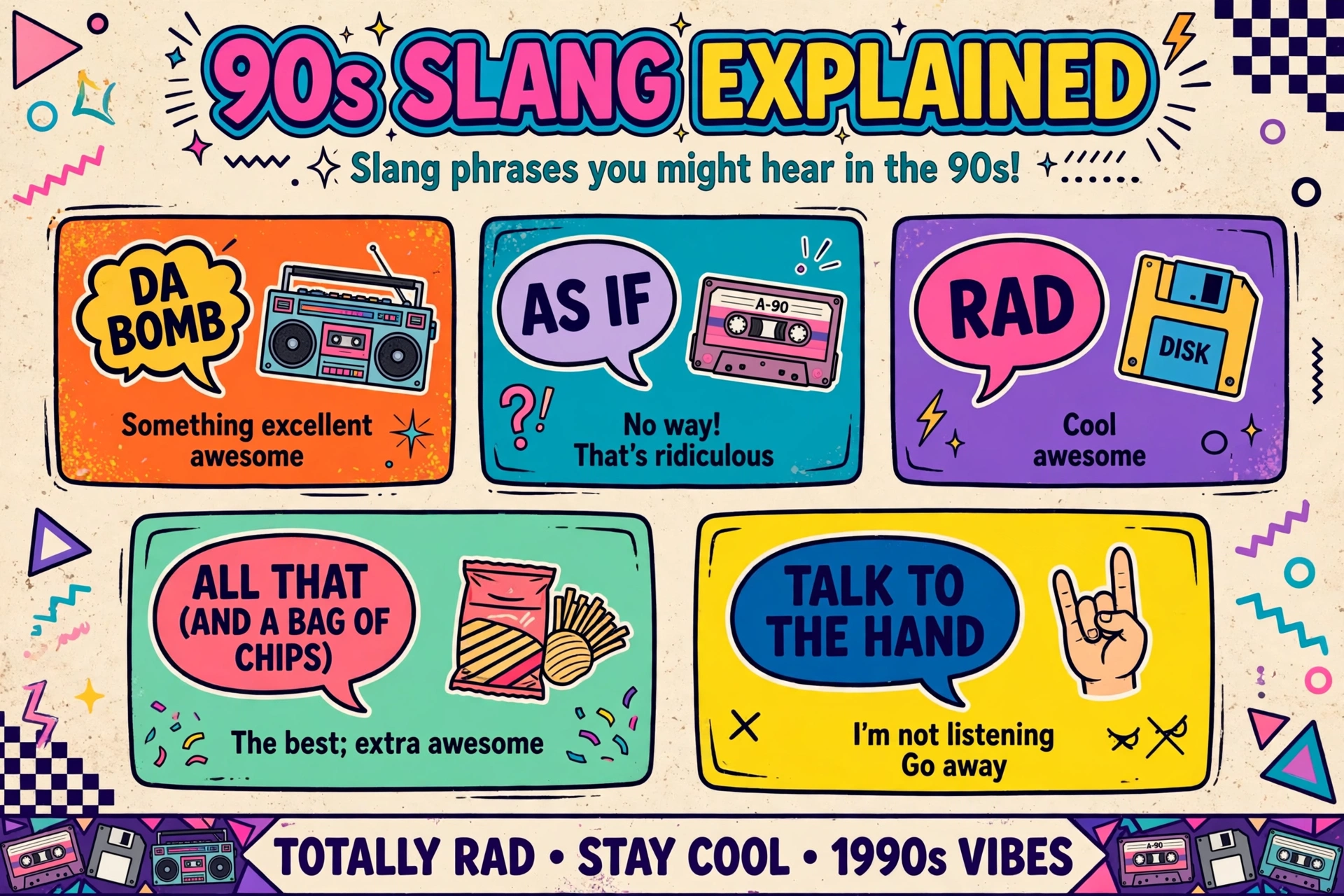
What makes 90s slang special is how visual and attitude-driven it was. Many phrases were not just words — they were gestures. “Talk to the hand” came with a palm in your face. “As if!” came with an eye roll perfected by Alicia Silverstone in Clueless. “Whatever” came with a dismissive hand wave. The language and the body language arrived as a package deal.
Introduction
Picture this: it is 1995, you just got home from school, and you flip on the TV. A character on screen says something is “phat,” your older cousin calls a new song “da bomb,” and your friend tells you her crush is “all that and a bag of chips.” You understood every word — not because someone explained them, but because they were simply in the air.
That is the magic of 90s slang. It was everywhere, and it belonged to everyone. Kids in New York, Los Angeles, Chicago, and small towns in between all spoke a version of it, even if the local flavor changed a little from city to city. Regional twists existed — New York slang had its own edge — but the big national phrases crossed every state line.
Today, 90s slang is back. Gen Z creators on TikTok and Instagram Reels are reviving words like “slay” (which actually started in 90s ballroom culture), “no cap,” and “da bomb” with a wink of irony and a dose of nostalgia. Millennials use these words to signal shared memories, and younger users adopt them because they sound fun, punchy, and refreshingly offline in an era of algorithm-driven language.
In this guide, you will get the full picture: what 90s slang means, where it came from, the 50+ most iconic words and phrases with real examples, how it compares to modern slang, the mistakes people make when using it, and answers to the questions everyone asks about it.
Origin
90s slang did not appear out of nowhere. It grew out of several overlapping cultural forces that all peaked at the same time:
- Hip-hop goes mainstream. By the early 90s, rap was no longer a niche genre — it was the sound of pop culture. Artists like Tupac, The Notorious B.I.G., Snoop Dogg, and TLC put street vocabulary into songs that topped the charts, and suburban kids repeated the lyrics word for word.
- Teen movies and sitcoms. Clueless (1995) alone gave us “as if,” “whatever,” and “totally buggin’.” The Fresh Prince of Bel-Air, Saved by the Bell, Friends, and Seinfeld turned catchphrases into national habits.
- Skate, surf, and mall culture. Words like “rad,” “gnarly,” “dude,” and “awesome” carried over from 80s surf and skate scenes and got a 90s polish.
- African American Vernacular English (AAVE). A huge share of 90s slang — “homie,” “crib,” “dope,” “fly,” “diss” — originated in Black communities and spread through music, comedy, and film. Respecting that origin matters: these words have a history, and using them with awareness beats using them as empty punchlines.
- The pre-internet grapevine. Without social media, slang traveled through mixtapes, magazines like Word Up! and Teen Beat, and word of mouth. A phrase had to be catchy enough to survive the journey — which is why the ones we remember are so memorable.
The result was a decade-long vocabulary boom. Some words burned out fast (does anyone still say “cowabunga” unironically?). Others stuck around so long that people forget they started in the 90s at all — “dude,” “cool,” and “awesome” never really left.
Popularity
Why is 90s slang trending again in 2026? Three reasons stand out:
- Nostalgia is a content engine. “90s kids” content — throwback playlists, retro fashion hauls, old sitcom clips — dominates TikTok and Reels. Slang is the fastest way to signal “I was there” or “I wish I was there.”
- It sounds confident. 90s phrases are short, punchy, and attitude-packed. “As if!” lands harder than a paragraph of explanation, and “talk to the hand” ends an argument with style.
- It is endlessly remixable. Creators pair old phrases with new contexts — a “da bomb” caption on a skincare routine, an “all that” comment on a fit check. The irony is the point, and the joke works precisely because everyone recognizes the reference.
Search interest backs this up: people constantly look up the meanings of individual 90s phrases they hear in songs, shows, and memes, and list-style guides to the decade’s vocabulary remain some of the most-shared nostalgia content online.
How It Is Used
90s slang works in a few distinct ways, depending on the word:
- As praise: “da bomb,” “dope,” “fly,” “phat,” “all that” — all ways to say something is excellent.
- As dismissal: “whatever,” “as if,” “talk to the hand,” “get outta here” — ways to shut down a statement or a person.
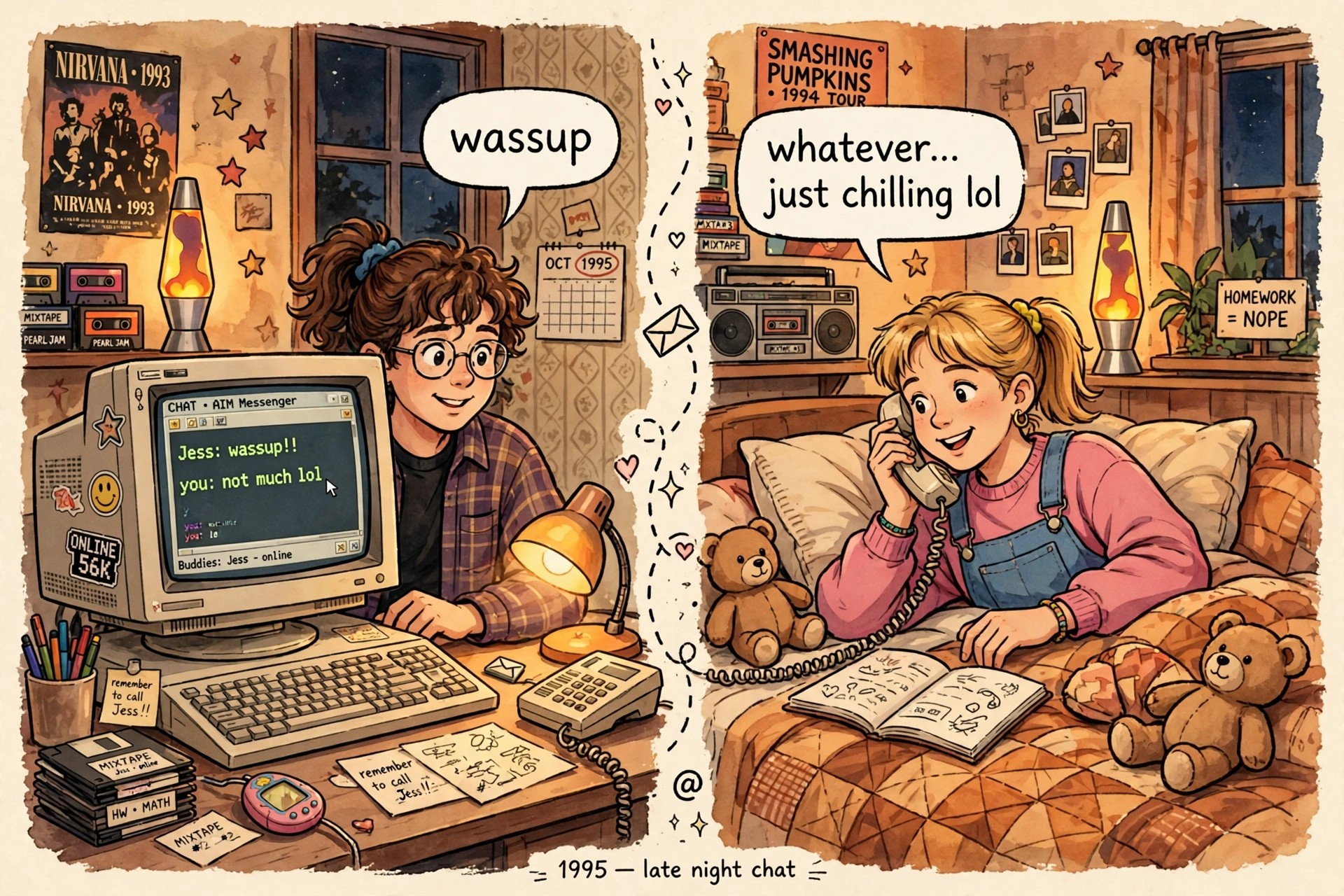
- As greeting and bonding: “what’s up,” “sup,” “homie,” “wassup” — casual ways to open a conversation and signal closeness.
- As intensifiers: “totally,” “hella,” “way,” “mad” (“mad cool”) — words that turn the volume up on whatever follows.
- As identity markers: calling your house your “crib” or your friend your “dawg” told people which scene you belonged to.
The golden rule of using 90s slang today: context is everything. Dropping “da bomb” into a nostalgic caption or a joke among friends is fun. Using it in a job interview or a formal email is not. Slang is a spice, not the main course — a little goes a long way.
Examples
Here are the most iconic 90s slang words and phrases, grouped by the tone they carry. Each one comes with a real-world example so you can see exactly how it sounded back then — and how it sounds now.
Friendly Examples
- What’s up / Wassup — the default greeting. “Wassup, homie? Long time no see!”
- Homie — a close friend. “That’s my homie since middle school.”
- Dawg — another word for a friend, popularized by hip-hop. “You got this, dawg.”
- Dude — a casual address for anyone. “Dude, you have to see this movie.”
- Chill / Chill out — relax, or a person who is easygoing. “He’s so chill about everything.” / “Chill out, it’s just a game.”
- Rad — cool, awesome. “That skateboard trick was totally rad.”
- Awesome — great, impressive. “We got front-row tickets — awesome!”
- Sweet — cool, nice. “You passed your driving test? Sweet!”
- No worries — it’s fine, don’t stress. “You forgot my book? No worries.”
- My bad — my mistake, sorry. “I ate your fries — my bad.”
Professional Examples
Yes, some 90s slang crossed into workplaces and polite conversation — usually the softer, less street-coded words:
- Cool — acceptable, fine, impressive. “Cool, let’s go with that plan.”
- No problem — happy to help. “Thanks for covering my shift.” “No problem.”
- What’s the deal? — what’s going on? (Thanks, Seinfeld.) “What’s the deal with the new schedule?”
- Cut to the chase — get to the point. “Let’s cut to the chase: the launch date moved.”
- Props — respect, credit. “Props to the design team for this one.”
- Word — I agree, understood. “Meeting moved to Friday.” “Word.”
Funny Examples
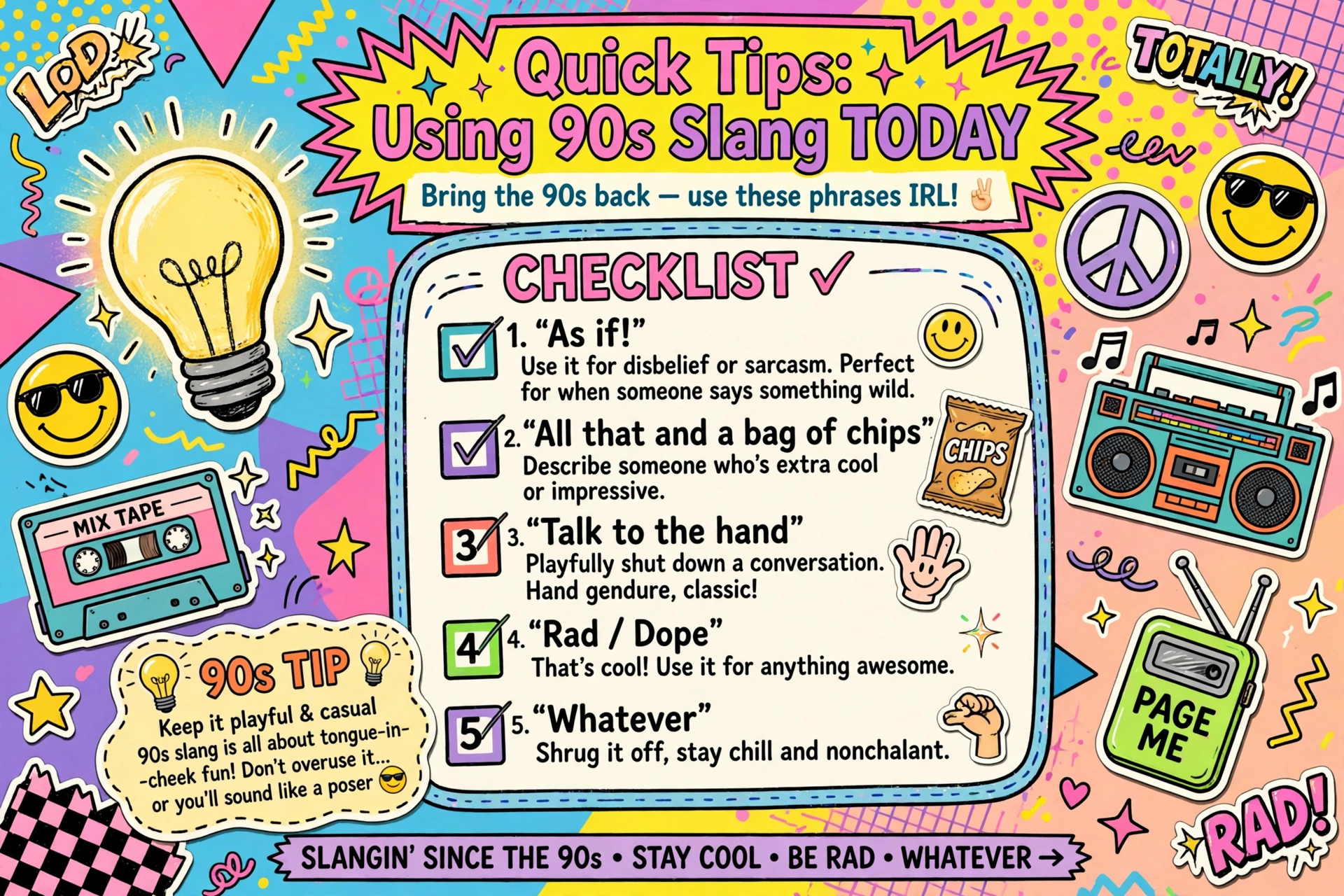
- As if! — no way, absolutely not. “You think I’m wearing that to prom? As if!”
- Talk to the hand — I am done listening to you. “You want me to do your homework? Talk to the hand.”
- Whatever — I don’t care, end of discussion. “Fine, wear the hat. Whatever.”
- Da bomb — the best, amazing. “This pizza is da bomb.”
- All that and a bag of chips — someone who thinks they are amazing (or actually is). “She walked in like she was all that and a bag of chips.”
- Totally buggin’ — overreacting, freaking out. “You’re totally buggin’ over one text.”
- Psych! — just kidding, got you. “I got you the new console… psych! It’s socks.”
- Booyah! — a triumphant exclamation. “Booyah! I passed the final.”
- Duh — obviously. “Is water wet? Duh.”
- Get outta here — no way, I don’t believe you. “You met the band? Get outta here!”
And the list goes on. Here is a quick-reference table of more classics:
| 90s Slang Word | Meaning | Example |
|---|---|---|
| Phat | Excellent, attractive, cool | “That beat is phat.” |
| Dope | Really good | “Those sneakers are dope.” |
| Fly | Stylish, attractive | “She’s looking fly tonight.” |
| Crib | Your house or apartment | “Come chill at my crib.” |
| Hella | Very, a lot (West Coast) | “That concert was hella fun.” |
| Scrilla / Cheddar | Money | “He’s stacking scrilla.” |
| Diss | To disrespect or insult | “Don’t diss my playlist.” |
| Bling / Bling-bling | Flashy jewelry or style | “Check out the bling on that chain.” |
| Bounce | To leave | “This party’s dead — let’s bounce.” |
| Kick it | To hang out | “Let’s kick it this weekend.” |
| Peep this | Look at this | “Peep this new track.” |
| Straight up | Honestly, truly | “Straight up, that was the best show ever.” |
| Fresh | New, stylish, cool | “Fresh kicks, man.” |
| Wack | Bad, lame, disappointing | “That movie was wack.” |
| Poser | Someone faking a lifestyle | “He’s just a poser with that board.” |
Comparison with Similar Terms
Slang changes every decade, but the jobs it does stay the same. Every generation needs a word for “cool,” a word for “friend,” a word for “leave,” and a word for “I don’t care.” Here is how 90s slang stacks up against the slang of the 2000s and today:
| Meaning | 90s Slang | 2000s Slang | Gen Z / Today |
|---|---|---|---|
| Cool / awesome | Da bomb, dope, phat | Sick, tight | Fire, lit, slaps |
| Friend | Homie, dawg | Bro, dude | Bestie, fam |
| Leave | Bounce, peace out | I’m out, ghost | I’m gonna head out, dip |
| I don’t care | Whatever, talk to the hand | Meh, whatevs | Idc, it’s giving nothing |
| Very / a lot | Hella, mad | Super, mad | Lowkey, highkey, so |
| Impressive style | Fly, fresh | Swag | Drip, slay |
| Money | Scrilla, cheddar, dough | Bread, paper | Bread, bag |
| Just kidding | Psych!, not! | JK, sike | JK, /j, sike |
Notice the pattern: the words change, but the attitude survives. Modern terms like “slay” and “no cap” actually trace back to 90s ballroom and hip-hop culture, which is why the revival feels less like a copy and more like a homecoming. If you want to see how slang keeps evolving, compare this with newer terms — for example, tweaking started as a 90s street word and picked up a totally different meaning online, and OP shows how internet culture builds its own shorthand the same way the 90s did.

Alternate Meanings
Most 90s slang has one clear meaning, but a few words carry alternate senses that trip people up:
- “Dope” as a noun originally referred to drugs, while “dope” as an adjective meant cool. Context tells you which one is meant — “that track is dope” is praise, not a confession.
- “Fly” as a verb (“let’s fly”) means to leave quickly, while “fly” as an adjective means stylish. “She’s fly” and “we gotta fly” are two different sentences.
- “Bomb” vs. “da bomb” — “the bomb” is a compliment; “bombed” (as in a movie bombing) means failed badly. Adding “da” flips the meaning entirely.
- “Bad” meaning good — “that’s bad!” could be praise in 90s slang (“bad” as in tough, impressive), a usage that goes back further to jazz slang. Tone and context make it clear.
- “Wicked” as an intensifier — in East Coast 90s slang, “wicked cool” meant very cool, not evil. It survives today in New England speech.
Professional or Polite Alternatives
If you love the energy of 90s slang but need to sound professional, here is how to translate the attitude without the slang:
| 90s Slang | Polite / Professional Alternative |
|---|---|
| Da bomb / dope | Excellent, outstanding, impressive |
| Whatever | That’s fine, let’s move on |
| Talk to the hand | I’d rather not discuss this further |
| My bad | My apologies, my mistake |
| Wassup | Hello, how are you? |
| No worries | You’re welcome, no problem at all |
| Bounce | I’ll head out, I need to leave |
| Props | Credit, recognition, well done |
The trick is keeping the warmth and confidence while dropping the words that would sound out of place in a meeting. “My bad” and “no worries” actually made the jump into professional English and are safe almost everywhere today.
Common Mistakes
People get 90s slang wrong in predictable ways. Avoid these:
- Using every word at once. A sentence stuffed with “da bomb,” “phat,” “fly,” and “hella” does not sound 90s — it sounds like a costume. Pick one phrase and let it land.
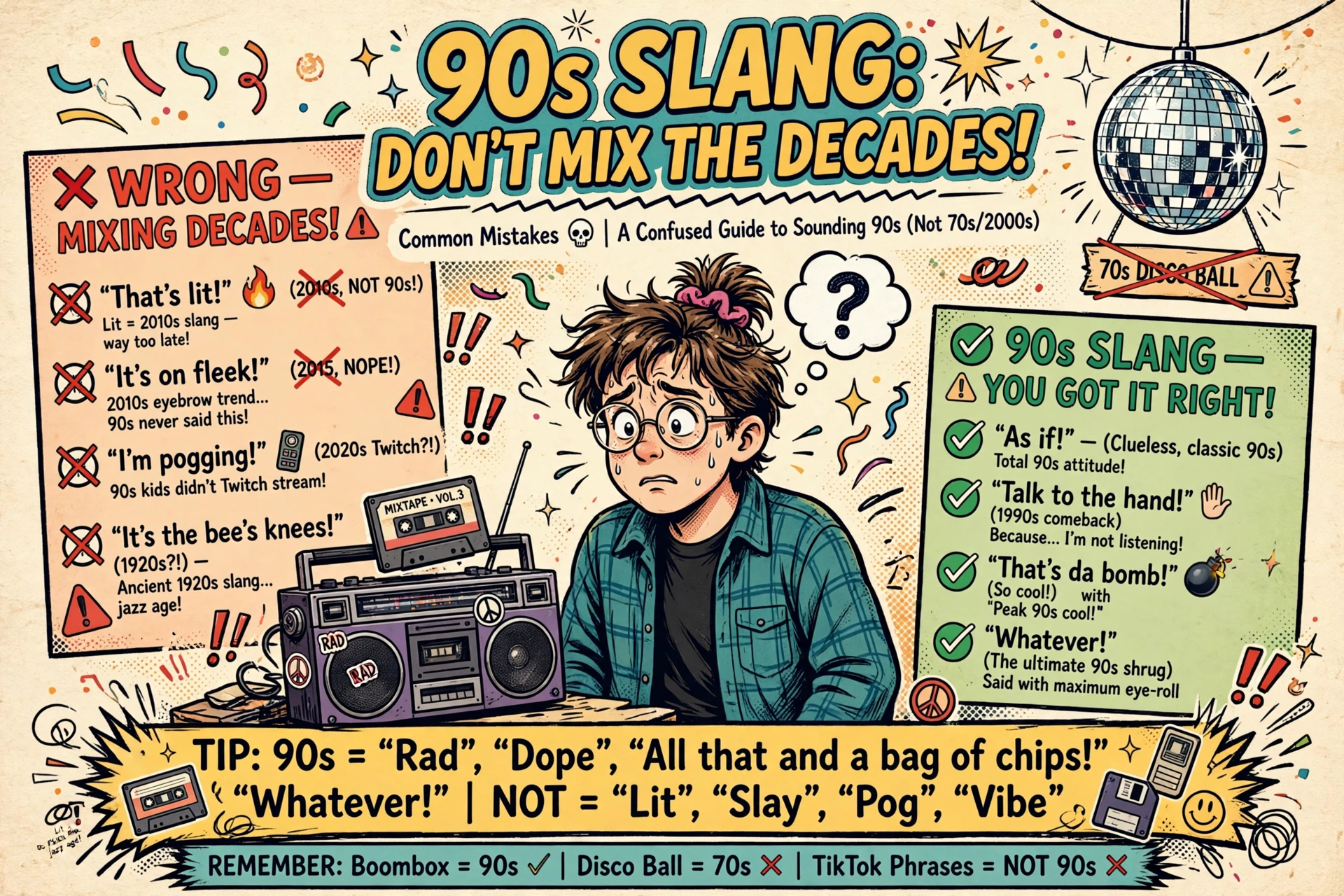
- Getting the decade wrong. “Groovy” is 60s/70s, “tubular” is 80s, “on fleek” is 2010s. Mixing decades breaks the nostalgic spell.
- Using AAVE-origin words as empty jokes. Words like “homie” and “dawg” come from Black culture. Using them respectfully and naturally is fine; using them to mock an accent or stereotype is not.
- Forgetting the gesture. “Talk to the hand” without the hand is only half the joke — and “as if” without the eye roll loses its punch.
- Forcing it in formal settings. Slang signals closeness and informality. In a cover letter or a condolence note, it signals the opposite of what you want.
- Confusing “phat” with “fat.” They are pronounced similarly but spelled differently — and the meanings are worlds apart. One is a compliment; the other, in this context, is an insult.
- Over-explaining the joke. Saying “that’s da bomb — which is 90s slang for great” kills the humor. Trust your audience to get it, or pick a clearer word.
Quick Tips
- Start with the safe classics: “cool,” “awesome,” “my bad,” and “no worries” work in almost any casual setting, even today.
- Match the moment: use praise words (“da bomb,” “dope”) for genuine excitement, and dismissal words (“whatever,” “as if”) only with people who know you are joking.
- Pair words with the right media: 90s slang shines in captions, throwback posts, themed parties, and retro playlists — contexts where nostalgia is the whole point.
- Learn one phrase’s story: knowing that “as if” comes from Clueless or that “bling” comes from hip-hop makes your use of it smarter and more fun.
- Watch modern revivals: if a 90s word pops up on TikTok, check how creators are using it now — meanings drift, and the current usage is what your audience will recognize. (A good example: YKD shows how short slang keeps getting reinvented for texting.)
- Keep it natural: if a phrase feels forced coming out of your mouth, skip it. The best slang sounds effortless.

FAQ
What is 90s slang?
90s slang is the informal vocabulary popular in the United States during the 1990s — words like “da bomb,” “as if,” “homie,” and “whatever” that came from hip-hop, teen movies, sitcoms, and skate culture.
What are the most popular 90s slang words?
The most iconic ones are “da bomb,” “as if,” “whatever,” “talk to the hand,” “dope,” “phat,” “homie,” “rad,” “all that,” “chill,” “wassup,” and “psych!” — most of them are still recognized instantly today.
What does “da bomb” mean in 90s slang?
“Da bomb” means the best, amazing, or excellent. “This song is da bomb” means the song is fantastic. It is a compliment, not a reference to explosives.
What does “as if” mean?
“As if” means “no way” or “absolutely not,” usually said with sarcasm. It became famous through the 1995 movie Clueless, where Cher Horowitz used it to reject ideas she found ridiculous.
Is 90s slang coming back?
Yes. TikTok, Instagram Reels, and nostalgia content have revived many 90s phrases, often used ironically by Gen Z and fondly by millennials. Words like “slay” and “no cap” also trace their roots back to 90s culture.
What is the difference between 90s slang and 2000s slang?
90s slang leaned on hip-hop, sitcoms, and surf/skate culture (“dope,” “phat,” “homie”), while 2000s slang leaned on early internet and reality TV (“sick,” “swag,” “bro”). The attitude is similar, but the vocabulary and the media that spread it changed.
Can I use 90s slang at work?
Some of it, yes — “cool,” “no worries,” “my bad,” and “props” are widely accepted in casual workplaces. Stronger slang like “da bomb” or “talk to the hand” is best saved for friends, captions, and informal chats.
Where did 90s slang come from?
It came from many places at once: African American Vernacular English, hip-hop lyrics, teen movies like Clueless, sitcoms like Friends and Seinfeld, and skate/surf culture. No single source owns it — it was a true pop-culture mix.
Conclusion
90s slang is more than a list of funny old words — it is a time capsule of a decade when music, movies, and TV all spoke the same playful language. Words like “da bomb,” “as if,” and “whatever” survived because they were short, vivid, and full of attitude, and their comeback proves that great slang never really dies — it just waits for its next moment.
Use this guide as your cheat sheet: start with the safe classics, save the bold phrases for the right moment, respect where the words came from, and do not be afraid to have fun with them. Whether you are writing a throwback caption, planning a 90s-themed party, or just trying to understand what your favorite old movie meant, you now have the vocabulary to talk the talk.
And if someone asks where you learned all this? Just smile and say: “As if I’d tell you… psych! Bookmark this guide — it is da bomb.” For a deeper dive into how slang itself is defined and how it evolves, the Merriam-Webster dictionary entry for slang is a great authoritative reference.

3 thoughts on “90s Slang: 50+ Iconic Words, Meanings, and How to Use Them Today”