
Quick definition: Based meaning slang is internet shorthand for someone who is unapologetically themselves — confident, authentic, and unafraid of what anyone thinks. When people say “that’s based,” they are giving one of the internet’s highest compliments: they are praising you for standing by your beliefs, speaking your mind, or doing something bold without caring about approval.
Based Meaning Slang — Meaning & Definition
If you have been searching for the based meaning slang definition, here is the simplest way to think about it: calling someone “based” is like giving them a digital medal for authenticity. It describes a person, opinion, or action that is grounded in genuine conviction — bold, principled, and free from the fear of other people’s opinions. A friend who refuses to laugh at a cruel joke, a creator who posts what they truly think instead of what gets likes, a stranger who calmly defends an unpopular opinion in a heated comment section — the internet would call all of them based.
Merriam-Webster defines based as being “used approvingly to describe someone who projects a lack of concern about how others feel about their actions or opinions,” noting that it can also describe something “bold and commendable, especially if it challenges or flouts convention.” Rapper Lil B, the man who gave the word its modern meaning, put it even more simply: “Based means being yourself. Not being scared of what people think about you. Not being afraid to do what you wanna do. Being positive.”
The word works as both an adjective and a one-word reply. As an adjective: “That’s such a based take.” As a standalone reply: someone posts a bold opinion and the top comment is simply “based.” In both forms, the tone is overwhelmingly positive — though, like most internet slang, it can be used ironically, which we will cover in the examples section below.
What makes based different from a generic compliment like “cool” or “awesome” is the specific quality it praises. You don’t call a sunset based or a sandwich based (well, some people might as a joke). You call a person based when they show moral backbone, independent thinking, or the courage to be different. It is praise with substance behind it — and that is exactly why the word has survived more than a decade of internet trend cycles.
Introduction
Picture this: you post an opinion online that you know is unpopular. You brace for the pile-on. Instead, the first reply simply says: “based.” No argument, no debate — just a single word that means “I respect that.” You have just received one of the internet’s most powerful compliments, and chances are you had no idea what it meant at first.
That is the strange double life of based. In some corners of the internet, it is the ultimate badge of honor — the word people use when someone shows genuine courage and authenticity. In other corners, it has been wrapped up in political memes, inside jokes, and layers of irony so thick that newcomers cannot tell when it is sincere. If you are confused about whether being called “based” is a good thing, you are asking the right question at the right time.
This complete guide breaks down everything about based meaning slang: the quick definition, the wild origin story (it starts with 1980s drug culture and a Berkeley rapper who turned an insult into a philosophy), why it exploded across Reddit, TikTok, and X, and — most importantly — how to use it correctly without accidentally sounding like a meme-lord from 2016. By the end, you will not only understand the word, you will understand the entire culture that made it matter. And if you enjoy decoding internet slang, you will love our sigma meaning slang guide too — sigma is one of based’s closest cousins in the compliment family.

Origin
The origin of based is one of the most fascinating stories in internet slang — because the word started as an insult about drugs, got reclaimed by a rapper, was stolen by political trolls, and then went fully mainstream. Here is the real timeline:
1970s–1980s: From “Basehead” to “Based”
Long before TikTok, “based” was street slang with a dark meaning. It came from “basehead” — a term for someone addicted to freebasing cocaine, a method of smoking the drug that swept the United States during the crack epidemic of the 1980s. Calling someone a basehead meant they were strung out or acting erratically. Over time, “based” became shorthand for acting strange or eccentric, whether or not drugs were involved. It was not a compliment — it was a way of saying someone was out of their mind.
2007–2011: Lil B Reclaims the Word
The modern meaning of based was born when Berkeley rapper Lil B (Brandon McCartney) decided to take the insult and flip it. His hip-hop group The Pack released an album titled Based Boys in 2007, and Lil B began calling himself “The BasedGod.” In a now-famous 2010 interview with Complex magazine, he explained his philosophy:
“Based means being yourself. Not being scared of what people think about you. Not being afraid to do what you wanna do. Being positive. When I was younger, based was a negative term that meant like dopehead, or basehead. People used to make fun of me… And what I did was turn that negative into a positive. I started embracing it like, ‘Yeah, I’m based.’ I made it mine.”
Lil B’s fans — especially on forums like 4chan — ran with the concept. They coined “TYBG” (“Thank You BasedGod”) as a catchphrase, built an entire ironic mythology around the BasedGod, and spread the word across gaming and meme communities. For Lil B’s supporters, being based meant rejecting negativity, embracing your quirks, and staying positive — a genuinely uplifting philosophy that had nothing to do with its drug-culture origins.
2014–2016: The Political Detour
Around 2014, during the Gamergate controversy over video game culture, online political communities — including the alt-right — began appropriating based as praise for anti-establishment or anti-“politically correct” stances. Conservative commentator Christina Hoff Sommers was nicknamed “Based Mom” for pushing back against criticism of gamer culture. The word became shorthand in right-wing forums for anyone who agreed with the group’s worldview, and phrases like “based and redpilled” entered the online vocabulary.
Lil B himself publicly objected to this hijacking. The political usage gave based a controversial edge it never had in Lil B’s original philosophy — and it is the reason some people still hesitate when they hear the word today.
2017–Today: Mainstream Comeback
By the late 2010s and into the 2020s, based shed most of its political baggage and returned to something close to Lil B’s original meaning: a sincere compliment for authenticity and courage. It spread across Reddit, X (formerly Twitter), Discord, and TikTok, where Gen Z uses it as casual praise. By 2025, Merriam-Webster had added a dedicated slang definition, cementing based as an official part of English. Today, calling something “based” is overwhelmingly positive — a word that survived a wild journey from street insult to internet gold.
Popularity
Based is one of the rare slang terms that has stayed relevant for over a decade — most internet words burn out in a year or two. Its staying power comes from usefulness: there is no single English word that quite captures “I admire your courage and authenticity,” so based filled a real gap in online communication.
On Reddit, “based” appears in comments across thousands of communities, from sports and gaming to philosophy and news. On X, it is a standard reply to bold posts — one word that signals respect without starting a debate. On TikTok, creators use it in captions and comment sections to praise authentic behavior, and it regularly trends alongside other internet compliments. Discord servers dedicated to gaming, music, and debate use it so often that some communities have based-themed emojis and reactions.
The word’s journey into dictionaries marks its peak mainstream moment. Merriam-Webster, Dictionary.com, and Wiktionary all now document the slang meaning, and mainstream media outlets regularly use it when describing internet culture. Unlike flash-in-the-pan slang, based has become infrastructure — a permanent part of how the internet expresses respect. Its popularity shows no sign of fading, because the thing it praises — genuine, unbothered authenticity — never goes out of style.
How It Is Used
Based is a flexible word, and it shows up in several common patterns. Understanding these patterns is the key to using it naturally:
- As an adjective describing a person: “He’s so based for saying that.” This is the most common use — praising someone’s character or confidence.
- As an adjective describing an opinion or action: “That’s a based take” or “Honestly, based behavior.” Here it praises the content, not the person.
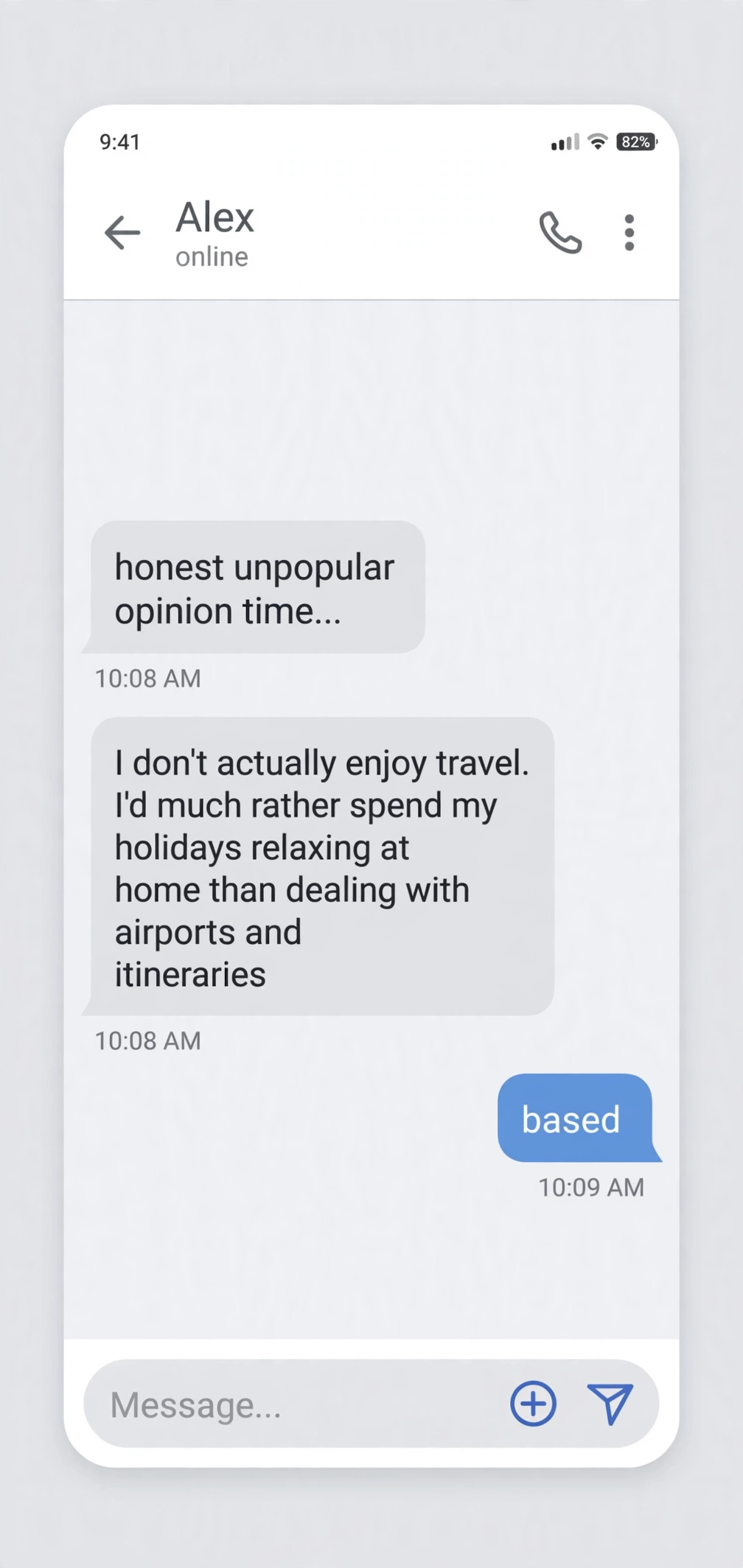
- As a one-word reply: Someone posts a bold opinion; the reply is simply “based.” This is internet shorthand for “I agree and I respect that.”
- In the “based and [X]” formula: “Based and honest,” “based and true,” “based and redpilled.” The second word specifies what kind of based you mean — use this one carefully, since “based and redpilled” carries political baggage.
- With intensifiers: “That’s so based,” “extremely based,” “based af” (casual contexts only). These add emphasis for extra-strong praise.
- Ironically or sarcastically: “Oh wow, so based” under a post everyone disagrees with. The irony works because everyone knows the sincere meaning — read the room before trying this.
Tone matters enormously. Sincere based is warm and admiring. Ironic based is playful mockery. The two look identical in text, so context is everything — check the surrounding conversation before deciding which one you are reading. A good rule of thumb: if the post is genuinely courageous and the reply says “based,” it is almost always sincere.
Examples
Theory is nice, but slang lives in real conversations. Here are real-world style examples of based meaning slang in action across different contexts:
Friendly Examples
These are the warm, everyday uses — based as a genuine compliment between friends:
- Text chat: “I finally told my boss I need a raise.” → “That’s so based. Proud of you.”
- Group chat: “Nah I’m not going to the party, I need sleep.” → “Honestly based. Rest is important.”
- Comment section: “Unpopular opinion: pineapple doesn’t belong on pizza and I’ll die on this hill.” → “Based.”
- Gaming lobby: “I’ll take the support role so the team wins.” → “Based teammate right here.”
- Real life: Your friend refuses to gossip about a classmate and changes the subject. You tell them later: “That was really based of you.”
Professional Examples
Based is informal, so it rarely belongs in a boardroom — but it does appear in casual professional settings like Slack, startup culture, and creative industries:
- Slack message: “I pushed back on the client’s timeline because the team was burning out.” → “Based call, honestly.”
- Team standup: “I’m going to admit I broke the build so we can fix it faster.” → “Based. Owning mistakes is how we improve.”
- Networking event: “I turned down the higher-paying offer because the other company’s values fit me better.” → “That’s such a based decision.”
- Creative review: “I know it’s risky, but I want to keep the weird ending — it’s the honest one.” → “Based. The safe version would be forgettable.”
Warning: only use based at work with colleagues who know internet slang. With a traditional boss or a client, swap it for “principled,” “courageous,” or “admirable” (see the alternatives section below).
Funny Examples
The internet loves using based for gloriously unserious things — the joke is that the praise is wildly over the top:
- “I ate the entire pizza by myself and I regret nothing.” → “Based.”
- “My grandma just said ‘slay’ correctly in a sentence.” → “Your grandma is so based.”
- “I told the Wi-Fi router to ‘try harder’ and it actually started working.” → “Based router.”
- “Nap at 3pm. Gym at 5pm. No thoughts, just vibes.” → “Based schedule.”
- “I named my houseplant ‘Kevin’ and apologize to him when I forget to water him.” → “Honestly? Based.”
The humor works because based carries real weight — applying it to a houseplant named Kevin is funny precisely because the word usually means something serious.
Comparison with Similar Terms
Based belongs to a family of internet words that judge people and opinions. Here is how it stacks up against the most similar slang terms:
| Term | What It Means | Tone | Example |
|---|---|---|---|
| Based | Praise for being authentic, confident, and unbothered by others’ opinions | Positive, admiring | “She spoke her mind — so based.” |
| Cringe | The exact opposite of based — embarrassing, try-hard, or painfully awkward behavior | Negative, mocking | “He was begging for likes. Total cringe.” |
| Redpilled | Claiming to see a hidden truth others miss (from The Matrix); often political | Varies — can be praise or criticism depending on the group | “He’s been redpilled on the whole industry.” |
| Sigma | A lone-wolf archetype — independent, self-reliant, outside social hierarchies | Positive but often ironic/meme-y | “Sigma grindset: working alone at 3am.” |
| Woke | Originally: alert to social injustice. Now often used sarcastically to mock performative activism | Originally positive; often sarcastic now | “That ad was so woke it hurt.” |
The key distinction: based praises authenticity, cringe punishes inauthenticity. They are mirror images. Redpilled is about beliefs (what you think), while based is about character (how bravely you stand by it). Sigma overlaps with based — both admire independence — but sigma is a whole personality archetype with meme baggage, while based is a simple compliment you can give anyone. If you want to go deeper on sigma, our sigma meaning slang guide breaks down the full lone-wolf mythology.

Alternate Meanings
Like many slang words, based has a few meanings depending on context. Here is how to tell them apart:
- “Based in” (location): “The company is based in Austin.” This is standard English — it just means headquartered or located somewhere. No slang involved.
- “Based on” (foundation): “The movie is based on a true story.” Again, standard English meaning derived from or founded upon.
- “Based department”: A meme format — “the based department called, they want their agent back.” It is a playful way of saying someone did something extremely based, as if there is an official department handing out based certifications.
- “Based on what?”: Careful — this is the standard-English phrase (“on what evidence?”), not the slang. If someone asks “based on what?” they are challenging your reasoning, not complimenting you.
- Historical “basehead” meaning: In 1980s street slang, being “based” meant acting erratic like a drug user. This meaning is essentially extinct online — but it is worth knowing so the origin story makes sense.
Quick test: if “based” can be replaced with “authentic” or “courageous” in the sentence, it is the slang meaning. If it is followed by “in” or “on,” it is standard English.
Professional or Polite Alternatives
Sometimes you want the spirit of based without the internet slang. These alternatives work in professional writing, formal emails, and conversations with people who don’t live online:
- Principled — “a principled stand” (best for moral courage)
- Authentic — “an authentic voice” (best for genuineness)
- Courageous / bold — “a bold decision” (best for bravery)
- Independent-minded — “an independent-minded thinker” (best for not following the crowd)
- Admirable — “an admirable choice” (safe, all-purpose praise)
- Commendable — “commendable honesty” (formal, great for performance reviews)
- Uncompromising — “uncompromising integrity” (strong, slightly serious)
- Genuine — “genuine and thoughtful” (warm and safe)
Example swap: instead of “That’s such a based email to the client,” write “That was a principled and honest email to the client.” Same respect, zero confusion.
Common Mistakes
Based is easy to use — but these are the mistakes people actually make:
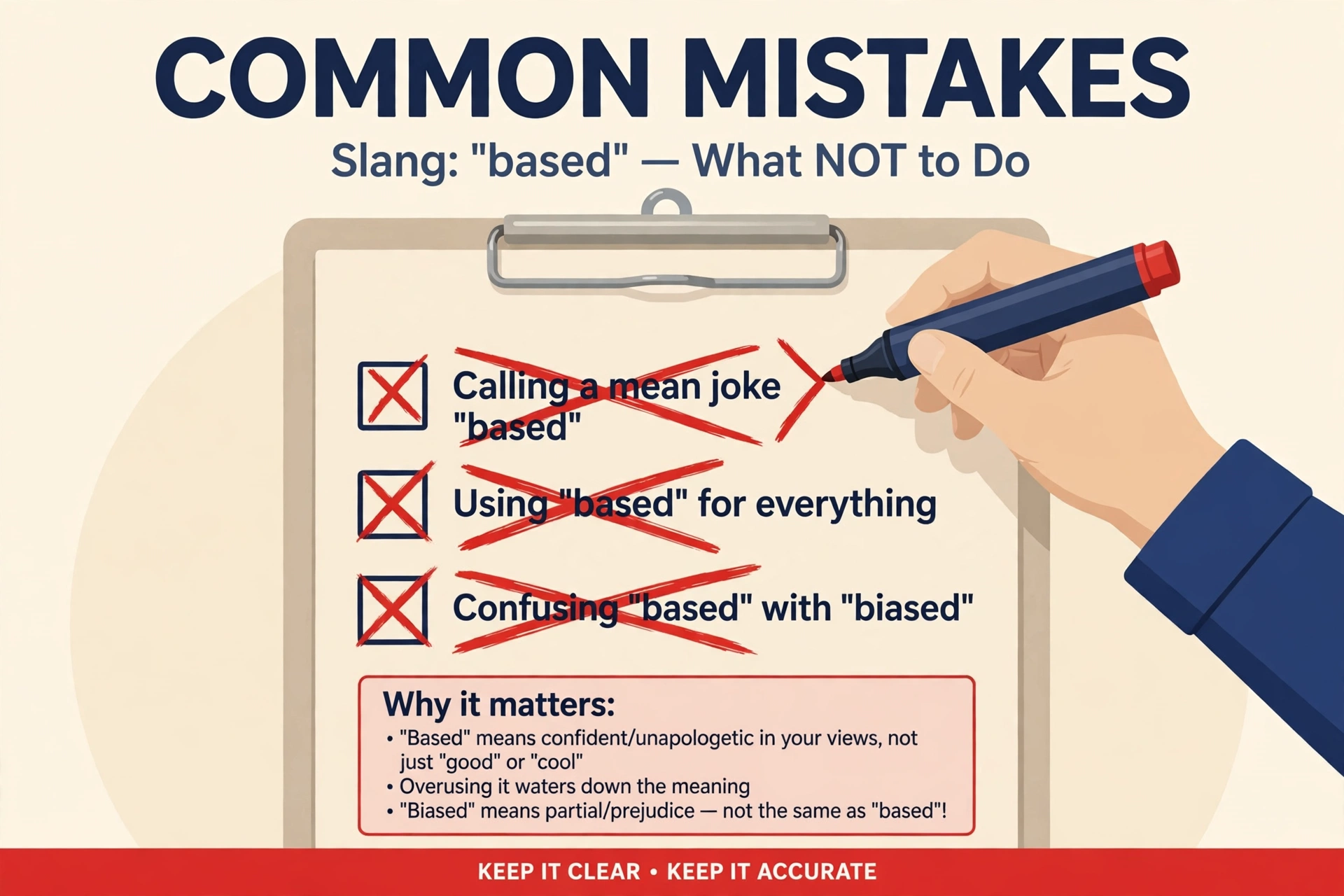
- Confusing it with “base” or “biased”: “Based” and “biased” sound nothing alike when you think about it, but fast readers mix them up. Based = authentic praise. Biased = unfair prejudice. Completely different words.
- Using it where it doesn’t fit: Don’t call objects or weather “based” unless you are joking. The word praises character and conviction — “based sandwich” is only funny because it is wrong.
- Missing the irony: The biggest beginner trap. If someone posts something obviously terrible and the replies say “based,” they are being sarcastic. Read the room before copying the usage.
- Using “based and redpilled” casually: This specific phrase carries political baggage from the word’s alt-right detour. If you just mean “authentic and honest,” say that instead — or use “based and true.”
- Dropping it in formal settings: Based is informal internet slang. Using it in a job interview, a college essay, or an email to your grandmother will confuse people. Use the professional alternatives above instead.
- Overusing it: Like any slang, based loses its power if you say it fifty times a day. Save it for moments that genuinely deserve it — that is what makes it meaningful.
- Spelling it “baised” or “bassed”: It is B-A-S-E-D. The misspellings usually come from confusing it with “biased” — which, as noted, means something entirely different.
Quick Tips
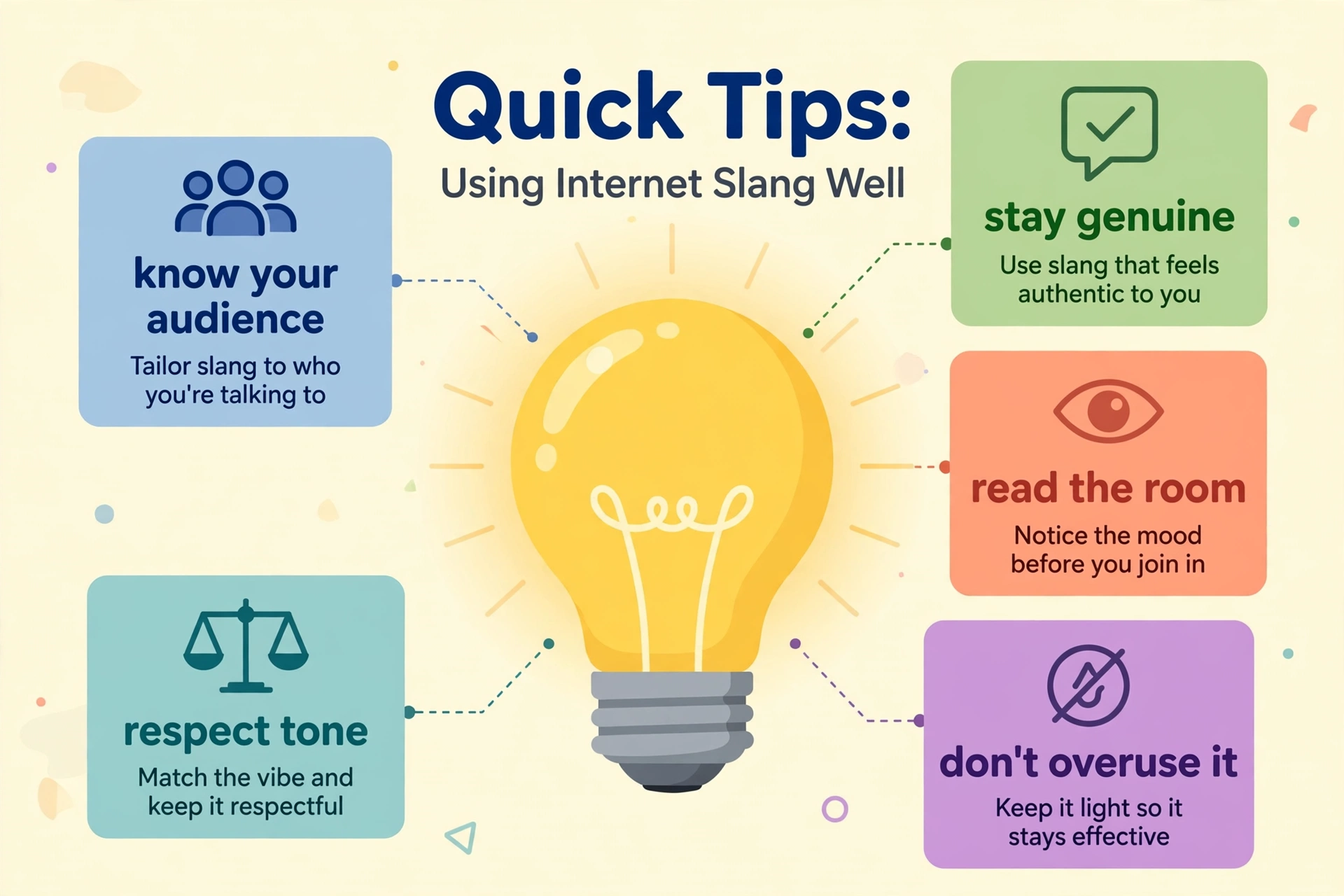
Want to use based like a native? Follow these quick rules:
- Do use it as sincere praise for courage, honesty, and authenticity — that is its core meaning.
- Do use the one-word reply “based.” in comment sections — it is the most natural form of the word.
- Do pair it with specifics: “Based for admitting the mistake” hits harder than just “based.”
- Don’t use it sarcastically until you can reliably tell when others are being sarcastic.
- Don’t use it in professional or formal writing — switch to “principled” or “admirable.”
- Don’t combine it with “redpilled” unless you understand — and intend — the political connotation.
- Remember the Lil B test: if the person is “being themselves, not scared of what people think, and being positive,” they are based.
- When in doubt, watch how it is used for a week before using it yourself. Slang is learned by observation.

FAQ
What does based mean in slang?
In slang, based means being unapologetically yourself — confident, authentic, and unbothered by other people’s opinions. It is used as praise: calling someone “based” is one of the internet’s highest compliments, reserved for people who show courage, honesty, or independent thinking.
What does “that’s based” mean?
“That’s based” means “I respect that” or “that took courage.” People say it in response to bold opinions, honest admissions, or principled actions. It is shorthand for admiring someone’s authenticity — for example, replying “that’s based” to a friend who turned down peer pressure.
Is based a compliment?
Yes — in the vast majority of cases, based is a compliment. It praises authenticity and courage. The only exception is ironic usage, where people say “based” sarcastically about something they actually disapprove of. Context tells you which one it is: sincere based appears under genuinely admirable posts, while ironic based appears under posts everyone is mocking.
Who is Lil B and why is he called the BasedGod?
Lil B is a Berkeley, California rapper who reclaimed the word “based” — originally an insult derived from “basehead,” slang for a drug addict — and turned it into a philosophy of being yourself and staying positive. His 2007 album Based Boys and his self-given nickname “The BasedGod” spread the positive meaning across the internet, especially on forums like 4chan, where fans coined the catchphrase “TYBG” (Thank You BasedGod).
Is based slang still used in 2026?
Absolutely. Based is one of the longest-lived internet slang terms, in steady use since the early 2010s across Reddit, X, TikTok, and Discord. It earned dictionary entries from Merriam-Webster and Dictionary.com, which signals it has moved from passing trend to permanent vocabulary. Unlike most slang, it survives because it fills a real gap — there is no other single word for “I admire your unbothered authenticity.”
What is the opposite of based?
The direct opposite of based is cringe — behavior that is embarrassing, try-hard, or desperate for approval. Where based praises people who don’t care what others think, cringe mocks people who care too much. The two words are mirror images, and you will often see them used together: “based vs. cringe” is a classic internet judgment scale.
Can I use based at work or in school?
Only in very casual settings with people who know internet slang — like a relaxed Slack channel or a group project chat with friends. In formal emails, presentations, essays, or conversations with authority figures, use professional alternatives like “principled,” “authentic,” “courageous,” or “admirable” instead. When in doubt, don’t use slang at work.
What does “based and redpilled” mean?
“Based and redpilled” combines two slang terms: “based” (authentic, unbothered) and “redpilled” (claiming to see a hidden truth, from The Matrix). The phrase became popular in online political communities — particularly right-wing forums — as praise for anti-establishment views. Because of that history, it carries political baggage that plain “based” does not. If you just want to praise someone’s honesty, say “based” alone.
Conclusion
Based meaning slang boils down to one of the simplest and most powerful ideas on the internet: be yourself, don’t fear judgment, stay positive. From its dark origins as 1980s street slang, through Lil B’s brilliant reclamation, past a messy political detour, and into the mainstream dictionaries of today, the word has survived because the thing it praises — genuine, unbothered authenticity — is something people will always admire.
Now you know exactly what it means, where it came from, and how to use it without embarrassing yourself. Drop a sincere “based” the next time someone shows real courage online — just make sure you mean it, save it for moments that deserve it, and keep the professional alternatives handy for the office.
Want to keep decoding the internet’s favorite words? Check out our delulu meaning guide to learn why TikTok thinks being delusional is a good thing, our glazing slang explained breakdown of the internet’s favorite over-the-top compliment, and the full Gen Alpha slang guide with 25+ terms you are guaranteed to see in your feed this week.

1 thought on “Based Meaning Slang: The Internet’s Boldest Compliment, Fully Explained (2026 Guide)”