Quick definition: The tbf meaning in text is “to be fair.” It is a short, conversational way to introduce a balanced opinion, add missing context, or soften a judgment before you say it. When someone texts “TBF,” they are about to look at both sides — even if they partly disagree with you.
TBF Meaning in Text: Meaning & Definition
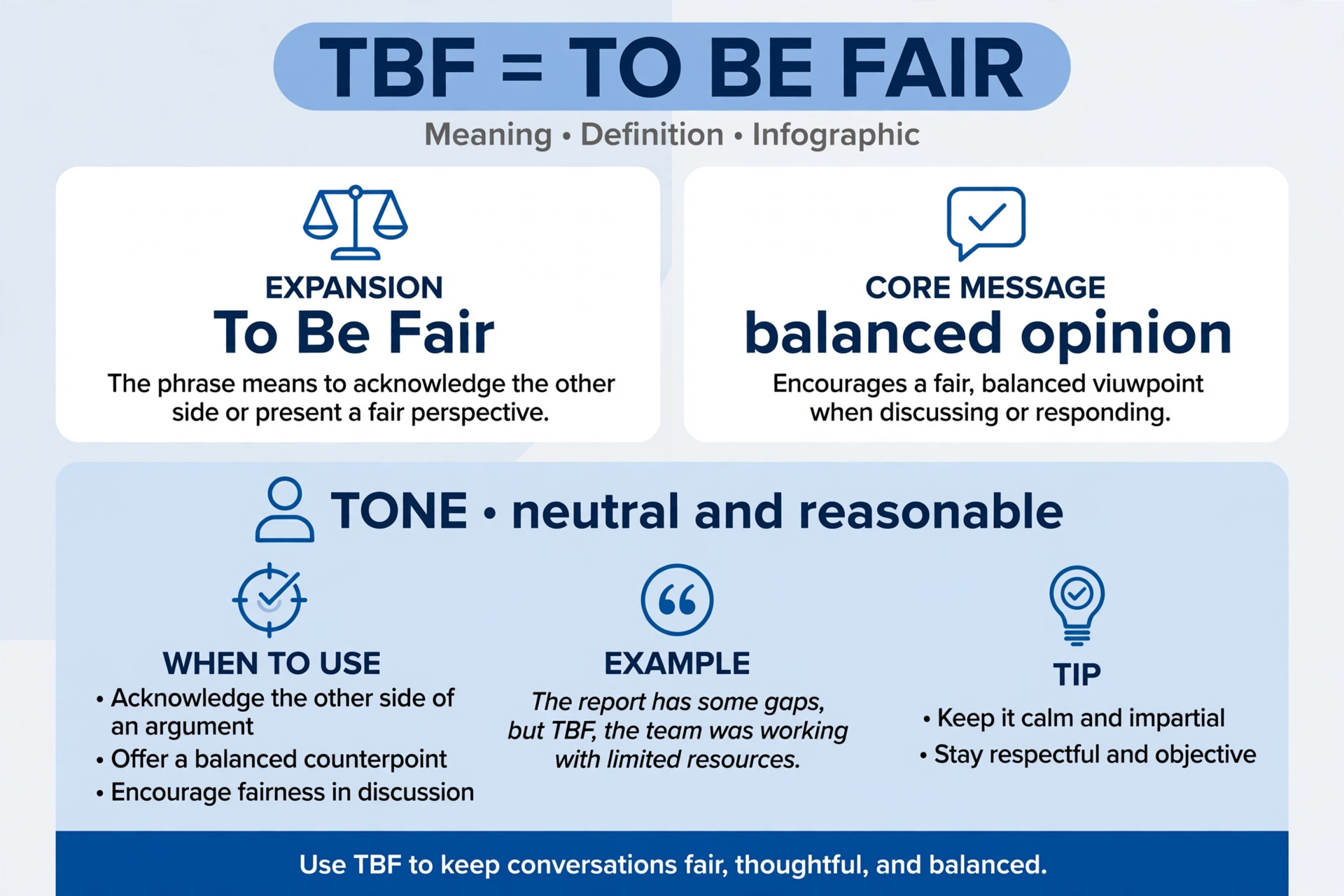
TBF is an acronym that stands for “to be fair.” In texting, it works like a fairness flag: it tells the reader that what follows is meant to be reasonable, not one-sided. It is the digital version of pausing mid-argument and saying, “Okay, but let us look at the whole picture first.”
That small pause is what makes TBF so useful. A plain opinion can sound blunt or dismissive — “The movie was boring.” Add TBF, and the same thought becomes balanced — “TBF, the movie was slow, but the ending was great.” The facts did not change, but the tone did. TBF signals that you are weighing the evidence instead of just reacting.
Here is the meaning in its simplest form:
| Element | What It Means |
|---|---|
| TBF | To Be Fair |
| Core message | I am about to give a balanced, reasonable take |
| Tone | Neutral, reasonable, mildly diplomatic |
| Where it appears | Texts, DMs, group chats, TikTok comments, Reddit, X, Discord |
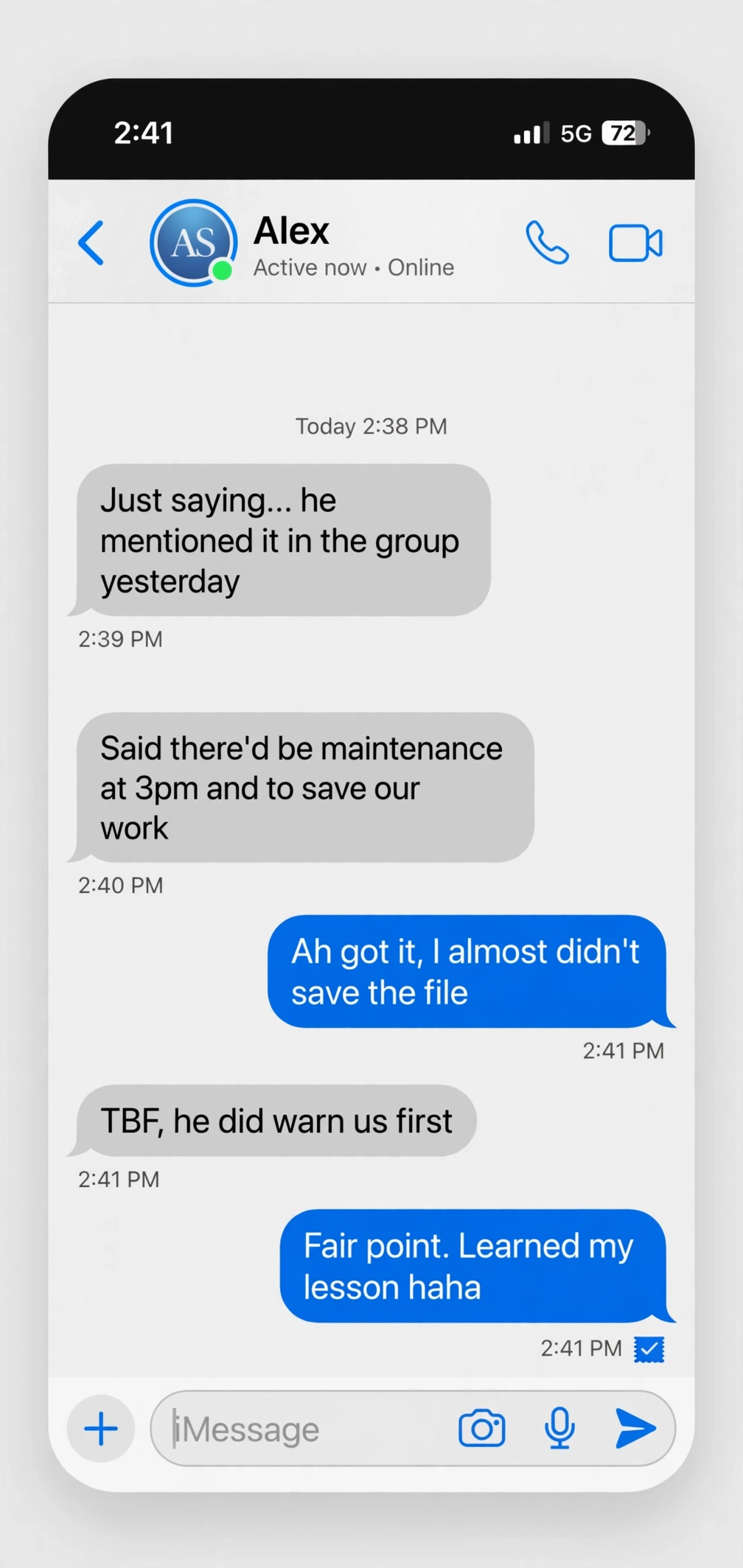
| Best paired with | A specific fact or concession, e.g. “TBF, he did warn us first” |
TBF is almost always written in capital letters, but lowercase “tbf” carries the same meaning. Capitals can feel a bit more deliberate or emphatic, while lowercase reads as relaxed or typed in a hurry. Punctuation matters too: “TBF!” sounds confident, “TBF…” can sound hesitant or passive-aggressive, and a bare “tbf” is neutral. The letters never change meaning — the context around them does.
Introduction
Picture this: you are venting in the group chat about a friend who cancelled plans, and someone replies, “TBF, she did text you twice yesterday.” Instantly, the conversation shifts. You are no longer just complaining — you are reconsidering. That tiny three-letter nudge is exactly why TBF has become one of the most common abbreviations in online conversation.
The tbf meaning in text is simple, but the way people use it is surprisingly rich. It can defend someone, soften criticism, play devil’s advocate, or admit a flaw in your own argument. It shows up in friendly chats, heated comment sections, gaming lobbies, and even careful work messages. And like all good slang, it has unwritten rules: use it to add fairness, not to disguise a dig, and always follow it with something genuinely fair.
In this guide, you will learn the full TBF meaning in text, where it came from, how it changes tone across platforms, and how to reply when someone sends it to you. You will also see plenty of real examples, a comparison with lookalike terms such as TBH and NGL, the mistakes people make with it, and polite alternatives for formal settings.
Origin
The phrase “to be fair” has been part of everyday English for centuries. People have long used it in speech to introduce a balancing thought — “To be fair, he had never done it before” — and to correct a harsh impression without sounding confrontational. The abbreviation came much later, when the internet made brevity a virtue.
TBF took off in the late 1990s and early 2000s, in internet forums, chat rooms, and early instant messaging, where typing speed mattered and character limits punished long phrases. It grew alongside its cousins TBH (“to be honest”), IMO (“in my opinion”), and NGL (“not gonna lie”) — a whole family of short openers that let people frame an opinion before delivering it.
British English played a big role in spreading it. “To be fair” is a very British conversational habit, and British users carried the abbreviation into global platforms such as Reddit, Twitter (now X), and YouTube comments. From there it spread to TikTok, Instagram, Snapchat, and WhatsApp, until it became one of those abbreviations that needs no explanation for most English-speaking internet users.
Today, TBF is no longer niche slang. Dictionary publishers list it as an abbreviation for “to be fair” in texting and social media, and it appears in everyday conversation far beyond the forums where it started. What began as a typing shortcut is now a tone tool — a way to sound reasonable in a medium where tone is easy to lose.
Popularity
TBF is popular because it solves a real problem in digital communication: text strips away tone of voice, facial expressions, and pauses, so a blunt opinion can read as ruder than intended. TBF restores a little of that missing softness. It tells the reader, “I have thought about this,” before the opinion lands.
It is especially common in opinion-heavy spaces:
- Comment sections: TikTok, Instagram, YouTube, and Reddit threads where people debate videos, celebrities, sports, and news.
- Group chats: friends settling disagreements, defending someone who is not there, or rebalancing a one-sided rant.
- Gaming chats: Discord and in-game chat, where TBF explains a loss, a teammate’s mistake, or an unfair matchup.
- Fandom spaces: discussions of TV shows, books, and celebrities, where fans argue about characters and plot twists.
Among Gen Z and millennials, TBF is everyday vocabulary. Older users know it too, because the full phrase “to be fair” is already familiar — the abbreviation is easy to decode even on first sight. That low barrier is part of its staying power: unlike slang that needs explaining, TBF explains itself the moment you expand it.
Search interest also stays steady year after year. People keep looking up the tbf meaning in text because they encounter it in a new context — a comment thread, a coworker’s message, a meme caption — and want to be sure they read the tone right. The answer is almost always the same: someone is trying to be fair.
How It Is Used
TBF almost always appears at the start of a sentence or clause, right before the balanced thought it introduces. Occasionally it lands at the end — “He did try, TBF” — where it works like a footnote that softens everything before it. Either way, its job is the same: frame what follows as fair-minded.
Here are the five most common jobs TBF does in conversation:
- Adding missing context: “TBF, the shop was about to close when we arrived.” The criticism stands, but the context makes it fairer.
- Defending someone: “TBF, she did apologize afterward.” You are sticking up for a person without picking a fight.
- Softening disagreement: “TBF, I see your point, but I still disagree.” The disagreement lands more gently.
- Playing devil’s advocate: “TBF, both sides made mistakes.” You are stepping back from a one-sided take.
- Admitting a flaw in your own argument: “TBF, I had not read the full article.” Honesty, framed as fairness.
Where you see TBF changes how it reads. The same three letters can feel supportive in a friend chat and argumentative in a debate thread. This table breaks down the tone by platform:
| Platform / Context | Typical Tone | Example |
|---|---|---|
| Texts & WhatsApp | Friendly, casual | “TBF, traffic was terrible today.” |
| TikTok comments | Opinionated, debate-style | “TBF, she handled that really well.” |
| Instagram DMs / comments | Casual, supportive | “TBF, that outfit actually looks amazing.” |
| Snapchat | Quick, informal | “TBF, you did warn me.” |
| Reddit threads | Analytical, devil’s advocate | “TBF, the post leaves out half the story.” |
| X (Twitter) | Punchy, debate-ready | “TBF, both teams played badly.” |
| Gaming / Discord | Excusing, team-oriented | “TBF, lag caused that loss.” |
| Work chats | Diplomatic, cautious | “TBF, the deadline was moved twice.” |
Notice the pattern: TBF rarely starts a conversation. It responds to something — a complaint, a judgment, a hot take — and rebalances it. If you see it, someone is usually saying, “Hold on, there is another side to this.”
Examples
Examples make TBF click faster than any definition. Below are real-world chats sorted by tone, so you can see how the same abbreviation flexes to fit the mood.
Friendly Examples
- “TBF, you were the one who suggested pineapple on pizza!” — playful teasing, not a real accusation.
- “TBF, he did try his best, and that counts for something.” — defending a friend gently.
- “TBF, the first season was slow, but it gets so much better.” — a fair recommendation.
- “TBF, I was already tired before the party started.” — an honest excuse, offered fairly.
- “TBF, you didn’t tell me the plan changed.” — a mild correction without blame.
Professional Examples
- “TBF, the client did approve the draft late, so the delay was not entirely our fault.” — diplomatic, in a team chat.
- “TBF, the new update has some useful features, even though the bugs are annoying.” — balanced feedback.
- “TBF, we did get an extension last week, so the timeline is tighter than it looks.” — owning a shared problem.
- “TBF, she had never handled a launch like this before.” — fair context in a performance discussion.
Keep TBF out of formal emails, reports, and messages to senior leadership. In those settings, write the full phrase — “To be fair, …” — or use a polished alternative from the section below.
Funny Examples
- “TBF, my plants died because I forgot they existed.” — self-deprecating humor.
- “TBF, the Wi-Fi chose violence today.” — blaming the Wi-Fi for a bad gaming session.
- “TBF, I said I would start my diet on Monday. I never said which Monday.” — a classic loophole joke.
- “TBF, the group project was doomed the moment we named the group chat.” — humor through hindsight.
How to Reply When Someone Sends You TBF
Your reply depends on whether you agree with the fair point they just made:
| Situation | Good Reply |
|---|---|
| You agree | “Yeah, that’s fair.” / “True, I didn’t think of it that way.” |
| You partly agree | “Fair enough — I still think the timing was off, though.” |
| You disagree politely | “I get that, but TBF, the other side matters too.” |
| They gave new context | “Oh, I didn’t know that. That makes sense now.” |
| It feels like a dig | “Haha, noted.” (then change the subject if you want to keep it light) |
Comparison with Similar Terms
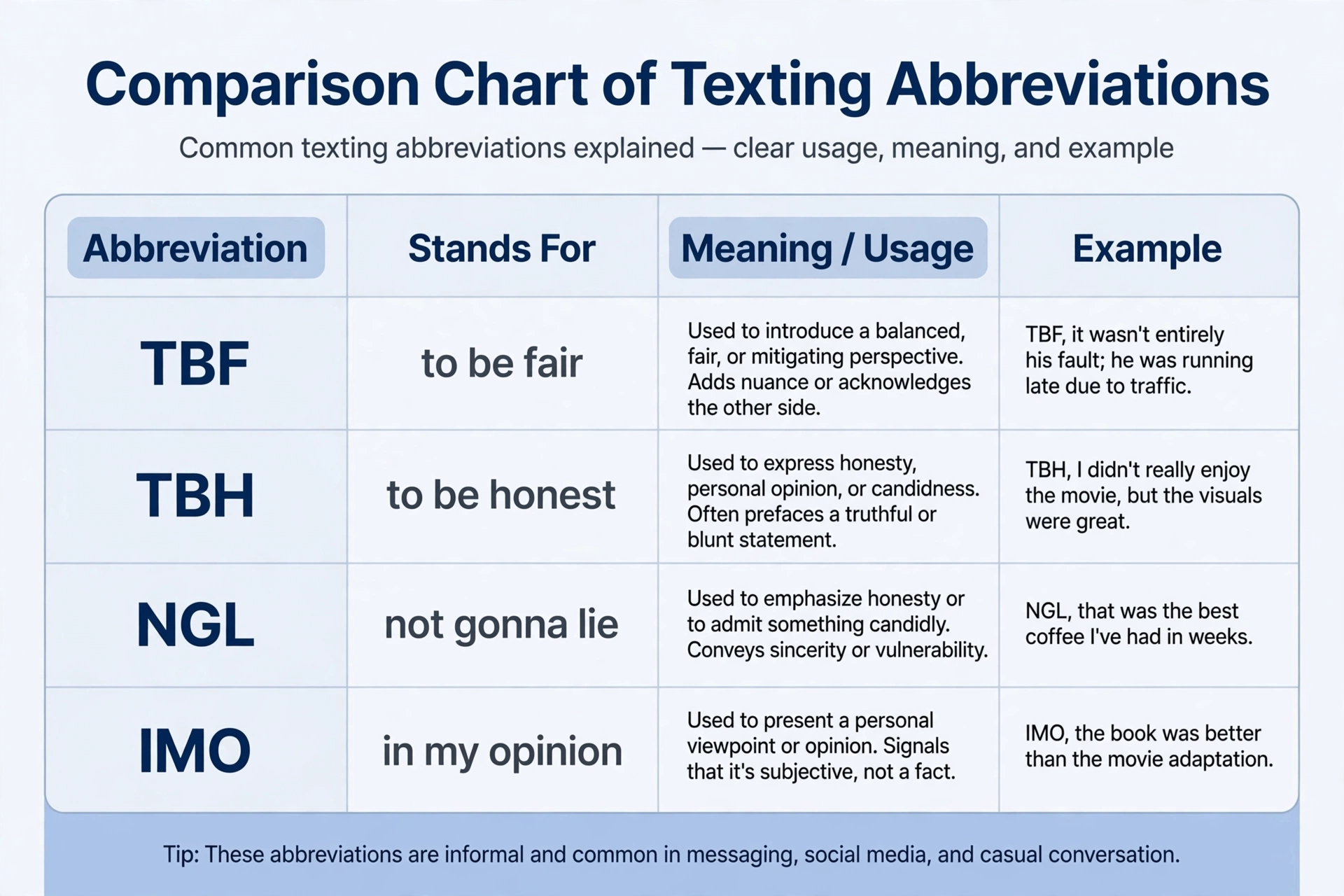
TBF looks a lot like its neighbors — TBH, NGL, IMO, FWIW — but each one frames an opinion differently. Mixing them up is the most common TBF mistake, so here is the full breakdown.
| Term | Stands For | What It Signals | Best When… |
|---|---|---|---|
| TBF | To be fair | Balance, fairness, both sides | You want to add context or soften a judgment |
| TBH | To be honest | Honesty, even if blunt | You are about to say something candid |
| NGL | Not gonna lie | Confession, casual honesty | You are admitting something slightly awkward |
| IMO / IMHO | In my (humble) opinion | Subjectivity, personal take | You are flagging that this is just your view |
| FWIW | For what it’s worth | Modest contribution | You are offering info without pushing it |
| JS | Just saying | Light observation | You are dropping a casual thought |
The key difference in one line: TBF balances, TBH reveals, NGL confesses, IMO softens, and FWIW downplays. Compare them in action:
- TBF: “TBF, the movie was slow, but the ending was great.” — a balanced review.
- TBH: “TBH, I didn’t enjoy the movie at all.” — blunt honesty.
- NGL: “NGL, I fell asleep halfway through the movie.” — an awkward confession.
- IMO: “IMO, the sequel is better.” — a personal preference, flagged as such.
If you want a deeper look at the confessional cousin of TBF, check out the ngl meaning in text guide. And if someone sends you an abbreviation you do not recognize at all — like omw meaning in text — the same rule applies: expand the letters, then read the tone from the context.
Alternate Meanings
In texting and social media, TBF means “to be fair” more than 99% of the time. A few other expansions exist, but they belong to specific professional or technical contexts, and they are almost never what a texter means:
- To be frank — an occasional alternate reading in chats. “TBF, I’m not a fan of that movie” could mean “to be frank.” The two meanings overlap so much that the sentence works either way, so this rarely causes confusion.
- To be filed — office and paperwork shorthand. You might see it on a document note, never in a casual chat.
- Total body fat — fitness and health contexts, usually written in full or with units.
- Temporary block flow / token bucket filter — networking and telecom jargon, far from everyday texting.
- Taco Bell Friday, Three Bags Full, Trial By Fire — joke or niche expansions that only make sense with heavy context.
The practical rule is simple: if you see TBF in a text, DM, comment, or group chat, read it as “to be fair.” Only in a technical document or a fitness report should you consider another meaning — and there, the surrounding words will make it obvious.
Professional or Polite Alternatives
TBF is informal. It is fine in casual team chats, but it looks sloppy in formal emails, reports, and client messages. Use these polished alternatives instead:
| Instead of TBF… | Say This | Best For |
|---|---|---|
| “TBF, he did warn us.” | “To be fair, he did warn us in advance.” | Meetings, emails |
| “TBF, both sides made mistakes.” | “In fairness, both sides made mistakes.” | Reports, discussions |
| “TBF, the timeline was tight.” | “It is worth noting that the timeline was tight.” | Formal updates |
| “TBF, I had not read the full article.” | “Admittedly, I had not read the full article.” | Owning a mistake |
| “TBF, the delay was not our fault.” | “In all fairness, the delay was partly outside our control.” | Client messages |
The full phrase “to be fair” is always safe. It carries the same meaning as TBF, sounds thoughtful in speech and writing, and never reads as slang.
Common Mistakes
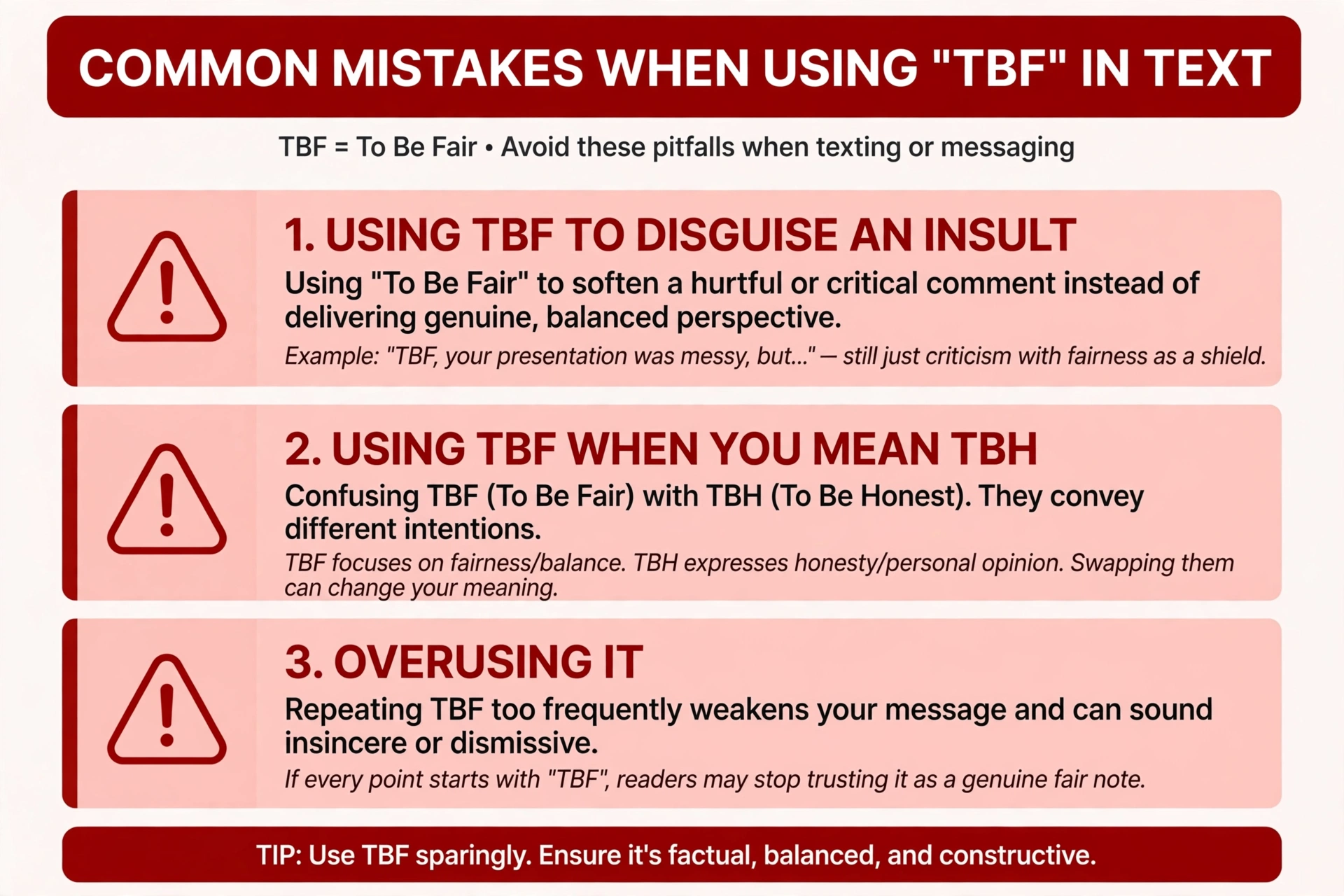
- Using TBF to disguise an insult. “TBF, you always mess this up” is not fair — it is a dig with a fairness costume. If the sentence after TBF is not genuinely balanced, drop the TBF.
- Using TBF when you mean TBH. “TBF, I hated the gift” is really “to be honest.” TBF promises balance, so follow it with something balanced — “TBF, the gift was thoughtful, even if it was not my style.”
- Overusing it in one conversation. Three TBFs in one paragraph make you sound like you are lawyering every sentence. One well-placed TBF per message is plenty.
- Using it in formal writing. Resumes, academic essays, client proposals, and formal emails should spell out “to be fair” or use a polished alternative.
- Reading sarcasm into every TBF. Most of the time, TBF is sincere. “TBF, you did warn me” is usually a genuine concession, not a passive-aggressive jab. Read the whole message before assuming attitude.
- Putting TBF where a full apology belongs. “TBF, traffic was bad” does not replace “Sorry I’m late.” Fairness and accountability are different things — use both when both are owed.
Quick Tips
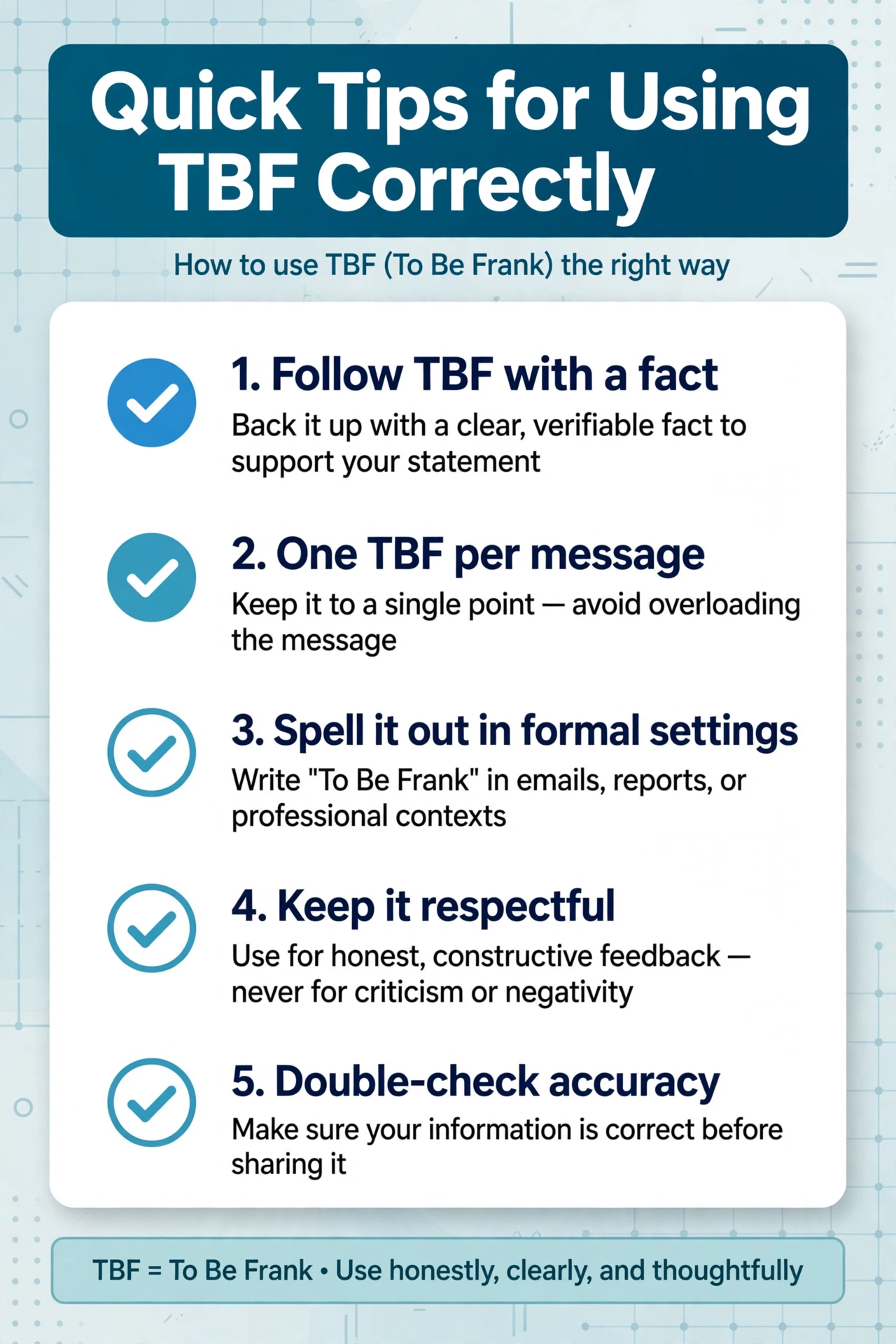
- Follow TBF with a fact, not just an opinion. “TBF, she texted twice” beats “TBF, she’s not that bad.” Facts make fairness believable.
- Use it once per thought. One TBF frames one balanced point. Repeating it dilutes it.
- Match the platform. TBF fits texts, DMs, comments, and casual team chats. Spell it out in formal settings.
- Watch your punctuation. “TBF…” can read as hesitant or shady. A comma and a plain sentence after TBF keeps it neutral.
- Pair it with a concession when you disagree. “TBF, you have a point, but I still think…” keeps debates civil.
- Do not use it to dodge accountability. Fairness adds context; it does not erase responsibility.
- When in doubt, expand it. If you are unsure the reader knows TBF, just write “To be fair…” — zero confusion, same effect.
FAQ
What does TBF mean in text?
TBF means “to be fair.” People use it in texts, DMs, and comments to introduce a balanced opinion, add missing context, or soften a judgment before they say it.
Is TBF rude?
No, TBF is not rude on its own. It usually makes a message sound more reasonable. It can feel blunt only when it is followed by criticism rather than a genuinely fair point — for example, “TBF, you always do this.”
Can I use TBF at work?
In casual internal chats, yes — “TBF, the deadline was moved twice” is fine. In formal emails, reports, or messages to senior leadership, write the full phrase “To be fair” instead.
What is the difference between TBF and TBH?
TBF (“to be fair”) adds balance and looks at both sides. TBH (“to be honest”) delivers a candid opinion, which can be blunt. TBF is about fairness; TBH is about honesty.
What does TBF mean on TikTok?
On TikTok, TBF usually appears in comments where someone offers a balanced take on a video — defending a creator, adding context, or softening a criticism. It means the same “to be fair” as everywhere else.
What does TBF mean on Snapchat?
On Snapchat, TBF shows up in private chats between friends, usually as a quick fairness note — “TBF, you did warn me” or “TBF, traffic was terrible.” It keeps casual conversations balanced.
Is TBF slang or an acronym?
Both. TBF is an acronym for “to be fair” and a piece of internet slang. It is informal, widely understood, and best kept out of formal writing.
What should I reply when someone says TBF?
If you agree, reply “Yeah, that’s fair” or “True, I didn’t think of it that way.” If you disagree, acknowledge their point first — “I get that, but…” — then give your side. That keeps the fairness going.
Conclusion
Now you know the full tbf meaning in text: “to be fair” — a three-letter signal that a balanced, reasonable thought is coming. It defends people, softens disagreements, adds missing context, and keeps online conversations fairer than they would be without it.
The key takeaways are simple. Use TBF to add genuine fairness, follow it with a fact or a real concession, keep it out of formal writing, and never use it as a costume for an insult. Master those habits, and TBF becomes a small act of diplomacy — proof that you can disagree without being disagreeable.
Texting slang is a whole language of its own, and every abbreviation has its own story. If you found this guide useful, you might also enjoy the wya meaning in text breakdown or the frfr meaning in text guide — and for a deeper look at how the phrase is defined in standard English, the Collins Dictionary entry for TBF is a solid reference.

1 thought on “TBF Meaning in Text: What It Really Means & How to Use It”