Quick definition: POV stands for “point of view.” In texts and on social media, it frames a message, video, or joke from a particular person’s perspective — inviting the reader or viewer to see a moment exactly as someone else sees it.
POV Meaning in Text & Definition
The pov meaning in text is refreshingly literal: those three letters stand for “point of view,” and they do exactly what they say. When someone drops POV into a text, a caption, or a comment, they are handing you a camera angle for the situation. You are not just reading words anymore; you are being asked to stand in someone else’s shoes for a second.
In everyday texting, POV usually shows up in two forms. The first is the scenario setup, borrowed straight from TikTok: “POV: you’re the last one awake in the group chat and everyone is planning without you.” The second is the opinion shorthand: “From my POV, the blue one looks better.” Both do the same job — they mark whose eyes you are supposed to be looking through. It is a small linguistic shortcut that packs a surprising amount of storytelling power into three letters.
Grammatically, POV is flexible. It works as a noun (“what’s your POV on this?”), as a caption label (“POV: Monday morning”), and as a conversational framing device. You will see it written as POV, pov, or #POV. The meaning stays the same across texting, TikTok, Instagram, Snapchat, and X. And for the record, dictionary definitions of the underlying phrase describe “point of view” as someone’s standpoint, opinion, or attitude toward a situation — the slang use is just a punchier, internet-native version of the same idea.
Introduction
Open TikTok for sixty seconds and you will trip over it. Scroll through a group chat and it is there too. POV has become one of those rare slang terms that escaped the group chat and colonized the entire internet — and unlike most viral acronyms, it actually has a respectable family tree. Before it was a TikTok caption, it was a film-school term. Before it was a meme, it was how novelists described narration. Understanding the pov meaning in text means understanding a word that traveled from Hollywood camera crews to your best friend’s texts without losing its soul.
What makes POV stick is that it solves a real communication problem. In a text, you cannot point a camera at anything. You cannot raise an eyebrow or gesture at the scene. POV gives you a workaround: three letters that say “imagine this through these eyes.” Whether you are setting up a joke, sharing an opinion, or captioning a video, POV turns a flat message into a little scene. This guide breaks down exactly what it means, where it came from, how to use it naturally, and the mistakes that make people cringe.
Origin
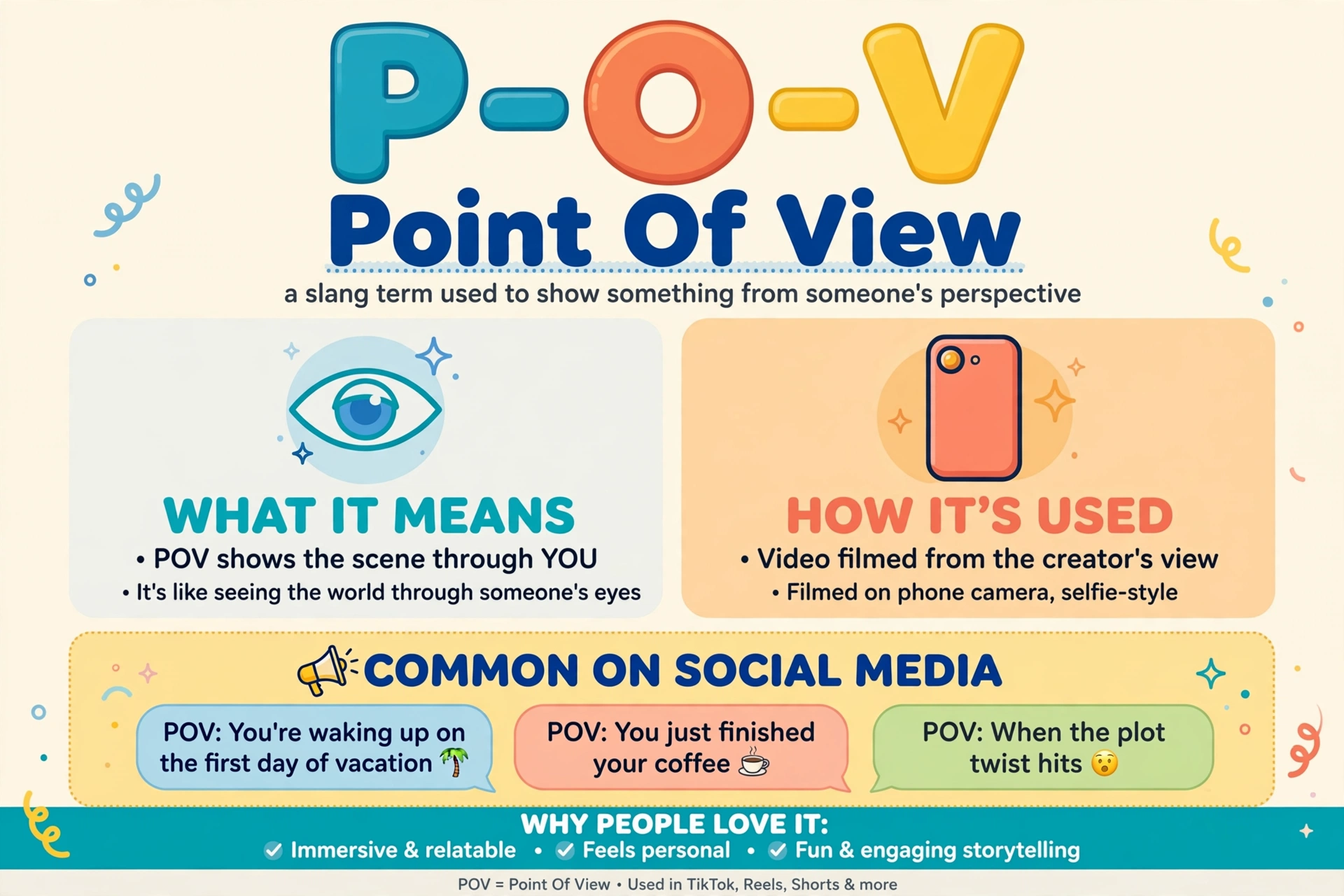
POV did not start on TikTok. The phrase “point of view” has lived in film and literature for well over a century. In movies, a “POV shot” is a scene filmed from a character’s literal perspective — the audience sees what the character sees, like looking through the eyes of the hero during a chase. In books, POV describes whose head the narration lives in: first-person POV, third-person POV, and so on. It is one of the oldest storytelling tools there is.
The jump to the internet happened gradually. Gamers and video creators used “POV” for years to label first-person footage — think GoPro clips of surfing, skiing, or driving where the camera is the person’s eyes. When TikTok exploded in 2020, creators took the film term and turned it into a genre. The early format was straightforward: the video genuinely showed the creator’s point of view, filmed on a smartphone, so viewers felt like they were in the room.
Then came the twist that made POV a phenomenon. Creators started using it not just for literal camera angles but for imagined scenarios. “POV: you’re a cashier and a Karen walks in.” The camera is no longer anyone’s eyes — it is a stage direction. The viewer is asked to play a role. That second-person, roleplay version of POV is what conquered TikTok’s For You Page, racked up billions of views, and then leaked into everyday texting. If you enjoy decoding TikTok-born terms, our guide to the grwm meaning covers another format that followed the exact same path from video genre to everyday slang.
Popularity
By the numbers, POV is a heavyweight. TikTok videos tagged #POV have accumulated tens of billions of views, making it one of the platform’s most durable content formats — not a one-month trend but a permanent fixture alongside wya meaning in text staples and other messaging slang. Creators use it for comedy skits, relatable scenarios, thirst traps, mini-dramas, and confessionals. The format is endlessly remixable: all you need is a scenario and a colon.
Its popularity comes down to three things. First, it is a built-in hook — “POV:” tells the viewer exactly what kind of video this will be before a single frame plays. Second, it is participatory; the second-person framing (“POV: you’re the one who forgot to study”) pulls the audience into the story instead of making them passive watchers. Third, it is platform-agnostic. The same three letters work in a TikTok caption, an Instagram Reel, a Snapchat story, a tweet, and a plain old text message. Few slang terms travel that well.
How It Is Used
POV has three main jobs in the wild, and recognizing which one is in play will instantly make you fluent.
1. The scenario setup (TikTok and captions). This is the big one. “POV:” followed by a situation places the viewer inside a scene. It can be first-person (“POV: I’m the only one who understood the meme”) or second-person (“POV: you’re trying to leave the party but your friend keeps talking”). Some creators play it straight; others use it ironically, setting up an absurd or deliberately wrong scenario for comedy.
2. The perspective marker (texts and conversation). In one-on-one messaging, POV usually means “my take” or “the way I see it.” It is a slightly more emphatic cousin of “IMO” — it carries a touch of ownership, as if to say this is genuinely how it looks from where I’m standing. Example: “From my POV, we should just tell him the truth.”
3. The meme caption. On memes, POV functions as a reusable template. The image shows one thing; “POV: …” tells you whose experience the image represents. It is the caption equivalent of a movie title card, and it is why the format survives every algorithm change: it gives lazy scrollers an instant frame of reference.
Examples
Theory is nice, but slang lives in examples. Here is how POV actually sounds in different tones and settings.
Friendly Examples
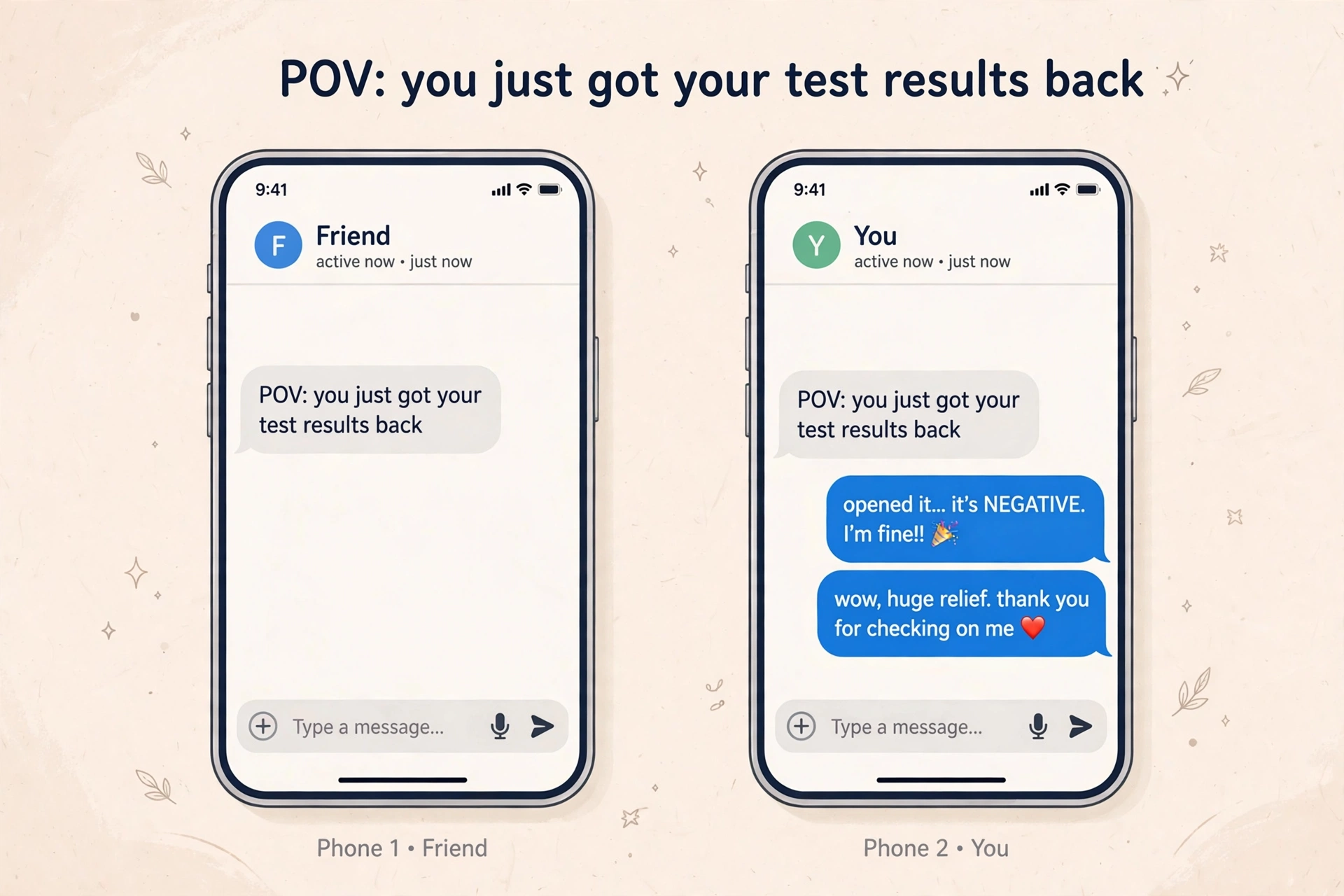
- Text between friends: “POV: we finally get matching tattoos on Saturday 😭” — here POV frames a shared daydream as a little scene.
- Group chat: “POV: you’re the only one who did the reading and the teacher keeps looking at you.” — relatable, second-person, instant comedy.
- Reacting to news: “Wait, from my POV that’s actually a good deal.” — gentle opinion, no drama attached.
- Complimenting: “POV: your best friend understood the assignment.” — paired with a photo, this is pure affection.
Professional Examples
Yes, POV has a professional register — with limits. In casual workplaces and creative teams, “from my POV” is a perfectly acceptable way to open an opinion:
- “From my POV, the timeline is realistic if we cut the second review round.”
- “I see your POV, but the client asked for the simpler version.”
- “What’s the POV from the design team on this mockup?”
That said, keep it out of formal documents, legal writing, and anything your grandmother’s lawyer might read. In those contexts, “perspective” or “view” does the job without the texting aftertaste.
Funny Examples
Comedy is where POV earns its keep. The formula is simple: relatable pain + second person + colon.
- “POV: you said ‘I’m 5 minutes away’ and you haven’t left the house.”
- “POV: the WiFi dies during the final boss fight.”
- “POV: you open the fridge for the 47th time hoping food appeared.”
- “POV: your alarm goes off and your first thought is betrayal.”
The funniest ones are hyper-specific. Vague scenarios fall flat; the comedy lives in the details your audience instantly recognizes.
Comparison with Similar Terms
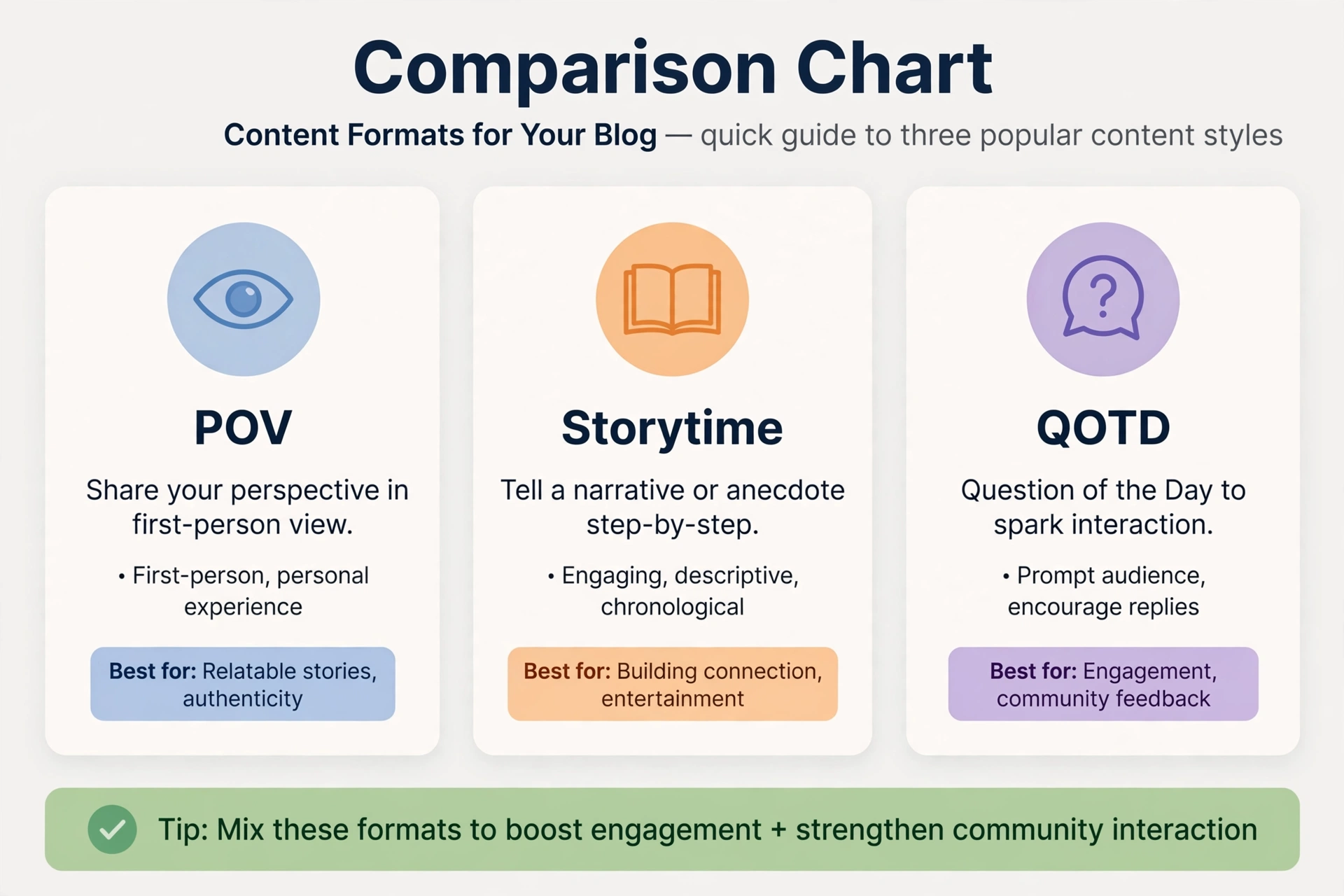
POV gets confused with a handful of neighboring terms. Here is how they actually differ:
| Term | Stands For | What It Does | Key Difference from POV |
|---|---|---|---|
| POV | Point of view | Frames a scene from someone’s perspective | — |
| Storytime | — | Signals a personal anecdote is coming | Storytime tells what happened; POV shows what it felt like to be there |
| GRWM | Get ready with me | Getting-ready video with conversation | GRWM is a specific video format; POV is a framing device that works anywhere |
| QOTD | Question of the day | Poses a daily question to followers | QOTD asks; POV shows |
| IMO / IMHO | In my (humble) opinion | Flags a statement as an opinion | IMO is just an opinion label; POV adds the “see it through my eyes” layer |
The closest cousin is “storytime,” and even there the distinction matters: a storytime video recounts an event, while a POV video reenacts the feeling of being inside it. One narrates, the other immerses. For more on the opinion side of internet shorthand, our breakdown of the iktr meaning in text covers another acronym that migrated from conviction to meme.
Alternate Meanings
In texts and on social media, POV means “point of view” roughly 99% of the time. But the letters do moonlight in other fields, so here is the quick tour:
- Privately owned vehicle — in military and government contexts, a POV is your personal car (as opposed to an official one). If a soldier texts about “taking the POV,” they mean the car, not a TikTok.
- Point of view (gaming) — first-person vs. third-person POV describes the camera in video games. Same root meaning, different arena.
- Point of view (writing) — first, second, or third person narration. The TikTok usage is essentially a playful descendant of this.
- Proof of value — in sales and business software, a POV is a trial demonstrating a product’s worth. Context makes this one obvious.
Rule of thumb: if there is a colon after it and a scenario after the colon, it is the slang. If someone is talking about cars, cameras, or contracts, it is one of the others.
Professional or Polite Alternatives
POV is casual by nature. When the room gets formal, swap it for one of these:
| Instead of… | Try… | Best for |
|---|---|---|
| “From my POV” | “From my perspective” | Meetings, emails, presentations |
| “My POV is…” | “My view is…” / “My take is…” | Discussions, feedback sessions |
| “What’s your POV?” | “What’s your perspective on this?” | Client calls, interviews |
| “POV: the deadline moved” | “To put this in context: the deadline moved” | Written updates, reports |
None of these carry the playful, cinematic energy of POV — which is exactly the point. Formality and memes are oil and water; pick the register the room expects.
Common Mistakes
POV is simple, but people still manage to mangle it. Here are the mistakes worth avoiding:
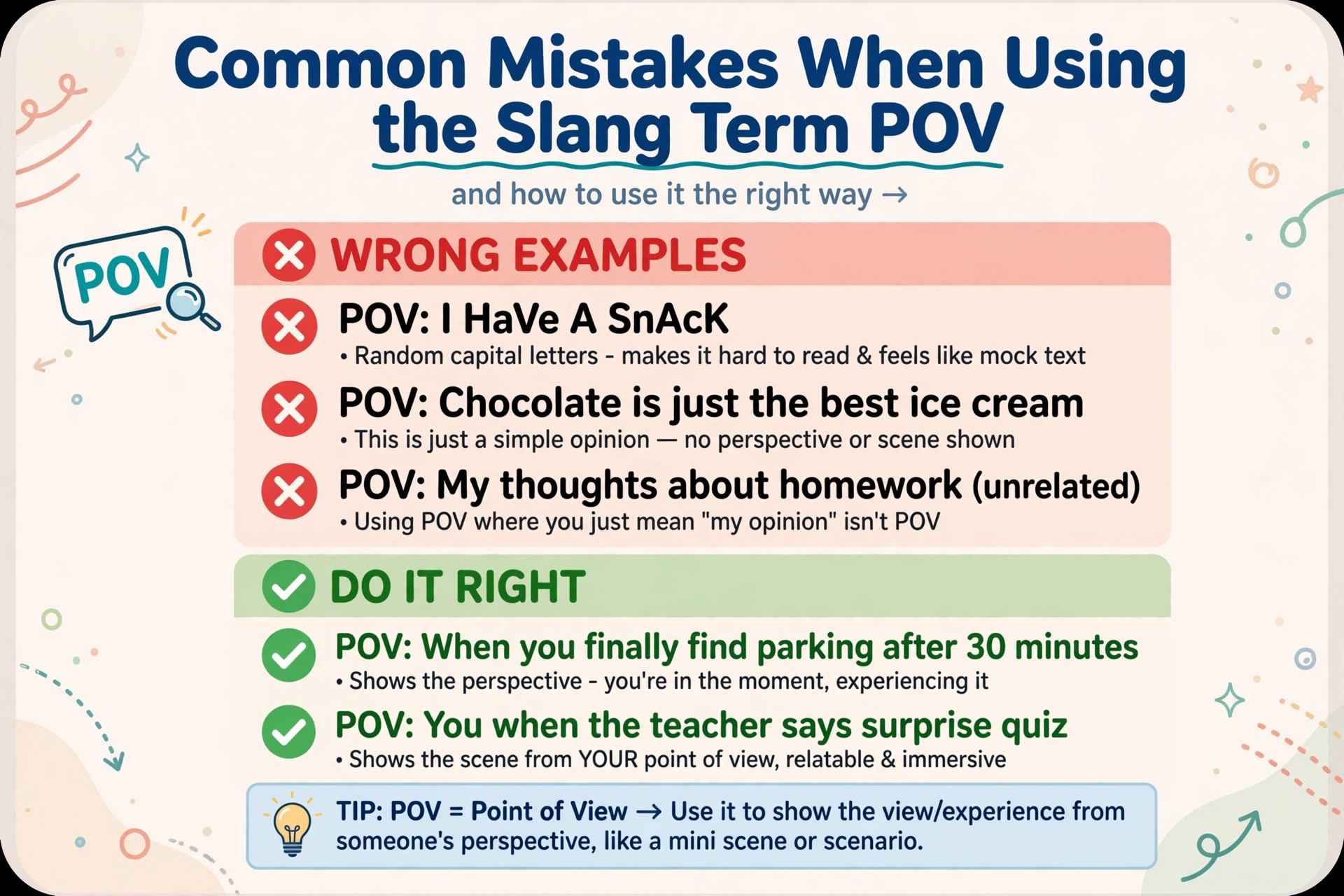
- Random capitalization. “pOv: you wake up late” looks like a typo had a baby with a meme. Pick POV or pov and commit.
- Forgetting the colon. “POV you’re the main character” reads fine, but the colon is the genre’s signature — it is what turns three letters into a camera cue. Keep it.
- Using it for plain opinions. “POV: pizza is the best food” is technically not wrong, but it wastes the format. POV shines with scenes, not takes. For plain opinions, “IMO” is the honest tool.
- Overexplaining after the setup. “POV: you’re nervous. So basically what I mean is you’re feeling anxious because…” — no. The scenario should land on its own. Trust the format.
- Forcing it into formal writing. A cover letter that opens “POV: I’m your ideal candidate” is memorable for all the wrong reasons.
- Mixing up the perspective. “POV: I’m watching you watch me” — fun for a thriller, confusing for a caption. One camera angle per POV, please.
Quick Tips
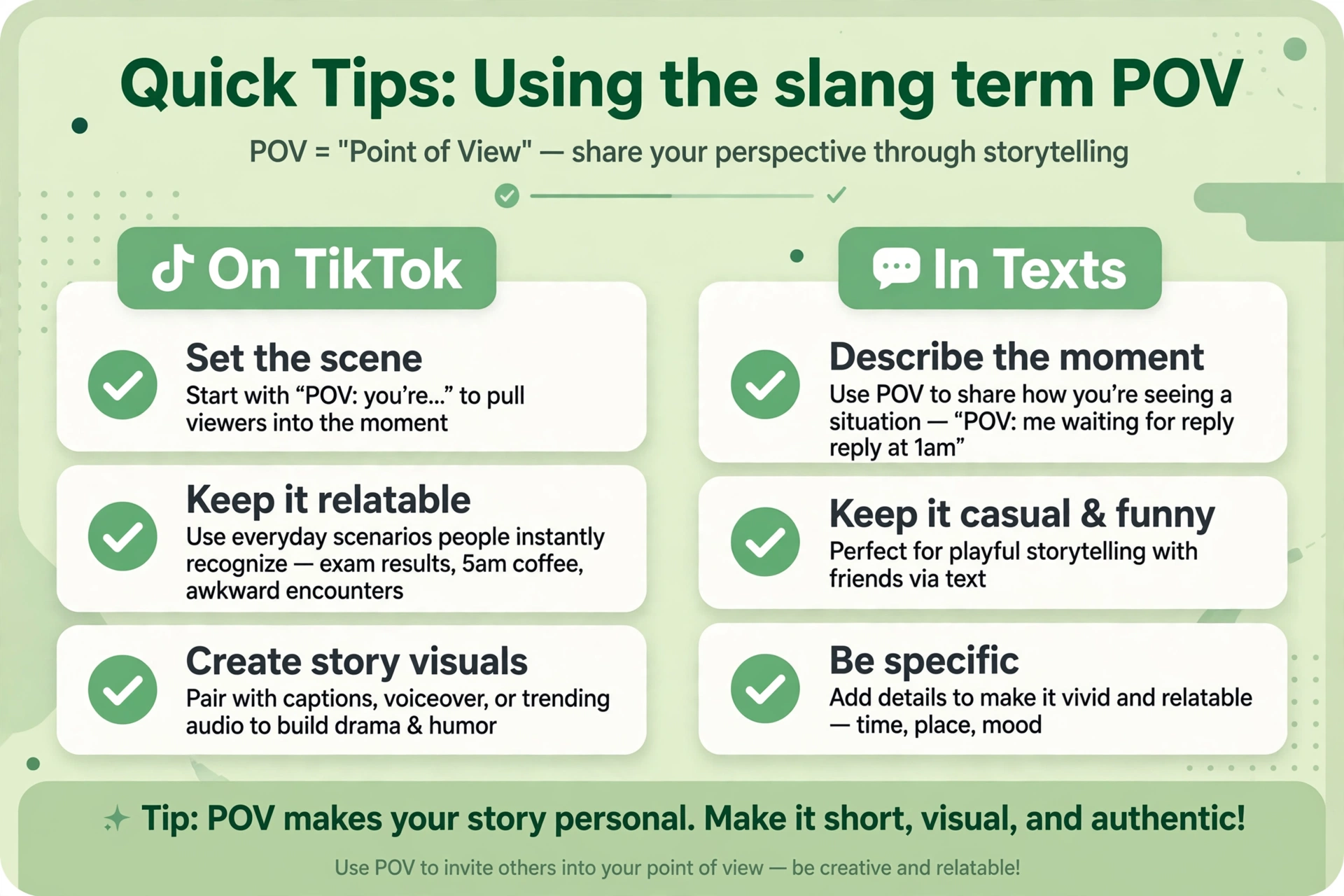
- Lead with the relatable. The best POV setups describe something your audience has personally lived through. Specificity beats cleverness every time.
- Second person is the cheat code. “POV: you’re…” pulls readers in faster than first person. It turns a caption into an invitation.
- Keep it to one line. If your POV setup needs a paragraph, it is not a POV setup — it is a story. Trim it until it snaps.
- Pair it with the right visual. On video, the POV caption and the footage should tell one story together. Mismatched caption and clip is the fastest way to confuse viewers.
- Don’t force the trend. Not every post needs a POV. If the scenario doesn’t genuinely benefit from a perspective frame, skip it — forced slang ages badly.
- Read the room. POV in the group chat? Perfect. POV in a condolence message? Absolutely not. The format is inherently playful; deploy it where playfulness is welcome.
FAQ
1. What does POV mean in text?
POV stands for “point of view.” In texts, it frames a message from a particular perspective — either setting up a mini-scenario (“POV: you’re the last one picked for the team”) or marking an opinion (“from my POV, that’s fair”).
2. What does POV mean on TikTok?
On TikTok, POV is both a filming style and a caption format. Creators use “POV:” to introduce skits and scenarios acted from a specific perspective, inviting viewers to imagine themselves inside the scene. It is one of the platform’s most-used content formats.
3. What does POV stand for?
POV stands for “point of view” — the same phrase used in film (a POV shot shows what a character sees) and literature (a story’s POV is whose perspective the narration follows).
4. Is POV only used for videos?
Not at all. While it blew up through TikTok videos, POV works in plain texts, tweets, memes, Instagram captions, and everyday conversation. Anywhere you want to frame something as “seen through these eyes,” POV fits.
5. How do you reply to a POV text?
Play along with the scenario. If a friend texts “POV: we’re stuck in traffic forever,” a good reply continues the bit (“POV: I start a new life in this car”) or reacts to it (“literally us last Friday”). Matching the energy matters more than the words.
6. What’s the difference between POV and storytime?
Storytime recounts something that happened (“storytime: how I met my roommate”); POV reenacts the experience of being in the moment (“POV: you’re meeting your roommate for the first time”). One narrates the past, the other stages the feeling.
7. Is it “POV:” with a colon or without?
With the colon is the standard, especially for the scenario format — the colon is what turns it into a camera cue. In casual opinion use (“from my POV”), no colon is needed.
8. Can I use POV in professional settings?
Sparingly. “From my POV” is fine in casual team chats and creative workplaces, but switch to “from my perspective” in formal emails, documents, and client-facing communication. And never open a cover letter with “POV:” — some lines should not be crossed.
Conclusion
The pov meaning in text boils down to three letters doing the work of a camera crew: POV hands your reader a perspective and says look through these eyes. It started as a film term, became a TikTok genre, and settled into everyday texting as one of the most versatile framing devices the internet has produced. Use it to set up scenarios, mark your perspective, and add a little cinematic flair to ordinary messages.
The formula to remember: keep the scenario specific, keep it to one line, match the tone to the room, and let the colon do its job. Do that, and every “POV:” you send will land exactly the way you meant it. And if this one clicked, keep decoding — from the idt meaning in text to dozens more, the internet’s shorthand is a language worth learning fluently.

1 thought on “POV Meaning in Text: What “Point of View” Really Means on TikTok”