
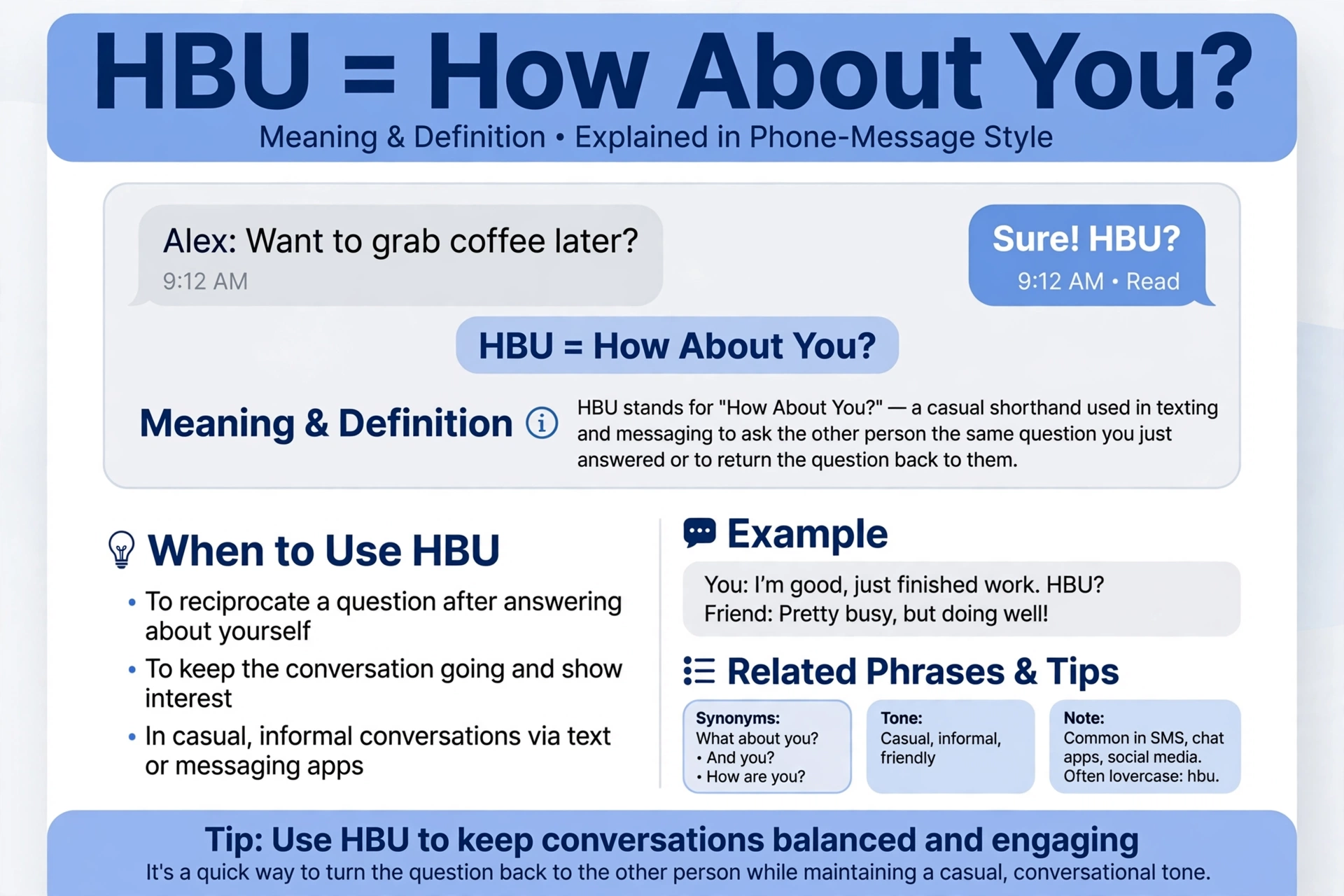
Quick definition: The hbu meaning in chat is simple: HBU stands for “how about you” — a short, casual way to bounce a question back to someone in text messages, DMs, and online chats after sharing your own answer first. Example: “I’m doing great, HBU?”
HBU Meaning in Chat: Meaning & Definition
If you’ve ever been mid-conversation and seen three little letters — HBU — tacked onto the end of a message, you’re not alone in pausing for a second. Is it a greeting? A question? A typo? Here’s the simple answer: HBU means “how about you” in chat and texting.
It’s one of the most common texting abbreviations in modern digital conversation, sitting right alongside WYD, LOL, and BRB. People use it as conversational shorthand — instead of typing out the full sentence “how about you?” they drop in HBU and keep the chat moving.
The way it works is almost always the same. Someone shares something about themselves first — their mood, their plans, what they’re doing — and then adds HBU to flip the question back to you. It’s a small social contract: I told you about me, now tell me about you. That’s what makes HBU more than just laziness; it’s actually a friendly gesture. It signals genuine interest and keeps conversations balanced instead of one-sided.
Introduction
Picture this: your phone buzzes. It’s a friend you haven’t talked to in a week. The message reads, “Hey! Just got back from the beach. HBU?” You freeze. HBU? Is that a new app? A name? Some kind of code?
Relax — it happens to almost everyone at some point. Just like figuring out what WSG means in text or what TYSM stands for, decoding texting abbreviations can feel like learning a new dialect. HBU is one of those terms that’s so deeply woven into casual digital chatter that most people type it without a second thought, assuming everyone knows it. But if you grew up before texting took over, or you just don’t live on your phone, it can feel like arriving at a party where everyone speaks a dialect you never learned.
This guide fixes that — and then some. You’re about to learn not just the basic hbu meaning in chat, but the full picture: where it came from, how wildly popular it is, exactly how and when to use it, dozens of real examples for every situation, how it compares to lookalike terms (like WBU and HRU), what else it can stand for, the polite alternatives for professional settings, the common mistakes that make people sound awkward, and quick tips that’ll make you look like a texting natural.
By the end, you’ll know how to use HBU confidently — and exactly how to reply when someone sends it to you. Let’s get into it.
Origin
To understand the hbu meaning in chat fully, it helps to know where it came from. HBU was born in the era of old-school SMS texting — the early 2000s, when mobile phones had tiny physical keyboards and carriers charged per message (or capped you at a strict character limit). Every character cost money, so people compressed language aggressively. “How about you?” became “HBU?” — three letters doing the work of fourteen.
Early adopters were teenagers and young adults texting on flip phones and Nokia-style devices, but HBU stuck around long after character limits disappeared. Why? Because it fills a real conversational need. In spoken conversation, when someone asks “How was your day?”, you answer and then naturally ask “How about yours?” In texting, typing that full follow-up feels like effort, so the abbreviation survived as the digital equivalent of that verbal habit.
As smartphones, WhatsApp, Snapchat, Instagram DMs, and Discord took over through the 2010s and 2020s, HBU rode the wave. It migrated from SMS to every messaging platform where speed and casualness matter. Linguists call this compressed style SMS language, which developed under exactly these space, time, and cost pressures. Unlike some abbreviations that faded (RIP to “TTYL” and “G2G”), HBU remained relevant because it’s genuinely useful — it’s a question-asker, a conversation-keeper, and a politeness signal all in one tiny package.
Interestingly, HBU has barely changed over the years. It doesn’t have the layered irony of LOL (which people now type without laughing) or the evolving meanings of terms like “bet.” HBU means “how about you” and has always meant “how about you.” That stability is part of why it’s so widely trusted in casual conversation.
Popularity
HBU is genuinely everywhere in casual digital communication. It ranks among the most-searched texting abbreviations in the United States, with search interest remaining consistently strong year after year. People don’t just use it — they actively look up what it means, which tells you it’s constantly entering new users’ vocabularies (hello, parents texting their teens).
You’ll find HBU most often in these spaces:
- Text messages (SMS/iMessage): The classic home turf. Quick check-ins between friends, family group chats, and casual catch-ups.
- Instagram and Snapchat DMs: Story replies especially — someone posts about their day, and followers respond with their own update plus HBU.
- WhatsApp and Telegram: Huge in group chats and one-on-one conversations across all age groups.
- Discord and gaming chats: Used between matches or during downtime to keep the social vibe going.
- Dating apps (Tinder, Bumble, Hinge): Extremely common in early conversations, where both people are trading basic getting-to-know-you questions.
Demographically, HBU skews young — it’s most popular with teens through thirty-somethings — but it’s crossed generational lines far more successfully than most slang. You’ll see it from millennials texting coworkers informally, and even from parents who picked it up from their kids. It’s one of those rare abbreviations that became part of mainstream digital literacy.
Geographically, it’s strongest in the US, UK, Canada, and Australia, but it’s understood across English-speaking internet culture worldwide, including India, Pakistan, the Philippines, and Nigeria, where English-language texting slang is widely used.
How It Is Used
Now for the practical part: how does HBU actually work in a real conversation? The pattern is remarkably consistent. This is the hbu meaning in chat in action — HBU almost never starts a conversation; it continues one. The standard formula is:
Your update/answer + HBU? = a returned question.
Here are the three most common usage patterns:
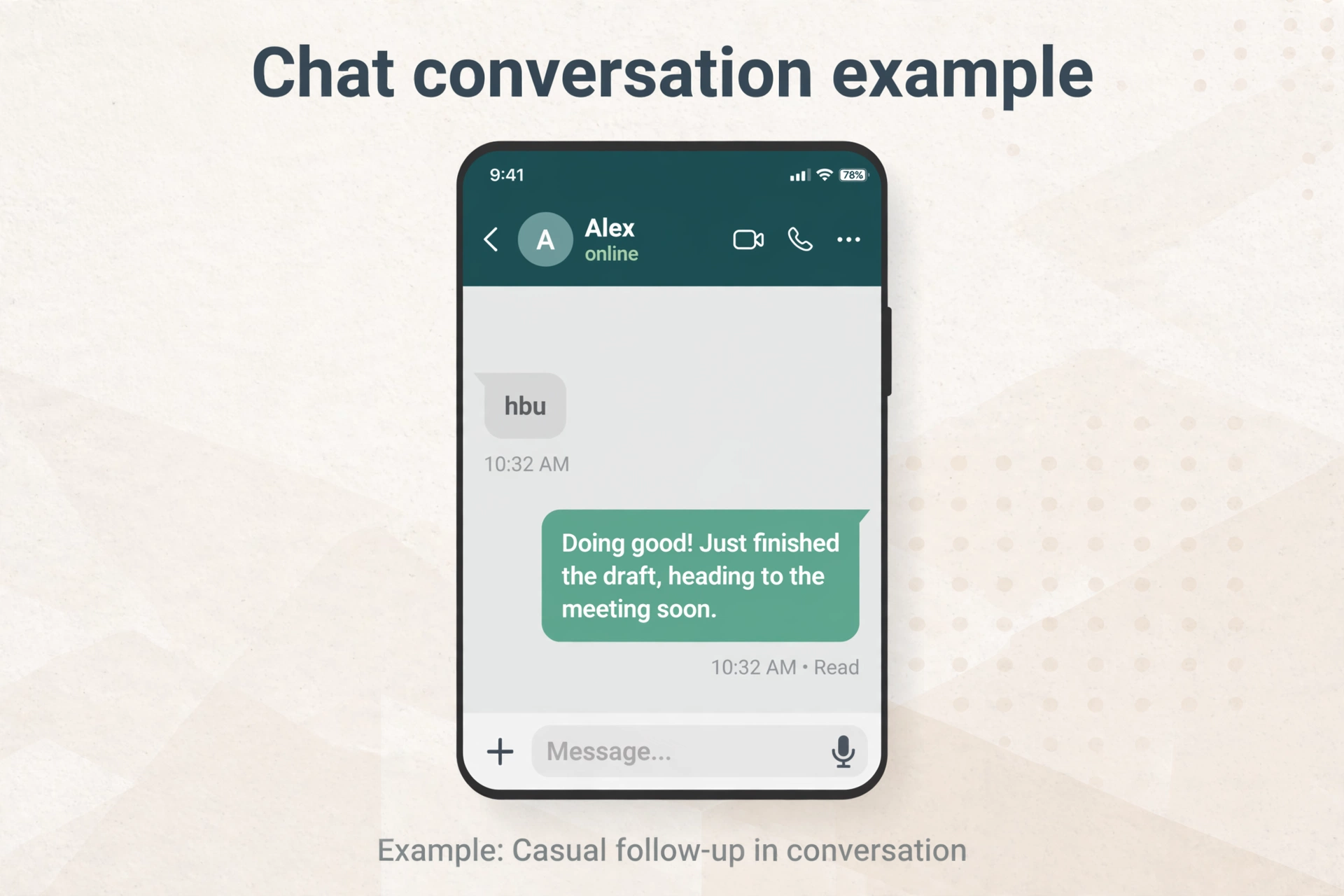
- After answering a question: Someone asks “How’s your day going?” You reply “Pretty good, just finished work. HBU?” You’ve answered and handed the question back.
- After volunteering an update: Out of nowhere: “Just booked my flights for December! HBU, any travel plans?” You shared news and invited them to share theirs.
- As a standalone check-in: “Hey, long time! How’ve you been? HBU?” (Here HBU reinforces the question rather than replacing it.)
A few usage notes worth knowing:
- The question mark is optional. “HBU?” and “HBU” are used interchangeably. Adding the question mark is slightly more polite and clearer; dropping it is more casual.
- Capitalization doesn’t matter. HBU, hbu, and Hbu all mean the same thing. Lowercase “hbu” tends to feel more casual and is very common among younger users.
- It’s a response tool, not an opener. Texting “HBU?” to someone out of the blue, with zero context, is confusing. It needs something to bounce off of.
- It softens directness. Asking someone about themselves can feel probing; HBU frames it as a trade — I shared, now you share — which feels warmer and more reciprocal.
- It works in group chats too. “Movie night was amazing, hbu guys — did everyone get home okay?” broadcasts the question to the whole group.
Examples
Theory is nice, but HBU really clicks when you see it in action. Below are real-style examples across friendly, professional-adjacent, and funny tones so you can see exactly how the hbu meaning in chat plays out in different situations.
Friendly Examples
This is HBU’s natural habitat — warm, casual, between people who like each other.
- Alex: “Just finished my workout, feeling great! HBU?”
Sam: “Nice! I just woke up lol, still in bed.” - Maya: “I’m so excited for the weekend. HBU, any plans?”
Jordan: “Same! Probably just chilling with family.” - Chris: “Lunch was amazing today 🍕 HBU, did you eat yet?”
Taylor: “Not yet, now I’m hungry 😂” - Priya: “Finally done with exams!! HBU, how did yours go?”
Rahul: “Ugh don’t ask 😅 one more to go.” - Emma: “Hey stranger! It’s been forever. I’m good, just busy with work. HBU?”
Liam: “I know right! Same here, work is crazy.”
Notice the pattern in every one: share first, then HBU. It feels like a genuine exchange, not an interrogation.
Professional Examples
Here’s an important nuance: HBU is too casual for formal professional communication. You should never use it in a client email, a cover letter, or a message to your CEO. However, it does appear in informal workplace chat — Slack DMs, Teams messages between friendly colleagues, or texts with a coworker you’re close to. In those settings it looks like this:
- Colleague: “Morning! I’m working from home today. HBU — office or remote?”
You: “Office today, see you at standup!” - Teammate: “Just wrapped the report. HBU, how’s your part coming along?”
You: “Almost done, sending it over in an hour.”
The rule of thumb: if you’d use an emoji with this person at work, HBU is probably fine. If the relationship is strictly formal, write out “how about you?” in full instead.
Funny Examples
HBU also shows up in playful, joking contexts where the humor comes from the contrast between a dramatic statement and the casual bounce-back.
- “I just ate an entire pizza by myself and I regret nothing. HBU?”
- “My plant died again. I’m officially a plant serial killer. HBU, how’s your garden?”
- “Survived Monday. Barely. HBU?”
- “Just spent my whole paycheck on concert tickets. Worth it. HBU — broke or responsible?”
- “I understood the assignment. The assignment did not understand me. HBU?”
In funny usage, HBU acts as the punchline setup — the exaggerated confession followed by “hbu?” invites the other person to match your energy.
| Tone | Example message | What HBU does here |
|---|---|---|
| Friendly | “Had the best coffee this morning ☕ HBU?” | Shares a small joy, invites theirs |
| Casual check-in | “Hey, haven’t talked in a while. All good here. HBU?” | Reconnects warmly |
| Work (informal) | “I’m remote today. HBU?” | Quick logistics, friendly tone |
| Funny | “Napped for 3 hours. Productive king. HBU?” | Self-deprecating humor, invites banter |
| Flirty | “Can’t stop thinking about our date last night 😊 HBU?” | Shares a feeling, asks for theirs |
Comparison with Similar Terms
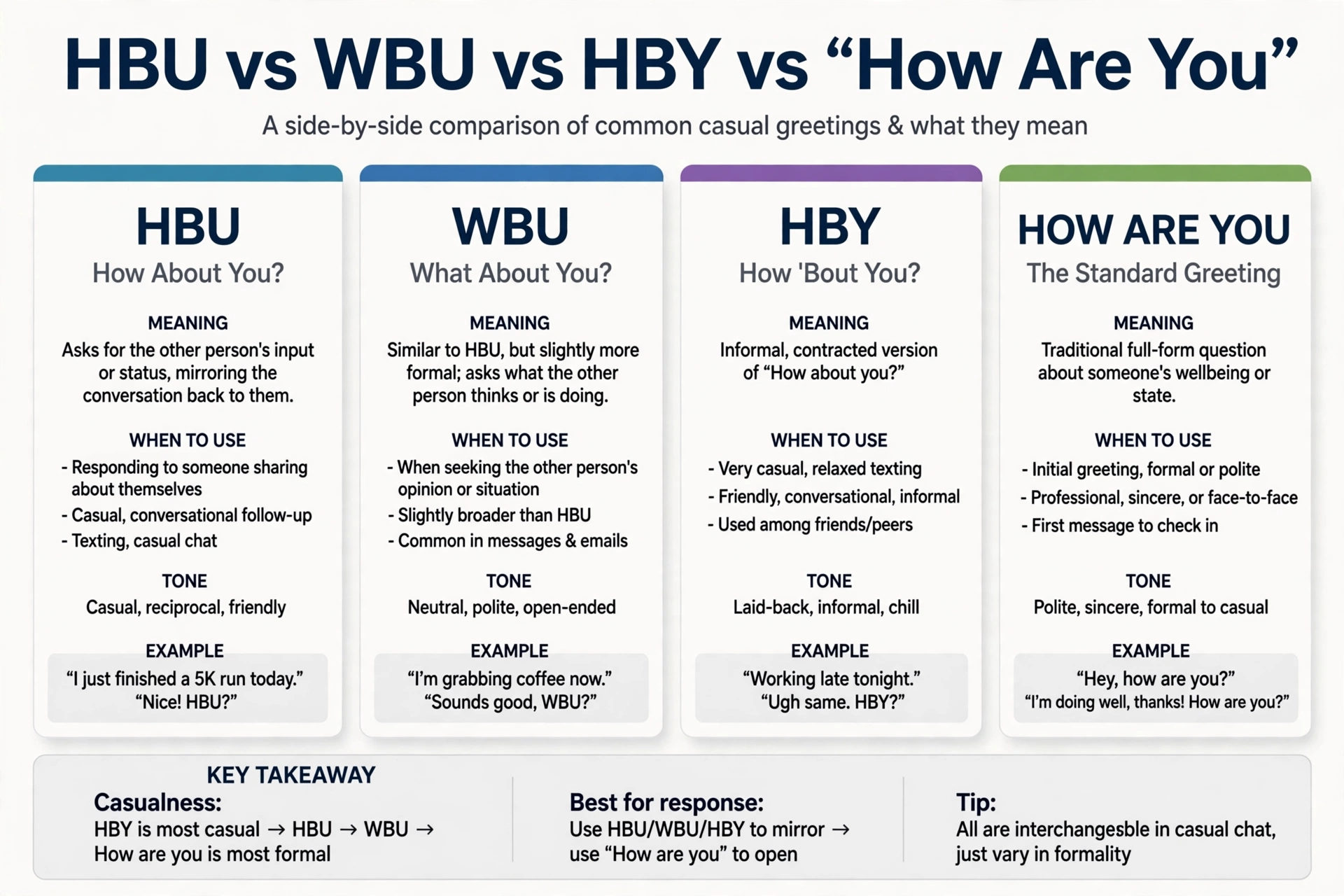
HBU has several close cousins in texting slang, and mixing them up is one of the most common sources of confusion. Here’s how it stacks up against the terms people most often confuse it with.
| Term | Stands for | Meaning & nuance | When to use it instead of HBU |
|---|---|---|---|
| HBU | How About You | Bounces a question back after sharing your own answer | Default choice for reciprocal questions |
| WBU | What About You | Nearly identical to HBU; slightly more direct | Interchangeable — pick whichever you like |
| HRU | How Are You | Asks about their wellbeing directly, no bounce-back needed | When you haven’t shared anything first |
| WYD | What You Doing | Asks about their current activity | When you want to know what they’re up to right now |
| HBY | How ‘Bout You | Same as HBU, just spelled differently | Personal style preference — HBU is more common |
| NM, HBU? | Not Much, How About You | The classic combo: minimal answer + returned question | When you have nothing exciting to report |
| Sup | What’s Up | Ultra-casual greeting | As a conversation opener (HBU can’t open) |
HBU vs WBU deserves special attention because it’s the #1 point of confusion. Honestly? They’re functionally the same. “How about you?” and “what about you?” are near-synonyms in casual speech. Some people feel WBU is a touch more direct while HBU is a touch softer, but no one in a real chat will notice or care which one you use. Use whichever feels natural.
HBU vs HRU is a more meaningful distinction. HRU (“how are you”) is a standalone question — you can open with it. HBU is a returned question — it needs your answer first. Texting “HRU?” to start a chat is normal; texting “HBU?” to start one is confusing.
Alternate Meanings
In texting and chat, HBU means “how about you” about 99% of the time. But like many abbreviations, it has a few alternate meanings in specific contexts — and knowing them can save you from an embarrassing mix-up.
- Historically Black Universities: In education and college-admissions contexts, HBU can refer to historically Black universities (the far more common term is HBCU — historically Black colleges and universities). If you see HBU in a discussion about college applications, campus life, or education policy, it’s almost certainly not about texting.
- University names: A few institutions use HBU as an acronym (for example, schools with “Baptist” or similar words in their names). Again, context makes this obvious.
- Business/tech jargon: Rarely, HBU appears as shorthand for business units or internal terms in corporate documents — you’ll know it by the very un-chat-like surroundings.
The practical rule: if you’re in a text conversation, DM, or social media chat, HBU means “how about you.” If you’re reading about colleges or business, it doesn’t. Context is everything, and in chat context the meaning is never ambiguous.
Professional or Polite Alternatives
Since HBU is firmly casual, here are polished alternatives for situations where abbreviations would look sloppy or disrespectful:
- “How about yourself?” — The direct formal equivalent. Safe for emails and professional chats.
- “And you?” — Short, warm, and professional enough for most workplace messages.
- “What about you?” — Neutral and universally appropriate.
- “How have you been?” — Better for reconnecting after a gap; shows more care than HBU.
- “I’d love to hear your thoughts.” — For professional discussions where you want someone’s opinion, not just their status.
- “How does that sound on your end?” — Perfect for work logistics (scheduling, project updates).
Example upgrade: instead of texting a client “Sounds good on my end. HBU?” write “That works for me. How does that look on your end?” Same function, completely different impression.
Common Mistakes
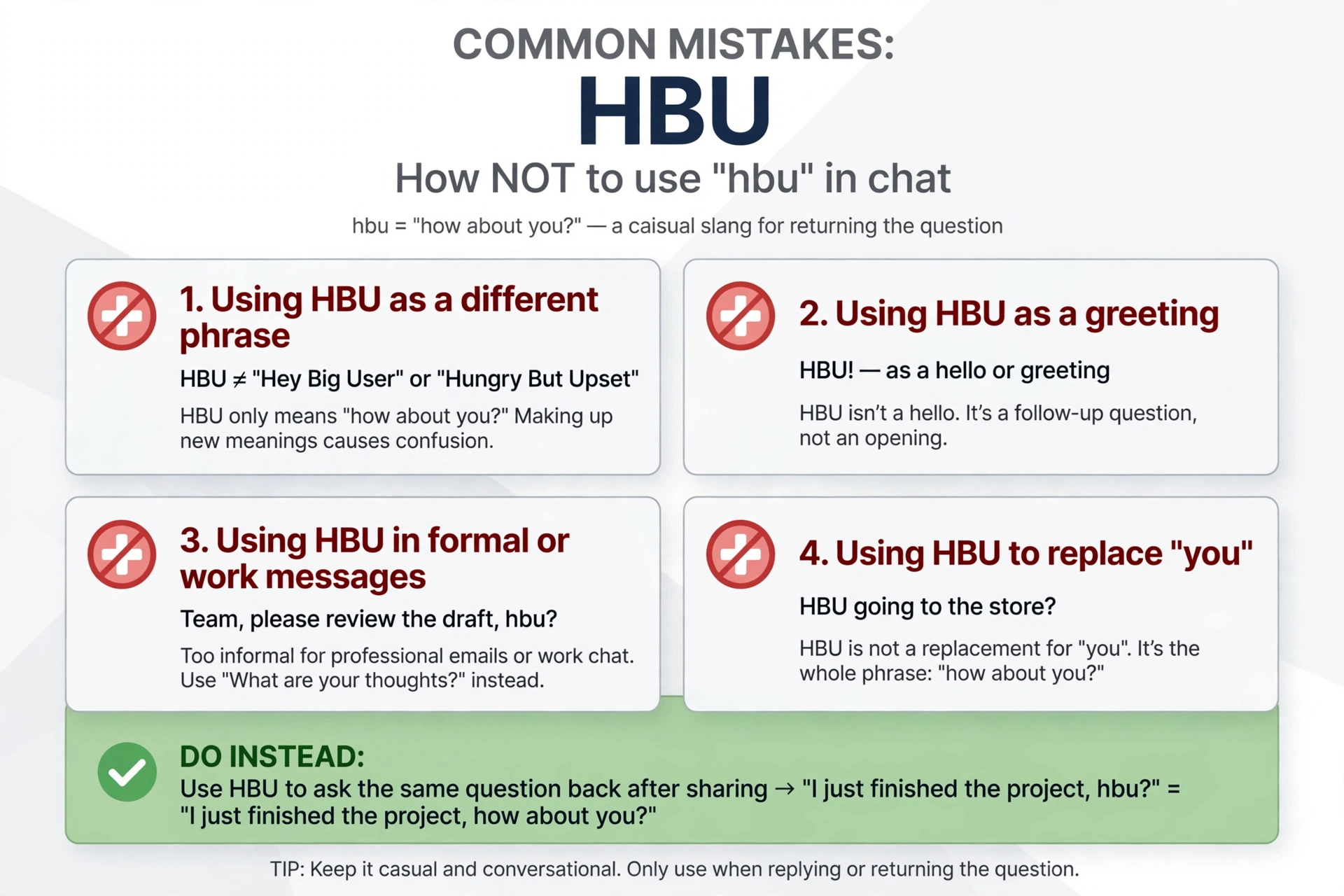
The hbu meaning in chat is simple, but people still manage to use it awkwardly. Here are the mistakes to avoid:
- Using it as a conversation opener. “HBU?” with no prior message is confusing — there’s nothing to bounce back. Always share or answer first.
- Using it in formal settings. Job applications, client emails, messages to professors or senior executives — HBU reads as careless here. Write it out in full.
- Stacking it redundantly. “How are you? HBU?” is repetitive. Pick one: “How are you?” or your answer + “HBU?”
- Using it with strangers in serious contexts. If a customer support agent or a new professional contact messages you, reply with full sentences, not abbreviations.
- Assuming everyone knows it. Texting your grandma “Doing well, hbu?” might get you a very confused phone call. With less tech-savvy people, spell it out.
- Overusing it. Ending every single message with HBU makes conversations feel like a tennis match with no rallies. Sometimes just share your update and let them respond naturally.
- Using it to dodge answering. “HBU?” right after someone asks you a direct question — without answering it yourself first — can come across as evasive. Answer first, then bounce it back.
Quick Tips
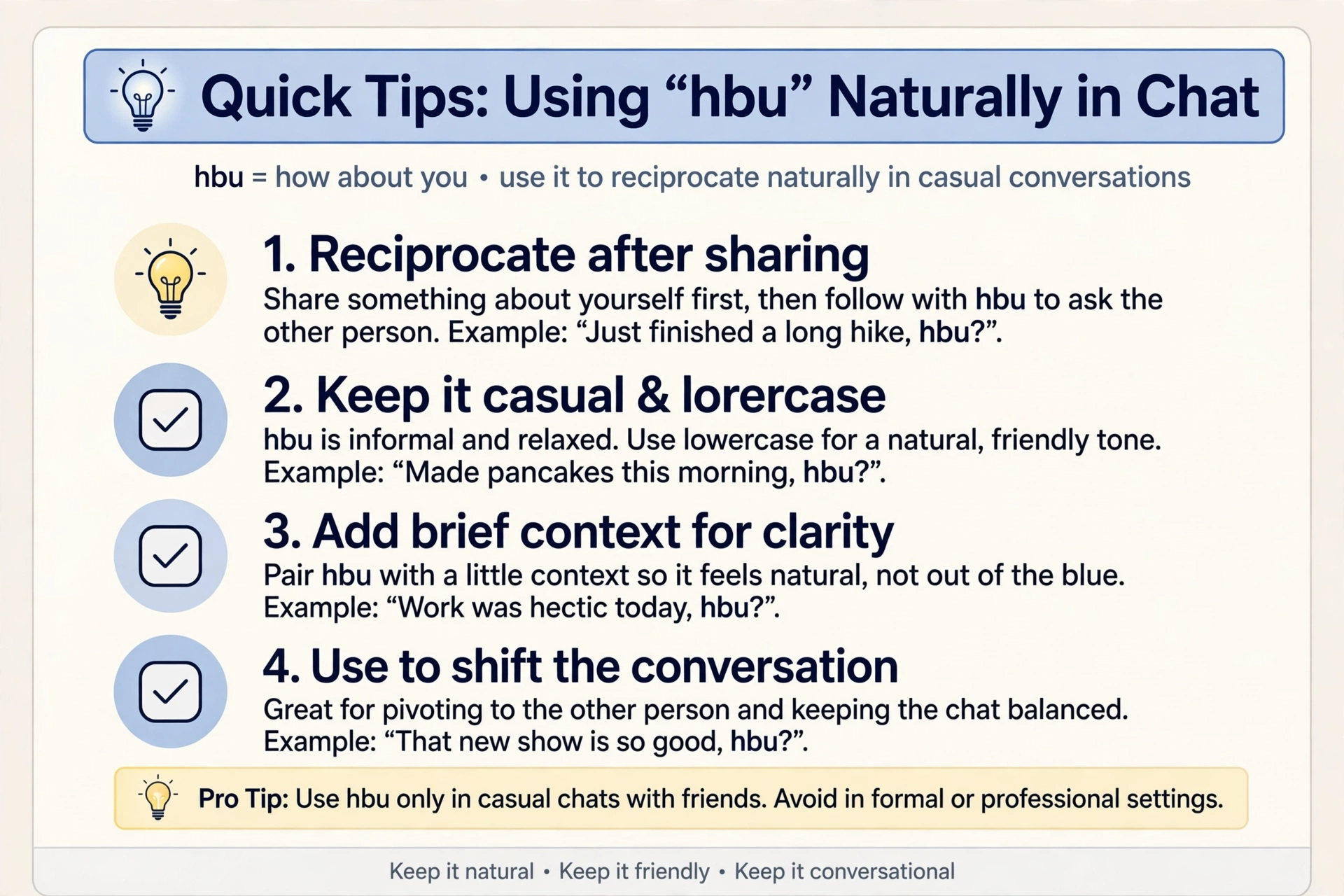
Now that you know the hbu meaning in chat, here are quick tips to use it like a natural:
- Pair it with a genuine answer. “I’m good, HBU?” works because “I’m good” is real. An empty “HBU?” after nothing feels hollow.
- Match the other person’s energy. If they wrote two sentences, don’t reply with just “hbu.” Mirror their effort level.
- Add an emoji for warmth. “Doing great! HBU? 😊” feels friendlier than the bare abbreviation — small touch, big difference.
- Use it to revive dying chats. When a conversation is fizzling, “Anyway, I’m grabbing coffee. HBU — what’s new with you?” is a natural restart.
- On dating apps, follow it with something specific. “I’m into hiking and bad reality TV. HBU — what’s your weekend usually look like?” beats a bare “HBU?” every time.
- Know when to spell it out. With parents, older relatives, bosses, or anyone formal: “How about you?” in full. It costs you two seconds.
- Don’t stress the question mark. “HBU” and “HBU?” are identical in meaning. Use whichever you type naturally.
- Reply to HBU with substance. When someone sends you HBU, give them something real to work with — a detail, a feeling, a plan — not just “nm hbu” back. Conversations die in loops.
FAQ
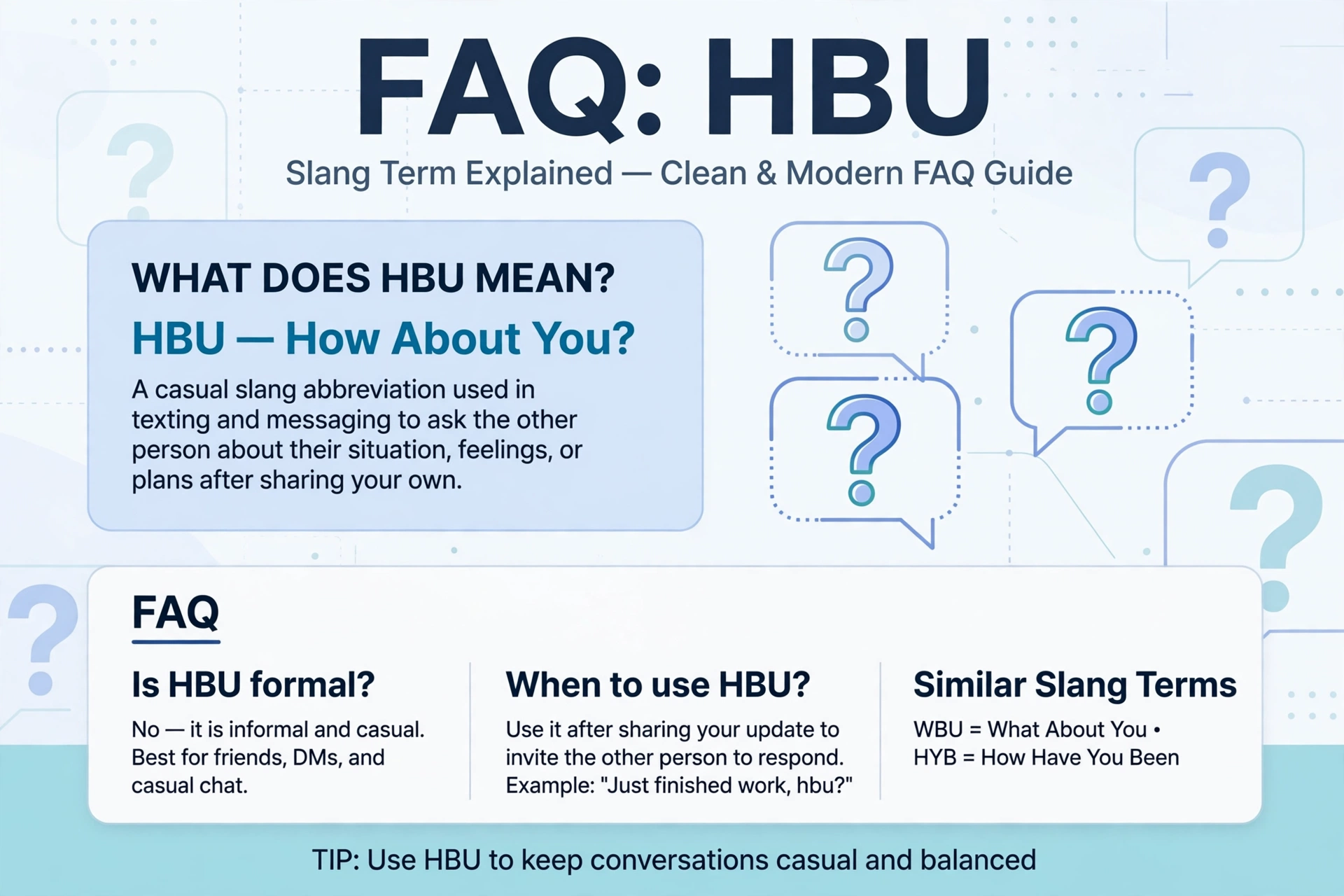
What does HBU mean in chat?
HBU stands for “how about you” — that is the hbu meaning in chat in a nutshell. It’s a texting abbreviation people use to bounce a question back to the other person after sharing their own answer — for example, “I’m doing well, HBU?” means “I’m doing well, how about you?”
What does HBU stand for in texting?
HBU stands for “how about you.” It originated in early-2000s SMS culture as a shortcut to save characters, and it remains one of the most widely used texting abbreviations in casual digital conversation today.
Is HBU the same as WBU?
Essentially, yes. HBU means “how about you” and WBU means “what about you” — they’re near-synonyms in casual chat. Some people feel WBU is slightly more direct, but in real conversations they’re interchangeable. Use whichever you prefer.
How do you reply to HBU?
Just answer honestly with a little detail. If someone texts “Just finished work, HBU?” reply with your own update: “Nice! I’m still at the office, heading out soon.” Avoid looping it straight back with “nm, hbu?” — that stalls the conversation. Share something real and, if you like, ask a follow-up question.
Is HBU flirty or just friendly?
It’s friendly by default. HBU only reads as flirty when the surrounding context is flirty — for example, “Can’t stop smiling after tonight 😊 HBU?” The abbreviation itself is neutral; the tone comes from the rest of the message.
Is it rude to say HBU?
No — in casual chats it’s polite, because it shows interest in the other person. It only becomes rude in the wrong context: formal emails, professional messages to people you don’t know well, or when used to dodge answering a direct question.
Can I use HBU in professional messages?
Not in formal ones. Skip HBU in emails, client messages, and anything going to senior colleagues. It’s acceptable in informal workplace chat (like a Slack DM with a friendly coworker), but when in doubt, write “how about you?” in full.
What does HBU mean on Snapchat, WhatsApp, and Instagram?
It means the same thing everywhere: “how about you.” On Snapchat it’s common in story replies and streak chats; on WhatsApp it shows up in group and one-on-one conversations; on Instagram it’s frequent in DMs. The platform doesn’t change the meaning.
Conclusion
So there you have it — the complete story behind the hbu meaning in chat. Three little letters that stand for “how about you,” carrying a surprising amount of social intelligence: share something about yourself, then hand the conversation back with genuine interest.
The key takeaways are simple. Use HBU after sharing your own answer — never as a cold opener. Keep it casual — it’s perfect for friends, family, dating apps, and informal chats, but has no place in formal or professional communication. Reply with substance when someone sends it to you, because conversations thrive on real details, not abbreviation tennis. And know its cousins — WBU is basically the same thing, HRU is the standalone version, and WYD asks about activity instead.
Texting slang can feel like a secret code when you’re on the outside, but HBU is one of the friendliest terms in the whole dictionary — and once you crack one abbreviation, the rest follow. Whether you’re decoding what WYF means or just want to keep your chats flowing, you now have the complete playbook. Now the next time your phone buzzes with “HBU?”, you won’t freeze. You’ll know exactly what it means — and exactly what to say back.

3 thoughts on “HBU Meaning in Chat: What It Stands For, How to Use It, and How to Reply Like a Pro”