Quick definition: British slang insults are informal, often funny British words for a foolish, annoying, or unpleasant person — words like muppet, plonker, numpty, git, and prat. Most of them are mild and playful, and in Britain they are used as often between friends as in anger. The trick is knowing the rudeness level: calling a friend a muppet for forgetting his keys is affectionate teasing, while calling a stranger a wanker is a genuine insult. Same country, same habit of inventing words — very different effect.
British Slang Insults Meaning & Definition
At its simplest, a British slang insult is a colloquial word or phrase used to call someone foolish, incompetent, annoying, or unpleasant, without reaching for formal language. Where American English might settle for “idiot” or “jerk,” British English has dozens of options, each with its own flavour, region, and level of sting. Muppet means a foolish or incompetent person whose efforts are hopelessly clumsy. Plonker is someone who has just made a silly mistake. Numpty, originally Scottish and now used all over Britain, is a stupid or incompetent person. Git is an unpleasant or contemptible person, roughly a “jerk.” Prat is a foolish, ineffectual person — the word behind the pratfall, the fall on your backside.
What makes British slang insults different from ordinary insults is the role of banter. Banter is the British habit of trading mock insults with friends as a form of affection, and it is everywhere: in pubs, in group chats, on football terraces, and in British television comedy. The insult is the joke, and the friendship is proved by how much teasing it can take. That is why so many of these words sound funny rather than cruel. Wally, donut, pillock, and daft are almost impossible to say angrily. They come out sounding like a laugh, even when they mean “you have been very silly indeed.” A British slang insult is therefore best understood as a social tool, not just a word: it can wound, but more often it bonds, deflates pomposity, or turns an embarrassing mistake into a story everyone can laugh at.
There is also a rudeness scale, and learning it matters more than learning the words themselves. At the mild end sit muppet, plonker, wally, berk, and donut — safe with friends, safe in most workplaces if the tone is right, and safe on television before the watershed. In the middle sit git, prat, pillock, gobshite, melt, and wazzock — cheeky, a little rude, and best kept for people who know you are joking. At the strong end sit tosser, bellend, knobhead, and wanker — vulgar, genuinely offensive to many people, and never safe with strangers, bosses, or anyone’s grandmother. This guide keeps that scale visible throughout, because the most common mistake visitors make is not choosing the wrong word, but choosing the right word at the wrong strength. For a wider tour of how regional vocabularies work across the English-speaking world, our Scottish slang guide covers the northern words — numpty, bampot, and eejit — that travelled south and became pan-British.
| Term | Plain meaning | Rudeness level |
|---|---|---|
| Muppet | A foolish, clumsy, incompetent person | Mild — playful |
| Plonker | Someone who made a silly mistake | Mild — affectionate |
| Numpty | A stupid or incompetent person | Mild to medium |
| Berk | An idiot or fool | Mild in use, rude in origin |
| Wally | A silly, clumsy person | Mild — gentle |
| Git | An unpleasant, contemptible person | Medium — like “jerk” |
| Prat | A foolish, ineffectual person | Medium |
| Pillock | A stupid, irritating person | Medium |
| Gobshite | Someone who talks nonsense | Medium to strong |
| Tosser | An irritating, contemptible person | Strong — vulgar |
| Bellend | A stupid or contemptible person | Strong — vulgar |
| Wanker | An objectionable, foolish person | Strong — vulgar |
Introduction
You have heard them in British shows and films, even if you did not know what they meant. A character locks his keys in the car and his friend sighs, “You absolute muppet.” A football fan shouts at the referee, “You plonker!” A Londoner in a sitcom mutters, “What a complete prat.” None of these people is reaching for a dictionary. They are reaching for the word that fits the moment: how annoyed they are, how well they know the person, and how funny they want it to sound. British slang insults are precision instruments disguised as jokes.
This guide explains British slang insults the way a British friend would: the meanings first, then the origins, then the rudeness scale, then the regional flavours, and then the rules of banter that decide whether a word lands as a laugh or as a fight. You will get the 30-plus terms Americans meet most often — from the gentle donut to the vulgar wanker — with real examples for friendly chats, work settings, and funny moments, a comparison with American equivalents, and a clear list of the words to avoid entirely. By the end, you will know why berk is ruder than it sounds, why numpty is Scottish, why muppet is almost affectionate, and why you should never call someone a chav. Read the scale, mind the context, and you will understand the joke instead of becoming it.

Origin
British slang insults have deep and wonderfully mixed origins, which is part of their charm. Some are centuries old. Prat is traced by the Oxford English Dictionary to the sixteenth century, where it originally referred to the buttocks; the pratfall — falling flat on your backside — is the same word in action, and the fool who falls became the fool himself. Nincompoop has a learned past: Samuel Johnson, compiler of England’s first proper dictionary, claimed it came from the Latin legal phrase non compos mentis, “not of sound mind.” Pillock travelled a longer road: it comes from pillicock, an old word that appears in Shakespeare’s King Lear, and was shortened and softened over centuries into a general word for a fool — though the Oxford English Dictionary still records its older, anatomical sense alongside the modern “stupid person” sense, with the figurative use cited from 1967.
Other British slang insults are much newer, and their origins show how Britain invents words. Muppet was borrowed from Jim Henson’s puppet characters and repurposed as an insult in the 1990s: someone whose attempts at competence are so inadequate that they seem to need someone else pulling the strings. It is hard to call someone a muppet while fully hating them, which is exactly why it works as affectionate contempt. Numpty is relatively new too, becoming a common British insult only in the 1980s, and it spread from Scotland to the rest of Britain on the back of television and football. Git comes from the old Scots word get, meaning a bastard in the literal, illegitimate-birth sense; as it travelled south it lost its harsh vowel and much of its sting, becoming the softer, spikier word Britons use today. Berk has the most surprising origin of all: it is Cockney rhyming slang, a shortening of “Berkeley Hunt,” which rhymes with a much ruder word. Most people who say “berk” have no idea, and use it as a friendly “idiot” — but the origin is a reminder that Cockney rhyming slang was designed to hide meaning from outsiders.
The engine behind all of this is class, region, and comedy. Britain’s regions each contributed words — Scotland gave numpty and bampot, the north of England gave wazzock, Ireland and Northern Ireland gave gobshite and eejit, London gave Cockney rhyming slang — and national television, football, and the internet mixed them together until a word from Glasgow could be heard in a London pub. British comedy then polished them: sitcoms, panel shows, and stand-up turned insults into catchphrases, and catchphrases into everyday speech. The history of British insults is also recorded in the great slang dictionaries, from Captain Francis Grose’s Dictionary of the Vulgar Tongue in 1811, which preserved words like clod-hopper for a slow-witted country bumpkin, to the modern Oxford English Dictionary entries that track each word’s journey. For the wider story of how British English itself varies by region and class, the British English overview is a useful starting point, and it explains why one small island has so many different ways to call someone a fool.
Popularity
British slang insults are popular for a simple reason: Britain loves understatement, and a funny insult is understatement in action. Saying “you muppet” instead of “you are behaving very foolishly” is shorter, funnier, and less confrontational. It lets the speaker complain without starting a row, and lets the listener laugh at themselves without losing face. That is why these words turn up constantly in everyday British life — in pubs, offices, school playgrounds, family WhatsApp groups, and football chants — and why they travel so well. American viewers meet them through British television, from classic sitcoms to modern panel shows, and through TikTok and YouTube clips where a perfectly timed “you absolute plonker” does more work than a paragraph of explanation.
Their popularity online follows a pattern. People do not search for British slang insults because the words are trending; they search because they heard one, did not quite get it, and want a fast answer before they reply or repeat it. A viewer hears “numpty” in a Scottish comedy, a gamer hears “gobshite” in a stream, a reader meets “pillock” in a novel, and the search begins. That curiosity is also why listicles of “50 British insults” are everywhere — but most of them are bare lists, with no rudeness scale, no regional notes, and no warning about which words are classist, sexist, or genuinely vulgar. This guide is built to fill exactly those gaps: every term here carries its strength, its region, and its safe-use rule, so you can enjoy the humour without stepping on a landmine. Regional slang travels the same way everywhere, which is why our Irish slang guide, with its own eejit and gobshite, and our Australian slang guide, with its cheerfully rude vocabulary, follow the same pattern: a core meaning everyone shares, plus local uses only insiders know.
There is also a cultural reason these words endure. Britain’s insult tradition prizes wit over volume. The ideal British insult is specific, surprising, and a little bit absurd — it identifies exactly what is wrong with someone, in a word that sounds like what it means. Numpty sounds befuddled. Wazzock sounds like a stumble. Gormless sounds vacant. A generic “idiot” does none of that work. So the vocabulary keeps growing, and older words keep being revived by new generations: wasteman, wet wipe, and neek (a blend of “nerd” and “geek”) are the youth-slang additions, used by younger Britons on TikTok and in group chats, while muppet, plonker, and prat remain the classics that every generation inherits. Old or new, the rule is the same: the funnier and more specific the word, the longer it lives.
How It Is Used
In practice, British slang insults show up in three main patterns. The first is the affectionate tease between friends: “You muppet, you put the teabag in the sugar bowl!” The mistake is small, the friendship is solid, and the insult is really a laugh shared at the speaker’s expense as much as the listener’s. The second is the exasperated reaction: “That pillock parked across two spaces!” The speaker does not know the driver, but the word vents annoyance without escalating anything. The third is the genuine insult, usually with one of the stronger words: “That tosser cut me off in traffic!” Here the tone is flat, the word is vulgar, and nobody is laughing. The same vocabulary does all three jobs, and tone, relationship, and setting decide which job it is doing.
Three features of British usage are worth learning. First, the intensifiers. Britons rarely say a bare “muppet.” They say “you absolute muppet,” “you complete prat,” “you proper numpty,” or “you daft sod.” Absolute, complete, and proper are the standard strengtheners, and they are almost always affectionate in the mild words and genuinely annoyed in the strong ones. Second, the softeners. Adding “mate,” “love,” or a laughing emoji turns an insult into banter: “Don’t be a melt, mate, it was only a joke.” Third, the self-insult. Britons happily call themselves these words — “What a plonker I am, I locked my keys in the car” — and self-deprecation is often the safest way to use them at all. If you are unsure whether a word is welcome, using it on yourself first is the classic British test: if people laugh, the word is safe in that group; if they wince, it is not.
Regional flavour changes the words people reach for. In Scotland, numpty, bampot (a foolish or crazy person), and tube are everyday currency, and eejit crosses over from Ireland. In the north of England, wazzock — a contraction of the sarcastic “wiseacre,” a know-it-all — is a 1990s lad-culture favourite that never quite left. In London, Cockney rhyming slang still supplies berk, and the East End habit of shortening everything gives us div (short for “divot,” a stupid person) and plank (“thick as a plank”). In Ireland and Northern Ireland, gobshite — someone who talks nonsense, from “gob,” the mouth — is so common that many Britons assume it is English, not Irish. And everywhere, the class dimension matters: some older insults, like chav, trollop, and scrubber, are loaded with class or misogynistic meaning, and modern Britons increasingly avoid them. This guide lists them in the “avoid” section below, because knowing why a word is off-limits is as useful as knowing the words you can use. The southern slang of the American South works the same way — a shared vocabulary with local rules about who can say what to whom — and the comparison is a good reminder that every region guards its insults differently.
| Situation | Safe word | Word to avoid |
|---|---|---|
| Friend makes a silly mistake | Muppet, plonker, donut | Wanker, bellend |
| Someone annoys you mildly | Git, prat, pillock | Tosser, knobhead |
| At work, with colleagues you know well | Donut, daft, numpty (lightly) | Any vulgar term |
| With a stranger | None — use plain English | Every slang insult |
| Joking about yourself | Plonker, muppet, wally | Chav, trollop, scrubber |
| Online, to someone you do not know | None — tone does not travel | Every slang insult |
Examples
The best way to learn British slang insults is to see them in real messages and moments, with the situation attached. The same word can be a greeting, a joke, or a genuine complaint depending on where it lands. These examples cover the range: friendly chats, work and professional settings, and the funny, exaggerated moments where British insults shine.
Friendly Examples
- “You forgot your wallet again? You muppet.” — The classic affectionate tease. A small mistake, a close friend, no harm meant.
- “Stop messing about, you plonker.” — Gentle, old-school, and almost always said with a smile. A favourite of parents and grandparents.
- “I waved back at someone who wasn’t waving at me — wally me.” — Self-deprecation. Calling yourself the insult is the safest use of all.
- “Don’t be such a numpty, you can’t charge your phone in the microwave.” — Scottish in origin, now universal. The absurdity of the mistake makes the word funny.
- “You’re being daft if you think wearing shorts in December is a good idea.” — Daft is silly in an endearing way, like calling someone a lovable fool.
- “Come on, dipstick, it’s not rocket science!” — Dipstick is for someone being particularly slow in the moment, not generally stupid.
- “He’s a bit of a melt about it, honestly.” — Melt means someone being pathetic or over-emotional about something small. Teasing, not cruel, between friends.
- “Look at that nutter dancing on the table!” — Nutter is a silly or eccentric person. Used warmly here; note it can be hurtful if aimed at real mental-health struggles, so keep it for voluntary silliness.
Professional Examples
In professional settings, British slang insults are rare, light, and almost always self-directed or aimed at a shared, harmless mistake. The rule is the same as for any slang at work: if the relationship and the workplace culture support it, a light touch is fine. If they do not, keep it in plain, standard English. A manager would never call a colleague a git in a meeting. The same manager might, after locking herself out of a shared document for the third time, sigh “I’m being a proper donut today” — and everyone laughs, because the insult is aimed at herself.
- “Sorry — I’m being a donut, I sent the draft to the wrong folder.” — Self-deprecation at work. Safe, funny, and human.
- “Don’t be a mug, double-check the invoice before you pay it.” — Mug means a foolish, gullible person. Here it is advice, not an insult, and it works because it is aimed at a situation, not a person.
- “He’s a bit gormless in meetings, but he means well.” — Gormless means lacking sense or initiative, often with a vacant expression. Said about an absent colleague, this is gossip; said to a friend about yourself, it is a joke. Context decides.
- “We were all plonkers on that call — nobody checked the time zone.” — Shared blame, shared word. Spreading the insult across the team makes it safe.
- “Let’s not be divs about this — read the brief before the client call.” — Div used as a team pep talk. Works only in a close, informal team.
Funny Examples
Humour is where British slang insults earn their keep. As reactions, they are the text equivalent of a double-take: something unbelievable happens, and before you have a full sentence ready, “You absolute muppet!” is already out. Meme captions use them the same way, often under a photo or clip that needs no further explanation.
- “You absolute muppet, you’ve put the milk in before the teabag!” — The canonical muppet example. A tiny domestic crime, a huge overreaction, and everyone knows it.
- “What a plonker, he tried to use a fork to eat soup!” — The sillier the mistake, the funnier the word. Exaggeration is the point.
- “You great turnip, that’s not how you use a microwave!” — Turnip is a stupid or slow person, and the vegetable comparison is what makes it funny.
- “That wazzock nearly crashed into me!” — Northern, annoyed, and funny precisely because the word itself sounds like a stumble.
- “Only a complete nincompoop would try to fix that without tools.” — The old-fashioned word makes the joke: it sounds like it walked out of a Dickens novel.
- “Don’t be such a wet wipe, it was just a joke.” — Wet wipe means someone soft, who cannot handle banter. The insult is that you cannot take an insult — which is, itself, very British.
- “He’s such a wasteman, never shows up when he says he will.” — Modern youth slang. Wasteman is someone unreliable who wastes everyone’s time.
| Term | Example sentence | What it really means |
|---|---|---|
| Muppet | “You muppet, you left the oven on!” | You clumsy fool — said with affection |
| Plonker | “Stop being a plonker and help me.” | You silly thing — gentle teasing |
| Numpty | “What kind of numpty parks like that?” | What an incompetent person |
| Git | “You’re being a right git today.” | You’re being unpleasant — medium strength |
| Prat | “You complete prat, you’ve ruined it!” | You foolish, ineffectual person |
| Pillock | “That pillock parked across two spaces.” | That irritating idiot |
| Berk | “You’re a complete berk for forgetting your umbrella.” | You’re an idiot — friendlier than it sounds |
| Gobshite | “Ignore him, he’s a total gobshite.” | He talks nonsense |

Comparison with Similar Terms
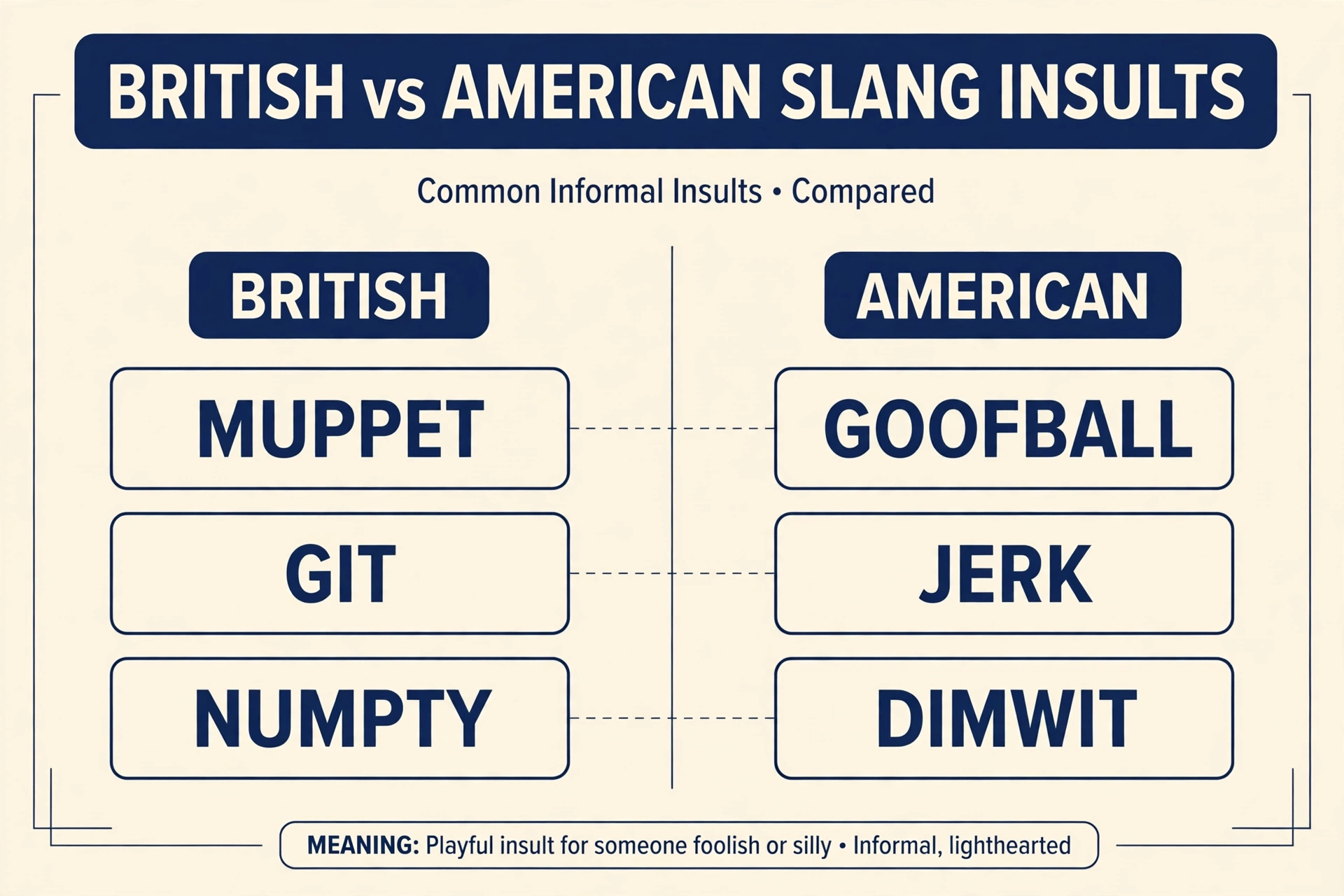
British slang insults are often compared with American insults, but the two traditions work differently. American insults tend to be direct and absolute — “idiot,” “moron,” “jerk,” “asshole” — and the strength is in the word itself. British insults tend to be indirect and graded: the same idea can be expressed at five different strengths, and the choice of word tells the listener how angry the speaker really is. “You donut” is barely an insult at all. “You wanker” is a fight. The comparison table below maps the most common British terms to their nearest American equivalents, with a warning: the equivalents are approximate, because the British words carry tone, region, and humour that the American words do not.
Within Britain, the terms also need separating from each other. Muppet, plonker, and wally all mean “fool,” but muppet stresses incompetence, plonker stresses a single silly mistake, and wally stresses harmless clumsiness. Git and prat both mean an unpleasant fool, but git stresses unpleasantness and prat stresses ineffectual silliness. Pillock and numpty both mean a stupid person, but pillock is irritating and numpty is incompetent. Tosser, wanker, bellend, and knobhead are all vulgar, but they are not interchangeable in company: tosser is the mildest of the strong group, and wanker is the one most likely to genuinely offend. Learning the distinctions is the difference between sounding British and sounding like a phrasebook.
British insults also differ from Australian and Irish neighbours. Australian slang is blunter and more cheerful about rudeness — words like drongo and galah for a fool are close cousins of muppet, but Australians deploy them with less worry about class. Irish slang, like eejit and gobshite, shares the British love of the musical, funny-sounding fool-word, and the two traditions have been borrowing from each other for centuries. The shared lesson is that English-speaking countries all invent fool-words, but Britain invented the most, graded them the most carefully, and turned the grading itself into a national pastime.
| British term | Nearest American equivalent | Strength match? |
|---|---|---|
| Muppet | Goofball, knucklehead | Yes — playful |
| Plonker | Doofus, goof | Yes — gentle |
| Numpty | Dimwit, blockhead | Yes — mild to medium |
| Berk | Idiot, dummy | Yes — but berk is ruder in origin |
| Git | Jerk | Yes — the closest match |
| Prat | Jerk, jackass (mild) | Close — prat is sillier |
| Pillock | Idiot, dolt | Yes — irritating idiot |
| Gobshite | Bullshitter | Close — gobshite is about talk |
| Tosser | Jerk, ass (vulgar) | Close — tosser is vulgar |
| Wanker | Dick, asshole (vulgar) | Yes — strong and vulgar |
| Mug | Sucker, chump | Yes — gullible fool |
| Skiver | Slacker, shirker | Yes — work-shirker |
Alternate Meanings
Not every word on this list is only an insult, and a few of them have completely separate lives that are worth knowing, especially for searchers who land here from a different question. First, several of these words are ordinary nouns before they are insults. Muppet is, first and foremost, a Jim Henson puppet character — Kermit, Miss Piggy, and the rest — and the insult sense is a borrowing from that. Donut (or doughnut) is a ring-shaped cake before it is a fool, and the insult works precisely because the cake is soft, round, and a bit silly. Plank is a long flat piece of timber before it is a dim-witted person, in the phrase “thick as a plank.” Melt is a verb meaning to turn from solid to liquid before it is a person being pathetic. Mug is a cup before it is a gullible person, and a face in old slang. Knowing the literal meaning usually explains the insult: the fool is like the object — soft, flat, empty, or easily manipulated.
Second, some of these words have regional senses that differ from the insult. Git in older Scots meant a child, and in some northern dialects it kept a softer sense for longer. Berk in Cockney rhyming slang is a deliberate disguise: rhyming slang replaces a word with a phrase that rhymes with it, then drops the rhyming part, so “Berkeley Hunt” becomes just “berk,” and outsiders hear a harmless word. Chav, which this guide tells you to avoid, originally circulated as a word for a young working-class person, supposedly from the Romani word chavi, meaning child — and its journey from neutral description to class insult is exactly why it is now considered snobbish and offensive. Skiver is not an insult to intelligence at all: it means someone who dodges work or responsibility, from an Old Norse root meaning to slice off, as in slicing off as much work as possible.
Third, a warning about words that sound like insults but are not, and words that are insults in one place and neutral in another. Daft in northern England can simply mean silly or mad in a fond way, and “daft as a brush” is a term of endearment. Nutter in British football culture can mean a passionate, eccentric fan, with no insult intended. Cheeky is not an insult at all — it means impudent in a funny, likeable way — but it travels with these words so often that visitors mix it in; “cheeky git” is a fond phrase, not a double insult. And wanker has a separate, literal sense that makes it far stronger than its neighbours: it refers to masturbation, which is why it sits at the top of the rudeness scale and why it shocks in a way tosser does not quite. Context, region, and literal meaning all matter, and no single-word translation survives contact with all three.
Professional or Polite Alternatives
Slang insults are for friends, family, and informal online spaces. In formal writing, in messages to strangers, and in professional settings, the polite move is to describe the behaviour, not label the person, and to use a little more language than the bare minimum. A bare “you plonker” can read as rude in a formal context even when you meant it warmly. The alternatives below keep the meaning and remove the ambiguity.
- Instead of “you muppet” to a colleague: “No worries — easy mistake, we’ve all done it.” It says the same thing, without the label.
- Instead of “you’re being a git” to a stranger: “That wasn’t very considerate, to be honest.” Direct, polite, and about the action.
- Instead of “what a prat” about a public figure: “That was a foolish decision, and it backfired.” Criticise the decision, not the person.
- Instead of “don’t be a pillock” to someone you do not know well: “Careful — that approach might not work.” Advice reads better than a label.
- Instead of “he’s a gobshite” in a work setting: “Take what he says with a pinch of salt.” The idiom does the warning work politely.
- Instead of any vulgar term in writing: use no insult at all. In published writing, a vulgar British insult reads as aggression, not humour, because the reader cannot hear your tone.
The general principle is simple: the more formal the setting, the more words you should use. Slang earns its place by being short. Politeness earns its place by being explicit. Knowing both registers, and switching between them on purpose, is what fluent British communication actually looks like. Nobody expects you to text your best friend like a business letter, and nobody expects you to email a client like a group chat. The skill is in the switch — and in knowing that the funniest word in the pub is often the worst word in the office.
Common Mistakes
Most mistakes with British slang insults are small, and Britons will usually understand you anyway. But a few of them change the meaning, or make a friendly message read as rude, so they are worth fixing on purpose.
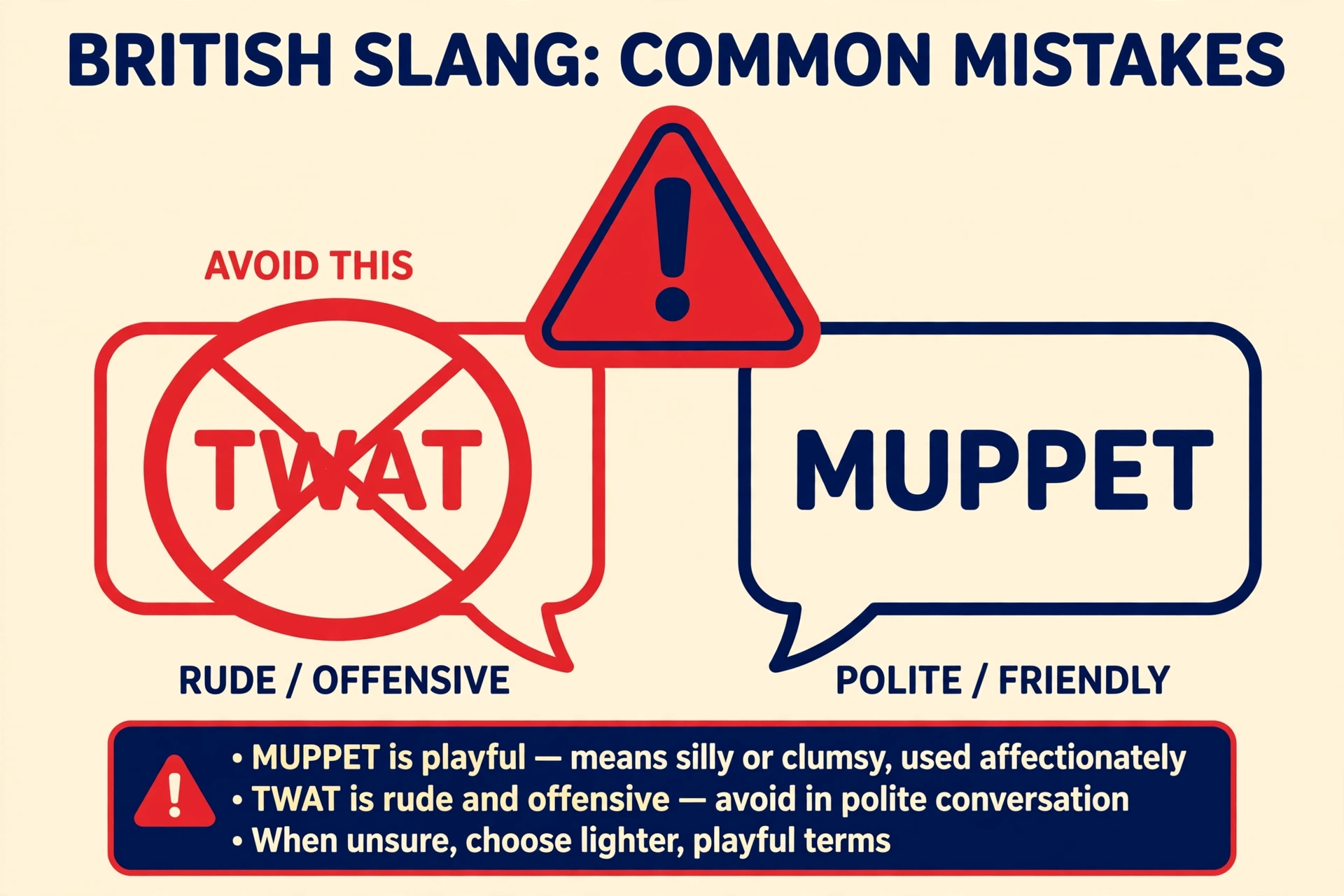
- Using a strong word with a stranger. Tosser, bellend, knobhead, and wanker are vulgar. With friends they can be banter; with strangers they are a genuine insult, and they can start a confrontation. If you do not know the person, use no slang insult at all.
- Assuming “berk” is harmless. It sounds friendly, and most users mean it that way — but it comes from Cockney rhyming slang for a very rude word. Use it with friends, not in formal settings, and know the origin before you repeat it to someone’s grandmother.
- Using class-loaded or misogynistic words. Chav punches down at working-class people. Trollop and scrubber are misogynistic insults for women. Minger, aimed at someone’s looks, is cruel rather than funny. Leave all of them out of your vocabulary; the funny alternatives on this page do the same work without the harm.
- Calling someone a “muppet” in anger. Muppet is almost always affectionate. Using it in a real argument sounds odd, like calling someone a “silly billy” during a row. Match the word to the feeling: mild words for mild feelings, and plain language for real anger.
- Overusing the words. One “you absolute muppet” in a conversation is funny. Ten is a catchphrase, and it stops being funny fast. British banter works on timing and surprise; repeating the same insult drains it.
- Using the words in writing as if tone travels. In a text or a comment, the reader cannot hear your laugh. A “you plonker” without a laughing emoji, a “mate,” or a shared joke can read as cold. Add the softener, or do not send it.
- Mixing up the regions. Calling a Scot a wazzock or a Londoner a bampot is not wrong, exactly — the words travel — but it marks you as someone who learned the words from a list. Listen to what locals actually say, and copy the local word first.
- Thinking every Briton uses these words. Many Britons rarely swear or insult at all, and some find even git rude. Age, class, region, faith, and personality all change the picture. Watch the room before you join in.
Quick Tips
- Start with the mild words. Muppet, plonker, wally, and donut are the safe starter set. Learn them first, and use them on yourself before you use them on anyone else.
- Learn the rudeness scale before the vocabulary. Knowing that wanker is vulgar and muppet is not matters more than knowing twenty extra words.
- Add “absolute,” “complete,” or “proper.” “You absolute muppet” and “you proper numpty” are the natural British forms, and they sound far more authentic than the bare word.
- Soften with “mate” or a laugh. “Don’t be a melt, mate” is banter. “Don’t be a melt” on its own can be a rebuke. The softener is doing real work.
- Use them on yourself first. “What a plonker I am” is the safest entry point, and it earns you the right to tease others in the same group.
- Never use the strong words at work. No context makes wanker or bellend safe in a professional setting. Keep them out of offices, emails, and meetings entirely.
- Listen before you borrow. If your British friends use numpty playfully, join in. If they never swear, follow their lead. Copy the local use, not the list.
- When in doubt, describe the mistake, not the person. “That was a daft thing to do” is almost always safer than “you’re daft,” and it is funnier too.


FAQ
What are British slang insults?
British slang insults are informal British words for a foolish, annoying, or unpleasant person — words like muppet, plonker, numpty, git, and prat. Most are mild and playful and are used between friends as banter, but some, like wanker and bellend, are vulgar and genuinely offensive. The rudeness level, the relationship, and the setting decide how each word lands.
What does “muppet” mean in British slang?
In British slang, a muppet is a foolish or incompetent person whose efforts are clumsy and hopeless — “You absolute muppet, you’ve put the teabag in the sugar bowl!” The word was borrowed from Jim Henson’s puppet characters in the 1990s. It is one of the mildest and most affectionate British insults, and it is hard to say it angrily, which is why friends use it for small mistakes rather than real offences.
What is the rudest British slang insult?
Among the common words, wanker is generally the strongest and most vulgar, followed by bellend and knobhead. Wanker has a literal sexual sense, which is why it shocks in a way that tosser or git does not. All three are best avoided with strangers, at work, and in writing. For everyday teasing, stick to the mild words: muppet, plonker, wally, and donut.
Is “git” a swear word?
Git is a mild swear word, roughly equivalent to the American “jerk.” It comes from the old Scots word get, and it means an unpleasant or contemptible person. It is considered fairly mild in Britain — safe among friends, and heard on television — but it is still an insult, so it is not suitable for formal settings or for strangers. Used with the right tone, it can even sound somewhat endearing: “He’s an annoying sod, but I love that silly git.”
What does “berk” mean, and is it rude?
Berk means an idiot or fool, and in everyday use it is a friendly, mild word: “You’re a complete berk for forgetting your umbrella.” Its origin, however, is rude: it is Cockney rhyming slang, a shortening of “Berkeley Hunt,” which rhymes with a much stronger word. Most people who say it do not know the origin, and it is fine between friends — but knowing where it comes from explains why it is best kept out of formal settings.
What does “numpty” mean in British slang?
Numpty means a stupid, foolish, or incompetent person — “What kind of numpty parks like that?” It is originally Scottish, became common across Britain in the 1980s, and is now pan-British. It is mild to medium in strength: funny between friends, a little pointed when aimed at a stranger. It is one of the most useful British slang insults for visitors, because it is funny, specific, and rarely genuinely offensive.
Can Americans use British slang insults?
Yes, if you use them the way the people around you use them. A mild word like muppet or plonker as a friendly tease is welcome and widely understood, especially by Britons used to American fans of British comedy. Avoid the strong and vulgar words, avoid class-loaded words like chav, and never use any of them with strangers or at work. Listen first, copy the local use, and use the words on yourself before you use them on anyone else.
What is the difference between British and American insults?
American insults tend to be direct and absolute — “idiot,” “jerk” — while British insults are graded and specific, with a different word for every level of rudeness, from the playful donut to the vulgar wanker. British insults also lean heavily on banter: trading mock insults with friends is a form of affection, and the funniest word often wins. The shared lesson is that both traditions invent fool-words, but Britain turned the grading of them into an art form, with region, class, and comedy all shaping which word fits which moment.
Conclusion
British slang insults are a small vocabulary with a large job. They let Britons complain without fighting, tease without wounding, and turn an embarrassing mistake into a joke everyone can share. Learn the mild words first — muppet, plonker, wally, donut — learn the rudeness scale before you learn the rest, and respect the words that are off-limits: the vulgar strong group, and the class-loaded and misogynistic words that modern Britain is leaving behind. The funniest British insult is always the specific one, said at the right moment, to the right person, with a laugh in the voice.
The best way to keep learning is to keep listening to how Britons actually use these words, in the same way you would learn any living slang. Notice when “you muppet” is a greeting and when it is a reaction. Try “what a plonker I am” on yourself, and see how natural the reply feels. And if you enjoy decoding regional speech, keep going with our other guides — Australian slang and Irish slang each show how the English-speaking world invents its own fool-words, with its own jokes attached. British slang insults reward the same habit that unlocks every slang vocabulary: listen for the meaning underneath the word, mind the rudeness scale, and you will understand far more than a list of funny words alone.
