Quick definition: The ikl meaning in text is simple — in texting and online chats, IKL stands for “I know, lol.” It blends acknowledgment (“I know”) with light laughter (“lol”) into one quick reply — the digital equivalent of nodding along while chuckling at what your friend just said.
IKL Meaning in Text: Meaning & Definition
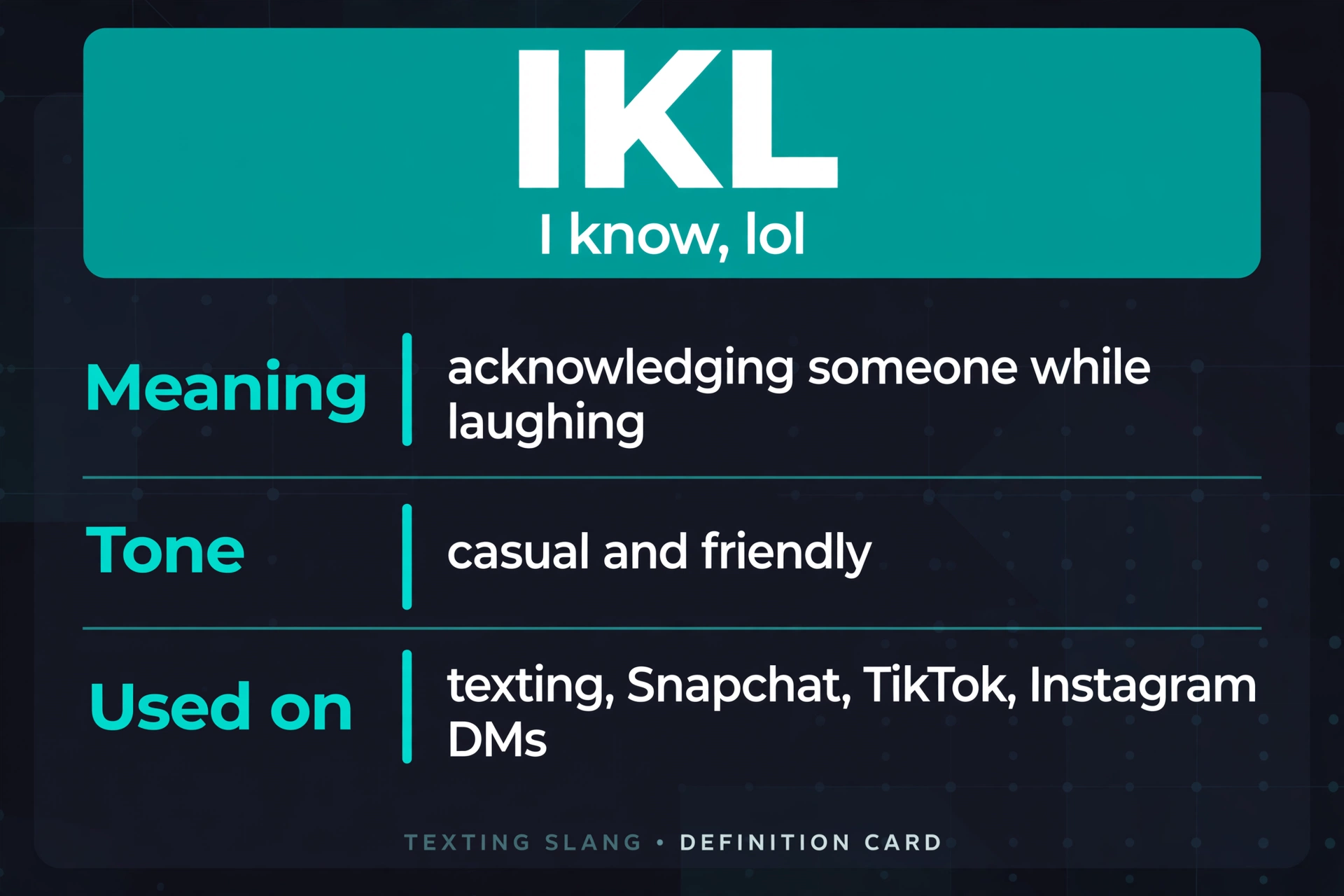
IKL is a casual texting abbreviation that stands for “I know, lol.” It fuses two of the most common reactions in digital conversation — acknowledgment and laughter — into a single three-letter reply. When someone texts you “ikl,” they are essentially saying, “Yeah, I know — haha.”
What makes IKL work so well is that it does two jobs at once. The “I know” half confirms the message landed: you heard them, you get it, you are on the same page. The “lol” half adds warmth and humor, signaling that you are amused rather than annoyed or bored. A plain “IK” on its own can sometimes read as flat or even dismissive — the added L softens the whole thing and keeps the vibe friendly.
| Part of IKL | Stands For | What It Adds to the Message |
|---|---|---|
| I | I | First person — this is your reaction, not a command |
| K | Know | Acknowledgment — “I already get it” or “you’re right” |
| L | LOL (laughing out loud) | Humor and warmth — “and I find it funny” |
Tone-wise, IKL is playful, light, and informal. It is never angry, never formal, and never meant to shut a conversation down. Think of it as the texting version of a knowing grin. You will mostly see it between friends, siblings, cousins, and online buddies — people who already share enough context that a three-letter reply carries a full sentence of meaning.
Pronunciation is simple: most people read it in their heads as the full phrase “I know, lol,” though some say the letters out loud — “I-K-L” — when quoting a message in real life. Either way, the meaning stays the same.
Introduction
You open your phone, your friend sends you a meme about Monday mornings being a personal attack, and all they add underneath is: “ikl 😂”. You stare at those three letters for a second. Is it a typo? Some new Gen Z code you missed? If you have been trying to pin down the ikl meaning in text, take a breath — you are definitely not the only one. Thousands of people across the United States search for this exact slang every single month, and here is the interesting part: almost nobody has written a proper, in-depth guide about it. The biggest slang sites out there mention IKL in a single FAQ line or a one-row glossary table and move on.
That is exactly why this guide exists. If you already know the ikr meaning in text or have looked up the fn meaning in text before, you are already halfway to understanding IKL — it belongs to the same family of quick-fire texting reactions. But IKL has its own personality, its own tone rules, and a few sneaky alternate meanings that can trip you up if you are not careful. In this guide, we will break down what IKL means, where it came from, how to use it naturally, how it compares to similar slang, the mistakes to avoid, and exactly how to reply when someone drops it on you. By the end, you will read and use IKL like a native texter.
Origin
Like most texting slang, IKL was born out of laziness — the good kind. In the late 1990s and early 2000s, texting happened on numeric keypads where typing “I know, that’s hilarious” took roughly a geological era. Early internet chatters on AIM, MSN Messenger, and Yahoo chat were already compressing everything: IK for “I know,” LOL for “laughing out loud,” BRB, TTYL, the whole crew.
At some point, the two most natural reactions to a funny-but-obvious message — “I know” and “lol” — started getting smashed together. Instead of typing both, people just typed IKL. Nobody held a ceremony; it simply emerged the way slang always does, one group chat at a time. As smartphones replaced flip phones and group chats, TikTok comments, and Discord servers took over from AIM, IKL rode along and found a permanent home in casual American texting culture.
It is worth being honest here: tracing the exact birthday of slang like this is nearly impossible. Abbreviations spread through millions of private conversations long before anyone writes them down. What we can say with confidence is that IKL is a natural blend of two well-documented texting staples, and its logic is obvious the moment someone explains it — which is exactly why it stuck.
Popularity
IKL is not a top-10 chart-topper like LOL or OMG, but it has a loyal following, especially among Gen Z and younger millennials in the United States. It thrives in the places where conversations move fast and character counts matter:
- TikTok comments and captions — reacting to relatable or funny videos
- Snapchat chats — quick back-and-forth with close friends
- Instagram DMs — responding to memes and reels shared by friends
- Discord servers — gaming and fandom communities
- iMessage and WhatsApp group chats — everyday friend conversations
Why did it catch on? Speed and vibe. Typing “haha yeah I know right” takes a second; typing “ikl” takes a fraction of one — and somehow it carries the same energy. It also fills a specific emotional gap. “LOL” alone just means something is funny. “IK” alone just means you know. But real reactions are layered: you laugh because you already know how true something is. IKL captures that exact feeling in three letters.
Search interest for IKL meaning spikes whenever the term pops up in a viral TikTok comment thread or a popular streamer’s chat, which then sends a fresh wave of confused parents, teachers, and curious texters to Google. If you are part of that wave — welcome. You are about to be fluent.
How It Is Used
IKL is flexible — it can stand alone as a complete reply or slide into a longer sentence. The placement changes the rhythm slightly, but the core meaning stays the same. Here is how it shows up in real conversations:
| Position | Example | What It Communicates | |
|---|---|---|---|
| Standalone reply | “ikl 😂” | The whole response — “I know, that’s hilarious” | |
| Start of a sentence | “ikl, he does that every single time” | Sets an amused, knowing tone for what follows | |
| Middle of a sentence | “That movie was, ikl, way too relatable” | A casual aside, like a verbal shrug-laugh | |
| End of a sentence | “She really said that out loud, ikl” | A punchline finish — lands the joke softly |
A few usage mechanics worth knowing:
- Lowercase “ikl” is the default — relaxed, breezy, low-effort in the best way.
- Uppercase “IKL” adds emphasis. It reads a little louder, like you are really cracking up or strongly agreeing.
- Emoji pairings are extremely common: 😂 (classic), 💀 (Gen Z “I’m dead” laughter), 👍 (acknowledgment), 👀 (knowing look), 🤣 (extra laughter).
- Punctuation matters. “ikl.” with a period can read slightly dry or sarcastic, while “ikl!!” or “ikl 😭” reads genuinely amused. When in doubt, skip the period.
As for who you can say it to: friends, siblings, cousins, classmates, gaming buddies, and internet friends are all fair game. Your boss, your professor, your grandmother, or anyone in a formal setting? Absolutely not — IKL lives and dies in casual territory, and we will cover the polite alternatives later in this guide.
Examples
Nothing teaches slang faster than seeing it in action. Below are real-world-style examples across different tones. Notice how the meaning of IKL stays consistent — “I know, lol” — while the surrounding context paints the mood.
Friendly Examples
- Friend 1: “I just spent 20 minutes looking for my phone while talking on it”
Friend 2: “ikl 😂 we’ve all been there” - Friend 1: “My dog judges me every time I eat without sharing”
Friend 2: “ikl, that guilt-trip stare is real” - Friend 1: “Group project meeting got moved AGAIN”
Friend 2: “ikl, at this point just tell me when it’s actually happening” - Friend 1: sends a meme about needing coffee to function
Friend 2: “IKL 💀 literally me every morning” - Friend 1: “I told myself I’d sleep early and now it’s 2am”
Friend 2: “ikl, the phone is too powerful”
In each of these, IKL does the same friendly work: I hear you, I relate, and it’s funny. It keeps the conversation warm without demanding a long reply — perfect for busy group chats.
Professional Examples
Let us be direct: IKL is not professional language. You should never use it in a work email, a client message, a school assignment, or any formal document. That said, modern workplaces have gray zones — a casual Slack channel with coworkers you are friendly with, for example. Even there, tread carefully.
- Coworker (casual Slack): “The printer jammed again, third time today”
You: “ikl 😅 that thing has a mind of its own” — acceptable only if your workplace culture is very relaxed - Teammate: “Meeting could have been an email, as usual”
You: “ikl” — risky; a simple “haha, true” is safer
The golden rule: if there is any chance the reader is your manager, a client, or someone you do not know well, swap IKL for a full phrase like “Haha, I know what you mean.” Slang in professional settings is a gamble where the upside is tiny and the downside is looking careless. When in doubt, spell it out.
Funny Examples
- Friend 1: “My plans for the weekend: absolutely nothing, and I’m excited about it”
Friend 2: “ikl, doing nothing is elite behavior 😌” - Friend 1: “I waved back at someone who wasn’t waving at me. I want to move cities”
Friend 2: “IKL 💀 the secondhand embarrassment is real” - Friend 1: “Adulting is just googling ‘is this normal’ over and over”
Friend 2: “ikl, my search history is a cry for help 😂” - Friend 1: “I bought a planner to be organized. It’s still in the plastic”
Friend 2: “ikl, the intention was there and that’s what counts”
| They Text | Tone of Their “ikl” | Best Reply |
|---|---|---|
| “ikl 😂” | Genuinely amused, friendly | “right?? 😂” or keep the joke going |
| “ikl.” | Slightly dry, maybe sarcastic | “haha sorry 😅” or change the subject lightly |
| “IKL 💀” | Cracking up, Gen Z energy | “💀💀” or a laughing emoji back |
| “ikl, exactly” | Agreeing + amused | “glad we’re on the same page lol” |

Comparison with Similar Terms
IKL has a lot of close cousins, and mixing them up is easy. This table puts the whole family side by side so you can feel the difference instantly:
| Term | Stands For | Core Meaning | How It Differs from IKL |
|---|---|---|---|
| IKL | I know, lol | Acknowledgment + laughter | The baseline — knowing and amused |
| IK | I know | Plain acknowledgment | No humor layer; can sound flat or curt |
| IKR | I know, right? | Strong agreement, seeks validation | Agreement-focused, not necessarily funny |
| IKTR | I know that’s right | Emphatic agreement | Bolder and sassier; no laughter implied |
| LOL | Laughing out loud | Amusement | Funny but no “I already knew that” layer |
| LMAO | Laughing my a** off | Stronger laughter | Bigger laugh, less acknowledgment |
| ICL | I can’t lie | Emphasizing honesty | About truthfulness, not laughter — easy to confuse! |
| NGL | Not gonna lie | Blunt honesty | Sets up an honest opinion, not a laugh |
| TBH | To be honest | Sincere opinion | Neutral-polite honesty, no humor built in |
The two mix-ups to watch: IKL vs. IKR — IKR asks for agreement (“I know, right?” expects a “right!”), while IKL just observes with a laugh and needs no response. And IKL vs. ICL — one letter apart, totally different jobs. ICL (“I can’t lie”) is about honesty; IKL (“I know, lol”) is about amused acknowledgment. Confusing them in a reply can genuinely change what your message means, so double-check that middle letter.

Alternate Meanings
“I know, lol” is the primary texting meaning of IKL, but it is not the only one. Context is everything with three-letter abbreviations, so here are the other meanings you might run into:
| Meaning | How Common | Example Context |
|---|---|---|
| “I kinda like” | Uncommon, but real | “ikl this new song, it’s growing on me” — used when warming up to something |
| “Ilk” (English word) | Formal writing only | “Politicians and their ilk” — means “type” or “kind,” usually with a negative shade |
| “I know, lol” | Overwhelmingly the most common in texts | Any casual chat, meme reply, or group message |
The “I kinda like” reading shows up occasionally, usually when someone is talking about music, food, or a new show — situations where “liking” makes more sense than “knowing.” If the sentence is about an opinion rather than a reaction, this is probably the intended meaning.
Then there is the formal English word “ilk,” pronounced the same way but spelled without the capital letters and used in a completely different universe. As Merriam-Webster’s definition of “ilk” explains, it means “type” or “kind” — as in “people of that ilk.” It often carries a slightly disapproving tone (“him and his ilk”). You will essentially never see this meaning in a text message, but knowing it exists stops you from being confused if you encounter “ilk” in an article or a book.
How to tell which meaning applies? Simple rule: if it is a casual text, DM, or comment, it means “I know, lol” about 95% of the time. If it is formal writing, it is the English word “ilk.” And if someone is describing their feelings about a song or a movie, consider “I kinda like.”
Professional or Polite Alternatives
Since IKL stays firmly in casual territory, it helps to have grown-up equivalents ready for every situation. Here is a quick translation guide:
| Instead of “ikl” | Casual-Polite | Professional | Formal |
|---|---|---|---|
| Reacting to something funny | “Haha, I know what you mean” | “That’s amusing — I completely understand” | “I appreciate the humor; I am familiar with the situation” |
| Acknowledging an obvious point | “Yeah, I know, right?” | “Yes, I’m aware of that” | “Indeed, I am already informed” |
| Agreeing warmly | “Lol, exactly” | “Agreed — that’s a fair point” | “I concur entirely” |
| Lightening the mood | “Haha, true” | “Well noted — made me smile” | “Duly noted, with appreciation” |
The pattern is simple: keep the acknowledgment, keep the warmth, drop the abbreviation. In professional settings, full sentences signal respect for the reader’s time and attention — the exact opposite of what slang is for.
Common Mistakes
IKL is easy to use, but these are the traps people fall into most often:
- Confusing IKL with ICL. One letter changes everything: IKL = “I know, lol” (amused), ICL = “I can’t lie” (honest). Replying “icl” when you meant “ikl” can make your message sound oddly serious.
- Using it with the wrong audience. Texting “ikl” to your boss, teacher, or a new client reads as careless. Match your slang to the relationship.
- Dropping it into serious conversations. If someone shares bad news — a breakup, a failed exam, a family emergency — “ikl” is the worst possible reply. It signals laughter where empathy is needed. Read the room first, always.
- Overusing it. If every one of your replies is “ikl,” you start sounding like a bot. Mix in real reactions: emojis, follow-up questions, actual sentences.
- Replying “ikl” to a question that needs an answer. “Can you pick me up at 6?” → “ikl” leaves the person hanging. IKL acknowledges; it does not answer. Give a real yes or no first, then add your “ikl” if you want.
- Misreading the tone. “ikl.” with a period can feel sarcastic or annoyed. If someone sends you a clipped “ikl,” don’t panic — but do consider that they might be lightly teasing you rather than laughing with you.
- Assuming everyone knows it. Parents, older relatives, and non-native English speakers may have no idea what IKL means. With them, just type the full phrase.
Quick Tips
- Do pair IKL with a 😂 or 💀 when you are genuinely laughing — it removes all ambiguity.
- Do use it as a conversation warmer, not a conversation ender — follow it with a question or comment when you want to keep chatting.
- Do match the other person’s energy — if they type in all lowercase with emojis, “ikl 😂” fits perfectly.
- Don’t use IKL in work emails, schoolwork, or formal messages — ever.
- Don’t send a bare “ikl” to someone who asked you a direct question — answer first.
- Don’t use it when someone is upset — switch to empathy mode instead.
How to reply when someone texts YOU “ikl”: good news — no reply is strictly required, since IKL is a reaction, not a question. But if you want to keep the vibe going, a laughing emoji, a “right??”, or building on the joke all work beautifully. If their “ikl” felt a little dry or sarcastic, a light “haha sorry 😅” smooths things over without making it weird.


FAQ
1. What does IKL mean in texting?
IKL stands for “I know, lol.” It is a casual texting abbreviation that combines acknowledgment (“I know”) with light laughter (“lol”). People use it to react to something funny, obvious, or relatable — essentially saying “Yeah, I know — haha” in three letters.
2. What is the ikl meaning in text on Snapchat and TikTok?
The meaning is the same on every platform: “I know, lol.” On Snapchat and TikTok you will mostly see it in comments and quick replies to funny or relatable content — for example, under a meme about procrastination, “ikl 😂” means “I know, that’s so true and it’s hilarious.”
3. Is IKL the same as IKR?
Not quite. IKR means “I know, right?” and is all about strong agreement — it practically asks the other person to confirm. IKL means “I know, lol” and is about amused acknowledgment; it does not need a response. Use IKR when you want to emphasize agreement, IKL when something is funny and already understood.
4. How do you reply to “ikl” in a text?
You don’t have to reply at all, since IKL is a reaction rather than a question. To keep the conversation alive, send a laughing emoji, reply “right??”, or build on the joke. If the “ikl” seemed sarcastic, a friendly “haha sorry 😅” keeps things smooth.
5. Is IKL rude or disrespectful?
No — IKL is friendly and playful by default. It only turns rude if used in the wrong context, like replying “ikl” to someone’s bad news or using it with a boss or teacher. Among friends in casual chats, it is warm and completely fine.
6. What is the difference between IKL and ICL?
They are one letter apart but mean different things. IKL = “I know, lol” (amused acknowledgment). ICL = “I can’t lie” (emphasizing honesty, like “to be honest”). Double-check that middle letter before you send, because swapping them changes your message’s entire tone.
7. Can I use IKL in professional or formal messages?
No. IKL is strictly casual slang. In work emails, client messages, or academic writing, use full phrases instead — “Haha, I know what you mean,” “Yes, I’m aware,” or “Agreed.” Slang in professional settings risks making you look careless.
8. What does IKL mean from a guy or a girl in flirty texts?
The meaning does not change by gender: it still means “I know, lol.” In a flirty or friendly conversation, it usually signals comfortable, playful energy — they get your joke and they’re vibing with you. As with all slang, the surrounding conversation matters more than who sent it.
Conclusion
So, what does IKL mean? Simply put: “I know, lol” — a tiny, efficient package of acknowledgment and laughter that keeps casual conversations flowing. You now know where it came from, how to place it in a sentence, how it differs from lookalikes like IKR and ICL, the alternate meanings to watch for, and exactly how to reply when it lands in your inbox. The golden rules are easy to remember: keep it casual, keep it kind, never aim it at bad news or your boss, and pair it with an emoji when you want the warmth to come through clearly.
Slang is a living thing, and every term you learn makes the next one easier to decode. If this guide cleared things up, keep exploring — the idt meaning in text and csl meaning in text guides break down two more abbreviations from the same texting family in the same plain-English style. Now go forth and “ikl” with confidence — your group chats will thank you. 😄
