
Quick definition: Mexican slang is the informal, everyday vocabulary of Mexican Spanish — words and phrases like güey (dude), órale (let’s go / wow), chido (cool), and no manches (no way!) that Mexicans use in casual conversation but that you will rarely find in a textbook. It grew out of centuries of Nahuatl influence, street culture, and border life, and today it is one of the most recognizable slang systems in the Spanish-speaking world.
Mexican Slang & Definition
Ask a Mexican friend “¿Qué onda?” and you will get a grin. Ask a textbook the same thing and you will get a blank stare — because textbooks teach you that onda means “wave,” and nobody told you it also means “what’s up.” That gap between classroom Spanish and real Spanish is exactly where mexican slang lives.
At its core, mexican slang is not a separate language or dialect. The grammar stays Spanish; only the vocabulary goes casual. Think of it the way American slang relates to formal English — same skeleton, different skin. A Mexican teenager texting friends uses güey, neta, and chido the way an American teen uses “bro,” “for real,” and “dope.” The words are informal, expressive, and deeply tied to identity — they signal that you belong, that you get the joke, that you are one of la banda (the crew).
What makes mexican slang special is its flavor. It borrows heavily from Nahuatl (the language of the Aztecs), it invents euphemisms to dodge vulgarity (no manches instead of no mames), it stretches single words across half a dozen meanings (órale can mean “hurry up,” “wow,” “okay,” or “really?” depending on your tone), and it changes from region to region — a chilango from Mexico City does not sound like a norteño from Monterrey.
In this guide, we will break down 50+ of the most popular mexican slang words and phrases: what they mean, how to pronounce them, real conversation examples with tone context, how they compare to slang in Spain and the rest of Latin America, the mistakes learners always make, and polite alternatives for formal situations. Whether you are learning Spanish, traveling to Mexico, or just trying to understand what your Mexican friends are laughing about in the group chat — this is the complete guide.
Introduction
Picture this: you have studied Spanish for two years. You can conjugate the subjunctive. You know your por from your para. Then you land in Mexico City, a taxi driver turns around and says, “¿Qué onda, güey? ¿A dónde le damos?” — and your two years of Spanish evaporate in about four seconds.
Every Spanish learner hits this wall. Classroom Spanish teaches you the neutral, dictionary version of the language. Real Mexican conversation runs on slang — fast, warm, funny, and completely undocumented in most courses. The good news? Mexican slang is extremely learnable. Most of it follows patterns, the most common 30 or 40 words cover the vast majority of casual conversation, and Mexicans are genuinely delighted when a foreigner drops a well-timed órale.
This guide is built for exactly that moment. We start with the essentials — the words you will hear in your first hour in Mexico — then go deeper: where mexican slang comes from, why it exploded in popularity, how it is actually used across friendly, professional, and funny contexts, and the traps that catch learners (yes, there are words that are friendly with friends and insulting with strangers). By the end, you will not just know what güey means — you will know when to say it, when to avoid it, and how to pronounce it without sounding like a textbook.
If you are building your Spanish slang vocabulary from scratch, our broader Spanish slang guide is a good companion read — it covers the pan-Hispanic terms that work everywhere, while this article goes deep on the words that are unmistakably Mexican.

Origin
Mexican slang did not appear overnight — it is the product of 500 years of language collision. The story has three big chapters.
Chapter one: Nahuatl roots. Before Spanish arrived, the Valley of Mexico spoke Nahuatl, the language of the Aztec Empire. When the two languages met, Spanish absorbed an enormous Nahuatl vocabulary that is still everyday speech: chocolate (from xocolatl), tomate, aguacate (avocado), elote (corn on the cob). Some of today’s slang comes straight from this layer — cuate (buddy, twin) traces to Nahuatl coatl, and apapachar (to cuddle or pamper someone) comes from papachoa. When a Mexican says “te apapacho,” they are speaking 600-year-old Nahuatl without knowing it.
Chapter two: the street invents euphemisms. Much of classic mexican slang was born as creative wordplay around vulgarity. No mames (literally “don’t suck,” used as “no way!”) is vulgar — so everyday speech softened it into no manches, which keeps the punch with none of the offense. Güey itself likely comes from buey (ox) — calling your friend an ox as a term of affection, worn smooth by a century of use. This habit of bending rude words into friendly ones is the engine of mexican slang: take something rough, sand down the edges, and it becomes a term of endearment.
Chapter three: media and the border. In the 20th century, Mexican cinema’s golden age, lucha libre, and later telenovelas broadcast chilango street slang across the whole country. Then the US–Mexico border added a new layer: Spanglish and Chicano slang — troca (truck, from English), parquear (to park), lonche (lunch) — flowed south while Mexican slang flowed north into the United States. Today the exchange runs through TikTok, reggaetón lyrics, and Netflix series, and it moves in both directions at lightning speed.
The Academia Mexicana de la Lengua — Mexico’s official language academy — documents how this everyday vocabulary evolves, and its dictionaries confirm what every learner discovers: the “real” Spanish of Mexico has always been bigger, funnier, and more inventive than the textbook version.
Popularity
Mexican slang is having a global moment, and the numbers explain why:
- 130 million native speakers. Mexico is the largest Spanish-speaking country in the world by far — more than double Spain’s population. When Mexico talks, the Spanish-speaking world listens, and Mexican slang sets the tone for international Spanish-language media.
- The US connection. With over 60 million people of Mexican origin in the United States, mexican slang is now part of American pop culture. Words like órale and güey show up in US movies, music, and memes — many Americans know them without speaking a word of Spanish.
- Streaming made it mainstream. Series like Club de Cuervos, La Casa de las Flores, and Narcos: México beamed unfiltered mexican slang into living rooms worldwide. Viewers who started watching for the plot stayed for the dialogue — and started Googling what no manches meant.
- Music carries it. From classic rancheras to modern reggaetón and corridos tumbados, Mexican artists pack their lyrics with slang. When a song goes viral on TikTok, its slang goes with it — millions of teenagers now know qué onda because they heard it in a 15-second clip.
- Language learners want the real thing. Spanish is the most-studied foreign language in US schools, and a generation of learners has figured out that sounding natural matters more than conjugating perfectly. “Mexican slang” is now one of the most-searched Spanish learning topics in English — learners do not want textbook Spanish anymore; they want the Spanish their friends actually speak.
The result: mexican slang has gone from street code to cultural export. It is the slang foreigners learn first, the slang that crosses borders fastest, and — for many learners — the whole reason they fell in love with Spanish in the first place.
How Mexican Slang Is Used
Knowing what a slang word means is only half the battle — mexican slang lives and dies on context. The same word can be warm, rude, hilarious, or completely neutral depending on who says it, to whom, and with what tone. Here are the patterns that govern real usage:
- It is a warmth dial, not an on/off switch. Mexicans slide between formal and slang constantly. A shopkeeper might greet you with a polite “¿En qué le puedo ayudar?” and, once you are chatting, switch to “órale, güey, ¿qué va a llevar?” That shift is a compliment — it means you have been accepted into the casual zone.
- Tone does the heavy lifting. Órale said flatly means “okay.” Said with rising excitement it means “wow!” Barked quickly it means “hurry up!” Learners who memorize definitions but ignore tone will misunderstand half of what they hear. When in doubt, watch faces, not dictionaries.
- It marks in-groups. Slang is social glue. Using carnal (bro) with your friend group says “we are close.” Using it with a police officer says “I have made a terrible decision.” The rule of thumb: match the energy of the people around you, and let Mexicans slang-ify you before you slang-ify them.
- It is regional. Chido is universal, but plenty of mexican slang is local. Chilango slang (Mexico City) leans on wey, neta, and cámara; the north (norteños) favors compa, fierro, and arre; Yucatán mixes in Maya words. If a word confuses a Mexican from another state, you have found a regionalism — congratulations, that is advanced level.
- Food is a slang minefield (in the best way). Mexican food vocabulary is thick with slang that means something totally different elsewhere. A torta is a sandwich in Mexico (we break down that delicious confusion in our torta slang guide), a chela is a beer, and el mal del puerco — “the pig’s curse” — is the food coma that hits after too many tacos.
The golden rule for learners: understand everything, say a little, and expand gradually. You want to recognize all of it (so you can follow conversations) while only actively using the words you are 100% sure about. That is how you avoid the classic foreigner mistake of calling your girlfriend’s father güey at Sunday dinner.
Examples
Here is mexican slang in action — real phrases organized by tone, so you know not just what to say but where you can say it.
Friendly Examples
These are the everyday workhorses — warm, common, and safe with friends, classmates, and anyone your age in a casual setting:
| Slang | Meaning | Example |
|---|---|---|
| Güey | Dude, bro | “¿Qué haces, güey?” — What are you up to, dude? |
| ¿Qué onda? | What’s up? | “¡Qué onda! ¿Cómo estás?” — Hey! How’s it going? |
| Chido | Cool, awesome | “Tu carro está bien chido.” — Your car is really cool. |
| Órale | Wow / let’s go / okay | “¡Órale! No sabía eso.” — Wow! I didn’t know that. |
| Carnal | Bro (close friend) | “Gracias, carnal, te debo una.” — Thanks, bro, I owe you one. |
| ¿Qué pedo? | What’s up? (very casual) | “¿Qué pedo? ¿Vamos al cine?” — What’s up? Wanna catch a movie? |
| Neta | Really? / for real | “¿Neta? ¡No lo puedo creer!” — Really? I can’t believe it! |
| Sale | Okay / deal / let’s do it | “¿Nos vemos a las 8? — Sale.” — See you at 8? — Deal. |
| Cuate | Buddy, pal | “Es mi cuate desde la primaria.” — He’s been my buddy since elementary school. |
| Padre | Cool (literally “father”) | “¡Qué padre está tu fiesta!” — Your party is so cool! |
Greetings deserve special attention: in Mexico, “¿Qué onda?” works almost exactly like “sup?” in English — casual, friendly, and expected among peers. If you want to see how English speakers handle the same moment, our guide to the best replies to “sup” shows the same social mechanics in another language.
Professional Examples
Yes, some mexican slang survives in workplaces — the trick is knowing which words are office-safe. These are commonly heard in Mexican offices, shops, and service jobs without raising eyebrows:
- “¿Qué tal?” — A neutral “how’s it going?” that works with your boss, clients, and strangers. The safest greeting in Mexican Spanish.
- “Ándale, con eso queda.” — “Alright, that settles it.” Ándale (come on / okay then) is mild enough for work when the tone stays professional.
- “Sale, nos vemos mañana.” — “Okay, see you tomorrow.” Sale as agreement is widely accepted in casual-professional settings.
- “¡Provecho!” — “Enjoy your meal!” Say it when coworkers start eating lunch. It is polite, traditional, and instantly earns goodwill.
- “Está cañón el tráfico hoy.” — “Traffic is rough today.” Cañón (rough/difficult) is mild slang that even managers use.
- “Mande?” — “Excuse me? / Come again?” The standard polite way to ask someone to repeat themselves in Mexico — far more courteous than a bare “¿qué?“
The line is clear: words that express attitude (greetings, agreement, mild emphasis) are usually fine at work; words that express familiarity (güey, carnal, qué pedo) stay with friends. When your Mexican coworkers start calling you güey, you have been promoted — socially, at least.
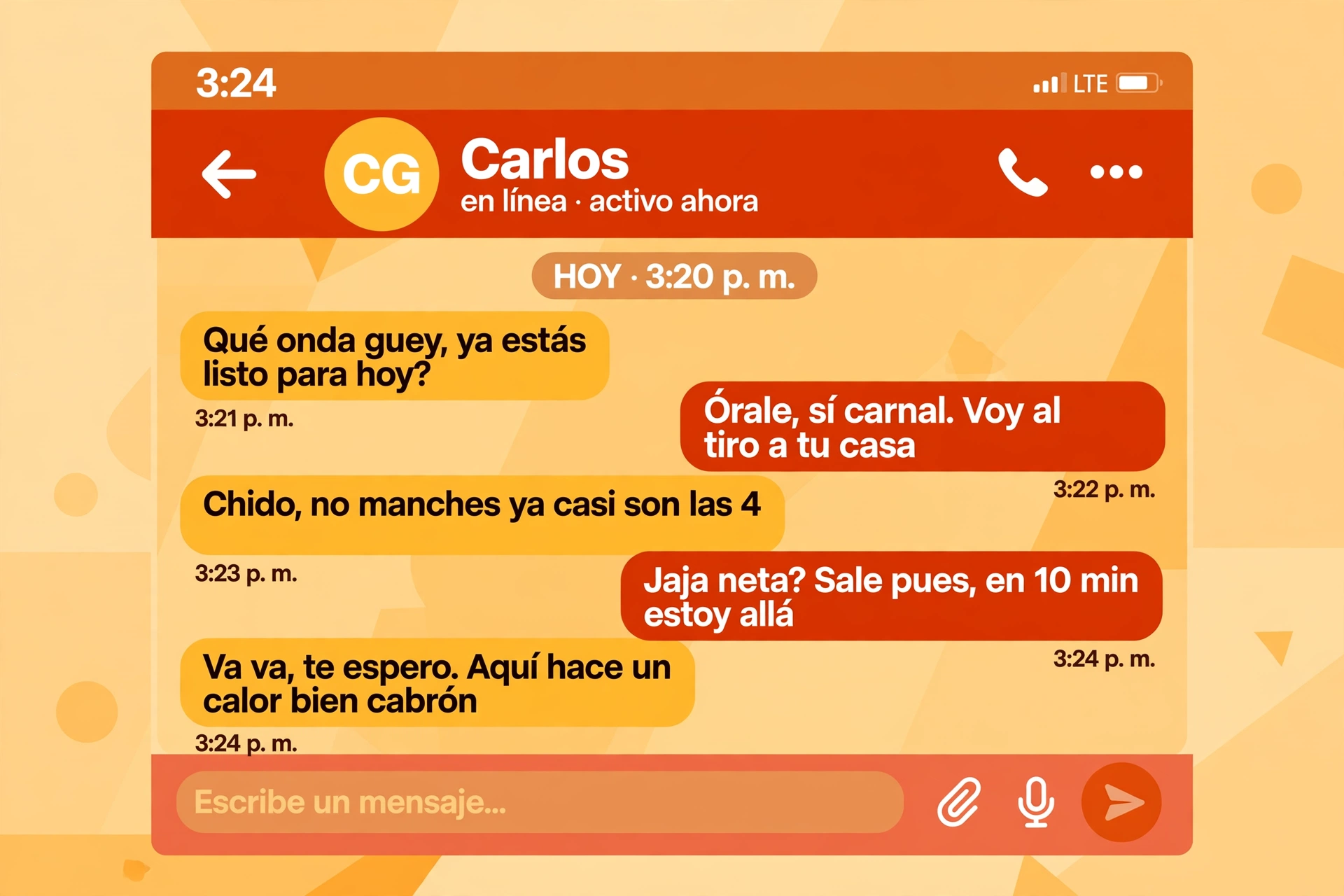
Funny Examples
Mexican humor runs on exaggeration, and the slang for funny situations is some of the most colorful in the language:
- “¡No manches! ¿En serio?” — “No way! Seriously?” The all-purpose reaction to shocking news — the Mexican “get out of here!”
- “¡Aguas! ¡Ahí viene el jefe!” — “Watch out! The boss is coming!” Aguas (literally “waters”) as “heads up!” is one of the funniest literal-vs-actual gaps in mexican slang.
- “Me dio el mal del puerco.” — “I got the pig’s curse.” Said while melting into the couch after a huge meal. Every Mexican knows this feeling intimately.
- “Ando bien crudo.” — “I’m so hungover.” Crudo literally means “raw” — as in, you feel like raw meat. Accurate.
- “Echamos la hueva todo el domingo.” — “We were lazy bums all Sunday.” Echar la hueva (to “throw the laziness”) is the noble art of doing nothing.
- “Está bien cañón este examen.” — “This exam is brutal.” Students everywhere, united by suffering and slang.
- “¡Híjole! Eso sí estuvo bueno.” — “Whoa! That was good.” Híjole is the sound of delighted surprise — half laugh, half gasp.
- “Ni modo, ya se acabó.” — “Oh well, it’s over.” Ni modo is the philosophical shrug of mexican slang: it is what it is, what can you do?
Comparison with Similar Terms
One of the biggest traps for learners is assuming all Spanish slang works everywhere. It does not — mexican slang can confuse (or amuse) speakers from Spain or Argentina, and vice versa. Here is how the same idea sounds across the Spanish-speaking world:
| Meaning | Mexican Slang | Spain | Argentina | Colombia |
|---|---|---|---|---|
| Dude / bro | Güey | Tío | Boludo / che | Parcero |
| Cool / awesome | Chido / padre | Guay / mola | Copado / bárbaro | Chévere / bacano |
| What’s up? | ¿Qué onda? | ¿Qué pasa? | ¿Qué hacés? | ¿Qué más? |
| No way! / really? | ¡No manches! | ¡No me digas! | ¡No me digas! | ¡No jodas! |
| Money | Lana / feria / varo | Pasta | Guita | Plata / billete |
| Work / job | Chamba | Curro | Laburo | Camello |
| Drunk | Pedo (ando pedo) | Borracho / pedo | En pedo | Jincho / prendido |
| Kid / young person | Chavo / morro | Chaval | Pibe | Pelado / chino |
| Hang out / party | Echar relajo / desmadre | Salir de fiesta | Hacer bardo | Rumbear |
| Annoying person | Castroso | Pesado | Rompebolas | Mamón |
Notice the pattern: every region invented its own words for the same everyday concepts. A Mexican saying “está chido, güey” and a Spaniard saying “mola, tío” are saying the exact same thing — and would each need subtitles for the other. Also note the fun overlap: pedo means “drunk” in both Mexico and Spain, one of the rare cases where the slang crossed the Atlantic intact.
Chicano and border slang deserves its own mention. Along the US–Mexico border and in Mexican-American communities, you will hear a hybrid layer: troca (truck), parquear (to park), lonche (lunch), wachar (to watch, from English “watch”). Some Mexicans in Mexico consider these pochismos (from pocho, a term for assimilated Mexican-Americans) — colorful, but not “proper” mexican slang. Use them in Los Angeles and you will fit right in; use them in Guadalajara and you might get a raised eyebrow.

Alternate Meanings
Some mexican slang words are shape-shifters — one word, many meanings, all determined by context. These are the ones that trip up learners the most:
- Órale — the champion of multi-meaning slang. “¡Órale!” (wow!), “Órale, pues” (okay then), “¡Órale, apúrate!” (hurry up!), “¿Órale?” (really?). Four meanings, one word, all in the tone.
- Pedo — literally “fart,” but in mexican slang it moonlights as “problem” (“tengo un pedo” = I have a problem), “drunk” (“ando pedo” = I’m drunk), “fight” (“se armó el pedo” = a fight broke out), and “what’s up” (“¿qué pedo?“). Context is everything — misread it and the sentence falls apart.
- Padre — literally “father,” slang for “cool” (“¡qué padre!“). But “ni padre” can dismiss something as uncool, and in some regions padre as slang is fading among younger speakers who prefer chido.
- Chido — mostly “cool/awesome,” but “qué chido” can carry a sarcastic edge (“oh, how nice for you”) when the tone goes flat. Sarcasm detection required.
- Ahorita — technically “right now” (diminutive of ahora), but in real mexican slang it famously means anything from “in a second” to “eventually” to “never, but politely.” If a Mexican says “ahorita voy,” do not hold your breath.
- Neta — “¿neta?” (really?) questions what you heard; “la neta” (the truth) emphasizes honesty (“la neta, no me gustó” = honestly, I didn’t like it); “de neta” intensifies (“de neta que sí” = for real, yes).
- Cámara — literally “camera,” but “¡cámara!” means “alright, see you!” and “cámara, güey” is a casual goodbye among friends in Mexico City. Nothing to do with photography.
- Fresa — literally “strawberry,” slang for a preppy, snobby, upper-class person — Mexico’s equivalent of “basic” or “posh.” “Es bien fresa” is not a compliment about fruit.
The lesson: never translate mexican slang word-for-word. The literal meaning is often a decoy — the real meaning lives in the situation, the tone, and the relationship between the speakers.
Professional or Polite Alternatives
Slang is wonderful with friends and risky everywhere else. Here is your translation chart for formal situations — job interviews, emails, talking to elders, or meeting your partner’s parents:
| Instead of (slang)… | Say (neutral/polite)… |
|---|---|
| Güey / carnal (dude/bro) | Amigo, compañero, colega — or just use the person’s name |
| ¿Qué onda? / ¿Qué pedo? | ¿Cómo está? / ¿Qué tal? — warm but respectful |
| ¡No manches! (no way!) | ¿En serio? / ¡No me diga! — surprise without the edge |
| Chido / padre (cool) | Excelente, muy bueno, me parece bien |
| Órale, apúrate (hurry up) | Por favor, date prisa / cuando puedas |
| Me vale madre (I don’t care — vulgar) | No me importa / me es indiferente — never use the slang version at work |
| Está cañón (it’s rough) | Está complicado / es difícil |
| Echar la hueva (to be lazy) | Descansar / tomar un descanso — “rest” sounds better on a performance review |
| Ando crudo (I’m hungover) | No me siento bien hoy — some truths need no translation |
| Mande? | Keep it! Mande is already the polite form — it is one of the few slang-adjacent words that is more courteous than the alternative |
A useful mindset: in Mexico, formality is not stiffness — it is respect. Switching to neutral Spanish with older people or in professional settings does not make you sound boring; it makes you sound educado (well-mannered), which Mexicans notice and appreciate. Save the slang for the friends who will love you for it.
Common Mistakes
Learners love mexican slang — and regularly step on the same rakes. Here are the classics, so you can skip them:
- Calling strangers güey. The number-one foreigner mistake. Güey is a friendship word; using it with a waiter, a taxi driver you just met, or anyone older can sound disrespectful. Earn it first — let them güey you.
- Confusing no manches with no mames. They look like twins, but no mames is vulgar (it references mamar). Learners who mix them up can accidentally swear in polite company. When in doubt, no manches is always the safe one.
- Using pedo without context. Because pedo means problem, drunk, fight, and fart, dropping it into the wrong sentence creates chaos. “Tengo un pedo” at a business lunch will not land the way you hoped.
- Assuming mexican slang works across Latin America. Say “está chido” in Buenos Aires and you will get blank stares; say “che, boludo” in Mexico City and same result. Slang is local — the comparison table above exists because this mistake is so common.
- Overusing slang to sound fluent. Nothing marks a learner faster than cramming five slang words into one sentence. Native speakers season with slang; they do not drown the dish. One órale per conversation beats ten.
- Saying me vale madre in public. It means “I don’t care,” but it invokes madre (mother) vulgarly — it is genuinely offensive to many Mexicans. This is not playful slang; it is fighting words in the wrong setting.
- Mispronouncing güey. It is “way” (one syllable), not “goo-ey” or “gway.” The diéresis (¨) over the u tells you to pronounce it — Spanish learners who skip that detail out themselves instantly.
- Using slang in writing. Mexican slang is overwhelmingly spoken. Dropping qué onda, güey into a work email or university essay reads as unprofessional even to Mexicans who say it ten times a day out loud.

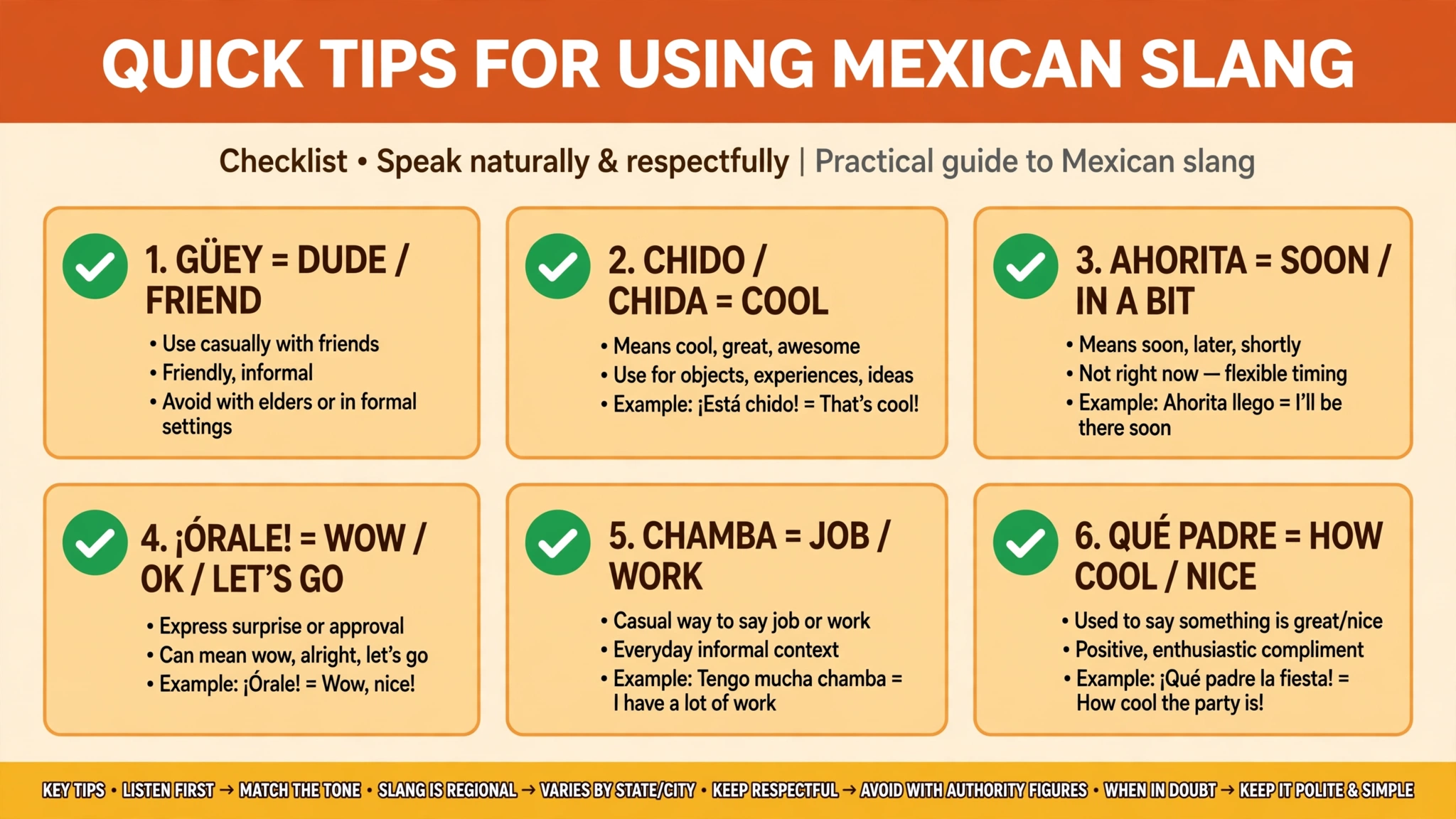
Quick Tips
- Learn the top 15 first. Güey, qué onda, órale, chido, no manches, neta, sale, carnal, padre, qué pedo, aguas, ni modo, cañón, cuate, and híjole will carry you through 90% of casual Mexican conversation. Master these before collecting rarer ones.
- Watch Mexican shows with subtitles. Series with natural dialogue — comedies especially — are the fastest way to hear mexican slang in context. Pause, repeat the line out loud, mimic the tone. Tone is half the meaning.
- Practice the greetings out loud. “¿Qué onda, güey? ¿Cómo estás?” should roll off your tongue before you ever say it to a real person. Muscle memory beats dictionary memory.
- Ask Mexicans to correct you. Most Mexicans love teaching slang to interested foreigners — it is a point of pride. Say “¿así se dice?” (is that how you say it?) and you will get a free masterclass.
- Keep a slang notebook. When you hear a new word, write the situation it appeared in, not just the definition. “Aguas — friend shouted it when I almost stepped into the street” teaches you more than “aguas = watch out.”
- Respect the regions. If you are visiting Yucatán, expect Maya-flavored slang; in Monterrey, expect norteño directness. A quick “¿qué significa eso aquí?” (what does that mean around here?) goes a long way.
- Never slang upward. With elders, bosses, officials, and strangers over 50, stay neutral until invited otherwise. This one rule prevents 95% of slang disasters.
Essential Pronunciation Guide
Mexican slang has to sound right. Here is how to say the essentials:
| Word | Say it like | Key tip |
|---|---|---|
| Güey | “way” | One syllable — the ¨ over the u means you pronounce it |
| Órale | “OH-rah-leh” | Stress the first syllable, as the accent mark shows |
| No manches | “no MAHN-chess” | Soft “ch” as in “cheese,” stress on MAN |
| Chido | “CHEE-doh” | Hard “ch,” short crisp vowels |
| ¿Qué onda? | “keh OHN-dah” | “Qu” sounds like “k”; stress ON |
| Neta | “NEH-tah” | Short “e” as in “net” |
| Híjole | “EE-hoh-leh” | The “j” is a breathy “h”; stress the first syllable |
| Carnal | “kahr-NAHL” | Rolled or tapped “r”; stress the last syllable |

FAQ
What does güey mean in Mexican slang?
Güey (also spelled wey) means “dude” or “bro” in mexican slang. It likely comes from buey (ox), worn down by a century of casual use into a term of friendly address. Among friends it is warm and constant — “¿qué haces, güey?” (what are you up to, dude?). With strangers or elders it can sound disrespectful, so save it for people you know well.
Is Mexican slang the same as Spanish slang?
No — and the difference matters. “Spanish slang” usually means slang from Spain (tío, guay, mola), while mexican slang (güey, chido, órale) belongs to Mexican Spanish. The two are often mutually unintelligible as slang, even though both are Spanish. Think of it like the difference between British and American slang: same language, different street vocabulary.
What is the most common Mexican slang word?
Güey is arguably the single most-heard word in casual Mexican conversation — it functions as “dude,” a filler word, and a punctuation mark all at once. Close runners-up are órale (the multi-meaning interjection), qué onda (the default greeting), and chido (the default “cool”). Learn those four and you will understand a remarkable share of everyday Mexican speech.
Is it rude to say güey?
It depends entirely on who you say it to. With friends your age, it is friendly — practically a term of affection. With strangers, service workers, elders, or in professional settings, it can come across as disrespectful or overly familiar. The safe rule: understand it everywhere, say it only with friends until a Mexican invites you into güey territory.
What does órale mean?
Órale is mexican slang’s most flexible word — its meaning changes with tone. Said with excitement it means “wow!”; said flatly it means “okay”; said quickly it means “hurry up!”; said with rising intonation (“¿órale?“) it means “really?” Native speakers read the intended meaning from context and tone instantly, which is why learners should listen for how it is said, not just that it is said.
What does no manches mean?
¡No manches! means “no way!”, “you’re kidding!”, or “seriously?” — the standard Mexican reaction to surprising news. It is a softened, polite version of the vulgar no mames, which is why it is safe in most company. Depending on tone it can express shock, disbelief, frustration, or delight.
How is Mexican slang different from Spain’s slang?
The two evolved separately for centuries, so the everyday words barely overlap: Mexico says güey where Spain says tío, chido where Spain says guay, chamba (work) where Spain says curro, and lana (money) where Spain says pasta. Mexican slang also carries heavy Nahuatl influence (cuate, elote, apapachar) that simply does not exist in Spain. See the comparison table above for a full side-by-side.
Can I use Mexican slang if I’m learning Spanish?
Absolutely — and you should. Understanding mexican slang is essential for following real conversations, movies, and music, and using a well-placed órale or qué onda instantly makes you sound more natural. Just follow two rules: learn the polite alternatives for formal situations (see the table above), and never use familiarity-words like güey with people you do not know well. Understand everything, deploy selectively.
Conclusion
Mexican slang is more than a list of funny words — it is a window into how Mexico actually talks, jokes, argues, flirts, and welcomes people in. From the Nahuatl roots hiding inside cuate and apapachar, through the street-born euphemisms like no manches, to the border Spanglish of troca and lonche, every slang word carries a little piece of Mexican history. Learn the words and you do not just expand your vocabulary — you earn your way into the conversations that textbooks never prepared you for.
Start with the essentials: greet people with qué onda, react with órale and no manches, agree with sale, and save güey for the friends who have earned it. Listen more than you speak at first, mimic the tone as much as the words, and let Mexicans pull you into the casual zone — that invitation is the real fluency test, and it is worth more than any exam score.
Want to keep decoding the way the Spanish-speaking world really talks? Check out our New York slang guide for another regional deep-dive — because every place has its own qué onda, and now you know how to find it.

1 thought on “Mexican Slang: 50+ Popular Words & Phrases Explained (2026)”