
Spanish Slang: 15 Essential Terms, Meanings & Real Examples (2026)
Quick definition: Spanish slang refers to informal, everyday words and phrases used by native Spanish speakers in casual conversation, texts, and social media — words you won’t find in a classroom textbook, like güey (dude), chévere (cool), and ¿qué onda? (what’s up?).
Spanish Slang Meaning & Definition
Spanish slang is the collection of informal expressions, shortcuts, and playful phrases that Spanish speakers use when they’re relaxed — with friends, family, on WhatsApp, or on TikTok. While formal Spanish follows the rules of the Spanish language, slang bends those rules on purpose: it shortens words, mixes in English, and invents new meanings that only insiders fully understand.
Think of it this way: the Spanish you learn in school is like the suit you wear to a job interview. Spanish slang is the hoodie you throw on to hang out with friends. Both are Spanish, but they live in completely different worlds.
One of the trickiest parts of Spanish slang is that it’s regional. The slang someone uses in Mexico City can sound totally foreign to someone in Madrid or Buenos Aires. A word that means “cool” in Colombia might mean something rude in Chile. That’s why learning Spanish slang isn’t just about memorizing words — it’s about understanding where each word belongs.
Introduction
If you’ve ever watched a Spanish-language show with subtitles and thought, “Wait — that’s not what my textbook taught me,” you’ve already met Spanish slang. From the reggaetón lyrics dominating global charts to the group chats of millions of bilingual Gen Z teens, Spanish slang is everywhere in 2026.
Spanish is now the second most spoken language in the world by native speakers, and its slang travels fast. A phrase born on the streets of Mexico City can go viral on TikTok and land in a Miami teenager’s texts within a week. Just like English internet slang — think of terms like sigma slang or Gen Alpha slang — Spanish slang evolves online at lightning speed, picking up new meanings with every trend.
In this guide, you’ll learn the real meaning of Spanish slang, where it comes from, the 15 most useful terms with examples, how it’s used in different tones, and the mistakes learners make when trying to use it. Whether you’re texting a Spanish-speaking friend, traveling through Latin America, or just trying to understand your favorite songs, this is your complete, no-fluff guide.

Origin
Spanish slang didn’t appear overnight — it grew out of centuries of regional culture, street life, and youth rebellion.
- Colonial roots: As Spanish spread across the Americas, it collided with Indigenous languages like Nahuatl, Quechua, and Guaraní. Many “slang” words today are actually borrowed Indigenous words that entered everyday speech centuries ago — like cuate (buddy) from Nahuatl.
- Immigration waves: Italian immigrants in Argentina shaped lunfardo, Buenos Aires’ famous street slang. African influences shaped Caribbean Spanish in Cuba, Puerto Rico, and the Dominican Republic.
- Border culture: Along the US–Mexico border, English and Spanish fused into Spanglish, creating hybrid slang like parquear (to park) and troca (truck).
- Music and media: Reggaetón, Latin trap, and telenovelas spread regional slang globally. Words like perreo and dembow went from Puerto Rican clubs to worldwide group chats.
- Social media era: Since 2020, TikTok and Instagram have made Spanish slang truly global. Creators from Spain, Mexico, Colombia, and Argentina remix each other’s expressions daily, the same way based and unc spread through English-speaking feeds.
Popularity
Spanish slang has never been more mainstream than it is right now:
- Music: Bad Bunny, Karol G, and Peso Pluma regularly top global charts with lyrics packed with regional slang. Fans worldwide look up meanings of words like bellakeo and bélico.
- Social media: Spanish-language TikTok creators have billions of combined views. Slang from Mexican, Colombian, and Argentine creators crosses borders in hours.
- US Hispanic culture: With over 60 million Spanish speakers in the US, Spanish slang is part of everyday American youth culture — especially in Texas, California, Florida, and New York.
- Language learning: Apps and online courses now teach slang alongside grammar, because learners realized textbook Spanish doesn’t help them understand real conversations.
- Search trends: Queries like “spanish slang,” “mexican slang,” and specific terms like no mames meaning see steady, growing search volume every year.
How It Is Used
Spanish slang shows up in almost every informal context:
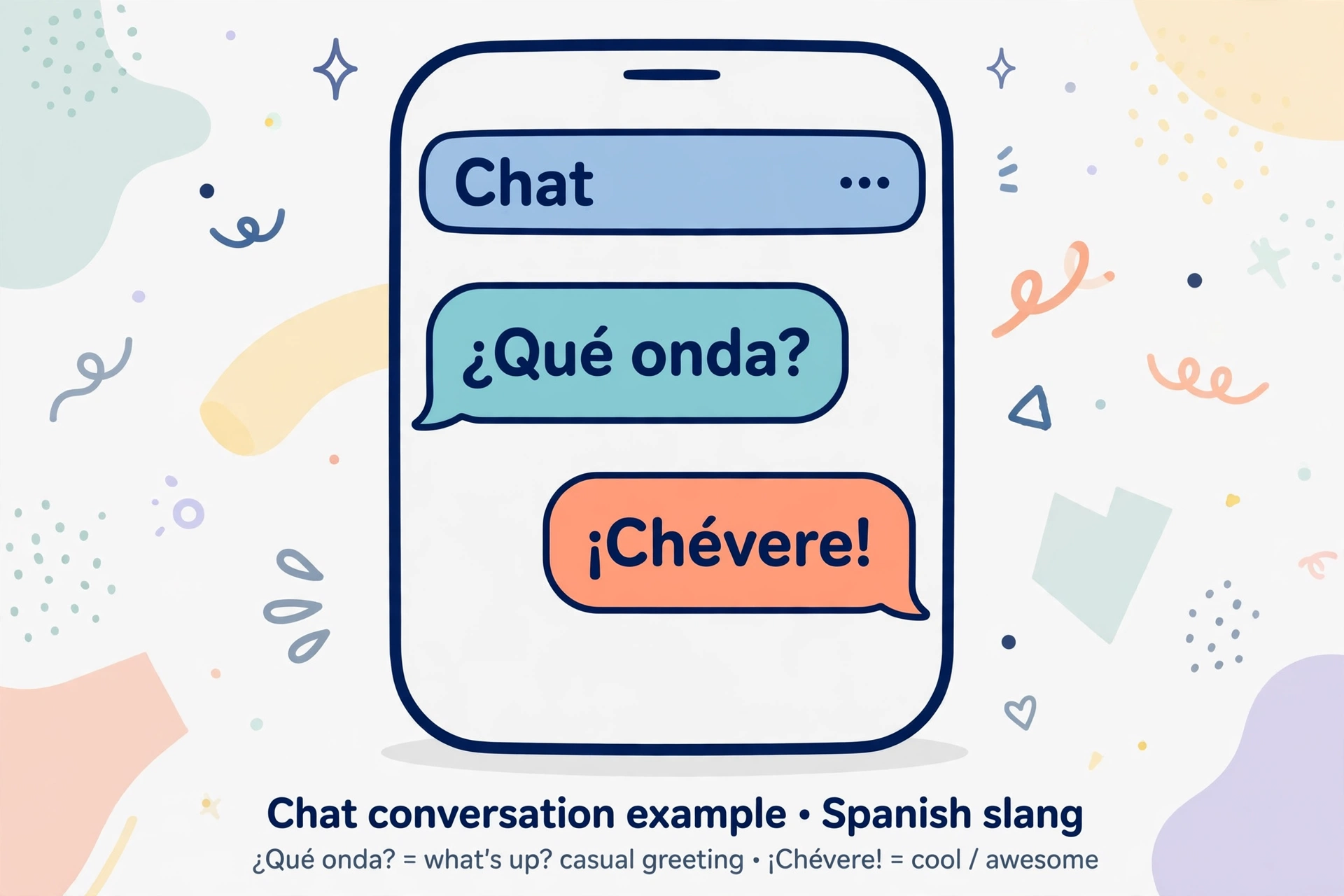
- Texting and DMs: Shortened, playful, often mixed with emojis — “¿Qué onda, güey? 😎”
- Social media captions: “Vibes chéveres hoy ✨” (Cool vibes today)
- Music and lyrics: Reggaetón and Latin trap are basically slang delivery vehicles.
- Everyday speech: Friends greeting each other, reacting to news, joking around.
- Memes: Spanish meme pages thrive on slang-heavy humor that outsiders can’t decode.
The golden rule: Spanish slang belongs in casual settings. Using it with your boss, a professor, or a stranger’s grandmother is the fastest way to sound disrespectful — even if your grammar is perfect.
Examples
Here are the most useful Spanish slang terms, organized by tone, with real examples of how they’re used.
Friendly Examples
- ¿Qué onda? (Mexico) — “What’s up?” Example: “¿Qué onda, cómo estuvo tu día?” (What’s up, how was your day?)
- Güey (Mexico) — “Dude/bro.” Example: “No manches, güey, ¿en serio?” (No way, dude, seriously?)
- Chévere (Colombia, Venezuela, Ecuador) — “Cool/awesome.” Example: “¡Qué chévere tu carro nuevo!” (Your new car is so cool!)
- Parce / parcero (Colombia) — “Buddy/pal.” Example: “Vamos, parce, no llegues tarde.” (Come on, buddy, don’t be late.)
- Tío / tía (Spain) — “Dude” (literally “uncle/aunt”). Example: “Tío, no te lo vas a creer.” (Dude, you won’t believe it.)
Professional Examples
Slang is rare in professional settings, but mild informal expressions do appear in relaxed workplaces:
- Vale (Spain) — “OK / got it.” Example: “Vale, lo reviso esta tarde.” (OK, I’ll check it this afternoon.)
- Órale (Mexico) — “Alright / let’s go.” Example: “Órale, empezamos la reunión.” (Alright, let’s start the meeting.)
- Bacano / bacana (Colombia) — “Cool person / nice.” Example: “Es un jefe muy bacano.” (He’s a really cool boss.)
Funny Examples
- No manches (Mexico) — “No way / you’re kidding! (polite version of a ruder phrase).” Example: “¿Reprobaste el examen? ¡No manches!” (You failed the exam? No way!)
- Estar en la luna — “To be on the moon” = spaced out. Example: “Perdón, estaba en la luna.” (Sorry, I was totally zoned out.)
- Meter la pata — “To put your foot in it” = to mess up. Example: “Metí la pata con el regalo.” (I messed up with the gift.)
- ¡Qué padre! (Mexico) — “How cool! (literally ‘how father’).” Example: “¿Ganaste el partido? ¡Qué padre!” (You won the game? That’s awesome!)
Comparison with Similar Terms
Spanish slang is often confused with related concepts. This table clears up the differences:
| Term | What It Means | Example | Key Difference from Spanish Slang |
|---|---|---|---|
| Spanish slang | Informal words/phrases across all Spanish-speaking regions | chévere, güey, tío | The umbrella term — covers everything below |
| Mexican slang | Slang specific to Mexico | no manches, chido, órale | Regional subset; not understood everywhere |
| Spanglish | Mix of Spanish and English | parquear, lonche | Blends two languages; Spanish slang is Spanish-only |
| Lunfardo | Buenos Aires street slang | laburo (work), mina (woman) | Argentina-specific, with Italian roots |
| Formal Spanish | Standard, textbook Spanish | amigo, excelente, ¿cómo estás? | Correct everywhere, but sounds stiff with friends |
| English internet slang | Online slang in English | sigma, based, unc | Different language, same youth-culture energy |
The biggest takeaway: “Spanish slang” is not one dialect — it’s a family of regional slangs. A Mexican term and an Argentine term can both be “Spanish slang” while being mutually unintelligible.

Alternate Meanings
The phrase “Spanish slang” itself can mean slightly different things depending on context:
- All Spanish-language slang: The most common meaning — informal Spanish from any country, from Madrid to Mexico City to Miami.
- Spain-specific slang: Some people use it to mean only Peninsular slang (words like vale, tío, mola), as opposed to Latin American slang.
- Slang in Spanish vs. slang about Spanish: Language learners usually mean the first; linguists sometimes discuss the second (how English speakers slang-ify Spanish words).
- Related local names: In different regions, Spanish slang goes by other names — jerga (general slang), modismos (idioms), lunfardo (Argentina), caló (Chicano/Mexican-American slang), parlache (Colombia). All of these fall under the “Spanish slang” umbrella.
Professional or Polite Alternatives
When slang isn’t appropriate, use these neutral alternatives:
| Instead of (slang) | Say this (neutral/polite) | Context |
|---|---|---|
| ¿Qué onda? | ¿Cómo estás? (How are you?) | Greetings |
| Güey / tío | Amigo / amiga (Friend) | Addressing someone |
| Chévere / chido | Excelente / genial (Excellent / great) | Approval |
| No manches | No me digas (You don’t say!) | Surprise |
| Órale | De acuerdo (Agreed) | Agreement |
| Estar en la luna | Estar distraído (To be distracted) | Apologizing |
Rule of thumb: in job interviews, classrooms, formal emails, and with elders, stick to standard Spanish. Save the slang for friends, social media, and song lyrics.
Common Mistakes
- Using Mexican slang in Spain (or vice versa): Calling someone güey in Madrid will get you blank stares; saying vale in Mexico City sounds oddly foreign. Match the slang to the region.
- Mixing formal and slang registers: “Estimado señor, ¿qué onda?” (Dear sir, what’s up?) is a classic learner blunder — pick one tone and commit.
- Using slang that’s actually offensive: Some “funny” slang words are vulgar or insulting in certain countries. No mames is much ruder than no manches; always learn the politeness level, not just the translation.
- Overusing slang to sound fluent: Dropping five slang words per sentence doesn’t make you sound native — it makes you sound like you’re trying too hard. One natural expression beats ten forced ones.
- Trusting direct translations: Embarazada doesn’t mean “embarrassed” (it means pregnant), and slang translations are even less reliable. Learn usage from native examples, not word-for-word dictionaries.
- Ignoring gender and number: Slang still follows Spanish grammar — bacano/bacana, tío/tía. Getting these wrong instantly marks you as a learner.

Quick Tips
- Learn slang by country, not by list. Pick one region (Mexican, Colombian, or Peninsular Spanish) and master its slang before branching out.
- Watch with Spanish subtitles. Shows like La Casa de Papel (Spain) or Club de Cuervos (Mexico) are slang goldmines — pause and note new expressions.
- Follow native meme pages. Spanish meme accounts on Instagram and TikTok teach slang in its natural habitat: jokes.
- Ask “¿qué significa?” freely. Native speakers love explaining their slang — asking shows interest, not ignorance.
- Practice in low-stakes chats. Try one new slang term per conversation with a friendly native speaker before using it widely.
- Note the tone, not just the meaning. Chévere is warm; no manches is playful-shocked; güey can be affectionate or annoyed depending on tone.
- Keep a slang notebook. Write the term, the country, an example sentence, and whether it’s polite, neutral, or risky.


FAQ
What is Spanish slang called?
Spanish slang is generally called jerga (slang) or modismos (idioms) in Spanish. Specific regions have their own names: lunfardo in Argentina, caló in Mexican-American communities, and parlache in Colombia.
What are some common Spanish slang words?
The most widely recognized include güey (dude, Mexico), chévere (cool, Colombia/Venezuela), ¿qué onda? (what’s up, Mexico/Argentina), tío/tía (dude, Spain), vale (OK, Spain), and no manches (no way, Mexico).
Is Spanish slang the same in every country?
No — this is the most important thing to understand. Spanish slang is highly regional. Mexican slang differs sharply from Spanish (Spain) slang and Argentine slang. Always learn which country a term belongs to before using it.
Can I use Spanish slang in formal situations?
Generally no. Spanish slang is for casual settings — friends, family, social media, and entertainment. In professional, academic, or formal contexts, use standard Spanish instead.
What does “¿qué onda?” mean?
¿Qué onda? literally means “what wave?” but it’s used as “what’s up?” or “how’s it going?” It’s extremely common in Mexico and parts of Argentina as a casual greeting.
What is the difference between Spanish slang and Spanglish?
Spanish slang uses Spanish words in informal ways (chévere, güey), while Spanglish mixes Spanish and English (parquear for “to park,” lonche for “lunch”). They’re related but distinct phenomena.
How can I learn Spanish slang fast?
Watch Spanish-language shows with Spanish subtitles, follow native meme pages and TikTok creators, listen to reggaetón and Latin trap lyrics, and practice one new term at a time with native speakers. Focus on one country’s slang first.
Is Spanish slang appropriate for beginners?
Yes, but learn the basics of standard Spanish first. Slang makes you sound natural, but only if your foundation is solid — otherwise it just sounds random. Start with polite, widely understood terms like chévere and ¿qué onda?
Conclusion
Spanish slang is the living, breathing side of the Spanish language — the part that textbooks skip and native speakers actually use every day. From Mexico’s güey to Colombia’s chévere to Spain’s tío, these expressions carry culture, humor, and identity in a way formal Spanish never can.
The key takeaways: learn slang by region, match it to casual settings only, and learn each term’s tone and politeness level — not just its translation. Start with the friendly, widely understood terms in this guide, practice them in real conversations, and build from there.
Language is always evolving, and Spanish slang evolves faster than most — new terms go viral every month on TikTok and in group chats, much like how unc and based spread through English-speaking feeds. Keep listening, keep asking ¿qué significa?, and you’ll be decoding Spanish slang like a native in no time. ¡Órale, a practicar!

2 thoughts on “Spanish Slang: 15 Essential Terms, Meanings & Real Examples (2026)”