
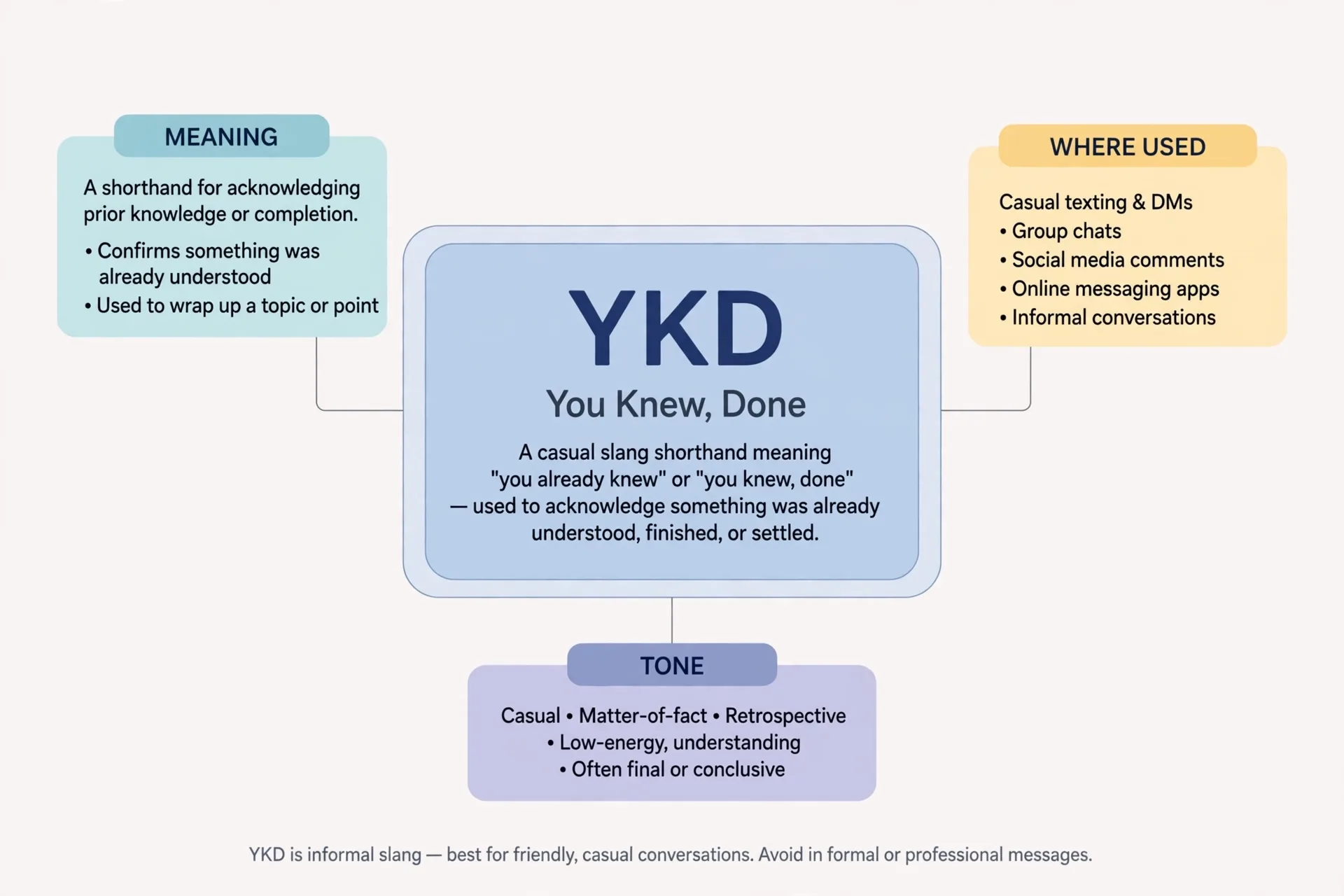
Quick definition: YKD stands for “Ya Know Dis” — a slangy spelling of “you know this.” In texting, it is used at the end of a statement to say that something is obvious, or to check that the other person agrees — similar to a casual “you know?”
YKD Meaning in Text: Meaning and Definition
If you have ever received a text that ended with “ykd” and had no idea what it meant, you are not alone. This tiny three-letter abbreviation confuses a lot of people, because it looks like it could be almost anything — a typo, a name, or a word from another language. So let us clear it up once and for all: in texting, YKD means “Ya Know Dis,” which is a relaxed, slang pronunciation of “you know this.”
Think of it as the texting version of saying “ya know?” after a sentence. When someone writes “that party was insane, ykd,” they are not asking a real question. They are saying something closer to: “That party was insane — you already know.” It adds confidence, rhythm, and a little personality to a message. Slang dictionaries agree — Urban Dictionary lists “Ya Know Dis” as the top definition of YKD.
Here is the simplest way to remember it:
| Element | Detail |
|---|---|
| Abbreviation | YKD |
| Stands for | “Ya Know Dis” |
| Plain English | “You know this” |
| Function | Tag phrase at the end of a statement |
| Tone | Casual, confident, playful |
| Where you see it | Text messages, Snapchat, TikTok comments, Instagram DMs, gaming chats |
Semantically, YKD belongs to the big family of “you know” abbreviations that dominate casual digital conversation — YK (“you know”), YKW (“you know what”), YKT (“you know that”), and IYKYK (“if you know, you know”). They all do the same basic job: they pull the listener into the conversation and assume shared understanding. YKD just does it with a bit more flavor and attitude.
Introduction
You are scrolling through your messages, everything is normal, and then suddenly: “bro that exam was impossible ykd.” You freeze. YKD? Is that a typo? A typo of what? Is your friend trying to say “you know” but their thumbs slipped? Before you reply with an awkward “huh?” — take a breath. What you just saw is one of the most personality-packed slang tags in modern texting. If you enjoy decoding abbreviations like this, you will also love our guide to ISTG meaning in text.
Texting slang changes faster than almost any other part of language. Every year, abbreviations appear, mutate, and sometimes disappear before your parents even learn them. Some slang is born in specific communities — gaming lobbies, TikTok comments, AAVE (African American Vernacular English) — and then spreads outward until millions of people are using it without ever knowing where it came from. YKD is one of those words.
In this complete guide, you will learn exactly what YKD means in text, where it came from, how it is actually used in real conversations, how it compares to look-alike abbreviations, and — importantly — when you should and should not use it. By the end, you will be able to drop a “ykd” into your own messages and sound like you have been saying it for years. Let us break it all down.
Origin
The story of YKD starts the way most texting slang stories start: with people typing fast, sounding casual, and spelling words the way they actually say them out loud.
“Ya know” is a pronunciation spelling of “you know” that has existed in American spoken English for well over a century. It shows up in song lyrics, movie dialogue, comedy routines, and everyday speech from every region of the country. When fast texting took off in the late 1990s and early 2000s — the era of SMS with its character limits and painfully slow T9 keypads — people began compressing common spoken phrases into letters. YK (“you know”) was one of the earliest results of that compression.
YKD came next as a fuller version of the idea. According to the most widely referenced definition on Urban Dictionary — the crowdsourced slang dictionary that has documented internet abbreviations since 1999 — YKD means “Ya Know Dis” (You know this). The definition notes that it is “often at the ends of statement to say that something is obvious or to do the parallel of asking ‘you know?'” In other words, it was never meant to be read as a proper word at all; it is meant to be heard in your head in the speaker’s voice.
The “dis” spelling — “this” written the way it sounds in many American accents — gives YKD its distinctive flavor. This kind of phonetic spelling has deep roots in hip-hop lyrics, comedy, and internet culture, where writing words the way they sound adds personality and rhythm. Think of it as the text equivalent of a knowing nod or a wink.
A few interesting details about YKD’s early life online:
- Urban Dictionary is where YKD’s “Ya Know Dis” meaning was first documented and voted on by real users, making it the primary reference definition.
- Related forms also appeared, including YKDV and YKDW, which are listed as related words — variations people typed when they wanted the same vibe with their own twist.
- Chat culture in the 2000s (AIM, MSN Messenger, MySpace comments) was the perfect breeding ground, because those platforms rewarded short, expressive, voice-like typing.
- It never really went mainstream the way YK or IYKYK did — which is exactly why it still feels fresh and a little insider-ish when someone uses it today.
Unlike corporate-created slang or marketing buzzwords, YKD was built bottom-up by ordinary people typing the way they talk. That is what gives it its staying power: it feels human, not manufactured.
Popularity
So how popular is YKD, really? It sits in an interesting spot on the slang popularity curve. It is not one of the giant, everyone-knows-it abbreviations like LOL, BRB, or TBH. Instead, it lives in what linguists might call the “insider slang” zone — well-known enough that thousands of people search for its meaning every month, but niche enough that using it still signals you are comfortable with internet culture.
Here is where YKD shows up most often today:
- TikTok comments — Users drop “ykd” at the end of hot takes and relatable videos, where it works like a knowing elbow-nudge to other viewers.
- Snapchat and Instagram DMs — Private chats between friends, where the casual, voice-like spelling feels natural.
- Gaming chats — Fast, expressive team communication in games like Fortnite, COD, and Roblox, where “that play was crazy ykd” lands perfectly.
- Twitter/X and Reddit — Punchy opinion posts and comment threads, where YKD adds a confident finishing touch.
- Group chats on WhatsApp and iMessage — Everyday friend conversations, especially among Gen Z and younger millennials.
Search data backs this up: people regularly Google phrases like “ykd meaning in text,” “what does ykd mean,” and “ykd meaning slang” — the classic pattern of a term that people keep encountering faster than they learn it. That steady curiosity is the hallmark of slang that is actively circulating rather than fading away.
Demographically, YKD skews young. It is most common among Gen Z texters (roughly ages 15–27), with spillover into younger millennial group chats. You are much less likely to see it in messages from older adults, which is part of why receiving it can feel so confusing — the person who sent it probably assumed it was obvious.
Compared to its cousins, YKD’s popularity ranking looks something like this:
| Slang term | Meaning | Relative popularity |
|---|---|---|
| YK | “You know” | ★★★★★ Extremely common |
| IYKYK | “If you know, you know” | ★★★★★ Extremely common |
| YKW | “You know what” | ★★★★☆ Very common |
| YKD | “Ya know dis” | ★★★☆☆ Niche but active |
| YKDV / YKDW | Variants | ★★☆☆☆ Rare |
The good news about YKD’s niche status: because it has not been overused into meaninglessness, it still carries genuine expressive punch when someone drops it in the right moment.
How It Is Used
Understanding what YKD means is only half the battle. The other half is understanding how people actually deploy it — because YKD is less about the definition and more about the feeling.
Position in a sentence
YKD almost always appears at the end of a statement. It is a tag phrase, which means its job is to color the sentence that came before it. You will rarely see it at the beginning or in the middle of a sentence.
- ✅ “That movie was so good ykd” — natural
- ✅ “I’m never doing that again, ykd!” — natural
- ❌ “Ykd that movie was good” — awkward, almost nobody does this
Tone and punctuation
The tone of YKD shifts with the punctuation around it. Here is a quick tone guide:
| Form | Tone it signals | Example |
|---|---|---|
| ykd (lowercase, no punctuation) | Chill, casual agreement-seeking | “we’re definitely going back ykd” |
| ykd? (with question mark) | Genuinely checking for agreement | “that was the best one ykd?” |
| ykd! (with exclamation mark) | Hyped, emphatic, confident | “she understood the assignment ykd!” |
| YKD (all caps) | Loud, dramatic, meme-energy | “THAT’S WHAT I’VE BEEN SAYING YKD” |
| ykd… (with ellipsis) | Knowing, slightly shady, suggestive | “you know exactly why he left ykd…” |
What it actually communicates
Depending on context, YKD can mean any of the following:
- “This is obvious” — “Water is wet ykd.” The sender is stating something they think everyone already knows.
- “You agree with me, right?” — “That game was rigged ykd?” The sender is inviting the reader to confirm a shared opinion.
- “I said what I said” — “Pineapple on pizza is elite ykd.” A confident, slightly defiant mic-drop.
- “We both know how this goes” — “He’s gonna text back in three days ykd.” Shared experience, weary familiarity.
- “Don’t even question it” — “She’s the main character ykd.” Playful certainty that shuts down debate.
Notice what all of these have in common: YKD never delivers new information. It is a social signal. It says, “You and I are on the same page about this.” That is why it feels so satisfying to read when you do agree — and so confusing when you do not know the reference.
Examples
The best way to learn any slang is to see it in action. Below are real-style conversation examples across different tones. Pay attention to how YKD always leans on the sentence before it — it is the seasoning, not the meal.
| Conversation | What YKD adds here |
|---|---|
| Sam: that concert was unreal Sam: best night ever ykd |
Shared excitement — “you felt it too” |
| Mia: he’s 20 minutes late again Mia: classic him ykd |
Weary familiarity — “we both know this pattern” |
| Dev: mom’s biryani hits different Dev: nothing else comes close ykd |
Confident food opinion — “don’t argue” |
| Alex: did you see the ending?? Jordan: i called it from episode 1 ykd |
“I told you so” energy, playful bragging |
Friendly Examples
In friendly chats, YKD is warm and inclusive. It says “we’re in on this together.”
- “Your dog is literally the cutest thing alive ykd 🐶”
- “We need a beach trip ASAP ykd”
- “That was the funniest thing I’ve seen all week ykd 😂”
- “You always know how to cheer me up ykd”
Tone explanation: Here YKD functions like a virtual hug or a friendly nudge. The emoji pairings (🐶, 😂) soften it further. Nobody reading these feels attacked — the abbreviation just makes the compliment or suggestion feel more personal and in-the-know.
Professional Examples
Let us be honest: YKD does not belong in professional communication. You should not end a work email with “the report is attached ykd.” That said, in relaxed workplace chats — a casual Slack channel, a friendly team group text — a playful YKD can occasionally appear between coworkers who are also friends. If you ever do use it at work, keep it extremely rare and only with people you know well.
- “Friday demos are the best part of the week ykd” — team chat, casual Friday energy
- “Nobody touches the office snacks on my watch ykd” — joking with close coworkers
- “That client call could’ve been an email ykd” — venting with a work friend (privately!)
Tone explanation: Even in these examples, the safer professional move is to drop the slang entirely. If you are unsure, replace YKD with “as you know” or just delete it — the sentence survives fine without it.
Funny Examples
Humor is where YKD truly shines. The abbreviation’s confident, slightly cocky energy makes it perfect for jokes, roasts, and meme-style captions.
- “Me pretending I understood the group project ykd 💀”
- “My bank account after one online shopping spree ykd”
- “POV: you said ‘5 more minutes’ 2 hours ago ykd”
- “My sleep schedule is a work of abstract art ykd”
- “Diet starts Monday. It’s currently Sunday night ykd 🍕”
Tone explanation: In funny contexts, YKD works like a laugh track — it tells the reader “this is the punchline, and you get it.” The skull emoji (💀) is its natural partner, signaling “I’m dead” laughter at one’s own joke.
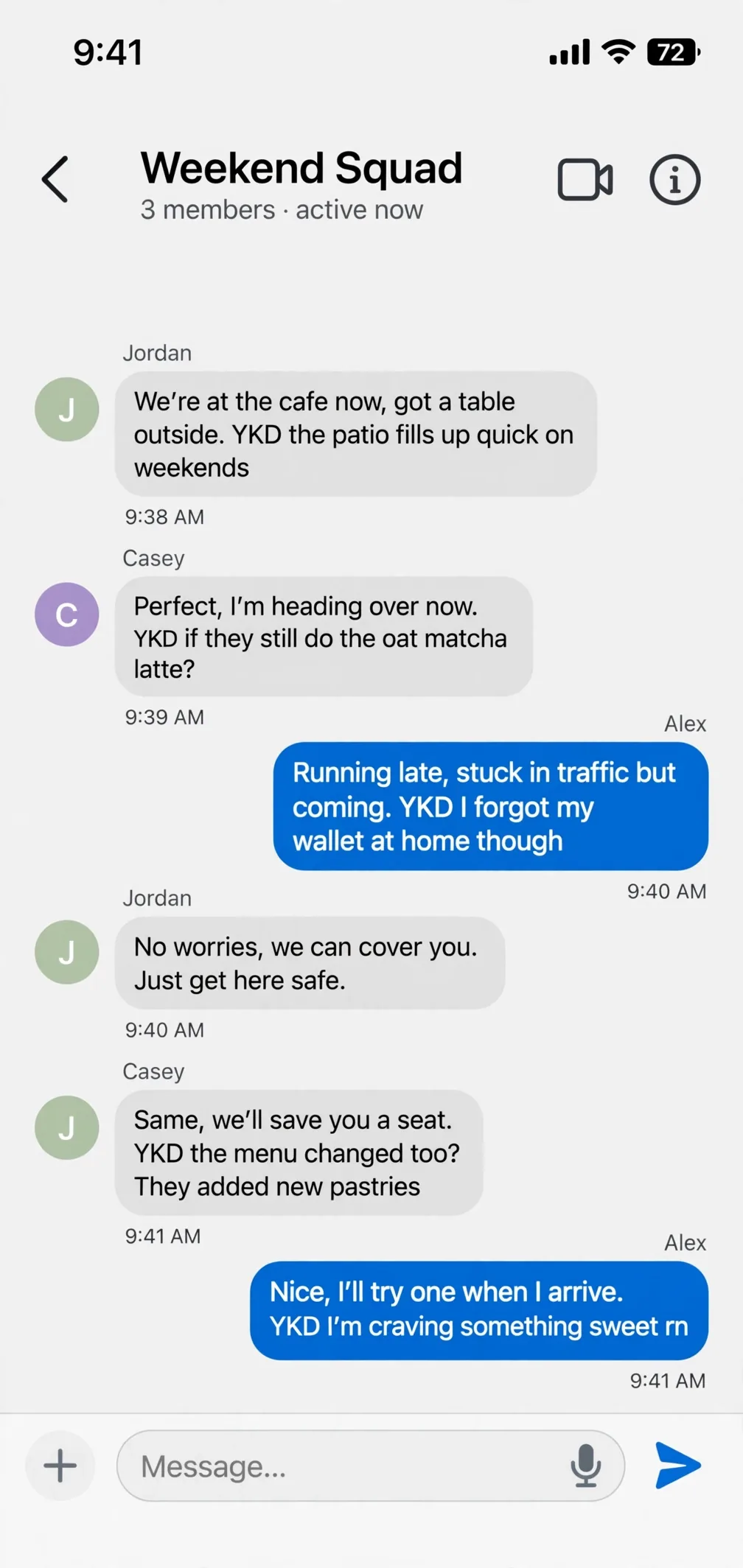
Comparison with Similar Terms
YKD has a lot of look-alikes and sound-alikes, and mixing them up is the number one source of confusion. This comparison table sorts them out once and for all.
| Term | Meaning | How it differs from YKD |
|---|---|---|
| YKD | “Ya know dis” — you know this | The original topic of this guide; statement tag |
| YK | “You know” | Shorter and more common; softer and more neutral than YKD |
| YKW | “You know what” | Usually starts a thought (“ykw, forget it”); YKD ends one |
| YKT | “You know that” | Near-synonym of YKD, but far less common |
| YDK | “You don’t know” | Opposite meaning! Different letter order — teasing or correcting someone |
| IYKYK | “If you know, you know” | Much more mainstream; implies insider knowledge, often used as a hashtag |
| YKTV | “You know the vibes” | Atmosphere-focused; about the mood, not the statement |
| FR | “For real” | Emphasizes truth/agreement; less conversational than YKD |
| TBH | “To be honest” | Introduces honesty; YKD assumes shared knowledge instead |
The most dangerous confusion is YKD vs. YDK. They contain the exact same letters in a different order, but they mean nearly opposite things:
- “That was obvious ykd” = “That was obvious — you know this.”
- “That was obvious ydk” = “That was obvious — you don’t know (but I do).”
The second one is teasing, even a little smug. Swapping them by accident can completely flip your message’s tone, so double-check your letter order before you hit send.
Another common mix-up is YKD vs. YKW. Remember the position rule: YKW usually opens a thought (“ykw, let’s just stay in tonight”), while YKD closes one (“staying in is the move ykd”). Once you feel that rhythm, you will never confuse them. For more look-alike abbreviations, check out our guides to SMH meaning in text and ATP meaning in text.
Alternate Meanings
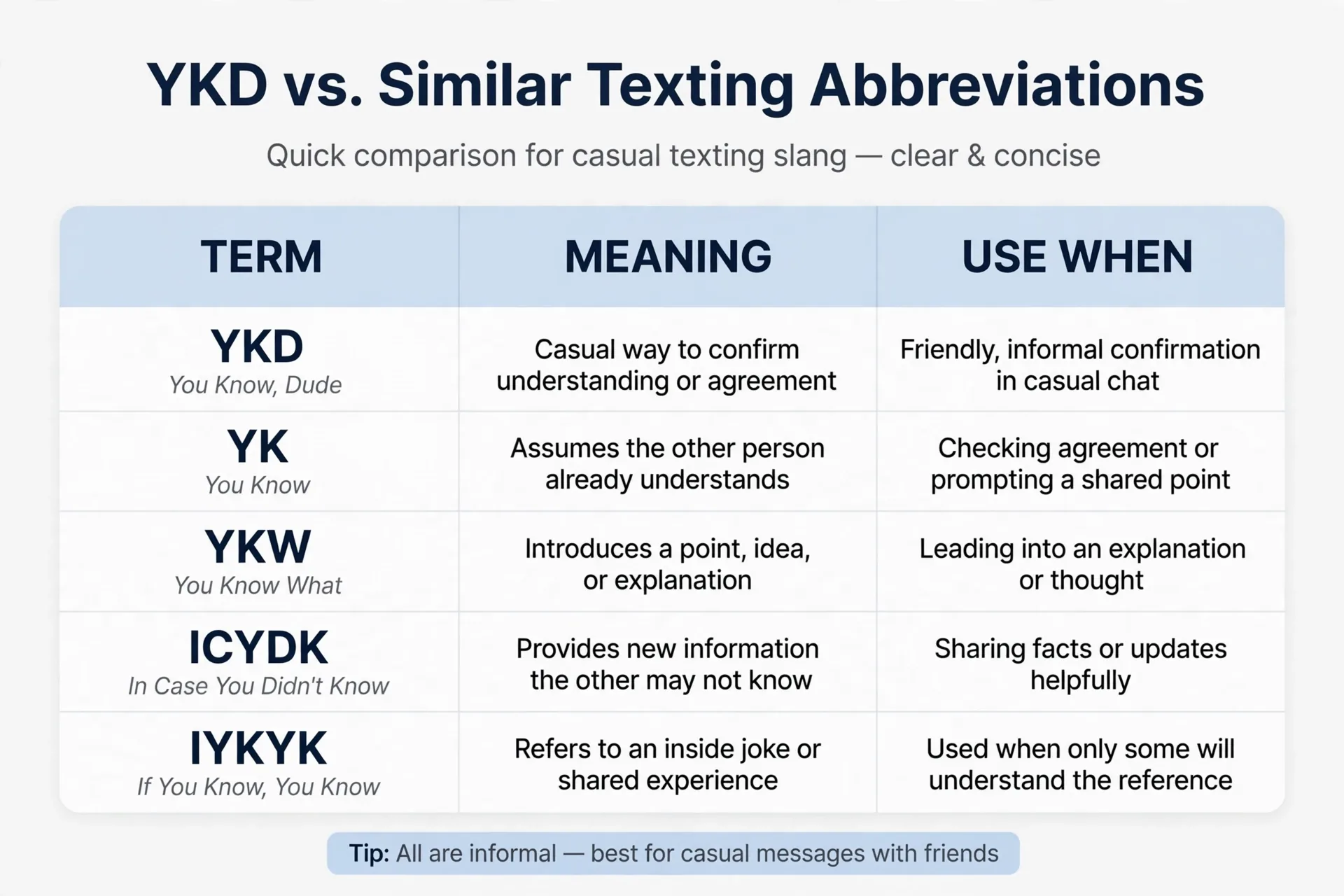
Like most three-letter abbreviations, YKD does not belong exclusively to texting slang. Depending on where you encounter it, it can mean something completely different. Context is everything.
- “You’re kidding” (informal reading): Some texters occasionally write “ykd” when they mean “you’re kidding” — expressing disbelief. This is a loose, non-standard usage; the more common abbreviations for that meaning are YK (“you’re kidding”) or JK (“just kidding”). If a message reads like surprise (“ykd?? no way”), this reading may be intended.
- Yukon-Kuskokwim Delta (geography): In Alaskan geography and environmental writing, YKD is the standard abbreviation for the Yukon-Kuskokwim Delta, a vast wetland region in southwestern Alaska. If you see YKD in a science article or travel guide, it has nothing to do with texting.
- Usernames and gamer tags: YKD shows up as a handle, clan tag, or username prefix across gaming and social platforms — usually just initials, not slang.
- YKDV / YKDW (variants): Urban Dictionary lists these as related words to YKD — playful extended spellings from the same slang family, used for extra emphasis.
How to tell which meaning applies: look at the setting. A text from a friend ending in “ykd”? Slang. A research paper mentioning the “YKD region”? Geography. A surprised reply of “YKD?!”? Possibly “you’re kidding.” The surrounding words almost always give it away.
Professional or Polite Alternatives
YKD is pure casual slang, which means there are plenty of situations — work emails, messages to older relatives, school assignments, first impressions — where you need the same idea without the slang. Here is your translation table:
| Instead of… | Say this (professional/polite) | Best for |
|---|---|---|
| “That was obvious ykd” | “That was clear, as you know.” | Work emails |
| “We’re meeting at 9 ykd” | “We’re meeting at 9, as I’m sure you’re aware.” | Formal reminders |
| “She’s the best ykd” | “She’s truly the best, as we all know.” | Polite praise |
| “Classic him ykd” | “That’s very typical of him.” | Neutral observation |
| “You get it ykd” | “I’m sure you understand.” | Respectful check-in |
| “Don’t even question it ykd” | “I feel confident about this.” | Confident but professional |
The general rule is simple: if you would not say “ya know?” out loud in that setting, do not type “ykd” in it. In any formal or unfamiliar context, plain clear English always wins. Save YKD for friends, memes, and group chats where everyone speaks fluent internet.
Common Mistakes
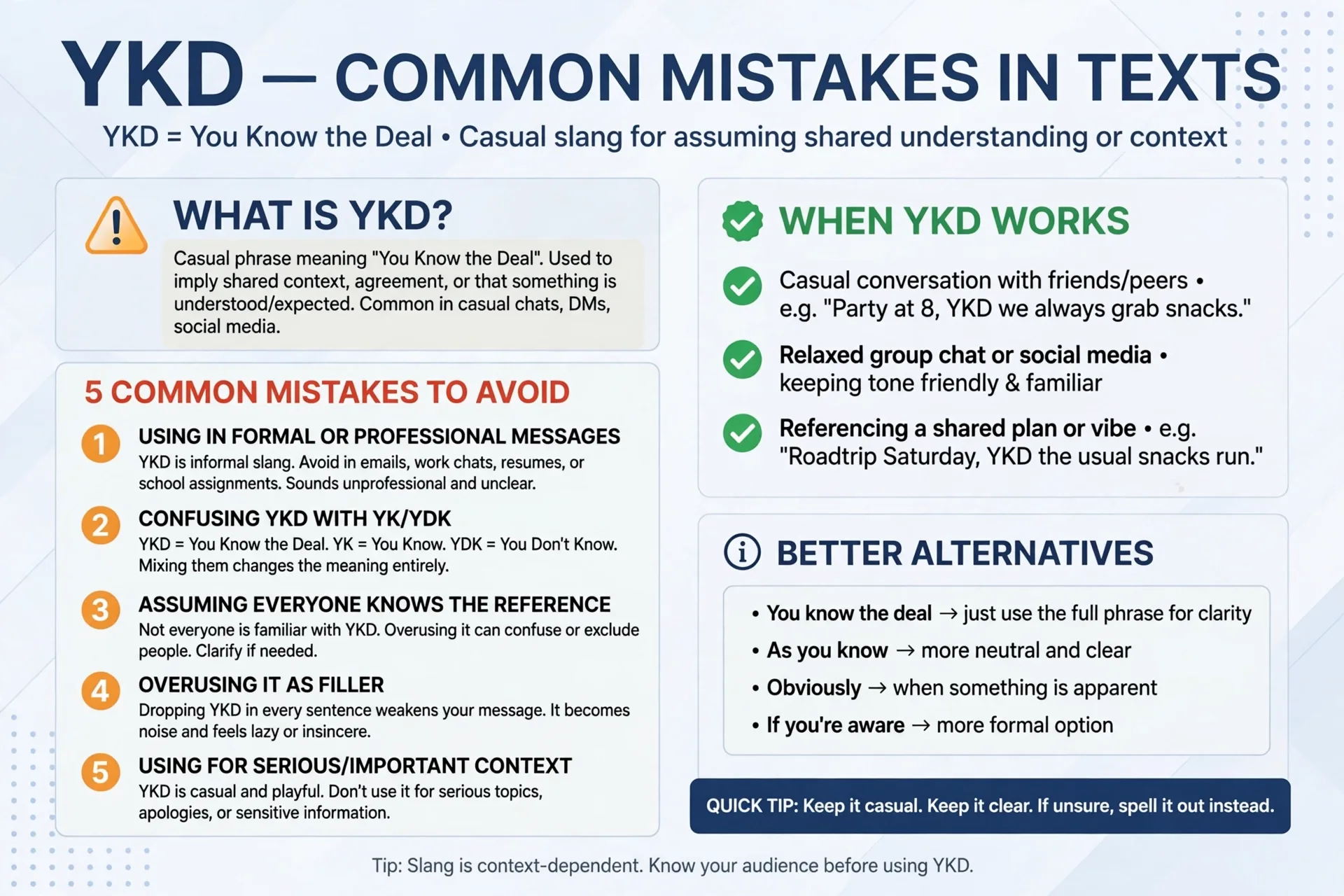
Even people who know what YKD means can use it badly. Here are the mistakes to avoid:
- Mixing up YKD and YDK. As covered above, these are near-opposites. “Ykd” = “you know this” (inclusive). “Ydk” = “you don’t know” (teasing). One letter swap, totally different message.
- Using it with people who won’t get it. Dropping “ykd” on your boss, your grandmother, or a new acquaintance usually just creates confusion — or makes you look unprofessional. Know your audience.
- Putting it in the wrong spot. YKD is an end-of-sentence tag. “Ykd we should leave” sounds wrong because the abbreviation was never built for the front of a sentence.
- Overusing it. Like any slang tag, YKD loses its punch if every single message ends with it. One “ykd” per conversation is plenty; more than that starts to feel like a verbal tic.
- Using it to dodge real communication. “We need to talk ykd” is not a substitute for actually explaining what is wrong. If something matters, use full sentences.
- Assuming the “you’re kidding” reading. If someone writes “ykd” at the end of a confident statement, they almost certainly mean “ya know dis” — not “you’re kidding.” Reading surprise into it will confuse you for no reason.
- Typing it in formal writing. School essays, job applications, and official messages are YKD-free zones. No exceptions.
A quick self-check before you send: Would this sentence still make sense if I replaced “ykd” with “you know?” If yes, you are using it correctly. If the sentence falls apart, rethink the placement.
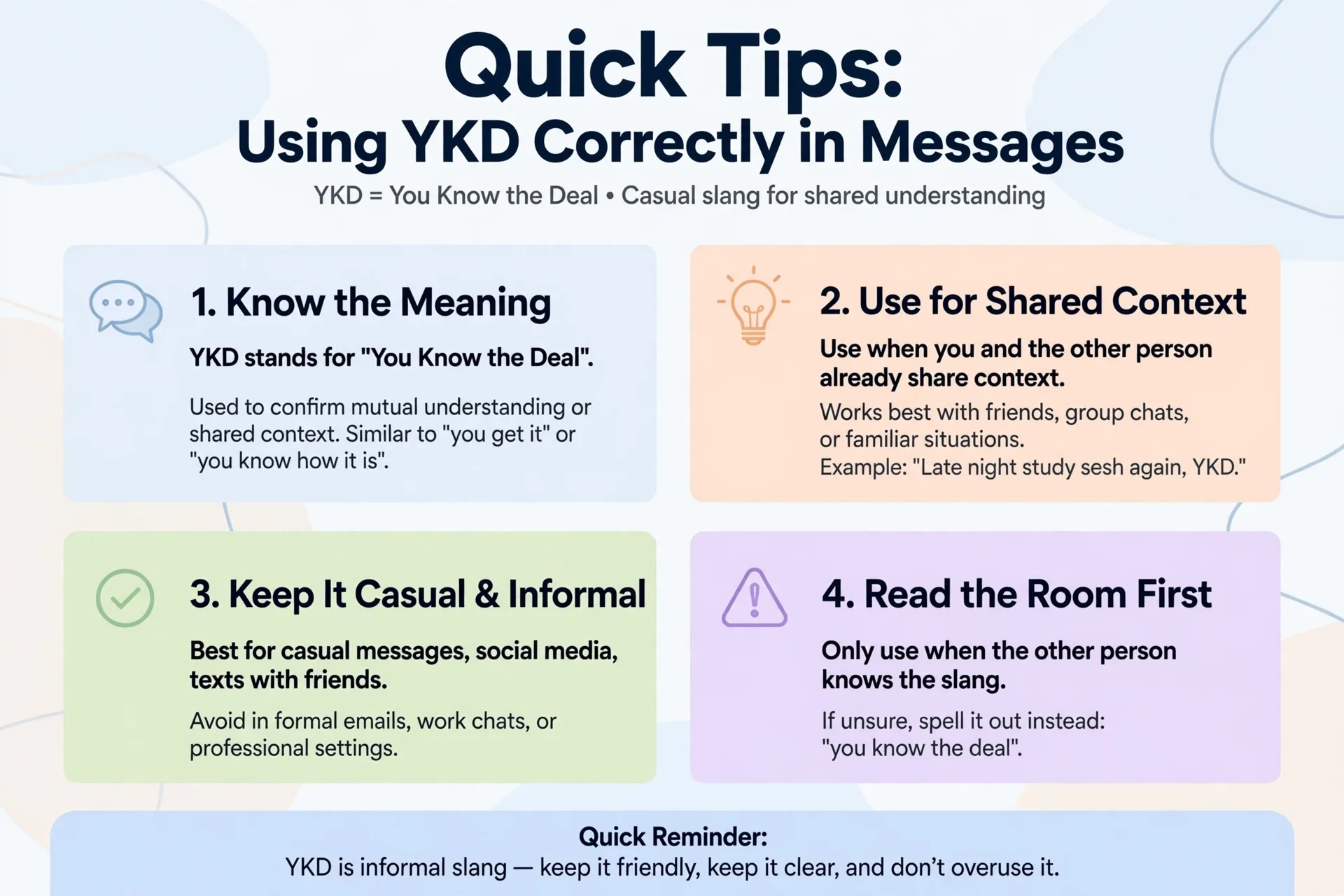
Quick Tips
Want to use YKD like a native? Follow these practical tips:
- Keep it at the end. YKD is a closing tag — let it finish your thought, not start it.
- Match the vibe. Pair it with emojis that fit the tone: 😂 for funny, 💀 for meme humor, 👀 for suggestive, none at all for chill confidence.
- One per conversation. A single well-placed “ykd” hits harder than five scattered ones.
- Read the room. Friends and peers? Go for it. Teachers, bosses, strangers? Skip it.
- Use punctuation for tone control. “ykd” is chill, “ykd?” asks, “ykd!” hypes. Choose deliberately.
- Don’t explain it mid-chat. If someone asks what it means, tell them — but never apologize for using slang with friends. Confidence is the whole point of YKD.
- Pair it with opinions, not facts. YKD shines on takes, jokes, and observations (“best fries ever ykd”), not on neutral information (“the meeting is at 3 ykd” feels off).
- Watch for the YDK trap. Double-check your letters before sending — autocorrect and fast thumbs love to betray you here.
- Try it in comments, not just texts. TikTok and Instagram comments are YKD’s natural habitat; a well-timed “ykd” under a relatable video can earn you likes.
- When in doubt, leave it out. The sentence works without it. YKD is seasoning — great when it fits, unnecessary when it doesn’t.

FAQ
1. What does YKD mean in text?
In texting, YKD means “Ya Know Dis,” a slang spelling of “you know this.” It is used at the end of a statement to say something is obvious or to check that the other person agrees — for example, “that was the best episode ykd.”
2. Is YKD rude?
Not by itself. YKD is casual and confident, but it is not an insult. It can sound slightly cocky or dismissive if used after a brag (“I’m always right ykd”), so tone and context matter. With friends, it is almost always playful.
3. What is the difference between YKD and YK?
YK means “you know” and is the shorter, more common, more neutral version. YKD (“ya know dis”) is a longer, more expressive variant with extra attitude. Think of YK as the everyday version and YKD as the version with personality.
4. Can I use YKD at work?
Generally, no. YKD is informal texting slang and does not belong in emails, reports, or messages to clients or managers. In a very casual team chat with close coworkers, it might pass as a joke — but when in doubt, use “as you know” instead.
5. What does YKD mean on Snapchat or TikTok?
The same thing it means in texts: “ya know dis” (you know this). On TikTok, it often appears in comments under relatable or funny videos, where it works like a knowing nod to other viewers. On Snapchat, it shows up in casual DM conversations between friends.
6. How do you reply when someone says YKD?
Just respond naturally to the statement before it. If you agree, say so (“fr, exactly” or “100%”). If you disagree, say that too (“nah I don’t see it”). You do not need to reply to the YKD itself — it is a tag, not a question (unless it has a question mark, in which case a simple “yeah” or “ikr” works).
7. Is YKD the same as YDK?
No — and this is the most common mix-up. YKD means “ya know dis” (you know this — inclusive, confident). YDK means “you don’t know” (teasing, corrective). Same letters, different order, nearly opposite meanings. Always double-check which one you received — or sent.
8. What does YKDV mean?
YKDV is listed on Urban Dictionary as a related word to YKD — essentially a playful extended variant of the same slang. It carries the same “ya know” energy with an extra syllable for emphasis, though it is much rarer than YKD itself.
Conclusion
So, what does YKD mean in text? It is short, it is sassy, and it is simpler than it looks: “Ya Know Dis” — you know this. Three little letters that turn an ordinary statement into a confident, knowing, personality-filled message.
The key takeaways are easy to remember. First, YKD goes at the end of a sentence, where it signals that something is obvious or seeks a nod of agreement. Second, it lives in casual spaces — friend chats, TikTok comments, gaming lobbies — and stays out of professional ones. Third, do not confuse it with YDK (“you don’t know”), its near-opposite twin. And fourth, like all good slang, a little goes a long way: one well-placed “ykd” is worth ten forced ones.
Language on the internet moves fast, but the instinct behind YKD is timeless. Every generation invents its own way of saying “you know what I mean?” — and right now, for a lot of texters, that way is three letters long. So the next time a friend ends a message with “ykd,” you will not freeze. You will just smile, because ya know dis — you already know. Keep exploring internet slang — learn what TS PMO means in text or the story behind the viral Fanum Tax meaning.
SEO Meta Title: YKD Meaning in Text: What It Means & How to Use It
SEO Meta Description: What does YKD mean in text? It’s slang for “Ya Know Dis” (you know this) — said when something is obvious. See real examples, usage tips, and the full FAQ.
SEO-Friendly URL Slug: ykd-meaning-in-text
Feature Image Prompt: Clean 1200×630 cover image for a slang-meaning blog article. Bold modern typography showing only the text “YKD” centered on a vibrant gradient background (deep purple to electric blue), with a subtle chat-bubble pattern in the background, small smartphone chat mockup in one corner, flat design style, no emojis, high contrast, professional blog featured image.
